
Biometric Vehicle Access System Market Size and Share
Market Overview
| Study Period | 2019 - 2031 |
|---|---|
| Market Size (2026) | USD 1.66 Billion |
| Market Size (2031) | USD 2.89 Billion |
| Growth Rate (2026 - 2031) | 11.32 % |
| Fastest Growing Market | Asia Pacific |
| Largest Market | Asia Pacific |
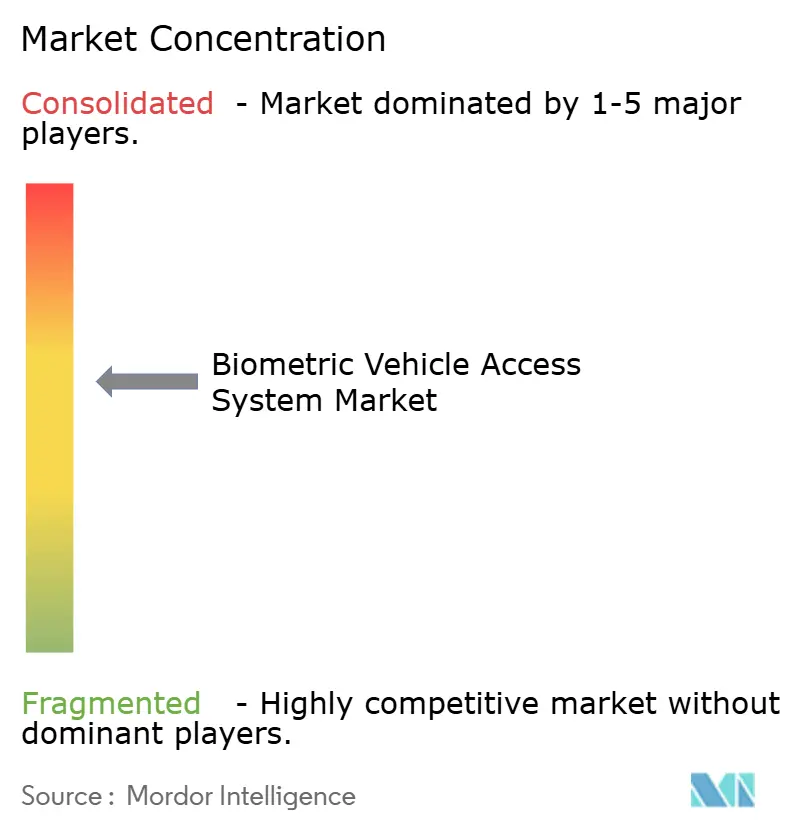
| Market Concentration | Medium |
Major Players
*Disclaimer: Major Players sorted in no particular order Image © Mordor Intelligence. Reuse requires attribution under CC BY 4.0. |
|
Biometric Vehicle Access System Market Analysis by Mordor Intelligence
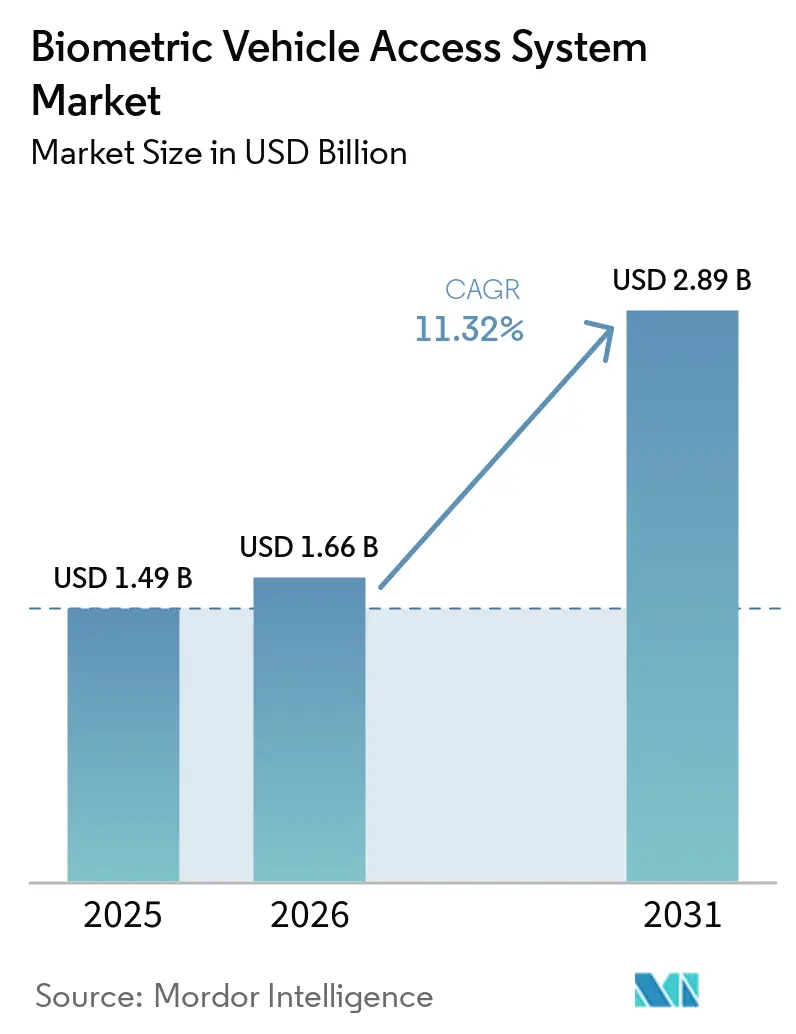
The Biometric Vehicle Access System Market size was valued at USD 1.49 billion in 2025 and is estimated to grow from USD 1.66 billion in 2026 to reach USD 2.89 billion by 2031, at a CAGR of 11.32% during the forecast period (2026-2031). Growth stems from the convergence of three forces: ISO/SAE 21434 cybersecurity mandates that took effect in 2025 and compel automakers to harden access-control layers, the proliferation of smartphone-class fingerprint sensors into mid-price vehicles where bill-of-materials pressure had previously confined biometrics to luxury tiers, and OEM strategies to monetize in-car commerce through password-free payment rails that require strong customer authentication.
Key Report Takeaways
- By authentication type, fingerprint recognition led with a 45.23% revenue share in 2025; iris recognition is projected to expand at a 27.58% CAGR through 2031.
- By vehicle type, passenger cars held a 63.14% share of the biometric vehicle access system market in 2025, while commercial vehicles are advancing at a 21.43% CAGR through 2031.
- By component, hardware commanded 68.08% of the biometric vehicle access system market share in 2025; the software and AI stack is forecast to grow at a 19.76% CAGR through 2031.
- By sales channel, OEM factory-fit installations accounted for 84.31% of the biometric vehicle access system market size in 2025. In contrast, aftermarket retrofit solutions are set to grow at an 18.64% CAGR between 2026 and 2031.
- By geography, Asia-Pacific captured 30.47% share in 2025 and is progressing at 18.61% CAGR until 2031.
Note: Market size and forecast figures in this report are generated using Mordor Intelligence’s proprietary estimation framework, updated with the latest available data and insights as of January 2026.
Market Trends and Insights
Drivers Impact Analysis of Biometric Vehicle Access System Market*
| Driver | (~) % Impact on CAGR Forecast | Geographic Relevance | Impact Timeline |
|---|---|---|---|
| Fingerprint Sensors Common in Mid-Price Cars | +2.8% | Global, with APAC leading adoption | Medium term (2-4 years) |
| OEM Push for Password-Free Payments | +2.1% | North America and EU premium segments | Short term (≤ 2 years) |
| ISO/SAE 21434 Cybersecurity Mandate | +1.9% | Global, mandatory compliance | Short term (≤ 2 years) |
| Tier-1 Biometrics-as-a-Service Models | +1.4% | North America and EU, expanding to Asia-Pacific | Medium term (2-4 years) |
| Multi-Factor Access Pilots in Robotaxis | +0.8% | Urban centers in US, China, EU | Long term (≥ 4 years) |
| Insurance Discounts for MFA Systems | +0.6% | North America and EU markets | Medium term (2-4 years) |
| Source: Mordor Intelligence | |||
Ubiquity of Smartphone-Class Fingerprint Sensors in Mid-Price Cars
The democratization of capacitive fingerprint sensors from premium smartphones to mid-market vehicles accelerates biometric adoption across price segments previously dominated by traditional key systems. Infineon's October 2024 launch of automotive-qualified fingerprint sensor ICs (CYFP10020A00 and CYFP10020S00) operating over -40°C to +105°C demonstrates the technical maturation required for mass-market deployment [1]"Infineon introduces new fingerprint sensor ICs for identification and authentication in automotive applications," infineon.com. . These sensors integrate with existing microcontroller architectures while providing trackpad functionality, reducing implementation complexity for OEMs targeting cost-sensitive segments. Mid-price passenger cars are integrating capacitive fingerprint sensors originally developed for smartphones, lowering per-unit costs to below USD 5 and enabling OEMs to offer biometric access in vehicles priced under USD 30,000.
OEM Push for Password-Free In-Car Payments
Automakers are embedding biometric authentication to enable frictionless in-car payments for fuel, tolls, parking, and digital services, eliminating the need for users to enter passwords or retrieve payment cards while driving. Mercedes-Benz launched the Mercedes me Fuel & Pay system in partnership with Visa, allowing drivers to authorize fuel purchases via fingerprint authentication integrated into the vehicle's infotainment system. FORVIA's biometric authentication solution, developed with Smart Eye and demonstrated in April 2025, enables secure payments and app access across a catalog of more than 200 applications integrated into 32 car brands from 13 OEMs, positioning biometric access as the gateway to recurring software revenue.
ISO/SAE 21434 Cybersecurity Mandates (2025)
ISO/SAE 21434, which became effective in 2025, establishes cybersecurity engineering requirements for road vehicles and mandates that automakers implement risk-based security controls throughout the vehicle lifecycle, including access-control mechanisms resistant to relay attacks and credential theft. Biometric authentication satisfies the standard's requirement for strong, non-transferable credentials, as fingerprints and iris patterns cannot be intercepted or replayed as with RFID key fobs. The regulation applies globally to vehicles sold in markets that have adopted the standard, including the European Union, Japan, South Korea, and, increasingly, North America, where NHTSA is aligning federal motor vehicle safety standards with the principles of ISO/SAE 21434. Compliance costs are driving OEMs to consolidate authentication functions into centralized biometric modules rather than deploying multiple discrete security layers, accelerating the shift from passive keyless entry systems to active biometric verification.
Tier-1 Suppliers' "Biometrics-as-a-Service" Revenue Models
Tier-1 automotive suppliers are transitioning from one-time sensor sales to subscription-based biometrics-as-a-service models, licensing authentication algorithms and cloud-based identity management platforms to OEMs on a per-vehicle or per-transaction basis. Fingerprint Cards signed a tier-1 automotive supplier agreement in July 2023 to license its iris recognition technology for integration into driver monitoring systems, enabling OEMs to activate biometric authentication via software updates without hardware retrofits. This approach aligns with the automotive industry's broader shift toward software-defined vehicles, in which features are unlocked via over-the-air updates and monetized through recurring subscriptions. The model also mitigates OEM capital expenditure, as suppliers bear the cost of algorithm development, anti-spoofing research, and regulatory compliance testing, while OEMs pay only for deployed licenses.
Restraints Impact Analysis of Biometric Vehicle Access System Market*
| Restraint | (~) % Impact on CAGR Forecast | Geographic Relevance | Impact Timeline |
|---|---|---|---|
| Cold-Weather Issues with Budget Fingerprint Readers | -1.2% | Northern regions, Canada, Nordic countries | Short term (≤ 2 years) |
| GDPR and CCPA Data-Privacy Litigation Risk | -0.9% | EU, California, expanding globally | Medium term (2-4 years) |
| No Global Spoof-Testing Standards | -0.7% | Global, affecting premium segments | Medium term (2-4 years) |
| VCSEL Supply-Chain Vulnerability | -0.5% | Global, concentrated in Asia-Pacific | Short term (≤ 2 years) |
| Source: Mordor Intelligence | |||
Cold-Weather Reliability Issues for Low-Cost Fingerprint Readers
Capacitive fingerprint sensors deployed in vehicle door handles and start buttons experience degraded performance in cold climates, where skin conductance drops 30% to 50% and sensor drift increases due to thermal contraction of materials and battery voltage sag. A Carleton University study found a weak correlation between ambient temperature and fingerprint recognition accuracy in controlled laboratory conditions. Yet, real-world user complaints on Mercedes EQE owner forums documented repeated authentication failures when temperatures fell below -10°C, forcing drivers to revert to backup key fobs.
Data-Privacy Litigation Risk Under GDPR and CCPA
Biometric data classification as sensitive personal information under the GDPR and the CCPA creates significant legal exposure for automotive manufacturers, with potential fines of up to 4% of global revenue for non-compliance. The trucking industry's experience with biometric privacy litigation under Illinois' Biometric Information Privacy Act (BIPA) demonstrates the financial risks, with recent amendments that limit penalties while requiring explicit written consent for data collection [2]Pamella De Leon, "Mitigating legal risks against collecting truck drivers' biometric data," Commercial Carrier Journal, ccjdigital.com.. Automotive applications face complexity due to cross-border data transfers and varying national privacy regulations, requiring data governance systems that increase costs and operational challenges. Litigation risks in European and California markets, where privacy enforcement is stringent, may lead to regional differences in biometric feature functionality. OEMs must balance system capabilities with privacy compliance, often resulting in reduced functionality or increased legal and technical burdens, impacting system economics and user experience.
*Our forecasts treat driver/restraint impacts as directional, not additive. The impact forecasts reflect baseline growth, mix effects, and variable interactions.
Biometric Vehicle Access System Market Segment Analysis
By Authentication Type:
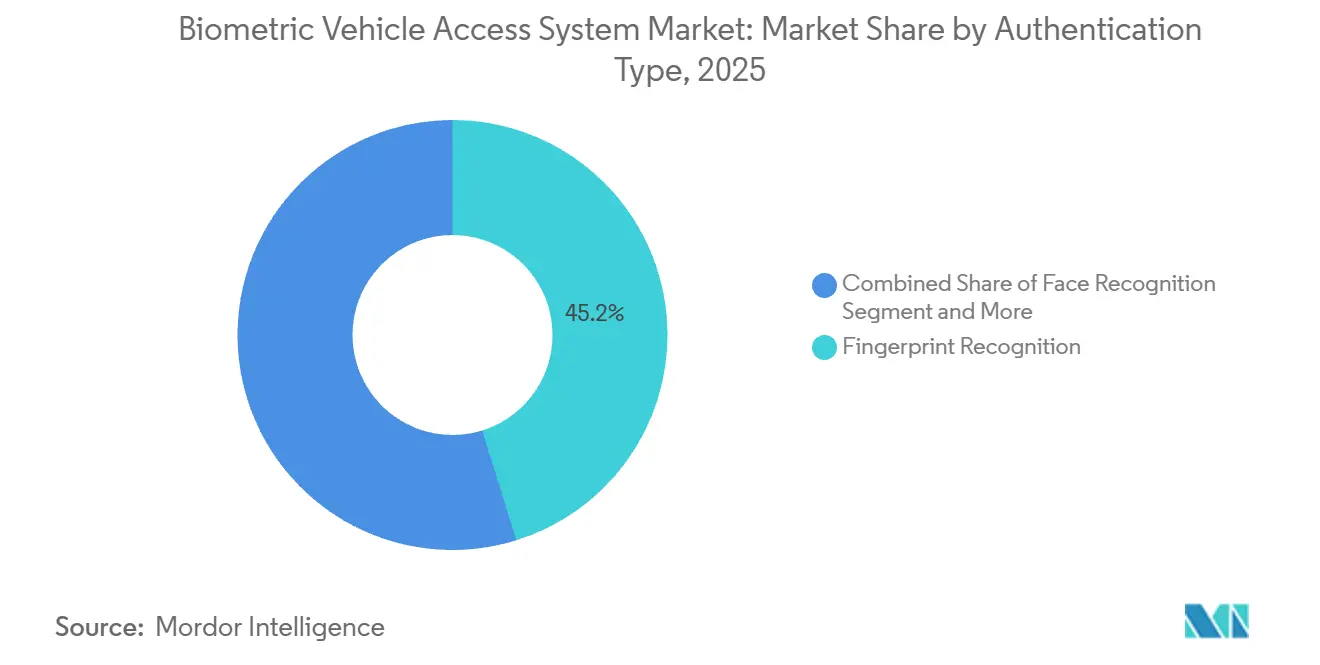
Multimodal Integration Drives Premium AdoptionIn 2025, fingerprint recognition holds a 45.23% market share, reflecting the industry's progression toward enhanced security measures for premium applications. Iris recognition is the fastest-growing authentication segment, with a 27.58% CAGR projected through 2031. This growth disparity highlights a market division: mainstream vehicles adopt cost-efficient fingerprint solutions, while luxury and commercial applications prefer advanced multimodal systems, justified by higher security implementation costs. Face and voice recognition segments, though smaller, remain strategically significant, particularly in hands-free operations and integration with infotainment systems. The premium segment increasingly features multimodal and multi-factor authentication (MFA) systems, combining biometric modalities to ensure security for high-value transactions and to meet regulatory compliance requirements.
Continental's CES 2025 presentation of invisible biometric sensing displays demonstrates the industry's movement toward integrated multimodal systems. By combining facial recognition with vital sign monitoring, these systems provide comprehensive authentication and safety solutions. Such integrations address the limitations of single-modality systems while offering additional functionalities that support premium pricing. This segmentation aligns with the automotive industry's transition to software-defined vehicles, where biometric capabilities can be updated through over-the-air updates, enabling OEMs to introduce new authentication methods without hardware modifications.



By Vehicle Type:
Commercial Fleets Lead Security InnovationIn 2025, passenger cars accounted for 63.14% of the market, highlighting fleet operators' focus on security, regulatory compliance, and operational efficiency over cost concerns. Commercial vehicles represented the fastest-growing segment, with a 21.43% CAGR. The FMCSA's planned implementation of biometric identity verification for trucking registrations in 2025 is expected to drive mandatory adoption, accelerating biometric deployment in commercial vehicles ahead of consumer applications. Fleet applications benefit from centralized procurement and higher vehicle utilization, resulting in better returns on biometric system investments compared to personal vehicles. Commercial vehicle biometric systems are often integrated with fleet management platforms, providing operators with access control, driver monitoring, and compliance reporting capabilities beyond basic vehicle access.
The growth of the commercial vehicle segment suggests potential technology transfer to passenger vehicles as biometric systems mature and production volumes reduce costs. Bosch's Fleet Management Xtended Access system illustrates how commercial applications foster innovation in areas such as remote access management and multi-vehicle authentication, which subsequently influence consumer vehicle development. This transfer pattern indicates that commercial vehicles serve as testing grounds for biometric advancements that eventually reach passenger car applications.
By Component:
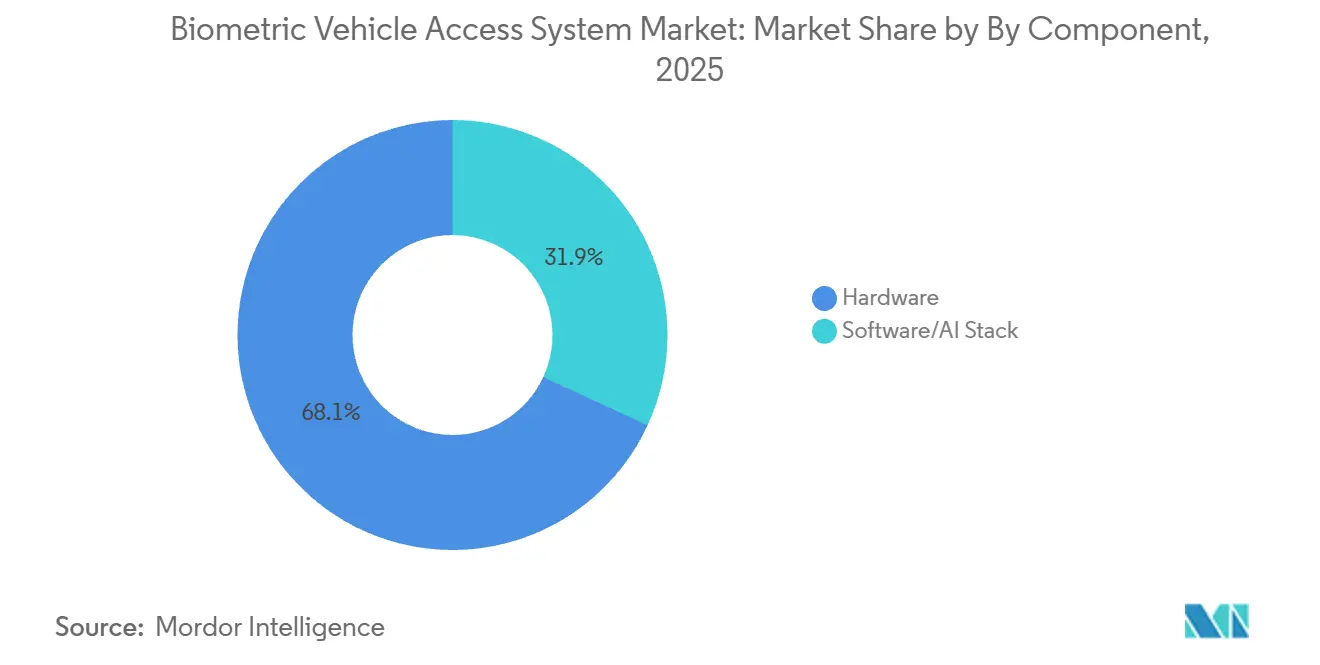
Software Intelligence Transforms Hardware ValueIn 2025, hardware components account for 68.08% of the market share. However, the software and AI stack segments exhibit significant growth, with a 19.76% CAGR. This trend highlights the industry's shift toward intelligence-driven biometric systems, where advanced algorithms drive differentiation and value. The growth reflects the commoditization of biometric sensors and the increasing reliance on machine learning algorithms for multimodal fusion, spoof detection, and continuous authentication. Software-centric approaches enable over-the-air updates, enhancing system performance and introducing new capabilities without hardware changes. This creates ongoing revenue opportunities for suppliers and improved functionality for users. The evolution of component segmentation aligns with broader trends in the automotive industry, where hardware serves as a platform for software-delivered features and services.
Infineon's integration of fingerprint sensors with trackpad functionality illustrates how hardware vendors incorporate software-enabled features to maintain differentiation in commoditized sensor markets. The software segment's growth indicates that successful biometric implementations increasingly depend on algorithmic sophistication rather than sensor hardware specifications. This shift in competitive dynamics benefits companies with strong AI and machine learning capabilities. It also creates opportunities for technology firms and software specialists to capture value in traditionally hardware-focused automotive supply chains.
By Sales Channel:
Aftermarket Retrofit Captures Legacy ValueIn 2025, OEM factory-fit installations hold a dominant 84.31% market share. Aftermarket and retrofit solutions are experiencing rapid growth, with an 18.64% CAGR. This growth creates opportunities for integrated and retrofit biometric systems. The aftermarket expansion is driven by a substantial installed vehicle base, many of which cannot access factory biometric systems but can benefit from retrofit solutions. This is particularly relevant in commercial fleet applications, where security upgrades justify retrofit investments. However, retrofit solutions face challenges such as integration with existing vehicle electronics and limited access to vehicle data networks, requiring specialized approaches distinct from factory-integrated systems. The division in sales channels highlights separate market segments with unique value propositions, technical requirements, and competitive dynamics.
Continental's Remote Cloud Key system illustrates a retrofit-friendly approach, offering biometric-enabled access without requiring extensive vehicle integration. It uses Bluetooth and battery power to reduce installation complexity. The growth in the aftermarket segment reflects significant demand for biometric vehicle access among existing vehicle owners, creating opportunities for suppliers to develop cost-effective retrofit solutions. This trend expands the market beyond new vehicle sales to include the larger population of existing vehicles, significantly increasing the total addressable market for biometric access systems.
Geography Analysis
APAC Biometric Vehicle Access System Market
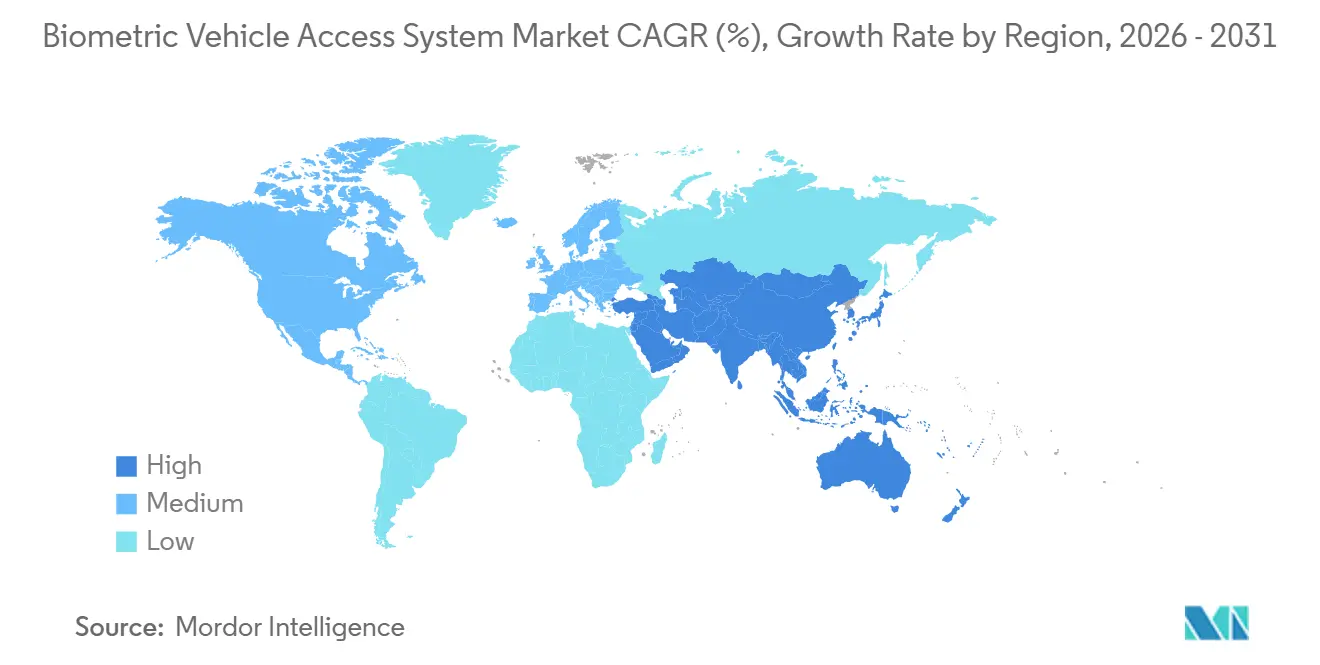
Asia-Pacific leads both market share at 30.47% in 2025 and growth rate at 18.61% CAGR through 2031, driven by Chinese automakers' aggressive biometric integration and supportive government policies for intelligent vehicle development[3]Jack Shaw, "Biometrics rolling towards relevance for automakers and drivers," Biometric Update, biometricupdate.com.. Government roadmaps for intelligent connected vehicles emphasize multimodal driver identification as a foundational component. Supplier orders increase when local authorities include this feature in Level 3 autonomy scoring. Taiwan’s Lextar has commenced volume production of VCSELs in accordance with AEC Q102 standards, ensuring a stable supply for domestic and export markets. This reduces costs and promotes higher adoption rates.
North America Biometric Vehicle Access System Market
North America ranks second in revenue, supported by regulations that require biometric validation for commercial motor carrier license renewals. This has spurred fleet retrofit programs. Detroit OEMs are pursuing subscription-based revenue models centered on digital wallets, while US consumers increasingly adopt pay-at-pump facial recognition, driven by familiarity with smartphone experiences. Cold-weather reliability challenges limit adoption in regions like the Midwest and Canada until sensors can operate reliably at −30 °C.
Europe Biometric Vehicle Access System Market
Europe is advancing steadily, driven by ISO/SAE 21434 compliance and competition among premium German automakers. GDPR mandates local data storage with encryption, pushing architectures toward edge AI chips in driver-monitoring cameras. Tier-1 suppliers such as Bosch and Valeo emphasize privacy-by-design, transforming compliance costs into brand advantages. While volumes in Europe lag behind those in Asia, the region's average unit selling prices are the highest globally, as consumers demand seamless multi-factor authentication linked to digital key sharing.

Competitive Landscape
The biometric vehicle access system market remains fragmented, with Tier-1 automotive suppliers such as Continental, Bosch, Denso, and Valeo partnering with biometric specialists including Fingerprint Cards, Synaptics, Smart Eye, and Safran to integrate authentication modules into cockpit electronics and access systems. Competition is intensifying along two axes: hardware commoditization, which compresses sensor margins and favors suppliers with scale and vertical integration, and algorithm differentiation, which rewards companies that can deliver superior liveness detection, anti-spoofing capabilities, and privacy-preserving architectures.
Strategic plays increasingly revolve around service models rather than hardware cost. Bosch’s Xtended Access is sold as a per-vehicle SaaS license that fleets renew annually; Continental’s Invisible Biometrics Sensing Display embeds cameras behind OLED layers, enabling later software unlocking for medical-grade vital-sign monitoring. Patent activity intensifies: Ford received new grants for keypad-integrated fingerprint arrays, and GM’s Cruise unit filed claims on gesture-based authentication for driverless pods. M&A tallies up as ASSA ABLOY buys niche badge-reader firms to cross-sell into the automotive market. At the same time, suppliers enter multi-year VCSEL wafer deals with IQE and Lumentum to secure optical inventory.
White-space opportunities persist in multimodal authentication for robotaxis, where passenger verification and payment authorization require non-intrusive, continuous identity checks, and in aftermarket retrofit solutions for commercial fleets seeking insurance discounts without vehicle replacement. Smart Eye and Fingerprint Cards demonstrated a combined face and iris authentication system in March 2026 that achieves a false-match rate of 1 in 1 billion and supports continuous authentication at distances up to 3 meters, enabling verification throughout a ride without requiring passengers to stop or interact with sensors.
Biometric Vehicle Access System Industry Leaders
-
Robert Bosch GmbH
-
Continental AG
-
Valeo SA
-
Synaptics Inc.
-
LG Electronics
- *Disclaimer: Major Players sorted in no particular order
Biometric Vehicle Access System Market Companies Covered in this Report
- Continental AG
- Robert Bosch GmbH
- Denso Corporation
- Safran SA
- Valeo SA
- Fingerprint Cards AB
- Synaptics Inc.
- Fujitsu Ltd
- Hitachi Ltd
- Methode Electronics
- Nuance Communications
- Cerence Inc.
- Thales Group
- Gentex Corporation
- LG Electronics

Recent Industry Developments in Biometric Vehicle Access System Market
- March 2026: Smart Eye and Fingerprint Cards demonstrated a multimodal biometric authentication system combining face and iris recognition at Auto China 2026 in Beijing, achieving a false-match rate of 1 in 1 billion by fusing two independent biometric signals captured through a single camera and supporting continuous authentication at distances up to 3 meters for in-vehicle access control and personalization. The system runs on dedicated hardware developed by Smart Eye and targets automotive, smart home, cybersecurity, and high-security sectors including law enforcement and defense.
- August 2025: WITTE Automotive and trinamiX presented a concept vehicle at IAA Mobility 2025 in Munich featuring a B-pillar-integrated face authentication system that combines 2D facial recognition with trinamiX's patented Beam Profile Analysis biometric imaging and liveness detection to differentiate real humans from ultra-realistic masks and deepfakes. The system eliminates the need for physical door handles, enabling new vehicle design possibilities, and provides theft protection by ensuring only pre-registered individuals can unlock the vehicle.


Global Biometric Vehicle Access System Market Report Scope
| Fingerprint Recognition |
| Face Recognition |
| Iris Recognition |
| Voice Recognition |
| Multimodal/MFA |
| Passenger Cars |
| Commercial Vehicles |
| Hardware |
| Software/AI Stack |
| OEM Factory-Fit |
| Aftermarket/Retrofit |
| North America | United States |
| Canada | |
| Rest of North America | |
| South America | Brazil |
| Argentina | |
| Rest of South America | |
| Europe | Germany |
| United Kingdom | |
| France | |
| Italy | |
| Spain | |
| Netherlands | |
| Rest of Europe | |
| Asia-Pacific | China |
| Japan | |
| South Korea | |
| India | |
| Australia | |
| Rest of Asia-Pacific | |
| Middle East and Africa | Saudi Arabia |
| United Arab Emirates | |
| South Africa | |
| Rest of Middle East and Africa |
| By Authentication Type | Fingerprint Recognition | |
| Face Recognition | ||
| Iris Recognition | ||
| Voice Recognition | ||
| Multimodal/MFA | ||
| By Vehicle Type | Passenger Cars | |
| Commercial Vehicles | ||
| By Component | Hardware | |
| Software/AI Stack | ||
| By Sales Channel | OEM Factory-Fit | |
| Aftermarket/Retrofit | ||
| By Geography | North America | United States |
| Canada | ||
| Rest of North America | ||
| South America | Brazil | |
| Argentina | ||
| Rest of South America | ||
| Europe | Germany | |
| United Kingdom | ||
| France | ||
| Italy | ||
| Spain | ||
| Netherlands | ||
| Rest of Europe | ||
| Asia-Pacific | China | |
| Japan | ||
| South Korea | ||
| India | ||
| Australia | ||
| Rest of Asia-Pacific | ||
| Middle East and Africa | Saudi Arabia | |
| United Arab Emirates | ||
| South Africa | ||
| Rest of Middle East and Africa | ||


Key Questions Answered in the Report
How big will the Biometric Vehicle Access System market be by 2031?
Biometric Vehicle Access System Market size was valued at USD 1.49 billion in 2025 and is estimated to reach USD 2.89 billion by 2031, at a CAGR of 11.32% during the forecast period (2026-2031)
Which region leads the biometric vehicle access system market?
Asia-Pacific commands 30.47% of 2025 revenue and posts the fastest 18.61% CAGR thanks to aggressive deployments by Chinese automakers and supportive policy frameworks.
Why are commercial vehicles adopting biometrics faster than passenger cars?
FMCSA identity-verification rules and fleet insurance discounts create immediate ROI, driving a 21.43% CAGR for commercial vehicle installations.
What challenges could restrain future adoption?
Cold-weather sensor reliability, strict privacy regulations like GDPR and CCPA, and periodic VCSEL supply shortages each exert downward pressure on overall CAGR forecasts.
Are retrofit solutions a viable opportunity?
Yes; aftermarket kits growing at 18.64% CAGR allow fleet operators and used-car dealers to add biometric entry to existing vehicles without OEM support.
Page last updated on:





