
Automotive OEM App Store Market Size and Share
Market Overview
| Study Period | 2019 - 2031 |
|---|---|
| Market Size (2026) | USD 9.59 Billion |
| Market Size (2031) | USD 14.27 Billion |
| Growth Rate (2026 - 2031) | 8.27 % |
| Fastest Growing Market | Asia-Pacific |
| Largest Market | North America |
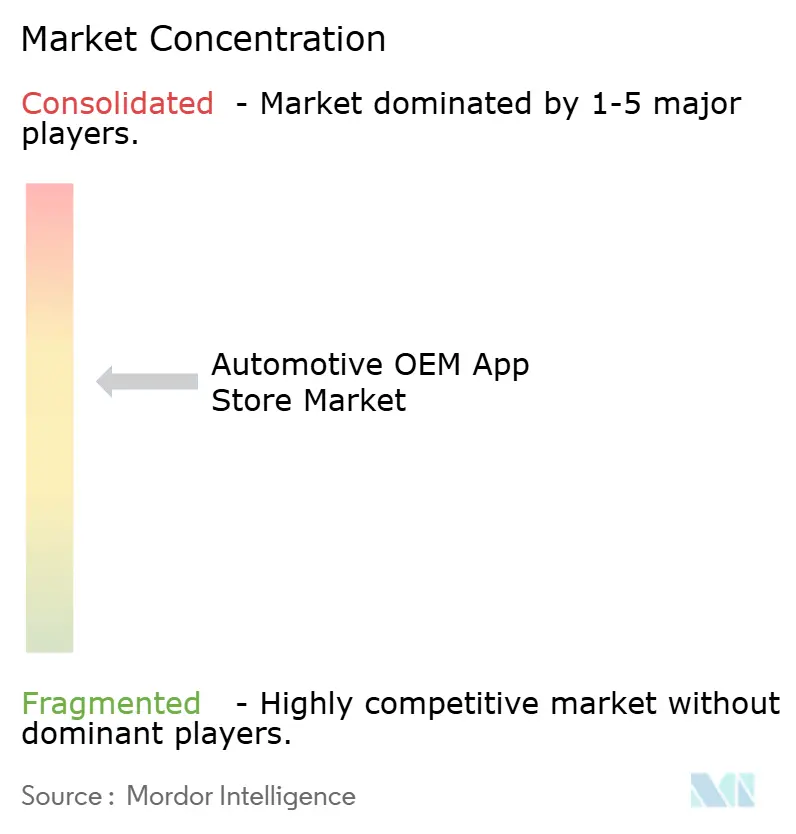
| Market Concentration | Medium |
Major Players *Disclaimer: Major Players sorted in no particular order Image © Mordor Intelligence. Reuse requires attribution under CC BY 4.0. | |
Automotive OEM App Store Market Analysis by Mordor Intelligence
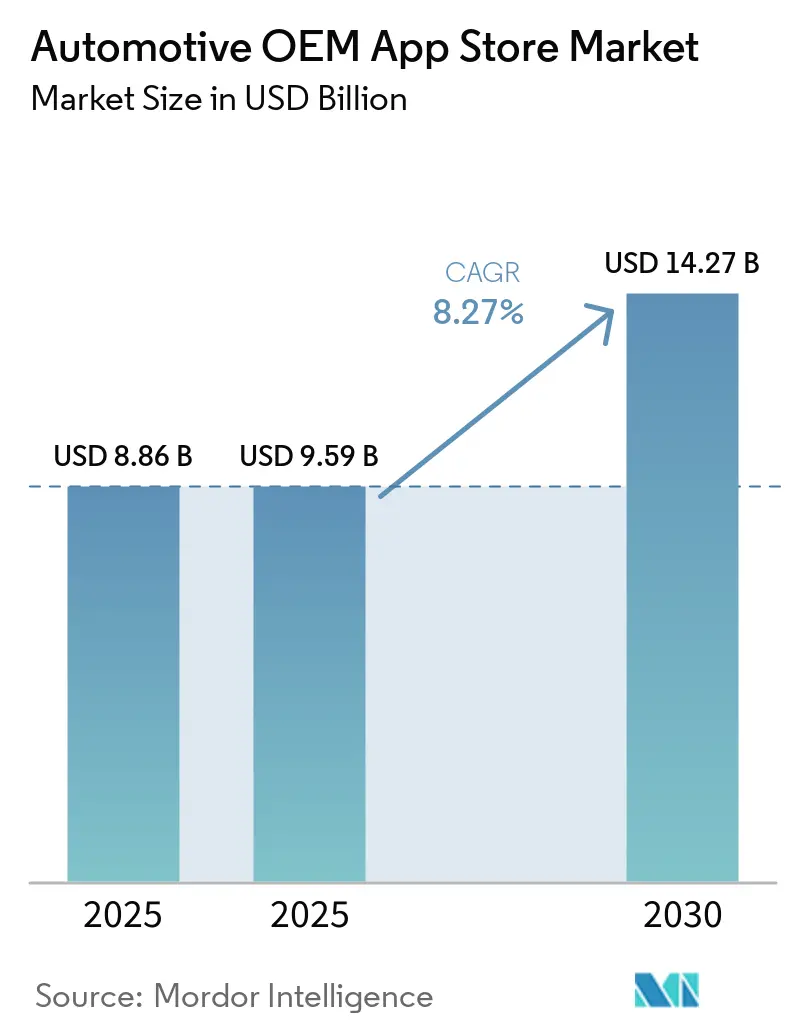
The Automotive OEM App Store Market was valued at USD 8.86 billion in 2025 and is projected to grow from USD 9.59 billion in 2026 to USD 14.27 billion by 2031, at a CAGR of 8.27% during the 2026–2031 forecast period. Intensifying competition to deliver software-defined vehicles, rising subscription uptake, and looming data-access mandates are accelerating platform revenues. The EU Data Act’s September 2026 enforcement window is dismantling data monopolies and obliging automakers to open real-time vehicle data to external developers, shifting rivalry toward curation quality and revenue-share terms. Navigation apps still anchor revenue, but Gen Z’s appetite for seamless in-car payments is pushing Payment and Purchase apps toward outsized growth. At the same time, third-party developers dominate code volume, even as BMW, Mercedes-Benz, and Toyota scale up proprietary stores to control margins.
Key Report Takeaways
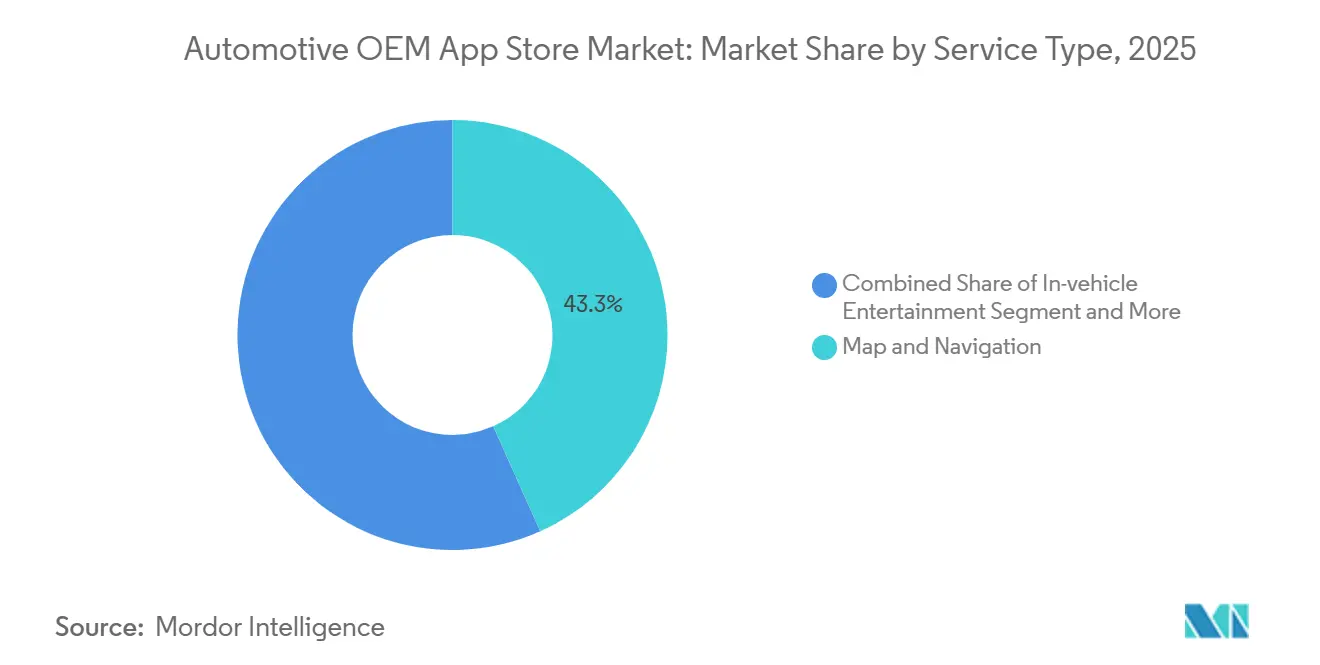
- By service type, Map and Navigation secured 43.27% of the Automotive OEM App Store market share in 2025, whereas Payment and Purchase are projected to expand at an 8.29% CAGR through 2031.
- By development type, third-party/outsourced development commanded a 68.65% share of the Automotive OEM App Store market in 2025, while in-house development is the fastest-growing at an 8.31% CAGR to 2031.
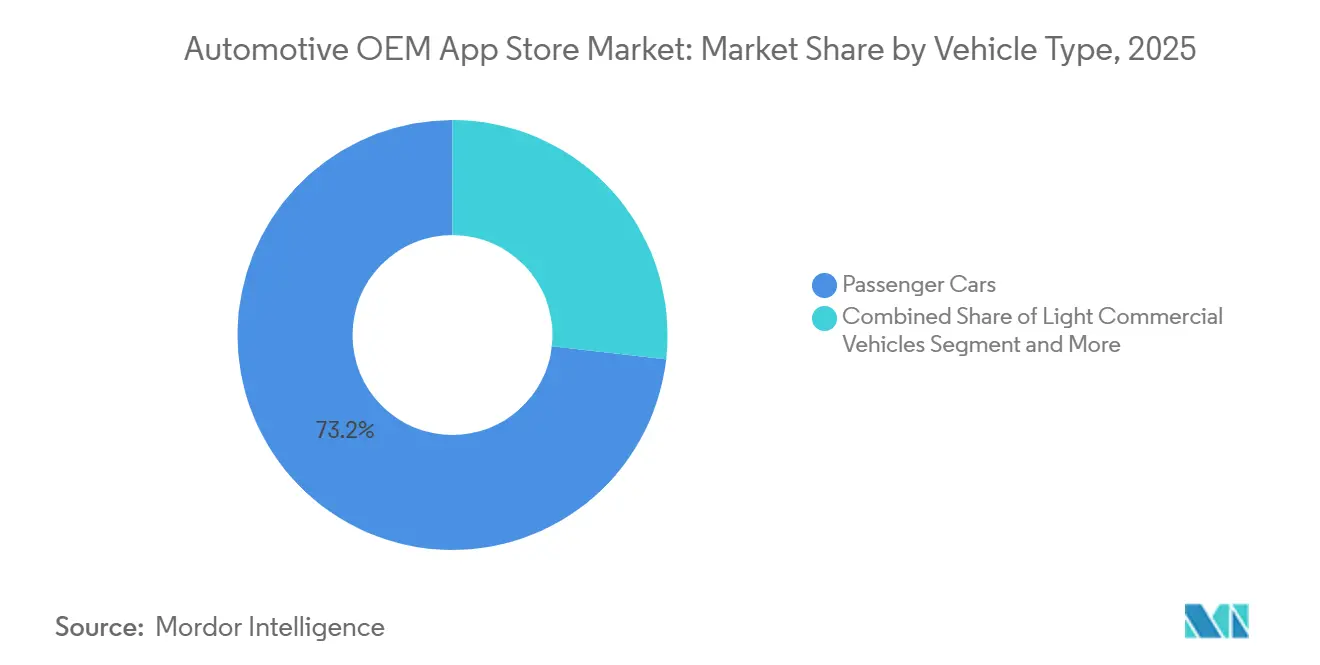
- By vehicle type, passenger cars accounted for 73.23% of the Automotive OEM App Store market size in 2025, and light commercial vehicles are poised to see the highest CAGR at 8.34% between 2026 and 2031.
- By operating system, Android held 76.36% Automotive OEM App Store market share in 2025; iOS implementations are forecast to climb at an 8.38% CAGR over the same horizon.
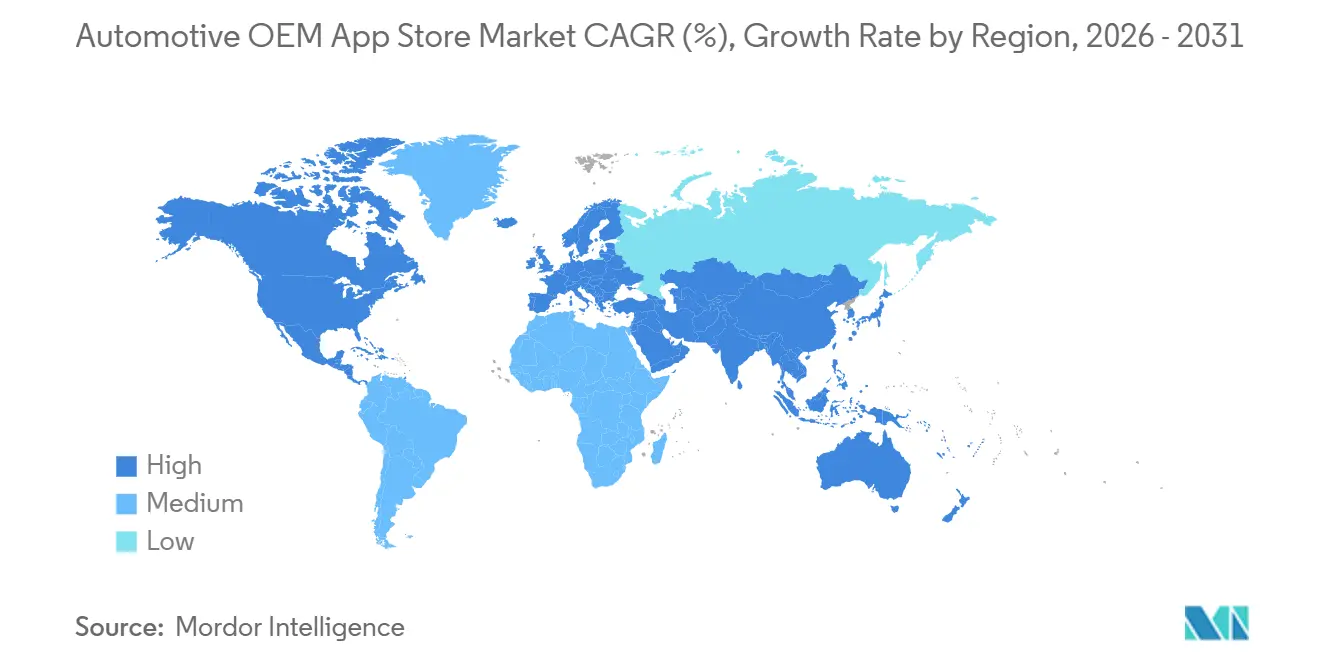
- By geography, North America led with 38.54% Automotive OEM App Store market share in 2025, yet Asia-Pacific is set to record the strongest CAGR at 8.41% through 2031.
Note: Market size and forecast figures in this report are generated using Mordor Intelligence’s proprietary estimation framework, updated with the latest available data and insights as of January 2026.
Market Trends and Insights
Drivers Impact Analysis of Automotive OEM App Store Market*
| Driver | (~) % Impact on CAGR Forecast | Geographic Relevance | Impact Timeline |
|---|---|---|---|
| OEM Shift to Software-Defined Vehicles and Recurring Revenue | +2.1% | North America & EU core, expanding to APAC | Long term (≥ 4 years) |
| Soaring Connected-Car Penetration | +1.8% | Global, with APAC and Europe leading adoption | Medium term (2-4 years) |
| Android Ecosystem Accelerating Third-Party App Availability | +1.5% | Global, concentrated in markets with Google Automotive Services partnerships | Short term (≤ 2 years) |
| EU Data Act Opening In-Vehicle Data Access | +1.2% | EU mandatory, spillover to UK and select APAC markets | Medium term (2-4 years) |
| Gen Z Demand for In-Car Digital Commerce and Payments | +0.9% | North America, Western Europe, urban APAC | Medium term (2-4 years) |
| 5G/Edge APIs Enabling Immersive Cockpit Apps | +0.7% | APAC core (China, South Korea), North America metro areas | Long term (≥ 4 years) |
| Source: Mordor Intelligence | |||
OEM Shift to Software-Defined Vehicles and Recurring Revenue
Electrical architectures are being redefined by manufacturers, with software now viewed as a key driver of profit. General Motors' Ultifi platform, which enables over-the-air feature activations, is at the heart of a significant near-term deferred-revenue target, underscoring the C-suite's focus on app-driven profits. Meanwhile, Mercedes-Benz has mobilized a substantial team of engineers to develop most of its software in-house, aiming to generate significant earnings from digital services in the coming years. By maintaining control over their platforms, these manufacturers are reaping considerably higher gross software margins compared to the minimal margins seen by traditional Tier-1 suppliers. However, this shift has intensified tensions with suppliers, who are now pushing for renegotiated revenue-sharing agreements.
Soaring Connected-Car Penetration
Connected vehicles now ship with always-on modems as standard, creating the baseline infrastructure for Automotive OEM App Store market expansion. The strategic pivot, however, stems from the EU Data Act’s requirement to expose live sensor feeds to any authorized developer, compelling brands to compete on user experience rather than data hoarding [1]. Volkswagen Group launched its Application Store across multiple Audi models in 2023 and is already curating more than 70 global apps to get ahead of the compliance cut-off[2]. Faster onboarding of third-party apps, therefore, becomes a make-or-break metric as connectivity shifts from an optional feature to a regulatory prerequisite.
Android Ecosystem Accelerating Third-Party App Availability
Android Automotive OS is becoming the dominant platform in the Automotive OEM App Store market, but differences between Google Automotive Services (GAS) and non-GAS deployments are fragmenting developer economics. Volvo, Google's lead partner, demonstrated Android 15 on the EX90 ahead of rivals, illustrating the first-mover advantage of close GAS alignment. The official app catalog is growing steadily, supported by the Car App Library and multi-display APIs, which are making it easier for developers to build and scale in-vehicle applications. OEMs running non-GAS forks, BMW, VW, and GM, must engage developers individually, which reduces network effects and duplicates certification overhead, making it harder for these ecosystems to keep pace.
EU Data Act Opening In-Vehicle Data Access
Mandatory real-time data sharing under the EU Data Act disrupts the walled-garden model that once protected captive infotainment ecosystems. API intermediaries such as Smartcar already integrate more than 40 marques, proving the feasibility of OAuth-secured, cross-brand data pipelines. Compliance pressures are global: Geely’s Global App launched in 34 countries in March 2025, with GDPR alignment to smooth the Middle Eastern rollout, signaling that EU norms are fast becoming worldwide reference standards. In response, platform specialists like FORVIA Appning pitch turnkey stores with verified apps and automated consent flows to help OEMs meet the 2026 enforcement deadline.
Restraints Impact Analysis of Automotive OEM App Store Market*
| Restraint | (~) % Impact on CAGR Forecast | Geographic Relevance | Impact Timeline |
|---|---|---|---|
| Cyber-Security / Privacy Approval Bottlenecks | -1.1% | EU and Japan (ISO/SAE 21434, UNECE WP.29 enforcement), spillover to North America | Medium term (2-4 years) |
| OS Fragmentation Between Android and iOS | -0.8% | Global, acute in markets with high iPhone penetration (North America, Western Europe, Japan) | Short term (≤ 2 years) |
| OEM–Tier-1 Revenue-Share Conflicts | -0.6% | North America & EU, where Tier-1 suppliers are repositioning as software providers | Medium term (2-4 years) |
| Driver-Distraction Regulatory Ceilings | -0.5% | Global, with NHTSA 2-second glance rule in North America, European Statement of Principles, Japan MLIT standards | Long term (≥ 4 years) |
| Source: Mordor Intelligence | |||
Cyber-Security ⁄ Privacy Approval Bottlenecks
ISO⁄SAE 21434 and UNECE WP.29 R155⁄R156 became mandatory in 2024, requiring every new or updated app to undergo rigorous threat analysis, vulnerability assessment, and over-the-air validation drills. TISAX assessments layer on supplier-security proof points, while U.S. procurement contracts increasingly cite the NIST Cybersecurity Framework, creating a de facto floor for compliance. Applying markets' pre-vetted catalogs to shortcut these hurdles, yet independent developers often lack the resources for multi-jurisdiction audits, entrenching big-brand dominance and lengthening launch cycles.
Driver-Distraction Regulatory Ceilings
NHTSA’s voluntary two-second glance rule and similar EU and Japan principles cap interface complexity when the vehicle is in motion. High-engagement categories, video, social media, and gaming, therefore, remain restricted until Level 3 or higher autonomy attains broader certification. Android’s sensitive-app protection and Appning’s compliance toolkits help filter UI elements, but fragmented enforcement across regions sustains legal risk. Monetization upside will remain limited until regulators sanction hands-free modes beyond geofenced pilot corridors.
*Our forecasts treat driver/restraint impacts as directional, not additive. The impact forecasts reflect baseline growth, mix effects, and variable interactions.
Automotive OEM App Store Market Segment Analysis
By Service Type:
Navigation Anchors Revenue, Payments AccelerateMap and navigation services accounted for 43.27% of the Automotive OEM App Store market in 2025, reflecting their role as baseline functionality bundled into most infotainment stacks. Drivers increasingly expect real-time routing and traffic updates as standard features rather than optional add-ons. HERE Technologies supplies data to 238 million vehicles and has established a USD 1 billion, 10-year alliance with AWS, illustrating how live mapping updates support recurring fee structures and give OEMs a reliable revenue stream over time.
Payment and Purchase apps are the fastest-growing category, advancing at an 8.29% CAGR through 2031, as OEMs integrate checkout flows and shift toward transaction-fee revenue models. This reflects a broader recognition that vehicles are becoming commerce-enabled spaces, not just transportation tools. Entertainment, News, and Productivity categories complement these portfolios but remain constrained by distraction regulations until hands-free autonomous driving becomes more widely available and regulators grow more comfortable with in-cabin engagement.

By Development Type:
Outsourcing Dominates, In-House Gains MomentumThird-party outsourcing accounted for 68.65% of the Automotive OEM App Store market in 2025, driven by efficiencies from turnkey platforms such as FORVIA Appning, Harman Ignite, and Visteon. FORVIA Appning alone supports more than 23 brands, demonstrating the platform scale that smaller OEMs use to rapidly expand their app catalogs. For many OEMs, particularly those with limited software resources, these platforms offer a practical path to market without the overhead of building proprietary infrastructure from the ground up.
In-house development is growing at an 8.31% CAGR, as BMW's iDrive 9 and Mercedes-Benz's MB.OS and Toyota's Arene pursue greater data control and software margins of 30-50%. These OEMs are making long-term bets on software as a core business, not just a feature. The Automotive OEM App Store market is therefore evolving along two tracks: third-party outsourcing for speed and breadth, and in-house development for differentiation. How OEMs balance these two approaches will likely define their competitive positioning over the next decade.
By Vehicle Type:
Passenger Cars Lead, Fleets DigitizePassenger cars accounted for 73.23% of the automotive OEM app store market size in 2025, supported by premium buyers paying USD 9.99 per month for BMW Digital Premium and similar bundles. Drivers increasingly expect their vehicles to offer the same digital convenience as their smartphones, making in-car app ecosystems a natural extension of daily life. Volkswagen Group's plan to connect 40 million cars by 2030 highlights why passenger-car ecosystems continue to dominate market adoption, with automakers competing to retain customer loyalty through software-driven experiences.
Light commercial vehicles are projected to grow at an 8.34% CAGR through 2031, as fleet managers adopt route optimization and compliance apps, and medium and heavy trucks integrate smart tachograph-driven services. For businesses managing large fleets, every efficiency gain translates directly into reduced operating costs, making these apps a practical investment rather than a luxury. These professional-grade use cases are expanding the automotive OEM app store market beyond consumer entertainment toward cost-saving analytics, reflecting a broader shift in how businesses view connected vehicle technology.
By Operating System Type:
Android Dominates, iOS ClimbsAndroid accounted for 76.36% of the Automotive OEM App Store market in 2025, supported by Google Automotive Services (GAS) alliances with Volvo, Renault, and Polestar, as well as AOSP forks deployed by BMW, Volkswagen, and GM. These partnerships reflect a broader industry shift toward standardized, scalable in-vehicle software platforms. Volvo's early access to Android 15 demonstrates the time-to-market advantage of full-stack collaboration with Google, giving OEMs a meaningful head start in delivering updated features to consumers ahead of competitors.
Apple's next-generation CarPlay is expected to drive iOS deployments at an 8.38% CAGR, even as GM and Stellantis discontinue phone-mirroring support. The contrast between OEMs embracing deeper Apple integration and those pulling back entirely reflects genuine uncertainty about which platform strategy will resonate with drivers. This dynamic keeps the Automotive OEM App Store market fragmented across GAS, non-GAS, and CarPlay segments, each requiring dedicated developer effort and distinct technical investment.
Geography Analysis
North America Automotive OEM App Store Market
North America retained 38.54% of the Automotive OEM App Store market revenue in 2025, propelled by GM’s OnStar, Ford SYNC, and Tesla’s vertically integrated model. Yet the region’s strict 2-second glance rule curtails high-engagement content, tempering upside relative to less-regulated arenas. Stellantis already embeds AppMarket across roughly 2 million vehicles, showing legacy brands can still scale software in a mature landscape.
Europe Automotive OEM App Store Market
Europe’s outlook is shaped by the EU Data Act, effective September 2026, which forces real-time data access for external developers. Volkswagen’s Application Store already hosts 70-plus apps and targets 40 million connected vehicles by 2030. BMW’s iDrive 9 expansion and FORVIA Appning’s GDPR-aligned, safety-verified catalog further catalyze developer onboarding, supporting sustained growth in the Automotive OEM App Store market.
APAC, EMEA and South America Automotive OEM App Store Market
Asia-Pacific is on track for the fastest 8.41% CAGR through 2031, driven by Chinese OEMs exporting software-centric cars and India’s connected-car rules. BYD’s DiLink, Geely’s cross-border app, and Toyota’s Arene showcase regional innovation that blends 5G, C-V2X, and smart-home convergence. SAIC’s July 2025 decision to deploy Appning across MG and IM exports underscores how Chinese brands leverage white-label stores to expand their presence in Europe, South America, and MEA, thereby expanding the Automotive OEM App Store market’s global footprint.
Competitive Landscape
The automotive OEM app store market is moderately fragmented, with three competitive tiers. First, vertically integrated OEMs such as Tesla, BYD, and GM capture end-to-end software value by controlling both the platform and the content layer. Second, Tier-1 suppliers, including FORVIA Appning, Harman Ignite, and Visteon, offer white-label marketplaces that smaller brands use to achieve faster time-to-market. Third, hyperscale cloud providers such as AWS and Google supply back-end services and developer tools that support catalog growth, making them quiet but important enablers across the ecosystem.
Strategic moves continue to reshape market positioning. FORVIA completed a 100% acquisition of Faurecia Aptoide Automotive in April 2024, rebranding it as Appning and targeting a 35% global market share of the automotive app store segment by 2030[3]. Harman's agreement with Volkswagen's CARIAD supports the VW Group Application Store. It establishes Ignite as a flagship reference, while BMW selected AWS for its Neue Klasse automated-driving stack, integrating cloud AI into future app services. These moves reflect how quickly alliances are forming across the value chain.
Underserved opportunities remain in commercial-fleet telematics, EV-charging orchestration, and vehicle-to-home IoT, areas where no single player has established a dominant position. Smaller entrants, such as Legible, which partnered with ACCESS Europe's Twine4Car in December 2024 to stream audiobooks, demonstrate that focused content offerings can still secure OEM shelf space despite growing platform consolidation. For agile players, these niches represent realistic entry points into a market that larger incumbents have not yet fully addressed.
Automotive OEM App Store Industry Leaders
-
Faurecia Aptoide Automotive
-
Google LLC
-
Harman International
-
Visteon Corporation
-
Apple Inc.
- *Disclaimer: Major Players sorted in no particular order
Automotive OEM App Store Market Companies Covered in this Report
- Harman International
- Tesla Inc.
- General Motors
- Ford Motor Company
- CognitiveClouds (Mahalo Digital)
- Cariad SE
- BMW Group
- Toyota Connected Corp.
- Amazon Web Services
- Mercedes-Benz Group
- Google LLC
- Apple Inc.
- Stellantis N.V.
- Appning (FORVIA)
- Visteon Corp.
- Continental AG
- Robert Bosch GmbH
- HERE Technologies
- TomTom International
- Mapbox Inc.
- Faurecia Aptoide Automotive
Recent Industry Developments in Automotive OEM App Store Market
- August 2026: Crunchyroll brought anime streaming to connected vehicles through Appning by Forvia, initially launching with BMW and Mini before expanding to more than 40 automotive brands.
- July 2026: P3 Digital Services GmbH and Micware Co., Ltd. partnered to integrate LeerosNavi navigation into SPARQ OS, an AAOS-based IVI platform.
- June 2026: American Honda Motor Co. launched the “Honda Trail Experience” app for TrailSport customers. Available free on the Apple App Store for TrailSport trims of the Honda Passport, Pilot, and CR-V, the app provides customizable, real-time vehicle data to enhance off-road driver confidence and safety, according to the company’s release.
Global Automotive OEM App Store Market Report Scope
The Automotive OEM App Store market is segmented by store type, application, vehicle type, connectivity, and region. By Store Type, the market is segmented into Proprietary OEM App Stores and Third-Party Collaborated Stores. By Application, the market is segmented into Navigation and Maps; Infotainment and Entertainment; Vehicle Diagnostics and Maintenance; Productivity and Utilities; and Smart Home and IoT Integration. By Vehicle Type, the market is segmented into Passenger Cars, Light Commercial Vehicles, and Heavy Commercial Vehicles. By Connectivity, the market is segmented into Embedded Systems and Tethered/Integrated Smartphone Apps. By Region, the market is segmented into North America (United States, Canada, and Rest of North America), South America (Brazil, Argentina, and Rest of South America), Europe (United Kingdom, Germany, France, Spain, Italy, Russia, and Rest of Europe), Asia-Pacific (India, China, Japan, South Korea, and Rest of Asia-Pacific), and Middle East and Africa (United Arab Emirates, Saudi Arabia, Turkey, Egypt, South Africa, and Rest of Middle East and Africa).
The Market Forecasts are Provided in Terms of Value (USD).
| Map and Navigation |
| In-vehicle Entertainment (podcast, music, audio) |
| News and Magazines |
| Payment and Purchase |
| Business / Productivity |
| Other Service Types (games, dealer locator, etc.) |
| In-house |
| Third-party / Outsourced |
| Passenger Cars |
| Light Commercial Vehicles |
| Medium and Heavy Commercial Vehicles |
| Android |
| iOS |
| North America | United States |
| Canada | |
| Rest of North America | |
| South America | Brazil |
| Argentina | |
| Rest of South America | |
| Europe | Germany |
| United Kingdom | |
| France | |
| Spain | |
| Italy | |
| Netherlands | |
| Russia | |
| Rest of Europe | |
| Asia-Pacific | China |
| India | |
| Japan | |
| South Korea | |
| Australia | |
| New Zealand | |
| Rest of Asia-Pacific | |
| Middle East and Africa | United Arab Emirates |
| Saudi Arabia | |
| Turkey | |
| South Africa | |
| Nigeria | |
| Rest of Middle East and Africa |
| By Service Type | Map and Navigation | |
| In-vehicle Entertainment (podcast, music, audio) | ||
| News and Magazines | ||
| Payment and Purchase | ||
| Business / Productivity | ||
| Other Service Types (games, dealer locator, etc.) | ||
| By Development Type | In-house | |
| Third-party / Outsourced | ||
| By Vehicle Type | Passenger Cars | |
| Light Commercial Vehicles | ||
| Medium and Heavy Commercial Vehicles | ||
| By Operating System Type | Android | |
| iOS | ||
| By Geography | North America | United States |
| Canada | ||
| Rest of North America | ||
| South America | Brazil | |
| Argentina | ||
| Rest of South America | ||
| Europe | Germany | |
| United Kingdom | ||
| France | ||
| Spain | ||
| Italy | ||
| Netherlands | ||
| Russia | ||
| Rest of Europe | ||
| Asia-Pacific | China | |
| India | ||
| Japan | ||
| South Korea | ||
| Australia | ||
| New Zealand | ||
| Rest of Asia-Pacific | ||
| Middle East and Africa | United Arab Emirates | |
| Saudi Arabia | ||
| Turkey | ||
| South Africa | ||
| Nigeria | ||
| Rest of Middle East and Africa | ||
Key Questions Answered in the Report
What are the current market value and growth rate of the Automotive OEM App Store Market?
The Automotive OEM App Store Market size was valued at USD 8.86 billion in 2025 and is projected to expand from USD 9.59 billion in 2026 to USD 14.27 billion by 2031, registering a CAGR of 8.27% between 2026 and 2031.
Why do many automakers favor Android Automotive OS over other platforms?
Android’s Car App Library, multi-display support, and Google Automotive Services integration shorten developer time-to-market, helping OEMs expand catalogs quickly.
What risks slow the roll-out of new cockpit apps?
Cyber-security certification under ISO/SAE 21434 and driver-distraction limits, such as NHTSA’s 2-second glance rule, frequently extend approval timelines.
Which region is expected to post the highest growth rate by 2031?
Asia-Pacific is forecast for an 8.41% CAGR as Chinese and Japanese manufacturers scale proprietary ecosystems and India enforces connected-car mandates.
How are Tier-1 suppliers positioning themselves in this space?
Companies like FORVIA Appning and Harman Ignite provide white-label marketplaces that let smaller brands enter the Automotive OEM App Store market without building full in-house stacks.