
Benelux UEM Market Size and Share
Market Overview
| Study Period | 2020 - 2031 |
|---|---|
| Forecast Data Period | 2026 - 2031 |
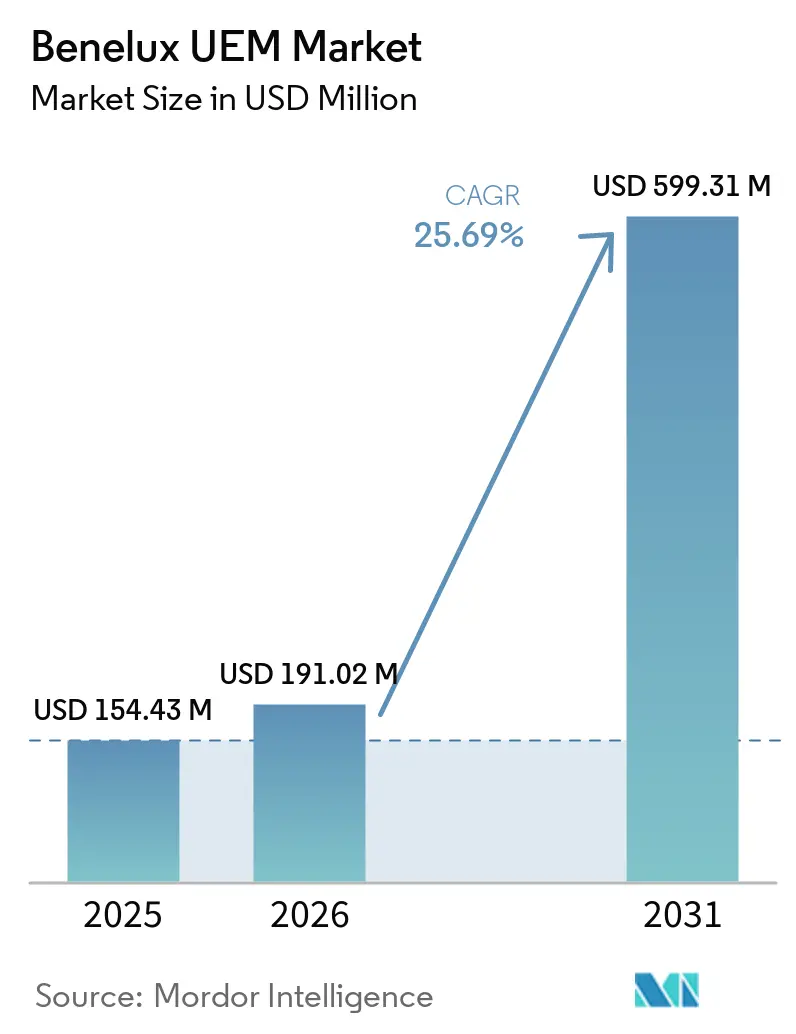
| Base Year Market Size (2025) | USD 154.43 Million |
| Market Size (2026) | USD 191.02 Million |
| Market Size (2031) | USD 599.31 Million |
| Growth Rate (2026 - 2031) | 25.69 % |
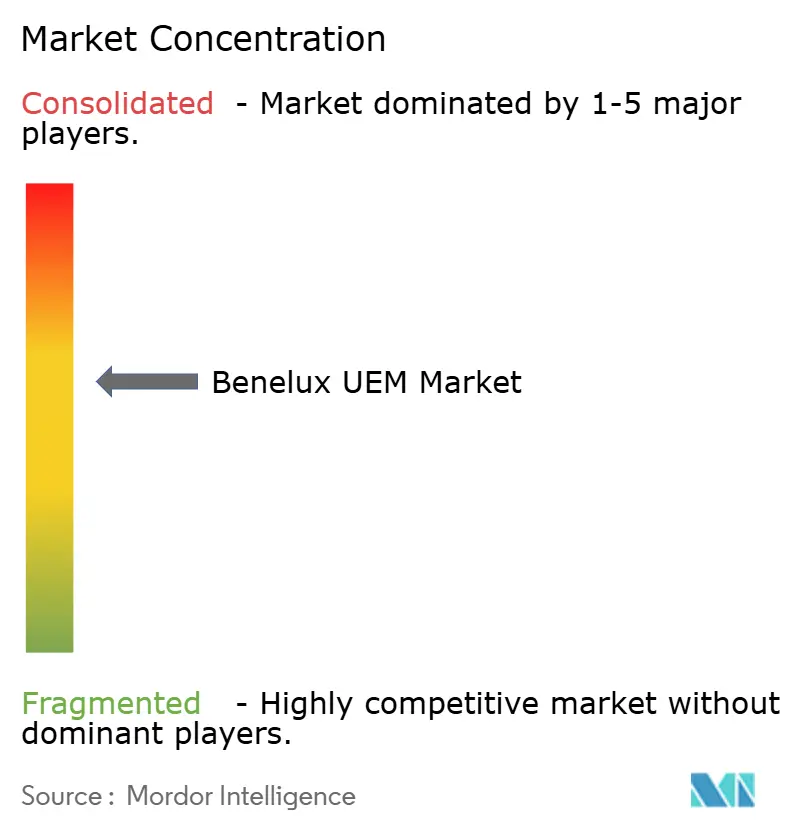
| Market Concentration | Medium |
Major Players *Disclaimer: Major Players sorted in no particular order Image © Mordor Intelligence. Reuse requires attribution under CC BY 4.0. | |
Benelux UEM Market Analysis by Mordor Intelligence
The Benelux UEM market size was valued at USD 154.43 million in 2025 and is estimated to grow from USD 191.02 million in 2026 to reach USD 599.31 million by 2031, at a CAGR of 25.69% during the forecast period (2026-2031). The Benelux UEM market is being boosted by institutional digitization programs, tighter cybersecurity obligations, and the continued adoption of distributed work models across Belgium, the Netherlands, and Luxembourg. Demand in this region is shaped less by scale and more by regulatory sensitivity, because multinational headquarters, financial institutions, and public sector bodies require stronger endpoint oversight than many peer markets in Europe. This operating mix shortens adoption cycles in the Benelux UEM market, as organizations need a single control layer across growing device estates and increasingly stringent audit requirements. Buyers are also placing more weight on integrated security, policy automation, and user experience, which is changing how platforms are assessed and narrowing the appeal of stand-alone device tools. Competitive pressure, therefore, remains high, with global platform vendors defending their positions while regional vendors use sovereignty, compliance alignment, and migration support to win selective accounts.
Key Report Takeaways
- By component, solutions held 73.43% of revenue in 2025 in the Benelux UEM market, and are projected to expand at a 25.99% CAGR through 2031.
- By deployment mode, cloud-based deployments accounted for 70.27% of the Benelux UEM market size in 2025 and are projected to expand at a 26.09% CAGR through 2031.
- By organization size, large enterprises held 74.86% share in 2025, while small and medium enterprises are projected to advance at a 26.26% CAGR through 2031.
- By end-user industry, IT and telecommunications accounted for 24.54% of demand in 2025, while healthcare and life sciences are projected to expand at a 26.34% CAGR through 2031.
- By geography, the Netherlands held 64.12% of the Benelux UEM market share in 2025, while Luxembourg is projected to grow at a 26.88% CAGR through 2031.
Note: Market size and forecast figures in this report are generated using Mordor Intelligence’s proprietary estimation framework, updated with the latest available data and insights as of January 2026.
Benelux UEM Market Trends and Insights
Drivers Impact Analysis*
| Driver | (~) % Impact on CAGR Forecast | Geographic Relevance | Impact Timeline |
|---|---|---|---|
| Rising Endpoint Sprawl Across Hybrid Workforces | +6.5% | Benelux-wide, acute in Netherlands and Belgium enterprise clusters | Short term (≤ 2 years) |
| Regulatory Pressure for Data Protection and Auditability | +5.2% | Belgium, Netherlands, Luxembourg | Short term (≤ 2 years) |
| Expansion of Zero Trust and Conditional Access Programs | +4.8% | Benelux-wide, concentrated in financial services and critical infrastructure | Medium term (2-4 years) |
| Increasing Need for Unified Policy Control Across Diverse Devices | +3.8% | Benelux-wide, especially multinational headquarters in Amsterdam, Brussels, and Luxembourg City | Medium term (2-4 years) |
| Growing Adoption of BYOD and Corporate-Owned Personally Enabled (COPE) Device Strategies | +3.40% | Benelux-wide, particularly among SMEs, professional services firms, and mobile-intensive workforces | Medium term (2–4 years) |
| Accelerating Digital Workplace and Cloud Transformation Initiatives | +4.30% | Benelux-wide, strongest in the Netherlands and Luxembourg where cloud adoption and digitalization programs are most advanced | Medium to long term (3–5 years) |
| Source: Mordor Intelligence | |||
Rising Endpoint Sprawl Across Hybrid Workforces
Hybrid work has become a permanent operating model for many employers in the region, and that shift has widened the number, location, and type of endpoints that need active oversight. Ivanti reported in February 2025 that 83% of IT professionals viewed flexible working as high value or essential, which signals that distributed endpoint estates are not a temporary condition for the Benelux UEM market.[1]Ivanti, “2025 Technology at Work Report,” Ivanti, ivanti.com As those estates grow, the device mix now extends well beyond laptops and smartphones into shared tablets, scanners, Chrome OS devices, and other operational endpoints that older management tools often fail to discover or govern consistently. That problem matters more in the Benelux Unified Endpoint Management (UEM) market because organizations in finance, government, logistics, and healthcare run mixed environments that cannot tolerate undocumented gaps in compliance or patching. Platforms that provide broad visibility across operating systems and device types are therefore gaining ground because they reduce blind spots that legacy mobile device management tools leave behind. The result is a faster shift toward consolidated endpoint platforms, since fragmented point tools raise operational overhead just as device diversity keeps expanding.
Regulatory Pressure For Data Protection And Auditability
Compliance requirements have raised the importance of endpoint auditability from a useful control to a formal operating requirement in regulated parts of the region. Ivanti’s April 2026 launch of Neurons for MDM Sovereign Edition EU showed how vendors are responding with EU-hosted, sovereignty-focused offerings that align with NIS2, GDPR, DORA, and the EU Cloud Sovereignty Framework. In the Benelux Unified Endpoint Management (UEM) market, this matters because public sector bodies and financial institutions increasingly need exportable audit trails, controlled data residency, and verifiable device compliance rather than basic device enrollment alone. Sovereign deployment options also help vendors address buyer concerns around where management data is stored, who can access it, and how that information can be presented during reviews or regulatory checks. These pressures are pushing platform selection toward vendors that can pair operational control with documented governance, which raises the value of reporting, analytics, and policy evidence inside the UEM stack. The broader effect is that endpoint management is being evaluated as part of enterprise risk control, not only as workplace administration software.
Expansion Of Zero Trust And Conditional Access Programs
Zero-trust programs are widening the role of endpoint platforms because device trust is now a core condition for secure application access. In March 2026, ManageEngine expanded Endpoint Central with endpoint detection and response and secure private access features, including device trust verification that supports Zero Trust access to internal applications. That kind of move reflects how the Benelux Unified Endpoint Management (UEM) market is being shaped by buyers who want compliant devices, identity controls, and remediation workflows to work together from a single policy framework. Conditional access models lose their effectiveness when the device layer is weak, making UEM a practical enforcement point rather than a separate management utility. Vendors that connect cleanly with identity systems and security tooling are therefore better positioned in enterprise evaluations, because they reduce the integration work that often slows security modernization. This is shifting the Benelux UEM market toward platforms that can support access control, compliance enforcement, and automated response in one operating model.
Increasing Need For Unified Policy Control Across Diverse Devices
The Benelux Unified Endpoint Management (UEM) market is also benefiting from the need to apply one policy structure across a wider set of devices, users, and jurisdictions. Baramundi expanded centralized UEM and Intune co-management with multi-tenant support in December 2025, which reflects the practical demand for shared control across multi-site environments and service-led deployments.[2]baramundi, “baramundi Expands Centralized UEM and Intune Co-Management with Multi-Tenant Support,” baramundi, baramundi.com The issue is not only device count, it is also policy consistency across Windows, macOS, iOS, Android, Linux, and adjacent operational endpoints that sit inside the same security perimeter. In cross-border enterprises based in Amsterdam, Brussels, and Luxembourg City, centralized control is especially valuable because one console often has to support several regulatory and business contexts at the same time. Open integration models are therefore gaining favor over closed stacks, since buyers want endpoint policy to work with service management, identity, analytics, and security tools without heavy engineering effort. That preference supports a longer-term shift in the Benelux UEM (Unified Endpoint Management) market toward platforms built for interoperability, automation, and continuous governance.
Restraints Impact Analysis*
| Restraint | (~) % Impact on CAGR Forecast | Geographic Relevance | Impact Timeline |
|---|---|---|---|
| High Migration Complexity From Legacy Device Tools | -2.8% | Benelux-wide, most acute in government, healthcare, and financial services | Long term (≥ 4 years) |
| Limited Budget Appetite Among Mid-Market Buyers | -2.1% | Belgium and Netherlands SME segment, Luxembourg mid-market | Medium term (2-4 years) |
| Integration Friction With Identity, Security, And ITSM Stacks | -1.6% | Benelux-wide, concentrated in large enterprises with complex tooling landscapes | Medium term (2-4 years) |
| Talent Gaps In Policy Automation And Endpoint Scripting | -1.2% | Benelux-wide, most acute in sectors outside IT and telecommunications | Long term (≥ 4 years) |
| Source: Mordor Intelligence | |||
High Migration Complexity From Legacy Device Tools
Migration from older endpoint tools remains one of the clearest speed limits in the Benelux Unified Endpoint Management (UEM) market, especially in sectors with long technology lifecycles and strict uptime requirements. Matrix42 noted that Ivanti Desktop Management Suite reaches end of life on December 31, 2026, forcing affected customers to make replacement decisions amid rising security and compliance pressure.[3]Matrix42, “Ivanti DSM End-of-Life 2026, Secure Replacement with Matrix42 UEM,” Matrix42, matrix42.com The difficulty is rarely the license decision alone, because new UEM platforms also need to connect with identity tools, service desks, security controls, and existing workflow structures without disrupting daily operations. In the Benelux UEM (Unified Endpoint Management) market, those migration projects are especially demanding in healthcare, government, and financial services, where policy errors or rollout delays can affect regulated processes and audit readiness. Large organizations, therefore, move more slowly than demand conditions alone would suggest, which means replacement intent does not always convert into immediate revenue. This creates a structural drag on adoption even when the strategic case for modernization is widely accepted.
Limited Budget Appetite Among Mid-Market Buyers
Budget discipline among mid-market organizations is a second restraint, as endpoint governance needs are rising faster than many smaller IT budgets can support. ENISA has highlighted that SMEs across Europe face a growing cybersecurity cost burden, which supports the view that certified endpoint management tools can still be difficult for smaller organizations to prioritize.[4]European Union Agency for Cybersecurity, “SMEs Cybersecurity,” ENISA, enisa.europa.eu This tension matters in the Benelux Unified Endpoint Management (UEM) market because many firms with 50 to 999 employees now face stronger security expectations, but still compare UEM investments against other pressing infrastructure and staffing needs. The June 2025 announcement of EUR 145.5 million and USD 164.2 million in cybersecurity funding for SMEs and public administrations offers some relief, but that funding does not immediately translate into committed UEM projects across the region CBI.EU. Mid-market buyers also tend to assess total managed cost, not license cost alone, which can delay standalone platform purchases when external support, integration work, and policy setup are added to the decision. As a result, growth in this part of the Benelux UEM market remains strong, but it still carries a practical budget ceiling.
*Our forecasts treat driver/restraint impacts as directional, not additive. The impact forecasts reflect baseline growth, mix effects, and variable interactions.
Segment Analysis
By Component: Solutions Remain The Core Of Platform Spending
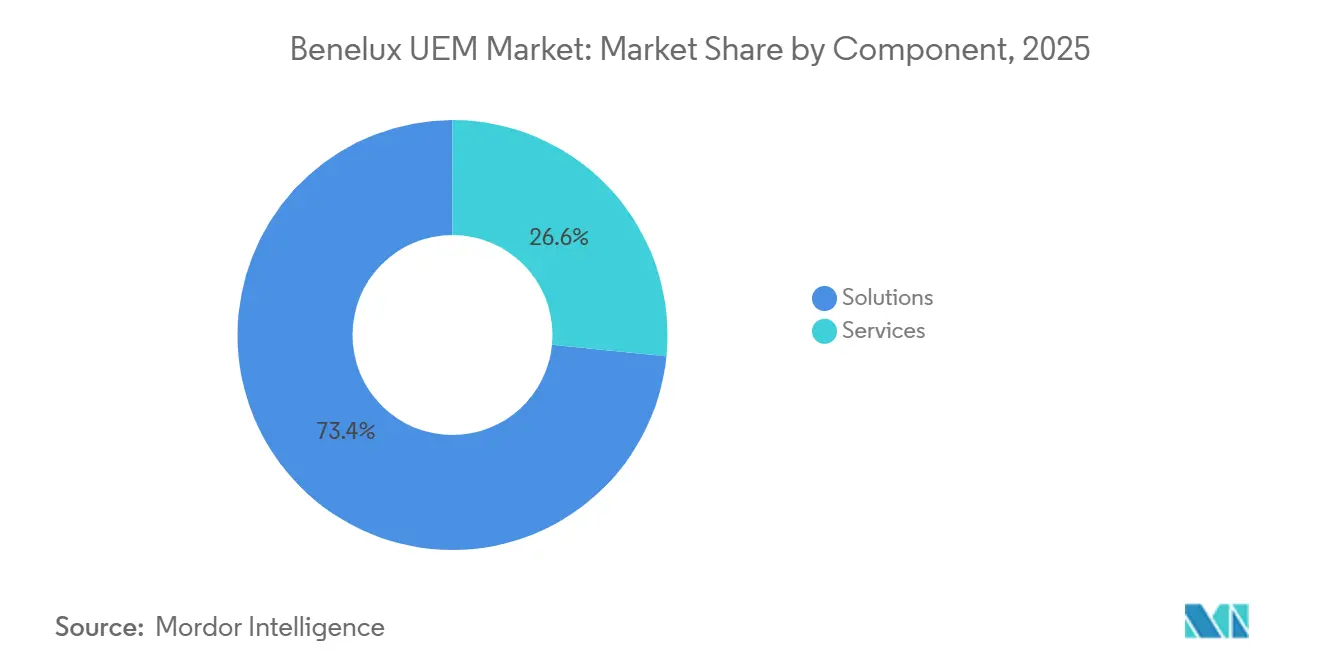
Solutions accounted for 73.43% of revenue in the Benelux Unified Endpoint Management (UEM) market in 2025, and posted the highest projected CAGR of 25.96% through 2031, which confirms that most buyers still preferred to own and direct their endpoint governance stack rather than rely mainly on outside delivery. This part of the Benelux UEM market is centered on the functions that give enterprises direct operational control, especially device enrollment, application administration, policy enforcement, and compliance reporting. Security and compliance management, along with analytics and automation, are drawing a larger share of attention inside solution budgets because buyers want UEM to do more than register devices. They increasingly expect the platform to surface risk, automate routine actions, and produce evidence that supports internal governance and external review. That change is reducing the stand-alone value of basic device and application control, because leading vendors are bundling those functions into wider platform tiers. In practical terms, the solutions layer is becoming the control plane through which organizations connect endpoint policy, access conditions, remediation logic, and user support into a single operating structure.
Services remained the smaller component in revenue terms, yet they hold a durable role in the Benelux UEM market because migrations and integrations are difficult to complete with minimal outside help. This is especially true when organizations move from older desktop or mobile management environments into cloud or hybrid models that need new workflows, scripting, and policy design. The Benelux Unified Endpoint Management (UEM) industry is therefore seeing managed service partners position UEM as an ongoing operating service rather than a one-time implementation project, particularly in the Netherlands and Belgium. That service opportunity expands when buyers lack in-house automation skills, when they manage several operating systems, or when compliance settings must be tuned for sector-specific rules. The result is a component structure where solutions dominate spending, but services remain closely tied to platform success because they lower migration risk and support more complex deployments. This balance should keep solution vendors central to the Benelux UEM market while still leaving room for specialist partners that can handle rollout, optimization, and policy upkeep.


By Deployment Mode: Cloud Moves Ahead While Hybrid Stays Relevant
Cloud-based deployment accounted for 70.27% of the Benelux Unified Endpoint Management (UEM) market in 2025 and posted the highest projected CAGR of 26.09% through 2031, indicating that cloud is now the default architecture for new projects. Buyers are drawn to cloud delivery because it supports distributed workforces, reduces local infrastructure requirements, and enables faster rollout of new management and security functions. The Benelux UEM market also benefits from the region’s broad use of cloud productivity and identity environments, which makes cloud-native endpoint control easier to adopt inside existing technology estates. This model is especially attractive for enterprises that want continuous policy updates, analytics, and automation without building new on-site management capacity. As a result, cloud is not acting as a transitional format in the Benelux UEM market; it is setting the operating baseline for many new deployments. The commercial effect is clear because vendors that deliver strong cloud governance with EU-friendly data handling are positioned closer to current buying patterns.
On-premise deployment still matters in the Benelux UEM market for government, defense, and critical infrastructure settings where tighter control over hosting and data handling remains necessary. Hybrid deployment is also keeping an important role because many large organizations cannot move directly from legacy tools into a fully cloud-native model without phased co-management. Baramundi’s December 2025 update on centralized UEM and Intune co-management with multi-tenant support reflects that middle stage, where enterprises and service providers need visibility across both established and newer management environments. That bridge matters because some Benelux organizations still run older device management tools in parallel with newer cloud services while they test policies, workloads, and migration paths. The persistence of hybrid models means the Benelux UEM market is not moving in a straight line from on-premise to cloud, even if cloud clearly leads on both scale and growth. Vendors that support coexistence well are therefore better placed to capture enterprise accounts that cannot accept forced cutovers.
By Organization Size: Large Enterprises Lead While SMEs Keep Closing The Gap
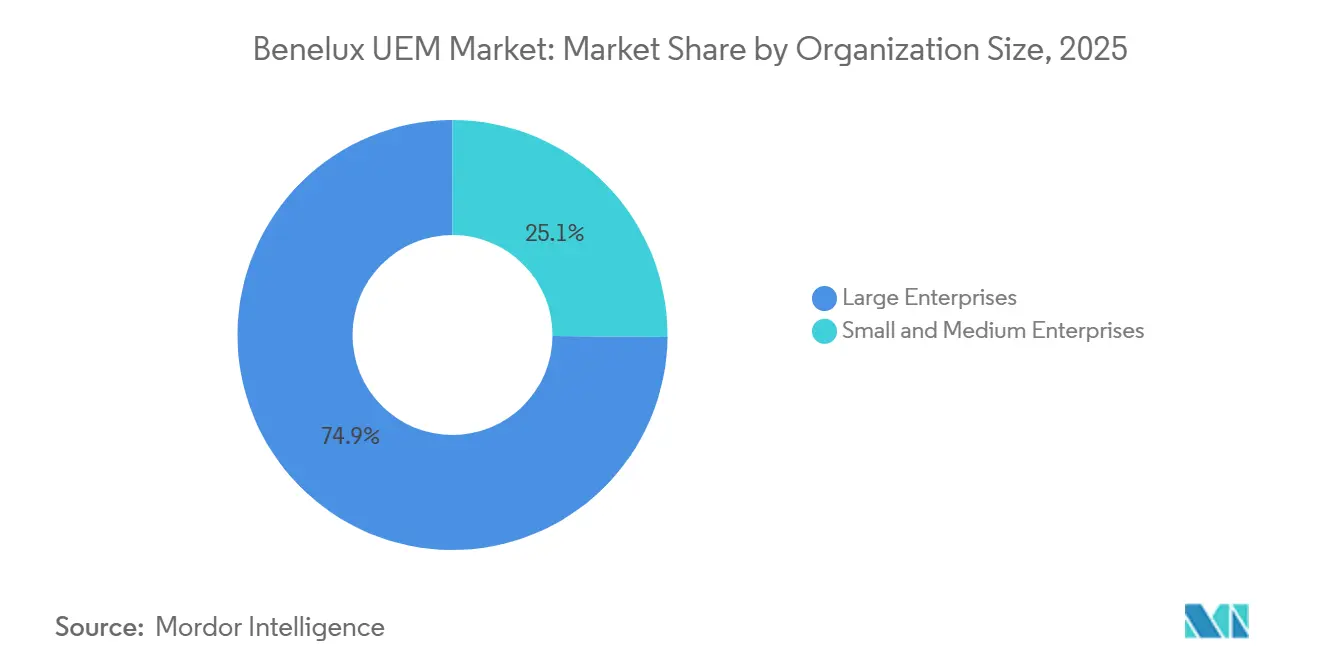
Large enterprises accounted for 74.86% of revenue in the Benelux Unified Endpoint Management (UEM) market in 2025, which reflects the scale and complexity of their multi-site device estates. These organizations typically manage more operating systems, more device ownership models, and more layered access policies than smaller firms, so they have both the need and the resources to adopt broad UEM platforms. In the Benelux UEM market, the large-enterprise use case often centers on cross-border policy enforcement, as headquarters in Amsterdam, Brussels, or Luxembourg City may need a single control structure across multiple European locations. This raises the importance of centralized visibility, role-based administration, and jurisdiction-aware governance features. It also favors vendors that can tie endpoint policy to identity, security, and service workflows without creating separate management silos. For these reasons, large enterprises still anchor demand and shape feature expectations across much of the Benelux Unified Endpoint Management (UEM) market.
Small and medium enterprises remain the fastest-growing organizational group, with a projected 26.26% CAGR through 2031, as formal endpoint governance is spreading into buyer groups that once relied on lighter controls. This shift is helped by subscription pricing, simpler deployment models, and stronger external pressure to maintain compliant endpoint practices even outside the largest accounts. ENISA’s work on SME cybersecurity pressure supports the view that smaller firms face growing digital risk even when staffing and budgets remain constrained. ManageEngine’s recognition as a Leader in IDC MarketScape evaluations for small and medium-sized businesses in late 2025 also reflects the widening relevance of platforms tailored to this buyer profile. Even so, SME adoption in the Benelux UEM market depends heavily on total cost, ease of management, and service support, not only on feature depth. That leaves the segment attractive and fast-growing, but also more price sensitive than large enterprise demand.
By End-User Industry: Healthcare Rises Fast While IT And Telecom Stays Largest
IT and telecommunications accounted for 24.54% of end-user demand in 2025, keeping this vertical as the largest revenue contributor in the Benelux UEM market. That position aligns with the sector’s role as both a heavy user of endpoint infrastructure and an early adopter of tools for managing complex, mixed-device estates. Financial services formed the next major demand cluster, where resilience requirements and regulatory scrutiny have raised the strategic value of device visibility and policy control. Government and defense also present a distinct buying profile in the Benelux UEM market, as these buyers place greater weight on sovereignty, certification, and tightly managed deployment models. Ivanti’s Sovereign Edition EU and TD SYNNEX’s BlackBerry distribution push across the Benelux both demonstrate how vendors are targeting regulated and public-sector demand for controlled endpoint environments. The larger point is that sector demand in the Benelux UEM market differs less by basic device count and more by compliance burden, security tolerance, and deployment preference.
Healthcare and life sciences are projected to advance at a 26.34% CAGR through 2031, making it the fastest-growing vertical in the Benelux Unified Endpoint Management (UEM) market. Growth here is tied to mobile clinical workflows, the replacement of legacy device management environments, and stronger controls around patient data access and auditability. Hospitals and care networks also manage shared devices, remote care tools, and mixed endpoint ownership patterns that fit naturally with unified policy models. That combination pushes healthcare buyers to look for platforms that can support continuous visibility and stable operations without disrupting frontline use. Manufacturing, retail and e-commerce, education, transportation and logistics, and energy and utilities are also broadening demand as ruggedized devices, scanners, and operational endpoints move closer to core enterprise IT. This means the functional definition of a managed endpoint in the Benelux UEM market keeps widening, which expands opportunity beyond the traditional office device base.
Geography Analysis
The Netherlands led the Benelux Unified Endpoint Management (UEM) market with a 64.12% share in 2025, which reflects its high enterprise digital maturity and its concentration of regional headquarters. The country also benefits from a large base of multinational organizations that require scalable endpoint governance across several offices and user groups. That operating structure supports demand for platforms that can centralize policy, automate routine enforcement, and support cross-border compliance needs from a single console. Dutch healthcare organizations have also remained active buyers as they modernize device estates used across clinical and administrative settings, which reinforces the country’s role as the main revenue center in the Benelux UEM market. The Netherlands, therefore, combines scale, complexity, and digital readiness in a way that keeps it structurally ahead of its regional peers.
Belgium followed with a smaller but strategically important position in the Benelux UEM market, shaped by strong regulatory pressure and meaningful demand from finance, energy, healthcare, and digital infrastructure users. The country’s value to vendors is not only tied to device volume, it also comes from the need for audit-ready governance and tighter control over endpoint data handling. This favors suppliers that can show strong reporting, local control options, and clear alignment with security-led procurement criteria. TD SYNNEX’s October 2025 exclusive distribution agreement with BlackBerry across the Benelux is one sign that vendors continue to target government and critical infrastructure demand in Belgium with secure endpoint propositions. Belgium therefore acts as a compliance-heavy market inside the wider Benelux Unified Endpoint Management (UEM) market, where regulated demand can influence product selection faster than broad-based scale alone.
Luxembourg is the fastest-growing geography in the Benelux Unified Endpoint Management (UEM) market, with a projected 26.88% CAGR through 2031. That growth is linked to the expansion of financial services and fintech activity, the country’s cross-border workforce structure, and its concentration of institutions with strong governance requirements. The practical challenge in Luxembourg is that many organizations manage employees and devices across several nearby jurisdictions, which raises the value of uniform policy application and clean audit trails. In May 2026, Luxembourg’s government advertised an MDM platform administrator role through GovJobs, which points to active investment in internal managed device capabilities at the public sector level. This mix of financial concentration, public sector attention, and cross-border operational complexity gives Luxembourg a strong growth profile even from a smaller base. It also means the Benelux UEM (Unified Endpoint Management) market is not driven by one country alone, because the fastest expansion is coming from the smallest geography in the region.
Competitive Landscape
The Benelux Unified Endpoint Management (UEM) market is moderately consolidated at the platform level, with Microsoft Intune and Omnissa Workspace ONE holding strong positions among large enterprise buyers. Their advantage comes from breadth, ecosystem fit, and the ability to support large, mixed-device estates without forcing several parallel tools. At the same time, Ivanti, ManageEngine, Jamf, Matrix42, and baramundi continue to compete for mid-enterprise, sovereign, and vertical-specific demand in the Benelux Unified Endpoint Management (UEM) market. This keeps the field active because buyers often compare global platform breadth against regional fit, migration ease, pricing, and policy flexibility. The center of competition has moved beyond simple device coverage, and vendors now need to show how endpoint management works with security operations, user experience, and access governance in a single operating model.
Several vendor moves over 2025 and 2026 show how that competition is evolving inside the Benelux UEM market. Ivanti’s April 2026 release of Neurons for MDM Sovereign Edition EU directly addressed buyer demand for data residency, compliance alignment, and operational control in regulated European settings. ManageEngine’s May 2026 rollout of Zia Agents across its digital enterprise management suite pointed to a stronger push toward autonomous task execution and AI-assisted endpoint operations. Matrix42’s Enterprise 26.1 release in May 2026 added UEM patch and vulnerability insights, a Microsoft Intune Booster add-on, and embedded AI functions across service and endpoint workflows. Each of these moves responds to the same commercial pressure, which is the need to deliver more security value, more automation, and easier integration without making platform operations harder. That shared direction suggests the Benelux UEM market is rewarding vendors that extend from administration into risk reduction and operational simplification.
European-heritage vendors also hold a clear opening in the Benelux UEM market because sovereignty and local control remain meaningful buying criteria, especially in public sector and regulated accounts. Baramundi’s multi-tenant and Intune co-management expansion in December 2025 is a good example of this approach, because it supports phased migration and service-led management rather than forcing customers into abrupt change. That matters in a region where many organizations still run a mix of legacy and modern tooling and need vendors that can work through the transition. The competitive balance in the Benelux UEM (Unified Endpoint Management) market therefore remains open enough for specialists to win targeted accounts even while large platforms dominate overall visibility. Buyers are rewarding vendors that can combine policy depth, compliance evidence, cloud and hybrid flexibility, and realistic migration support. This keeps the market active, but it also raises the bar for smaller suppliers that cannot prove clear value beyond core device management.
Benelux UEM Industry Leaders
Microsoft Corporation
IBM Corporation
BlackBerry Limited
Ivanti, Inc.
Omnissa, LLC
- *Disclaimer: Major Players sorted in no particular order

Recent Industry Developments
- May 2026: ManageEngine rolled out Zia Agents, its proprietary autonomous AI agent, across its digital enterprise management suite, enabling orchestrated, self-executing endpoint management tasks without human intervention, a milestone in the company's autonomous IT management roadmap built within a privacy-compliant framework.
- May 2026: Matrix42 released Enterprise 26.1, featuring enhanced UEM patch and vulnerability insights, a new Microsoft Intune Booster add-on for service management customers, and native AI functions embedded into endpoint and service workflows at its 2026 European Partner Conference.
- April 2026: Ivanti launched Neurons for MDM Sovereign Edition EU, a cloud-based UEM solution certified at SEAL-2 under the EU Cloud Sovereignty Framework, hosted by certified European provider sector27, and aligned with BSI IT-Grundschutz requirements. The solution targets European public institutions and regulated industries requiring verifiable data residency, auditability, and operational control under NIS2, GDPR, and DORA.
- October 2025: TD SYNNEX announced an exclusive distribution agreement with BlackBerry Limited to deliver BlackBerry's secure communication and UEM solutions across the Benelux, strengthening BlackBerry's reach into government and critical infrastructure organizations in Belgium, Luxembourg, and the Netherlands.


Benelux UEM Market Report Scope
The Benelux Unified Endpoint Management (UEM) Market refers to the market for software and services used to centrally manage, secure, and monitor endpoints such as laptops, desktops, smartphones, tablets, and other connected devices across Belgium, the Netherlands, and Luxembourg. It enables IT teams to enforce security policies, control device access, deploy applications, and maintain compliance from a single platform.
The Benelux Unified Endpoint Management (UEM) Market Report is Segmented by Component (Solutions, and Services), Deployment Mode (Cloud-Based, On-Premise, and Hybrid), Organization Size (Large Enterprises, and Small and Medium Enterprises), End-User Industry (IT and Telecommunications, BFSI, Government and Defense, Healthcare and Life Sciences, Manufacturing, Retail and E-Commerce, Education, Transportation and Logistics, and Energy and Utilities), and Country. The Market Forecasts are Provided in Terms of Value (USD).
| Solutions | Device Management |
| Application Management | |
| Content Management | |
| Security and Compliance Management | |
| Analytics and Automation | |
| Services |
| Cloud-Based |
| On-Premise |
| Hybrid |
| Large Enterprises |
| Small and Medium Enterprises |
| IT and Telecommunications |
| BFSI |
| Government and Defense |
| Healthcare and Life Sciences |
| Manufacturing |
| Retail and E-Commerce |
| Education |
| Transportation and Logistics |
| Energy and Utilities |
| Other End-User Industries |
| Belgium |
| The Netherlands |
| Luxembourg |
| By Component | Solutions | Device Management |
| Application Management | ||
| Content Management | ||
| Security and Compliance Management | ||
| Analytics and Automation | ||
| Services | ||
| By Deployment Mode | Cloud-Based | |
| On-Premise | ||
| Hybrid | ||
| By Organization Size | Large Enterprises | |
| Small and Medium Enterprises | ||
| By End-User Industry | IT and Telecommunications | |
| BFSI | ||
| Government and Defense | ||
| Healthcare and Life Sciences | ||
| Manufacturing | ||
| Retail and E-Commerce | ||
| Education | ||
| Transportation and Logistics | ||
| Energy and Utilities | ||
| Other End-User Industries | ||
| By Country | Belgium | |
| The Netherlands | ||
| Luxembourg |


Key Questions Answered in the Report
What is the current and forecast value of the Benelux UEM market?
The Benelux UEM market stood at USD 0.15 billion in 2025, reached USD 0.19 billion in 2026, and is forecast to reach USD 0.60 billion by 2031 at a 25.69% CAGR.
Which deployment model is leading across Belgium, the Netherlands, and Luxembourg?
Cloud-based deployment led with 70.27% share in 2025 and is also the fastest-growing model, with a projected 26.09% CAGR through 2031.
Why are enterprises in Benelux adopting unified endpoint management faster?
Stronger cybersecurity obligations, hybrid work, cross-border operations, and tighter audit needs are pushing organizations toward centralized endpoint governance.
Which user group is growing fastest in this space?
Healthcare and life sciences is the fastest-growing end-user vertical, with a projected 26.34% CAGR through 2031, while SMEs are the fastest-growing organization size segment at 26.26%.
Which country is driving the most revenue, and which one is expanding fastest?
The Netherlands led with 64.12% share in 2025, while Luxembourg is forecast to post the fastest growth at a 26.88% CAGR through 2031.
What is shaping vendor competition most strongly right now?
Buyers are comparing platforms on sovereignty, zero trust support, migration ease, policy automation, and integration with security and service management tools, not just on basic device coverage.
Page last updated on:





