
Benelux Digital Workplace Market Size and Share
Market Overview
| Study Period | 2020 - 2031 |
|---|---|
| Forecast Data Period | 2026 - 2031 |
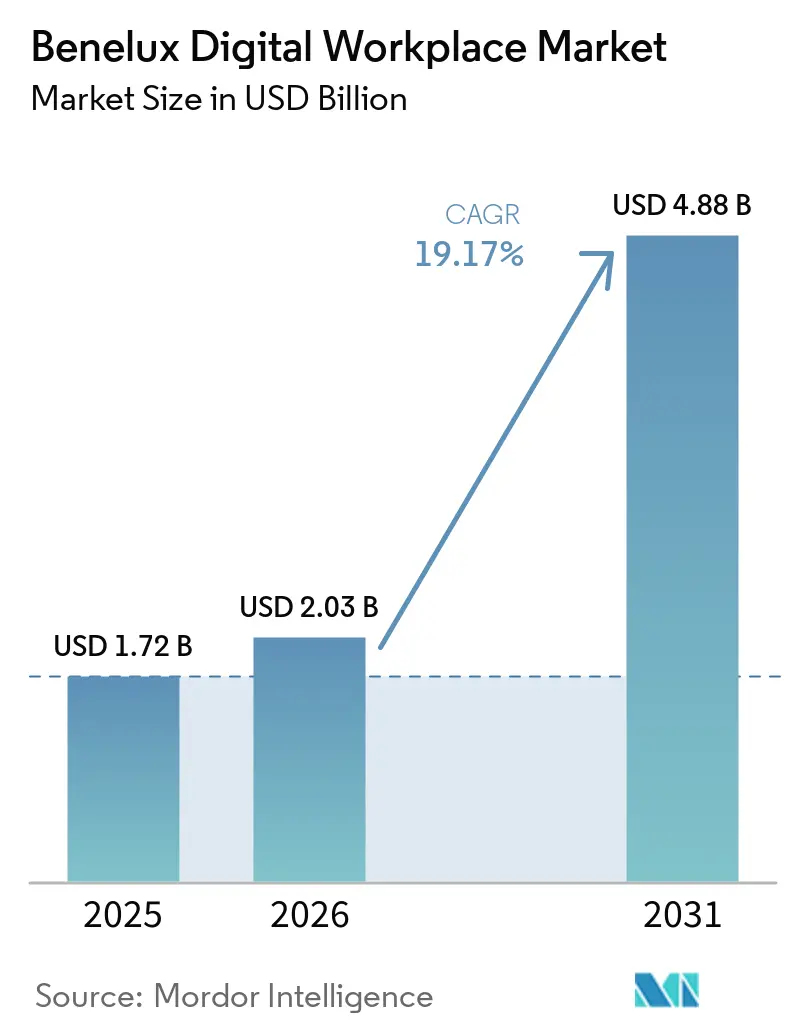
| Base Year Market Size (2025) | USD 1.72 Billion |
| Market Size (2026) | USD 2.03 Billion |
| Market Size (2031) | USD 4.88 Billion |
| Growth Rate (2026 - 2031) | 19.17 % |
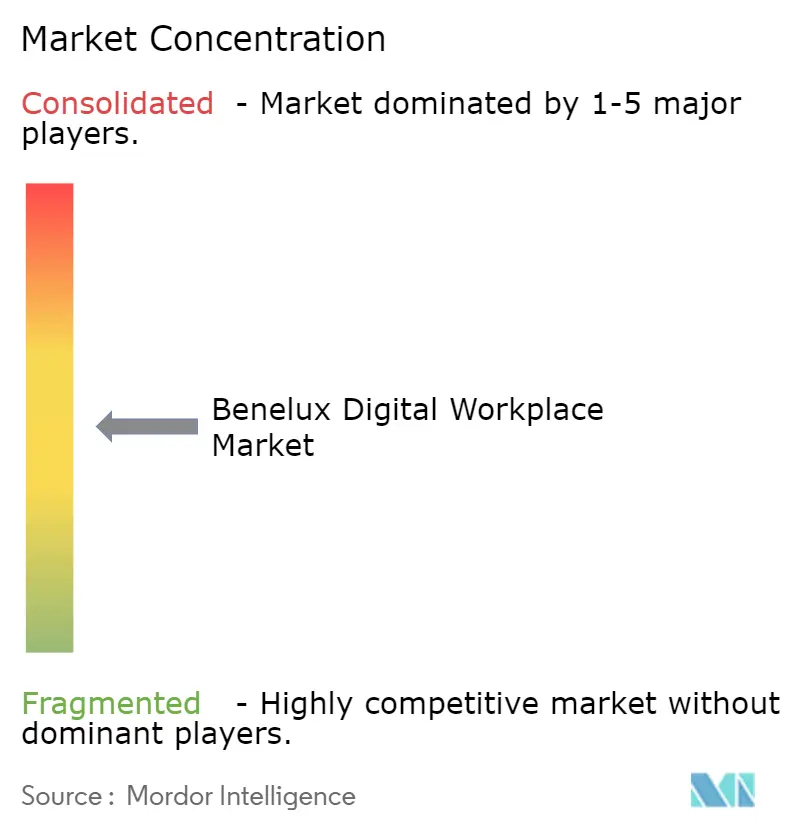
| Market Concentration | Medium |
Major Players *Disclaimer: Major Players sorted in no particular order Image © Mordor Intelligence. Reuse requires attribution under CC BY 4.0. | |
Benelux Digital Workplace Market Analysis by Mordor Intelligence
The Benelux digital workplace market size is expected to grow from USD 1.72 billion in 2025 to USD 2.03 billion in 2026 and is forecast to reach USD 4.88 billion by 2031 at 19.17% CAGR over 2026-2031. The Benelux digital workplace market is expanding on the back of hybrid work becoming part of normal operating models across the region, which keeps demand firm for collaboration, endpoint management, secure access, and workflow tools. High digital maturity in the Netherlands and sustained work-from-home adoption in Belgium have raised the baseline need for connected and policy-driven workplace systems, which supports steady spending across both large organizations and smaller firms. AI adoption is also changing buying priorities, because enterprises now want workplace platforms that can automate routine work while also supporting governance, auditability, and worker notification requirements under the EU AI Act. Competitive activity is increasingly split between global platform vendors that want deeper control of productivity, security, and identity layers, and service providers that compete on deployment, integration, and managed support. The Benelux digital workplace market also has room to grow through sovereign cloud models, mid-market packages, and industry-specific automation, even as legacy estates and specialist talent shortages continue to slow full-scale modernization.
Key Report Takeaways
- By component, solutions led with 68.12% revenue share of the Benelux digital workplace market in 2025, and are projected to grow at a 20.31% CAGR through 2031.
- By deployment mode, cloud held 65.37% share in 2025 and is projected to expand at a 20.73% CAGR through 2031.
- By organization size, large enterprises accounted for 61.54% of the Benelux digital workplace market share in 2025, while Small and Medium-Sized Enterprises are expected to grow at a CAGR at 20.69% through 2031.
- By end-user industry, BFSI held 23.18% share in 2025, while healthcare is projected to advance at a 20.53% CAGR through 2031.
- By geography, the Netherlands led the Benelux digital workplace market with 58.94% market share in 2025, while Luxembourg is expected to expand at a 20.86% CAGR through 2031.
Note: Market size and forecast figures in this report are generated using Mordor Intelligence’s proprietary estimation framework, updated with the latest available data and insights as of January 2026.
Market Trends and Insights
Drivers Impact Analysis of Benelux Digital Workplace Market*
| Driver | (~) % Impact on CAGR Forecast | Geographic Relevance | Impact Timeline |
|---|---|---|---|
| Hybrid Work Normalization Across Benelux Enterprises | +4.2% | Pan-Benelux, the Netherlands, and Belgium lead adoption; Luxembourg's financial sector remains concentrated | Short term (≤ 2 years) |
| AI-Augmented Workflow Automation In Knowledge-Heavy Workplaces | +3.5% | Netherlands technology and professional services, Luxembourg fund administration, and BFSI | Medium term (2-4 years) |
| Microsoft 365 And Teams Ecosystem Lock-In | +3.0% | Pan-Benelux, all verticals, strongest in mid-to-large enterprises | Short term (≤ 2 years) |
| Data Sovereignty And Compliance-Driven Cloud Modernization | +2.5% | The Netherlands government and critical infrastructure, Belgium's regulated industries, and Luxembourg's financial sector | Medium term (2-4 years) |
| Rising Demand For Digital Employee Experience Platforms | +2.0% | Pan-Benelux, healthcare, manufacturing, and retail lead adoption | Long term (≥ 4 years) |
| Security Consolidation Across Endpoint, Identity, And Workspace Layers | +1.8% | Pan-Benelux, BFSI, and government are early adopters, with spillover into professional services | Long term (≥ 4 years) |
| Source: Mordor Intelligence | |||
Hybrid Work Normalization Across Benelux Enterprises
Hybrid work has moved from an emergency response to a durable operating model, and that shift keeps the Benelux digital workplace market on a firm growth path. Belgium reported that 34.8% of employees worked from home in 2025, far above the 18.9% recorded in 2019. In the Netherlands, 80% of businesses with 10 or more employees offered telework in 2025, indicating that remote and flexible work practices are already embedded in day-to-day business activity. This kind of normalization raises the need for tools that can manage devices, identities, collaboration, and secure access across distributed teams without raising complexity for employers. As a result, workplace spending is less tied to one-off projects and more tied to recurring operating needs across the Benelux digital workplace market.
AI-Augmented Workflow Automation In Knowledge-Heavy Workplaces
AI-led automation is gaining traction because many employers in the region rely on knowledge-heavy work that benefits from structured, repeatable digital workflows. The Benelux digital workplace market is seeing this most clearly in Luxembourg, where the CSSF and Banque centrale du Luxembourg reported that local entities expected AI investment growth in 2025 and 2026 to outpace group-level growth as firms applied broader AI strategies within their own operations. The early focus on back-office and controlled workflow use cases aligns well with digital workplace platforms that combine collaboration, knowledge access, and task routing in a single environment. The EU AI Act is also shaping demand because deployers of high-risk AI systems face governance obligations that increase the value of platforms with logging, oversight, and clear controls.[1]European Commission, “Regulatory Framework for Artificial Intelligence,” European Commission Digital Strategy, digital-strategy.ec.europa.eu ServiceNow strengthened that direction in 2026 through launches such as Autonomous Workforce and Otto, which showed how vendors are packaging AI automation as part of broader workplace platforms rather than as isolated tools.
Microsoft 365 And Teams Ecosystem Lock-In
The Microsoft stack has become a strong anchor for workplace decisions because it spans productivity, identity, collaboration, security, and AI under a single commercial relationship. That breadth matters in the Benelux digital workplace market because buyers often prefer fewer vendors as data-handling, governance, and support expectations rise. Microsoft reinforced its regional position in April 2026 by launching a new Azure data center region in Belgium and opening EU Sovereignty and Resilience Studios in Brussels and Amsterdam. It expanded that approach again in March 2026 with Microsoft 365 E7, which bundled Copilot, Agent 365, advanced Defender AI, and Purview tools into a unified enterprise AI governance tier. These moves make it harder for single-point competitors to displace Microsoft, as the purchase decision increasingly covers the entire workplace architecture rather than a single application.
Data Sovereignty and Compliance-Driven Cloud Modernization
Cloud adoption in the region is no longer driven solely by cost or scalability; it is now closely tied to data location, control, and compliance. That has become a strong support for the Benelux digital workplace market, as regulated organizations seek modern workplace tools without losing confidence in where information is processed and governed. Microsoft’s Belgium launch directly addressed this need by enabling Belgian and Luxembourg customers to store and process data within Belgium under the EU Data Boundary framework. The same pattern is visible in endpoint management, where Ivanti introduced Neurons for MDM Sovereign Edition EU in 2026 for regulated sectors that need centralized control under EU jurisdiction. As sovereignty moves into mainstream procurement, cloud modernization becomes a longer and more durable spending theme across the Benelux digital workplace market.
Restraints Impact Analysis of Benelux Digital Workplace Market*
| Restraint | (~) % Impact on CAGR Forecast | Geographic Relevance | Impact Timeline |
|---|---|---|---|
| Fragmented Legacy Application Estates | -3.2% | Pan-Benelux has the highest impact in manufacturing and government, with spillover to healthcare | Medium term (2-4 years) |
| Skills Shortage in Workplace Transformation and VDI Architecture | -2.7% | Pan-Benelux, Luxembourg BFSI, and the Netherlands IT sector are the most acute | Medium term (2-4 years) |
| Integration of Complexity Across Multi-Vendor Collaboration Stacks | -2.0% | Pan-Benelux, large enterprises with multi-generational tool estates, are most affected | Short term (≤ 2 years) |
| High Change-Management Burden for SME Adoption | -1.6% | Belgium, where linguistic fragmentation adds complexity, and Luxembourg, where cross-border workforce dynamics matter | Long term (≥ 4 years) |
| Source: Mordor Intelligence | |||
Fragmented Legacy Application Estates
Legacy application sprawl continues to slow modernization, as many organizations still run mixed environments that were not designed to function as a single system. This remains a clear friction point for the Benelux digital workplace market because workplace upgrades often depend on identity links, endpoint policies, and secure integrations across older and newer software layers. The challenge is sharper in regulated and operational settings, where firms cannot retire important systems quickly even when those systems create duplication and manual work. As cloud, on-premises, and hybrid layers remain active simultaneously, integration costs rise and project timelines stretch. The result is that enterprises often spend more time rationalizing old estates than scaling new workplace capabilities across the organization.
Skills Shortage in Workplace Transformation and VDI Architecture
Specialist talent is another significant barrier, as digital workplace programs require both technical depth and change leadership. The Benelux digital workplace market depends on capabilities in VDI architecture, Microsoft 365 governance, endpoint management, security, and user adoption, and those skills are not easy to replace at scale. In the Netherlands, the information and communication sector reached 98% basic digital intensity, indicating a highly digitized operating base that still requires skilled labor to keep complex environments aligned and effective. Where those capabilities are in short supply, projects take longer, and employers risk rolling out new tools without enough governance or training. That delay slows the pace at which organizations can convert platform investments into sustained productivity gains.
*Our forecasts treat driver/restraint impacts as directional, not additive. The impact forecasts reflect baseline growth, mix effects, and variable interactions.
Benelux Digital Workplace Market Segment Analysis
By Component:
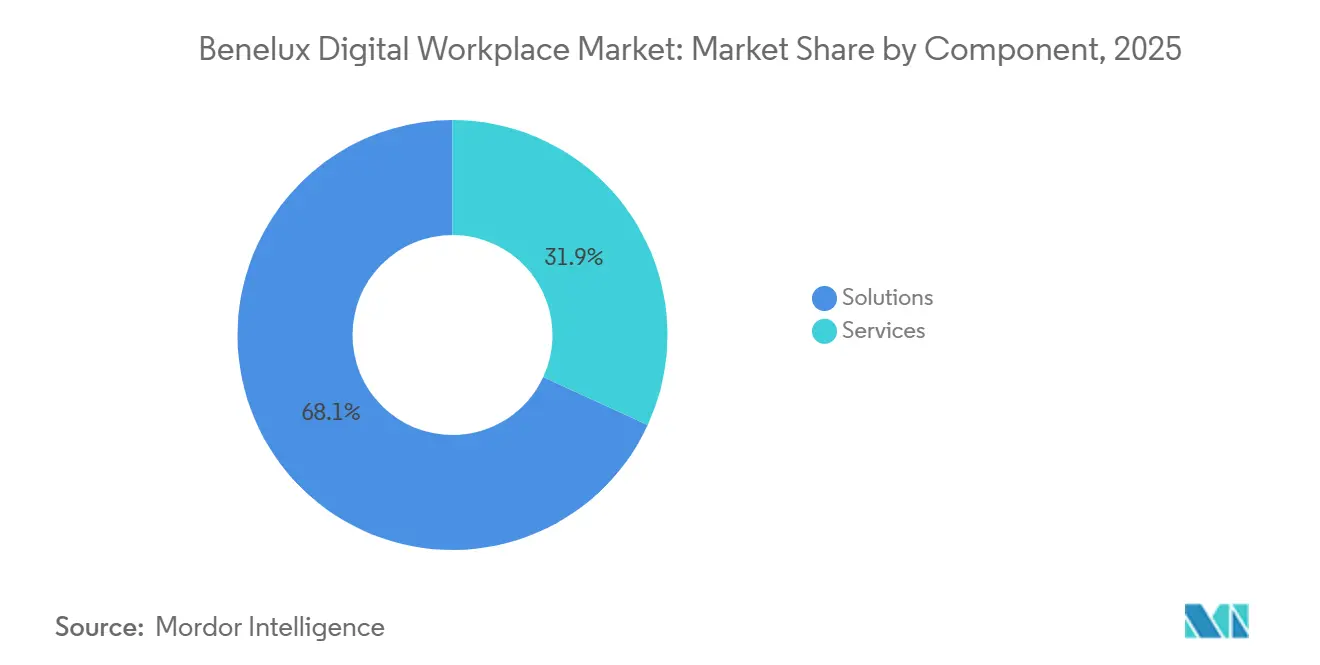
Solutions Drive Platform-Led Workplace ConsolidationSolutions accounted for 68.12% of the Benelux digital workplace market share in 2025, which showed that software-led spending was already ahead of pure services demand. Unified communication and collaboration remained the largest sub-segment within solutions because enterprises needed a common environment for meetings, messaging, files, and task coordination. Unified endpoint management and enterprise mobility management also gained ground as employers tried to manage Windows, macOS, and mobile estates through fewer administrative layers. Ivanti’s 2026 launch of Neurons for MDM Sovereign Edition EU reflected this shift by linking endpoint control with sovereignty and compliance needs in regulated environments.
Virtual desktop infrastructure and cloud PC tools also remained relevant as employers sought secure desktop delivery with reduced endpoint data exposure. Employee experience platforms and intranet tools gained attention because organizations increasingly judged value by adoption and day-to-day usability rather than solely by deployment status. Workflow automation and knowledge management tools moved closer to the center of the Benelux digital workplace market as AI features made it easier to route tasks, summarize activity, and surface information inside one workspace. Services still mattered for integration, support, and change programs, but the revenue mix showed that the core of demand sat with the platforms themselves.


By Deployment Mode:
Cloud Adoption Deepens as Sovereign Models MatureCloud held a 65.37% share of the Benelux digital workplace market in 2025 and is projected to expand at a 20.73% CAGR through 2031, making it both the largest and the fastest-growing deployment model. This growth reflected a more mature wave of adoption, in which enterprises sought compliant, controllable cloud models rather than just cheaper infrastructure. Microsoft’s April 2026 launch in Belgium strengthened that case by giving regional customers a clearer in-region option under the EU Data Boundary framework. Ivanti’s 2026 sovereign endpoint management release showed the same demand pattern on both the device and administration sides.
On-premises deployments still mattered in defense-adjacent, public sector, and tightly regulated financial settings where full cloud migration was not yet practical. Hybrid models, therefore, maintained an important role because they allowed employers to separate sensitive workloads from less critical ones without abandoning modernization. This balance is likely to remain important in the Benelux digital workplace market as buyers continue to choose cloud services, while exercising stricter control over data location and governance. In practice, cloud growth in the region now means sovereign-by-design and policy-aware deployment, not a simple shift to fully public cloud environments.
By Organization Size:
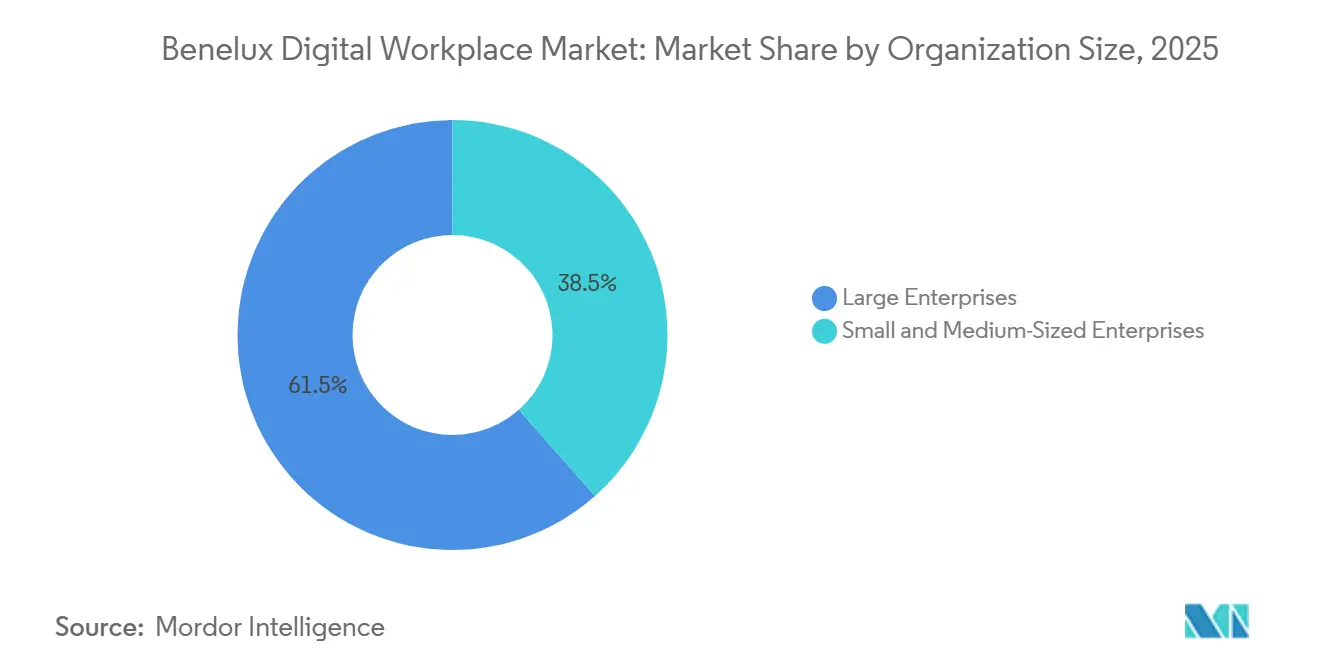
SME Adoption Rises as Delivery Models Become SimplerLarge enterprises held 61.54% of the Benelux digital workplace market in 2025, reflecting their larger seat counts, wider software estates, and stronger spending capacity. These organizations often purchased broader platform bundles that combined collaboration, security, identity, endpoint control, and managed support under longer contracts. Their demand was reinforced by the high digital maturity of Dutch business environments, where the information and communication sector reached 98% basic digital intensity. Large financial, legal, and professional organizations also remained important buyers because knowledge work and compliance needs were closely linked in their workplace models.
Small and Medium-Sized Enterprises are projected to expand at a 20.69% CAGR through 2031, making them the fastest-growing segment in the Benelux digital workplace market. Standardized cloud packages have lowered entry barriers by reducing upfront infrastructure, shortening setup time, and making enterprise-grade tools easier to consume. Atos supported that direction in May 2026 when it launched Digital Workplace as a Service for mid-size companies that needed stronger automation and employee support without large implementation contracts.[2]Atos, “Atos Launches AI-First Digital Workplace As A Service to Empower Mid-Size Companies,” Atos Press Release, atos.net Even so, smaller organizations still face adoption friction because limited internal IT capacity and change-management demands can slow the full use of workplace platforms after purchase.
By End-User Industry:
Healthcare Accelerates While BFSI Anchors Core DemandBFSI held 23.18% of the Benelux digital workplace market in 2025, making it the largest end-user segment by share. That position was closely tied to Luxembourg’s role in European fund administration and to the digital workflow demands of regulated financial operations. Financial institutions need workplace environments that can support document handling, secure collaboration, knowledge access, and policy-based oversight across distributed teams. Those conditions make BFSI a stable demand base for integrated digital workplace platforms rather than a short-term source of spending.
Healthcare is projected to grow at a 20.53% CAGR through 2031, making it the fastest-growing end-user segment in the Benelux digital workplace market. The Dutch Ministry of Health’s work on the Landelijk Dekkend Netwerk moved further into testing and pilots in 2026, which supported broader digital exchange and secure work practices across the care system. That setting increases the need for secure access, managed devices, and dependable collaboration between clinical and administrative teams. IT and telecommunications, manufacturing, retail, public sector, education, energy and utilities, and legal and professional services also contributed to demand, but healthcare and BFSI showed the clearest mix of growth momentum and structural spending need.
Geography Analysis
Netherlands Digital Workplace Market
The Netherlands held 58.94% of the Benelux digital workplace market share in 2025, which gave it the largest country position in the region. Dutch demand is supported by both scale and digital readiness, with 90% of businesses with 10 to 250 employees achieving basic digital intensity and 80% allowing telework in 2025. This broad digital base means workplace demand is spread across many sectors rather than tied to a narrow set of buyers. It also gives the Benelux digital workplace market a strong regional center where collaboration, endpoint control, and secure remote access are already treated as standard business infrastructure.
Belgium Digital Workplace Market
Belgium remained a major contributor to the Benelux digital workplace market because hybrid work and public-sector complexity both support workplace modernization. Statbel reported that 34.8% of Belgian employees worked from home in 2025, indicating a strong structural shift from the 18.9% level seen in 2019.[3]Belgian Statistical Office, “Working from Home,” Statbel, statbel.fgov.be That pattern underscores the need for managed collaboration, device governance, and secure identity controls across multilingual, distributed work settings. Microsoft’s April 2026 launch of its Belgium data center further strengthened the local case for sovereign, compliant cloud-based workplace deployments.
Luxembourg Digital Workplace Market
Luxembourg is projected to expand at a 20.86% CAGR through 2031, which makes it the fastest-growing geography in the Benelux digital workplace market. The country’s smaller population base is offset by the high-value needs of financial services and fund administration, where workflow quality, auditability, and secure collaboration are critical. The CSSF and Banque centrale du Luxembourg reported that local AI investment was expected to rise more steeply in 2025 and 2026 than at group level, which points to stronger local execution demand. That supports greater interest in automation, knowledge handling, and governed workplace platforms across financial institutions. Luxembourg’s cross-border labor structure also adds operational complexity, which increases the value of centralized workplace tools that can support consistent control across dispersed teams.
Competitive Landscape
The Benelux digital workplace market is moderately concentrated in platform software and more fragmented in implementation and managed services. A limited group of global vendors shapes the core platform stack because buyers want strong integration across collaboration, identity, endpoint management, security, and AI. At the same time, the service layer remains open to many competitors, since enterprises still need localized delivery, migration help, and sector-specific execution support. This split keeps the Benelux digital workplace market competitive even when a few software ecosystems hold strong positions.
Microsoft strengthened its position in 2026 by launching a Belgium Azure region and opening EU Sovereignty and Resilience Studios in Brussels and Amsterdam, which improved its appeal to regulated buyers concerned with data handling and jurisdiction. It added another layer in March 2026 with Microsoft 365 E7, which bundled AI, security, and compliance into a single workplace tier. ServiceNow also widened its role in 2026 through Otto, Autonomous Workforce, and deeper Microsoft integration, showing a clear push to own workflow orchestration and AI governance across enterprise environments.[4]ServiceNow, “ServiceNow Otto Creates The Unified AI Experience For The Enterprise,” ServiceNow Newsroom, newsroom.servicenow.com Cisco followed a related path through its 2025 partnership with ServiceNow, which linked network, security, and AI workflow capabilities in a broader enterprise proposition.
These moves show that the most active competitors are not selling isolated workplace tools, and are instead trying to control larger portions of the operating environment. There is still clear room for specialists and regional providers in the Benelux digital workplace market. Mid-size organizations need packaged offerings that reduce project complexity, and Atos addressed that gap in May 2026 with its Digital Workplace as a Service launch for mid-market customers. Regulated sectors also create openings for vendors with sovereignty-focused tools, as shown by Ivanti’s 2026 EU sovereign endpoint management release. This combination of strong platform anchors and open service opportunities supports a market that is competitive, active, and still evolving.
Benelux Digital Workplace Industry Leaders
Microsoft Corporation
Cisco Systems, Inc.
ServiceNow, Inc.
Citrix Systems, Inc.
Omnissa, LLC
- *Disclaimer: Major Players sorted in no particular order
Benelux Digital Workplace Market Companies Covered in this Report
- Microsoft Corporation
- Cisco Systems, Inc.
- ServiceNow, Inc.
- Citrix Systems, Inc.
- Omnissa, LLC
- Google LLC
- Zoom Communications, Inc.
- Atlassian Corporation
- IBM Corporation
- Salesforce, Inc.
- Unily Group Limited
- Workvivo Limited
- Ivanti, Inc.
- Accenture plc
- Capgemini SE
- Atos SE
- Cognizant Technology Solutions Corporation
- Wipro Limited
- Tata Consultancy Services Limited
- Infosys Limited

Recent Industry Developments in Benelux Digital Workplace Market
- May 2026: ServiceNow expanded AI agent governance capabilities through deeper integration with Microsoft, making ServiceNow AI specialists available in the Microsoft Agent 365 Marketplace and enabling the AI Control Tower to govern AI agents across both platforms. This positions ServiceNow as an enterprise-level AI governance layer that spans multi-vendor tool estates rather than a single-vendor workflow platform.
- May 2026: Atos launched Digital Workplace as a Service, a modular, AI-first, subscription-based offering designed for mid-market enterprises requiring rapid-deployment automation, proactive endpoint management, and improved employee experience without enterprise-heavy implementation contracts. The service targets organizations with 5,000 to 15,000 employees, a segment that sits above the SME threshold but below full enterprise complexity.
- April 2026: Microsoft launched a new Azure data center region in Belgium and opened EU Sovereignty and Resilience Studios in Brussels and Amsterdam, enabling Belgian and Luxembourg customers to store and process data within Belgium under the EU Data Boundary framework. The studios allow governments and enterprises to collaborate with Microsoft on sovereign cloud and AI strategies within EU jurisdiction.
- March 2026: Microsoft announced Microsoft 365 E7, a new Frontier Suite integrating Copilot, Agent 365, advanced Defender AI, and Purview security and compliance tools into a unified enterprise AI governance tier. The suite is designed to allow organizations to deploy, observe, govern, and secure AI agents operating across core business functions including sales, service, and IT operations.


Benelux Digital Workplace Market Report Scope
The Benelux Digital Workplace Market encompasses solutions and services that enable organizations in Belgium, the Netherlands, and Luxembourg to enhance employee productivity, collaboration, and engagement through digital tools and platforms. This report examines the adoption of technologies such as cloud computing, virtual collaboration tools, and enterprise mobility solutions within the region. It also analyzes market trends, growth drivers, challenges, and opportunities, providing insights into the competitive landscape and key players.
The Benelux Digital Workplace Market is Segmented by Component [Solutions (Unified Communication and Collaboration, Unified Endpoint Management, Enterprise Mobility Management, Employee Experience Platforms and Intranet, Workflow Automation and Knowledge Management, and Virtual Desktop Infrastructure and Cloud PC), and Services], Deployment Mode (Cloud, On-Premises, and Hybrid), Organization Size (Large Enterprises, and Small and Medium-Sized Enterprises), End-User Industry (IT and Telecommunications, BFSI, Healthcare, Manufacturing, Retail, Government and Public Sector, Education, Energy and Utilities, Legal and Professional Services, and Other End-User Industries), and Geography (Belgium, Netherlands, and Luxembourg). The Market Sizes and Forecasts are Provided in Terms of Value (USD).
| Solutions | Unified Communication and Collaboration |
| Unified Endpoint Management | |
| Enterprise Mobility Management | |
| Employee Experience Platforms and Intranet | |
| Workflow Automation and Knowledge Management | |
| Virtual Desktop Infrastructure and Cloud PC | |
| Services |
| Cloud |
| On-Premises |
| Hybrid |
| Large Enterprises |
| Small and Medium-Sized Enterprises |
| IT and Telecommunications |
| BFSI |
| Healthcare |
| Manufacturing |
| Retail |
| Government and Public Sector |
| Education |
| Energy and Utilities |
| Legal and Professional Services |
| Other End-User Industries |
| Belgium |
| Netherlands |
| Luxembourg |
| By Component | Solutions | Unified Communication and Collaboration |
| Unified Endpoint Management | ||
| Enterprise Mobility Management | ||
| Employee Experience Platforms and Intranet | ||
| Workflow Automation and Knowledge Management | ||
| Virtual Desktop Infrastructure and Cloud PC | ||
| Services | ||
| By Deployment Mode | Cloud | |
| On-Premises | ||
| Hybrid | ||
| By Organization Size | Large Enterprises | |
| Small and Medium-Sized Enterprises | ||
| By End-User Industry | IT and Telecommunications | |
| BFSI | ||
| Healthcare | ||
| Manufacturing | ||
| Retail | ||
| Government and Public Sector | ||
| Education | ||
| Energy and Utilities | ||
| Legal and Professional Services | ||
| Other End-User Industries | ||
| By Geography | Belgium | |
| Netherlands | ||
| Luxembourg |


Key Questions Answered in the Report
What is the size of the Benelux digital workplace market?
The Benelux digital workplace market stood at USD 1.72 billion in 2025, reaches USD 2.03 billion in 2026, and is forecast to reach USD 4.88 billion by 2031 at a 19.17% CAGR.
Which component leads spending across Benelux digital workplace solutions?
Solutions led spending with 68.12% share in 2025, showing that software platforms remained the main revenue driver over stand-alone services.
Why is cloud deployment growing so quickly in Benelux workplaces?
Cloud held 65.37% share in 2025 and is projected to grow at a 20.73% CAGR because employers want flexible delivery models that also meet sovereignty and compliance needs.
Which organization size segment is expanding the fastest?
Small and Medium-Sized Enterprises are projected to grow at a 20.69% CAGR through 2031 as cloud-native workplace products reduce deployment barriers and lower upfront complexity.
Which end-user segment creates the strongest current demand?
BFSI held the largest share at 23.18% in 2025, supported by Luxembourg’s strong financial services base and ongoing demand for secure, governed digital workflows.
Which country is the main revenue center in the region?
The Netherlands led with 58.94% share in 2025, supported by broad digital maturity, high telework adoption, and strong enterprise demand across sectors.
Page last updated on:





