
Nordics Digital Workplace Market Size and Share
Market Overview
| Study Period | 2020 - 2031 |
|---|---|
| Forecast Data Period | 2026 - 2031 |
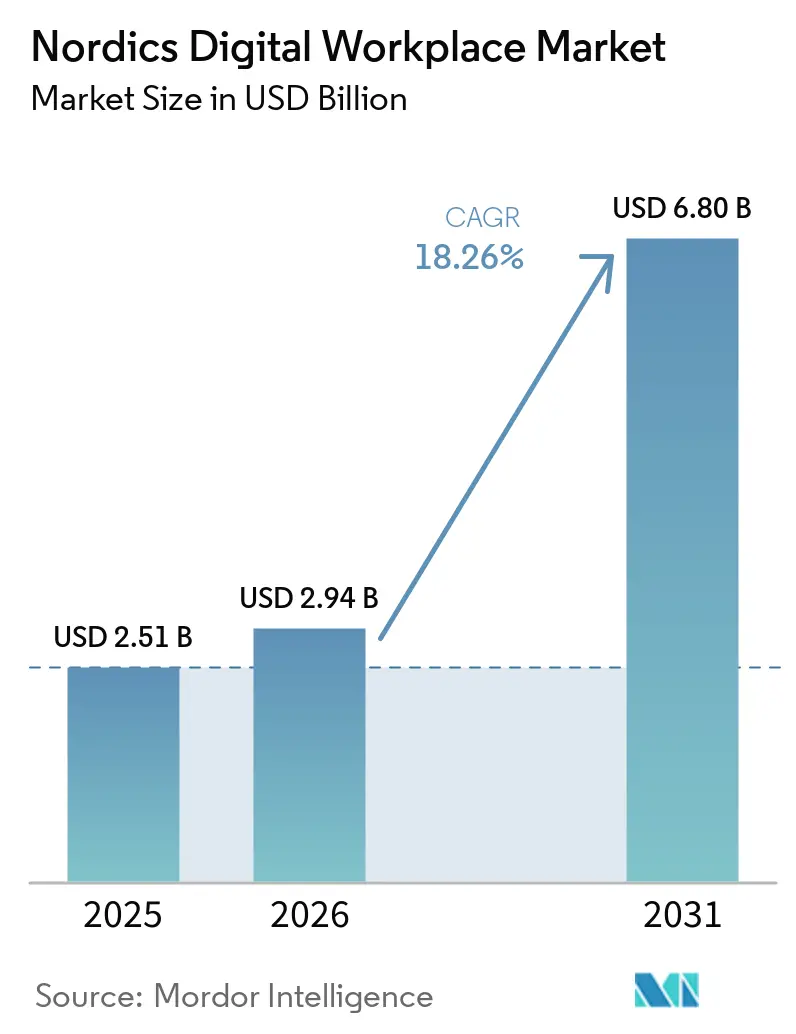
| Base Year Market Size (2025) | USD 2.51 Billion |
| Market Size (2026) | USD 2.94 Billion |
| Market Size (2031) | USD 6.80 Billion |
| Growth Rate (2026 - 2031) | 18.26 % |
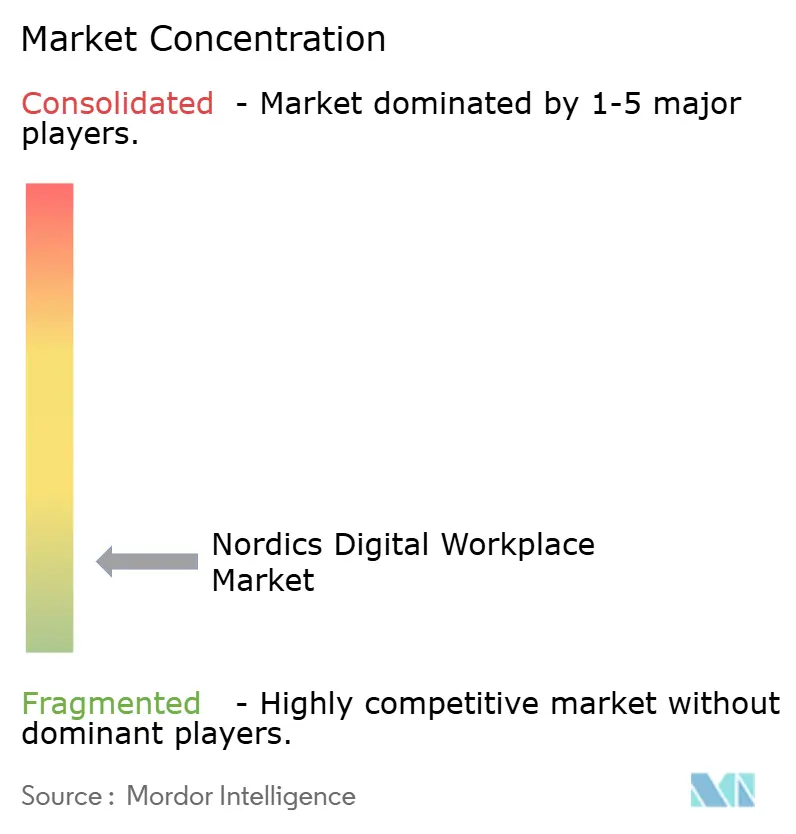
| Market Concentration | Low |
Major Players *Disclaimer: Major Players sorted in no particular order Image © Mordor Intelligence. Reuse requires attribution under CC BY 4.0. | |
Nordics Digital Workplace Market Analysis by Mordor Intelligence
The Nordics digital workplace market size was USD 2.51 billion in 2025 and is projected to reach USD 6.80 billion by 2031 at a CAGR of 18.26% during 2026-2031. Growth in the Nordics digital workplace market is being shaped by stable broadband access, mature cloud environments, and a steady push to place AI into everyday work routines. The market is also benefiting from strong alignment between enterprise technology plans and public digital policy across the region, which shortens adoption cycles for workplace platforms. Demand is moving beyond basic collaboration tools because buyers increasingly want secure communication, identity controls, workflow automation, and measurable employee adoption in the same environment. Competition in the Nordics digital workplace market remains layered, with global software platforms setting standards and Nordic service providers handling integration, migration, and ongoing support. The main constraint is not weak demand but the difficulty of integrating new AI and collaboration tools into large, often mixed technology estates.
Key Report Takeaways
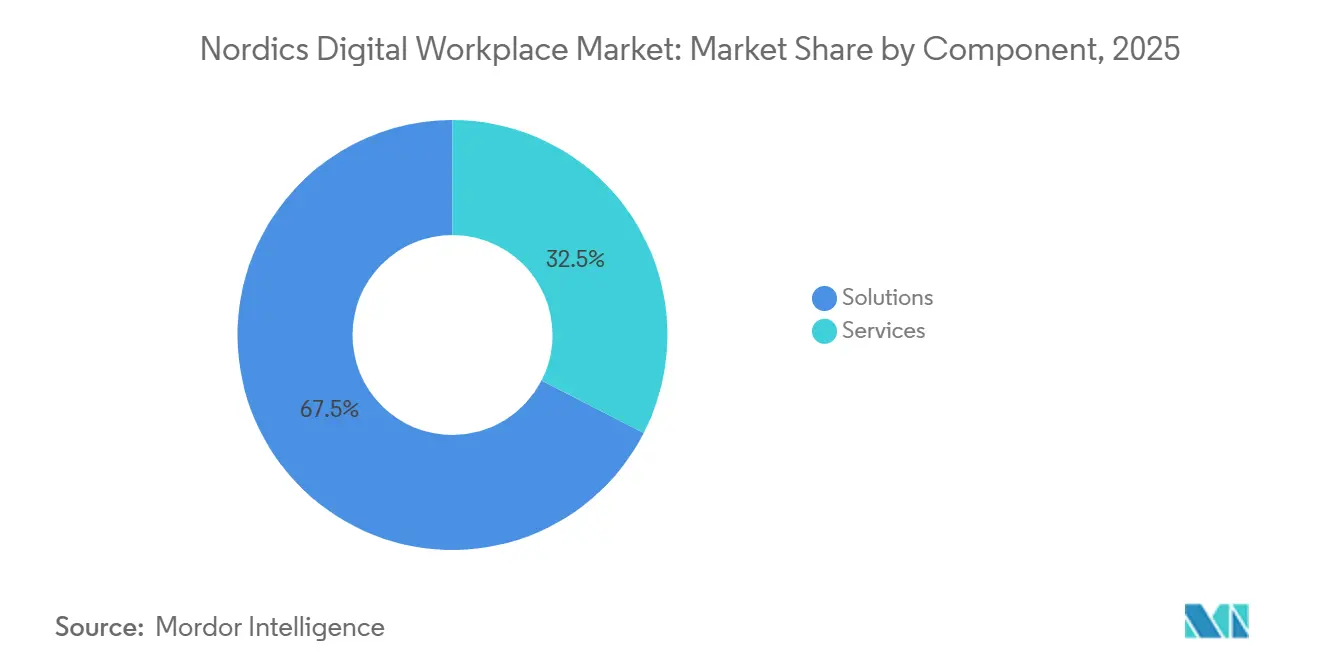
- By component, solutions held 67.46% of the Nordics digital workplace market in 2025, and are projected to grow at a 19.25% CAGR through 2031.
- By deployment mode, cloud accounted for 63.15% Nordics digital workplace market share in 2025 and is projected to expand at a 19.84% CAGR through 2031.
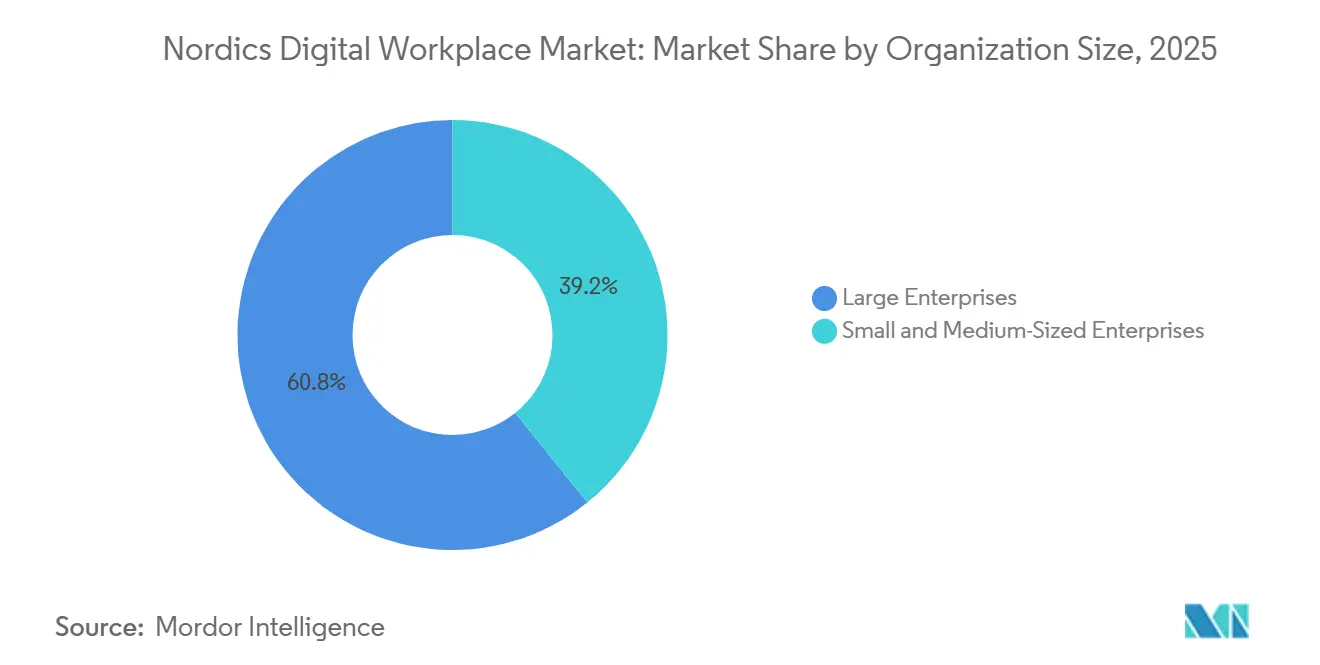
- By organization size, large enterprises held 60.78% share in 2025, while Small and Medium-Sized Enterprises are expected to record the fastest growth at a 19.57% CAGR through 2031.
- By end-user industry, IT and telecommunications accounted for 23.18% share in 2025, while healthcare is projected to grow at a 19.36% CAGR through 2031.
- By geography, Sweden led with 36.51% share in 2025, while Finland is expected to expand at a 19.48% CAGR through 2031.
Note: Market size and forecast figures in this report are generated using Mordor Intelligence’s proprietary estimation framework, updated with the latest available data and insights as of January 2026.
Market Trends and Insights
Driver Imapct Analysis of Nordics Digital Workplace Market*
| Driver | (~) % Impact on CAGR Forecast | Geographic Relevance | Impact Timeline |
|---|---|---|---|
| Hybrid Work Normalization Across Nordic Enterprises | +3.1% | Region-wide, strongest in Norway, Denmark, and Sweden | Medium term (2-4 years) |
| Cloud-First Workplace Modernization | +3.8% | Region-wide, strongest in Norway and Denmark | Short term (≤ 2 years) |
| Rising Demand for Secure Collaboration and Identity Governance | +2.4% | Region-wide, with strong regulatory pull across the Nordics and the EU | Medium term (2-4 years) |
| Employee Experience and Digital Adoption Analytics | +2.0% | Region-wide, with early demand in Stockholm, Copenhagen, and Helsinki | Medium term (2-4 years) |
| Workflow Automation to Offset Skills Shortages | +1.8% | Region-wide, with early gains in major urban centers | Medium term (2-4 years) |
| Sovereign and Data Residency Aligned Workplace Stack Adoption | +2.1% | Region-wide, with strong pull in regulated sectors | Long term (≥ 4 years) |
| Source: Mordor Intelligence | |||
Cloud-First Workplace Modernization
Cloud-first modernization remains the strongest single growth force in the Nordics digital workplace market because it affects how collaboration, endpoints, and AI tools are bought and deployed. Norway had already completed a comprehensive cloud migration across 76% of enterprises by 2025, while Sweden and Denmark remained closer to 40%, which created clear differences in deployment readiness across the region. In Denmark, 51% of surveyed enterprises were fully operational in cloud environments in 2025, which showed that a large part of the market had already moved beyond basic migration work. That maturity is shifting spending toward cloud-delivered employee experience tools, virtual desktop services, and AI-enabled communication suites rather than simple collaboration licenses. It also explains why the Nordics digital workplace market is seeing more demand for governance, cost control, and workflow design than for first-stage cloud adoption. Markets that standardized faster on cloud foundations are now better positioned to scale AI workplace tools across larger employee bases with less operational friction.
Hybrid Work Normalization Across Nordic Enterprises
Hybrid work has become a fixed operating model in the Nordics digital workplace market rather than a temporary response to earlier disruptions. In 2024, 40% of Norwegian knowledge workers operated under formal hybrid arrangements, usually with 3 days in the office and 2 days remote. That shift matters because offices no longer run on predictable attendance, which pushes companies to invest in shared collaboration spaces, flexible endpoint support, and digital scheduling tools. Workplace software is therefore being selected less for messaging alone and more for how well it supports variable presence, device access, and employee coordination. The SIHW research project across Iceland, Norway, and Sweden is still examining the effect of hybrid work on inclusion and sustainability through 2026, and that work is likely to shape public-sector technology standards. As a result, the Nordics digital workplace market is increasingly tied to attendance patterns and digital work design rather than to office headcount alone.
Rising Demand for Secure Collaboration and Identity Governance
Security, identity control, and compliance are becoming central purchase factors in the Nordics digital workplace market because AI tools now sit at the heart of daily communication and workflow systems. The EU AI Act, NIS2, and GDPR are pushing enterprises to review access policies, AI behavior controls, and cross-border data handling before they scale new workplace tools. Norway's National Security Authority stated in its 2026 risk assessment that the use of foreign cloud services can reduce national control over digital infrastructure and stored data, which is influencing procurement thinking in the region. Platform vendors are responding by linking collaboration and security more closely, as seen in Cisco's April 2025 expansion of its partnership with ServiceNow around AI risk management and SecOps integration. This means secure collaboration is no longer treated as a separate IT layer but is now a built-in requirement for enterprise workplace design. In the Nordics digital workplace market, vendors that can support governance and identity needs alongside usability are in a stronger position with regulated buyers.
Sovereign and Data Residency Aligned Workplace Stack Adoption
Sovereign deployment and data residency needs are becoming a longer-term driver in the Nordics digital workplace market, especially in healthcare, government, and other regulated settings. Buyers are increasingly asking whether collaboration platforms can run in certified regional clouds or remain partly on-premises when policy demands it. The Nordic discussion is being shaped by security concerns and sector-specific data rules, not only by technology preferences. Healthcare adds another layer, as the European Health Data Space regulation adopted in March 2025 is pushing systems toward interoperable, compliant digital environments across clinical and administrative workflows. This is changing procurement logic in the Nordics digital workplace market, as buyers want AI-enabled tools that also comply with jurisdictional and sector rules from the start. Over time, the vendors that offer flexible deployment choices and stronger control over data location will have a clearer advantage.
Restraints Impact Analysis of Nordics Digital Workplace Market*
| Restraint | (~) % Impact on CAGR Forecast | Geographic Relevance | Impact Timeline |
|---|---|---|---|
| Integration of Complexity Across Legacy Collaboration and Endpoint Estates | -1.8% | Region-wide, highest in Sweden and Denmark | Medium term (2-4 years) |
| High Switching Costs for Enterprise Workplace Suites | -1.5% | Region-wide | Long term (≥ 4 years) |
| Privacy and Cross-Border Data Compliance Burden | -1.2% | Region-wide, with higher pressure in Norway and Finland | Long term (≥ 4 years) |
| Vendor Overlap and Platform Sprawl in Mature IT Environments | -0.9% | Region-wide, most visible in Denmark and Sweden | Medium term (2-4 years) |
| Source: Mordor Intelligence | |||
Integration Complexity Across Legacy Collaboration and Endpoint Estates
Integration complexity is the most immediate brake on the Nordics digital workplace market because many enterprises still run mixed collaboration and endpoint environments. In 2025, 31% of Nordic enterprise leaders said AI integration into existing collaboration and endpoint estates was their biggest technology challenge, and 29% pointed to a lack of in-house expertise as a major barrier. Large organizations often combine on-premises identity systems, cloud productivity suites, room devices, and legacy service management tools, which slows modernization and increases its cost. Public-sector buyers face an added challenge because procurement limits often prevent the full replacement of older systems in a single step. This pushes a larger share of project budgets toward migration work, testing, and specialist services rather than toward new innovation layers. The Nordics digital workplace market, therefore, grows from a strong demand base, but execution speed still depends heavily on how well buyers can simplify existing estates.
High Switching Costs for Enterprise Workplace Suites
High switching costs also hold back faster change in the Nordics digital workplace market because many large customers have already built deeply integrated workplace stacks between 2019 and 2025. The cost is not limited to software licenses, because full suite changes affect data migration, user retraining, security models, and connected workflows. NRK's 2025 decision to move around 3,500 employees from Microsoft 365 to Google Workspace demonstrated that large transitions are possible, but they also require significant planning and support for delivery.[1] In most cases, buyers prefer to extend current relationships by adding AI, automation, or management layers rather than replacing the entire platform. That favors incumbent suppliers and makes it harder for new vendors to enter the largest enterprise accounts. As a result, growth in the Nordics digital workplace market often comes from deeper use of existing platforms, greenfield adoption by SMEs, and specialized vertical requirements rather than wholesale replacement cycles.
*Our forecasts treat driver/restraint impacts as directional, not additive. The impact forecasts reflect baseline growth, mix effects, and variable interactions.
Nordics Digital Workplace Market Segment Analysis
By Component:
Solutions Lead Spending While Services Drive AdoptionSolutions held 67.46% of the Nordics digital workplace market in 2025, which made software platforms the largest revenue base across the component structure. This share reflects a clear buyer preference for integrated tools that combine communication, workflow, endpoint management, and employee experience in one environment. Unified communication and collaboration platforms remain the largest solutions sub-segment because hybrid work is now a standard operating model across both private and public organizations. Virtual desktop infrastructure and cloud PC offerings are also gaining ground as companies try to simplify device access and extend secure connectivity to distributed teams. The Nordics digital workplace market size for solutions remains supported by the need to standardize daily work across offices, homes, clinical settings, and field operations.
The solutions mix is also changing as AI moves from pilot programs into regular work activities. Employee experience tools and intranet platforms are growing in popularity as companies seek clearer visibility into adoption, workflow friction, and training needs. Solita reported a 70-point gap between the share of Nordic workers who expect AI to reshape their roles within 5 years and the much smaller share who see AI literacy as critical to their careers, which highlights the need for adoption support inside workplace tools. Services remain smaller in share, but they are strategically important because integration and change management often determine whether software spending produces measurable results. Cisco's 2025 global hybrid work study showed that employers and employees both rated collaboration tools among the most effective supports for hybrid work, which supports continued platform spending in the Nordics digital workplace market.
By Deployment Mode:
Cloud Sets the Pace While Hybrid Remains a Practical BridgeCloud accounted for 63.15% of the market in 2025 and is projected to grow at a 19.84% CAGR through 2031, giving it the largest share and fastest growth in the deployment mix. That position shows how far the region has moved toward subscription-based workplace tools, AI-ready environments, and remotely managed services. The cloud segment also captured the leading share of the Nordics digital workplace market size because many buyers now want regular feature updates, flexible scaling, and simpler deployment across multiple locations. Norway's high migration rate and Denmark's growing cloud-readiness helped create a stronger base for AI-enabled workplace expansion than in less standardized environments. In the Nordics digital workplace industry, cloud is no longer a future option, but the main model around which new workplace functions are built.
On-premises deployment still matters in regulated areas where national control, auditability, and residency rules remain critical. Financial services, defense-related agencies, and health authorities in Norway and Finland continue to keep parts of their workplace environments outside fully public cloud models. Hybrid deployment remains the practical bridge for many large enterprises because it lets them add modern collaboration tools while older endpoint and service systems remain in place. That transitional model is common where buyers need to modernize without breaking established workflows or procurement commitments. The Nordics digital workplace market therefore shows strong cloud direction, but the real operating reality for many large accounts is still a hybrid path that will take several years to unwind.
By Organization Size:
Large Enterprises Hold Revenue While SMEs Expand FasterLarge enterprises held 60.78% of the market in 2025, which reflected their scale, IT staffing, and stronger ability to manage compliance-heavy workplace programs. These organizations led the first broad rollout of Microsoft 365, Cisco Webex, and ServiceNow, and are now moving into deeper AI and workflow use. Aker BP's rollout of Microsoft 365 Copilot across its workforce showed how large Nordic employers are pairing workplace tools with executive-backed AI adoption programs. This group still accounts for the largest share of the Nordics' digital workplace market because enterprise contracts often include broad licensing, integration services, and advanced governance layers. In the Nordics digital workplace market, large companies remain the main source of complex, multi-year transformation projects.
SMEs are projected to grow at a 19.57% CAGR through 2031, making them the fastest-growing organization-size segment. Growth is being helped by cloud-native pricing, simpler managed services, and AI-assisted support models that reduce the need for large in-house IT teams. In Denmark, 44% of companies said they preferred a single consolidated technology partner to handle workplace complexity, which supports managed service adoption among smaller firms. The Danish Ministry of Digitisation also reported in 2026 that 37% of Danish SMEs used AI in 2025, while 60% still did not engage with AI or automation, which shows both momentum and a large remaining opportunity pool. The Nordics digital workplace market will therefore keep drawing revenue from large enterprises, while future expansion is likely to be increasingly shaped by SME uptake.
By End-User Industry:
IT And Telecom Leads While Healthcare Grows FasterIT and telecommunications accounted for 23.18% of the market in 2025, making it the largest end-user segment by revenue. These organizations often act as both early adopters and test environments for collaboration, automation, and endpoint management tools before wider enterprise rollout. BFSI also remains a major demand center because secure communication, identity controls, and audit-ready workflows are core operating needs. Government, education, manufacturing, retail, energy and utilities, and legal and professional services all contribute to steady demand, especially where hybrid work and compliance requirements overlap. The Nordics digital workplace market size for IT and telecom remains strong because these buyers usually adopt new workplace functions earlier and at larger scale than other verticals.
Healthcare is projected to grow at a 19.36% CAGR through 2031, which makes it the fastest-growing end-user segment in the market. The main force is regulatory and operational change, because the European Health Data Space regulation adopted in March 2025 is pushing systems toward more interoperable digital health environments. Tieto Caretech stated in 2026 that its Lifecare EHR system operates across 16 of Finland's 21 wellbeing services counties, which shows how deeply workplace tools must align with clinical information systems.[2] Finland's government also proposed in 2026 to allow technology-assisted healthcare triage under the Health Care Act, which further supports digital workflow use in frontline care. In the Nordics digital workplace market, healthcare is becoming one of the clearest areas where compliance, interoperability, and workplace modernization now move together.
Geography Analysis
Sweden Digital Workplace Market
Sweden held 36.51% of the market in 2025, giving it the largest geographic position in the Nordics digital workplace market. Stockholm's role as a regional technology center and Sweden's large enterprise base continue to support broad demand across collaboration, endpoint, and workflow platforms. Tieto reported in 2026 that 39% of Swedish employees use AI extensively in their daily work, the highest level among the Nordic countries. That level of usage points to strong short-term demand for AI-enabled workplace software, employee experience monitoring, and governance tools. Sweden also faces a governance gap, as Solita reported in 2025 that 14% of Swedish organizations still lacked formal AI usage guidelines, the highest rate in the region.
Denmark and Norway Digital Workplace Market
Denmark and Norway remain the next key revenue centers in the Nordics digital workplace market, but their demand patterns are different. Denmark stood out for strong AI uptake, with 65% of knowledge workers using GenAI by late 2025 and a high share of companies already running AI in broad production settings. That supports demand for more advanced workplace capabilities such as AI agents, digital adoption analytics, and connected workflow tools. Norway's position is supported by deeper cloud migration and a more consolidated provider landscape, which gives larger buyers a cleaner base for scaled workplace rollouts. The NRK migration project also showed that Norwegian organizations will pursue large platform shifts when operational gains or technology direction justify the change.
Finland and Iceland Digital Workplace Market
Finland is projected to grow at a 19.48% CAGR through 2031, which makes it the fastest-growing country in the Nordics digital workplace market. The main reasons are strong healthcare digitization, solid technology readiness, and active alignment with EU health data rules. The VALO project led by Nordic institutions is helping define common principles for health data use and EHDS implementation, which supports a wider workplace modernization base around health systems.[3] Iceland and the rest of the region are smaller in absolute terms, but they still offer targeted opportunities for cloud-native managed workplace services where low local infrastructure complexity supports faster rollout.
Competitive Landscape
The Nordics digital workplace market is split between a platform layer and an implementation layer, and that structure shapes how competition works. Their role is strongest when buyers want broad suites that combine collaboration, automation, endpoint oversight, and AI support within a single commercial relationship. The second layer includes Nordic-focused service providers such as Vivicta, Atea, and Knowit, which compete more on integration depth, local delivery, and sector familiarity than on platform ownership. This layered structure means the Nordics digital workplace market is not controlled by a single vendor type, as platform and delivery power sit in different parts of the value chain.
Several strategic moves since 2025 show how vendors are trying to strengthen those positions. Cisco expanded its partnership with ServiceNow in April 2025 to combine AI Defense with ServiceNow SecOps, thereby aligning collaboration growth more closely with governance and security needs. DEVOTEAM acquired KPMG Denmark's ServiceNow unit in June 2025, strengthening its Nordic implementation capacity within the fast-growing workflow ecosystem. Plat4mation then announced plans in March 2026 to acquire Adeno to deepen its Nordic ServiceNow footprint.[4] These moves suggest that service partners are trying to build stronger regional scale around the same enterprise workflow platforms.
Platform vendors are also using AI rollouts to tighten their hold on enterprise accounts. Microsoft and KPMG announced in June 2026 that KPMG would deploy Microsoft 365 Copilot and Agent 365 across more than 276,000 professionals, which signals how quickly AI workplace tools are moving into enterprise-wide use. Vivicta's designation as one of the first Microsoft Frontier companies in the Nordics in March 2026 also showed how regional providers are aligning with major platform roadmaps to stay relevant in AI-led workplace projects. The Nordics digital workplace market still leaves room for smaller managed providers, especially in the SME space where buyers often want one partner and lower contract thresholds. That said, the largest enterprise opportunities will likely continue to favor vendors that can combine platform relationships, compliance delivery, and local execution strength.
Nordics Digital Workplace Industry Leaders
-
Microsoft Corporation
-
Cisco Systems, Inc.
-
Zoom Communications, Inc.
-
ServiceNow, Inc.
-
Omnissa, LLC
- *Disclaimer: Major Players sorted in no particular order
Nordics Digital Workplace Market Companies Covered in this Report
- Microsoft Corporation
- Cisco Systems, Inc.
- Zoom Communications, Inc.
- ServiceNow, Inc.
- Omnissa, LLC
- Ivanti, Inc.
- OpenText Corporation
- Salesforce, Inc.
- Google LLC
- Amazon Web Services, Inc.
- IBM Corporation
- Tietoevry Corporation
- Atea ASA
- Knowit AB
- Capgemini SE
- Accenture plc
- DXC Technology Company
- Dell Technologies Inc.
Recent Industry Developments in Nordics Digital Workplace Market
- June 2026: KPMG and Microsoft announced an expansion of their global relationship, with KPMG deploying Microsoft 365 Copilot and Agent 365 across its entire global workforce of more than 276,000 professionals. This signals the normalization of enterprise-wide AI workplace deployments at partner and professional-services firms operating across Nordic markets.
- April 2026: DXC Technology signed a multi-year contract with If, one of the largest insurance groups in the Nordics, to simplify and modernize If's technology estate across Finland, Sweden, Denmark, and the Baltics using DXC OASIS, an intelligent orchestration layer across mainframe, data center, and Microsoft Azure hybrid cloud environments.
- March 2026: Vivicta was designated one of the first Microsoft Frontier companies in the Nordics, a status recognizing advanced AI scaling capabilities and positioning the company as a strategic partner for AI-powered digital workplace deployments across the Nordic region.
- March 2026: Plat4mation announced plans to acquire Adeno, a Nordic-focused ServiceNow specialist, to strengthen its regional presence and expand value-driven ServiceNow adoption across the Nordics, building on Plat4mation's Swedish market entry in 2024.
Nordics Digital Workplace Market Report Scope
The Nordics Digital Workplace Market encompasses the adoption, implementation, and management of digital tools and technologies that enable seamless collaboration, communication, and productivity within organizations across Nordic countries. This report examines the market trends, drivers, challenges, and opportunities influencing the adoption of digital workplace solutions in the region. The study provides insights into market dynamics, competitive landscape, and growth prospects during the forecast period, offering a comprehensive understanding of the digital workplace ecosystem in the Nordics.
The Nordics Digital Workplace Market is Segmented by Component [Solutions (Unified Communication and Collaboration, Unified Endpoint Management, Enterprise Mobility Management, Employee Experience Platforms and Intranet, Workflow Automation and Knowledge Management, and Virtual Desktop Infrastructure and Cloud PC), and Services], Deployment Mode (Cloud, On-Premises, and Hybrid), Organization Size (Large Enterprises, and Small and Medium-Sized Enterprises), End-User Industry (IT and Telecommunications, BFSI, Healthcare, Manufacturing, Retail, Government and Public Sector, Education, Energy and Utilities, Legal and Professional Services, and Other End-User Industries), and Geography (Sweden, Denmark, Norway, Finland, Iceland, and Rest of Nordics). The Market Sizes and Forecasts are Provided in Terms of Value (USD).
Segmentation Overview
| Solutions | Unified Communication and Collaboration |
| Unified Endpoint Management | |
| Enterprise Mobility Management | |
| Employee Experience Platforms and Intranet | |
| Workflow Automation and Knowledge Management | |
| Virtual Desktop Infrastructure and Cloud PC | |
| Services |
| Cloud |
| On-Premises |
| Hybrid |
| Large Enterprises |
| Small and Medium-Sized Enterprises |
| IT and Telecommunications |
| BFSI |
| Healthcare |
| Manufacturing |
| Retail |
| Government and Public Sector |
| Education |
| Energy and Utilities |
| Legal and Professional Services |
| Other End-User Industries |
| Sweden |
| Denmark |
| Norway |
| Finland |
| Iceland |
| Rest of Nordics |
| By Component | Solutions | Unified Communication and Collaboration |
| Unified Endpoint Management | ||
| Enterprise Mobility Management | ||
| Employee Experience Platforms and Intranet | ||
| Workflow Automation and Knowledge Management | ||
| Virtual Desktop Infrastructure and Cloud PC | ||
| Services | ||
| By Deployment Mode | Cloud | |
| On-Premises | ||
| Hybrid | ||
| By Organization Size | Large Enterprises | |
| Small and Medium-Sized Enterprises | ||
| By End-User Industry | IT and Telecommunications | |
| BFSI | ||
| Healthcare | ||
| Manufacturing | ||
| Retail | ||
| Government and Public Sector | ||
| Education | ||
| Energy and Utilities | ||
| Legal and Professional Services | ||
| Other End-User Industries | ||
| By Geography | Sweden | |
| Denmark | ||
| Norway | ||
| Finland | ||
| Iceland | ||
| Rest of Nordics |
Key Questions Answered in the Report
What is the size of the Nordics digital workplace market?
The Nordics digital workplace market was valued at USD 2.51 billion in 2025 and is projected to reach USD 6.80 billion by 2031 at a CAGR of 18.26% during 2026-2031.
Which deployment model is growing fastest across Nordic workplace platforms?
Cloud is the fastest-growing deployment mode, with 63.15% share in 2025 and a projected 19.84% CAGR through 2031.
Which country leads spending across the Nordic region?
Sweden led with 36.51% share in 2025, supported by a strong enterprise base and high AI usage across daily work environments.
Which end-user vertical is expanding the fastest?
Healthcare is projected to grow at a 19.36% CAGR through 2031, driven by stronger interoperability needs and digital health regulation.
Why are SMEs becoming more important in this space?
SMEs are expected to grow at a 19.57% CAGR because cloud-native pricing and managed services reduce the cost and complexity of adoption.
What is the main challenge slowing adoption across the region?
Integration remains the biggest barrier because many enterprises still run mixed legacy and cloud environments that make AI and workplace upgrades harder to deploy at scale.