
Mexico Digital Workplace Market Size and Share
Market Overview
| Study Period | 2020 - 2031 |
|---|---|
| Forecast Data Period | 2026 - 2031 |
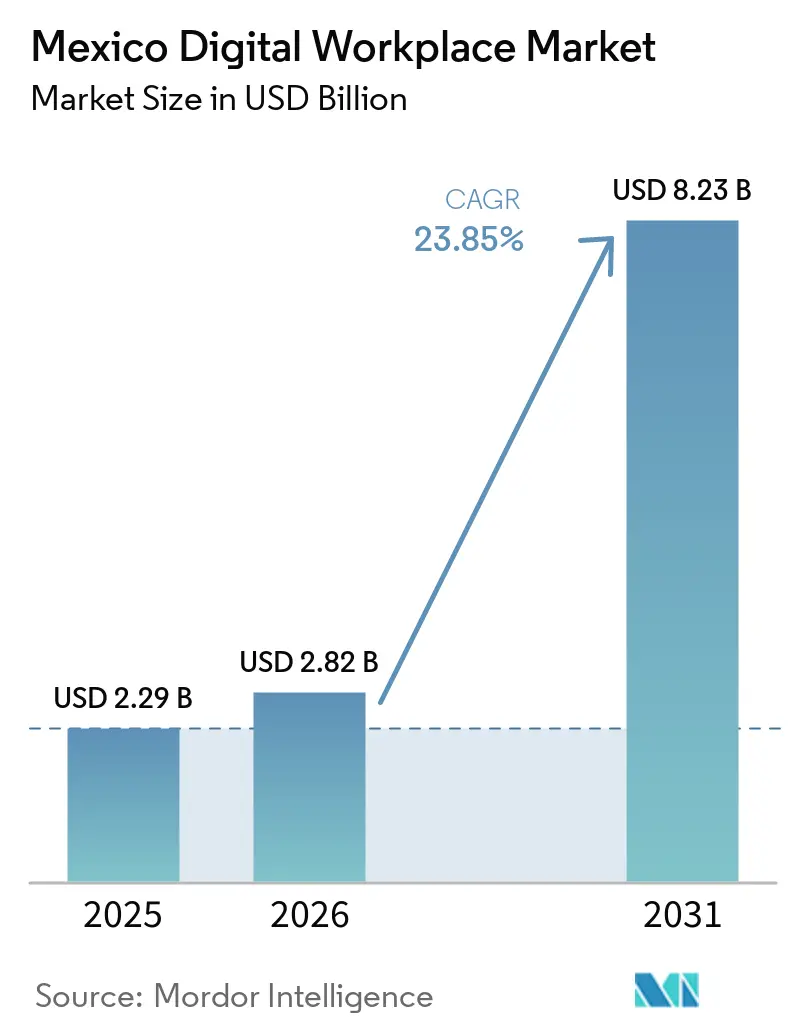
| Base Year Market Size (2025) | USD 2.29 Billion |
| Market Size (2026) | USD 2.82 Billion |
| Market Size (2031) | USD 8.23 Billion |
| Growth Rate (2026 - 2031) | 23.85 % |
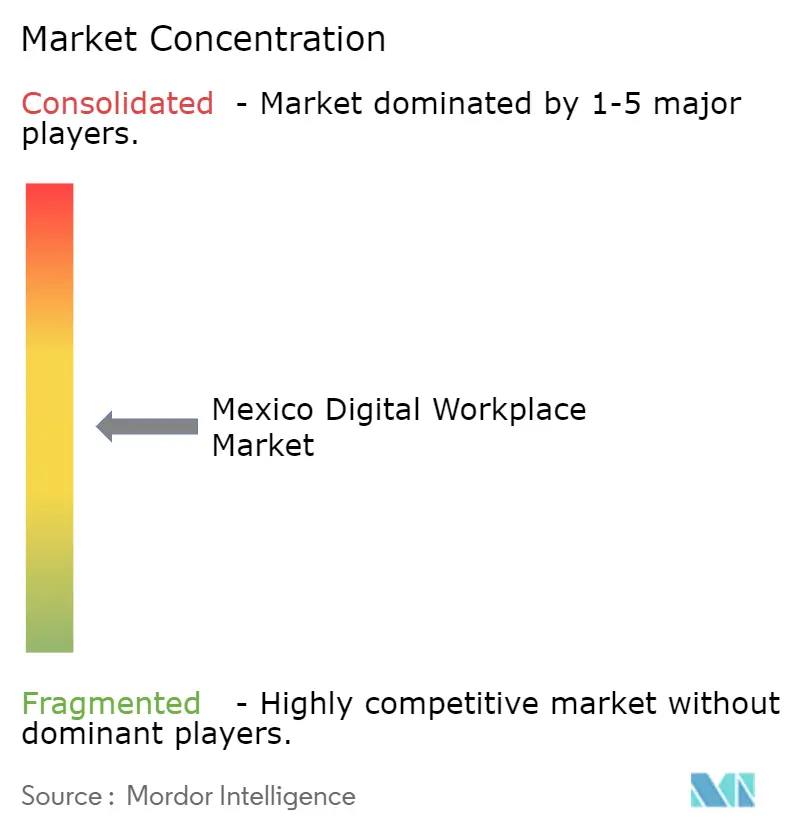
| Market Concentration | Medium |
Major Players *Disclaimer: Major Players sorted in no particular order Image © Mordor Intelligence. Reuse requires attribution under CC BY 4.0. | |
Mexico Digital Workplace Market Analysis by Mordor Intelligence
The Mexico digital workplace market size was USD 2.29 billion in 2025 and is forecast to reach USD 8.23 billion by 2031 at a CAGR of 23.85% from 2026 to 2031. The Mexico digital workplace market is expanding as enterprise technology spending shifts toward cloud-delivered collaboration, endpoint control, workflow automation, and AI-enabled support layers that can be deployed faster than traditional infrastructure. The market is also benefiting from a wider move toward platform-based workplace programs, where communication, employee support, security, and productivity functions are bought together instead of through separate tools. Compliance requirements in regulated sectors are raising the need for locally suitable cloud workplace environments, and that is improving the case for vendors that can combine security, governance, and service management in one stack. At the same time, legacy ERP and communication estates still slow decisions, especially where large employers must align workplace upgrades with broader application modernization cycles. The Mexico digital workplace market, therefore, continues to favor providers that can combine cloud migration, managed services, AI orchestration, and regulatory readiness in a single commercial offer.
Key Report Takeaways
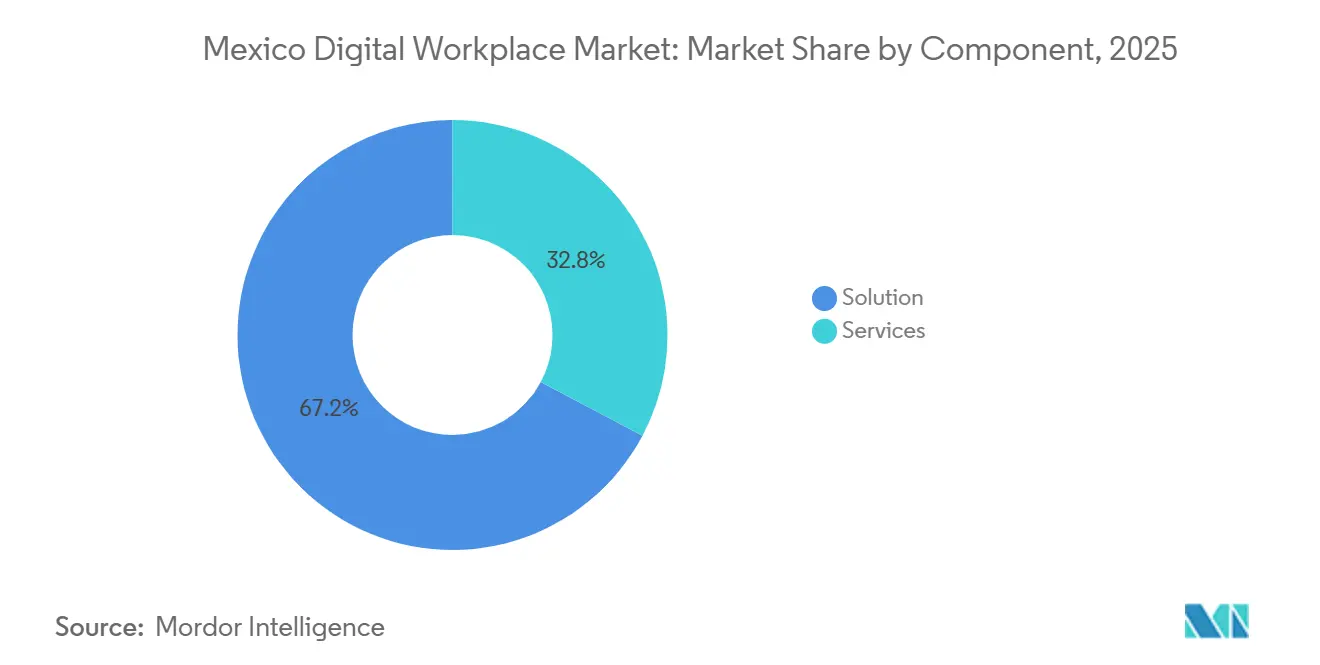
- By component, Solutions held 67.23% of the revenue of the Mexico digital workplace market in 2025, while Services accounted for the remaining 32.77% of the market.
- By deployment mode, Cloud was the largest deployment mode and is projected to expand at a 24.01% CAGR from 2026 to 2031.
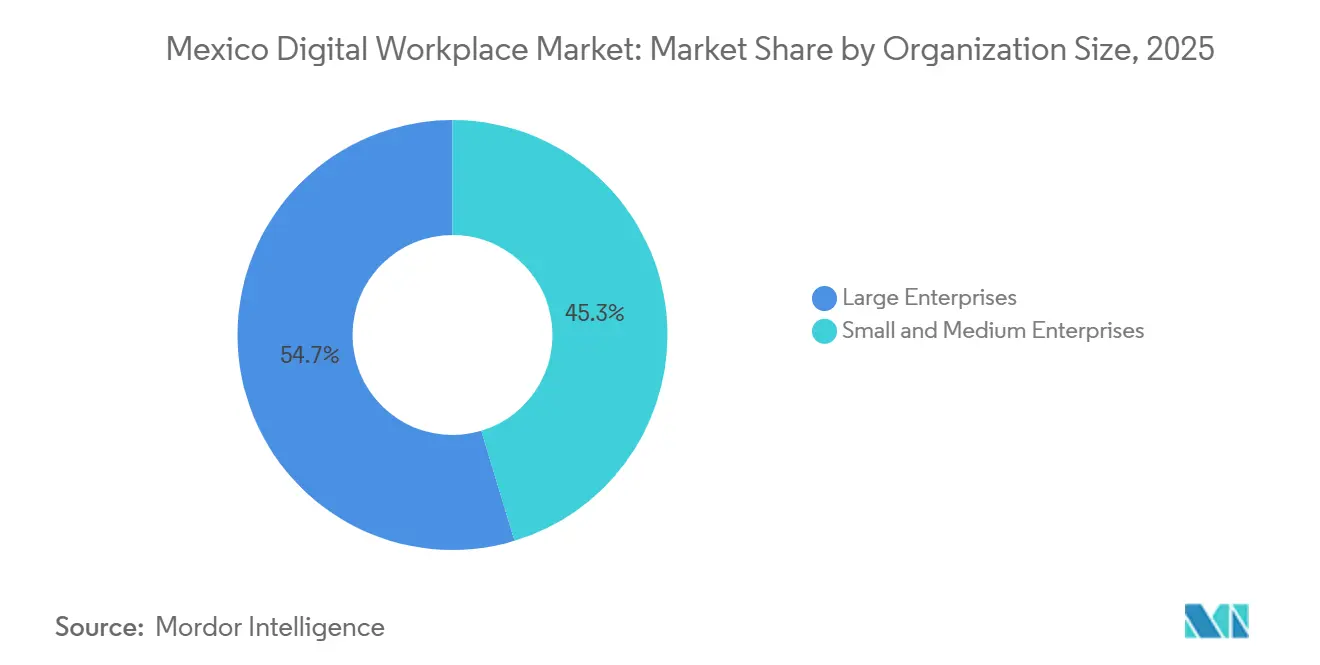
- By organization size, Large Enterprises held 54.66% of revenue in 2025, while SMEs are projected to expand at a 24.43% CAGR through 2031.
- By end-user industry, Manufacturing held 26.44% of revenue in 2025, while Healthcare is projected to expand at a 24.56% CAGR through 2031.
Note: Market size and forecast figures in this report are generated using Mordor Intelligence’s proprietary estimation framework, updated with the latest available data and insights as of January 2026.
Mexico Digital Workplace Market Trends and Insights
Drivers Impact Analysis*
| Driver | (~) % Impact on CAGR Forecast | Geographic Relevance | Impact Timeline |
|---|---|---|---|
| Rising Demand For Hybrid Work Enablement | +4.8% | National, with concentrated gains in Mexico City, Monterrey, and Guadalajara | Short term (≤ 2 years) |
| GenAI-Assisted Employee Productivity And Support | +4.3% | National, led by IT, financial services, and manufacturing sectors | Medium term (2-4 years) |
| Cloud-First Workplace Modernization In Mexican Enterprises | +3.9% | National, with nearshoring corridors in Nuevo León and Bajío leading | Medium term (2-4 years) |
| Endpoint Security And Identity Control Requirements | +3.1% | National, with financial services and telecom sectors most exposed | Short term (≤ 2 years) |
| Multisite Operations Requiring Centralized Workforce Orchestration | +2.4% | Nearshoring manufacturing clusters in Bajío, Monterrey, and Puebla corridors | Medium term (2-4 years) |
| Pressure To Reduce Ticket Volumes Through Self-Service And Automation | +1.8% | National, with early traction in IT, retail, and financial services sectors | Medium term (2-4 years) |
| Source: Mordor Intelligence | |||
Rising Demand For Hybrid Work Enablement
Hybrid work has become a fixed operating model for many employers, and that keeps the Mexico digital workplace market tied to collaboration, device management, digital HR support, and employee experience platforms. Enterprises are no longer treating workplace tools as a temporary response and are instead combining them with office redesign, meeting room technology, and distributed support workflows. This shift changes contract scope because buyers now expect communication, service desk access, identity control, and employee engagement functions to work together across office, plant, branch, and home environments. Labor compliance requirements linked to employee wellbeing and working conditions are also pushing companies to formalize digital oversight and reporting within workplace programs. That adds weight to vendors that can connect productivity suites with policy, monitoring, and managed support layers. It also shortens the runway for point tools that solve only one task and cannot fit into a broader workplace operating model.
GenAI-Assisted Employee Productivity And Support
Generative AI is moving from pilot use to routine workplace support, and this is becoming a direct demand driver for the Mexico digital workplace market. The near-term need is not only AI access, but also secure orchestration across service management, knowledge retrieval, employee onboarding, and issue resolution. This is why platform vendors are moving beyond copilots and into governance layers that control how AI agents are deployed inside enterprise workflows. Cisco and ServiceNow deepened this direction in April 2025 by linking Cisco AI Defense with ServiceNow SecOps, which gave enterprises a more direct path to scale AI use without separating it from risk controls.[1] ServiceNow then expanded its Microsoft relationship in May 2026 so AI Control Tower could govern AI agents across the Microsoft ecosystem, which further linked workplace productivity with policy, traceability, and workflow control.[2] As a result, the Mexico digital workplace market is shifting toward vendors that can pair employee productivity gains with governance, service design, and controlled automation.
Cloud-First Workplace Modernization In Mexican Enterprises
Cloud-led modernization remains a core structural driver for the Mexico digital workplace market because it lowers deployment friction and supports faster rollouts across distributed workforces. The effect is strongest when cloud workplace tools are linked with broader AI, analytics, and service transformation programs instead of being installed as standalone collaboration products. Microsoft announced a USD 1.3 billion investment in Mexico for cloud and AI infrastructure, and that commitment included support for wider AI and cloud adoption among SMEs.[3] In April 2026, Accenture and AWS opened a cloud and AI innovation and delivery center in Mexico City to help enterprises move AI programs into scaled deployment, which supports the same shift toward production-grade cloud workplace environments. The commercial result is that cloud procurement is becoming more closely tied to managed migration, AI readiness, and local delivery capability. That gives the Mexico digital workplace market a stronger base in multi-year transformation spending rather than one-time license decisions.
Endpoint Security And Identity Control Requirements
Security is now embedded inside workplace buying decisions, and this is raising the value of endpoint control, identity management, and policy enforcement across the Mexico digital workplace market. Hybrid work and mobile-first operations increase the number of devices, users, and application touchpoints that must be managed in a consistent way. That is why enterprises are asking for workplace environments that can link collaboration, service access, and device governance through one operating layer. ServiceNow’s expanding AI governance alignment with Microsoft shows how vendors are turning security and control into part of the workplace proposition rather than a separate technology purchase. Cisco’s integration with ServiceNow also shows that enterprises want AI adoption and security control to move together, especially where automated workflows are becoming more central to daily operations. This keeps the Mexico digital workplace market tilted toward vendors that can combine productivity and access control in a single managed framework.
Restraints Impact Analysis*
| Restraint | (~) % Impact on CAGR Forecast | Geographic Relevance | Impact Timeline |
|---|---|---|---|
| Legacy System Integration Complexity | -2.8% | National, with highest exposure in manufacturing and government sectors | Short term (≤ 2 years) |
| Cybersecurity And Data Residency Concerns | -2.1% | National, with heightened risk in financial services, healthcare, and government | Medium term (2-4 years) |
| Budget Sensitivity In Mid-Market And Public Sector Buyers | -1.6% | National, concentrated in public sector and non-metro commercial centers | Medium term (2-4 years) |
| Limited Internal Change Management Capability | -1.1% | National, with SME and public sector organizations most affected | Long term (≥ 4 years) |
| Source: Mordor Intelligence | |||
Legacy System Integration Complexity
Legacy integration remains a direct restraint on the Mexico digital workplace market because many large employers still run core HR, ERP, and communications systems that are difficult to connect with newer cloud platforms. In these environments, workplace modernization is often delayed until broader application migration plans are funded and sequenced. The approaching end of SAP ECC standard support in 2027 is tightening that timeline, and this causes some enterprises to prioritize mandatory ERP transition over discretionary workplace spending. Kyndryl’s selection by Grupo Pavisa in February 2025 to support a SAP S/4HANA Cloud migration on Google Cloud shows how large-scale transformation work is increasingly centered on application modernization and workplace change together. TCS also expanded delivery capacity in Mexico City in August 2025 with specialists across AI, cloud computing, cybersecurity, IoT, and cognitive operations, which reflects the scale of integration-heavy enterprise demand in the country. Vendors that can place digital workplace upgrades inside larger migration programs are, therefore, in a better position to capture near-term spending.
Cybersecurity And Data Residency Concerns
Cybersecurity and data residency concerns continue to slow adoption in parts of the Mexico digital workplace market, especially where regulated data, cross-border workflows, and sector-specific controls shape procurement. Even when enterprise interest in cloud workplace tools is strong, buyers still need clarity on where data is stored, how identities are governed, and how AI activity is monitored. This is one reason why providers are investing in formal governance layers instead of promoting productivity features alone. ServiceNow’s May 2026 extension of AI Control Tower across the Microsoft environment directly addressed enterprise demand for broader oversight, which supports adoption but also shows how serious governance requirements have become. Cisco and ServiceNow also framed secure AI adoption as a core enterprise need in their April 2025 partnership, reinforcing the view that workplace modernization cannot be separated from control frameworks. As long as buyers continue to weigh jurisdictional risk and operational security together, decision cycles in the Mexico digital workplace market will remain longer in tightly regulated accounts.
*Our forecasts treat driver/restraint impacts as directional, not additive. The impact forecasts reflect baseline growth, mix effects, and variable interactions.
Segment Analysis
By Component: Solutions Anchor The Market As Sub-Segment Divergence Widens
Solutions held 67.23% of the Mexico digital workplace market share in 2025, which shows that buyers favored platform capability over labor-led delivery. The strongest demand inside this layer came from unified communication and collaboration, unified endpoint management, and virtual desktop infrastructure tools. These categories matter because enterprises want core communication, device control, and digital access to operate as a connected environment rather than through fragmented tools. The Mexico digital workplace market also continued to reward providers that can bundle employee experience, intranet, and workflow tools into the same workplace stack. This made the component mix more platform-heavy as organizations looked for easier deployment and clearer user adoption outcomes.
Inside Solutions, virtual desktop and cloud PC demand is becoming more contested as enterprises review their infrastructure choices and assess alternatives to older virtualization models. Unified endpoint management and enterprise mobility tools are also moving into a more mature phase because mobile-first operations now stretch across offices, plants, terminals, and home settings. Workflow automation and knowledge management tools are gaining a larger role because they help connect productivity suites with ERP, CRM, and compliance processes that employees use every day. Services, which represented the remaining 32.77% of revenue in 2025, are still important, but the role is shifting from implementation-only support toward managed operations with AI, governance, and lifecycle management. This means the Mexico digital workplace market is not reducing the value of services, but it is changing where those services sit in the buying stack. The stronger commercial position now belongs to vendors that can support platforms over time instead of delivering only one-time deployment work.
By Deployment Mode: Cloud Spending Reconfigures Enterprise IT Economics
Cloud is the largest deployment mode in the Mexico digital workplace market and is projected to expand at a 24.01% CAGR from 2026 to 2031, which gives cloud the clearest growth position in this segmentation. That growth reflects stronger enterprise confidence in hosted productivity environments, particularly when they can support AI use, service integration, and distributed access at the same time. It also reflects the practical need to standardize workplace experiences across large networks without extending complex on-premises architecture. Microsoft’s USD 1.3 billion investment in Mexico added weight to this shift by expanding local cloud and AI capacity and by supporting wider cloud adoption across business sizes. As a result, cloud is shaping the operating baseline for a large part of the Mexico digital workplace market.
On-premises deployment still has a role where public sector entities, defense-linked operations, or data-sensitive industrial environments move more slowly. Hybrid deployment also remains important because many enterprises still need to preserve older systems while modern workplace tools are introduced in phases. That keeps integration, observability, policy alignment, and cross-environment governance central to vendor selection. The Mexico digital workplace market size for cloud deployment is therefore growing not only because hosted tools are cheaper to start, but because they fit broader modernization programs and cross-site support models. At the same time, hybrid remains the bridge architecture for companies that cannot shift all workloads at once. This leaves room for vendors that can manage cloud growth without forcing full infrastructure standardization too early in the transformation cycle.
By Organization Size: Large Enterprises Lead, But SMEs Set The Pace
Large Enterprises accounted for 54.66% of the Mexico digital workplace market in 2025, reflecting their wider site networks, larger user bases, and more complex transformation agendas. These buyers usually need workplace programs that cover service desk functions, cybersecurity, connectivity, identity management, and workflow orchestration in a single contract structure. Kyndryl’s expanded work with MOBILITY ADO in March 2026 showed this multi-layer model clearly, as the engagement covered IT infrastructure management, service desk support, cybersecurity, and service management across distributed operations. Enterprise demand is also becoming more AI-oriented, especially where workload scale justifies greater automation across support and employee service layers. NTT DATA stated in 2026 that its workplace portfolio includes agentic AI-led capabilities for digital work, which supports the view that enterprise buyers are moving toward more automated workplace operations.
SMEs are projected to expand at a 24.43% CAGR from 2026 to 2031, making them the fastest-growing organization-size segment in the Mexico digital workplace market. Affordable cloud suites have reduced the capability gap between smaller firms and large organizations, especially for communication, endpoint management, and AI-assisted work support. Microsoft’s Mexico investment specifically included support for cloud and AI adoption among SMEs, which strengthens the commercial path for partner-led workplace deployment in this segment. INEGI’s 2024 Economic Census confirmed that SMEs accounted for 99.8% of Mexico’s economic units, which shows why even gradual workplace adoption in this base can reshape overall demand over time. The Mexico digital workplace market size for SMEs is therefore rising on the back of accessibility, vendor channel support, and the need for managed compliance and productivity tools without large in-house IT teams. This growth does not displace large enterprises, but it does widen the addressable base faster than in the earlier phase of market development.
By End-User Industry: Manufacturing Anchors Demand, Healthcare Claims The Growth Premium
Manufacturing commanded 26.44% of the Mexico digital workplace market size in 2025, which placed it at the center of end-user demand. This position reflects the heavy digitalization needs of export-oriented industrial clusters where factory workers, supervisors, and back-office teams all depend on connected workflows. In these settings, workplace tools are not limited to communication and meeting software, but also support mobility, frontline coordination, and workflow connection with production systems. Volkswagen de México stated in August 2025 that it was integrating digital technologies across its Puebla and Silao plants, including supply chain optimization systems, connected worker platforms, and electrified vehicle production processes. The Mexico digital workplace industry therefore remains strongly linked to nearshoring-led industrial modernization.
Healthcare is projected to expand at a 24.56% CAGR from 2026 to 2031, making it the fastest-growing end-user segment in the Mexico digital workplace market. Hospitals and health networks are raising spending on clinical workflow support, digital service management, and connected employee environments that reduce friction between IT and patient-facing operations. CHRISTUS Health Mexico went live on the NEXUS platform in April 2026, built on ServiceNow Health, and described the rollout as a new digital stage across multiple hospital units. This move matters because it shows that healthcare-specific digital workplace deployment is already shifting from concept to operational use in Mexico. The broader end-user mix still includes IT and telecom, BFSI, government and public sector, retail, energy and utilities, education, and legal and professional services. Even so, manufacturing anchors the current revenue base while healthcare carries the clearest growth premium through the forecast period.
Geography Analysis
Mexico City remained the leading demand center in the Mexico digital workplace market in 2025 because it holds the largest concentration of BFSI, media, government, and technology organizations. These buyers have a strong need for enterprise-grade collaboration, identity management, service workflows, and regulated cloud environments. The capital also matters because workplace transformation decisions made there often influence procurement standards across national branches and field networks. Microsoft’s cloud and AI investment in Mexico gives added weight to Mexico City as a center for enterprise modernization activity and partner-led deployment. The result is that the Mexico digital workplace market keeps a strong concentration of strategic buying power in the capital, even while growth spreads into industrial regions.
Northern and Bajío corridors are gaining importance because manufacturing-led digitalization is widening the use of connected worker tools, endpoint management, and multi-site orchestration. Monterrey stands out in this pattern because large industrial employers need workplace environments that can coordinate plants, warehouses, offices, and mobile teams through one system. TCS’s August 2025 expansion in Mexico City and its wider regional delivery model show that providers are building local capacity to support this broader national spread of complex workplace programs. Volkswagen de México’s plant digitalization program also reinforces the importance of industrial corridors in shaping future workplace demand.
Southern and central states remain at an earlier stage of adoption, with demand more closely tied to public institutions, hospitals, and education networks. This part of the Mexico digital workplace market should still open gradually because public digitalization, compliance obligations, and healthcare modernization are creating more structured workplace needs. CHRISTUS Health Mexico’s 2026 rollout shows how healthcare demand can emerge outside a purely corporate office setting and still shape broader regional technology adoption. Over time, regional expansion is likely to depend less on office concentration alone and more on whether vendors can support regulated, distributed, and service-heavy use cases across different local operating environments.
Competitive Landscape
The Mexico digital workplace market has a moderate concentration profile in the enterprise tier, where a group of global integrators and major platform vendors compete across different layers of the value chain. One layer is built around managed services, transformation support, and integration-heavy delivery for large employers. The second layer is built around recurring software, AI governance, collaboration, and employee workflow control. This split matters because some companies are stronger at operating the environment, while others are stronger at owning the platform and product logic inside it. The Mexico digital workplace market is therefore becoming more competitive around who can connect those two layers most effectively.
Kyndryl has been active in strengthening its position through product and contract moves. In April 2026, the company launched an AI-powered Digital Twin for the Workplace on Microsoft Azure, which was designed to move workplace operations from experimental AI use toward scaled operational intelligence. In March 2026, Kyndryl also expanded work with MOBILITY ADO in Mexico, showing that it continues to compete through large, service-rich enterprise engagements. These steps show how providers are using both proprietary offerings and long-term contracts to hold share in the Mexico digital workplace market.
ServiceNow and Microsoft are shaping the platform side of competition through governance-led AI integration rather than only through seat-based software expansion. ServiceNow’s November 2025 and May 2026 Microsoft-related announcements show a clear strategy to anchor AI orchestration and compliance workflows inside the broader workplace stack. Cisco is also competing through secure AI adoption and by linking control functions more closely to enterprise workflow systems. TCS, NTT DATA, and other large service firms remain relevant because integration depth, local delivery scale, and the ability to support multi-country operations still matter for large Mexican accounts. This keeps the Mexico digital workplace market competitive, but not highly fragmented, because scale, delivery credibility, product alignment, and governance capability all raise the barrier to entry.
Mexico Digital Workplace Industry Leaders
-
Microsoft Corporation
-
IBM Corporation
-
Accenture plc
-
Tata Consultancy Services Limited
-
Wipro Limited
- *Disclaimer: Major Players sorted in no particular order
Recent Industry Developments
- June 2026: Kyndryl and CMPC, one of the world's largest pulp and paper companies, completed an enterprise-wide Microsoft 365 digital collaboration modernization, integrating security, compliance, identity management, mobility, and automation capabilities into a more agile and resilient IT environment. The project demonstrated Kyndryl's capacity for complex, multi-country digital workplace transformation engagements and provides a replicable delivery model for industrial conglomerates in Mexico.
- May 2026: ServiceNow expanded its strategic partnership with Microsoft at Knowledge 2026, extending AI Control Tower governance across Microsoft Agent 365's AI agent ecosystem and making ServiceNow AI specialists available as digital employees in the Microsoft Agent 365 Marketplace. The integration sets a new enterprise standard for AI agent auditability and cross-platform governance, directly strengthening both vendors' positioning in Mexico's growing enterprise AI governance market.
- April 2026: Kyndryl launched the AI-powered Digital Twin for the Workplace, a Microsoft Azure-based platform leveraging Microsoft Foundry for agentic AI orchestration, enabling organizations to move from experimental AI deployments to operational workplace intelligence at scale. The launch builds on Kyndryl's recognition as a Leader in the 2025 Gartner Magic Quadrant for Outsourced Digital Workplace Services and the July 2025 launch of the Kyndryl Microsoft Acceleration Hub.
- April 2026: CHRISTUS Health Mexico became the first healthcare institution in Mexico to go live on ServiceNow Health, deploying the NEXUS platform across multiple hospital units to unify IT and digital health service management. The implementation, supported by IT Matters, positions ServiceNow as the reference platform for clinical workforce digitalization in the Mexican healthcare market.
Mexico Digital Workplace Market Report Scope
The Mexico Digital Workplace Market refers to the market for digital tools, platforms, and services that enable employees in Mexico to collaborate, communicate, and work effectively across office, remote, and hybrid environments. It includes collaboration software, unified communications, cloud-based productivity suites, employee experience platforms, and endpoint management solutions.
The Mexico Digital Workplace Market Report is Segmented by Component (Solutions and Services), Deployment Mode (Cloud, On-Premises, and Hybrid), Organization Size (Large Enterprises, and Small and Medium-Sized Enterprises), End-User Industry (IT and Telecommunications, BFSI, Healthcare, Manufacturing, Retail, Government and Public Sector, Energy and Utilities, and Legal and Professional Services). The Market Forecasts are Provided in Terms of Value (USD).
| Solutions | Unified Communication and Collaboration |
| Unified Endpoint Management | |
| Enterprise Mobility and Management | |
| Employee Experience Platforms and Intranet | |
| Workflow Automation and Knowledge Management | |
| Virtual Desktop Infrastructure and Cloud PC | |
| Services |
| Cloud |
| On-Premises |
| Hybrid |
| Large Enterprises |
| Small and Medium-Sized Enterprises |
| IT and Telecommunications |
| BFSI |
| Healthcare |
| Manufacturing |
| Retail |
| Government and Public Sector |
| Education |
| Energy and Utilities |
| Legal and Professional Services |
| Other End-User Industries |
| By Component | Solutions | Unified Communication and Collaboration |
| Unified Endpoint Management | ||
| Enterprise Mobility and Management | ||
| Employee Experience Platforms and Intranet | ||
| Workflow Automation and Knowledge Management | ||
| Virtual Desktop Infrastructure and Cloud PC | ||
| Services | ||
| By Deployment Mode | Cloud | |
| On-Premises | ||
| Hybrid | ||
| By Organization Size | Large Enterprises | |
| Small and Medium-Sized Enterprises | ||
| By End-User Industry | IT and Telecommunications | |
| BFSI | ||
| Healthcare | ||
| Manufacturing | ||
| Retail | ||
| Government and Public Sector | ||
| Education | ||
| Energy and Utilities | ||
| Legal and Professional Services | ||
| Other End-User Industries |
Key Questions Answered in the Report
What is the current and forecast size of the Mexico digital workplace space?
The Mexico digital workplace market size was USD 2.29 billion in 2025 and is forecast to reach USD 8.23 billion by 2031, growing at a 23.85% CAGR from 2026 to 2031.
Which component leads revenue in Mexico?
Solutions led revenue with a 67.23% share in 2025, supported by strong demand for collaboration, endpoint management, VDI, and workflow tools.
Which deployment model is growing the fastest in Mexico?
Cloud is the fastest-growing deployment mode and is projected to expand at a 24.01% CAGR through 2031.
Why are SMEs becoming more important in this space?
SMEs are projected to grow at a 24.43% CAGR because cloud suites and managed services now give smaller firms access to collaboration, AI, and security tools without large IT teams.
Which end-user sector creates the strongest current demand?
Manufacturing held 26.44% of revenue in 2025 because nearshoring and plant digitalization are raising demand for connected worker, mobility, and workflow tools.
Which end-user sector is likely to grow the fastest through 2031?
Healthcare is projected to grow at a 24.56% CAGR as hospital networks and health institutions invest more in digital service management and clinical workflow support.