
Banknotes Market Size and Share
Market Overview
| Study Period | 2020 - 2031 |
|---|---|
| Market Size (2026) | USD 9.21 Trillion |
| Market Size (2031) | USD 11.27 Trillion |
| Growth Rate (2026 - 2031) | 4.12 % |
| Fastest Growing Market | Asia-Pacific |
| Largest Market | North America |
| Market Concentration | High |
Major Players *Disclaimer: Major Players sorted in no particular order Image © Mordor Intelligence. Reuse requires attribution under CC BY 4.0. | |
Banknotes Market Analysis by Mordor Intelligence
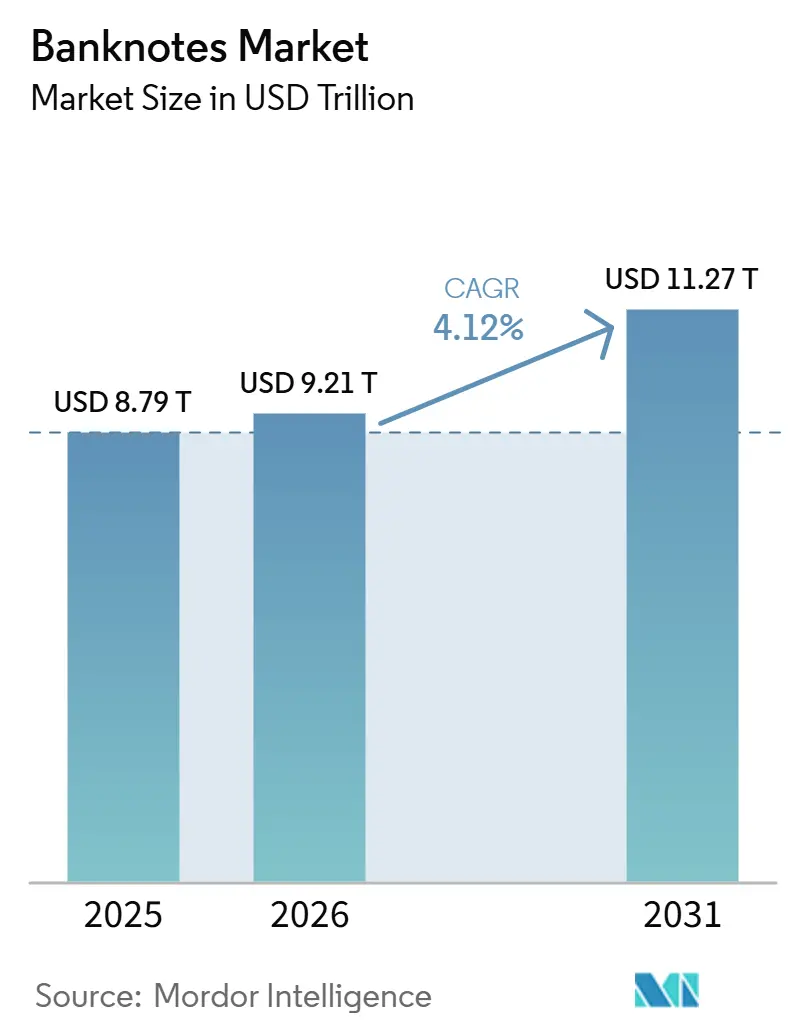
The Banknotes Market size was valued at USD 8.79 trillion in 2025 and is estimated to grow from USD 9.21 trillion in 2026 to reach USD 11.27 trillion by 2031, at a CAGR of 4.12% during the forecast period (2026-2031).
The banknotes market continues to expand, even as digital payments grow, because physical currency still serves as a fallback store of value and an offline payment tool in many economies. A large part of the banknotes market demand also comes from informal and cash-reliant activity in emerging countries, where digital access is still uneven, and the Central Banking Currency Benchmarks 2024 survey showed that the median central bank expected cash in circulation to rise by 5% in 2024, with reported values up 8.6% and volumes up 2% across surveyed jurisdictions. In the banknotes market, competition remains strongest around long-term sovereign printing contracts and proprietary substrate and security-feature supply, where a small group of established firms still shapes design and production choices. The banknotes market is also being supported by a new upgrade cycle focused on machine-readable features, as banks and cash recyclers need notes that can withstand high-speed authentication and sorting. At the same time, the banknotes market faces pressure from lower transactional print demand in advanced economies, high capital costs associated with polymer conversion, and procurement uncertainty linked to digital currency experiments and sustainability requirements.
Key Report Takeaways
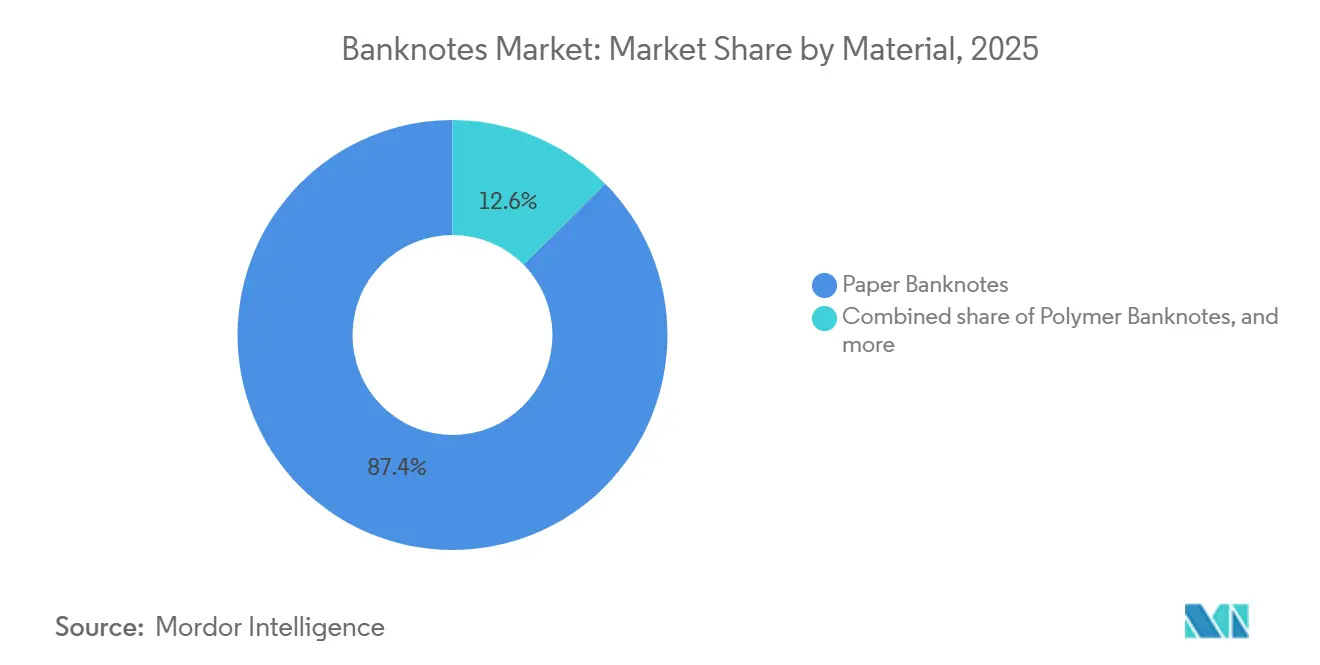
- By material, paper banknotes captured 87.4% of the banknotes market share in 2025, while polymer banknotes are projected to grow at 12.2% CAGR through 2031.
- By security feature, substrate-embedded features (watermarks, security threads, etc.) accounted for 46.7% of the banknotes market share in 2025, while optical variable devices (holograms, color-shifting inks, etc.) are projected to grow at a 7.7% CAGR through 2031.
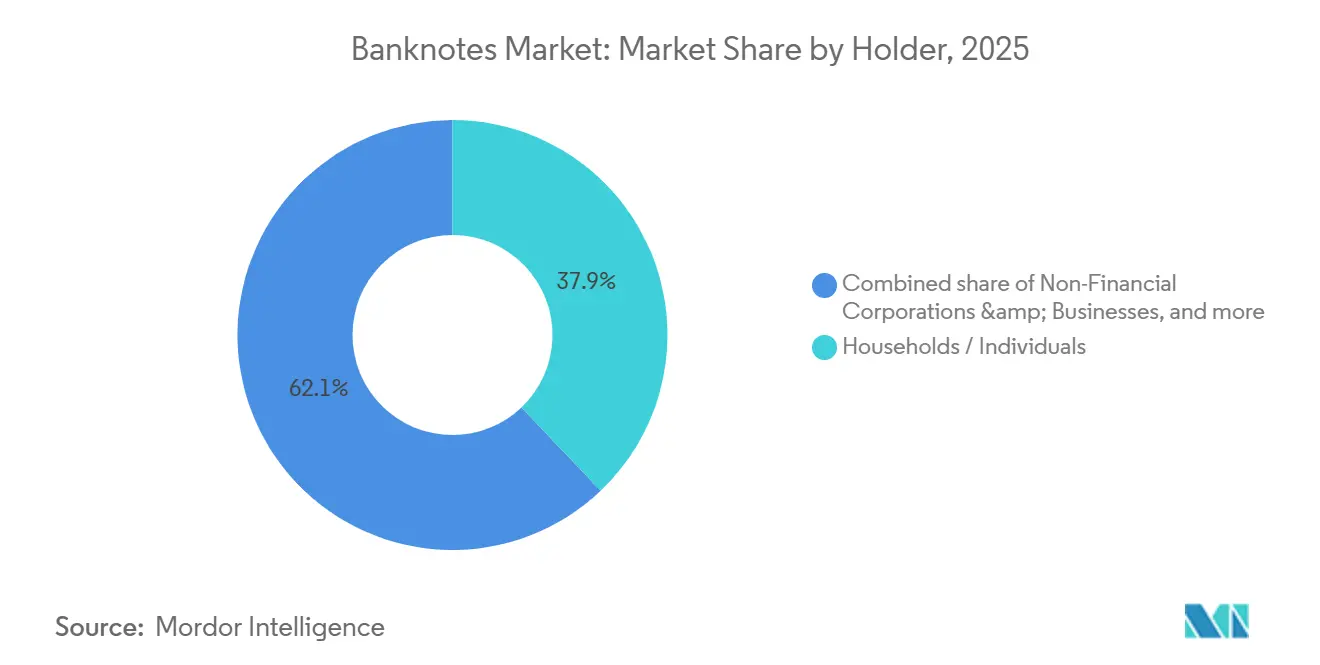
- By holder, households and individuals held 37.9% of the banknotes market share in 2025, while non-financial corporations and businesses are projected to grow at 5.7% CAGR through 2031.
- By geography, North America held 36.2% of the banknotes market share in 2025, while Asia-Pacific is projected to grow at 6% CAGR through 2031.
Note: Market size and forecast figures in this report are generated using Mordor Intelligence’s proprietary estimation framework, updated with the latest available data and insights as of January 2026.
Market Trends and Insights
Drivers Impact Analysis of Banknotes Market*
| Driver | (~) % Impact on CAGR Forecast | Geographic Relevance | Impact Timeline |
|---|---|---|---|
| Rising Need for Anti-Counterfeit Currency Upgrades | +1.0% | Global, with early intensity in South Asia and Sub-Saharan Africa | Medium term (2-4 years) |
| Expansion of Cash Circulation in Informal and Emerging Economies | +0.8% | Asia-Pacific core, spill-over to MEA and South America | Long term (≥ 4 years) |
| Shift Toward Polymer and Hybrid Substrates for Longer Note Life | +0.6% | Global, led by Asia-Pacific and MEA adopters | Medium term (2-4 years) |
| Central Bank Redesign and Note Replacement Cycles | +0.5% | Global, concentrated in Europe and North America | Short term (≤ 2 years) |
| Machine-Readable Features for Cash Automation and Sorting | +0.3% | North America and Europe | Medium term (2-4 years) |
| Low-Visibility Authentication for High-Denomination and Special Issue Notes | +0.2% | Global, focus on G20 and high-denomination series | Long term (≥ 4 years) |
| Source: Mordor Intelligence | |||
Rising Need for Anti-Counterfeit Currency Upgrades
The banknotes market is experiencing increasing demand for advanced security features in countries where cash circulation continues to expand. In India, the number of counterfeit INR 500 banknotes detected increased by 20.5% year over year to 141,907 pieces in FY2025–26, representing a notional value of INR 70.95 million (USD 0.74 million), while the total volume of banknotes in circulation grew by 10.5% over the same period[1]. The banknotes market is also being shaped by the fact that authentication no longer stops at central bank vaults, as ATMs and cash recyclers now verify notes at the teller and branch levels. That shift is shortening the effective security refresh cycle in high-volume markets, as older feature sets are under greater stress from both counterfeiting and machine handling. ECB counterfeit authentication standards and fitness protocols also continue to influence procurement specifications beyond Europe, which is pushing more central banks toward layered, machine-verifiable note security.
Expansion of Cash Circulation in Informal and Emerging Economies
The banknotes market continues to be supported by rising cash holdings in emerging economies, where physical currency serves both transactional and precautionary purposes. In India, currency in circulation reached INR 41.68 trillion (USD 496 billion) in FY2025–26, despite continued rapid growth in Unified Payments Interface (UPI) transactions, indicating that cash and digital payments increasingly complement rather than substitute for one another. During the same period, the gap between ATM withdrawals and currency in circulation widened to INR 9,127 (USD 109) per capita in FY2025–26 from INR 1,804 (USD 22) per capita in FY2023–24, reflecting higher cash holdings outside the banking system for precautionary savings and emergency liquidity[2]. Globally, the Bank for International Settlements (BIS) reported that adult digital payment adoption in emerging market and developing economies increased from 35% to 57% between 2014 and 2021, while cash demand also continued to grow over the period. As a result, the banknotes market remains supported by financial inclusion gaps, the resilience of cash-based transactions, and the continued role of physical banknotes as the most accessible and liquid financial asset for many households. In addition, academic research published in Economic Expressions Letters highlights a positive relationship between informal economic activity and sustained demand for lower-denomination banknotes, reinforcing the long-term relevance of cash in emerging markets.
Shift Toward Polymer and Hybrid Substrates for Longer Note Life
The banknotes market is moving steadily toward polymer and hybrid materials because the cost case is now more established. Central Banking’s 2024 survey found that polymer substrates represented 23.3% of printed banknotes across 30 jurisdictions, and many paper-only issuers had already identified polymer adoption as a policy objective. Costa Rica’s central bank data showed lifecycle savings of 74% per note for the CRC 1,000 polymer series against cotton equivalents, supported by a service life that was 5 times longer[3]. The banknotes market is also shifting because suppliers are addressing sustainability concerns that once slowed polymer adoption, including reduced-plastic-content hybrid substrates and bio-renewable polymer inputs. G+D said its Hybrid Green Banknotes substrate reduced the plastic content by 86% compared with standard polymer while maintaining comparable durability. IACA’s 2026 award for CCL Secure’s GUARDIAN ENVIRO further showed that recyclability and feedstock provenance are becoming part of mainstream central bank procurement evaluation.
Central Bank Redesign and Note Replacement Cycles
The banknotes market continues to depend on redesign cycles that trigger large, visible sovereign procurement waves. In January 2025, the European Central Bank (ECB) selected two design themes for the next euro banknote series, with a final design decision expected by the end of 2026 and phased circulation beginning in 2028.[4]. Similarly, the Bank of England awarded a banknote production contract covering March 2028 to February 2038, with an option to extend through 2041, demonstrating how a single sovereign issuance program can support production capacity over an extended period. Increasingly, central banks are implementing redesign programs in phased denomination releases rather than replacing all banknotes simultaneously, resulting in a more consistent procurement pipeline. Reflecting this trend, De La Rue reported an order book of GBP 338 million (USD 433 million) in November 2024, highlighting a robust pipeline of overlapping redesign and supply contracts scheduled for delivery between 2026 and 2028. While these long-term programs improve revenue visibility for established suppliers, they also increase competitive pressure on manufacturers that lack sufficient substrate production and secure printing capacity to meet sustained procurement demand.
Restraints Impact Analysis of Banknotes Market*
| Restraint | (~) % Impact on CAGR Forecast | Geographic Relevance | Impact Timeline |
|---|---|---|---|
| Rising Substitution by Digital Payments and Card Usage | -1.2% | North America, Western Europe, East Asia | Long term (≥ 4 years) |
| High Capital Intensity of Secure Printing and Substrate Conversion | -0.7% | Global, concentrated in lower-income sovereign printers | Medium term (2-4 years) |
| Longer Procurement Cycles and Sovereign Approval Dependencies | -0.4% | Global | Medium term (2-4 years) |
| Sustainability Pressure on Cotton-Based and Security-Coated Note Waste Streams | -0.2% | North America and Europe | Long term (≥ 4 years) |
| Source: Mordor Intelligence | |||
Rising Substitution by Digital Payments and Card Usage
The banknotes market is under pressure in advanced economies, where digital channels are reducing cash transactions. The Federal Reserve’s CY 2026 print order of 3.8 billion to 5.1 billion notes was 8.2% to 13.3% below the CY 2025 order range, which reflected lower replenishment needs in the United States for lower-value notes that now circulate less intensively. The banknotes market is still growing in value terms, but the volume mix is changing because the denominations most exposed to digital substitution are also the highest in terms of piece count. That creates pressure on print economics even when higher-value denominations remain in demand for reserve holding and international use. The IMF also warned that even unsuccessful CBDC pilots can unsettle existing cash systems through expectation effects, which adds another layer of uncertainty to long-cycle procurement planning.
High Capital Intensity of Secure Printing and Substrate Conversion
The banknotes market continues to face a significant structural barrier: the high capital investment required to convert legacy paper-based printing infrastructure into polymer-compatible production facilities. A full-scale sovereign transition to polymer banknotes can require investments of USD 100 million or more in specialised inking, drying, and lamination systems, while lower-volume central banks often face investment payback periods exceeding 15 years. Reflecting these ongoing infrastructure requirements, Pakistan's Security Papers Limited awarded a EUR 8.297 million (USD 9 million) contract to Giesecke+Devrient (G+D) in 2024 to modernise its paper production capabilities ahead of a new banknote series. The high capital intensity of currency production also contributes to market concentration, as only a limited number of suppliers possess the financial capacity and technical expertise to support large-scale infrastructure upgrades. Procurement governance has consequently become an increasingly important consideration. For example, Kenya's five-year single-source banknote contract with G+D, valued at KES 14.2 billion (USD 109 million), was reviewed by the Kenyan Senate in 2025, highlighting how capital-intensive projects and supplier concentration can extend procurement timelines and increase regulatory scrutiny.
*Our forecasts treat driver/restraint impacts as directional, not additive. The impact forecasts reflect baseline growth, mix effects, and variable interactions.
Banknotes Market Segment Analysis
By Material:
Paper Dominates While Polymer Reshapes EconomicsPaper accounted for 87.4% of the banknotes market in 2025, reflecting the extensive installed base of cotton-fibre banknote printing infrastructure across central banks and sovereign printing facilities worldwide. The continued dominance of paper substrates is supported by decades of capital investment in printing equipment, established procurement systems, and specialised workforce capabilities, making large-scale infrastructure replacement both costly and time-consuming. However, the paper's market leadership is increasingly underpinned by legacy infrastructure rather than long-term economic advantages. As more central banks complete polymer banknote pilot programmes and validate their longer lifecycle and lower replacement costs, paper's share is expected to gradually decline over the forecast period, although it is likely to remain the dominant substrate in the near term.
Polymer is projected to register a 12.2% CAGR between 2026 and 2031, making it the fastest-growing material segment in the banknotes market. Growth is being driven by the second wave of polymer adoption across Southeast Asia, Africa, and Latin America, where declining procurement risks and improving production economics are encouraging broader implementation. In December 2024, the Bangko Sentral ng Pilipinas completed the rollout of its first full polymer banknote series across all major denominations using CCL Secure's GUARDIAN® substrate, marking a significant milestone in polymer adoption. Similarly, Fiji introduced its first fully polymer banknote series in December 2025, demonstrating that smaller issuing authorities are increasingly moving from pilot programmes to nationwide implementation. Hybrid banknote formats also remain strategically important, enabling central banks to enhance durability, security, and sustainability while transitioning gradually from paper to polymer substrates without requiring an immediate, full-scale infrastructure conversion.
By Security Feature:
Substrate-Embedded Entrenched, OVDs Gain MomentumSubstrate-embedded security features accounted for 46.7% of the banknotes market in 2025, making them the largest security feature segment. Watermarks, embedded security threads, and security fibres continue to dominate because they form part of the banknote substrate itself and are integrated into long-term sovereign procurement programmes. These contracts typically extend 5–10 years for each banknote denomination, limiting the pace at which central banks can transition to alternative security technologies, even when newer solutions provide enhanced public authentication. As a result, substrate-embedded features remain firmly established across the banknotes market, supported by proven durability, high counterfeit resistance, procurement continuity, and compatibility with existing banknote printing infrastructure.
Optical variable devices (OVDs) are projected to grow at a CAGR of 7.7% between 2026 and 2031, reflecting increasing investment in advanced visual security technologies. Central banks are prioritising Level 1 public authentication features for higher-denomination banknotes, as these enable instant visual verification without requiring specialised equipment. In 2025, Giesecke+Devrient (G+D) introduced its RollingStar® Venus security thread featuring nanostructure-based colour effects and secured multiple long-term supply contracts for the technology. Similarly, in December 2025, Authentix launched PICO Secure, the first production-qualified nano-optic plasmonic optical variable device developed specifically for currency applications. While machine-readable and tactile printed security features remain integral to banknote authentication, investment within the banknotes market is increasingly shifting toward highly visible, difficult-to-replicate optical security technologies that can be seamlessly incorporated into both paper and polymer banknotes.
By Holder:
Households Anchor Demand While Corporates Lift GrowthHouseholds and individuals accounted for 37.9% of the banknotes market in 2025, making them the largest end-user segment. This dominance is driven not only by day-to-day cash transactions but also by precautionary cash holdings, as consumers continue to view physical currency as a reliable store of value and a resilient payment instrument during periods of economic uncertainty, natural disasters, cyber incidents, and payment system disruptions. The European Central Bank (ECB) has highlighted that the tangibility, offline functionality, and universal acceptance of cash become increasingly important during periods of disruption. In addition, several European and national authorities continue to recommend maintaining emergency cash reserves as part of household contingency planning, reinforcing the strategic role of banknotes even in markets with high digital payment adoption.
Non-financial corporations and businesses are projected to grow at a CAGR of 5.7% between 2026 and 2031, making them the fastest-growing holder segment in the banknotes market. Growth is being driven by expanding cash-intensive activities across the retail, hospitality, transportation, and agricultural sectors in emerging economies, where cash usage continues to outpace the availability of digital payment infrastructure. Increasing business demand extends beyond higher banknote volumes to include greater use of mid-denomination notes incorporating advanced security features for efficient cash handling and counterfeit protection. The Central Bank of Brazil also noted in 2025 that cash is increasingly being held as a store of value in addition to its traditional role as a medium of exchange. Financial institutions and public sector organisations continue to play an important role in the banknotes market, particularly through currency distribution, reserve holdings, and cross-border demand for internationally recognised reserve currencies, supporting banknote circulation well beyond their issuing jurisdictions.
Geography Analysis
North America Banknotes Market
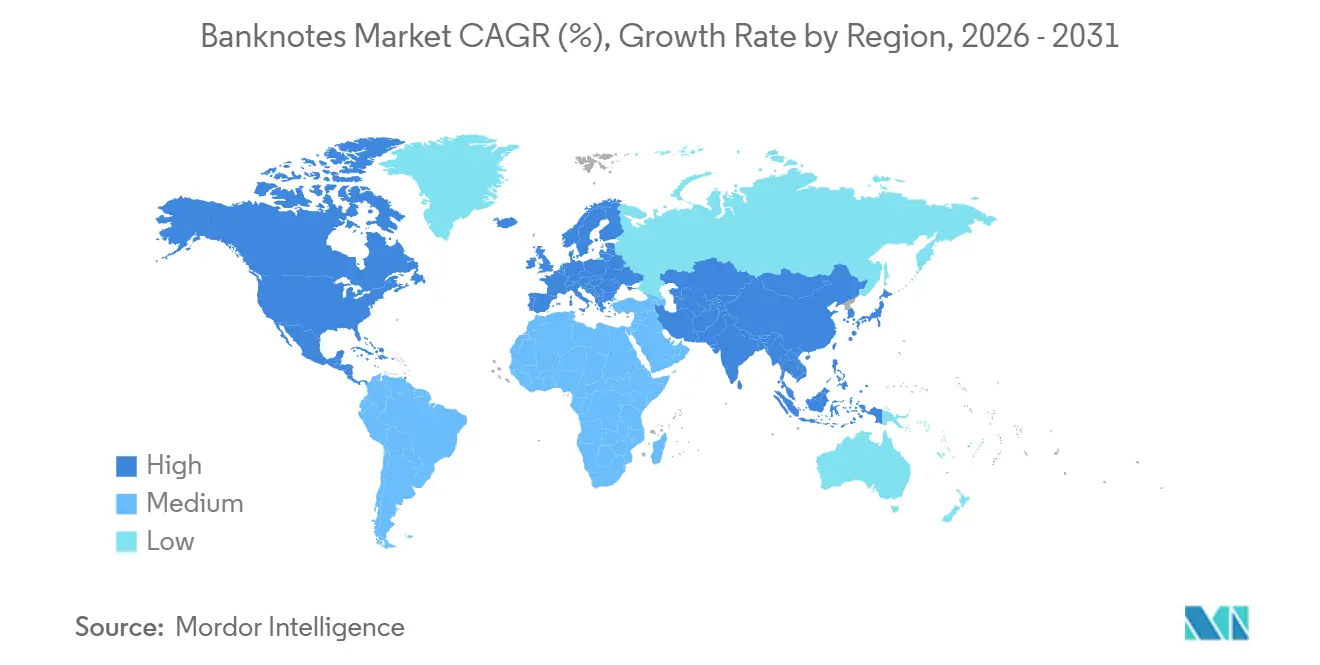
North America accounted for 36.2% of the banknotes market in 2025, making it the largest regional market. The region's leadership is primarily supported by the United States dollar's global reserve currency status rather than by domestic transactional cash demand alone. For CY2026, the United States Federal Reserve's print order ranged between 3.8 billion and 5.1 billion banknotes, representing a total face range of USD 108.9 billion to USD 139.6 billion, and the USD 100 denomination alone accounted for USD 75.8 billion to USD 87.7 billion of the total order value, highlighting the continued role of United States currency as a global store of value, reserve asset, and medium for international trade and cross-border transactions. Canada continues to provide stable demand through its long-term sovereign currency procurement model, while Mexico remains a significant regional issuer with an established polymer banknote programme and ongoing investments in advanced security features.
APAC Banknotes Market
Asia-Pacific is projected to register the fastest growth, with a CAGR of 6.0% between 2026 and 2031, driven by expanding currency circulation, financial inclusion, and accelerating polymer banknote adoption across emerging economies. In India, currency in circulation increased to INR 41.68 trillion (USD 496 billion) in FY2025–26 despite record levels of digital payment activity, demonstrating the complementary roles of cash and digital payments. Regional polymer adoption is also accelerating. In March 2026, CCL Secure signed a supply agreement with the State Bank of Vietnam to provide GUARDIAN® polymer substrate for the VND 200,000 denomination, while polymer banknotes continue to gain traction across the Philippines, Indonesia, and Thailand. In parallel, the China Banknote Printing and Minting Corporation is advancing domestic innovation through the development of paper-plastic composite substrates incorporating translucent windows and flexible OLED security elements, strengthening the region's indigenous banknote technology capabilities.
EMEA and South America Banknotes Market
Europe remains one of the most strategically important regions in the banknotes market, supported by large-scale sovereign redesign programmes that will drive procurement activity throughout the forecast period. The European Central Bank's next euro banknote redesign programme is expected to generate one of the largest global currency procurement pipelines, while the Bank of England's long-term banknote production contract provides stable manufacturing demand and capacity utilisation through the late 2030s. In the Middle East and Africa, central banks continue to modernise currency production capabilities and security technologies. For example, in April 2026, the Central Bank of Uzbekistan signed separate cooperation agreements with De La Rue and Oberthur Fiduciaire covering secure products and banknote production. Meanwhile, South America is progressing through a broader transition toward modern banknote series, with Bolivia introducing its Series B banknotes in 2025 and Paraguay's 2025–2029 institutional strategy supporting the development of a new family of banknotes. Collectively, these regional developments indicate that growth in the banknotes market is being shaped by a combination of global reserve currency demand, sovereign banknote redesign programmes, substrate modernisation, and the adoption of advanced security technologies rather than by a single global market trend.
Competitive Landscape
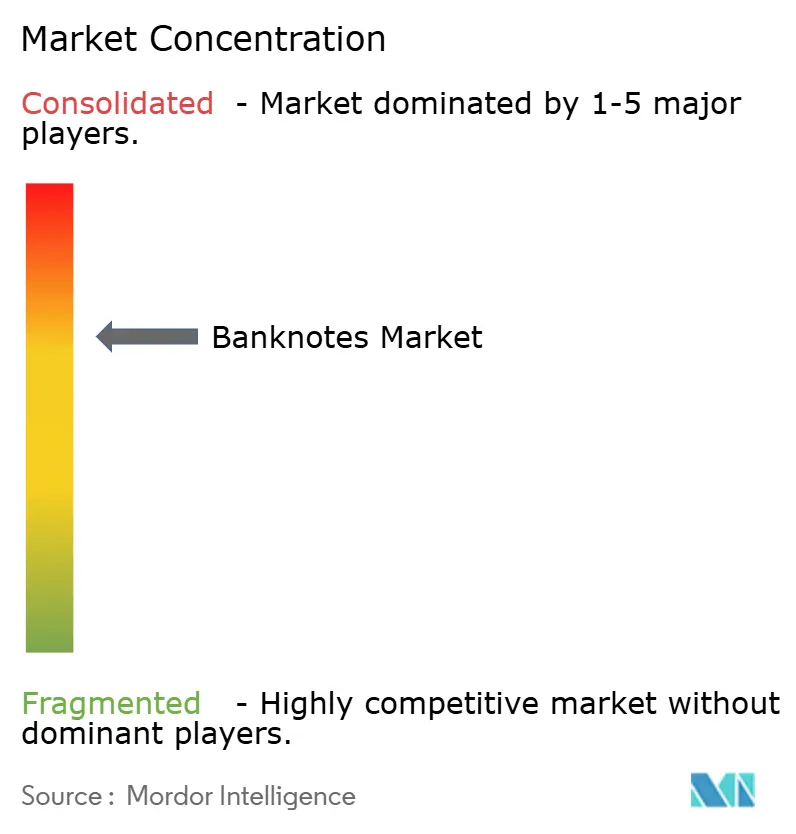
The banknotes market is concentrated, with a relatively small group of established security printing companies, including De La Rue, Giesecke+Devrient, Oberthur Fiduciaire, Crane Currency, and several state-owned security printers, which together account for a substantial share of global sovereign banknote production. The market has high entry barriers, as central bank procurement contracts typically extend 5–10 years and require compliance with stringent substrate specifications, security feature standards, and production quality requirements. These long-term contracts provide incumbents with stable revenue visibility while making supplier transitions complex and costly for issuing authorities. Industry consolidation has further strengthened the competitive position of leading suppliers. In April 2025, Atlas Holdings completed the USD 330 million acquisition of De La Rue, followed by Crane Currency's USD 300 million acquisition of De La Rue's Authentication Division in May 2025. These transactions reinforced capabilities across secure printing, authentication technologies, and currency security solutions, further consolidating expertise within the industry.
Competition is becoming increasingly technology-driven at the substrate and security-feature levels, where proprietary innovations influence procurement decisions well before production contracts are awarded. De La Rue entered 2025 with an order book of GBP 338 million (USD 433 million), reflecting sustained demand from sovereign currency programmes. Meanwhile, Giesecke+Devrient's Currency Technology business generated EUR 1,222.5 million (USD 1,320 million) in revenue during 2025, while total group order intake reached EUR 3,596 million (USD 3,884 million) and backlog increased to EUR 2,550 million (USD 2,754 million), demonstrating strong long-term business visibility. The company also expanded its intellectual property portfolio through a 2026 patent application covering dual-layer luminescent banknote security features with differentiated ultraviolet authentication, reinforcing its focus on advanced security technologies. Consequently, competitive differentiation in the banknotes market increasingly depends not only on secure printing capacity but also on ownership of proprietary substrates, optical security features, authentication technologies, and machine-readable design standards.
Despite the strong position of leading suppliers, innovation continues to create opportunities for specialised participants. Sustainable banknote substrates are gaining importance as central banks increasingly incorporate environmental performance into procurement criteria. Products such as CCL Secure's GUARDIAN ENVIRO and Giesecke+Devrient Louisenthal's Green LongLife illustrate the growing emphasis on environmentally sustainable currency solutions. Nano-optic security technologies are also emerging as an important area of competition, with Authentix PICO Secure and Giesecke+Devrient's Venus security thread advancing next-generation visible authentication features. At the same time, innovations such as Bundesdruckerei's STELLA concept and Covestro's Autentium monomer-polymer substrate highlight the industry's increasing focus on recyclability, durability, and production efficiency. Specialist companies such as Spectra Systems and Landqart continue to expand their presence by providing differentiated security technologies and alternative supply options. As a result, although the banknotes market remains moderately concentrated, technological innovation, specialised capabilities, and evolving central bank procurement priorities continue to create opportunities for niche suppliers while established players retain advantages in scale, long-term customer relationships, and integrated security printing capabilities.
Banknotes Industry Leaders
-
De La Rue plc
-
Giesecke+Devrient GmbH
-
Crane Currency
-
Bundesdruckerei GmbH
-
Canadian Bank Note Company, Limited
- *Disclaimer: Major Players sorted in no particular order
Banknotes Market Companies Covered in this Report
- De La Rue plc
- Giesecke+Devrient GmbH
- Crane Currency
- Bundesdruckerei GmbH
- Canadian Bank Note Company, Limited
- China Banknote Printing and Minting Corporation
- Oberthur Fiduciaire SAS
- Security Printing and Minting Corporation of India Limited
- CCL Secure
- SICPA Holding SA
- Authentix, Inc.
- Royal Joh. Enschedé
- The Royal Mint Limited
- Note Printing Australia Limited
- Poland Security Printing Works
- Landqart AG
- Orell Füssli AG
- Koenig and Bauer AG
- Komori Corporation
- Bobst Group SA
Recent Industry Developments in Banknotes Market
- May 2026: CCL Secure received the IACA 2026 Excellence in Currency Award for Best New Banknote Feature, Product or Process for GUARDIAN ENVIRO, its bio-renewable polymer substrate incorporating tall oil and used cooking oil inputs, signaling eco-substrate as an emerging competitive differentiator in central bank procurement evaluation.
- April 2026: The European Central Bank had decided to stop producing and issuing the EUR 500 (USD 568.8) banknotes as part of the new Europa series, while the note remained legal tender and kept its value. The move was made over concerns that the high-denomination bill could facilitate illegal activities, and issuance was planned to end around late 2018, when new EUR 100 (USD 113.8) and EUR 200 (USD 227.5) notes were introduced.
- April 2026: The Central Bank of Uzbekistan signed separate memoranda of understanding with De La Rue and Oberthur Fiduciaire at the Global Currency Forum in Antalya, formalizing cooperation on secure banknotes production and the adoption of modern printing technologies, signaling active Central Asian sovereign procurement for both companies in the near term.
- March 2026: CCL Secure announced a supply agreement with the State Bank of Vietnam for GUARDIAN polymer substrate covering the VND 200,000 (USD 7.6) denomination, extending the company's Southeast Asian polymer supply network and reinforcing GUARDIAN's position as the region's dominant polymer banknotes substrate.
Global Banknotes Market Report Scope
Segmentation Overview
| Paper Banknotes |
| Polymer Banknotes |
| Hybrid Banknotes |
| Substrate-Embedded Features (watermarks, security threads, etc.) |
| Optical Variable Devices (holograms, color-shifting inks, etc.) |
| Tactile & Printed Security Features (microprinting, intaglio, etc.) |
| Machine-Readable Features (UV, IR, magnetic, etc.) |
| Households / Individuals |
| Non-Financial Corporations & Businesses |
| Financial Institutions |
| Government & Public Sector |
| North America | United States |
| Canada | |
| Mexico | |
| South America | Brazil |
| Argentina | |
| Rest of South America | |
| Europe | United Kingdom |
| Germany | |
| France | |
| Italy | |
| Spain | |
| Rest of Europe | |
| Asia-Pacific | China |
| Japan | |
| India | |
| South Korea | |
| Australia | |
| Indonesia | |
| Thailand | |
| Malaysia | |
| Singapore | |
| Vietnam | |
| Rest of Asia-Pacific | |
| Middle East and Africa | Saudi Arabia |
| United Arab Emirates | |
| Turkey | |
| South Africa | |
| Egypt | |
| Rest of Middle East and Africa |
| By Material | Paper Banknotes | |
| Polymer Banknotes | ||
| Hybrid Banknotes | ||
| By Security Feature | Substrate-Embedded Features (watermarks, security threads, etc.) | |
| Optical Variable Devices (holograms, color-shifting inks, etc.) | ||
| Tactile & Printed Security Features (microprinting, intaglio, etc.) | ||
| Machine-Readable Features (UV, IR, magnetic, etc.) | ||
| By Holder | Households / Individuals | |
| Non-Financial Corporations & Businesses | ||
| Financial Institutions | ||
| Government & Public Sector | ||
| By Geography | North America | United States |
| Canada | ||
| Mexico | ||
| South America | Brazil | |
| Argentina | ||
| Rest of South America | ||
| Europe | United Kingdom | |
| Germany | ||
| France | ||
| Italy | ||
| Spain | ||
| Rest of Europe | ||
| Asia-Pacific | China | |
| Japan | ||
| India | ||
| South Korea | ||
| Australia | ||
| Indonesia | ||
| Thailand | ||
| Malaysia | ||
| Singapore | ||
| Vietnam | ||
| Rest of Asia-Pacific | ||
| Middle East and Africa | Saudi Arabia | |
| United Arab Emirates | ||
| Turkey | ||
| South Africa | ||
| Egypt | ||
| Rest of Middle East and Africa | ||
Key Questions Answered in the Report
What is the current and forecast value of the global banknotes space?
The banknotes market size is expected to move from USD 8.79 trillion in 2025 to USD 9.21 trillion in 2026 and reach USD 11.27 trillion by 2031, at a 4.1% CAGR over 2026-2031.
Why is physical currency still growing despite digital payment adoption?
Cash still serves as an offline backup, a store of value, and a practical tool in informal and underbanked economies, which is why circulation can rise even when digital payment use also expands.
Which material segment leads and which one is growing fastest?
Paper led with 87.4% share in 2025, while polymer is projected to grow fastest at 12.2% CAGR through 2031, supported by better durability and stronger lifecycle economics.
Which security feature category is gaining the most traction?
Substrate-embedded features remained the largest at 46.7% share in 2025, but optical variable devices are growing fastest at 7.7% CAGR as issuers seek stronger public authentication and anti-counterfeit performance.
Which region offers the strongest growth outlook through 2031?
Asia-Pacific is projected to record the fastest growth at 6% CAGR, supported by circulation growth, polymer adoption, and new note technology development across South and Southeast Asia.
What are the main risks suppliers face in this space?
The biggest risks are digital substitution in mature economies, the high cost of substrate conversion, and slower sovereign approval cycles that can delay awards and raise capital exposure.