
Bangladesh Cybersecurity Market Size and Share
Market Overview
| Study Period | 2021 - 2031 |
|---|---|
| Forecast Data Period | 2026 - 2031 |
| Base Year Market Size (2025) | USD 218.15 Million |
| Market Size (2026) | USD 250.76 Million |
| Market Size (2031) | USD 503.28 Million |
| Growth Rate (2026 - 2031) | 14.95 % |
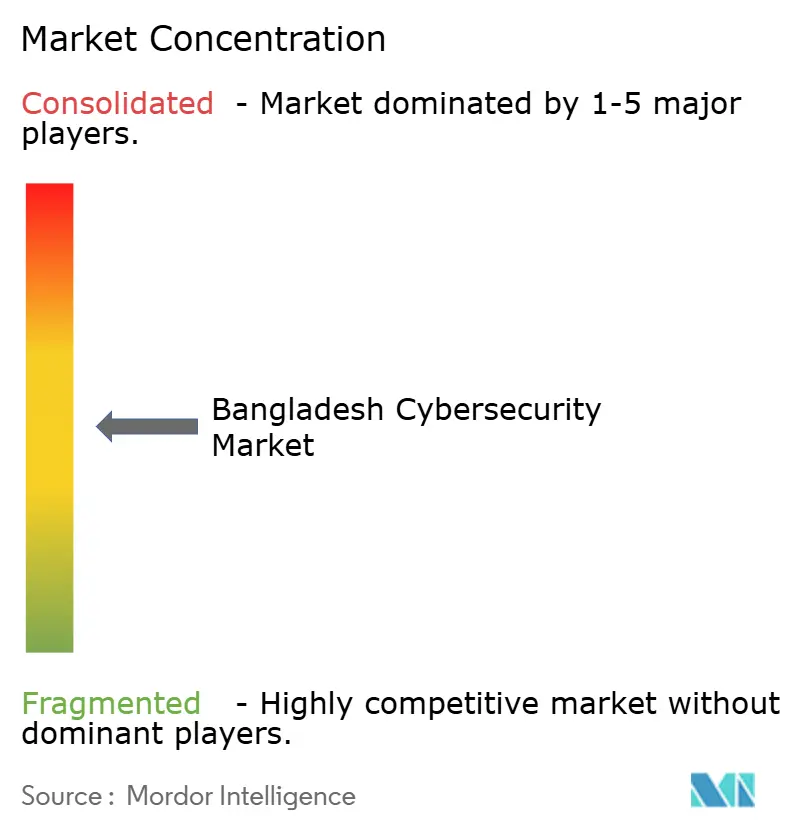
| Market Concentration | Medium |
Major Players *Disclaimer: Major Players sorted in no particular order Image © Mordor Intelligence. Reuse requires attribution under CC BY 4.0. | |
Bangladesh Cybersecurity Market Analysis by Mordor Intelligence
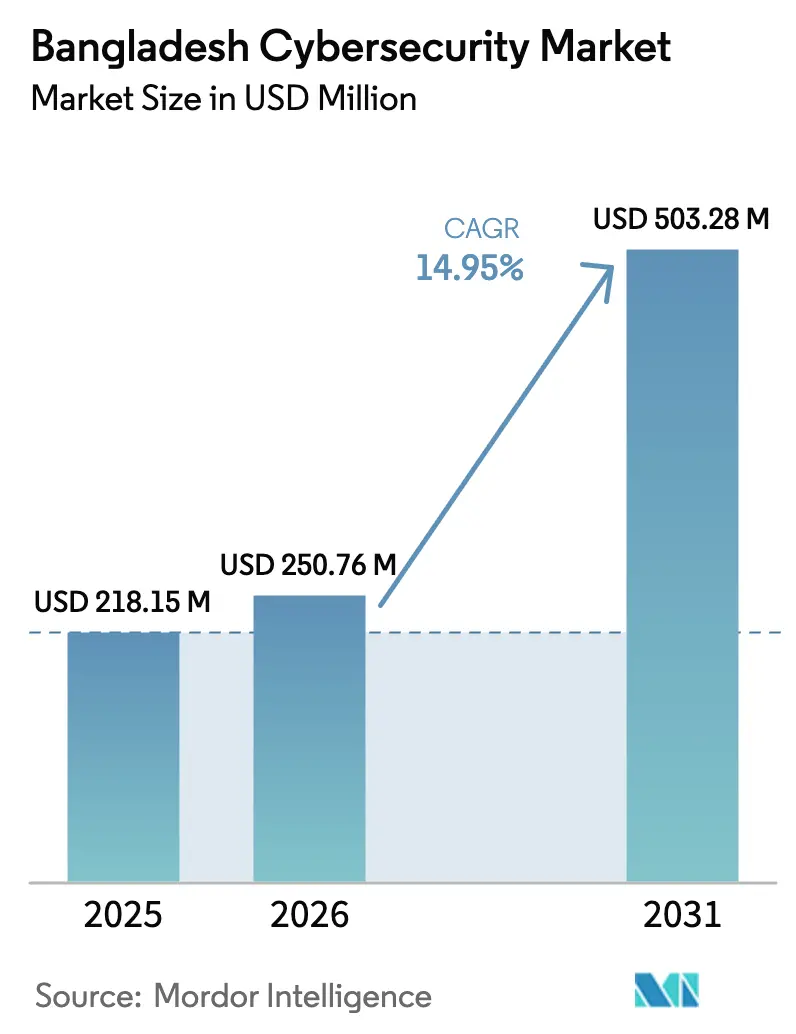
The Bangladesh Cybersecurity market size is expected to grow from USD 218.15 million in 2025 to USD 250.76 million in 2026 and is forecast to reach USD 503.28 million by 2031 at 14.95% CAGR over 2026-2031. This expansion builds on Smart Bangladesh policies that have put digital resilience at the center of economic planning. Growth is stimulated by cloud-first IT strategies, new mandates under the Cyber Security Act 2023, and the need to protect high-capacity submarine cables that will double national bandwidth. Demand concentrates in services because most organizations prefer managed detection and response over building in-house teams. Heightened attack frequency against banks and fast-growing mobile-payment rails is pushing even conservative firms toward advanced threat analytics and 24/7 security operations.
Key Report Takeaways
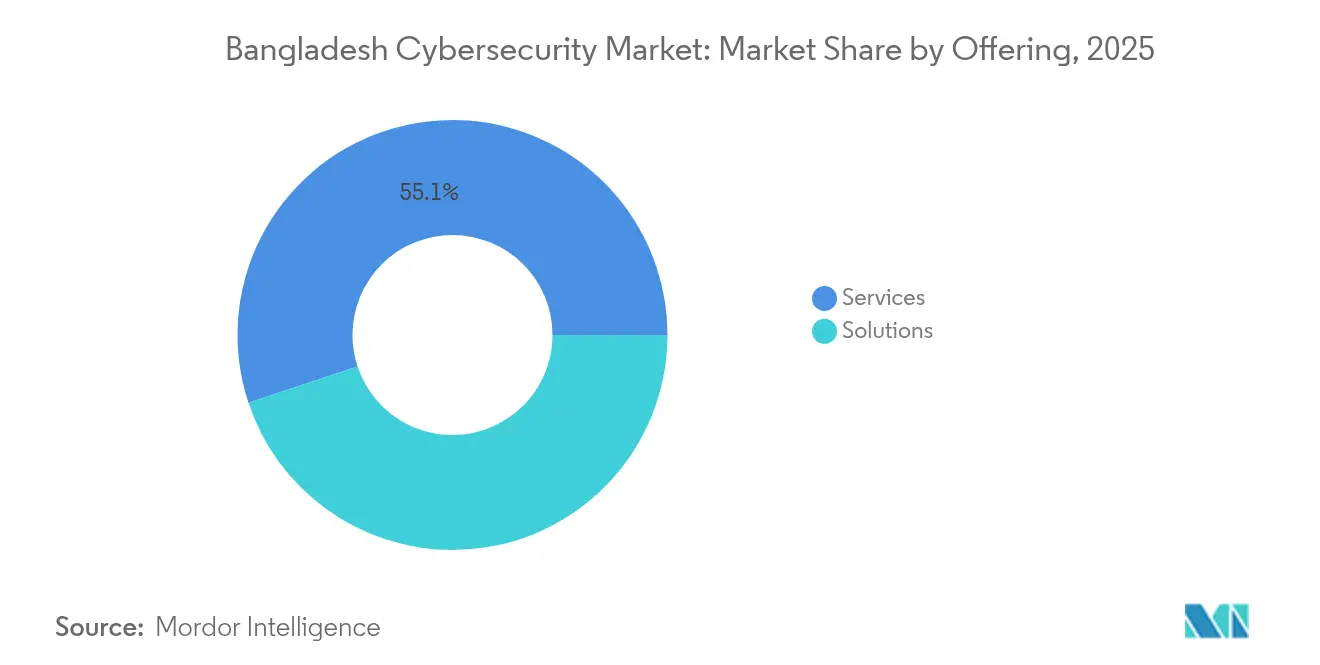
- By offering, services held 55.10% of Bangladesh cybersecurity market share in 2025, while solutions are projected to expand at an 18.2% CAGR to 2031.
- By deployment mode, cloud captured 63.40% of the Bangladesh cybersecurity market size in 2025 and is forecast to grow at 23.4% CAGR through 2031.
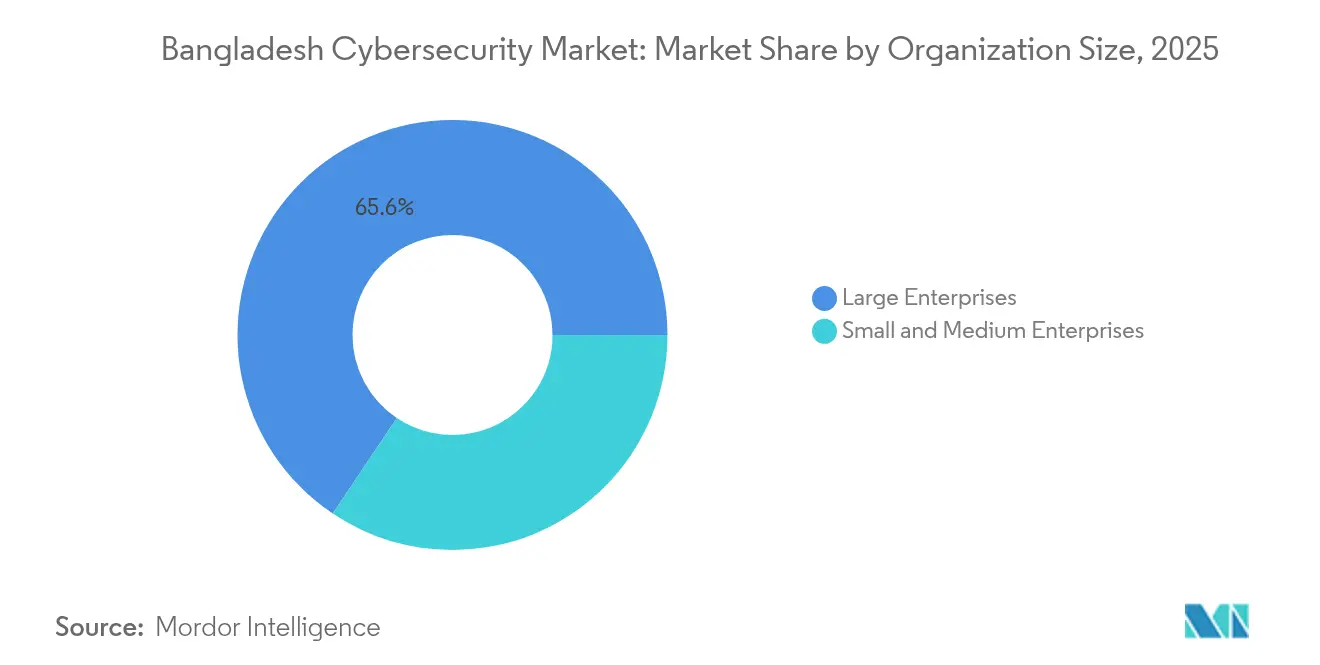
- By organization size, large enterprises commanded 65.60% share of the Bangladesh cybersecurity market in 2025, but SMEs are advancing at a 18.85% CAGR to 2031.
- By end user, BFSI led with 29.40% revenue share in 2025; healthcare is the fastest-growing vertical at a 20.95% CAGR to 2031.
Note: Market size and forecast figures in this report are generated using Mordor Intelligence’s proprietary estimation framework, updated with the latest available data and insights as of 2026.
Bangladesh Cybersecurity Market Trends and Insights
Drivers Impact Analysis*
| Driver | (~) % Impact on CAGR Forecast | Geographic Relevance | Impact Timeline |
|---|---|---|---|
| Digital-Bangladesh programmes & CSA-2023 enforcement | +2.8% | National; early gains in Dhaka, Chittagong, Sylhet | Medium term (2-4 years) |
| Surging cyber-attacks on BFSI & mobile-payment rails | +3.2% | National; concentrated in financial hubs | Short term (≤ 2 years) |
| Enterprise cloud-migration wave | +2.5% | National; led by urban centers | Medium term (2-4 years) |
| SEA-ME-WE-6 cable doubling bandwidth | +1.8% | National; spillover to regional connectivity | Long term (≥ 4 years) |
| EU apparel-supply-chain security mandates | +1.4% | Export-oriented regions, mainly Dhaka and Chittagong | Medium term (2-4 years) |
| Rise of export-oriented Bangla cyber-talent & MSSP hubs | +2.1% | National; concentration in tech parks | Long term (≥ 4 years) |
| Source: Mordor Intelligence | |||
Digital-Bangladesh programmes & CSA 2023 enforcement
Government enforcement of the Cyber Security Act 2023 has turned compliance into a decisive budget line. The law obliges critical-infrastructure operators to deploy specific controls and to localize sensitive data, prompting a rush toward domestic security operations centers. At the same time, the Smart Bangladesh framework funds cyber sensor units that perform proactive threat hunting, spurring demand for analytics platforms capable of ingesting local telemetry. Vendors that can pair technical controls with regulatory guidance are winning contracts as organizations grapple with still-ambiguous definitions of lawful authority.[1]
Surging cyber-attacks on BFSI & mobile-payment rails
Banks and mobile-financial-service (MFS) providers face a wave of credential-stuffing, BIN, and real-time fraud attacks that outstrip legacy perimeter defenses. The 2025 City Bank breach, where client statements surfaced on underground forums, underlined the weakness of session management and multifactor authentication at scale.[2] Domestic regulators now insist on continuous transaction monitoring and behavioral analytics, solidifying BFSI as the single largest spending vertical.
Enterprise cloud-migration wave
Rapid cloud adoption has moved beyond cost optimization to business enablement, yet many firms have rolled out workloads faster than they have implemented guardrails. The National Data Centre’s track record of zero downtime proves that secure hyperscale operations are possible, but most enterprises still rely on poorly governed multi-cloud estates. Oracle’s forthcoming G-Cloud stack will test whether Bangladesh can export secure data-hosting services that meet overseas compliance expectations.
SEA-ME-WE 6 cable doubling data-centre bandwidth
The new submarine cable will add 6 Tbps of capacity and could position Bangladesh as a regional transit hub. Learning from the 2024 SEA-ME-WE 5 outage which temporarily cut one-third of national capacity telecom carriers now treat cybersecurity as integral to cable resiliency. Protection requirements include route-level anomaly monitoring and incident-ready playbooks that satisfy international co-location clients.[3]
Restraints Impact Analysis*
| Restraint | (~) % Impact on CAGR Forecast | Geographic Relevance | Impact Timeline |
|---|---|---|---|
| Acute cyber-skills gap & salary inflation | -2.4% | National; most severe in Dhaka and Chittagong | Short term (≤ 2 years) |
| Capex constraints at MSMEs | -1.8% | National; strongest in rural and semi-urban areas | Medium term (2-4 years) |
| Legal grey zones in Cyber Security Act 2023 | -1.2% | National; uneven enforcement across regions | Medium term (2-4 years) |
| Absence of local cyber-insurance ecosystem | -0.9% | National; affects all sectors uniformly | Long term (≥ 4 years) |
| Source: Mordor Intelligence | |||
Acute cyber-skills gap & salary inflation
Demand for certified security analysts far exceeds supply, forcing enterprises into bidding wars that smaller firms cannot match. The BASIS–SICIP program aims to certify 3,000 professionals over four years, yet near-term shortages continue to push organizations toward managed security services rather than in-house SOCs.
Capex constraints at MSMEs
Micro and small businesses, which account for 25% of GDP, often lack both awareness and liquidity to acquire enterprise-grade controls. Without affordable, cloud-delivered protection, this cohort remains an expanding but underserved attack surface that could dampen broader digital-economy confidence.[4]
*Our forecasts treat driver/restraint impacts as directional, not additive. The impact forecasts reflect baseline growth, mix effects, and variable interactions.
Segment Analysis
By Offering: Services Anchor Security Transformation
The services segment led the Bangladesh cybersecurity market with 55.10% revenue in 2025 as organizations prioritized rapid access to expertise over tool ownership. Professional services thrive on regulatory-compliance consulting linked to the Cyber Security Act 2023, while managed detection and response gains momentum as firms outsource SOC operations. Solutions, although smaller, are forecast to grow at an 18.2% CAGR, signaling an evolution from point products to integrated platforms that secure cloud, mobile, and IoT endpoints.
Network security equipment still posts steady sales thanks to new data-center builds, but identity and access management platforms are the breakout category as BFSI and regulated industries shift toward zero-trust architectures. Artificial-intelligence-enhanced analytics is a differentiator, allowing vendors to offset talent shortages through automated alert triage. Each of these dynamics supports the long-term climb in the Bangladesh cybersecurity market size for solutions providers through 2031.

By Deployment Mode: Cloud Security Accelerates
Cloud deployments accounted for 63.40% of Bangladesh cybersecurity market share in 2025 and are on track for a 23.4% CAGR through 2031 as enterprises lift-and-shift core workloads. Even institutions bound by data-sovereignty clauses now favor hybrid strategies, keeping personally identifiable information on-premise while running analytic workloads in the cloud.
Success of the model hinges on proper configuration, spurring demand for posture-management tools and cloud access security brokers that can enforce consistent policy across multi-cloud estates. The forthcoming Oracle G-Cloud at the National Data Centre could become a showcase for Bangladesh-based secure cloud services, reinforcing international trust and further expanding the Bangladesh cybersecurity market size attached to cloud controls.
By Organization Size: SME Adoption Surges
Large enterprises contributed 65.60% of 2025 revenue due to early adoption and compliance obligations, yet SMEs represent the fastest-growing slice of the Bangladesh cybersecurity market at a 18.85% CAGR. This rise reflects cybercriminal focus on mid-sized targets and government incentives that push smaller firms online.
SMEs favor subscription-based security-as-a-service models that bundle threat protection, monitoring, and compliance into a single dashboard. Providers that can simplify onboarding and deliver localized support stand to unlock significant incremental Bangladesh cybersecurity market size as digitization spreads beyond metropolitan centers.
By End User: Healthcare Takes the Growth Lead
BFSI kept its dominant 29.40% stake in 2025, but healthcare is on course for the highest CAGR, 20.95% to 2031, as hospitals digitize records and telemedicine platforms proliferate. Banking investments focus on real-time fraud analytics and post-incident forensics after high-profile breaches, while healthcare buyers rush to modernize legacy infrastructure vulnerable to ransomware.
IT & telecom remains a steady spender because submarine-cable, 5G, and data-center projects must comply with new critical-infrastructure standards. Industrial and defense entities increasingly secure operational-technology networks, and the retail sector is scaling e-commerce fraud defenses. Collectively, these verticals sustain a diversified demand profile across the Bangladesh cybersecurity market.
Geography Analysis
Domestic demand is led by Dhaka and Chittagong, where banks, telcos, and government agencies concentrate. These hubs attract the bulk of SOC build-outs and create spillover opportunities for regional service providers in Sylhet and Khulna. Outside major cities, adoption trails because internet infrastructure and cyber talent remain uneven, yet national Smart Bangladesh grants are beginning to bridge the gap.
Cross-border collaboration is rising: a 2024 Bangladesh–India agreement established joint cyber drills and intelligence exchange, positioning local firms to service South Asian neighbors. With SEA-ME-WE 6, Bangladesh could export managed security services to Southeast Asia, provided it proves compliance with international frameworks such as ISO 27001 and GDPR.
The National Data Centre, now one of the world’s largest, offers geographic leverage. If bundled with robust incident-response SLAs, it can anchor regional hosting deals, reinforcing the competitive value of the Bangladesh cybersecurity market for both local and multinational vendors.
Competitive Landscape
The market shows moderate concentration: global leaders such as IBM, Microsoft, and Palo Alto Networks battle domestic specialists like Trustaira and Enterprise Infosec Consultants. International providers win on product breadth and proven compliance features, especially in BFSI. Local firms counter with regulatory know-how, Bengali-language threat intelligence, and flexible service pricing.
Hybrid go-to-market models are emerging. Global vendors form alliances with Bangladeshi MSSPs to navigate Cyber Security Act requirements and deliver on-site support. Meanwhile, disruptors offer cloud-native XDR platforms tailored for SMEs, addressing skill shortages through automation and low-code orchestration.
The BASIS America Desk, launched in 2024, encourages US–Bangladesh cybersecurity partnerships, potentially unlocking equity investment and joint R&D. Vendors that can integrate global technology stacks with domestic compliance services are best positioned to capture incremental Bangladesh cybersecurity market share over the forecast period.
Bangladesh Cybersecurity Industry Leaders
-
IBM Corporation
-
Palo Alto Networks, Inc.
-
Microsoft Corporation
-
Fortinet Inc.
-
Cisco Systems Inc.
- *Disclaimer: Major Players sorted in no particular order
Recent Industry Developments
- June 2025: Bangladesh introduced a data-classification framework under the Personal Data Protection Act, compelling firms to localize sensitive personal data.
- March 2025: Bangladesh Cyber Security Intelligence revealed insider data theft by officials who accessed the National Intelligent Platform, accelerating demand for insider-threat monitoring.
- January 2025: City Bank PLC reported a breach that exposed client financial statements, underscoring deficiencies in session management and MFA.
- November 2024: BASIS and SICIP began a four-year program to train 3,000 cybersecurity professionals.
Bangladesh Cybersecurity Market Report Scope
The Bangladeshi cybersecurity market's scope encompasses the revenues derived from solutions and services utilized across end-user industries. The analysis draws from a blend of secondary research and primary sources, providing a comprehensive view of the market. The market also delves into the key drivers and restraints shaping its growth trajectory.
The Bangladesh cybersecurity market is segmented by offerings (solutions [application security, cloud security, data security, identity access management, infrastructure protection, integrated risk management, network security, end-point security, and other solution types] and services [professional services and managed services]), by deployment (On-premise, and cloud), by organization size (SMEs, large enterprises), by end-user vertical (BFSI, healthcare, IT and telecom, industrial and defense, retail, energy and utilities, manufacturing, and other end-user industries). The market sizes and forecasts are provided in terms of value in (USD) for all the above segments.
| Solutions | Application Security |
| Cloud Security | |
| Data Security | |
| Identity and Access Management | |
| Infrastructure Protection | |
| Integrated Risk Management | |
| Network Security Equipment | |
| Endpoint Security | |
| Other Solutions | |
| Services | Professional Services |
| Managed Services |
| Cloud |
| On-premise |
| Small and Medium Enterprises |
| Large Enterprises |
| BFSI |
| Healthcare |
| IT and Telecom |
| Industrial and Defense |
| Retail |
| Energy and Utilities |
| Manufacturing |
| Others |
| By Offering | Solutions | Application Security |
| Cloud Security | ||
| Data Security | ||
| Identity and Access Management | ||
| Infrastructure Protection | ||
| Integrated Risk Management | ||
| Network Security Equipment | ||
| Endpoint Security | ||
| Other Solutions | ||
| Services | Professional Services | |
| Managed Services | ||
| By Deployment Mode | Cloud | |
| On-premise | ||
| By Organization Size | Small and Medium Enterprises | |
| Large Enterprises | ||
| By End User | BFSI | |
| Healthcare | ||
| IT and Telecom | ||
| Industrial and Defense | ||
| Retail | ||
| Energy and Utilities | ||
| Manufacturing | ||
| Others | ||
Key Questions Answered in the Report
What is the current size of the Bangladesh cybersecurity market?
The market stands at USD 250.76 million in 2026 and is projected to reach USD 503.28 million by 2031.
Which segment leads the Bangladesh cybersecurity market by deployment mode?
Cloud deployments lead with 63.40% share in 2025 and are forecast to grow at a 23.4% CAGR.
Who are the key players in Bangladesh Cybersecurity Market?
Rapid digitization of medical records and telemedicine platforms is driving healthcare cybersecurity spending at a 20.95% CAGR.
How severe is the talent shortage in Bangladesh cybersecurity?
A national skills gap is shaving an estimated 2.4% off forecast CAGR, prompting reliance on managed security services and large-scale training programs.
What role will the SEA-ME-WE 6 cable play in the market?
The new cable will double bandwidth capacity, creating fresh attack surfaces and boosting demand for critical-infrastructure security solutions.