
India Network Security And Cyber Risk Management Market Size and Share
Market Overview
| Study Period | 2020 - 2031 |
|---|---|
| Forecast Data Period | 2026 - 2031 |
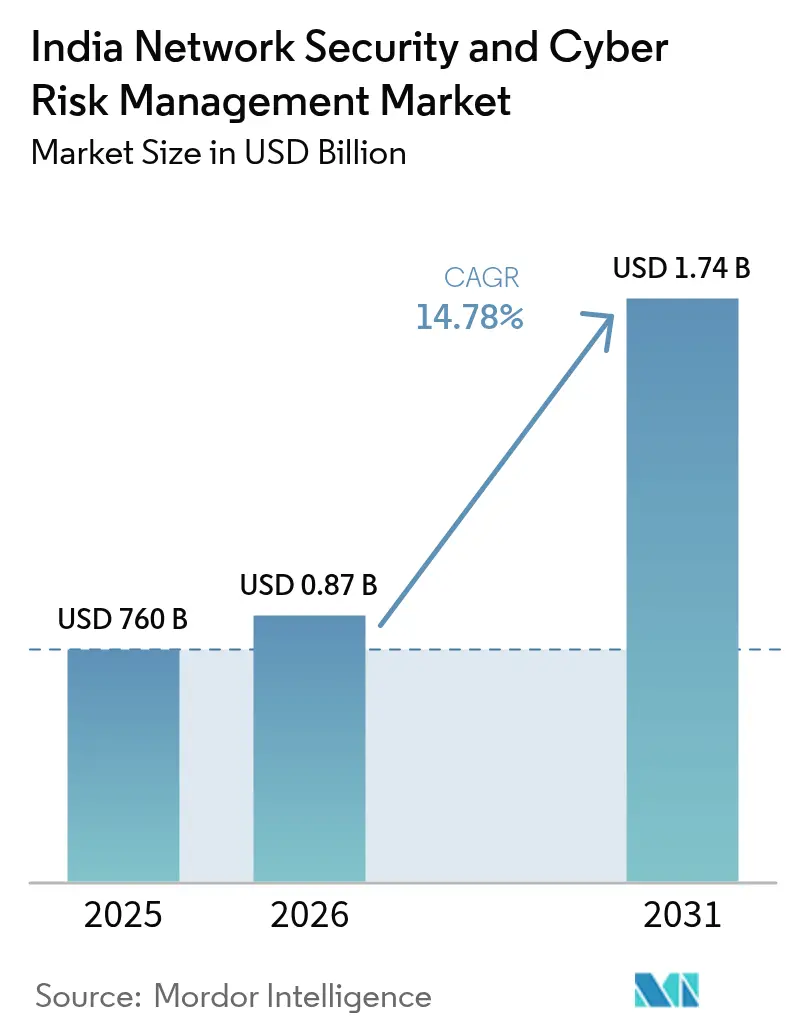
| Base Year Market Size (2025) | USD 760 Billion |
| Market Size (2026) | USD 0.87 Billion |
| Market Size (2031) | USD 1.74 Billion |
| Growth Rate (2026 - 2031) | 14.78 % |
| Market Concentration | Medium |
Major Players *Disclaimer: Major Players sorted in no particular order Image © Mordor Intelligence. Reuse requires attribution under CC BY 4.0. | |
India Network Security And Cyber Risk Management Market Analysis by Mordor Intelligence
The India network security and cyber risk management market size is expected to grow from USD 760 million in 2025 to USD 872.3 million in 2026 and is forecast to reach USD 1.74 billion by 2031 at 14.78% CAGR over 2026-2031. Ongoing digital transformation, tighter privacy regulations, and a rise in sophisticated cyber incidents anchor this expansion. Breach-reporting rules that compel notification within six hours spur investments in real-time monitoring, while the Digital Personal Data Protection Act (DPDP 2023) drives heavy penalties for non-compliance, encouraging proactive security adoption. Accelerating cloud adoption among micro, small, and medium enterprises (MSMEs) expands attack surfaces and elevates demand for managed detection and response services. Parallel rollouts of private 5G networks across manufacturing corridors introduce new operational-technology risks that push organizations toward integrated, zero-trust architectures. Finally, a severe shortage of skilled cyber talent propels outsourcing to managed service providers and automation-led solutions, reshaping competitive dynamics across the India network security and cyber risk management market.
Key Report Takeaways
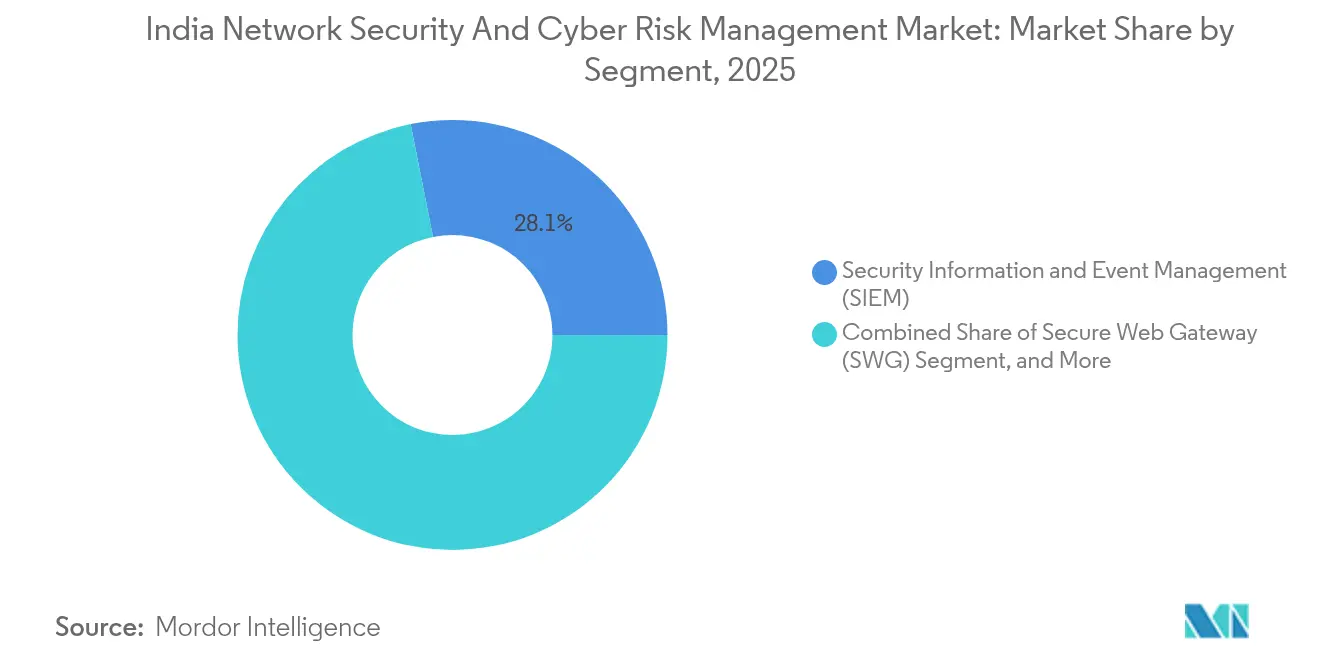
- By segment, Security Information and Event Management (SIEM) held 28.12% of the India network security and cyber risk management market share in 2025; Identity Governance and Administration (IGA) is projected to expand at a 17.18% CAGR to 2031.
- By solution, Identity and Access Management captured a 31.05% share of the India network security and cyber risk management market size in 2025, while Zero Trust Network Access is advancing at an 18.05% CAGR through 2031.
- By service, Network Security accounted for 34.12% of the India network security and cyber risk management market size in 2025; Cloud Security is forecast to register a 20.62% CAGR to 2031.
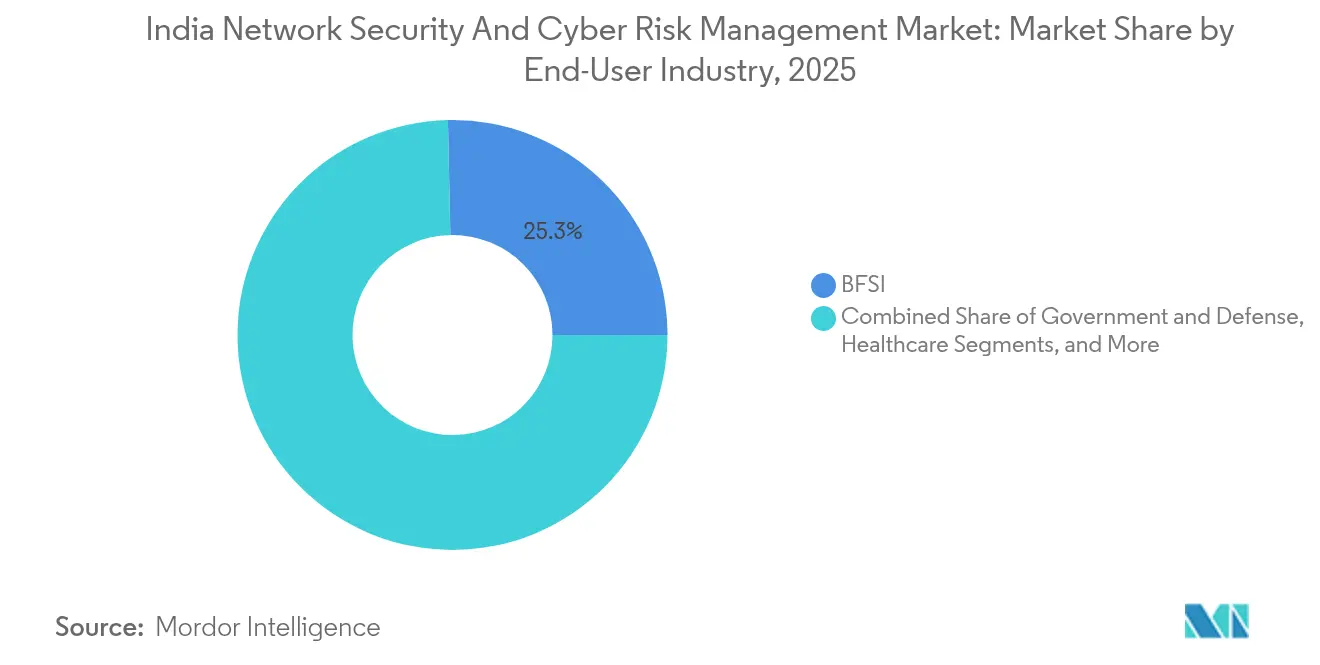
- By end-user industry, the BFSI segment commanded 25.34% revenue share in 2025, while Healthcare is advancing at the highest projected CAGR at 19.62% through 2031.
- By deployment mode, on-premises models led with 55.92% share of the India network security and cyber risk management market size in 2025, whereas cloud-based deployments are growing at a 20.14% CAGR between 2026-2031.
Note: Market size and forecast figures in this report are generated using Mordor Intelligence’s proprietary estimation framework, updated with the latest available data and insights as of 2026.
India Network Security And Cyber Risk Management Market Trends and Insights
Drivers Impact Analysis*
| Driver | (~) % Impact on CAGR Forecast | Geographic Relevance | Impact Timeline |
|---|---|---|---|
| FinTech transaction-sprawl intensifying attack surface | +2.8% | National, with concentration in Mumbai, Bengaluru, Delhi NCR | Short term (≤ 2 years) |
| Zero-day supply-chain exploits on Indian OEM firmware | +2.1% | National, with higher exposure in manufacturing hubs | Medium term (2-4 years) |
| Mandatory CERT-In six-hour breach-reporting rule | +3.2% | National | Short term (≤ 2 years) |
| Rising cloud-native adoption among MSMEs | +2.5% | Tier-II and Tier-III cities, with spillover to metro areas | Medium term (2-4 years) |
| 5G private‐network rollouts in smart-manufacturing hubs | +1.9% | Gujarat, Tamil Nadu, and Maharashtra industrial corridors | Long term (≥ 4 years) |
| Generative-AI-driven phishing and deep-fake prevention spend | +2.5% | National, with early adoption in the BFSI and Healthcare sectors | Short term (≤ 2 years) |
| Source: Mordor Intelligence | |||
FinTech Transaction-Sprawl Intensifying Attack Surface
Indian FinTech platforms recorded 429,847 cyber incidents in 2023, with exploits frequently targeting open APIs and third-party integrations that multiply entry points for attackers. The Aditya Birla Capital breach, which siphoned USD 0.23 million in digital gold, illustrates cascading risks created by interconnected service providers. Compliance with DPDP 2023 demands encryption, audit trails and breach notification, pushing FinTechs toward advanced SIEM platforms with AI-based anomaly detection. Competitive pressures encourage rapid feature releases, yet every new integration widens the attack surface. Consequently, chief information security officers prioritize continuous monitoring, micro-segmentation and identity-centric controls to protect customer transactions and sustain trust across the India network security and cyber risk management market.
Zero-Day Supply-Chain Exploits on Indian OEM Firmware
CERT-In has flagged multiple critical vulnerabilities in local OEM firmware, including Samsung devices running Android 11-14, enabling arbitrary code execution and sensitive-data exfiltration [1]CERT-In, “Multiple Vulnerabilities in Samsung Products,” cert-in.org.in. A 2024 ransomware campaign against Indian banks leveraged CVE-2024-23897 embedded in Jenkins servers to breach payment gateways, underscoring how firmware flaws propagate across supply chains [2]Juniper Threat Labs, “How CVE-2024-23897 Enabled Ransomware Attack on Indian Banks,” juniper.net. Proliferation of Industry 4.0 devices magnifies this exposure, especially in export-oriented manufacturing hubs. Enterprises, therefore, embed firmware-integrity checks, vendor-audit scorecards, and continuous vulnerability scanning in procurement workflows. Tightening supply-chain security raises demand for endpoint detection and response tools integrated with SIEM and SOAR platforms, reinforcing growth in the India network security and cyber risk management market.
Mandatory CERT-In Six-Hour Breach-Reporting Rule
The six-hour incident-reporting mandate enforces clock synchronization, 180-day log retention, and designation of a CERT-In liaison across all sectors. Non-compliance invites stiff fines and possible imprisonment, prompting urgent upgrades to logging, threat-detection, and automated response capabilities. Organizations now treat breach-reporting readiness as a board-level objective that affects brand equity. Demand surges for managed detection services able to contain threats and assemble compliant incident reports within statutory windows. Vendors differentiate through out-of-the-box compliance templates and machine-learning analytics that reduce mean-time-to-detect, further accelerating the India network security and cyber risk management market.
Rising Cloud-Native Adoption Among MSMEs
Government incentives and affordable SaaS tools have spurred a surge in cloud adoption, with 35% of MSMEs running critical workloads on public clouds by 2025. While cloud helps firms scale rapidly, resource constraints limit dedicated security teams. Cloud-native attacks such as misconfigured storage buckets and compromised access keys now rank among the top breach vectors. MSPs step in with bundled Cloud Security Posture Management and Zero-Trust Network Access offerings tailored to MSME budgets. Community-training programs foster basic cyber hygiene, but automated policy enforcement remains the game-changer for securing India’s distributed business landscape and sustaining momentum in the India network security and cyber risk management market.
Restraints Impact Analysis*
| Restraint | (~) % Impact on CAGR Forecast | Geographic Relevance | Impact Timeline |
|---|---|---|---|
| Shortage of 400k skilled cyber-security professionals | -1.8% | National, acute in Tier-II cities | Long term (≥ 4 years) |
| Fragmented state-level data-protection enforcement | -1.2% | Varies by state regulatory maturity | Medium term (2-4 years) |
| High TCO of zero-trust architectures for SMEs | -1.5% | MSME-concentrated regions across India | Medium term (2-4 years) |
| Legacy OT systems in critical infrastructure | -1.1% | Power generation hubs, manufacturing belts | Long term (≥ 4 years) |
| Source: Mordor Intelligence | |||
Shortage of 400k Skilled Cyber-Security Professionals
India requires 1 million cybersecurity professionals by 2027, yet only 300,000 people currently possess employable skills, creating a 400,000-person gap. BFSI alone accounts for half of this unmet demand, which raises labor costs and stretches internal teams [3]Economic Times Commentary, “India’s Skill Gap Crisis,” economictimes.indiatimes.com. Organizations increasingly outsource to Managed Detection and Response providers and deploy AI-based automation to compensate for missing talent. Government initiatives like Microsoft’s CyberShikshaa upskill underrepresented groups, yet annual output remains below market needs. Skills scarcity thereby slows implementation of sophisticated architectures such as zero-trust among small and mid-size enterprises, tempering the growth trajectory of the India network security and cyber risk management market.
Fragmented State-Level Data-Protection Enforcement
Although the DPDP 2023 establishes federal privacy norms, enforcement remains uneven across India’s states, leading to differing compliance deadlines and inconsistent audit criteria. Enterprises operating nationwide face overlapping mandates and duplicative reporting, driving up compliance costs. Smaller firms struggle with the legal complexity and risk of project delays as they await detailed state-level guidelines. The anticipated Data Protection Board may harmonize enforcement by 2025-end, yet the current patchwork hinders seamless data flows and slows procurement decisions for security solutions. Vendors respond by embedding compliance management dashboards that map security controls to multiple regulatory frameworks, a feature now viewed as critical in vendor evaluations across the India network security and cyber risk management market.
*Our forecasts treat driver/restraint impacts as directional, not additive. The impact forecasts reflect baseline growth, mix effects, and variable interactions.
Segment Analysis
By Segment: SIEM Remains Core While IGA Accelerates
The SIEM segment generated 28.12% of the India network security and cyber risk management market size in 2025, reflecting organizations’ need for centralized log analytics and automated alerts that satisfy CERT-In mandates. Large enterprises integrate SIEM with SOAR to orchestrate playbooks, reducing response times and audit overhead. Mid-sized firms prefer cloud-hosted SIEM subscriptions to avoid capital expenditure. Meanwhile, IGA solutions compound at a 17.18% CAGR as identity becomes the new perimeter in hybrid workplaces. Automated provisioning and risk-based access reviews improve user-lifecycle efficiency and compliance reporting.
Growth in both segments stems from demand for unified visibility in multi-cloud environments. Vendors embed machine-learning models for anomaly detection, while marketplace integrations pull telemetry from SaaS, container and IoT layers. As digital supply chains deepen, customers favor platforms that combine SIEM, XDR and identity governance, signaling a shift toward converged security operations that will redefine the India network security and cyber risk management market.



By Solution: IAM Holds Lead, ZTNA Gains Momentum
Identity and Access Management retained a 31.05% share of the India network security and cyber risk management market in 2025, anchoring everything from privileged-access controls to single sign-on. Regulatory clauses requiring granular access logs further entrench IAM platforms. Yet Zero Trust Network Access posts the fastest 18.05% CAGR, propelled by remote-work policies and 5G edge connectivity. ZTNA replaces perimeter-based VPNs with continuous verification, micro-segmentation, and contextual policies.
Encryption and DLP gain traction as enterprises prepare for post-quantum threats and DPDP compliance, respectively. Buyers increasingly adopt solution suites that integrate IAM, ZTNA, and encryption under unified policy engines. This convergence reduces operational overhead and accelerates adoption among MSMEs, expanding revenue opportunities across the India network security and cyber risk management market.
By Service: Network Security Foundational, Cloud Security Surging
Network Security services contributed 34.12% of the India network security and cyber risk management market size in 2025, reflecting demand for firewalls, IDS/IPS, and segmentation across data centers and branch networks. However, Cloud Security services are climbing at a 20.62% CAGR as enterprises pursue multi-cloud strategies. Cloud Access Security Brokers, container-security plugins, and serverless-function scanning become mainstream purchase criteria.
Managed Detection and Response fills talent gaps with 24/7 threat hunting valued by sectors facing advanced persistent threats. Wireless and endpoint security round out service portfolios, addressing 5G private networks and IoT proliferation. Providers bundle offerings to deliver outcome-based pricing, reinforcing the shift toward opex models in the India network security and cyber risk management market.
By End-User Industry: BFSI Leads, Healthcare Rising
BFSI accounted for 25.34% of revenue in 2025, driven by high-value digital transactions and stringent RBI technology guidelines. Threat actors target payment APIs, driving heavy spending on fraud analytics and tokenization. Healthcare, benefiting from telemedicine expansion, projects a 19.62% CAGR as ransomware actors exploit legacy hospital infrastructure and sensitive patient data.
Government and defense sustain steady investments to safeguard citizen services, while IT-telecom anchor consumption of cloud and 5G-edge security controls. Manufacturing firms, once focused on perimeter defense, now adopt OT-security gateways following high-profile plant disruptions. These dynamics collectively strengthen diversification across the India network security and cyber risk management market.
By Deployment Mode: On-Premise Still Dominant, Cloud Gains
On-premise deployments represented 55.92% of the India network security and cyber risk management market share in 2025 as regulated industries prefer data-center control. Financial institutions and healthcare providers often maintain in-house hardware for auditability and latency consistency. Cloud-based deployments, however, climb at 20.14% CAGR due to MSME adoption, elastic scalability and pay-as-you-grow billing.
Hybrid architectures become the norm, using on-premise appliances for core applications and SaaS security for customer-facing workloads. Vendors deliver policy orchestration layers that synchronize controls across Kubernetes, virtual machines and physical networks, supporting seamless expansion of the India network security and cyber risk management market.
Geography Analysis
Metropolitan hubs, Mumbai, Bengaluru, Delhi NCR, and Chennai, account for roughly 59.40% of spending thanks to dense clusters of banks, IT services, and startups that foster rapid technology uptake. These cities boast skilled talent pools and mature digital infrastructure, encouraging early adoption of XDR platforms, AI-powered analytics, and post-quantum encryption pilots. Vendor presence and channel ecosystems are deepest here, easing proof-of-concept deployment and accelerating upgrade cycles across the India network security and cyber risk management market.
Tier-II and Tier-III cities such as Jaipur, Coimbatore, and Kochi register a faster 17-19% CAGR as MSMEs digitize operations. Government Digital India initiatives subsidize broadband, while local incubators drive SaaS innovation that embeds security-by-design principles. Cloud-first strategies dominate in these regions because capital expenditure budgets remain tight, increasing reliance on managed services that bundle compliance support alongside threat defense.
Industrial corridors in Gujarat, Tamil Nadu, and Maharashtra emerge as cybersecurity hotspots owing to private 5G roll-outs that connect smart factories. Edge computing nodes located near production lines introduce novel attack vectors, pressing manufacturers to adopt OT-specific intrusion-prevention systems. State governments collaborate with academia on cyber-range facilities, improving workforce readiness and fostering local vendor ecosystems that fuel growth in the India network security and cyber risk management market.
Regulatory Landscape
India's network security and cyber risk management requirements are anchored by the Information Technology Act, 2000, with CERT-In designated as the national incident response agency under Section 70B. CERT-In Directions dated April 28, 2022 operationalize mandatory incident reporting within six hours for service providers, intermediaries, data centers, and body corporates, and also require time synchronization and log retention. This framework pushes organizations toward always-on monitoring and SIEM-led detection workflows.
Regulatory expectations continued to broaden during 2025-2026 through compliance-led governance and AI-focused security guidance. The Digital Personal Data Protection Act (DPDP) 2023 is complemented by DPDP Rules, 2025, notified on November 13, 2025, which advanced the Board establishment timeline, while CERT-In issued its Blueprint for reducing exposure and defending against AI-assisted vulnerabilities exploitation in digital infrastructure on May 25, 2026. Sector regulators also tightened cyber expectations, for example, IRDAI's Information and Cybersecurity Guidelines, 2026 for insurers and intermediaries, alongside public funding signals, with the Union Budget 2025-26 allocating INR 782 crore toward cybersecurity.
Value Chain Analysis
The value chain begins with foundational technology suppliers, including network and security hardware, OS and cloud platforms, cryptographic and identity components, and security software vendors covering SIEM, IAM/IGA, DLP, IDS/IPS, and ZTNA. Increasingly, these capabilities are packaged into platform subscriptions, which then feed system integrators, telecom and cloud service providers, and MSSPs/MDR providers that design, deploy, and operate security controls.
Downstream, certified audit and assurance organizations perform periodic assessments and validation aligned to CERT-In directions and sector-specific rules. Compliance and assurance have become a distinct, recurring layer in India due to CERT-In requirements, including mandatory incident reporting within six hours and the July 25, 2025 Comprehensive Cyber Security Audit Policy Guidelines that formalize audit expectations for government entities and critical infrastructure providers. Demand then propagates into continuous monitoring, log management, threat intelligence, and incident response retainers, with buyers in BFSI, telecom, healthcare, and government selecting partners that can operationalize governance, risk, and compliance alongside detection and response. The ecosystem also reflects consolidation and capability building, as global assurance and cybersecurity firms acquire or partner with Indian specialists to strengthen payment security, PCI/DSS readiness, and managed cyber defense delivery.
Competitive Landscape
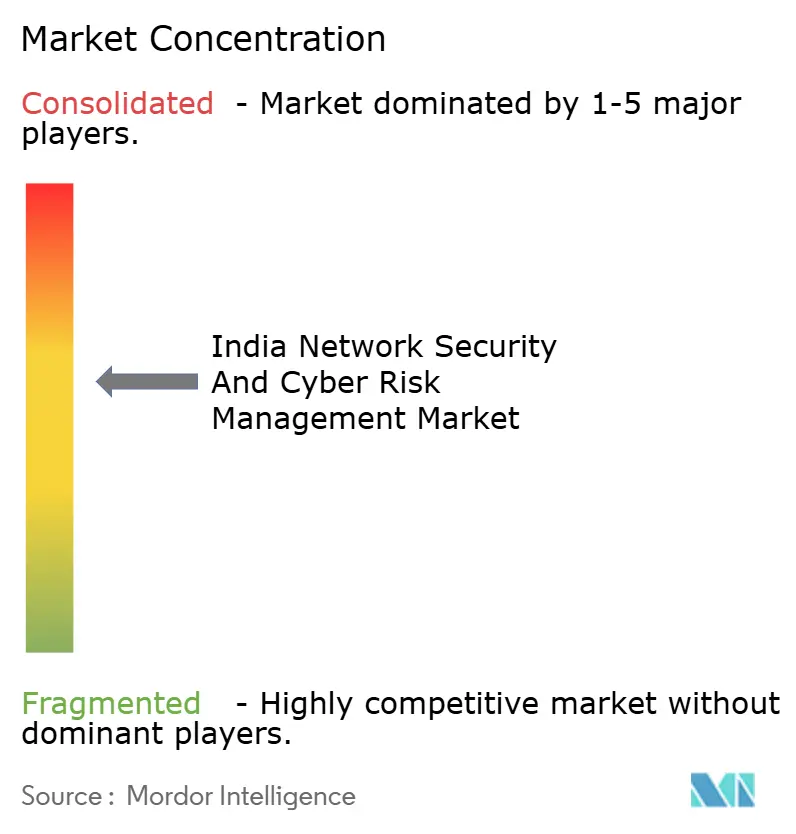
The market remains moderately fragmented, with global majors—Cisco, Palo Alto Networks, and IBM—holding sizeable mindshare while domestic vendors innovate around price-performance. Consolidation intensified in 2023 as strategic buyers closed 396 cybersecurity M&A deals worldwide. SentinelOne’s USD 100 million purchase of Bangalore-based PingSafe gave the acquirer a cloud-native attack-surface management suite tailored for Indian developers [4]Business Standard Reporters, “SentinelOne Acquires PingSafe,” business-standard.com.
Strategic alliances reshape service delivery. Palo Alto Networks acquired IBM’s QRadar cloud assets and trained 1,000 IBM consultants on its platform to penetrate regulated verticals. Indigenous firms face profitability pressures; Quick Heal’s 67% profit slide in 2024 spurred a pivot to AI-based anti-fraud solutions. Yet local providers retain an edge in public-sector deals that require data-sovereignty assurances.
Product roadmaps converge on platformization. Vendors bundle SIEM, SOAR, and XDR within single subscriptions, advertising a lower total cost of ownership for stretched security teams. Post-quantum cryptography support emerges as a differentiator after the government released its quantum-safe roadmap [5]DD News Service, “India Releases Quantum-Safe Roadmap,” ddnews.gov.in. AI-driven threat-hunting features, multilingual dashboards, and pay-as-you-use pricing keep competition vibrant, sustaining healthy buyer bargaining power across the India network security and cyber risk management market.
India Network Security And Cyber Risk Management Industry Leaders
Cisco Systems Inc.
Palo Alto Networks Inc.
IBM Corporation
Check Point Software Technologies Ltd.
Trend Micro Inc.
- *Disclaimer: Major Players sorted in no particular order

Market Opportunities and Future Outlook
Regulatory cadence and operational mandates are creating opportunities for compliance-native security operations, particularly in sectors with explicit governance requirements. IRDAI's Information and Cybersecurity Guidelines, 2026 raise the bar for insurer-wide cyber governance and risk management structures, while CERT-In's May 2026 blueprint on defending against AI-assisted vulnerability exploitation elevates expectations for AI-aware vulnerability assessment across OEMs and technology providers. Together, these changes support demand for SIEM modernization, SOAR-aligned incident workflows, log retention and search at scale, and managed services that can produce audit-ready evidence under tight reporting windows.
AI-led defense and sovereign capability building also broaden the opportunity set beyond traditional perimeter controls. In July 2026, CERT-In launched an AI-powered war room for large-scale detection and remediation of security weaknesses, and the government directed local AI entities such as Sarvam AI and BharatGen to work on sovereign cybersecurity AI models, pointing to demand for domestic-grade analytics, data handling, and model governance. On the commercial side, enterprises are adopting AI-led MDR and consolidated security operations, with service providers expanding partnerships to operationalize platforms and reduce tool sprawl, supporting growth for MDR, cloud security posture management, and identity-centric zero trust implementations across distributed and multi-cloud environments.
Recent Industry Developments
- June 2026: Wipro expanded its partnership with Palo Alto Networks to deliver AI-powered cyber defense services, including MDR capabilities using Cortex XSIAM integrated with Wipro's CyberShield. The update strengthens packaged, outcome-led security operations delivery for Indian enterprises managing faster incident reporting cycles and talent constraints.
- May 2026: Securonix partnered with GRAMAX Cybertech to scale managed cyber defense in India using the Securonix Unified Defense SIEM, targeting critical and regulated environments, including major airport infrastructure. The partnership reflects rising demand for managed monitoring, centralized log analytics, and incident workflows aligned to compliance and resilience requirements.
- April 2026: IRDAI issued the Information and Cybersecurity Guidelines, 2026 for insurers and intermediaries, tightening governance and risk management expectations and aligning them with DPDP obligations. The guidelines increase compliance urgency for regulated BFSI-adjacent institutions and lift demand for audit-ready controls such as IAM, continuous monitoring, and incident response documentation.


Research Methodology Framework and Report Scope
Market Definition and Coverage
This market covers spending in India on network security solutions and cyber risk management work used to prevent, detect, and respond to cyber threats across enterprise networks, cloud, endpoints, and wireless environments. It is sized as revenue for solutions and related security services delivered to end users.
Scope exclusions: it does not count general IT hardware refresh cycles, non-security networking equipment, or broader IT outsourcing work that is not directly tied to security outcomes.
Segmentation Overview
- By Segment
- Security Information and Event Management (SIEM)
- Secure Web Gateway (SWG)
- Identity Governance and Administration (IGA)
- Enterprise Content-Aware Data Loss Prevention (DLP)
- By Solution
- Encryption
- Identity and Access Management (IAM)
- Data Loss Protection (DLP)
- Intrusion Detection/Prevention (IDS/IPS)
- Zero-Trust Network Access (ZTNA)
- By Service
- Network Security
- Endpoint Security
- Wireless Security
- Cloud Security
- Managed Detection and Response (MDR)
- By End-user Industry
- BFSI
- Government and Defence
- Healthcare
- IT and Telecom
- Retail and E-Commerce
- Manufacturing
- By Deployment Mode
- On-premise
- Cloud-based
Data Sources, Market Sizing, and Validation
Desk Research
Desk research was used to shape the base structure of the model and keep inputs anchored to India conditions before assumptions were finalized. The work leaned on public sources such as CERT-In advisories and reporting guidance, MeitY policy notes, RBI and SEBI cyber and IT risk circulars, and standards references like ISO and NIST for control categories and terminology.
To convert those signals into usable sizing inputs, we also reviewed incident disclosures, sector spend cues from public budget documents, and direction from trade bodies and reputed press coverage. Company annual reports, investor presentations, and official product documentation were reviewed to understand service mix shifts and typical pricing movement in security categories. In a few cases, paid subscriptions were used only for company financials, patent lookups, and news validation, and then checked again through publicly visible evidence. The sources listed here are illustrative only, and many other references were also used for data collection, validation, and clarification.
Primary Interviews and Surveys
Primary conversations were carried out with solution providers, system integrators, managed security teams, and enterprise security buyers across regulated and high-risk industries, so gaps left by public data could be closed. We also included viewpoints from risk, compliance, and IT operations roles, since budget ownership and buying triggers differ across India. These inputs were used to validate adoption curves, service attach rates, and the pace of cloud security migration before final totals were locked.
Distribution of primary research fieldwork respondents
| Company type | Respondent position |
|---|---|
| Top tier: 38% | CXOs: 13% |
| Mid tier: 48% | Functional/Unit leaders: 37% |
| Smaller Players: 14% | Managers: 50% |
Market-Sizing & Forecasting
Sizing starts from a top-down demand-pool build for India, where sector-level digital exposure and compliance pressure are used to reconstruct likely security spend that is addressable by network security and cyber risk management. We then corroborate totals using selective bottom-up checks, such as sampling supplier and channel revenues, checking typical annual contract values, and applying sampled ASP x volume logic for licenses and managed services, followed by adjustments when primary feedback indicates a mismatch.
Key inputs used in the model include the pace of cloud workload migration, remote access usage intensity, incident and breach reporting signals, compliance-driven control adoption commonly seen in BFSI and government, service mix shifts between managed and project-led work, and average price progression by solution group. Where smaller suppliers and unreported revenues create gaps, the model bridges them using penetration proxies and validated ranges from interviews rather than forcing a full supplier roll-up.
Forecasting uses scenario analysis with a small set of demand drivers. Assumptions are refreshed using expert consensus on budget growth, enforcement intensity, and procurement cycle length. The scenarios remain practical so they can be re-run quickly if a material change happens, for example, a new reporting requirement or a sudden spike in threat activity.
Data Validation & Update Cycle
Outputs are checked against independent signals, such as sector IT spend direction, security hiring trends, and disclosed incident patterns, so totals do not drift away from real-world behavior. When a variance looks too large, the assumptions behind adoption, service attach, or pricing are revisited, and a follow-up is triggered with relevant respondents to confirm what changed.
Before sign-off, the model goes through multi-step analyst reviews focused on year-on-year jumps, segment share consistency, and currency conversion timing. The report is refreshed annually, with interim updates when policy changes, high-impact breach events, or large deal cycles materially shift near-term demand. Before delivery, an analyst performs a fresh pass so clients receive the latest updated view.
Mordor Intelligence's India Network Security and Cyber Risk Management Market Estimate Compared With Other Published Estimates
Published market sizes for this space often do not match because studies pick different end-user coverage, different component groupings, and different year anchors for currency and inflation. Differences also come from how each publisher treats services, especially managed security, and how tightly the totals are linked to India-only revenue recognition.
The main gap comes from whether telecom-only cyber security spending and broad, all-vertical cybersecurity budgets are mixed into the same total. Mordor Intelligence counts India network security and cyber risk management revenues only within defined solution and service categories (including SIEM, SWG, IGA, DLP, and services such as cloud and endpoint security) and keeps the 2025 base year aligned to a consistent USD conversion timing.
Benchmark comparison
| Source | Market Size | Gaps in Research Methodology |
|---|---|---|
| Mordor Intelligence | USD 0.76 B (2025) | |
| Industry Study A | USD 6.06 B (2023) | Uses a broader domestic cybersecurity definition that includes overall products and services, which expands the demand pool beyond network security controls and risk management categories, and it anchors the number to 2023. |
| Sector Outlook B | USD 1.36 B (2024) | Limits the scope to IT and telecom end users and reports a component split including hardware, so the addressable revenue set and buyer mix differ from an all-vertical view, and the base year is 2024. |
The spread in the table is largely explained by scope selection and by which industries and cost buckets are counted inside the total. By keeping inclusions explicit, tying inputs to observable adoption and compliance signals, and then pressure-testing totals with interviews, the output stays traceable to repeatable steps that can be updated when conditions change.


Key Questions Answered in the Report
Which segment currently generates the highest revenue?
Security Information and Event Management accounts for 28.12% of revenue as of 2025.
Why is Zero Trust Network Access adoption accelerating?
Hybrid work models and limitations of legacy VPNs drive ZTNA’s 18.05% CAGR through 2031.
How are private 5G roll-outs influencing cybersecurity spending?
Factory-focused 5G networks create new OT threat vectors, prompting investment in specialized intrusion-prevention and segmentation controls.
What factor most constrains market growth?
A shortage of 400 k qualified cybersecurity professionals hampers advanced technology deployment.
Page last updated on:


 Your data is secure and never sold or shared.


