
Market Overview
| Study Period | 2020 - 2031 |
|---|---|
| Forecast Data Period | 2026 - 2031 |
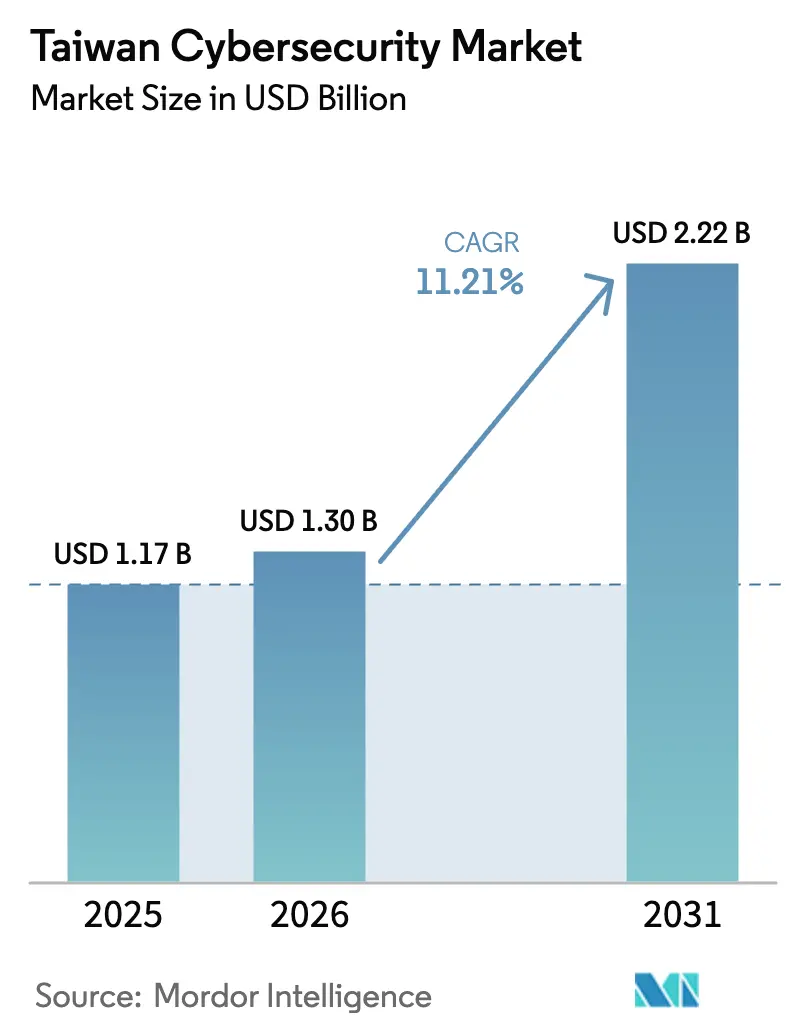
| Base Year Market Size (2025) | USD 1.17 Billion |
| Market Size (2026) | USD 1.3 Billion |
| Market Size (2031) | USD 2.22 Billion |
| Growth Rate (2026 - 2031) | 11.21 % |
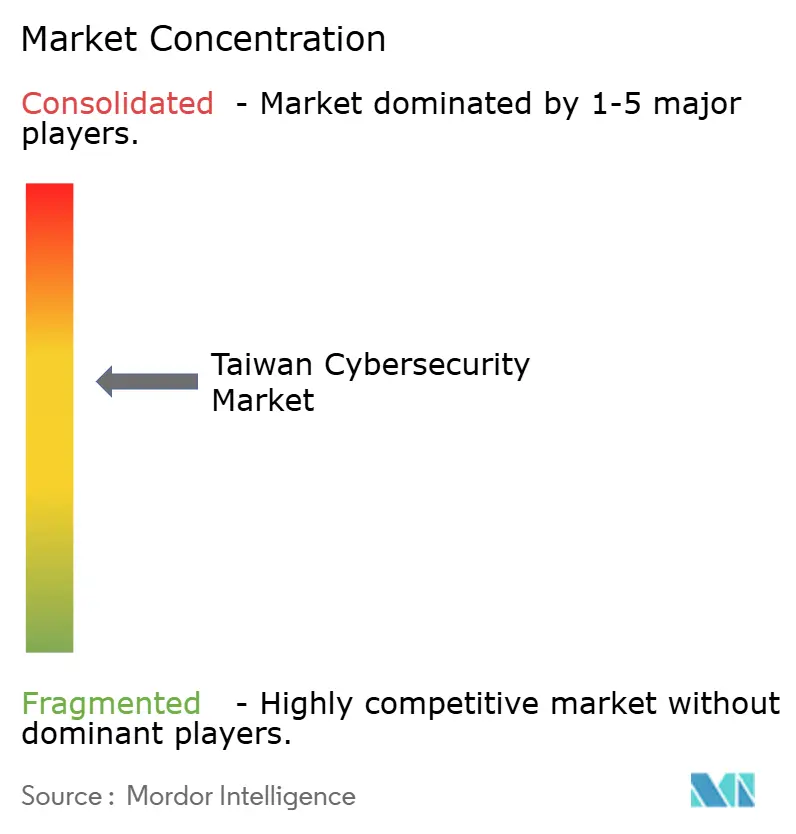
| Market Concentration | Medium |
Major Players *Disclaimer: Major Players sorted in no particular order Image © Mordor Intelligence. Reuse requires attribution under CC BY 4.0. | |
Taiwan Cybersecurity Market Analysis by Mordor Intelligence
The Taiwan cybersecurity market size is expected to grow from USD 1.17 billion in 2025 to USD 1.3 billion in 2026 and is forecast to reach USD 2.22 billion by 2031 at 11.21% CAGR over 2026-2031. Geopolitical tensions, supply-chain reliance on semiconductors, and an average of 2.4 million daily cyberattacks drive continuous spending across government and industry. Regulatory enforcement—most notably the Cyber Security Act 2.0—elevates compliance from voluntary best practice to legal obligation with fines up to NT$10 million for non-reporting of incidents, tilting budgets toward managed security services. Private 5G roll-outs inside science parks, post-quantum cryptography migration guidelines, and zero-trust frameworks in banking anchor future-proof investment patterns. Simultaneously, a chronic talent shortfall of about 80,000 specialists inflates demand for automation and outsourced security operations. Cost-sensitive SMEs nevertheless remain hesitant, leaving a sizable but fragmented addressable base for the Taiwan cybersecurity market.
Key Report Takeaways
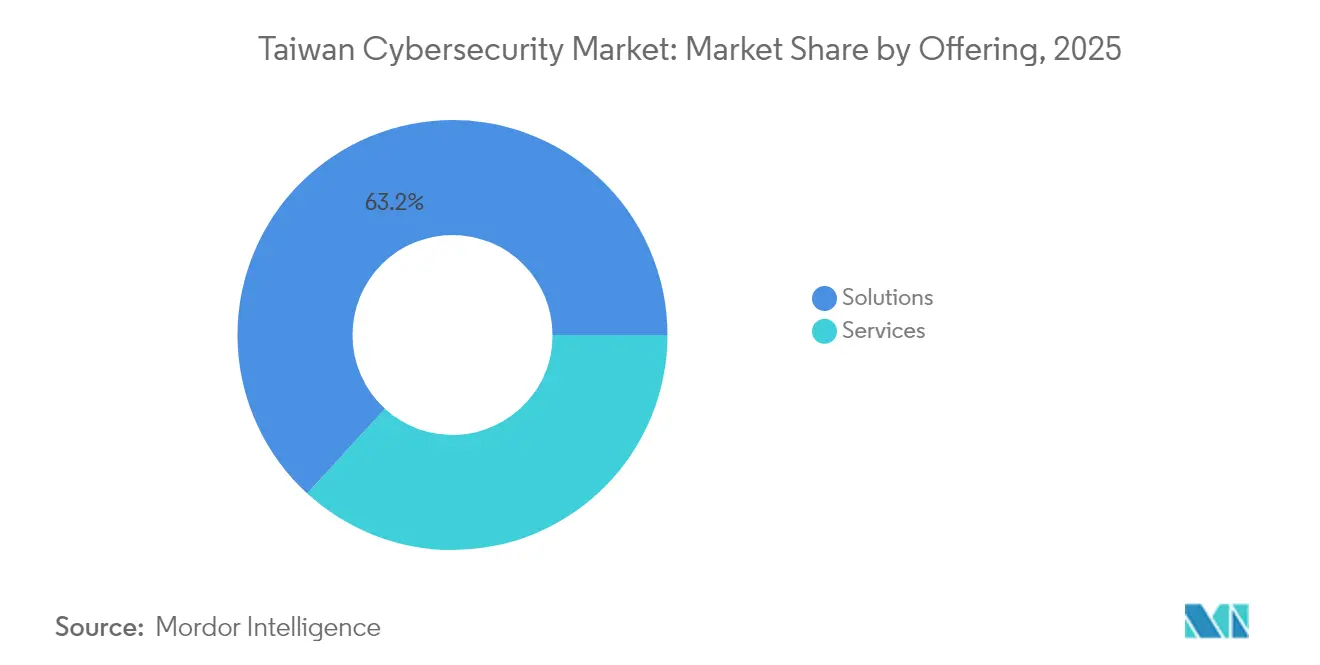
- By offering, solutions commanded 63.20% of the Taiwan cybersecurity market share in 2025; managed services are forecast to expand at a 14.23% CAGR through 2031.
- By deployment mode, on-premise held 56.20% of the Taiwan cybersecurity market size in 2025; cloud is projected to grow at 16.34% CAGR to 2031.
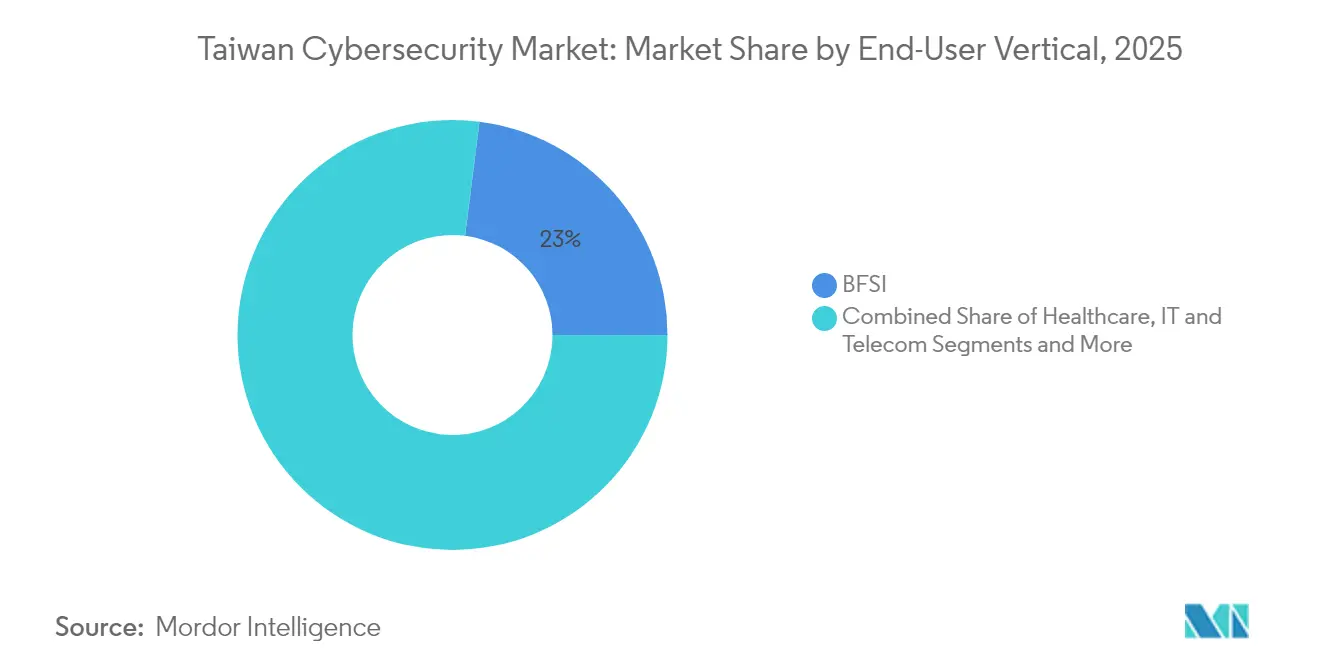
- By end-user vertical, BFSI led with 23.00% revenue share in 2025, while healthcare is advancing at a 15.02% CAGR to 2031.
- By enterprise size, large enterprises captured 71.60% share of the Taiwan cybersecurity market in 2025; SMEs record the fastest growth at 12.26% CAGR to 2031.
Note: Market size and forecast figures in this report are generated using Mordor Intelligence’s proprietary estimation framework, updated with the latest available data and insights as of 2026.
Taiwan Cybersecurity Market Trends and Insights
Drivers Impact Analysis*
| Driver | (~) % Impact on CAGR Forecast | Geographic Relevance | Impact Timeline |
|---|---|---|---|
| Smart-manufacturing OT–IT convergence secures IP | +2.1% | National, Hsinchu Science Park focus | Medium term (2-4 years) |
| Cyber Security Act 2.0 and critical-infrastructure resilience mandates | +2.8% | National, six critical sectors | Short term (≤ 2 years) |
| 5G private-network roll-outs in science parks boost edge security | +1.7% | Kaohsiung and regional parks | Medium term (2-4 years) |
| FinTech sandbox accelerating zero-trust adoption in BFSI | +1.4% | Taipei financial district | Short term (≤ 2 years) |
| Semiconductor supply-chain security demands from US/EU clients | +2.3% | National with global linkages | Long term (≥ 4 years) |
| Surge in ransomware on gaming and semiconductor sectors | +1.9% | Sector-specific clusters | Short term (≤ 2 years) |
| Source: Mordor Intelligence | |||
Smart-manufacturing OT–IT convergence secures IP
Convergence blurs once-separate networks, exposing legacy equipment to internet-borne threats. TXOne Networks’ 2024 survey indicated that 94% of Taiwanese factories logged OT incidents linked to IT vectors, underscoring the urgency for industrial-grade security platforms. For instance, Inventec’s fully virtualized 5G private network raised straight-through production rates from 70% to 85%, yet introduced new vulnerabilities for automated guided vehicles that now require micro-segmenting defenses. Vendors are therefore integrating real-time anomaly detection, immutable logs, and downtime-free patching features to fit strict production-quality metrics.
Cyber Security Act 2.0 and critical-infrastructure resilience mandates
Legislative amendments broaden coverage from 4 to 6 sectors and impose NTD 10 million penalties for unreported breaches, prompting immediate procurement of incident-response platforms and 24/7 SOC services[1]. The Ministry of Digital Affairs further requires annual third-party audits, accelerating demand for consulting and vulnerability assessment. Organizations unable to self-staff SOC teams increasingly outsource to domestic MSSPs to meet stringent response-time benchmarks.
5G private-network roll-outs in science parks boost edge security
Far EasTone Telecom’s 5G smart-patrol deployment for Kaohsiung police showcased how network slicing enforces application isolation while maintaining latency below 10 ms. Closed architectures like HTC Reign Core allow customizable bandwidth to critical workloads, addressing intellectual-property leakage concerns prevalent in RandD labs within the Taiwan cybersecurity market.
FinTech sandbox accelerating zero-trust adoption in BFSI
The Financial Supervisory Commission’s sandbox permits rapid piloting of AI fraud detection and blockchain remittances while mandating “never-trust, always-verify” controls. E.SUN Bank’s Fraud Prevention Laboratory now correlates biometrics, device posture, and behavioral analytics, cutting false-positive transaction flags by 27% in 2025. Large banks are therefore issuing multi-factor hard tokens and deploying micro-service gateways to secure open-banking APIs.
Restraints Impact Analysis*
| Restraint | (~) % Impact on CAGR Forecast | Geographic Relevance | Impact Timeline |
|---|---|---|---|
| Fragmented SME base with low cyber-insurance uptake | -1.8% | Traditional manufacturing belts | Medium term (2-4 years) |
| Appliance-centric procurement slows SaaS migration | -1.3% | Government and large enterprise | Long term (≥ 4 years) |
| Cross-border data-transfer curbs for foreign MSSPs | -0.9% | National | Short term (≤ 2 years) |
| Shortage of bilingual cyber talent raises service costs | -1.6% | Taipei and Hsinchu | Long term (≥ 4 years) |
| Source: Mordor Intelligence | |||
Fragmented SME base with low cyber-insurance uptake
Over 98% of the corporate landscape consists of SMEs that rarely exceed 1% of revenue on cyber spending. A 2025 Digital Development Department audit found sizable capability gaps in sectors such as food processing, where only 22% of firms perform annual penetration testing. Limited appetite for cyber-insurance perpetuates underinvestment, forcing providers to tailor low-cost bundles that combine endpoint security, awareness training, and simplified incident cover.
Appliance-centric procurement slows SaaS migration
Government agencies still favor hardware security modules and appliance firewalls due to data-sovereignty concerns. This stance postpones cloud-native adoption, lengthens refresh cycles, and escalates total cost of ownership. For example, a state-run bank procured 650 physical devices in 2025 to maintain an air-gapped environment despite equivalent SaaS alternatives that deliver automatic patching and elastic scaling.
*Our forecasts treat driver/restraint impacts as directional, not additive. The impact forecasts reflect baseline growth, mix effects, and variable interactions.
Segment Analysis
By Offering: Solutions dominance amid services acceleration
Solutions held 63.20% of the Taiwan cybersecurity market share in 2025. Demand centered on unified threat management, endpoint protection, and secure-web gateways. Yet the services category is the growth engine: managed services are forecast at 14.23% CAGR to 2031 as organizations confront a talent deficit exceeding 80,000 professionals. Vendors now bundle MDR, threat hunting, and compliance reporting into subscription models that align with operating rather than capital budgets.
Professional services also gain traction. CyCraft’s AI-powered red-team engagements demonstrated 38% faster breach discovery versus manual assessments, prompting large retailers to allocate incremental budgets for continuous testing. Meanwhile, endpoint and cloud workload protection within the solutions bucket are the preferred entry points for SMEs because they can be deployed rapidly with minimal on-site integration.

By Deployment Mode: Cloud gains momentum despite on-premise preference
On-premise maintains 56.20% share of the Taiwan cybersecurity market size in 2025, reflecting entrenched data-residency rules in government and finance. However, economic pressure and evolving attack surfaces push hybrid models. Cloud deployments grow at 16.34% CAGR and now account for most green-field projects, especially analytics-heavy SIEM replacements. The sovereign-cloud initiatives of Chunghwa Telecom and Far EasTone supply compliant hosting that alleviates regulatory hurdles.
Use cases such as secure access service edge (SASE) and cloud access security brokers (CASB) showcase rapid uptake because they unify remote-work protection for distributed teams. GECP’s private-cloud migration in 2025 lowered mean-time-to-detect by 46% while halving log-storage costs, a trend that encourages even cautious sectors to pilot cloud-native defenses.
By End-User Vertical: BFSI leadership with healthcare acceleration
BFSI contributes 23.00% revenue, driven by stringent sandbox regulations and zero-trust mandates. Financial institutions now combine real-time AI analytics with multi-factor authentication to mitigate account takeover. For example, CTBC Bank’s open-banking API gateway blocked 1.9 million suspicious calls in 2025 without service disruption.
Healthcare grows fastest at 15.02% CAGR, catalyzed by 5G telemedicine and escalating ransomware attacks. The Ministry of Digital Affairs dispatched emergency teams to Mackay Memorial Hospital after a March 2025 breach, spurring sector-wide vulnerability assessments. Hospitals now prioritize network segmentation, immutable backups, and AI-driven anomaly detection to safeguard electronic medical records.
By End-User Enterprise Size: Large-enterprise dominance with SME momentum
Large enterprises command 71.60% of the Taiwan cybersecurity market in 2025. They integrate SOAR, deception grids, and quantum-safe VPNs, setting reference architectures adopted downstream. TSMC expanded its Supply Chain Security Association to 620 vendors in 2025, imposing baseline requirements that spread best practice across tiers.
SMEs, although smaller in spend, are the growth frontier at 12.26% CAGR. Subsidized audits and training improved baseline security awareness for 77.6% of SMEs completing the 2025 maturity assessment. Local MSSPs respond with pay-as-you-grow bundles that include EDR, phishing simulation, and cyber-insurance gateways.
Geography Analysis
Northern Taiwan anchors about 59.40% of the Taiwan cybersecurity market, with Taipei and Hsinchu housing financial headquarters and semiconductor fabs that demand layered defenses. Daily hostile probes from state-sponsored actors average 2.4 million, reinforcing a survival-driven mindset toward cyber readiness. The government’s NT$8.8 billion resilience program allocates grants across energy, healthcare, and finance but prioritizes deployments in population-dense urban hubs where critical infrastructure densities are highest.
Central Taiwan benefits from cluster manufacturing in Taichung, spurring adoption of OT security appliances that factor in latency-sensitive CNC machinery. Kaohsiung’s Asia New Bay Area 5G AIoT Hub positions the south as a testbed for edge-security startups, attracting venture capital and public-private pilots for autonomous logistics.
International collaboration further shapes regional demand. SEMI’s semiconductor-specific cybersecurity standards headquartered in Hsinchu guide fabs across the island, while joint Taiwan-Japan research on post-quantum crypto opens export channels for domestic IP. US defence engagement programs channel funding into threat-sharing platforms that enhance situational awareness island-wide. These dynamics collectively broaden the Taiwan cybersecurity market while reinforcing local sovereignty requirements that favor domestic providers.
Regulatory Landscape
Taiwan’s cybersecurity requirements are anchored by the Cyber Security Management Act (CSMA), with oversight authority transferred to the Ministry of Digital Affairs (MODA) effective December 1, 2025. Under MODA’s Administration for Cyber Security, compliance emphasis has shifted toward operational readiness and enforceable controls for government agencies and designated critical infrastructure, tightening incident handling, reporting discipline, and supplier governance.
Implementation details were updated in early 2026 through amendments to the Enforcement Rules of the CSMA (January 5, 2026), the Regulations Governing the Classification of Cyber Security Responsibility Levels (January 7, 2026, five responsibility levels A-E), and the Regulations Governing the Operations of Cyber Security Affairs Handled by Personnel From Government Agencies (January 13, 2026). The framework also strengthens restrictions on using products that may compromise national cybersecurity and formalizes outsourcing controls, including written contracts and cooperation requirements that shape procurement and managed service delivery models.
Value Chain Analysis
Taiwan’s cybersecurity value chain spans policy and coordination bodies (MODA’s Administration for Cyber Security and the National Institute of Cyber Security), solution and component vendors, integrators, and managed security service providers delivering monitoring, incident response, and compliance operations. Government-led coordination with key industries and the designation of critical infrastructure providers influence demand signals and standardize baseline controls, which drives recurring needs for audits, drills, and reporting workflows.
On the supply side, domestic specialists contribute differentiated capabilities alongside global vendors, including CyCraft (AI-driven defense, red teaming), Egis Technology (standards-based authentication and security IP, including FIDO-aligned approaches), and ADLINK (edge computing and IoT gateway platforms that embed security-by-design requirements). Outsourcing mandates under the CSMA, such as written contracts and drill cooperation, create structured handoffs between end users, system integrators, and MSSPs, while sovereignty and data-handling constraints reinforce the role of local hosting, local SOC operations, and domestic compliance mapping in solution packaging.
Competitive Landscape
Competition is balanced between global majors and agile domestic specialists inside the Taiwan cybersecurity market. Fortinet, Palo Alto Networks, and Trend Micro retain enterprise penetration due to robust channel ecosystems yet face pricing pressure from local firms offering Mandarin interfaces and compliance mapping out of the box. CyCraft’s XecGuard AI model, launched July 2025, improves defensive accuracy by 19.4%, elevating the domestic vendor’s profile in managed detection services.
Strategic investments illustrate a consolidation wave: Chunghwa Telecom injected NTD 65 million into CyCraft to form a “national team,” blending carrier data telemetry with AI analytics for sovereign threat intelligence. TXOne Networks strengthens its OT niche by embedding anomaly sensors in PLC firmware through partnerships with Advantech. Meanwhile, F5 and ASUS have launched post-quantum toolkits, anticipating regulatory pushes for quantum resilience.
White-space opportunities remain around SME packages, AI model security, and cross-border compliance advisory. Onward Security leverages Common Criteria certification labs to win IoT security testing contracts, while BTQ Technologies pilots lattice-based algorithms inside HSMs for financial clients. The top five suppliers held about 43% collective revenue in 2024, indicating moderate concentration and room for disruptive entrants.
Taiwan Cybersecurity Industry Leaders
-
Adlink Technology
-
Egis Technology Inc.
-
AuthenTrend
-
CureLAN Technology Co
-
CyCraft
- *Disclaimer: Major Players sorted in no particular order
Market Opportunities and Future Outlook
Compliance-driven operating requirements under the CSMA, alongside MODA’s central role since December 2025 and early-2026 rule updates, create whitespace for audit-ready managed services that bundle continuous monitoring, incident reporting playbooks, and drill execution. This pull is most visible where organizations cannot staff around-the-clock teams, supporting the market shift toward outsourced SOC operations and automation, alongside expectations for annual third-party audits that are increasingly built into procurement.
AI-native security and industrial edge/OT security form two adjacent opportunity lanes grounded in recent market evidence. CyCraft’s July 2025 launch of the XecGuard AI defense model, reported as delivering a 19.4% uplift against prompt-injection attacks, and its selection as a sample provider in a 2026 Gartner emerging-tech AI vendor context point to buyer attention toward AI-enabled detection and testing. In parallel, ADLINK’s IEC 62443-4-1 certification (January 2026) and Taiwan’s ongoing OT-IT convergence needs reinforce demand for secure-by-design industrial platforms, leaving room for vendors and service providers to combine certification-aligned product engineering with deployment, assessment, and lifecycle services for factories and science-park deployments.
Recent Industry Developments
- July 2026: CyCraft was named a sample provider in a Gartner emerging-tech report focused on the AI vendor race and reasoning-model driven pricing approaches. The inclusion highlights international visibility for a Taiwan-based AI-native cybersecurity player and supports enterprise confidence in adopting locally developed AI defense capabilities.
- February 2026: CyCraft Technology Corporation (TWSE: 7823) officially listed on the Taiwan Stock Exchange Innovation Board. The listing strengthens access to capital and elevates corporate governance expectations, supporting scaling of product development and managed security delivery for Taiwan enterprises.
- January 2026: ADLINK Technology achieved IEC 62443-4-1 certification for its industrial edge computing development lifecycle. This certification supports secure-by-design positioning for edge and IIoT deployments and helps align supplier qualification requirements for manufacturers implementing OT security programs.
Research Methodology Framework and Report Scope
Market Definition and Coverage
For this methodology, the Taiwan cybersecurity market covers spending by Taiwan-based customers on tools and services that prevent, detect, and respond to cyber threats across networks, endpoints, applications, and data, including delivery through on-premise and cloud.
Scope exclusions: Standalone consumer antivirus and personal device security apps sold only to individuals are excluded from this market sizing.
Segmentation Overview
- By Offering
- Solutions
- Application Security
- Cloud Security
- Data Security
- Identity and Access Management
- Infrastructure Protection
- Integrated Risk Management
- Network Security Equipment
- Endpoint Security
- Other Services
- Services
- Professional Services
- Managed Services
- Solutions
- By Deployment Mode
- On-Premise
- Cloud
- By End-User Vertical
- BFSI
- Healthcare
- IT and Telecom
- Industrial and Defense
- Manufacturing
- Retail and E-commerce
- Energy and Utilities
- Others
- By End-User Enterprise Size
- Small and Medium Enterprises (SMEs)
- Large Enterprises
Data Sources, Market Sizing, and Validation
Desk Research
Desk research sets the base structure for our Taiwan sizing model and keeps the logic consistent across years. We use public sources to understand Taiwan's digital footprint and the threat environment, then translate those signals into a spend model tied to where security budgets typically flow.
Common inputs come from sources such as Taiwan's National Communications Commission releases, Digital Affairs related public statistics, Ministry of Economic Affairs publications, and National Police Agency cybercrime disclosures where available, plus global references like ITU cybersecurity indicators and peer-reviewed security research. We also review listed company filings and investor presentations, and we use reputable local press coverage on major incidents. Patent databases help us identify active technology areas. Select paid subscriptions are used only to cross-check company financials, track credible news, and validate patent activity signals. These examples are not exhaustive, and many other public and paid sources are also used for data collection, validation, and clarification.
Primary Interviews and Surveys
We use interviews and surveys with cybersecurity suppliers, distributors, service providers, procurement specialists, and security managers operating in Taiwan. Respondents help clarify cloud adoption, managed-service purchasing, pricing, buying cycles, and regulatory spending where public data is limited. Their input is compared with the desk research, and differences in assumptions are reviewed before the final estimates are triangulated.
Distribution of primary research fieldwork respondents
| Company type | Respondent position |
|---|---|
| Top tier: 28% | CXOs: 18% |
| Mid tier: 47% | Functional/Unit leaders: 32% |
| Smaller Players: 25% | Managers: 50% |
Market-Sizing & Forecasting
Sizing starts from a top-down demand build where Taiwan's addressable IT and security spend pool is reconstructed using public budget cues, enterprise digitization intensity, and adoption patterns by vertical, then allocated into security sub-areas based on observed buying mixes. After that, the totals are corroborated with selective bottom-up checks like sampled vendor revenue splits tied to Taiwan exposure, channel feedback on average deal sizes, and simple ASP times volume sanity checks for common tools.
Inputs that typically shape the model include cloud workload migration pace in Taiwan, reported breach and ransomware activity, regulatory compliance pressure in critical sectors, enterprise headcount and device density, and the mix of managed security services versus product licensing. Where direct revenue visibility is limited, gaps are handled by using proxy ratios from comparable buyer groups, then adjusted using interview feedback until the spend shares look realistic for Taiwan.
For forecasting, we rely on scenario analysis supported by a light multivariate view, where demand is linked to drivers like cloud adoption, incident frequency, and compliance intensity, and then moderated by expected budget discipline. Assumptions are reviewed with experts so the forecast reflects practical procurement cycles, not only theoretical threat growth.
Data Validation & Update Cycle
Validation happens in layers so the final outputs are not dependent on a single source type. We compare model totals against independent signals such as public cyber incident trends, public sector digital programs, and the implied security spend per employee in key industries, and then we check for sharp year-to-year jumps that cannot be explained.
When variances show up, analysts re-open the underlying assumptions, re-check unit economics, and re-contact select interviewees to confirm whether the change is real or a data artifact. A second analyst review is completed before sign off so calculation logic and year mapping are consistent. Reports are refreshed annually, and interim updates are done when a material event changes demand, followed by a final freshness pass before delivery.
Mordor Intelligence's Taiwan Cybersecurity Market Size Measured Against Other Published Estimates
Different published market sizes for Taiwan cybersecurity can vary even when they sound similar, mainly because scope, buyer definition, and the assumed split between products and services are not always aligned. Timing also matters because cybersecurity budgets can shift quickly after major incidents or new compliance enforcement.
Standalone consumer antivirus and personal device security apps sit outside Mordor Intelligence's scope here, and that alone can pull down totals versus estimates that mix consumer security with enterprise and government spend. Other gaps usually come from counting only software licenses while leaving out managed services, using aggressive cloud security penetration assumptions, applying different currency conversion timing, or not reconciling the forecast with local procurement cycles and renewal behavior.
Benchmark comparison
| Source | Market Size | Gaps in Research Methodology |
|---|---|---|
| Mordor Intelligence | USD 1.30 B (2026) | |
| Industry Association A | USD 1.45 B (2026) | Often includes consumer security and adjacent IT risk services, and it may use member reported totals without fully separating renewals from new project spend. |
| Trade Journal B | USD 1.10 B (2025) | Typically focuses on core software spending only and can undercount managed security services and incident response retainers, which are meaningful in regulated sectors. |
The spread in the table mostly traces back to what is counted as cybersecurity spend and whether services and consumer items are blended into the same bucket. By keeping the inputs tied to practical demand signals like renewals, managed service mix, and compliance driven buying, the final number stays easier to reconcile and repeat year after year.
Key Questions Answered in the Report
What is the current value of the Taiwan cybersecurity market?
The Taiwan cybersecurity market size stands at USD 1.3 billion in 2026.
How fast is the Taiwan cybersecurity market expected to grow?
The market is projected to register an 11.21% CAGR and reach USD 2.22 billion by 2031.
Which industry vertical spends the most on cybersecurity in Taiwan?
Banking, financial services, and insurance contribute the largest share at 23.00% of 2025 revenue.
What legislation most influences cybersecurity spending in Taiwan?
The Cyber Security Act 2.0, which imposes fines up to NTD 10 million (USD 0.34 Million) for unreported incidents, is the primary regulatory driver.