
Autonomous Finance Market Size and Share
Market Overview
| Study Period | 2020 - 2031 |
|---|---|
| Market Size (2026) | USD 33.19 Billion |
| Market Size (2031) | USD 112.84 Billion |
| Growth Rate (2026 - 2031) | 27.73 % |
| Fastest Growing Market | Asia-Pacific |
| Largest Market | North America |
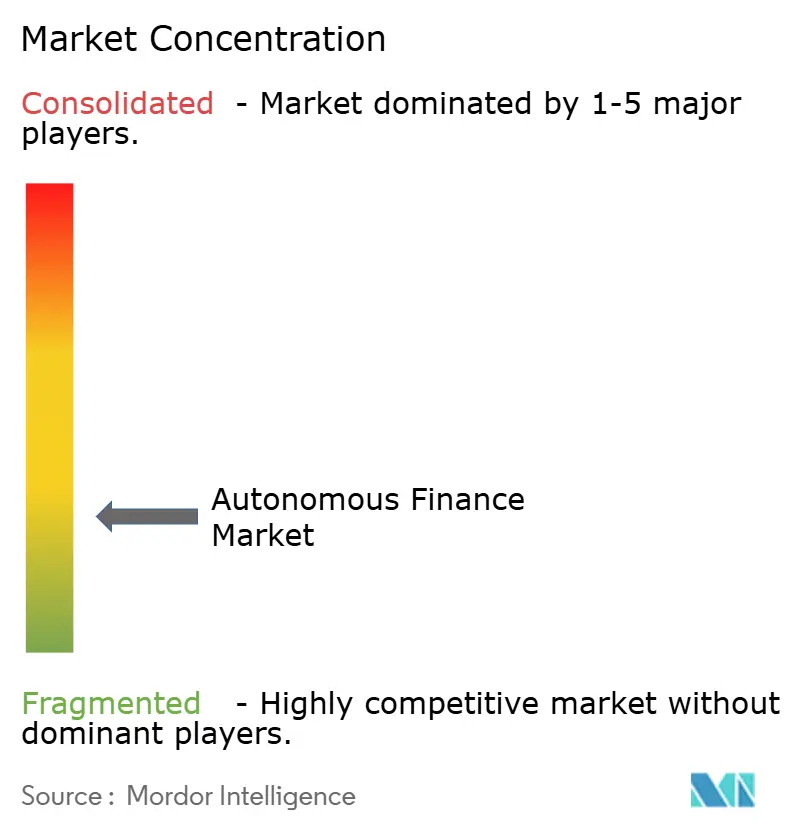
| Market Concentration | Low |
Major Players *Disclaimer: Major Players sorted in no particular order Image © Mordor Intelligence. Reuse requires attribution under CC BY 4.0. | |
Autonomous Finance Market Analysis by Mordor Intelligence
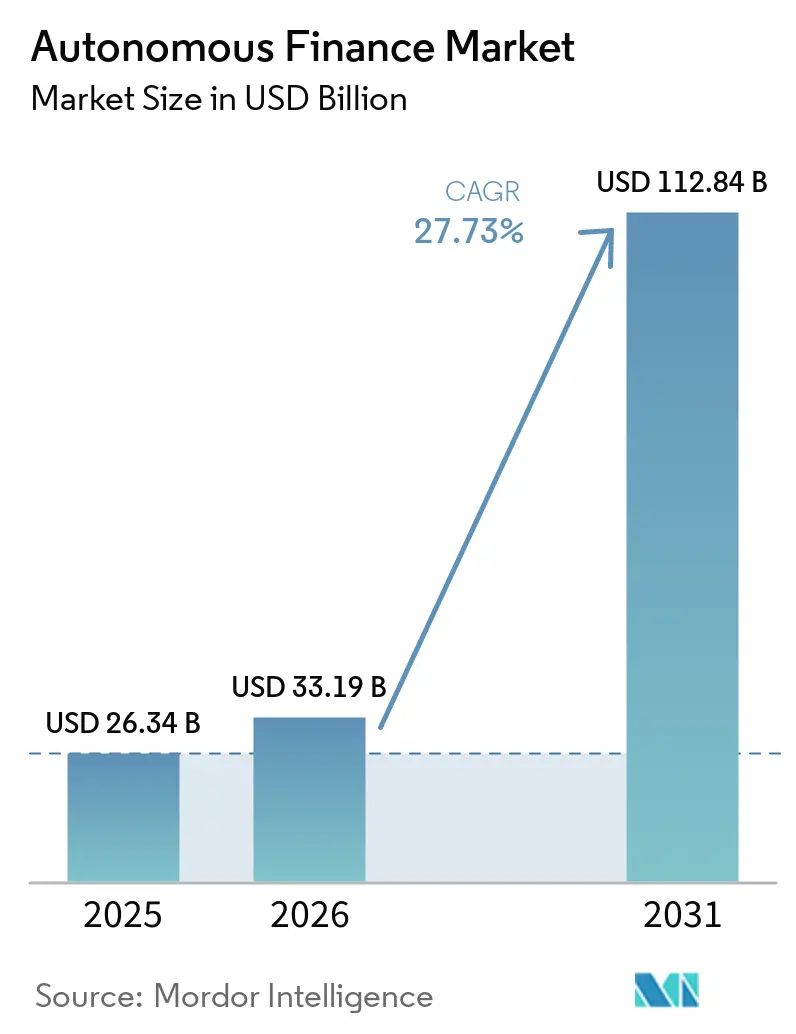
The Autonomous Finance Market size is projected to expand from USD 26.34 billion in 2025 and USD 33.19 billion in 2026 to USD 112.84 billion by 2031, registering a CAGR of 27.73% between 2026 to 2031.
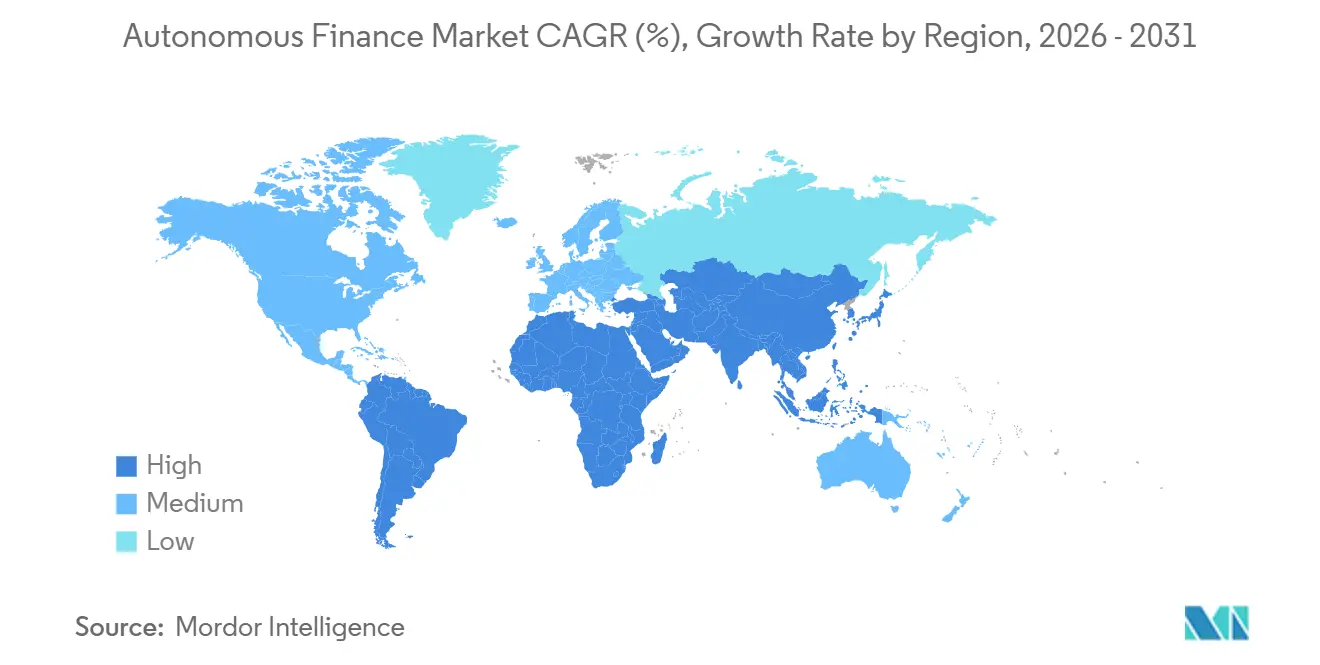
The autonomous finance market is expanding faster than the broader financial technology space because generative AI, cloud-based finance platforms, and tighter governance requirements are advancing simultaneously. North America held the largest regional share at 38.3% in 2025, supported by early adoption across major United States banks and large enterprise treasury functions. Asia-Pacific is projected to record the fastest pace at 30.1% through 2031, reflecting digital bank expansion and stronger investment in AI-enabled finance operations across Japan, India, and Southeast Asia. Commercial demand is shaping the autonomous finance market as finance teams move from periodic automation to always-on execution across treasury, payables, close, and compliance workflows. Competition is also shifting as specialized vendors, ERP providers, and orchestration platforms vie to become the control layer financial institutions use to manage autonomous decisions across the finance stack.
Key Report Takeaways
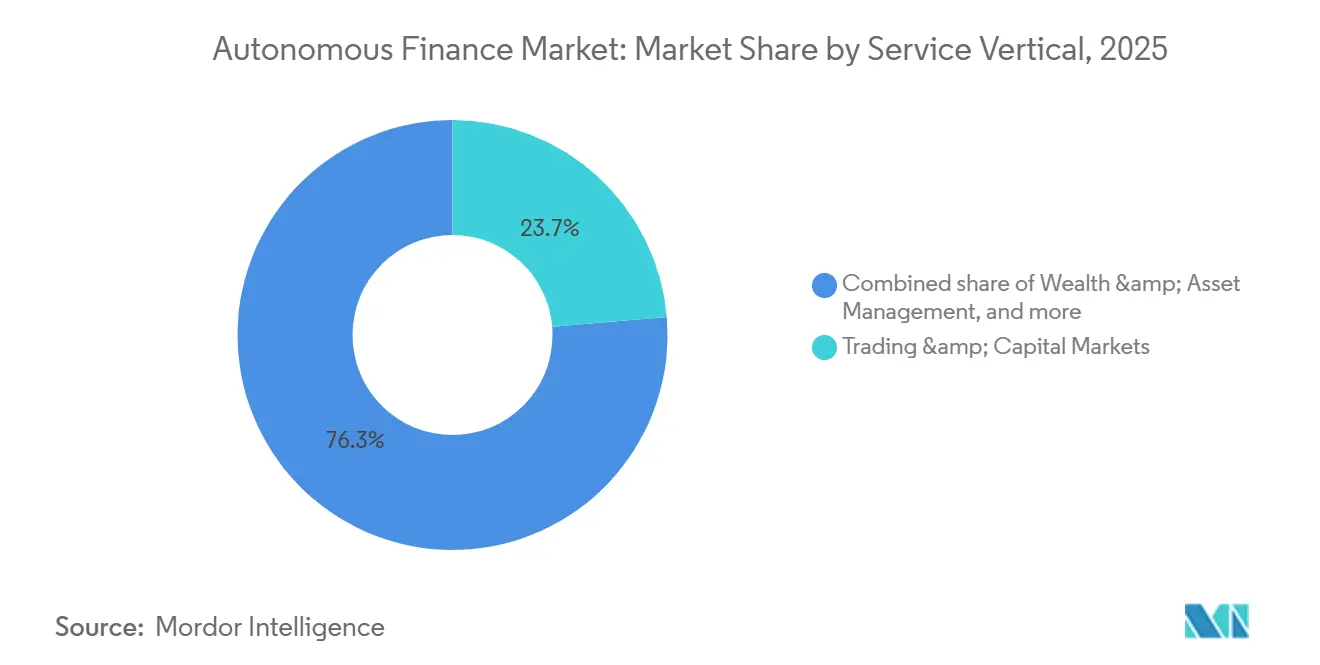
- By service vertical, trading & capital markets held 23.7% of the autonomous finance market share in 2025, while payments, treasury & cash management is projected to grow at 32.3% CAGR through 2031.
- By user segmentation, the commercial segment accounted for 66.5% of the autonomous finance market share in 2025 and is projected to grow at a 29.0% CAGR through 2031.
- By geography, North America captured 38.3% of the autonomous finance market share in 2025, while Asia-Pacific is projected to grow at 30.1% CAGR through 2031.
Note: Market size and forecast figures in this report are generated using Mordor Intelligence’s proprietary estimation framework, updated with the latest available data and insights as of January 2026.
Market Trends and Insights
Drivers Impact Analysis of Autonomous Finance Market*
| Driver | (~) % Impact on CAGR Forecast | Geographic Relevance | Impact Timeline |
|---|---|---|---|
| AI-Driven Straight-Through Processing In Finance Operations | +4.5% | Global, strongest in North America and Europe | Short term (≤ 2 years) |
| Real-Time Decisioning For Treasury, Cash, And Risk Workflows | +3.8% | Global, early deployment in North America and the Asia-Pacific core | Short term (≤ 2 years) |
| Regulatory Demand For Explainable, Auditable Automation | +2.6% | EU primary, spillover to North America and Asia-Pacific | Medium term (2-4 years) |
| Cloud-Native ERP Integration Accelerating Mid-Market Adoption | +3.2% | North America and Europe, spillover to the Asia-Pacific | Medium term (2-4 years) |
| Agentic AI Reducing Back-Office Staffing Dependency | +4.1% | Global | Short term (≤ 2 years) |
| Embedded Finance And Transaction Data Convergence | +3.5% | Asia-Pacific core, spillover to the Middle East and Africa and South America | Medium term (2-4 years) |
| Source: Mordor Intelligence | |||
AI-Driven Straight-Through Processing Compresses the Operational Cost Stack
Straight-through processing is moving from a workflow improvement tool to a core cost reduction lever in the autonomous finance market. Finastra introduced its Intelligent Routing Module at Sibos 2025 and reported a 95% straight-through processing rate across mass, instant, and high-value cross-border payments through real-time routing logic, demonstrating how payment operations are being redesigned around autonomous handling rather than manual review queues[1]. SmartStream also stated that AI-driven reconciliation can deliver auto-matching rates above 95% in optimized environments, reinforcing the same direction in post-trade and operational finance tasks. As these performance levels become more common in large institutions, demand in the autonomous finance market is shifting toward banks and finance teams that still carry high exception volumes and slower manual handoffs. This creates a stronger opening for vendors that can prevent, detect, and resolve payment and reconciliation issues inside existing operations without requiring a full platform rebuild.
Real-Time Decisioning Re-Architects Treasury and Risk Operations
Real-time decisioning is changing treasury and risk workflows from scheduled review cycles to continuous action in the autonomous finance market. SEB stated that 2026 is the year when real-time payment flows become intelligent, with treasury operations increasingly tied to simultaneous activities such as cash positioning, fraud monitoring, and foreign exchange handling[2]. That shift matters because finance teams no longer evaluate liquidity, payments, and control exceptions as separate events processed at different times. Instead, the operating model is moving toward coordinated decision layers that act simultaneously within the same workflow. Vendors that can support this form of synchronized execution are better positioned in the autonomous finance market, as treasury modernization now depends on speed, control, and explainability together.
Agentic AI Converts Headcount Reduction Into a Boardroom-Level KPI
Labor efficiency has become one of the clearest buying signals in the autonomous finance market because autonomous systems are now being measured against workforce capacity rather than small process gains. GMO Aozora Net Bank announced in May 2026 that it plans to replace 2,800 internal tasks with 1,100 AI agents by FY2028, while expanding operating capacity to the equivalent of 40,000 personnel with a workforce of around 400 employees. HighRadius also stated that its cash application and cash forecasting modules had already reached 90% automation by February 2025 across more than 1,000 enterprise clients, including 3M, Unilever, and Hershey’s, and it set a 2027 goal for a fully autonomous finance platform across the Office of the CFO[3]. Citizens Bank reported that 82% of mid-size company CFOs and 95% of private equity firm leaders had begun or planned to implement agentic AI in 2026, while 99% of adopters reported improved operational efficiency. This combination of staffing leverage, measurable automation, and executive-level urgency is pushing the autonomous finance market from pilot activity into broader operating adoption.
Cloud-Native ERP Integration Opens the Mid-Market Entry Point
Cloud-native ERP integration is expanding the addressable market for autonomous finance by lowering the cost and complexity of deployment for smaller enterprises. Workday announced that its Illuminate Agents would be available in production from 2026 across financial close, cost, and profitability analytics, and financial audit workflows, all within the same finance and HR data environment. BlackLine took a similar path with the September 2025 launch of Verity across its Studio360 platform, using an embedded AI layer built on its record-to-report and invoice-to-cash data foundation[4]. These launches matter because finance teams do not need to create a separate data estate before using agent-based tools for reconciliation, close, or audit support. The autonomous finance market is therefore gaining traction beyond the largest institutions and into mid-market organizations that previously lacked the scale to justify custom AI finance programs.
Restraints Impact Analysis of Autonomous Finance Market*
| Restraint | (~) % Impact on CAGR Forecast | Geographic Relevance | Impact Timeline |
|---|---|---|---|
| Data Privacy, Governance, And Consent Management Complexity | -2.8% | EU primary, Asia-Pacific emerging | Medium term (2-4 years) |
| Legacy Core System Integration And Data Quality Friction | -3.1% | Global, most acute in North America and Europe large institutions | Long term (≥ 4 years) |
| High Model-Risk Validation Burden For Autonomous Decisions | -2.2% | North America and Europe | Medium term (2-4 years) |
| Talent Scarcity In Finance AI, Controls, And AI Governance | -1.9% | Global | Medium term (2-4 years) |
| Source: Mordor Intelligence | |||
Data Privacy and Governance Constraints Create Uneven Deployment Velocity
Data governance remains a major constraint for the autonomous finance market because these systems ingest, interpret, and act on highly sensitive financial records across multiple decision layers. The ACPR and Banque de France noted that the EU AI Act, effective from August 2024 with phased obligations through 2026 to 2028, treats credit scoring and insurance pricing systems as high-risk AI applications that require conformity checks, transparency documentation, and ongoing human oversight. The same publication also signaled preparation for sector-level enforcement in finance, meaning vendors targeting European institutions face a longer compliance path than those serving less-regulated markets. This creates uneven deployment speed across regions and increases the practical burden of launching autonomous products across lending, insurance, and customer risk functions. The constraint is not only legal; institutions also need internal rules for how outputs from one agent can be reused by another within a broader workflow.
Legacy Core System Friction Prolongs Manual Handoff Points
Legacy infrastructure slows the autonomous finance market because many banks and enterprises still run finance operations on systems built for periodic processing rather than continuous AI-led execution. SmartStream stated that AI reconciliation can produce 45% to 50% time savings and auto-matching rates above 95% in optimized settings, yet those results depend on strong data quality and a timely operating data layer. Where those conditions are missing, institutions still rely on manual reconciliation, fragmented data mapping, and delayed exception resolution. That means autonomous tools often improve only part of the workflow until the core architecture is modernized enough to support end-to-end execution. The autonomous finance market, therefore, faces a sequencing challenge because platform adoption often depends on earlier investments in data architecture, ERP renewal, and operating controls.
*Our forecasts treat driver/restraint impacts as directional, not additive. The impact forecasts reflect baseline growth, mix effects, and variable interactions.
Autonomous Finance Market Segment Analysis
By Service Vertical:
Payments and Treasury Functions Redefine Market VelocityTrading & Capital Markets held 23.7% of the autonomous finance market share in 2025, which reflects the scale, speed, and cost sensitivity of institutional trading workflows. Broadridge stated in May 2026 that it had deployed agentic AI in production across capital markets and wealth management workflows, and that new clients could achieve up to 30% Day-1 operational cost reduction. The same announcement linked the rollout to a financial services data ontology built around more than USD 15 trillion in daily trading activity across 40-plus managed services clients since 2024. That operating profile explains why this segment continues to lead the autonomous finance market: exception volume is high, each delay carries a measurable cost, and the value of automation becomes visible quickly. It also explains why vendors with existing transaction depth in capital markets still hold an advantage over newer entrants that do not yet control similar workflow density or data context.
Payments, Treasury & Cash Management is projected to expand at a 32.3% CAGR between 2026 and 2031, making it the fastest-growing service vertical in the autonomous finance industry. The main reason is that finance teams are moving from batch-based payment and liquidity management toward real-time execution across settlement, cash positioning, fraud checks, and currency handling. SEB stated that 2026 marks the point when real-time payment flows become intelligent, which aligns directly with stronger demand for agent-based orchestration in treasury and transaction operations. Risk, Compliance & Operations is also gaining momentum as institutions use AI agents for fraud and anti-money-laundering workflows, while FIS said its Financial Crimes AI Agent can compress AML investigations from hours to minutes by assembling evidence across core systems. Lending and insurance automation still have meaningful demand potential, but the autonomous finance industry faces a slower path in Europe, where explainability, human supervision, and auditability standards are stricter for high-risk decision applications.

By User Segmentation:
Commercial Sector Anchors Both Scale and GrowthCommercial users accounted for 66.5% of the autonomous finance market size in 2025 and are forecast to grow at 29.0% CAGR through 2031. This lead reflects the large volume of treasury, accounts payable, financial close, and working capital tasks that enterprises are now moving into semi-autonomous and autonomous execution. Workday said its Illuminate Agents support financial close, cost management, and audit workflows within the native ERP environment, thereby lowering the integration barrier that had delayed adoption in commercial finance teams. HighRadius also reported more than 2,700 implementations across 1,000-plus companies and stated that key modules had already reached 90% automation, providing the autonomous finance market with a strong proof base in corporate finance settings. Citizens Bank further noted that 61% of CFOs agreed that AI made financial processes easier in 2025, up from 38% in 2024, indicating rising confidence among commercial decision-makers rather than isolated pilot success.
Retail users represent the smaller part of the autonomous finance market, but activity is increasing as banks extend autonomous capabilities into customer-facing advisory, planning, and engagement tools. GMO Aozora Net Bank said in May 2026 that it would launch a personalized AI banking interface in November 2026, with the top screen tailored by industry, company size, and user preference. That example shows how the boundary between commercial and retail-facing finance experiences is becoming less rigid as personalization and decision-support tools become part of a shared architecture. Even so, retail deployment still moves more carefully in regions with tighter privacy, consent, and localization expectations, because customer-level data sharing is subject to stricter control than many internal finance workflows. The result is a user mix where commercial demand still leads the autonomous finance market today, while retail adoption builds through bank-led interfaces and supervised advisory functions.
Geography Analysis
North America Autonomous Finance Market
North America accounted for 38.3% of the autonomous finance market in 2025, making it the largest regional base in the current cycle. The region benefits from early enterprise willingness to fund AI-enabled finance transformation across banking, capital markets, and corporate treasury. Citizens Bank reported that 82% of mid-size company CFOs and 95% of private equity firm leaders had begun or planned to implement agentic AI in 2026, indicating strong demand across both operating companies and financial sponsors. The region also has active vendor momentum, with Fiserv launching agentOS in May 2026 as an agentic AI operating system for banking workflows and broader availability targeted for August 2026. In practical terms, North America continues to lead the autonomous finance market because deployment appetite, vendor supply, and existing transaction scale all support faster commercial rollout than in most other regions.
APAC Autonomous Finance Market
Asia-Pacific is projected to grow at a 30.1% CAGR through 2031, making it the fastest-growing regional market in the forecast period. The region is not moving on a single pattern, because Japan, Southeast Asia, India, and other markets are adopting autonomous finance at different speeds and under different regulatory settings. GMO Aozora Net Bank’s May 2026 announcement on internal AI agents, customer interface personalization, and third-party Agentic API access shows how Japanese institutions are treating AI-led finance transformation as a multi-layer operating agenda rather than a single product release. In Singapore, MetaComp launched the StableX Know Your Agent framework in April 2026 for regulated financial services, showing that governance infrastructure is also being built alongside deployment use cases. These developments support the autonomous finance market in Asia-Pacific, as regional growth is driven by both application rollouts and the control frameworks needed to scale autonomous interactions safely.
EMEA and South America Autonomous Finance Market
Europe remains one of the most important regions for the autonomous finance market, but adoption there is shaped more directly by regulatory structure than in many other markets. The ACPR and Banque de France stated that the EU AI Act places credit scoring and insurance pricing among high-risk applications, and that these systems require stronger supervision, documentation, and control mechanisms. That creates a more demanding path for fully autonomous deployment in lending and insurance, even while it raises demand for explainability, audit, and orchestration tools. South America is still in earlier stages of development, with financial institutions evaluating how agentic models can support inclusion, credit access, and payment efficiency under evolving governance structures. The Middle East and Africa are also becoming more relevant to the autonomous finance market because newer digital banking builds in Saudi Arabia and the UAE are not constrained by the same legacy system burden that slows adoption in older banking environments.
Competitive Landscape
The autonomous finance market is fragmented, with competition spread across large ERP and platform vendors, AI-native specialists, and a growing class of orchestration layer providers. Competitive intensity varies materially by workflow, as trading operations, treasury platforms, financial close, and compliance automation do not share the same vendor mix. Fiserv’s May 2026 launch of agentOS demonstrates how infrastructure incumbents are seeking to become the operating layer for AI agents across banking workflows, including risk management, regulatory reporting, deposit operations, and reconciliation. That move matters because institutions may prefer a shared orchestration layer over a collection of isolated point tools, especially where control, trust, and integration are central to deployment. As a result, the autonomous finance market is becoming less about one isolated AI feature and more about who controls the environment in which multiple autonomous tools operate.
Data depth and workflow adjacency are also shaping competitive advantage in the autonomous finance market. Broadridge’s production deployment across capital markets and wealth operations, supported by a data ontology linked to more than USD 15 trillion in daily trading activity, gives it scale advantages in institutional transaction environments. BlackLine’s Verity launch in September 2025 shows a similar pattern in office-of-the-CFO workflows, where existing reconciliation and record-to-report data serve as the foundation for embedded AI differentiation. Workday is taking a related path by placing finance agents directly inside the same operating data environment used for enterprise ledgers and cost workflows. These moves suggest that the autonomous finance market is rewarding vendors that already sit close to system-of-record data, because they can add agent capability without forcing clients into a separate operating model.
Competitive openings still exist, especially in underpenetrated workflow areas and customer groups. FIS said in May 2026 that its Financial Crimes AI Agent can compress AML investigations from hours to minutes, demonstrating that targeted use cases with direct operational pain points still offer room for specialized expansion even as platform vendors broaden their reach. Experian’s Agent Operating System, launched in June 2026, points to another route where compliance-forward orchestration can differentiate across fraud, identity, credit risk, and compliance workflows. HighRadius remains important in commercial finance because its automation depth is already validated across a large installed base of enterprise users. This leaves the autonomous finance market with active competition between incumbents that own workflow context, specialists that solve narrow finance problems well, and orchestration players that want to sit above both.
Autonomous Finance Industry Leaders
-
HighRadius Corporation
-
Oracle Corporation
-
SAP SE
-
Workday, Inc.
-
BlackLine, Inc.
- *Disclaimer: Major Players sorted in no particular order
Autonomous Finance Market Companies Covered in this Report
- HighRadius Corporation
- Oracle Corporation
- SAP SE
- BlackLine, Inc.
- Workday, Inc.
- Prophix Software Inc.
- Auditoria.AI
- Vic.ai
- Emagia Corporation
- NICE Ltd.
- Signzy Technologies Private Limited
- Roots Automation Inc.
- ReGov Technologies Sdn Bhd
- Fennech Financial Ltd.
- IBM Corporation
- Microsoft Corporation
- JPMorgan Chase and Co.
- Goldman Sachs Group, Inc.
- Temenos AG
- Pegasystems Inc.
Recent Industry Developments in Autonomous Finance Market
- June 2026: SmartStream launched Smart Agents, an agentic AI solution for bank back-office operations, proven across Tier-1 pilot deployments and natively integrated with SmartStream's reconciliation platform. The solution operates in both assistive and autonomous modes with full step-by-step explainability and data privacy, enabling firms to scale AI adoption within internal governance requirements.
- June 2026: Experian unveiled its Agent Operating System at Money20/20 Europe, a trusted agentic AI orchestration layer within the Ascend Platform that enables Experian, clients, and partners' AI agents to work together through a shared trust, semantic, and audit architecture across fraud, identity, credit risk, and compliance workflows.
- May 2026: Fiserv launched agentOS, an agentic AI operating system built with OpenAI on AWS Bedrock and co-developed with six financial institutions, featuring the industry's first agent marketplace for banking workflows spanning risk management, regulatory reporting, deposit operations, and back-office reconciliation. Broad availability is targeted for August 2026.
- May 2026: Broadridge Financial Solutions deployed agentic AI capabilities in production across capital markets and wealth management, offering new clients up to 30% Day-1 operational cost reduction. The deployment is built on a completed financial services data ontology integrating USD 15 trillion in daily trading activity across 40-plus managed services clients since 2024.
Global Autonomous Finance Market Report Scope
Segmentation Overview
| Wealth & Asset Management |
| Trading & Capital Markets |
| Lending & Credit |
| Insurance |
| Payments, Treasury & Cash Management |
| Risk, Compliance & Operations |
| Retail |
| Commercial |
| North America | United States |
| Canada | |
| Mexico | |
| South America | Brazil |
| Argentina | |
| Rest of South America | |
| Europe | United Kingdom |
| Germany | |
| France | |
| Italy | |
| Spain | |
| Rest of Europe | |
| Asia-Pacific | India |
| China | |
| Japan | |
| South Korea | |
| Australia | |
| South East Asia (Singapore, Malaysia, Thailand, Indonesia, Vietnam, and Philippines) | |
| Rest of Asia-Pacific | |
| Middle East and Africa | United Arab Emirates |
| Saudi Arabia | |
| South Africa | |
| Nigeria | |
| Rest of Middle East and Africa |
| By Service Vertical | Wealth & Asset Management | |
| Trading & Capital Markets | ||
| Lending & Credit | ||
| Insurance | ||
| Payments, Treasury & Cash Management | ||
| Risk, Compliance & Operations | ||
| By User Segmentation | Retail | |
| Commercial | ||
| By Geography | North America | United States |
| Canada | ||
| Mexico | ||
| South America | Brazil | |
| Argentina | ||
| Rest of South America | ||
| Europe | United Kingdom | |
| Germany | ||
| France | ||
| Italy | ||
| Spain | ||
| Rest of Europe | ||
| Asia-Pacific | India | |
| China | ||
| Japan | ||
| South Korea | ||
| Australia | ||
| South East Asia (Singapore, Malaysia, Thailand, Indonesia, Vietnam, and Philippines) | ||
| Rest of Asia-Pacific | ||
| Middle East and Africa | United Arab Emirates | |
| Saudi Arabia | ||
| South Africa | ||
| Nigeria | ||
| Rest of Middle East and Africa | ||
Key Questions Answered in the Report
What is the 2031 outlook for autonomous finance?
The autonomous finance market is forecast to reach USD 112.8 billion by 2031 from USD 33.2 billion in 2026, growing at a 27.7% CAGR over 2026-2031.
Which service area leads autonomous finance adoption today?
Trading & Capital Markets led with 23.7% share in 2025 because institutional workflows have high transaction density, costly exceptions, and a clear return on automation.
Which service area is growing the fastest through 2031?
Payments, Treasury & Cash Management is the fastest-growing vertical with a projected 32.3% CAGR, supported by the shift toward real-time payment, cash, and liquidity operations.
Why are commercial users driving adoption more than retail users?
Commercial users held 66.5% share in 2025 and are also the fastest-growing user group at 29.0% CAGR because enterprises have broader finance workflows ready for autonomous execution.
Which region is leading, and which region is growing the fastest?
North America held the largest share at 38.3% in 2025, while Asia-Pacific is expected to post the fastest growth at 30.1% through 2031.
What is the main barrier slowing wider deployment?
The biggest barriers are governance and legacy architecture, especially in Europe where high-risk finance AI use cases face stricter oversight, and in large institutions where older core systems still limit end-to-end automation.