
Sustainable Finance Market Size and Share
Market Overview
| Study Period | 2020 - 2031 |
|---|---|
| Market Size (2026) | USD 15.06 Trillion |
| Market Size (2031) | USD 26.93 Trillion |
| Growth Rate (2026 - 2031) | 12.34 % |
| Fastest Growing Market | Europe |
| Largest Market | Asia Pacific |
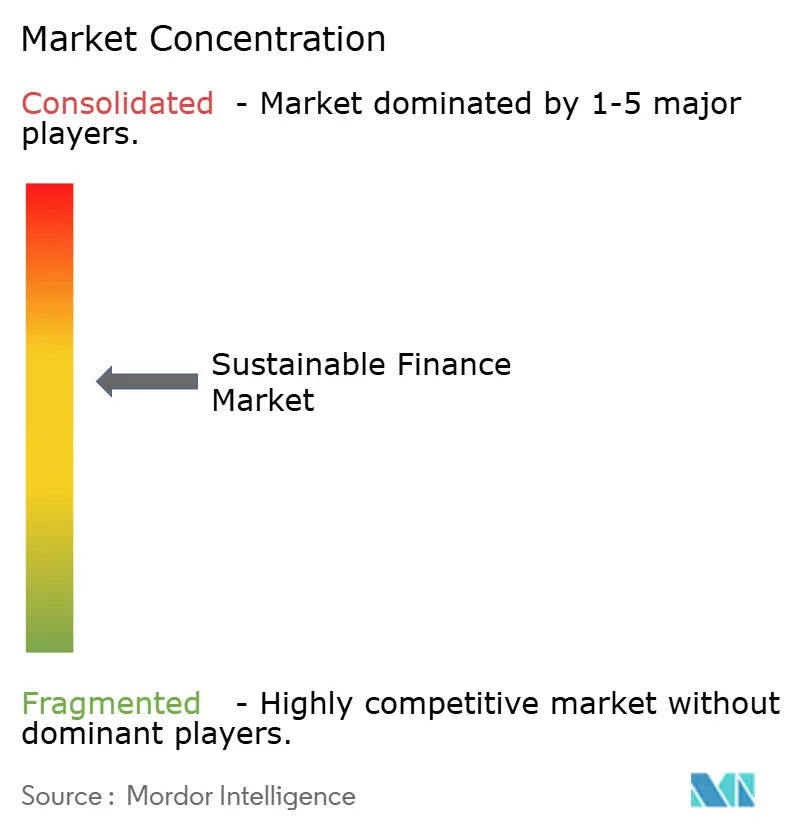
| Market Concentration | Medium |
Major Players *Disclaimer: Major Players sorted in no particular order Image © Mordor Intelligence. Reuse requires attribution under CC BY 4.0. | |
Sustainable Finance Market Analysis by Mordor Intelligence
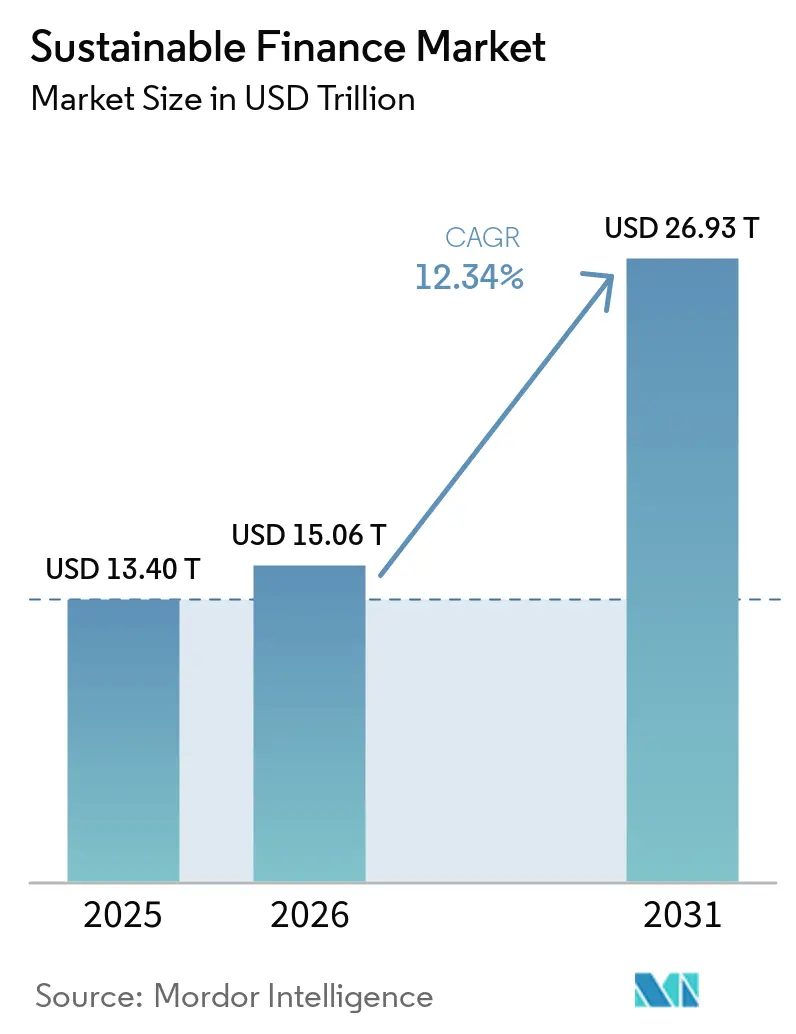
The Sustainable Finance Market size was valued at USD 13.40 trillion in 2025 and is estimated to grow from USD 15.06 trillion in 2026 to reach USD 26.93 trillion by 2031, at a CAGR of 12.34% during the forecast period (2026-2031).
Europe remains the largest regional pool, yet institutional capital is rotating quickly toward Asia-Pacific as sovereign green bond programs accelerate. Central-bank climate stress-testing, mandatory disclosure rules, and sovereign issuance pipelines have turned environmental, social, and governance (ESG) factors from optional screens into core risk variables for global banks and investors. Rapid product innovation, from tokenized green assets to performance-linked debt, has broadened the investable universe and reduced transaction frictions. Although regulatory momentum is strong, the market’s forward trajectory still hinges on harmonized taxonomies, interest-rate dynamics that preserve the greenium, and sustained political support for ESG mandates.
Key Report Takeaways
- By transaction type, green bonds accounted for 53.88% of the sustainable finance market share in 2025, while sustainability-linked and transition bonds are on track to rise at a 14.08% CAGR to 2031.
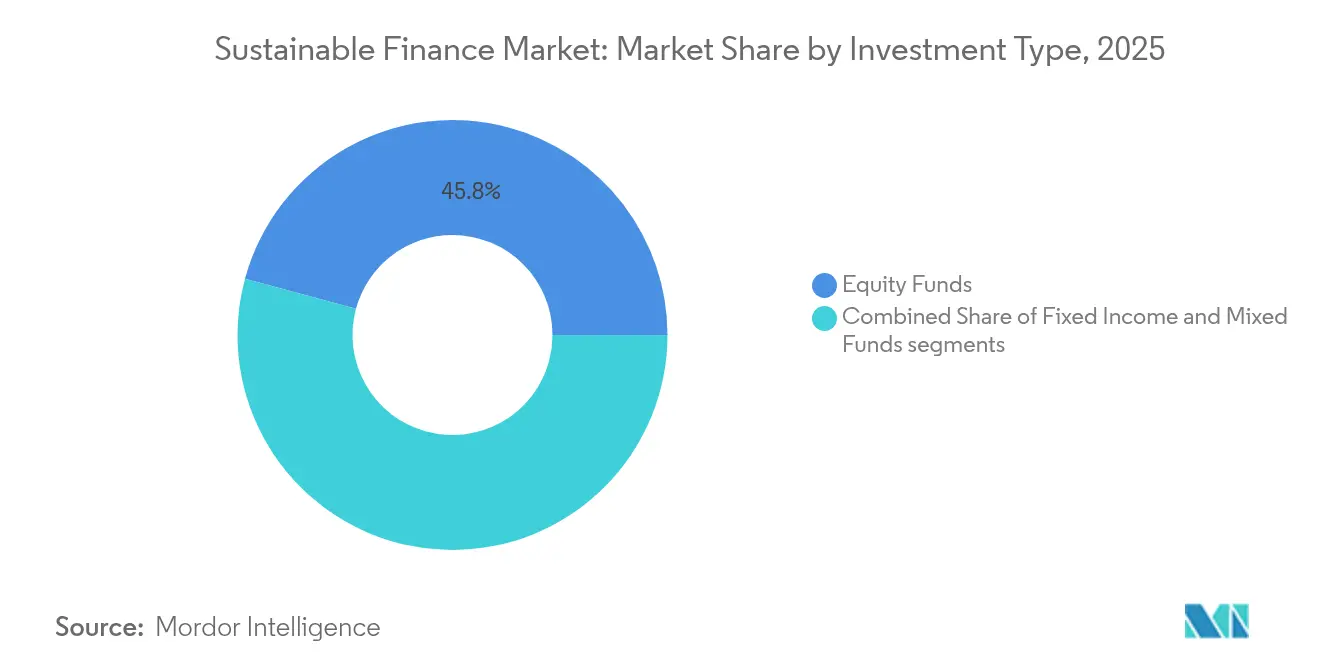
- By investment type, equity funds led with 45.78% of the market share in 2025; mixed/multi-asset strategies are forecast to expand at 13.22% CAGR through 2031.
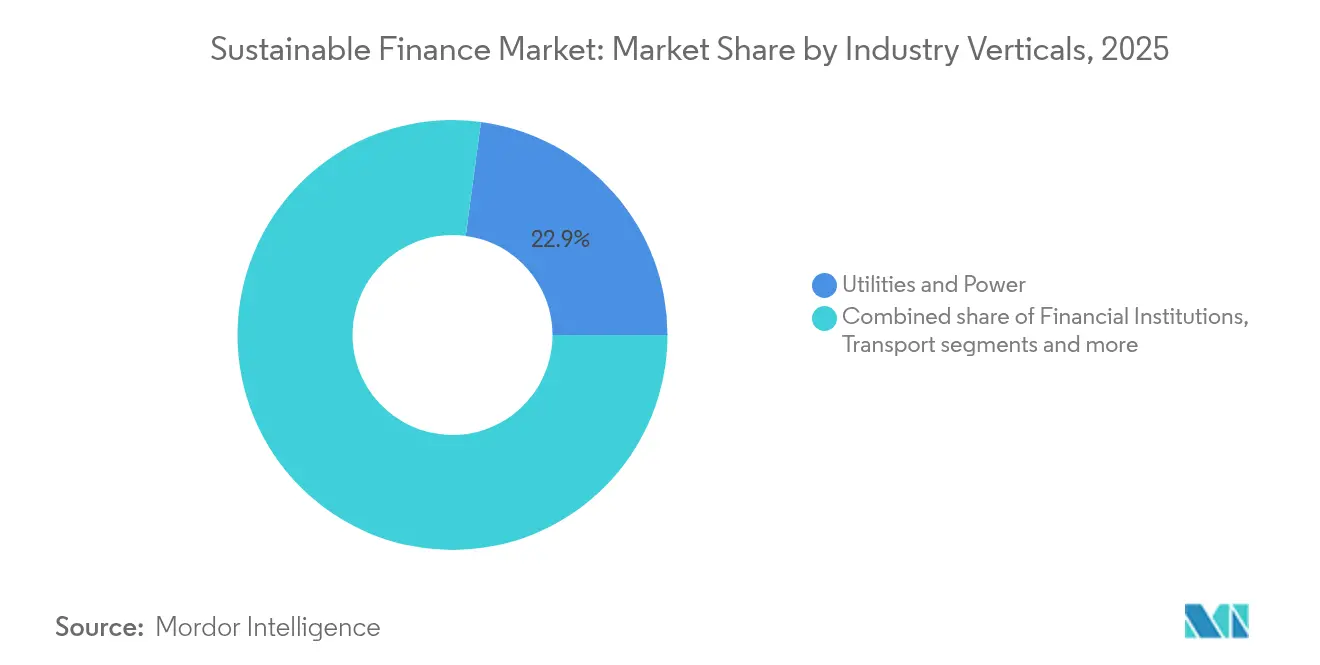
- By industry vertical, utilities and power captured 22.89% of the sustainable finance market size in 2025, whereas financial institutions are projected to post the fastest 13.14% CAGR to 2031.
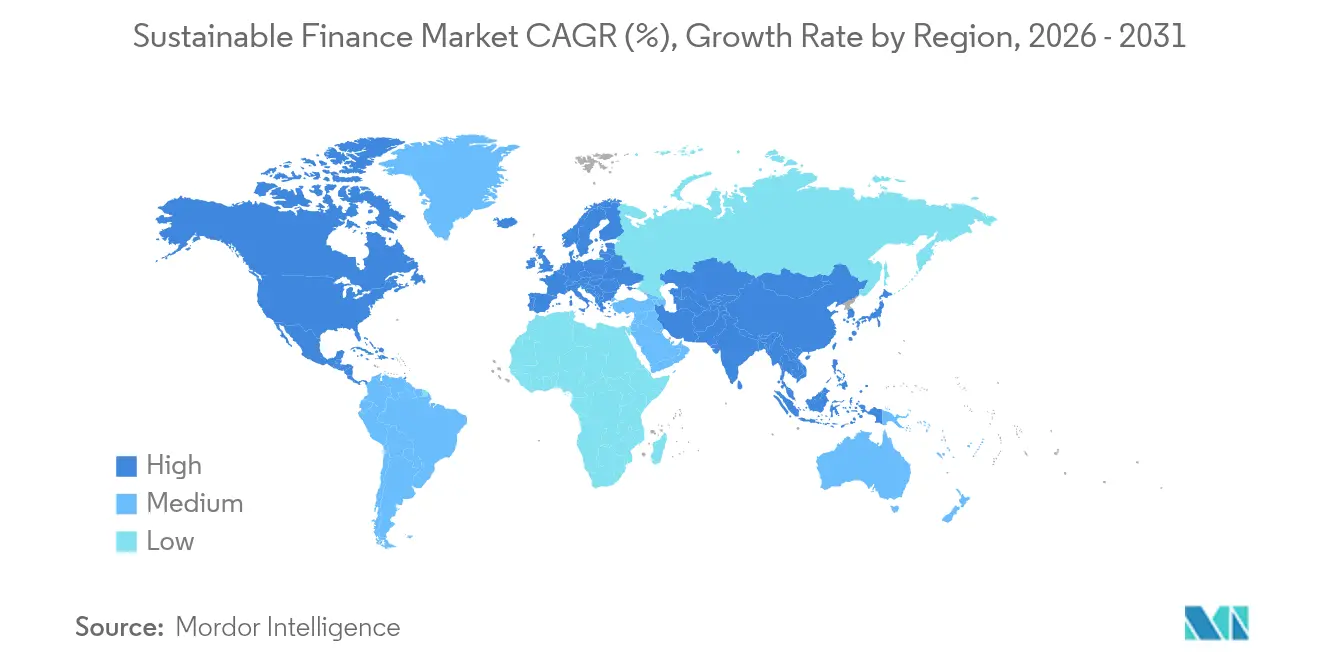
- By geography, Europe held a 31.72% revenue share of the market in 2025; Asia-Pacific is projected to grow at a 12.53% CAGR to 2031.
Note: Market size and forecast figures in this report are generated using Mordor Intelligence’s proprietary estimation framework, updated with the latest available data and insights as of 2026.
Market Trends and Insights
Drivers Impact Analysis of Sustainable Finance Market*
| Driver | ( ~ ) % Impact on CAGR Forecast | Geographic Relevance | Impact Timeline |
|---|---|---|---|
| Regulatory push & mandatory ESG disclosures | +2.5% | Global (EU leadership; APAC uptake) | Medium term (2-4 years) |
| Rise of corporate-stakeholder ESG pressure | +1.8% | North America & Europe spreading to APAC | Short term (≤2 years) |
| Proven long-term risk-adjusted returns of ESG assets | +2.1% | Global institutional markets | Long term (≥4 years) |
| Central-bank climate stress-testing of balance sheets | +1.4% | Developed markets; selective emerging economies | Medium term (2-4 years) |
| Tokenization & blockchain-based green asset issuance | +0.9% | Global; early adoption in Singapore and Hong Kong | Long term (≥4 years) |
| Climate-adaptation & resilience finance demand surge | +1.2% | Global; concentrated in climate-vulnerable regions | Long term (≥4 years) |
| Source: Mordor Intelligence | |||
Regulatory Push and Mandatory ESG Disclosures
The EU Corporate Sustainability Reporting Directive now obliges more than 50,000 companies to publish detailed sustainability metrics, giving investors a consistent data spine for portfolio analysis[1]. Similar frameworks from the International Sustainability Standards Board are being adopted in the UK, Japan, and Australia, creating a de facto global “accounting language” for climate data. Mandatory disclosures shrink information asymmetry, reduce diligence costs, and enable easier cross-border comparison of issuers. Asset managers are using the new data to adjust credit spreads for transition risk, rewarding compliant borrowers with cheaper capital. Sovereign regulators are also embedding disclosure requirements into listing rules, extending the discipline to private and state-owned enterprises. As a result, ESG considerations have moved from voluntary policies to core prudential standards within the sustainable finance market.
Rise of Corporate-Stakeholder ESG Pressure
Shareholder support for ESG resolutions rose to 28% in 2024, signaling a broader willingness to influence corporate policy[2]. Boards face simultaneous pressure from customers and employees who increasingly select suppliers and employers on sustainability performance, accelerating target-setting for decarbonization and social equity. Financial institutions have responded with sizeable balance-sheet pledges, HSBC aims for USD 750 billion in sustainable finance by 2030, ING targets USD 162 billion, and Deutsche Bank earmarks USD 540 billion. These public goals generate a competitive cascade as peers match or exceed commitments to avoid reputational risk. Lenders are also tightening sustainability covenants in revolving credit facilities, sharpening incentives for real-economy issuers. Together, these forces reinforce a self-reinforcing cycle that channels incremental capital toward the sustainable finance market.
Proven Long-Term Risk-Adjusted Returns of ESG Assets
A 2024 survey of 700 ESG equity funds found that 73% beat conventional benchmarks on a volatility-adjusted basis. Outperformance stems from ESG metrics acting as proxies for management quality, supply-chain robustness, and regulatory preparedness, all of which translate into steadier cash flows. Academic work shows ESG leaders experience lower financing costs and smaller drawdowns during market stress, improving Sharpe ratios. Pension trustees and endowments are increasingly making ESG integration a fiduciary requirement, not an optional overlay. Liquidity has improved as market makers quote tighter spreads for labelled bonds and ETFs, reducing transaction costs for allocators. Collectively, the empirical return profile underpins sustained growth in the sustainable finance market.
Central-Bank Climate Stress-Testing of Balance Sheets
The European Central Bank’s 2024 stress test of 98 banks covering 70% of euro-area assets indicated potential transition-risk losses of up to USD 75.6 billion under disorderly-transition scenarios[3]. The Bank of England and the United States Federal Reserve have launched parallel pilots, embedding climate metrics into capital adequacy reviews. As supervisors publish results, banks must re-price high-carbon exposures and raise capital against worst-case losses. This pushes lenders to expand green lending books and scale back fossil-fuel finance, reallocating credit to renewable infrastructure and resilience projects. Insurers face similar solvency tests, driving asset-side portfolio shifts. These supervisory tools hard-wire ESG risk into prudential frameworks, accelerating capital flows into the sustainable finance market.
Restraints Impact Analysis of Sustainable Finance Market*
| Restraint | ( ~ ) % Impact on CAGR Forecast | Geographic Relevance | Impact Timeline |
|---|---|---|---|
| Lack of global taxonomy / data standardization | -1.3% | Global; especially challenging for emerging markets | Medium term (2-4 years) |
| Perceived green-washing & credibility gaps | -0.8% | Global; sharper in regimes with weak oversight | Short term (≤2 years) |
| Political backlash & anti-ESG legislation (US states) | -0.9% | North America, with spillover effects to global asset flows | Short term (≤ 2 years) |
| Rising rates eroding "greenium" bond pricing | -0.7% | Global fixed-income markets, particularly developed economies | Medium term (2-4 years) |
| Source: Mordor Intelligence | |||
Lack of Global Taxonomy / Data Standardization
While the EU Taxonomy provides granular screening criteria, the US, China, and India have developed divergent frameworks, forcing multinational issuers to navigate conflicting definitions of “sustainable”. Compliance teams must map activities to multiple classifications, inflating issuance costs and delaying transaction timelines. For investors, inconsistent data hinders cross-border portfolio comparisons and may reduce appetite for foreign labelled debt. Emerging-market borrowers face the steepest hurdles because they often lack internal capacity to meet varied disclosure rules. Efforts by the International Sustainability Standards Board aim to converge approaches, but wholesale alignment is unlikely before 2027. Until then, fragmented taxonomies will continue to shave growth points off the sustainable finance market.
Perceived Green-Washing & Credibility Gaps
The European Securities and Markets Authority’s 2024 review uncovered widespread inconsistencies between fund labels and underlying holdings, sparking stricter naming rules and possible reclassifications. Asset managers now incur higher assurance and audit costs to validate sustainability claims. Investors, wary of reputational risk, conduct deeper due diligence, extending allocation lead times and sometimes opting for passive benchmarks with clear rules. Litigation risk is climbing, as class-action suits target alleged mis-selling of ESG products in the US and Australia. Rating agencies have responded with tougher methodologies, occasionally downgrading issuers that overstate decarbonization plans. These credibility concerns can curb inflows until impact-measurement standards mature, tempering the sustainable finance market’s expansion.
*Our forecasts treat driver/restraint impacts as directional, not additive. The impact forecasts reflect baseline growth, mix effects, and variable interactions.
Sustainable Finance Market Segment Analysis
By Investment Type:
Multi-Asset Strategies Gain GroundMixed and multi-asset vehicles hold rising appeal, growing at a 13.22% CAGR through 2031 as institutions seek diversified access across public equity, private credit, and infrastructure. Equity funds still represent 45.78% of the sustainable finance market share in 2025, buoyed by robust renewable and clean-tech performance. Yet the rapid uptake of multi-asset products underscores a desire to capture the full transition spectrum in one mandate. The Wellington-Vanguard-Blackstone collaboration showcases how partnerships can democratize previously exclusive strategies. Private-market sleeves inside these vehicles channel capital to grid modernization, battery storage, and nature-based carbon projects; areas where listed exposure is scarce. Fixed-income allocations are also swelling as labelled-bond pipelines deepen; global sustainable bond issuance approached USD 1 trillion in 2024, broadening credit diversification. Investors welcome the ability to toggle risk profiles dynamically across asset classes without leaving a single vehicle, reinforcing momentum behind multi-asset solutions.
A second trend is the steady institutionalization of thematic ETFs and mandates tracking water, circular-economy, and social-inclusion indices. These instruments have attracted endowments and insurers looking to address specific impact goals within overall climate strategies, further enlarging the sustainable finance market. To support product integrity, managers embed third-party assurance and on-chain data feeds, which shorten reporting cycles and enhance credibility. As these structures mature, they provide a blueprint for expanding the sustainable finance market size by mobilizing retail and defined contribution capital.

By Transaction Type:
Performance-Linked Debt Reshapes IssuanceSustainability-linked and transition bonds are the fastest-moving corner of the sustainable finance market, advancing at 14.08% CAGR. Cumulative issuance since 2019 topped USD 250 billion, equal to more than 10% of the green-bond universe. The appeal lies in coupon step-ups if issuers miss decarbonization or diversity targets, aligning incentives with impact. Green bonds, however, remain anchor instruments with a 53.88% share of 2025 issuance. The European Central Bank’s decision to accept sustainability-linked paper as collateral has increased liquidity and compressed spreads. Early observation dates in 2025 will test issuer commitment, but preliminary data suggest most firms are on track, reinforcing investor confidence.
Adjacent innovations include blue bonds financing ocean conservation and resilience bonds for climate adaptation. Sovereigns such as Uruguay have pioneered sustainability-linked sovereign formats that embed GDP-adjusted coupons, signalling future optionality for fiscal authorities. Tokenised micro-bond structures under trial in Hong Kong could open the sustainable finance market to smaller corporates by cutting settlement costs. Together, these developments point toward a more granular capital stack aligned to transition pathways, broadening participation and enlarging the sustainable finance market size.
By Industry Vertical:
Finance Sector Leads ESG MainstreamingUtilities and power companies drew 22.89% of sustainable finance volumes in 2025, reflecting multi-trillion-dollar grid and renewables requirements. Yet banks and diversified financials display the highest 13.14% CAGR as they embed net-zero roadmaps into primary lending and advisory businesses. Commitments such as HSBC’s USD 750 billion-1 trillion and Deutsche Bank’s USD 540 billion targets illustrate how core balance sheet strategies are shifting toward climate-aligned exposures. Insurance groups are likewise tilting general accounts toward green infrastructure, having identified lower catastrophe risk correlations versus legacy portfolios. The sustainable finance industry is witnessing rapid product creation for transport, chemicals, and agriculture, each attracting blended-finance structures that combine multilateral guarantees with private debt. The growth of sustainability-linked derivatives for shipping and aviation fuels further attests to vertical expansion.
In parallel, corporate treasury teams are embedding ESG performance criteria into revolving credit facilities, extending sustainable finance beyond capital markets issuance. This cross-pollination boosts demand for external assurance providers and data analytics firms, generating a competitive service ecosystem that reinforces the sustainable finance market. Looking forward, industrial firms in hard-to-abate segments are expected to tap transition instruments heavily as they align with 2030 decarbonization milestones, enlarging segmental diversity.
Geography Analysis
Europe Sustainable Finance Market
Europe retained 31.72% of global sustainable finance market share in 2025, supported by the EU Taxonomy, CSRD, and the Sustainable Finance Disclosure Regulation, which together create the most comprehensive rulebook worldwide. Germany’s twin-tranche Bund green securities and Italy’s BTP Green series shape the euro yield curve, anchoring investor demand. The European Central Bank’s collateral policy further underwrites market liquidity. Regional growth is driven by the European Green Deal, which mobilises USD 1.08 trillion in public-private investment toward mid-century carbon neutrality.
APAC Sustainable Finance Market
Asia-Pacific records the fastest 12.53% CAGR to 2031. China’s USD 824 million sovereign green bond on the London Stock Exchange signalled Beijing’s commitment and is expected to catalyse onshore issuance. Singapore intends to raise up to USD 25.9 billion in green bonds and has launched Project Greenprint to digitalise sustainability data across the financial sector. Japan and Australia are debuting sovereign green programmes, with Canberra’s USD 4.62 billion green bond attracting USD 14.5 billion in bids from 105 global investors, illustrating surplus appetite for APAC climate assets. Southeast Asian nations are exploring blended-finance vehicles to de-risk early-stage renewable projects, while India’s Reserve Bank inclusion of green bonds in statutory liquidity norms is likely to drive domestic demand.
The Americas and MEA Sustainable Finance Market
North America remains a deep capital pool despite political contestation. US asset managers control trillions in ESG mandates, and federal incentives under the Inflation Reduction Act underpin renewable deployment, steering capital into climate infrastructure. Canada’s second USD 2.96 billion sovereign green bond, which controversially included nuclear energy, drew 66% ESG-oriented investors. Momentum could vary by state regulation, yet institutional allocations appear durable due to fiduciary appreciation of climate risk. Emerging markets in South America and the Middle East are gaining traction; Uruguay’s sustainability-linked bond and Saudi Arabia’s prospective green municipal issuances hint at diversification of the sustainable finance market. Although these regions start from smaller bases, regulatory ambition and infrastructure needs suggest outsized growth potential once frameworks mature.
Regulatory Landscape
Sustainable finance regulation has broadened into a multi-jurisdictional compliance stack, with UNCTAD's Sustainable Finance Regulations Platform tracking 807 regulations across 35 economies. In Europe, the CSRD (Directive (EU) 2022/2464) widens mandatory sustainability reporting coverage (more than 50,000 companies), while 2026 legislative activity such as the Sustainability Omnibus has targeted amendments to scope thresholds across CSRD and the CSDDD, creating near-term uncertainty for issuers and asset managers around perimeter, timing, and data requirements.
Outside the EU, rulemaking is converging around disclosure and transition planning through named supervisors and standard setters. The UK Financial Conduct Authority's 2026 consultation (CP26/5) aligns sustainability disclosures with ISSB-style reporting, with proposed application for accounting periods starting on or after 1 January 2027, and Singapore's Monetary Authority of Singapore issued Environmental Risk Management (Transition Planning) guidelines in March 2026, with effectiveness from September 2027 across banks, insurers, and asset managers. In parallel, European Parliament committee work in 2026 on SFDR and PRIIPs revisions reinforces the shift from voluntary ESG claims toward label discipline, including product-level comparability, naming rules, and clearer disclosure expectations.
Value Chain Analysis
The sustainable finance value chain starts with policy and standards setting, including the EU Taxonomy and CSRD, plus SFDR and ISSB-aligned disclosure rulemaking, which define the data fields and definitions that flow downstream. Issuers (sovereigns, corporates, and financial institutions) then originate labeled and performance-linked instruments, while banks and arrangers structure frameworks, KPIs, and documentation for green bonds, sustainability bonds, and sustainability-linked and transition formats. Verification and assurance providers, ESG data vendors, and index administrators convert disclosures into investable signals that asset managers and owners use for screening, portfolio construction, stewardship, and reporting.
Distribution and market infrastructure complete the chain via exchanges, depositories, custodians, fund platforms, and analytics layers that reduce friction and support ongoing monitoring. On the buy side, large global managers and regional banks consolidate demand through mutual funds, ETFs, mandates, and private-market vehicles, while engagement and voting policies link capital allocation to issuer performance and governance choices. Outcome measurement and multi-theme underwriting increasingly shape underwriting and packaging decisions, including nature, adaptation, and transition planning, as reflected in practices such as integrating supply-chain climate-risk analysis into due diligence and allocation processes under multi-year climate strategies.
Competitive Landscape
The sustainable finance market features moderate concentration: the top three asset managers, BlackRock, Vanguard, and State Street, hold significant shares yet face accelerating competition from fintechs, ESG data specialists, and regional champions. BlackRock’s USD 12 billion acquisition of HPS Investment Partners created a USD 220 billion private-credit platform that can structure bespoke sustainable loans, while the USD 3 billion purchase of Global Infrastructure Partners adds a USD 100 billion renewable and transport infrastructure pipeline. Vanguard has deepened shareholder-engagement capacity, and State Street is embedding real-time ESG analytics across its custody network to retain institutional stickiness.
Partnership models are proliferating. Wellington Management, Vanguard, and Blackstone have teamed up on multi-asset climate portfolios, demonstrating that scale players value specialist expertise to win mandates from pension and sovereign clients. Meanwhile, regional banks in Asia, such as DBS and OCBC, leverage local networks to originate green and transition loans, subsequently distributing risk via labelled securitizations. Blockchain-enabled platforms operating in Hong Kong and Singapore tokenize solar or energy-efficiency assets, expanding investor bases through fractionalization and instant settlement.
Competitive pressure also arises from ESG data providers that offer granular emissions, biodiversity, and supply-chain indicators, allowing midsize managers to compete on analytics rather than AUM heft. To defend margins, incumbents are investing in proprietary datasets, AI-driven impact measurement, and automated client reporting. Regulatory divergence across jurisdictions creates an advantage for globally diversified firms that can absorb compliance costs, yet nimble local players thrive by tailoring products to domestic guidelines. Over the forecast horizon, consolidation is likely as managers seek scale in private markets and infrastructure, while specialist impact houses will continue to carve out niches in adaptation finance and nature-based solutions, enlarging the sustainable finance market size.
Sustainable Finance Industry Leaders
-
BlackRock
-
Vanguard Group
-
State Street Global Advisors
-
Amundi
-
BNP Paribas Asset Management
- *Disclaimer: Major Players sorted in no particular order
Sustainable Finance Market Companies Covered in this Report
- BlackRock
- Vanguard Group
- State Street Global Advisors
- JPMorgan Asset Management
- Citigroup
- Goldman Sachs
- UBS
- Bank of America
- Amundi
- Allianz Global Investors
- BNP Paribas Asset Management
- HSBC Holdings
- Credit Agricole CIB
- NatWest Group
- Morgan Stanley
- AXA Investment Managers
- Deutsche Bank
- Legal & General Investment Management
- Nordea
- Schroders
- Macquarie Group
- ING Group
Market Opportunities and Future Outlook
Disclosure and transition-planning requirements are expanding the flow of decision-grade sustainability data, creating whitespace in data engineering, assurance, and portfolio analytics that convert CSRD-style reporting into investable metrics and product labeling. Demand is also moving beyond pure mitigation into adaptation and resilience financing, supporting broader use of sustainability-linked and transition structures that tie pricing to issuer targets and can be deployed by hard-to-abate sectors where use-of-proceeds capex aligned with taxonomies is less available. Product design is shifting toward multi-asset solutions that combine public markets with private credit and infrastructure, as shown by the Wellington Management, Vanguard, and Blackstone collaboration on public-private multi-asset climate portfolios.
Nature and biodiversity finance is also taking shape as a separate opportunity set alongside climate, with the State of Finance for Nature 2026 calling out the scale required to meet Rio Convention commitments, including a need to scale investment in nature-based solutions to USD 571 billion annually by 2030. This supports growth in natural-capital strategies across forests, farmland, and water-linked real assets, as well as biodiversity-aware datasets and benchmarks used for risk management and reporting. Investments by large managers at the platform level into biodiversity and impact intelligence broaden the toolset for product innovation and client reporting, while taxonomy fragmentation and greenwashing scrutiny keep demand high for third-party verification, clearer naming conventions, and auditable impact measurement.
Recent Industry Developments in Sustainable Finance Market
- June 2026: BlackRock collaborated with the Natural History Museum to integrate the Biodiversity Intactness Index into the BlackRock Sustainable Investing Intelligence platform, expanding biodiversity aware investing capabilities. The platform expands biodiversity metrics across $125B strategies. Strengthens data driven sustainable investing moat and ESG analytics competitiveness.
- April 2026: BlackRock announced a 1.2 trillion ESG Infrastructure Initiative focusing on renewable energy, EV charging, water management, broadband, and climate resilient coastal infrastructure. Massive infrastructure program expanding sustainable asset exposure. Broadens sustainable infra pipeline and reinforces leadership in large scale ESG financing.
- February 2026: Vanguard Group settled antitrust litigation with 13 states for $29.5 million, agreeing to passivity commitments restricting climate related shareholder engagement through June 2032. Legal settlement affecting climate shareholder engagement norms. Constrains ESG activism and informs governance engagement strategy amid regulatory headwinds.
Sustainable Finance Market Report Scope and Research Methodology
Market Definition and Coverage
For this study, the sustainable finance market is defined as capital deployed and managed with explicit environmental, social, and governance objectives, covering financing and investment products that channel funds into sustainability outcomes across regions.
Scope exclusions: The sizing excludes voluntary carbon markets and sustainability derivatives where value is not comparable to financing or investment product value.
Segments Covered in This Report
- By Investment Type
- Equity Funds
- Fixed-Income Funds
- Mixed / Multi-Asset Allocation
- By Transaction Type
- Green Bonds
- Social Bonds
- Sustainability Bonds
- ESG Investing
- Others
- By Industry Vertical
- Utilities & Power
- Transport & Logistics
- Chemicals & Materials
- Food, Beverage & Agriculture
- Public Sector / Government
- Financial Institutions
- Geography
- North America
- United States
- Canada
- Mexico
- South America
- Brazil
- Argentina
- Rest of South America
- Europe
- Germany
- United Kingdom
- France
- Spain
- Russia
- Rest of Europe
- Asia-Pacific
- China
- Japan
- India
- Rest of Asia-Pacific
- Middle East & Africa
- United Arab Emirates
- Saudi Arabia
- South Africa
- Rest of Middle East & Africa
- North America
Data Sources, Market Sizing, and Validation
Desk Research
Desk research was used to set the outer limits of the market and to align definitions across products such as sustainable bonds and ESG-oriented funds, before modeling assumptions were finalized. Public sources including UNCTAD publications, World Bank and IMF macro series, OECD finance and investment indicators, and central bank and securities regulator releases were used to track issuance patterns, assets under management signals, and regional shifts.
We also reviewed issuer and asset manager filings, annual reports, investor presentations, stock exchange sustainable bond frameworks, and reputable press coverage to map activity levels and typical product structures. Where needed, paid subscriptions that include company financials, news and financials, and patent databases were used to cross-check disclosures and timeline events that can move the market. These desk research sources are illustrative and not exhaustive, and we also relied on other public and paid references for data collection, validation, and clarification.
Primary Interviews and Surveys
Primary interviews focused on confirming what gets counted as sustainable finance in issuer and investor buying decisions, then pressure-testing assumptions such as product mix and regional growth. We spoke with practitioners across issuers, asset managers, banks, advisers, and institutional investors, and we balanced inputs across major regions so the model reflects differences in policy push, disclosure maturity, and investor demand.
Distribution of primary research fieldwork respondents
| Company type | Respondent position | Region |
|---|---|---|
| Top tier: 34% | CXOs: 13% | APAC: 39% |
| Mid tier: 50% | Functional/Unit leaders: 42% | EMEA: 34% |
| Smaller Players: 16% | Managers: 45% | Americas: 27% |
Market-Sizing & Forecasting
Market sizing starts with a top-down build where public issuance and investment product signals are reconstructed into a coherent demand pool across regions and product types, then adjusted for definitional consistency. For sustainable finance, the key is to keep like-for-like treatment between capital market instruments (such as green, social, and sustainability bonds) and managed investment exposure (such as ESG-oriented equity, fixed income, and mixed allocation products).
To keep the totals realistic, we corroborated outputs with selective bottom-up checks. These included sampled reviews of reported sustainable AUM ranges, issuer program activity, and implied value from average ticket sizes multiplied by observed deal frequency where disclosure allowed. Variables that shaped the model included sustainable bond issuance trends, fund asset levels and net flows, changes in disclosure and labeling rules, policy targets that influence financing pipelines, and the regional mix shift between EMEA, APAC, and the Americas. When coverage gaps appeared in bottom-up checks, the missing pieces were handled through conservative proxy ratios tied back to the most comparable public series, followed by another review with interview feedback.
For forecasting, we used scenario analysis because adoption depends heavily on regulation and investor sentiment. We then applied a light multivariate regression layer to link growth to macro indicators and capital market conditions that experts repeatedly highlighted. The final trajectory was only accepted after the implied growth rates stayed consistent with what issuers and investors described as feasible over the forecast window.
Data Validation & Update Cycle
Outputs are validated through repeated cross-checks against independent signals, such as reported sustainable fund assets, sustainable bond issuance totals, and region-level shifts visible in public disclosures. When a number looked unusual, we traced the drivers back to the assumption level, then either corrected it or flagged it for follow-up with additional expert inputs before sign-off.
We use a multi-step internal review so that market totals, growth rates, and regional splits are checked by another analyst, and then re-checked for consistency across the full time series. Reports are refreshed annually, and interim updates are triggered when material events occur, such as major rule changes in labeling or disclosure, or abrupt shifts in issuance and flows. Before delivery, a final pass is completed so clients receive the latest updated view aligned to the most recent data releases.
Mordor Intelligence's Sustainable Finance Market Size Versus Other Published Estimates
Published market sizes for sustainable finance often do not match because the term is used in different ways, and the data inputs are not always comparable across products. In practice, the biggest swings come from whether an estimate treats the market as assets under management, annual issuance, or a combined view that mixes stocks and flows.
The other common gap drivers are scope and timing choices, such as counting only bonds and funds versus adding broader ESG investing activity, using different base years, and applying spot foreign exchange versus averaged conversion for global totals. Differences also show up when aggressive scenarios are reported as the main case, or when older estimates are not revalidated after major shifts in labeling rules, disclosure enforcement, or regional issuance strength.
Benchmark comparison
| Source | Market Size | Gaps in Research Methodology |
|---|---|---|
| Mordor Intelligence | USD 13.40 T (2025) | |
| Trade Journal A | USD 7.00 T (2023) | Counts only publicly traded sustainable investment products like bonds and funds, which understates totals if broader ESG investing and mixed structures are included. |
| Global Consultancy B | USD 5.87 T (2024) | Uses a different base-year definition and a longer forecast frame, and the market value appears anchored to a narrower product set with limited transparency on stock versus flow treatment. |
The table shows that scope choices, especially whether an estimate blends outstanding exposure with annual activity, can create a multi-trillion dollar spread. By keeping bond, fund, and broader ESG investing treatment consistent across regions and then re-checking against issuance and AUM signals on an annual refresh, the estimate stays repeatable and easier to audit, which explains the higher 2025 total reported by Mordor Intelligence.
Key Questions Answered in the Report
What is the current size of the sustainable finance market?
The sustainable finance market size stood at USD 15.06 trillion in 2026 and is forecast to reach USD 26.93 trillion by 2031.
Which region leads the sustainable finance market today?
Europe held 31.72% of global sustainable finance market share in 2025, supported by the EU’s comprehensive regulatory architecture.
Which product segment is growing fastest?
Sustainability-linked and transition bonds are expanding at a 14.08% CAGR through 2031, making them the fastest-growing transaction category.
Why are multi-asset strategies popular in sustainable investing?
Institutions prefer multi-asset vehicles because they offer diversified exposure across public equity, private credit, and infrastructure while meeting ESG objectives, and they are growing at a 13.22% CAGR.