
Automotive Piston Market Size and Share
Market Overview
| Study Period | 2019 - 2031 |
|---|---|
| Market Size (2026) | USD 3.05 Billion |
| Market Size (2031) | USD 3.41 Billion |
| Growth Rate (2026 - 2031) | 2.25 % |
| Fastest Growing Market | Middle East and Africa |
| Largest Market | Asia-Pacific |
| Market Concentration | Medium |
Major Players
*Disclaimer: Major Players sorted in no particular order Image © Mordor Intelligence. Reuse requires attribution under CC BY 4.0. |
|
Automotive Piston Market Analysis by Mordor Intelligence
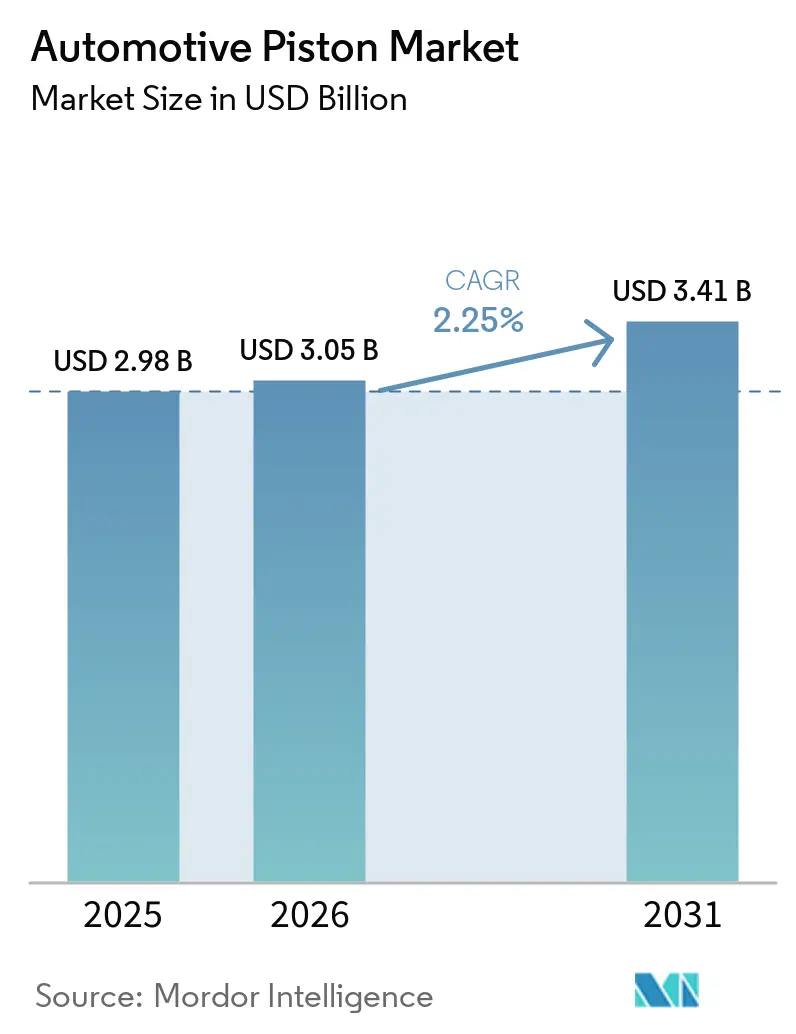
The automotive piston market size was valued at USD 2.98 billion in 2025 and is expected to grow from USD 3.05 billion in 2026 to USD 3.41 billion by 2031 at a 2.25% CAGR over 2026-2031. Robust internal combustion engine (ICE) production in emerging economies keeps volumes stable even as electrification advances in developed regions, ensuring the automotive piston market remains a significant value pool. Lightweight aluminum designs with advanced coatings are becoming standard because they help automakers meet tighter emissions regulations while preserving performance. Steel variants are gaining footholds in high-temperature hydrogen ICE prototypes, giving suppliers a hedge against future fuel shifts. Rising vehicle age in major fleets sustains a healthy aftermarket, adding resilience to the automotive piston market through replacement demand.
Key Report Takeaways
- By component type, pistons captured 49.02% of the automotive piston market share in 2025, while piston pins are projected to post the fastest 3.84% CAGR through 2031.
- By coating type, thermal-barrier coatings led with 42.34% of the automotive piston market share in 2025, and dry-film lubrication coatings are set to advance at a 3.29% CAGR through 2031.
- By vehicle type, passenger cars held 64.55% of the automotive piston market share in 2025, whereas commercial vehicles are set to record the highest CAGR at 2.66% through 2031.
- By material type, aluminum dominated with a 73.24% of the automotive piston market share in 2025, but steel is expected to grow at the fastest rate, with a 2.44% CAGR through 2031.
- By geography, Asia-Pacific commanded 47.71% of the automotive piston market share in 2025, while the Middle East and Africa are forecast to expand at a 2.52% CAGR to 2031.
Note: Market size and forecast figures in this report are generated using Mordor Intelligence’s proprietary estimation framework, updated with the latest available data and insights as of January 2026.
Global Automotive Piston Market Trends and Insights
Drivers Impact Analysis*
| Driver | (~) % Impact on CAGR Forecast | Geographic Relevance | Impact Timeline |
|---|---|---|---|
| Continued ICE Vehicle Demand | +1.2% | Asia-Pacific, South America, Middle East and Africa | Medium term (2-4 years) |
| Lightweight Al and Coated Pistons | +0.9% | Global, with early gains in Europe, North America | Short term (≤ 2 years) |
| Growing Vehicle Parc | +0.8% | Global, spill-over to mature markets | Long term (≥ 4 years) |
| Hydrogen ICE Prototypes | +0.7% | Europe, Japan, select North America programs | Long term (≥ 4 years) |
| Low-Friction Skirt Coatings | +0.6% | North America and EU, APAC core | Medium term (2-4 years) |
| 3-D Printed Custom Pistons | +0.4% | Global, with early gains in motorsport, premium segments | Long term (≥ 4 years) |
| Source: Mordor Intelligence | |||
Continued ICE Vehicle Demand in Emerging Markets
Emerging economies still rely on ICE powertrains because charging infrastructure remains limited and vehicle affordability is crucial. India exported more than 858,000 vehicles in fiscal 2025, most of them gasoline or flex-fuel models serving Africa and South America[1]"India's Car Exports Hit Record 858,000 Units in 2025 with 15% Growth," Acko Drive Team, ackodrive.com. China follows a dual-track approach, keeping ICE exports flowing even while domestic sales shift toward battery-electric platforms. Brazil’s ethanol program and Argentina’s CNG taxi fleets extend the service life of piston-equipped engines, supporting regional demand. Suppliers with plants in Uttar Pradesh, São Paulo, or Monterrey can meet this volume efficiently. The automotive piston market benefits because low-income buyers in these regions prioritize proven ICE technology over newer alternatives.
Stringent Emissions Pushing Lightweight Al and Coated Pistons
Euro 7 legislation, effective November 2026, and forthcoming Bharat Stage 7 standards are pushing automakers toward lighter, better-cooled pistons that curb NOx and particulate emissions. Aluminum pistons with thermal-barrier crowns lower peak temperatures and allow higher compression without knock. Skirt coatings infused with molybdenum disulfide cut friction at cold start, aiding fleet-average CO₂ compliance in Europe and the United States. These regulations encourage rapid technology refresh cycles, creating new contract opportunities for coated-piston specialists. As similar rules proliferate in Southeast Asia and South America, the automotive piston market scales these solutions across multiple continents.
Growing Vehicle Parc Driving Aftermarket Piston Replacement
The average U.S. vehicle age reached 12.8 years in 2025, increasing demand for overhaul parts such as pistons and rings[2]"Average age of vehicles in the US Rises to 12.8 Years in 2025," Team-BHP.com, www.team-bhp.com. Similar trends in Europe and Japan prolong engine maintenance cycles even as new sales plateau. Independent garages order piston-pin-ring kits that simplify stocking and reduce labor time. Online catalogs speed delivery, allowing smaller brands to compete with Tier-1s on lead time. Consequently, the aftermarket segment of the automotive piston market cushions suppliers from OEM production swings.
Hydrogen-ICE Prototypes Need High-Temperature Steel Pistons
Toyota, Cummins, and Daimler Trucks have demonstrated hydrogen-fueled engines that operate at higher combustion temperatures than diesel. Chromium-molybdenum steel pistons withstand this heat and resist hydrogen embrittlement, making them the preferred option in pilot fleets. Early motorsport testing shows acceptable durability over extended duty cycles, and commercial trials in heavy trucks are underway. Although volumes remain small, the development roadmap signals a new niche where steel can displace aluminum. Suppliers prepared to certify hydrogen-ready designs will gain first-mover advantage as infrastructure builds out.
Restraints Impact Analysis*
| Restraint | (~) % Impact on CAGR Forecast | Geographic Relevance | Impact Timeline |
|---|---|---|---|
| Accelerating EV Penetration | -1.5% | Europe, China, select North America markets | Medium term (2-4 years) |
| Engine Downsizing | -1.1% | Global, with concentration in developed markets | Short term (≤ 2 years) |
| Cylinder-Deactivation | -0.8% | North America and EU, expanding to Asia | Medium term (2-4 years) |
| OEM Cap-Ex | -0.6% | Global OEM strategies | Short term (≤ 2 years) |
| Source: Mordor Intelligence | |||
Accelerating EV Penetration Cannibalizes ICE Volumes
Battery-electric vehicles captured roughly 35% of new registrations in China and ~20% in Europe during 2025, directly displacing demand for piston vehicles. Tesla, BYD, and other EV manufacturers are scaling capacity, and legacy OEMs are reallocating capital to meet carbon-neutral pledges. Fewer ICE vehicles mean fewer pistons across both OEM and aftermarket channels. The revenue impact is most severe in regions offering purchase incentives or zero-emission mandates. Suppliers are offsetting this decline by targeting markets with slower EV uptake, but the overall drag on the automotive piston market remains material.
Engine Downsizing Reduces Piston Count per Vehicle
Turbocharged three- and four-cylinder engines are replacing larger six-cylinder units, cutting piston content by up to half per vehicle. Automakers achieve fuel-economy targets while preserving horsepower, but component suppliers sell fewer parts per engine. In response, piston makers add value via multi-zone coatings and integrated ring-pin assemblies. These higher-margin products soften the volume loss but do not eliminate it, so the restraint persists through the forecast period.
*Our forecasts treat driver/restraint impacts as directional, not additive. The impact forecasts reflect baseline growth, mix effects, and variable interactions.
Segment Analysis
By Component Type: Precision Pins Outpace Core Pistons
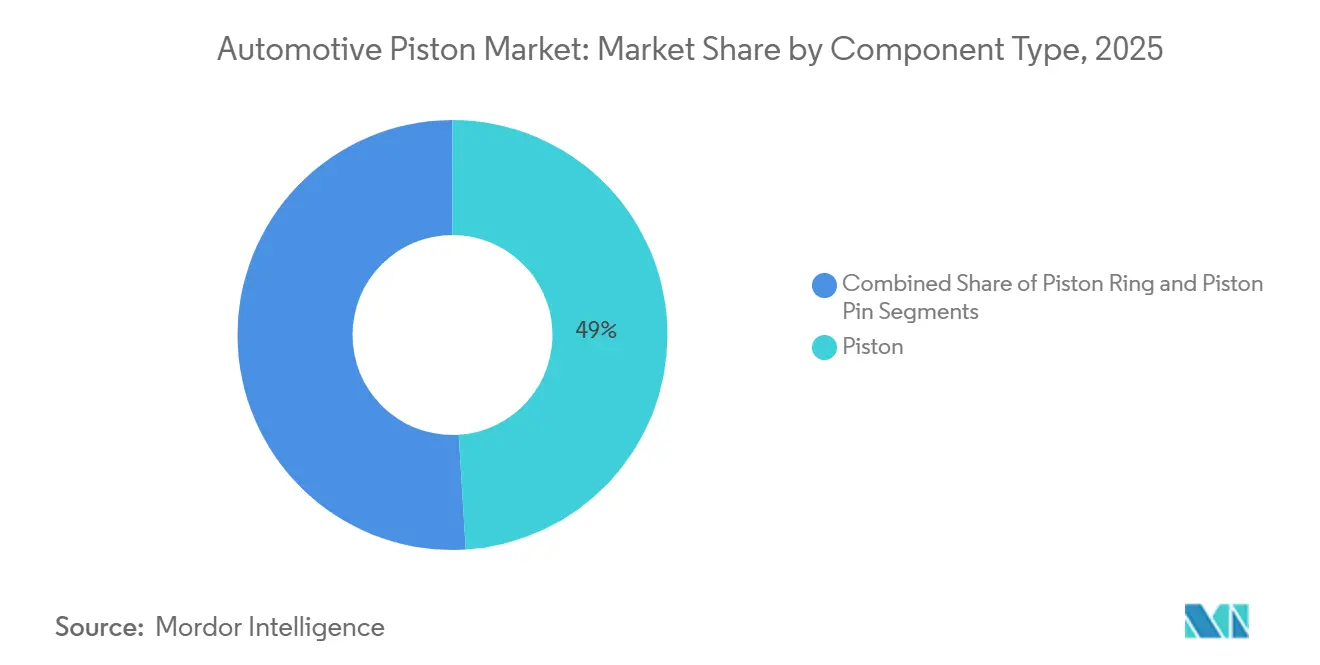
Pistons accounted for the largest share, 49.02% of 2025 component revenue, anchoring the automotive piston market share for this segmentation. Suppliers continue to refine crown geometry and skirt profiles to manage heat and reduce friction under stricter emissions regimes. Design efforts focus on weight reduction to accommodate higher cylinder pressures in downsized engines. Pistons thus remain the volume backbone despite pressure to electrify. Tier-1 manufacturers leverage global foundries to assure just-in-time delivery for high-volume assembly plants.
Piston pins registered the fastest 3.84% CAGR as OEMs adopt DLC-coated, case-hardened varieties for turbocharged platforms. The upgrade boosts fatigue life and enables higher RPM without galling. Aftermarket buyers favor complete pin-ring kits that streamline overhaul labor. Industry collaboration with coating specialists accelerates qualification cycles and shortens time-to-market. As value shifts toward high-precision pins, smaller niche producers gain room to differentiate.



By Coating Type: Friction Cuts Drive Dry-Film Uptake
Thermal-barrier coatings led with a dominant 42.34% of the automotive piston market share in 2025, reinforcing their role in insulating piston crowns and stabilizing combustion. These ceramic-based layers help meet PN10 standards in Euro 7 and upcoming EPA rules. OEMs prioritize durability over cost, awarding multi-year contracts for proven suppliers. Integration with lightweight aluminum pistons reduces mass while preserving thermal protection. Certification per global lab protocols has become an entry requirement.
Dry-film lubrication coatings set the pace with a 3.29% CAGR, the fastest within this segment. Molybdenum disulfide blends lower boundary friction during cold starts, contributing to lower fleet-average CO₂. Emerging chemistries use tungsten disulfide and graphite nanoflakes to extend life at higher loads. Multilayer coatings combine oil-shedding properties, thereby increasing the functional density per unit area. As automakers seek every gram of CO₂ reduction, the automotive piston market rewards suppliers offering validated friction-reduction gains.
By Vehicle Type: Fleets Lengthen Duty Cycles
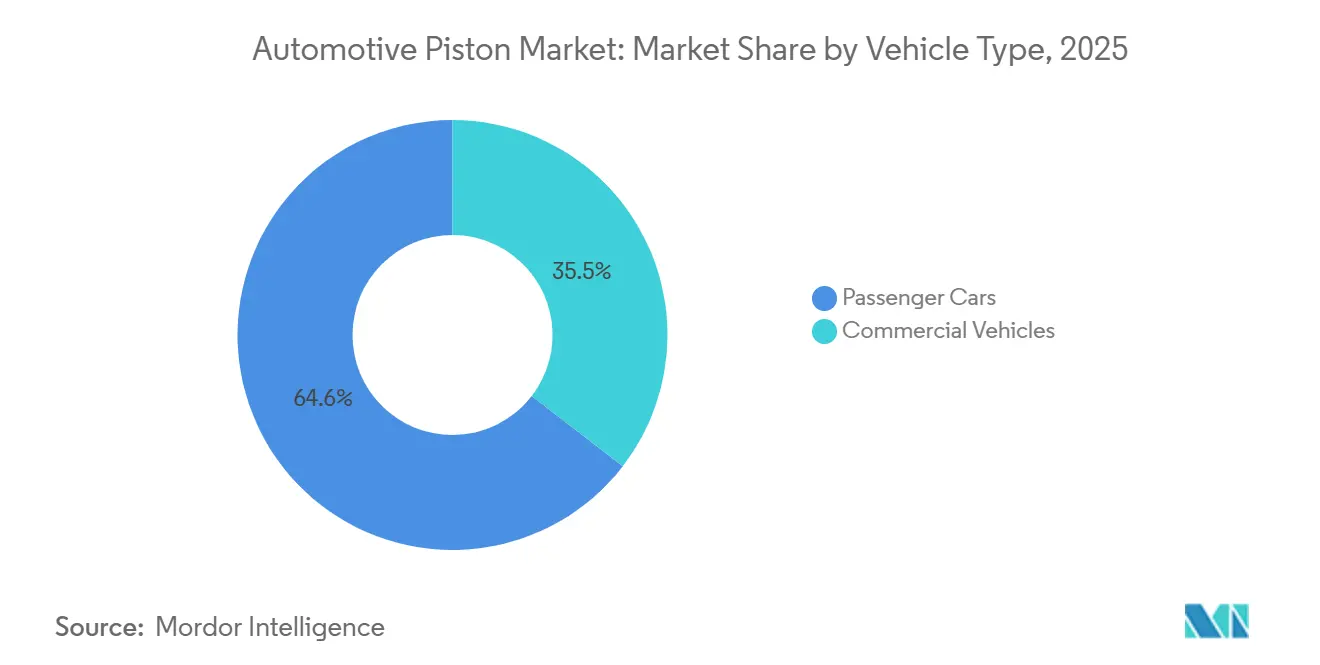
Passenger cars dominated, with 64.55% of the automotive piston market share in 2025, accounting for the bulk of the automotive piston market size by vehicle type. However, electrification erodes this base fastest in Europe and coastal China. ICE-hybrid architectures slow the descent by retaining smaller displacement engines alongside electric drives. Pistons in hybrids face frequent start-stop cycles, prompting emphasis on low-wear coatings. As regulations tighten further, automakers may shift small cars to full electrification, trimming future piston volume in this category.
Commercial vehicles delivered the strongest 2.66% CAGR, driven by durability-oriented buyers in the freight and vocational segments. Higher torque demands justify the use of forged aluminum or steel pistons, thereby raising the average selling price. Regulatory milestones such as EPA 2027 and Euro VII push fleets toward cleaner ICE solutions rather than a wholesale shift to EVs, especially for long-haul duty cycles. Suppliers service this need with high-temperature crowns and reinforced pin bosses. The business case favors extended maintenance intervals, boosting sales of premium piston assemblies.
By Material Type: Steel Enters High-Heat Niches
Aluminum held a commanding 73.24% share of the automotive piston market in 2025, maintaining its leadership by material. Silicon-rich alloys control thermal expansion, making them ideal for mainstream gasoline and diesel engines. Cost-efficient die-casting supports high-volume delivery. Material recyclability also aligns with OEM carbon-footprint goals. Procurement teams lock in multi-year contracts to avoid alloy price swings.
Steel posted the fastest 2.44% CAGR, propelled by hydrogen and high-load diesel prototypes that require elevated-temperature tolerance. Advanced forging and selective hardening reduce weight penalties while conserving strength. Motorsport programs validate fatigue life under extreme rev ranges, providing proof points for commercial fleets. Hybrid piston concepts combine an aluminum skirt with a steel crown to balance mass and heat resistance. These innovations carve a profitable niche inside the broader automotive piston market.
Geography Analysis
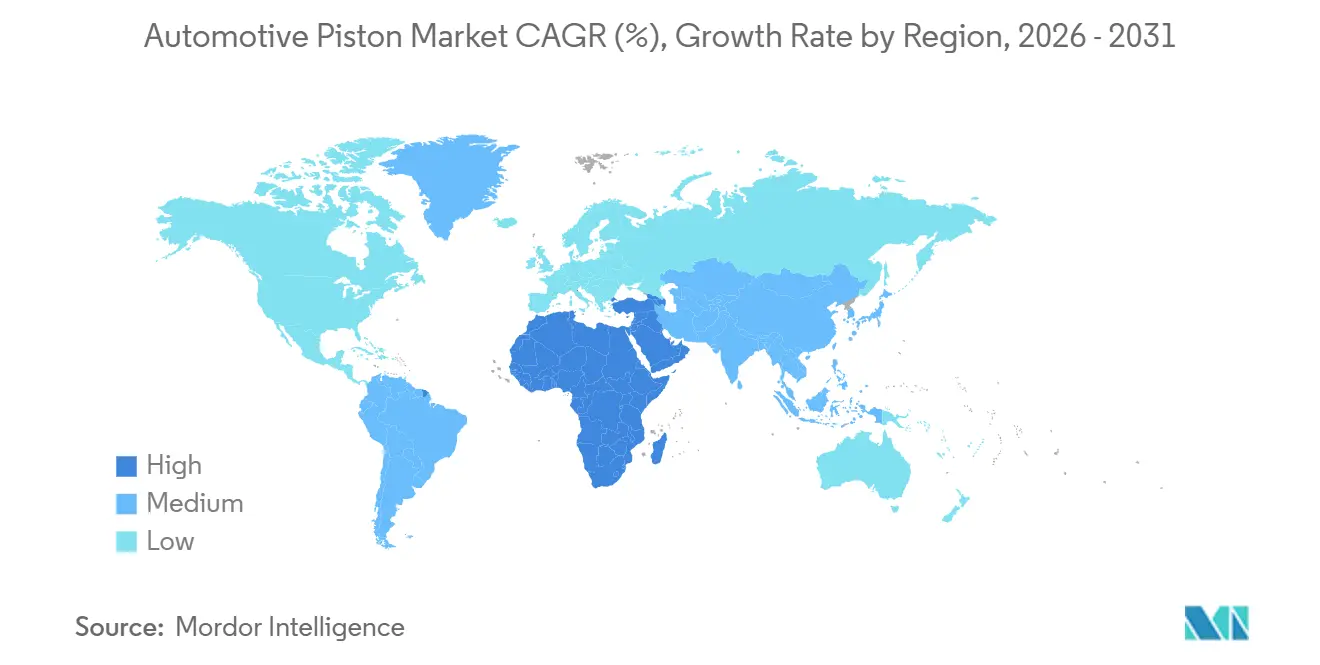
Asia-Pacific accounted for 47.71% of the automotive piston market share in 2025, underscoring its central role in the market. India’s export-oriented assembly lines ship gasoline compact cars to Africa and South America, prolonging global ICE demand. China maintains large-scale ICE production for Belt and Road partners even as domestic sales tilt toward EVs. Japan emphasizes hybrid and hydrogen initiatives, requiring precision-machined pistons with specialized coatings. Regional suppliers invest in dual production lines to handle both cost-sensitive cast aluminum and premium coated products.
Europe and North America are mature but remain critical through stringent emissions mandates and sizable aftermarket fleets. Euro 7 and EPA 2027 standards oblige OEMs to refine combustion chambers, keeping piston innovation alive despite falling volumes. Aging vehicle populations elevate replacement sales, buffering suppliers from new-vehicle volatility. Capital infusions, such as General Motors’ recent upgrades to V-engine plants, confirm a lengthy transition rather than an abrupt ICE exit—local Tier-1s secure profitability by offering value-added coatings and rapid aftermarket distribution.
The Middle East and Africa, forecasted to grow at a 2.52% CAGR, and South America offer volume upside because electrification lags due to infrastructure and affordability constraints. Brazil’s ethanol fleet and Argentina’s CNG taxis need high-compression pistons resistant to corrosive fuels. Oil-funded fleets in Gulf states renew ICE vehicles on shorter cycles, supporting OEM assembly kits and aftermarket parts. Suppliers with facilities in Mexico or South Africa leverage trade agreements to serve both continents efficiently. Collectively, these emerging regions broaden the automotive piston market's growth as advanced economies pivot to electrified powertrains.

Competitive Landscape
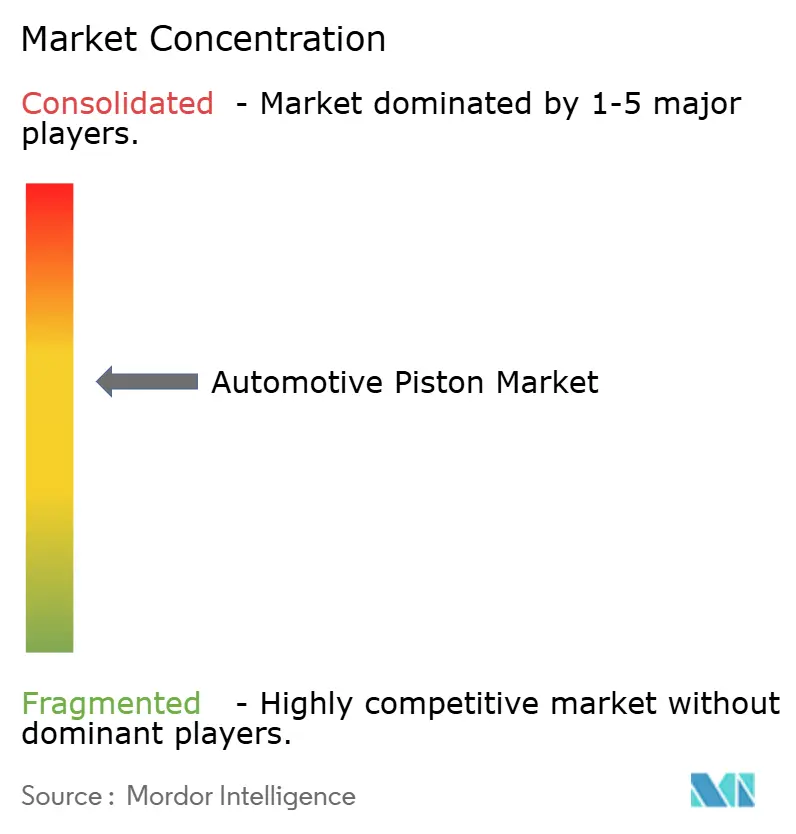
The automotive piston market indicates moderate fragmentation, with a handful of Tier-1 firms shaping technology roadmaps. Mahle, Tenneco, Rheinmetall (after divesting small-piston assets to Comitans Capital), Aisin, and Shriram Pistons hold influential positions. In February 2026, Aisin expanded its USD 100 million venture fund to identify battery and materials startups. In April 2025, Tenneco partnered with Apollo Fund X to strengthen its balance sheet while continuing investments in its Clean Air business.
Technology collaborations accelerate differentiation. Mahle, Porsche, and Trumpf produced 3D-printed pistons that trim weight and enhance cooling, validating additive manufacturing at OEM scale. Shriram Pistons rebranded as SPR Auto Technologies and bought Grupo Antolin’s Indian units to diversify beyond ICE, broadening its resilience strategy. Burgess-Norton leverages plants across four continents to supply localized, just-in-time pins, challenging larger rivals on logistics agility.
Market entrants face higher certification costs as ISO 6621 coating and ASTM D7421 friction tests become baseline requirements. Suppliers owning in-house labs secure faster validation, shortening development cycles. Niche firms focusing on hydrogen-ready steel pistons or integrated pin-ring kits can win share where large incumbents prioritize electrification. Competitive intensity, therefore, centers on specialization and speed rather than pure scale, keeping the automotive piston market dynamic through the forecast horizon.
Automotive Piston Industry Leaders
-
Mahle GmbH
-
Tenneco Inc.
-
Rheinmetall AG
-
Aisin Corporation
-
Shriram Pistons and Rings Ltd.
- *Disclaimer: Major Players sorted in no particular order

Recent Industry Developments
- April 2026: IPD expanded its Detroit 60 Series piston kit range for heavy-duty aftermarket customers. Its valvetrain portfolio includes valves, guides, seats, springs, locks, spring seats, rotocoils, and stem seals for reliable high-load performance.
- March 2026: SPR Auto Technologies amended its corporate charter to include electric-vehicle activities and the manufacture of advanced components, including pistons, engine bearings, connecting rods, gear assemblies, and others.


Global Automotive Piston Market Report Scope
The Automotive Piston market is analyzed across component type, coating type, vehicle type, material type, and region.
By Component Type, the market is segmented into Piston, Piston Ring, and Piston Pin. By Coating Type, the categories include Oil Shedding, Dry Film Lubrication, and Thermal Barrier. By Vehicle Type, the market covers Passenger Cars and Commercial Vehicles. By Material Type, the segments are Aluminum and Steel. By Geography, the market is analyzed across North America (United States, Canada, Rest of North America), South America (Brazil, Argentina, Rest of South America), Europe (United Kingdom, Germany, Spain, Italy, France, Russia, Rest of Europe), Asia-Pacific (India, China, Japan, South Korea, Rest of Asia-Pacific), and Middle East and Africa (UAE, Saudi Arabia, Turkey, Egypt, South Africa, Rest of Middle East and Africa).
Market forecasts are typically provided in terms of Value (USD) and Volume (Units).
| Piston |
| Piston Ring |
| Piston Pin |
| Oil Shedding |
| Dry Film Lubrication |
| Thermal Barrier |
| Passenger Cars |
| Commercial Vehicles |
| Aluminum |
| Steel |
| North America | United States |
| Canada | |
| Rest of North America | |
| South America | Brazil |
| Argentina | |
| Rest of South America | |
| Europe | United Kingdom |
| Germany | |
| Spain | |
| Italy | |
| France | |
| Russia | |
| Rest of Europe | |
| Asia-Pacific | India |
| China | |
| Japan | |
| South Korea | |
| Rest of Asia-Pacific | |
| Middle East and Africa | United Arab Emirates |
| Saudi Arabia | |
| Turkey | |
| Egypt | |
| South Africa | |
| Rest of Middle East and Africa |
| By Component Type | Piston | |
| Piston Ring | ||
| Piston Pin | ||
| By Coating Type | Oil Shedding | |
| Dry Film Lubrication | ||
| Thermal Barrier | ||
| By Vehicle Type | Passenger Cars | |
| Commercial Vehicles | ||
| By Material Type | Aluminum | |
| Steel | ||
| By Region | North America | United States |
| Canada | ||
| Rest of North America | ||
| South America | Brazil | |
| Argentina | ||
| Rest of South America | ||
| Europe | United Kingdom | |
| Germany | ||
| Spain | ||
| Italy | ||
| France | ||
| Russia | ||
| Rest of Europe | ||
| Asia-Pacific | India | |
| China | ||
| Japan | ||
| South Korea | ||
| Rest of Asia-Pacific | ||
| Middle East and Africa | United Arab Emirates | |
| Saudi Arabia | ||
| Turkey | ||
| Egypt | ||
| South Africa | ||
| Rest of Middle East and Africa | ||


Key Questions Answered in the Report
How large will the automotive piston market be by 2031?
It is projected to reach USD 3.41 billion by 2031 at a 2.25% CAGR over 2026-2031.
Which region currently dominates global piston demand?
Asia-Pacific leads with 47.71% share in 2025 because China and India still manufacture high volumes of ICE vehicles.
Which coating type is gaining share fastest?
Dry-film lubrication coatings post the highest 3.29% CAGR as automakers cut friction to meet fuel-economy targets.
What material segment is the growth hotspot?
Steel pistons, although currently a minority segment, are projected to grow at a 2.44% CAGR due to the higher heat-tolerance requirements of hydrogen-powered and heavy-duty engines.
Page last updated on:


 Your data is secure and never sold or shared.


