
Automotive Motors Market Size and Share
Market Overview
| Study Period | 2019 - 2031 |
|---|---|
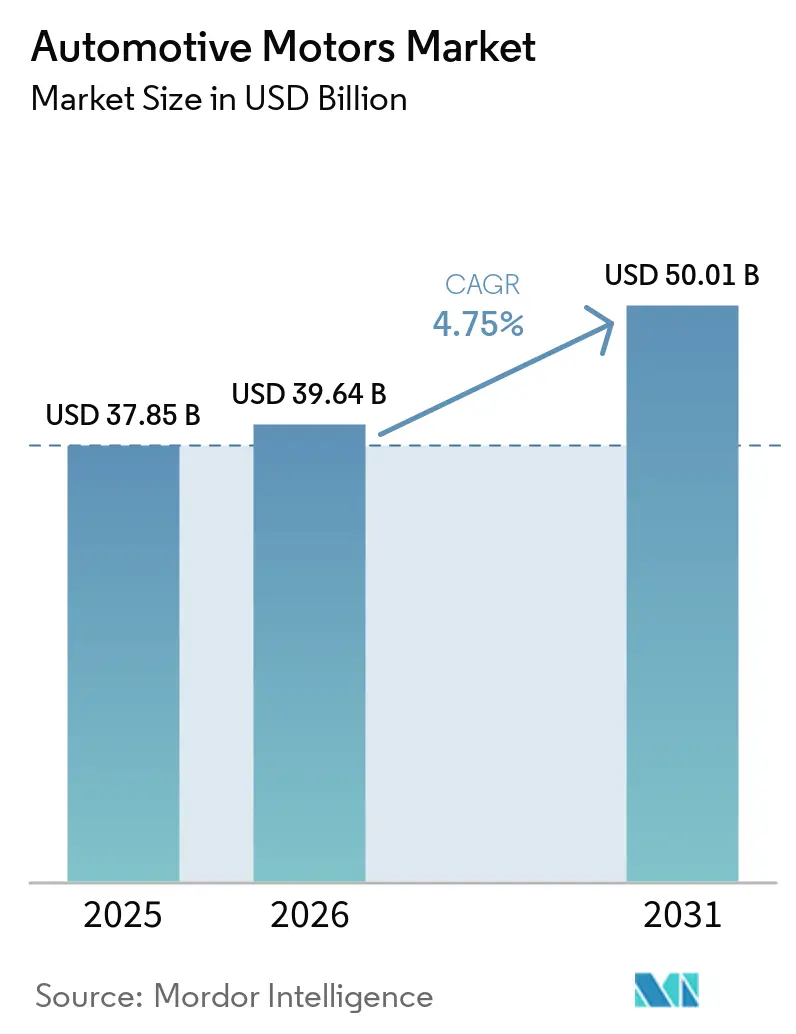
| Market Size (2026) | USD 39.64 Billion |
| Market Size (2031) | USD 50.01 Billion |
| Growth Rate (2026 - 2031) | 4.75 % |
| Fastest Growing Market | Asia Pacific |
| Largest Market | Asia Pacific |
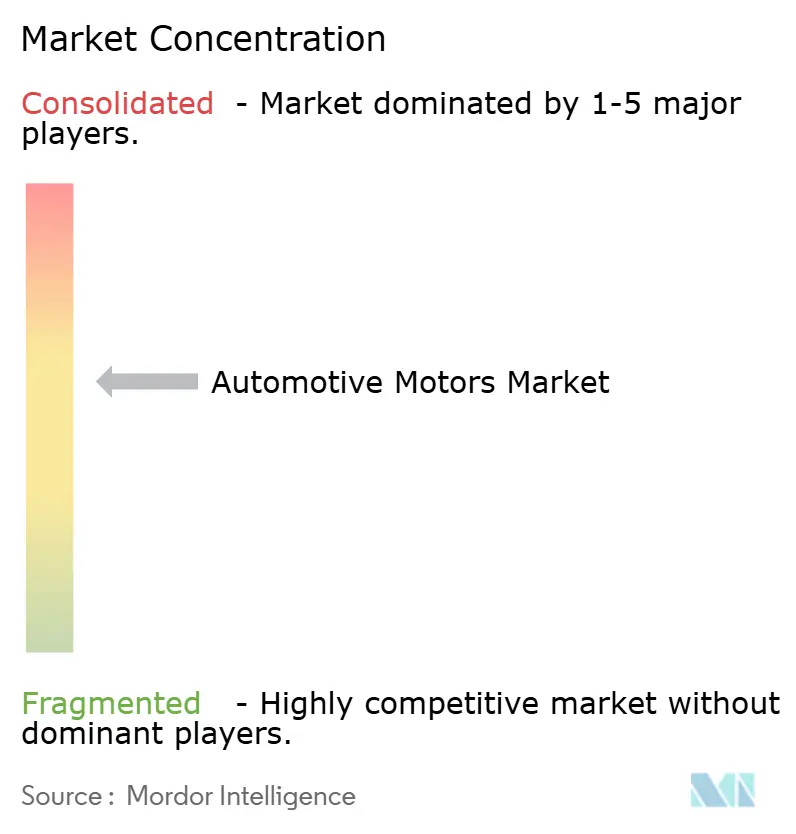
| Market Concentration | Medium |
Major Players *Disclaimer: Major Players sorted in no particular order Image © Mordor Intelligence. Reuse requires attribution under CC BY 4.0. | |
Automotive Motors Market Analysis by Mordor Intelligence
The Automotive Motors Market size was valued at USD 37.85 billion in 2025 and is estimated to grow from USD 39.64 billion in 2026 to reach USD 50.01 billion by 2031, at a CAGR of 4.75% during the forecast period (2026-2031). The growing use of electrified auxiliaries, high-power e-axles, and software-defined vehicle platforms is increasing the average motor count per car, while efficiency regulations are pushing brushed designs toward brushless and permanent-magnet topologies. Original equipment manufacturers (OEMs) are localizing motor assembly to comply with regional trade rules, thereby shortening supply chains and sharpening cost competition. Safety regulations mandating automatic emergency braking (AEB) and lane-keeping assist are amplifying demand for stepper motors, even as zone controller architectures seek to consolidate actuator functions. Finally, the proliferation of premium battery-electric vehicles (BEVs) is elevating demand for low-noise brushless direct-current (BLDC) motors, creating new opportunities for suppliers that can balance acoustics, thermal performance, and price.
Key Report Takeaways
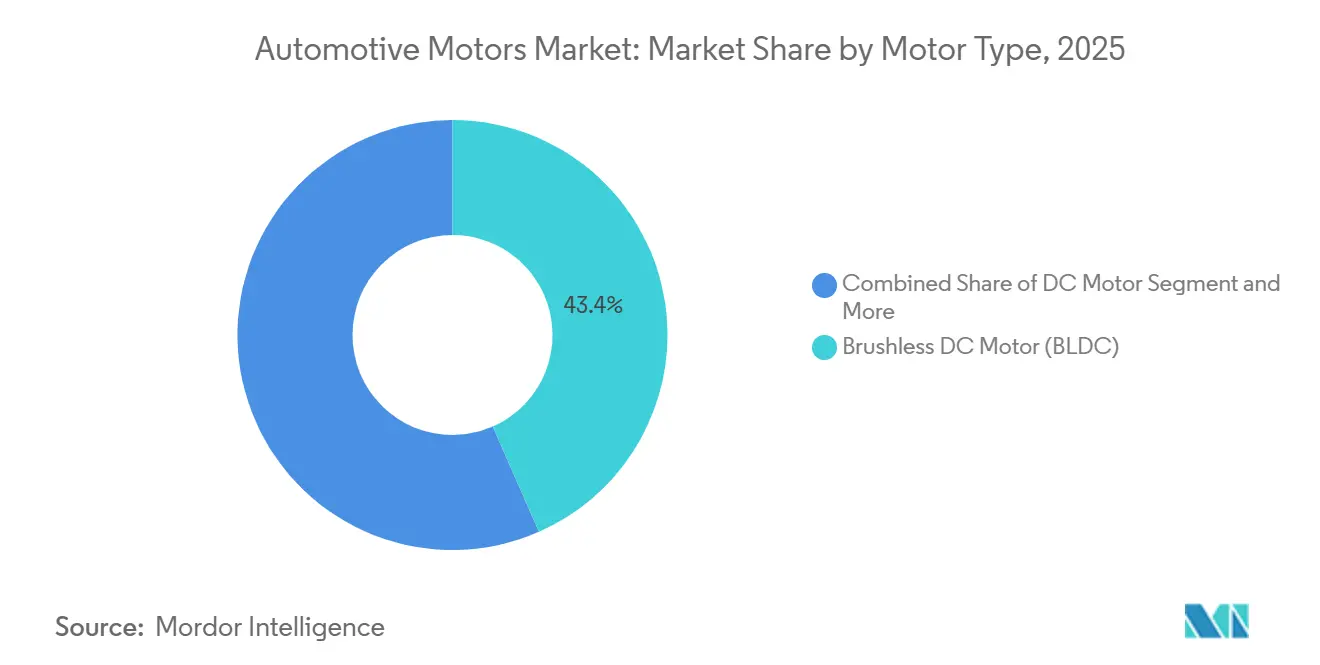
- By motor type, BLDC designs led with 43.36% of the automotive motor market share in 2025, while traction motors are projected to advance at a 4.77% CAGR through 2031.
- By application, powertrain accounted for a 47.21% share of the automotive motors market in 2025, and safety systems are growing at a 4.79% CAGR through 2031.
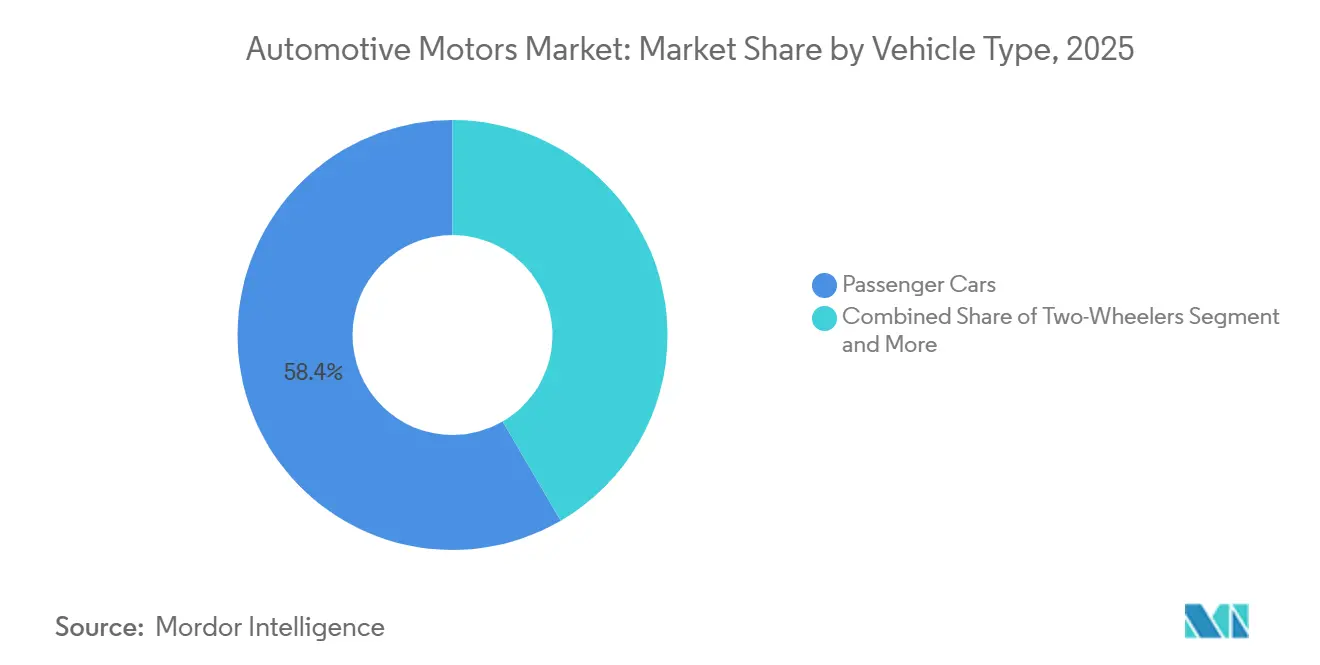
- By vehicle type, passenger cars accounted for 58.38% of 2025 volume and are projected to expand at a 4.85% CAGR through 2031.
- By sales channel, OEM distribution accounted for 83.37% in 2025, while the aftermarket is set to grow at a 4.81% CAGR over the forecast period.
- By geography, Asia-Pacific accounted for 44.57% of revenue in 2025 and is expected to post a 4.87% CAGR through 2031.
Note: Market size and forecast figures in this report are generated using Mordor Intelligence’s proprietary estimation framework, updated with the latest available data and insights as of January 2026.
Global Automotive Motors Market Trends and Insights
Drivers Impact Analysis*
| Driver | (~) % Impact on CAGR Forecast | Geographic Relevance | Impact Timeline |
|---|---|---|---|
| Electrification of Auxiliary Systems | +1.2% | Global, with early concentration in Europe and China | Medium term (2-4 years) |
| Rapid Adoption of ADAS-Grade Safety Actuators | +1.0% | North America, Europe, China (regulatory-driven); spillover to ASEAN, Latin America | Short term (≤ 2 years) |
| Rising OEM Focus on 48-V Mild-Hybrid Architectures | +0.9% | Global, led by Europe and Japan; accelerating in India for compact sedans | Medium term (2-4 years) |
| Regulatory Push for Energy-Efficient HVAC Blowers | +0.6% | North America (EPA CAFE), Europe (CO₂ fleet standards), China (NEV credits) | Long term (≥ 4 years) |
| Growth of In-Cabin Comfort and Wellness Features | +0.5% | Premium segments in North America, Europe, China; expanding to mass-market in Asia-Pacific | Medium term (2-4 years) |
| Increasing Demand for Low-Noise BLDC Solutions in Premium EVs | +0.4% | Europe, North America, China (luxury BEV segments) | Short term (≤ 2 years) |
| Source: Mordor Intelligence | |||
Electrification of Auxiliary Systems (E-Pumps, E-Compressors)
Variable-speed motors are replacing belt-driven pumps and compressors, cutting fuel use by up to 5% in internal-combustion powertrains and extending BEV range by roughly 6-8% because auxiliary loads are decoupled from engine speed [1]“Electric Coolant Pumps Reach 10 Million-Unit Run Rate,” Company release, MAHLE, mahle.com . MAHLE shipped more than 10 million electric coolant pumps in 2024 alone, showing that even legacy programs now favor electronic actuation. ZF’s 48-V oil pump, launched in 2025, removes parasitic drag during coasting and supports cylinder deactivation in new European and Japanese hybrids [2]“48-Volt Oil Pump for Mild Hybrids,” Press briefing, ZF Group, zf.com . Compact BLDC units rated between 50 W and 500 W dominate this transition, and suppliers are embedding inverters to shrink wiring harnesses. As 800-V battery packs raise heat flux, premium BEVs add multiple coolant, refrigerant, and oil pumps, lifting per-vehicle motor content and sustaining demand through the decade.
Rapid Adoption of ADAS-Grade Safety Actuators
Regulation is accelerating motor penetration: the U.S. National Highway Traffic Safety Administration’s 2024 rule mandates AEB on all new light vehicles, and the EU’s General Safety Regulation II requires lane-keeping and intelligent speed assistance from mid-2024 [3]“Federal Motor Vehicle Safety Standards: Automatic Emergency Braking,” U.S. NHTSA, nhtsa.gov . According to MITRE's PARTS database, the vast majority of U.S. sales for the 2023 model year have already integrated AEB, highlighting swift compliance. Each ADAS feature requires several stepper or servo motors for tasks such as camera positioning, radar shuttering, and steering-torque overlay. China's C-NCAP, set for 2025, is incentivizing active lane-change features, leading to increased demand for more powerful steppers. Suppliers like Valeo are now pairing adaptive headlamp modules with dual-axis motors to enable real-time beam adjustments. This advanced capability is gradually making its way into mainstream trims, thanks to declining LED prices.
Rising OEM Focus on 48-V Mild-Hybrid Architectures
Toyota, Stellantis, and Audi broadened 48-V fitment in 2025 to capture idle-stop, torque-fill, and active anti-roll benefits without the cost of high-voltage packs. The architecture electrifies oil pumps, water pumps, and HVAC compressors, creating sustained demand for sub-10 kW BLDC and permanent-magnet synchronous motors. India is emerging as a key volume market because 48-V systems suit compact sedans priced below USD 15,000. Suppliers are rolling out integrated motor-inverter modules that reduce harness mass, and the automotive motors market is poised to benefit as platforms standardize on shared 48-V components.
Regulatory Push for Energy-Efficient HVAC Blowers
In the U.S., Corporate Average Fuel Economy credits, alongside Europe’s CO₂ fleet caps and China’s New Energy Vehicle regulations, incentivize efficient cabin cooling, supporting growth in the automotive motors market. Compared to brushed units, BLDC blower motors significantly reduce HVAC energy consumption, mitigating range penalties for BEVs. With costs now becoming more affordable, mass-market adoption is on the horizon. Brose and Valeo have begun integrating sensors and pulse-width modulation, enabling predictive conditioning—be it cooling or heating—while vehicles charge, thereby preserving driving range.
Restraints Impact Analysis*
| Restraint | (~) % Impact on CAGR Forecast | Geographic Relevance | Impact Timeline |
|---|---|---|---|
| Copper and Rare-Earth Price Volatility | -0.8% | Global, with acute exposure in Asia-Pacific manufacturing hubs | Short term (≤ 2 years) |
| Thermal Management Challenges at Higher Power Densities | -0.5% | Global, concentrated in high-performance BEV and PHEV segments | Medium term (2-4 years) |
| Supply-Chain Concentration of Traction-Motor Magnets | -0.4% | Global, with dependency on China for NdFeB processing and sintering | Long term (≥ 4 years) |
| Competition from Integrated Smart Actuators Reducing Motor BOM | -0.3% | Europe, North America (zone-controller adoption); emerging in China | Medium term (2-4 years) |
| Source: Mordor Intelligence | |||
Copper & Rare-Earth Price Volatility
In early 2026, copper prices reached their peak due to disruptions in key producing regions like Chile and Peru, before stabilizing slightly in the following months. This price volatility has significantly impacted motor margins, as copper windings constitute a substantial portion of the material cost in BLDCs. Around the same period, the cost of neodymium-praseodymium magnets rose sharply, driven by stricter export policies from China. In response, leading companies are adopting strategies such as hedging, vertical integration, or the exploration of magnet-free alternatives. One such alternative is Niron's iron-nitride alloy, though current prototypes face challenges, including reduced power density. This ongoing volatility has led to a slight decline in the projected growth rate of the automotive motors market.
Thermal Management Challenges at Higher Power Densities
Silicon-carbide inverters, while enabling compact, high-torque motors, significantly increase heat flux in high-voltage systems. DENSO's upcoming dual-sided-cooled inverter, which substantially reduces power loss, highlights a potential solution. However, liquid loops, traditionally used for traction motors, are now being adopted for auxiliary pumps and blowers, leading to increased costs and space requirements. Although graphene thermal pads and immersion cooling offer benefits, they remain expensive. Compact vehicles face the brunt of these challenges, compelling OEMs to compromise on power to manage temperature margins. This trade-off not only lengthens validation cycles but also slightly dampens the growth outlook for the automotive motors market.
*Our forecasts treat driver/restraint impacts as directional, not additive. The impact forecasts reflect baseline growth, mix effects, and variable interactions.
Segment Analysis
By Motor Type: High-Density Traction Designs Gain Momentum
Traction motors started from a smaller 2025 base yet are forecast to deliver a 4.77% CAGR as BEVs proliferate. BLDC designs accounted for 43.36% of 2025 demand owing to entrenched roles in HVAC blowers, seat drives, and coolant pumps. Hairpin winding lifts slot fill to 70%, and YASA’s axial-flux layout, now at 3.5 kW/kg, shows what premium hybrids can achieve. Servo motors thrive in active aero and multi-axis seats, while stepper motors remain essential for adaptive lighting and camera gimbals. Magnet-free prototypes offer supply resilience but give up torque density. Overall, efficiency, packaging, and raw-material security determine which topologies win as the automotive motors market diversifies.
The automotive motors market size for traction motors is projected to command USD -X billion by 2031, while BLDC designs will still hold a sizeable slice, albeit at slower growth. As SiC inverters shrink and integrate, OEMs can optimize for total system cost rather than peak efficiency, enabling a blended portfolio in which cost-effective ferrite units coexist with high-density NdFeB models. Suppliers capable of modular stator lamination, flexible winding, and embedded control software will capture disproportionate value.



By Application: Safety Systems Accelerate Under Regulation
Powertrain dominated with 47.21% share in 2025, yet safety systems will grow the fastest to 2031 on the back of AEB and lane-keeping rules. Every new ADAS layer adds servo, stepper, or micro-BLDC motors for braking, steering, or sensing. Marelli’s adaptive-beam lamps, compliant with UN R-123, use dual-axis steppers and are already standard on European C-segment cars. HVAC retains steady pull because efficient BLDC blowers shave fleet CO₂ for credits. Comfort motors may consolidate as zone controllers share actuators, yet new seat-massage and active-noise features offset losses. Overall, functional safety and energy efficiency jointly steer demand in the automotive motors market.
Safety-system demand translates into 1-2 additional motors per car each model year, supporting expansion in the automotive motors market size even as some legacy alternators disappear. Tier-ones that bundle sensor fusion, firmware updates, and self-diagnostics will outpace pure hardware peers.
By Vehicle Type: Passenger-Car Dominance Continues
Passenger cars accounts 58.38% of the 2025 segmental revenue and will post a 4.85% CAGR through 2031, led by premium EVs in China and Europe and mild hybrids in India. High-end BEVs contain upward of 60 motors, from active grille shutters to power-door closers. Two-wheelers add scale: China sold 7 million electric scooters in 2024, and India registered 1.3 million in the same year, each featuring hub motors and regenerative braking systems. Light commercial and heavy trucks lag in range economics but adopt high-torque e-axles in pilot fleets.
The automotive motors market share for passenger cars may soften toward 2031 as off-highway electrification accelerates, yet absolute volume remains highest. Suppliers must therefore split portfolios: cost-optimized small motors for Asia’s two-wheelers and advanced liquid-cooled units for premium sedans and SUVs.
By Sales Channel: Right-to-Repair Bolsters Aftermarket
OEM supply ownership stood at 83.37% in 2025, but aftermarket motors will advance at a 4.81% CAGR as vehicle age increases and legislation guarantees access to diagnostic data, supporting the automotive motors market. Europe’s proposed Right to Repair Directive compels OEMs to sell replacement BLDC blowers and seat drives to independent shops at non-discriminatory prices. Average U.S. vehicle age hit 12.5 years in 2025, creating a predictable replacement curve for motors that fail after 8-10 years of service. E-commerce platforms in China improve traceability, squeezing counterfeit units out of the supply.
The automotive motors industry increasingly sees remanufacturing and refurbishment as viable profit pools. Tier-twos with regional warehouses and fast fulfillment will capture share as warranty expirations boost demand for do-it-yourself and fleet maintenance.
Geography Analysis
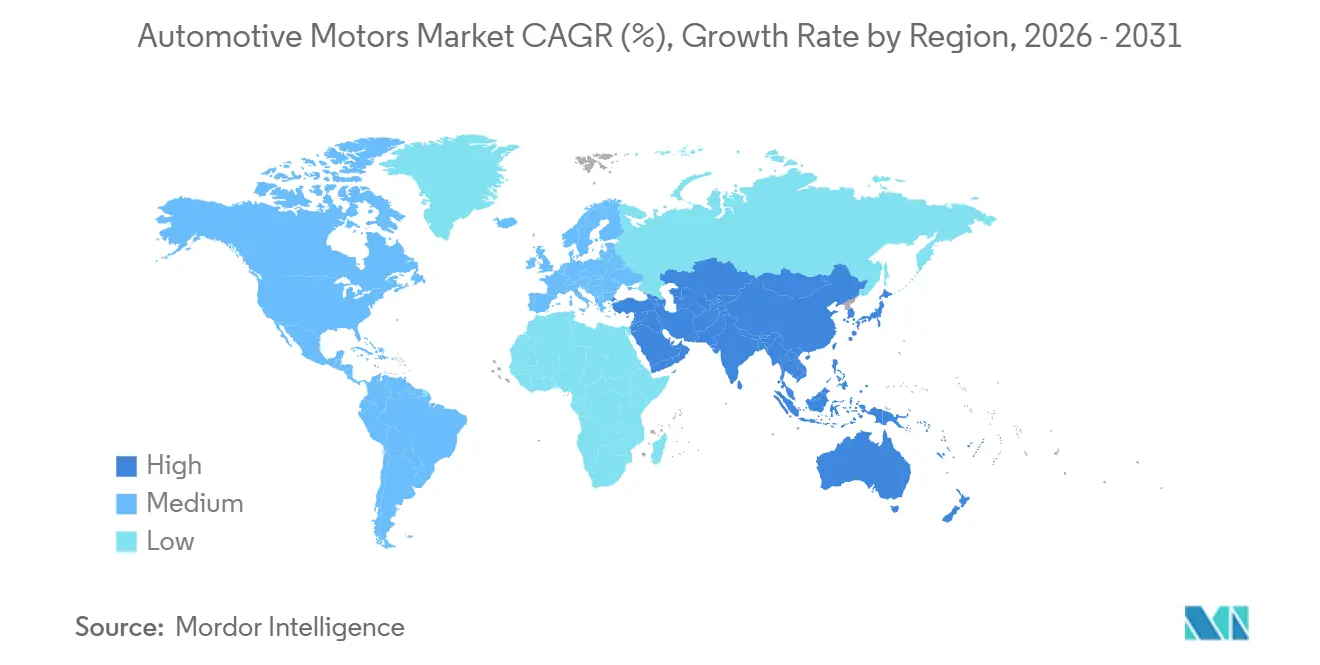
Asia-Pacific remained the largest regional contributor, accounting for 44.57% of 2025 revenue, and is projected to expand at a 4.87% CAGR. China's integrated approach—from rare-earth mining to final assembly—enables its vendors to price traction motors significantly lower than their Japanese and European counterparts. In India, government subsidies bolster demand for hub motors in two- and three-wheelers. Meanwhile, Thailand, Indonesia, and Vietnam are actively seeking investments for BLDC component plants. Japanese industry leaders, DENSO and Nidec, have halted their investments in internal combustion engines (ICE) and are redirecting funds towards SiC inverters and e-axles, enhancing the region's technological prowess.
While North America lags in volume, it is witnessing a surge in reshoring, spurred by trade rules that emphasize regional value. Companies like BorgWarner, Continental, and Dana are expanding capacity in Mexico and the southern U.S. to meet the local-content requirements for Detroit's battery-electric vehicle (BEV) initiatives. Additionally, recent legislation makes domestic battery packs more affordable, indirectly boosting motor demand. However, the exclusion of Chinese magnets complicates sourcing, a challenge that Canadian and U.S. rare-earth projects might alleviate in the future.
Europe grapples with stringent CO₂ regulations, driving the adoption of battery electric vehicles (BEVs) and extending the aftermarket's longevity. Bosch's shift from fuel injectors to e-motors, albeit accompanied by painful staff reductions, underscores the region's pressing urgency. While Eastern Europe is attracting greenfield motor plants serving German OEMs, it remains reliant on Asian sources for rare earths and SiC wafers. The Middle East is prioritizing hydrogen, resulting in a limited focus on battery-electric vehicles. However, there's a budding demand for hybrids in hotter climates, presenting modest opportunities for motors. These regional distinctions are molding tailored strategies in the automotive motors landscape.

Competitive Landscape
The top suppliers—Bosch, DENSO, Nidec, Continental, BorgWarner, Valeo, Mitsubishi Electric, Hitachi Astemo, Mabuchi, and Johnson Electric—dominate the automotive motors market, controlling a significant share of global sales. Vertical integration stands out as the primary strategy. In recent years, DENSO has invested in amorphous-alloy cores to reduce iron loss. Meanwhile, BorgWarner acquired Santroll’s eMotor division, aligning with its electrification goals. Bosch is piloting a rare-earth recycling line, successfully recovering a high percentage of neodymium, a strategic move to shield against geopolitical uncertainties. Chinese firms Wuxi CasCadi and Shanghai Edrive are capitalizing on the domestic BEV market, offering competitive pricing to challenge established players. They've also started engaging European OEMs, enticing them with extended warranty offers.
Key technological advancements focus on thermal management, noise reduction, and software integration. Suppliers that merge SiC inverters with graphene thermal pads and embedded diagnostics can command a notable price premium. Honda's recent move to boost its stake in Astemo underscores the growing OEM interest in proprietary software capabilities. Adhering to standards such as ISO 26262 and IATF 16949 poses a significant challenge, requiring extensive validation labs and digital traceability, thereby acting as a barrier for new entrants.
Looking ahead, the automotive landscape is set for polarization. Tier-one players with semiconductor fabs, magnet recycling capabilities, and cloud analytics will enjoy the highest profit margins. In contrast, those dealing in commodity hardware may face diminishing returns due to consolidations in zone controllers. As the automotive market expands, it also becomes more competitive, prompting smaller firms to pursue mergers, acquisitions, or joint ventures to gain the scale necessary for survival.
Automotive Motors Industry Leaders
Robert Bosch GmbH
DENSO Corporation
Nidec Corporation
Continental AG
Mitsubishi Electric Corporation
- *Disclaimer: Major Players sorted in no particular order

Recent Industry Developments
- April 2025: Bosch and Farizon Auto signed a strategic cooperation agreement at Auto Shanghai 2025 to co-develop methanol-hydrogen-electric technologies and deploy 1,000 commercial vehicles in H2 2025.
- April 2025: Bosch partnered with X-Motors and CATL to open Indonesia’s first Bosch Car Service flagship center in Jakarta, with plans to expand to 120 locations.
- March 2025: Samvardhana Motherson invested USD 5–7 million to maintain its 18.6% stake in REE Automotive and accelerate the commercialization of the REEcorner integrated wheel module.


Global Automotive Motors Market Report Scope
The scope of the report includes Motor Type (DC Motor and More), Application (Powertrain and More), Vehicle Type (Two-Wheelers and More), Sales Channel (OEM and Aftermarket), and Geography.
| DC Motor |
| Brushless DC Motor (BLDC) |
| Stepper Motor |
| Traction Motor |
| Servo Motor |
| Powertrain |
| Comfort Systems |
| Safety Systems |
| HVAC |
| Infotainment |
| Others |
| Two-Wheelers |
| Passenger Cars |
| Light Commercial Vehicles (LCVs) |
| Heavy Commercial Vehicles (HCVs) |
| Off-Highway Vehicles |
| OEM |
| Aftermarket |
| North America | United States |
| Canada | |
| Rest of North America | |
| South America | Brazil |
| Argentina | |
| Rest of South America | |
| Europe | United Kingdom |
| Germany | |
| Spain | |
| Italy | |
| France | |
| Russia | |
| Rest of Europe | |
| Asia-Pacific | India |
| China | |
| Japan | |
| South Korea | |
| Rest of Asia-Pacific | |
| Middle East and Africa | United Arab Emirates |
| Saudi Arabia | |
| Turkey | |
| Egypt | |
| South Africa | |
| Rest of Middle East and Africa |
| By Motor Type | DC Motor | |
| Brushless DC Motor (BLDC) | ||
| Stepper Motor | ||
| Traction Motor | ||
| Servo Motor | ||
| By Application | Powertrain | |
| Comfort Systems | ||
| Safety Systems | ||
| HVAC | ||
| Infotainment | ||
| Others | ||
| By Vehicle Type | Two-Wheelers | |
| Passenger Cars | ||
| Light Commercial Vehicles (LCVs) | ||
| Heavy Commercial Vehicles (HCVs) | ||
| Off-Highway Vehicles | ||
| By Sales Channel | OEM | |
| Aftermarket | ||
| By Geography | North America | United States |
| Canada | ||
| Rest of North America | ||
| South America | Brazil | |
| Argentina | ||
| Rest of South America | ||
| Europe | United Kingdom | |
| Germany | ||
| Spain | ||
| Italy | ||
| France | ||
| Russia | ||
| Rest of Europe | ||
| Asia-Pacific | India | |
| China | ||
| Japan | ||
| South Korea | ||
| Rest of Asia-Pacific | ||
| Middle East and Africa | United Arab Emirates | |
| Saudi Arabia | ||
| Turkey | ||
| Egypt | ||
| South Africa | ||
| Rest of Middle East and Africa | ||


Key Questions Answered in the Report
How large will the automotive motors market be by 2031?
It is projected to reach USD 50.01 billion by 2031, expanding at a 4.75% CAGR (2026-2031).
Which motor type is growing fastest in passenger vehicles?
Traction motors are forecast to post a 4.77% CAGR through 2031 as BEV platforms scale.
Which region leads demand growth?
Asia-Pacific holds 44.57% revenue share and is expected to advance at 4.87% CAGR, buoyed by China and India’s electrification programs.
Why is the aftermarket gaining share?
Extended vehicle age and right-to-repair rules in Europe and the United States boost replacement demand, pushing aftermarket motors to a 4.81% CAGR.
What is the main supply-chain risk for motor producers?
Dependence on Chinese rare-earth magnets exposes the sector to export restrictions and price swings, subtracting 0.4 percentage points from forecast CAGR.
How concentrated is supplier power?
The top 10 vendors hold roughly three-fifths of the market share, giving the market a moderate concentration level (score 6).
Page last updated on:





