
Automotive Engine Valve Market Size and Share
Market Overview
| Study Period | 2019 - 2031 |
|---|---|
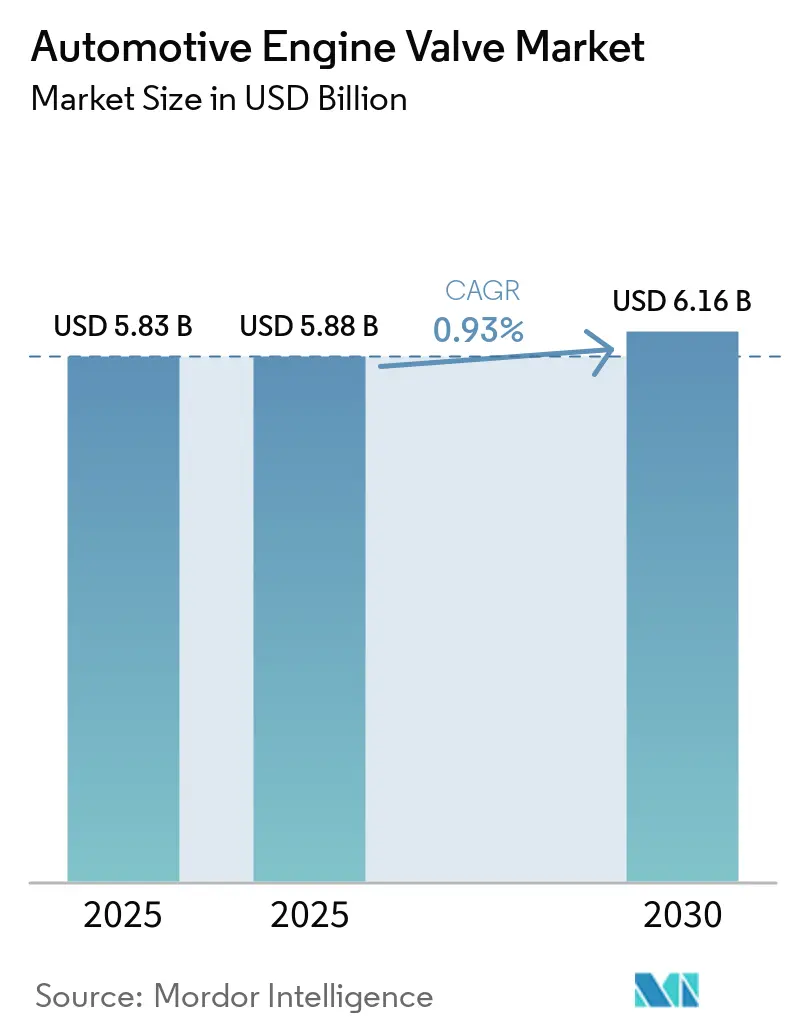
| Market Size (2025) | USD 5.88 Billion |
| Market Size (2030) | USD 6.16 Billion |
| Growth Rate (2026 - 2031) | 0.93 % |
| Fastest Growing Market | Asia Pacific |
| Largest Market | Asia Pacific |
| Market Concentration | Medium |
Major Players *Disclaimer: Major Players sorted in no particular order Image © Mordor Intelligence. Reuse requires attribution under CC BY 4.0. | |
Automotive Engine Valve Market Analysis by Mordor Intelligence
The Automotive Engine Valve Market size is expected to increase from USD 5.83 billion in 2025 to USD 6.06 billion in 2026 and reach USD 7.35 billion by 2030, growing at a CAGR of 3.93% over 2025-2030. Electrification is limiting internal-combustion engine (ICE) volumes, yet commercial-vehicle upcycles, CNG/LPG fleet conversions, and a wave of Euro 7/Tier 4 compliance programs are sustaining demand for precision-machined valves in segments where ICE powertrains remain economically entrenched. Tightening emission rules are accelerating the adoption of variable valve timing and sodium-filled hollow exhaust valves, while near-sourcing in Mexico and India is shortening supply chains and lifting regional content. Meanwhile, predictive-maintenance pilots are shifting heavy-duty fleets toward condition-based valve replacement, creating fresh aftermarket revenue pools for suppliers that can pair hardware with data services. Together, these counter-currents explain why the automotive engine valve market is advancing at a muted headline pace yet continues to generate targeted growth pockets for material and process innovators.
Key Report Takeaways
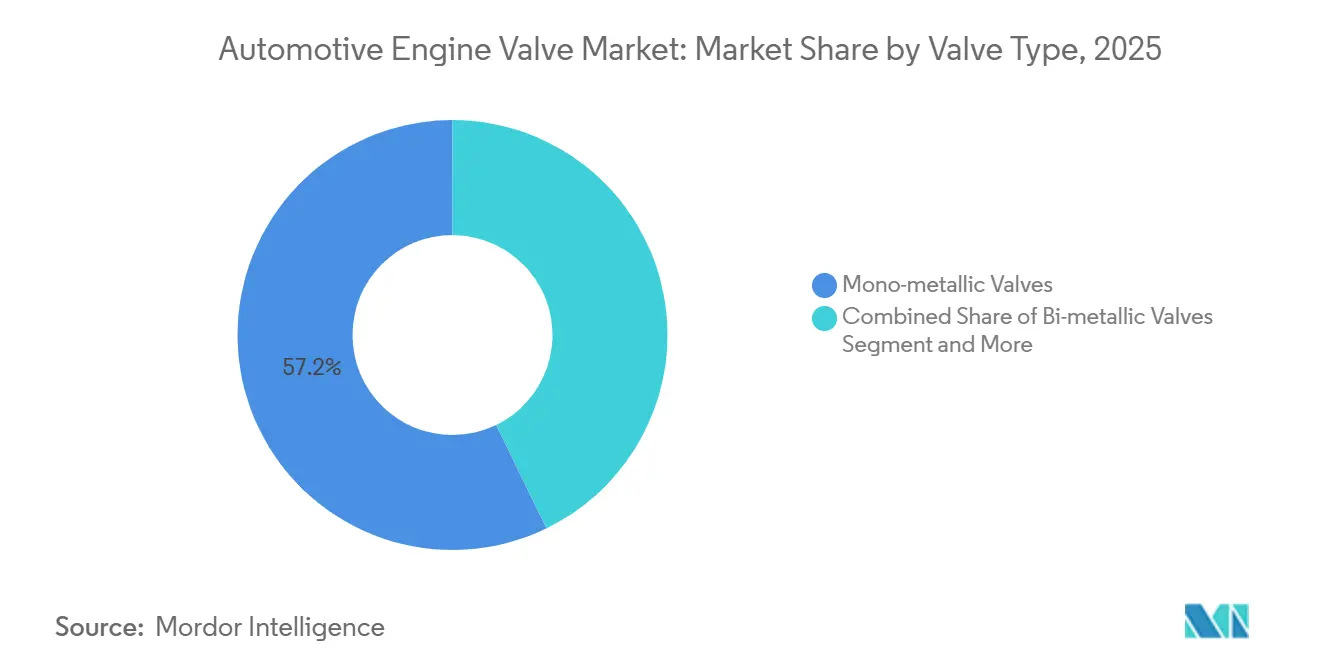
- By valve type, mono-metallic designs led with 57.18% of the automotive engine valve market share in 2025, while hollow valves are projected to expand at a 3.95% CAGR through 2031.
- By function, intake valves accounted for 63.37% of revenue in 2025; exhaust valves are the fastest-growing, at a 3.98% CAGR through 2031.
- By material, steel dominated, accounting for 65.46% of 2025 sales, whereas titanium valves posted the highest CAGR at 4.03% through 2031.
- By vehicle type, passenger cars accounted for 54.57% of 2025 demand, while medium- and heavy-commercial vehicles are forecast to grow at a 4.04% CAGR between 2026-2031.
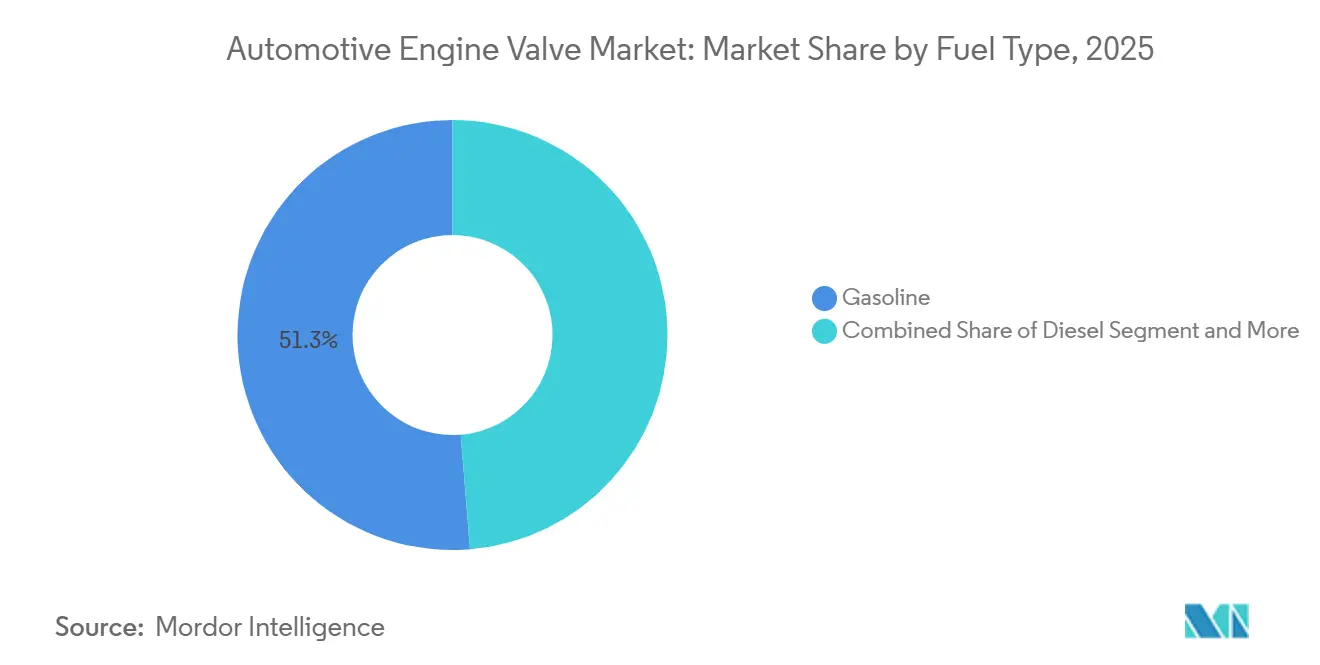
- By fuel type, gasoline engines retained 51.26% share in 2025, but CNG/LPG valves are advancing at a 4.08% CAGR over the same horizon.
- By distribution channel, OEM supply captured 76.36% of 2025 volumes, while the independent aftermarket delivered the fastest 4.11% CAGR through 2031.
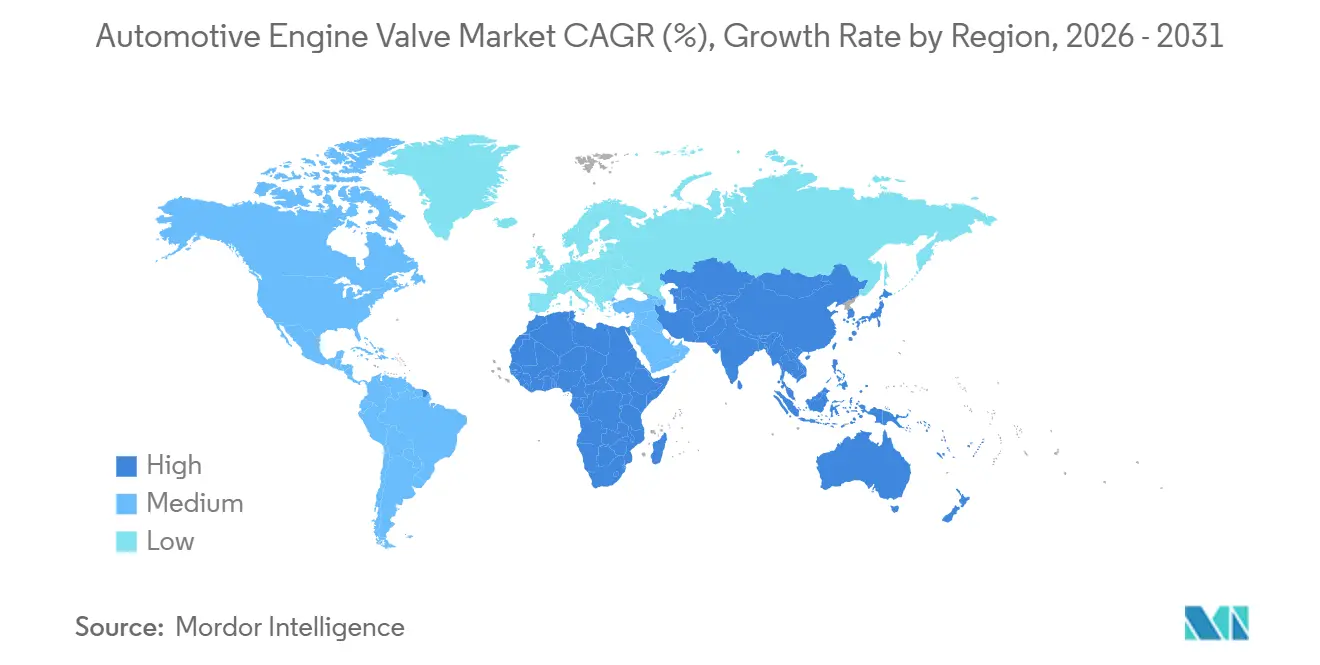
- By geography, Asia-Pacific accounted for 45.67% of global revenue in 2025 and remains the fastest-growing region, with a 4.14% CAGR during 2026-2031.
Note: Market size and forecast figures in this report are generated using Mordor Intelligence’s proprietary estimation framework, updated with the latest available data and insights as of January 2026.
Market Trends and Insights
Drivers Impact Analysis of Automotive Engine Valve Market*
| Driver | (~) % Impact on CAGR Forecast | Geographic Relevance | Impact Timeline |
|---|---|---|---|
| Stringent Emission and Fuel-Efficiency Regulations | +0.3% | Global, with early gains in EU, North America, China | Long term (≥ 4 years) |
| Rising Global Vehicle Production | +0.2% | Asia Pacific core, spill-over to MEA | Medium term (2-4 years) |
| Engine Downsizing and Turbocharging Trends | +0.2% | Global | Medium term (2-4 years) |
| CNG/LPG Fleet Expansion in Asia and MEA | +0.2% | Asia Pacific, MEA (Nigeria, Egypt, India, Pakistan) | Short term (≤ 2 years) |
| Regional Micro-Machining and Near-Sourcing of Valves | +0.1% | North America, India, Mexico | Medium term (2-4 years) |
| Predictive-Maintenance Enabled "Smart" Valves | +0.1% | North America, EU, Japan | Long term (≥ 4 years) |
| Source: Mordor Intelligence | |||
Stringent Emission and Fuel-Efficiency Rules
Euro 7, in force since 2025, mandates 10 years or 200,000 km of compliance and tighter PN10 particulate limits, prompting widespread use of variable valve timing (VVT) and lift (VVL). The International Council on Clean Transportation calculates that VVT/VVL yields 1-5.5% fuel-economy gains when paired with cylinder deactivation [1]“Effects of VVT and VVL on Fuel Economy,” International Council on Clean Transportation, theicct.org . BorgWarner will deliver variable cam-timing units for an East Asian OEM’s 2026 hybrids, and EPA Tier 4 rules, starting in model year 2027, further tighten NMOG+NOx thresholds. Denso’s U.S. patent 9002618 details a learning-phase VCT algorithm that preserves combustion stability during phase shifts [2]“Variable Valve Timing Control Apparatus, US 9002618,” United States Patent & Trademark Office, uspto.gov . These regulations steer OEMs toward precision, heat-resistant exhaust valves, thereby enlarging the addressable automotive engine valve market.
Rising Global Vehicle Production
Commercial-vehicle builds are offsetting softness in passenger cars, benefiting valve suppliers. In December 2025, Ashok Leyland reported a significant year-on-year surge in domestic medium- and heavy-commercial vehicle (MHCV) sales, reflecting strong growth in this segment. Simultaneously, sales of light-commercial vehicles grew notably, underscoring robust freight demand in India [3]“Sales Performance December 2025,” Ashok Leyland Ltd., ashokleyland.com. Notably, MHCV engines use more valves than passenger cars. Given their harsher duty cycles, these engines also require valve replacements more frequently. Industry forecasts indicate steady growth in India's MHCV volumes over the next few years. Additionally, a reduction in GST rates has led to a considerable decrease in new-truck costs, encouraging pre-buying. With the production mix increasingly favoring commercial vehicles, the automotive engine valve market finds a buffer against the challenges posed by electrification.
Engine Downsizing and Turbocharging
Turbocharged engines, known for their heightened cylinder pressures and elevated exhaust temperatures, are prone to accelerated valve-face erosion. Testing by MAHLE indicates that sodium cooling significantly reduces valve-head temperatures, leading to a notable extension in service life. Since their recent introduction, Eaton's hollow sodium-filled valves have primarily been aimed at heavy-duty diesel engines. Failures in these engines can result in substantial financial losses for fleets, emphasizing the importance of reliable components. Even as the industry pivots towards electrification, variable-geometry turbochargers are being integrated into hybrid platforms planned for the near future. As the trend of downsizing continues, valves enhanced with advanced materials such as nickel alloys or nitrided coatings are capturing a growing share of the market, further driving the expansion of the automotive engine valve sector.
CNG/LPG Fleet Expansion
Nigeria has set an ambitious goal to convert a significant number of vehicles to CNG within the next few years, while Egypt is focusing on a substantial number of conversions in the near term, leveraging its abundant domestic gas reserves. India has already established a large CNG fleet and is working to significantly expand its fueling infrastructure over the coming years. CNG engines, although operating at cooler temperatures, face challenges such as increased valve-seat wear. To address this, manufacturers are incorporating hardened overlays made of materials like Stellite or Inconel, which slightly increase the cost per valve. The growing trend of retrofitting vehicles with CNG systems is driving aftermarket demand and boosting the automotive engine valve market, despite slower production rates among original equipment manufacturers.
Restraints Impact Analysis of Automotive Engine Valve Market*
| Restraint | (~) % Impact on CAGR Forecast | Geographic Relevance | Impact Timeline |
|---|---|---|---|
| Rapid Power-Train Electrification | -0.4% | Global, with early impact in EU, China, North America | Long term (≥ 4 years) |
| Titanium and Nickel Alloy Price Volatility | -0.2% | Global | Short term (≤ 2 years) |
| Proliferation of Counterfeit Aftermarket Valves | -0.1% | Asia Pacific, MEA, South America | Medium term (2-4 years) |
| Recycling Compliance for Bimetallic Valves | -0.1% | EU, with spill-over to North America | Long term (≥ 4 years) |
| Source: Mordor Intelligence | |||
Rapid Power-Train Electrification
Battery-electric vehicles (BEVs) are set to dominate the automotive landscape, already accounting for a significant portion of global light-vehicle sales in 2025. In China, BEV sales have surpassed half of the market, while Vietnam is steadily approaching a substantial share. Each BEV's emergence translates to a notable reduction in demand for valves used in internal combustion engines (ICE). Furthermore, Europe's draft regulation on end-of-life vehicles is increasing costs associated with dismantling ICEs, making BEVs an increasingly favorable option in terms of total ownership costs. While hybrids provide some relief to the declining demand for ICE components, they rely on smaller engines, which further reduces the need for valves per vehicle. Rane Engine Valve highlights this industry shift, indicating that a considerable portion of its fiscal year revenue now comes from segments less affected by the transition to electrification, such as marine engines. As the automotive landscape evolves, electrification poses challenges for the engine valve market, even as heavy-duty and niche ICE sectors remain resilient.
Titanium & Nickel Alloy Price Volatility
In early 2026, disruptions in Indonesia caused a significant rally in nickel prices. During the previous year, Inconel superalloys, which are critical for manufacturing exhaust valves, experienced a substantial price increase. A notable rise in nickel prices directly impacts the cost of finished exhaust valves, leading to moderate increases in production costs and putting pressure on profit margins, which are already limited within the industry. Titanium Grade 5, a key material, showed considerable price volatility, with China maintaining a dominant position in global supply, controlling a significant share of the market. While larger companies mitigate risks through hedging strategies such as futures, smaller firms, constrained by their limited scale, face growing challenges as their profit margins shrink in the competitive automotive engine valve market.
*Our forecasts treat driver/restraint impacts as directional, not additive. The impact forecasts reflect baseline growth, mix effects, and variable interactions.
Automotive Engine Valve Market Segment Analysis
By Valve Type:
Sodium Cooling Drives Hollow Valve AdoptionHollow sodium-filled valves captured growing interest as OEMs sought to mitigate the 850 °C exhaust-gas peaks prevalent in turbocharged engines. In 2025, mono-metallic units dominated by volume owing to a cost advantage of USD 2-4 per valve, accounting for 57.18% of the automotive engine valve market. Yet adoption of hollow formats is proceeding at a 3.95% CAGR because sodium cooling lowers valve-head temperature by nearly 100 °C, thereby lengthening service life during heavy-duty cycles.
The automotive engine valve market size for hollow units is still modest. Yet, high-performance gasoline and heavy-duty diesel programs increasingly specify them to avoid USD 10,000-20,000 repair bills tied to valve failure. BMW’s S85 and Nissan’s VR38DETT inventories confirm migration from motorsport to series production. Continued cost declines in cold-working and rolling techniques should narrow the premium over bi-metallic offerings and accelerate mainstream penetration.



By Function Type:
Exhaust Valves Face Harsher Duty CyclesIntake valves accounted for 63.37% of 2025 sales, driven by higher per-engine counts and lower material grades. However, the exhaust subset is expanding faster at a 3.98% CAGR because Euro 7 durability mandates elevate peak-temperature and thermal-cycling demands. Exhaust units increasingly deploy nickel alloys and nitrided coatings, nudging average selling prices and boosting the automotive engine valve market size for premium materials.
FUJI OOZX’s 14 million-unit Toyota contract underscores the scale at which advanced exhaust valves are now sourced. Variable lift and cylinder-deactivation architectures impose ±0.02 mm stem-diameter tolerances, raising the bar for machining precision. In CNG and LPG retrofits, hardened Stellite seats are mandatory, further strengthening growth on the exhaust side of the automotive engine valve market.
By Material Type:
Titanium Lightweighting Gains TractionSteel remained the economic default, commanding 65.46% of shipments, yet titanium valves saw the fastest growth at a 4.03% CAGR as premium brands hunt for mass savings in reciprocating. A titanium valve weighs 40-50% less than its steel peer, enabling higher rev ceilings and quicker transient response. The automotive engine valve market share for titanium is still under 10%, but motorsport and luxury OEM pull is firm.
Nickel-based Inconel and Nimonic alloys dominate turbocharged exhaust positions even as price volatility tempers purchasing appetite. MAHLE’s nitrided-steel solution offers a middle path, promising 25-40% longer life at a fraction of the cost of nickel alloy, and could shift share if acceptance widens. Powder-metallurgy parts with recycled scrap may meet looming EU content rules, albeit with 5-10% lower mechanical properties that designers must accommodate.
By Vehicle Type:
Commercial Vehicles Lead GrowthPassenger cars accounted for 54.57% of 2025 valve demand, but MHCVs will expand at a 4.04% CAGR as logistics growth and fleet aging in India and Southeast Asia drive replacements. A typical MHCV engine houses 12-16 valves and operates on 100,000-150,000 km service intervals, resulting in higher lifetime valve throughput than in passenger cars.
Light commercial vehicles ride the e-commerce tailwinds, while bus demand is concentrated in urban transit in the Asia-Pacific. Electrification is slower in heavy-duty fleets, giving the automotive engine valve market insulation from BEV substitution. Pre-buying ahead of India’s FY 2027-28 brake and safety norms could further accelerate near-term MHCV valve volumes.
By Fuel Type:
CNG/LPG Conversions AccelerateGasoline still led in 2025 with 51.26% share, yet CNG/LPG valves clocked the fastest 4.08% CAGR. Nigeria’s million-vehicle goal and Egypt’s 165,000 planned conversions exemplify state-backed momentum. Each retrofit demands hardened valve seats and higher-nickel exhaust valves to counter dry-gas wear, swelling aftermarket consumption within the automotive engine valve market.
Diesel remains indispensable in MHCVs, though particulate standards are nudging OEMs to advanced exhaust-gas recirculation valves. Hybrid-electric passenger cars preserve some gasoline valve volume even as BEVs rise, cushioning total demand over the forecast window.
By Distribution Channel:
Aftermarket Gains ShareOEM build cycles still account for 76.36% of 2025 volumes. Still, independent aftermarket demand is advancing at a 4.11% CAGR, driven by aging vehicle fleets—the average age of cars in the United States hit 13.6 years in 2024. Online parts sales of USD 42.4 billion in 2024 showcase the shift toward e-commerce procurement.
Aftermarket growth is tempered by counterfeit proliferation, yet blockchain traceability pilot programs may restore buyer confidence. Predictive-maintenance data from fleet telematics will steer parts replacement toward condition-based triggers, lifting high-margin premium valve kits and software-enabled service contracts in the automotive engine valve industry.
Geography Analysis
APAC and North America Automotive Engine Valve Market
Asia-Pacific, with a 45.67% share of revenue in 2025, is expected to grow steadily with a CAGR of 4.14% over the forecast period. India's auto-component exports have grown robustly, while Japanese OEMs have made substantial investments to enhance local engine manufacturing capabilities, underscoring the region's growing importance in the automotive engine valve market. China remains a leader in single-country production volumes; however, the rising penetration of battery electric vehicles (BEVs) is reducing demand for internal combustion engine (ICE) components in passenger cars, even as commercial vehicle production continues to thrive. Additionally, Japanese companies such as FUJI OOZX and Nittan Valve are expanding their global footprint, with FUJI's facility in Mexico strategically positioned to benefit from North American trade agreements.
Europe and North America Automotive Engine Valve Market
Europe occupies a moderate position in the market. The implementation of stricter emission standards, such as Euro 7, is driving the adoption of advanced technologies like variable lift systems, which is increasing demand for precision-engineered valves. However, the growing adoption of BEVs and the introduction of end-of-life vehicle (ELV) regulations pose long-term challenges for ICE component manufacturers. In North America, the dominance of light trucks and the trend of near-shoring are providing significant advantages. For instance, Tenneco's expansion in Mexico is reducing lead times for major automakers in the region, thereby strengthening North America's role in the automotive engine valve market.
MEA and South America Automotive Engine Valve Market
Although South America and the Middle East & Africa are smaller contributors to the market, they are experiencing accelerated growth. In Nigeria, the government's focus on compressed natural gas (CNG) and Egypt's incentives for gas conversion are driving increased demand for aftermarket valves. In Brazil, commercial-vehicle manufacturers are upgrading engines to meet stricter emission standards, incorporating higher-quality exhaust valves. Collectively, these emerging markets are helping to offset the decline in demand for ICE components in developed economies, largely driven by the shift toward electrification.

Competitive Landscape
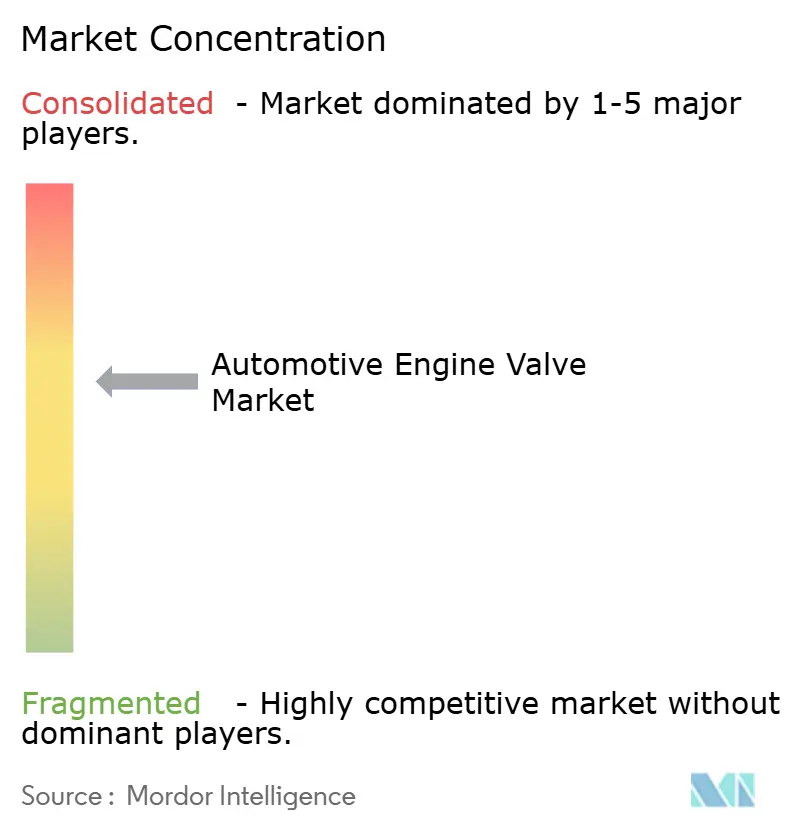
Competition ranges from moderate to high. Global giants like Eaton, MAHLE, BorgWarner, Tenneco, and Denso leverage their extensive scale in R&D and commodity hedging. In contrast, regional players such as FUJI OOZX and Rane Engine Valve capitalize on their proximity to customers and cost advantages. Tenneco's recent investment in Mexico is expected to significantly enhance its global valve market share. This strategic move will enable the company to substantially increase its annual supply capacity to North American OEMs. FUJI OOZX, holding a dominant position in Japan's domestic market, has secured a major contract for exhaust valves with Toyota North America, which is set to commence soon. With a long-term vision, FUJI OOZX is aiming to expand its presence in the global market over the next several years.
There's a noticeable shift in innovation focus towards "smart" valves equipped with sensors, advanced surface treatments, and friction-welded hollow designs. These innovations not only meet the stringent Euro 7 durability standards but also maintain competitive weight advantages. Rane Engine Valve has made significant advancements in India, where its automated production line has achieved a remarkable increase in productivity while also reducing capital expenditure per unit. This demonstrates how process innovations can help smaller players compete effectively against larger-scale leaders. The automotive engine valve market is witnessing a wave of consolidation, underscored by private-equity moves such as a recent stake acquisition in Tenneco. Such investments highlight a strong confidence in the market's cash-flow visibility, even amidst the challenges posed by electrification risks.
Supply-chain dynamics are also evolving. As OEMs navigate tariff uncertainties and pursue regional content, Mexico and India are emerging as critical hubs for production and supply. While employing blockchain to combat counterfeiting adds a slight premium to unit costs, it serves as an essential safeguard for brand equity. However, smaller suppliers who lack the capacity to hedge or operate in niches without intellectual property protection are facing increasing pressure. As raw material prices for key components fluctuate, these suppliers are facing significant margin pressures, accelerating restructuring within the sector.
Automotive Engine Valve Industry Leaders
Eaton Corporation
Mahle GmbH
BorgWarner Inc.
Fuji Oozx Inc.
Federal-Mogul (Tenneco)
- *Disclaimer: Major Players sorted in no particular order
Automotive Engine Valve Market Companies Covered in this Report
- Eaton Corporation
- Mahle GmbH
- Fuji Oozx Inc.
- BorgWarner Inc.
- Federal-Mogul (Tenneco)
- Denso Corporation
- Aisan Industry Co., Ltd.
- Rane Engine Valve Ltd.
- Ferrea Racing Components
- Nittan Valve Co.
- Continental AG
- Schaeffler Group
- Hitachi Astemo
- Valeo SA

Recent Industry Developments in Automotive Engine Valve Market
- August 2025: Nissan adopted valve seats manufactured using cold spray technology, marking the first global application of this technology in automotive engines. Nissan applies cold spray technology to its new 1.5-liter turbocharged engine, designed exclusively to power the third-generation e-POWER hybrid powertrain. The Qashqai compact crossover is the first vehicle globally to feature this new e-POWER system. Production began at Nissan’s state-of-the-art factory in Sunderland, UK, in July.
- May 2025: BorgWarner expanded its business with a major North American OEM by securing extensions for four EGR system volume contracts. The OEM uses these EGR systems across several passenger and light-commercial vehicle platforms, including combustion and hybrid applications. Production of EGR components—including EGR valves, coolers, and modules—is expected to continue through the end of 2029.


Global Automotive Engine Valve Market Report Scope
The scope of the report includes Valve Type (Mono-metallic and More), Function Type (Intake and Exhaust), Material Type (Steel, Titanium, and Nickel-based Alloys), Vehicle Type (Passenger Cars and More), Fuel Type (Gasoline and More), Distribution Channel (OEM and Aftermarket), and Geography.
| Mono-metallic Valves |
| Bi-metallic Valves |
| Hollow Valves |
| Intake Valves |
| Exhaust Valves |
| Steel |
| Titanium |
| Nickel-based Alloys |
| Passenger Cars |
| Light Commercial Vehicles (LCVs) |
| Medium and Heavy Commercial Vehicles (MHCVs) |
| Buses and Coaches |
| Gasoline |
| Diesel |
| CNG/LPG |
| OEM |
| Aftermarket |
| North America | United States |
| Canada | |
| Rest of North America | |
| South America | Brazil |
| Argentina | |
| Rest of South America | |
| Europe | United Kingdom |
| Germany | |
| Spain | |
| Italy | |
| France | |
| Russia | |
| Rest of Europe | |
| Asia-Pacific | India |
| China | |
| Japan | |
| South Korea | |
| Rest of Asia-Pacific | |
| Middle East and Africa | United Arab Emirates |
| Saudi Arabia | |
| Turkey | |
| Egypt | |
| South Africa | |
| Rest of Middle East and Africa |
| By Valve Type | Mono-metallic Valves | |
| Bi-metallic Valves | ||
| Hollow Valves | ||
| By Function Type | Intake Valves | |
| Exhaust Valves | ||
| By Material Type | Steel | |
| Titanium | ||
| Nickel-based Alloys | ||
| By Vehicle Type | Passenger Cars | |
| Light Commercial Vehicles (LCVs) | ||
| Medium and Heavy Commercial Vehicles (MHCVs) | ||
| Buses and Coaches | ||
| By Fuel Type | Gasoline | |
| Diesel | ||
| CNG/LPG | ||
| By Distribution Channel | OEM | |
| Aftermarket | ||
| By Geography | North America | United States |
| Canada | ||
| Rest of North America | ||
| South America | Brazil | |
| Argentina | ||
| Rest of South America | ||
| Europe | United Kingdom | |
| Germany | ||
| Spain | ||
| Italy | ||
| France | ||
| Russia | ||
| Rest of Europe | ||
| Asia-Pacific | India | |
| China | ||
| Japan | ||
| South Korea | ||
| Rest of Asia-Pacific | ||
| Middle East and Africa | United Arab Emirates | |
| Saudi Arabia | ||
| Turkey | ||
| Egypt | ||
| South Africa | ||
| Rest of Middle East and Africa | ||


Key Questions Answered in the Report
What is the projected value of the automotive engine valve market by 2031?
The automotive engine valve market is forecast to reach USD 6.16 billion by 2031 at a 3.93% CAGR over 2026-2031.
Which valve type is growing fastest through 2031?
Hollow sodium-filled valves are expected to expand at a 3.95% CAGR as turbocharged and high-performance engines demand superior thermal management.
Why are exhaust valves gaining traction under Euro 7?
Euro 7 durability rules raise peak-temperature and cycling loads, prompting OEMs to specify nickel-alloy or nitrided exhaust valves that can withstand 200,000 km of service.
How does electrification influence future valve demand?
Each BEV eliminates 8-16 engine valves, and rising BEV penetration, particularly in Europe and China, is expected to curb long-term ICE valve volumes despite hybrid offsets.
Which region offers the highest growth opportunity?
Asia-Pacific leads in both share and growth, with a projected 1.14% CAGR through 2031, driven by India’s commercial-vehicle upcycle and expanding CNG infrastructure [MORDOR INTELLIGENCE].
How are suppliers combating counterfeit valves in the aftermarket?
Tier-1 manufacturers are piloting blockchain-based serialization and QR-code part authentication to help workshops and consumers verify genuine valves before installation.
Page last updated on:





