
Automotive Fog Lights Market Size and Share
Market Overview
| Study Period | 2019 - 2031 |
|---|---|
| Market Size (2026) | USD 1.15 Billion |
| Market Size (2031) | USD 1.31 Billion |
| Growth Rate (2026 - 2031) | 2.65 % |
| Fastest Growing Market | Asia-Pacific |
| Largest Market | Asia-Pacific |
| Market Concentration | Medium |
Major Players *Disclaimer: Major Players sorted in no particular order Image © Mordor Intelligence. Reuse requires attribution under CC BY 4.0. | |
Automotive Fog Lights Market Analysis by Mordor Intelligence
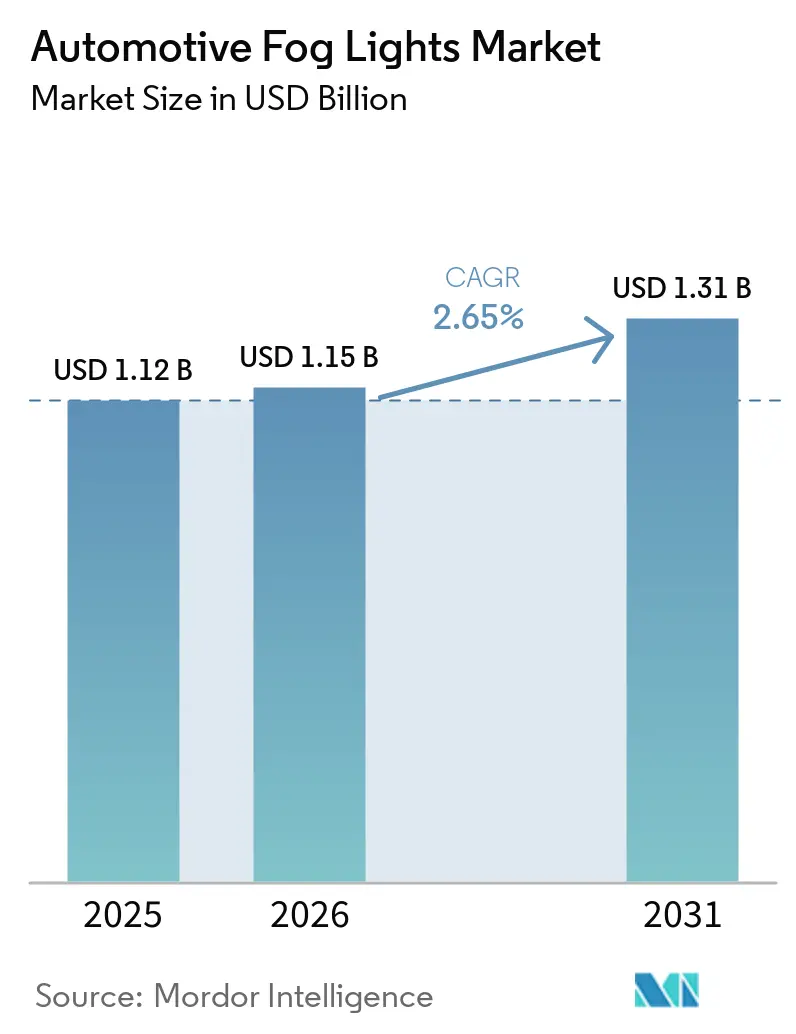
The automotive fog lights market size was valued at USD 1.12 billion in 2025 and is estimated to grow from USD 1.15 billion in 2026 to reach USD 1.31 billion by 2031, at a CAGR of 2.65% during the forecast period (2026–2031). Moderate growth reflects the increasing adoption of energy-efficient lighting solutions, the implementation of stricter fitment mandates, and the integration of advanced driver assistance systems. LED fog lamps currently maintain a dominant position in the market, while advancements in adaptive beam software and sensor fusion technologies continue to drive product differentiation. Localization of supply chains within the Asia-Pacific region is contributing to enhanced cost competitiveness, while the emergence of software-defined lighting is transforming fog lamps into upgradeable safety features, offering additional value to end-users.
Key Report Takeaways
- By light type, LEDs captured a 51.96% share in the automotive fog light market in 2025 and are projected to grow at a 3.63% CAGR during the forecast period (2026-2031).
- By vehicle type, passenger cars led with a 59.81% share in the automotive fog light market in 2025, and are expected to record the fastest CAGR of 9.24% during the forecast period (2026-2031).
- By application, front fog lights hold a 70.59% share of the automotive fog light market in 2025 and are expected to advance at a 3.82% CAGR during the forecast period (2026-2031).
- By technology, conventional static systems retained a 76.47% share in the automotive fog light market in 2025; adaptive systems are projected to post a 3.92% CAGR during the forecast period (2026-2031).
- By distribution channel, OEMs commanded a 54.91% share in the automotive fog light market in 2025, whereas the aftermarket is projected to grow at a 3.06% CAGR during the forecast period (2026-2031).
- By geography, Asia-Pacific captured a 37.25% share in the automotive fog light market in 2025 and is forecasted to be the fastest-growing region, with a 2.75% CAGR during the forecast period (2026-2031).
Note: Market size and forecast figures in this report are generated using Mordor Intelligence’s proprietary estimation framework, updated with the latest available data and insights as of January 2026.
Market Trends and Insights
Drivers Impact Analysis of Automotive Fog Lights Market*
| Driver | (~) % Impact on CAGR Forecast | Geographic Relevance | Impact Timeline |
|---|---|---|---|
| ADAS Sensor Integration | +1.1% | Global, Led By North America and Europe | Medium Term (2-4 Years) |
| Shift Toward LED Lamps | +0.9% | Global, Accelerated In Asia-Pacific | Short Term (≤ 2 Years) |
| Stringent Safety Regulations | +0.8% | Emerging Markets, India and China Focus | Medium Term (2-4 Years) |
| OTA Adaptive Beam Software | +0.7% | North America and Europe Premium Segments | Long Term (≥ 4 Years) |
| Low-Voltage Lighting Demand | +0.5% | Global Urban Centers, EU Leading | Short Term (≤ 2 Years) |
| Passenger-Vehicle Production Growth | +0.4% | Asia-Pacific, South America | Medium Term (2-4 Years) |
| Source: Mordor Intelligence | |||
Integration of Fog Lamps with ADAS Sensor Housings
Manufacturers these days embed LiDAR, radar, and cameras inside fog lamp assemblies to create multipurpose safety units[1]. Sensor fusion facilitates the real-time adjustment of beam patterns, ensuring consistent visibility in challenging weather conditions such as fog, rain, and snow. Infineon’s 16,000-pixel micro-LED array has demonstrated the effectiveness of this approach in improving object detection capabilities, particularly at lower speeds. This architecture also provides significant design flexibility, as sensors can be seamlessly integrated within existing lighting structures, maintaining the aesthetic appeal of the vehicle. However, challenges related to cost efficiency and thermal management continue to pose obstacles. Despite these challenges, major suppliers in the industry anticipate the adoption of this platform in vehicle models expected to be launched in 2026, reflecting the growing importance of advanced sensor technologies in automotive applications.
Shift Toward LED Fog Lamps for Energy-Efficiency
LED fog lamps consume approximately 75% less power compared to halogen units, which contributes to extending the range of electric vehicles and reducing CO₂ emissions. The 2024 NIGHT BREAKER SMART series introduced by ams OSRAM incorporates advanced thermal control systems along with adaptive brightness capabilities. In 2024, the prices of components experienced a reduction of approximately 20%, primarily due to the increased production capacity of Chinese back-end packaging facilities. This development has significantly reduced the price disparity between LED and halogen technologies. Regulatory frameworks established by the European Union and California, which mandate the discontinuation of halogen lamps by 2027, are encouraging original equipment manufacturers to expedite the adoption of LED lighting solutions. Furthermore, the availability of customizable color temperatures and programmable lighting patterns is driving increased demand, particularly among brands that prioritize design and aesthetic appeal.
Stringent Safety Regulations Mandating Front/Rear Fog Lamps
Regulators in India and China introduced new photometric and color norms, lifting global demand. The NHTSA amendment to FMVSS 108 in 2022 cleared the path for adaptive driving beams in the United States[2]. China's GB 4785 standard updates require improved fog lamp photometric performance and introduce specific color temperature restrictions, which favor the adoption of LED technology over traditional halogen systems[3]. These regulatory changes provide advantages to suppliers with certified global platforms, enabling them to align with compliance requirements effectively. Additionally, these updates create significant opportunities in the aftermarket segment, particularly for the development and sale of compliant retrofit kits. The emphasis on LED technology is expected to drive innovation and encourage manufacturers to invest in advanced lighting solutions to meet the updated standards.
Over-the-Air Up-gradable Adaptive Beam Software
Software-defined lighting allows fog lamps to be updated throughout a vehicle's life cycle. Tesla's introduction of adaptive headlight functionality through over-the-air updates in 2024 underscores the potential for software-driven lighting advancements to be implemented across existing vehicle fleets. Companies such as Valeo and ams OSRAM are actively developing RGB driver ecosystems that are compatible with open vehicle networks, enabling hazard communication through the use of color-coded beams. These advancements aim to enhance vehicle safety and communication capabilities. Additionally, pixel LED matrices provide improved granularity in lighting systems; however, their high production costs are anticipated to restrict widespread adoption in mass-market segments until 2027. The ongoing development of these technologies reflects the automotive industry's focus on integrating innovative lighting solutions to improve functionality and adaptability over time.
Restraints Impact Analysis of Automotive Fog Lights Market*
| Restraint | (~) % Impact on CAGR Forecast | Geographic Relevance | Impact Timeline |
|---|---|---|---|
| High Upfront Cost | -0.7% | Global, Most Acute In Price-Sensitive Markets | Short Term (≤ 2 Years) |
| Raw-Material Price Volatility | -0.5% | Global Manufacturing Hubs | Medium Term (2-4 Years) |
| Thermal Issues | -0.4% | Premium Vehicle Segments Globally | Long Term (≥ 4 Years) |
| Regional Color-Temperature Bans | -0.3% | Europe, Select Asian Markets | Medium Term (2-4 Years) |
| Source: Mordor Intelligence | |||
High Upfront Cost of LED/Adaptive Fog Lights
The high cost of LED and adaptive fog lights continues to represent a significant obstacle to widespread adoption, particularly in cost-sensitive markets and the commercial vehicle segment. LED fog lamps are generally three to four times more expensive than halogen units, while adaptive systems can cost up to ten times more due to the integration of advanced sensors. Furthermore, the increase in tariffs and labor costs during 2024 has placed additional pressure on manufacturers, especially smaller companies that lack the advantage of economies of scale. The production process is further complicated by the need for specialized equipment and adherence to stringent quality control standards, which contribute to higher manufacturing costs. However, advancements in manufacturing processes and efficiency are expected to gradually reduce the cost of LED fog lights, potentially aligning them more closely with halogen units by the period of 2027 to 2028. These developments are likely to enhance the affordability and accessibility of LED and adaptive fog lights, thereby supporting their adoption in a broader range of markets and vehicle segments.
Raw-Material Price Volatility for Lenses and Housings
Fluctuating prices of essential materials such as aluminum, polycarbonate, and rare earth elements are creating significant cost and supply chain challenges for fog lamp manufacturers. Aluminum prices experienced a notable increase, while polycarbonate is facing heightened regulatory scrutiny due to environmental concerns, compelling companies to explore more expensive alternative materials. The reliance on China for rare earth elements introduces considerable geopolitical risks, which could lead to disruptions in the supply of LED phosphors. Furthermore, the escalation of freight costs from Asia is intensifying these challenges, particularly for smaller manufacturers that have limited flexibility in managing their inventory. These factors are likely to drive increased consolidation within the market, favoring larger manufacturers that possess stronger and more resilient supply chain capabilities. This trend underscores the growing importance of strategic supply chain management and resource diversification to mitigate risks and maintain competitiveness in the evolving market landscape.
*Our forecasts treat driver/restraint impacts as directional, not additive. The impact forecasts reflect baseline growth, mix effects, and variable interactions.
Automotive Fog Lights Market Segment Analysis
By Light Type:
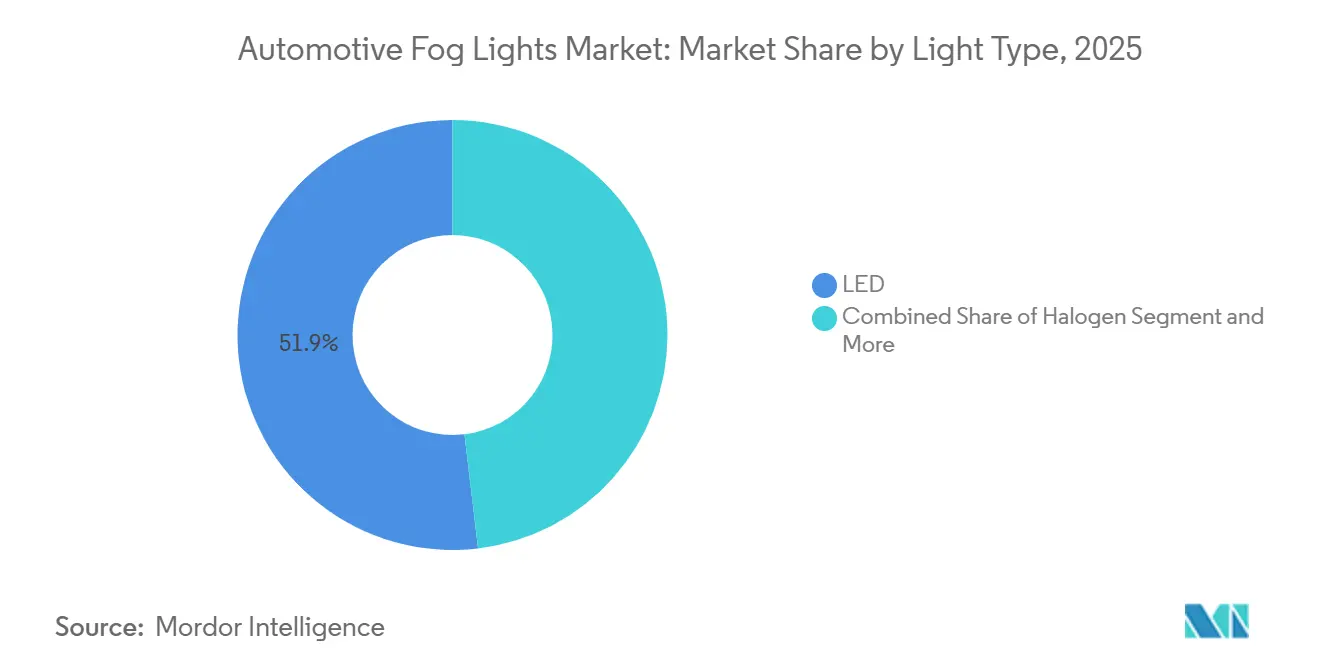
LED Technology Drives Market EvolutionIn 2025, LED fog lamps accounted for 51.96% of the automotive fog light market and are projected to grow at a 3.63% CAGR during the forecast period (2026-2031). This growth is driven by their longer service life, reduced power consumption, and compatibility with electric vehicle efficiency requirements. Halogen solutions remain relevant for cost-sensitive replacement markets, but OEM adoption is declining due to regulatory emphasis on energy efficiency. Xenon/HID systems, previously common in premium trims, are losing market share due to ballast complexity and high costs. Replacement cycles are also extending as newer LEDs often last the vehicle's lifetime.
Laser fog lamps, introduced through BMW prototypes, deliver precise beams but face challenges related to heat dissipation. Leading suppliers are developing hybrid LED-laser modules that combine high intensity with improved thermal management, paving the way for advanced adaptive arrays. Thermal management advancements and cost reductions could drive adoption after 2028, particularly in high-performance vehicles. Start-ups are exploring graphene heat sinks to reduce laser package sizes. If successful, lasers could transform premium fog-light designs in the next product cycle.

By Vehicle Type:
Commercial Segments Accelerate AdoptionIn 2025, passenger cars accounted for 59.81% of the automotive fog light market. This segment is expected to register the highest CAGR of 9.24% from 2026 to 2031, driven by increasing LED adoption in compact and mid-size models. LEDs reduce maintenance and downtime, benefiting delivery services operating in challenging urban conditions. Low-voltage architectures in electric vans enhance efficiency, making LED fog lamps a common feature in 2025 fleet-procurement tenders. Regulatory incentives linking insurance discounts to modern lighting upgrades further boost demand.
Adaptive functions, previously limited to luxury vehicles, are now entering mainstream segments due to declining controller costs. Studies associating modern fog lighting with reduced collision rates encourage consumer investment in upgrades. Government rebate programs in China and India promoting advanced safety features are driving demand for LED and adaptive units. By 2031, the market share gap between passenger and commercial vehicles is expected to narrow. E-commerce growth continues to support unit volumes in both segments.
By Application:
Front Fog Dominance With Adaptive InnovationIn 2025, front fog lights accounted for 70.59% of the automotive fog light market, driven by their critical safety role during heavy rain and fog. OEM fitment remains strong, with a projected 3.82% CAGR from 2026 to 2031. Rear fog lights, while significant under EU and Chinese regulations, exhibit slower growth due to their single-function nature. However, color-balanced LED rear fog modules are gaining traction for improved visibility without glare. Premium brands are integrating rear fog functions into continuous light bars, enhancing design value.
Adaptive front fog systems, utilizing matrix LEDs and sensors, precisely adjust beam cut-off. Forvia Hella’s 2024 rear wing lighting for LYNK & CO demonstrated the potential of adaptive concepts beyond the front. UNECE Regulation R149 provides a clear certification framework, expediting global rollout plans for 2026 model lines. Over-the-air firmware enables updates such as new beam patterns or weather modes post-sale, enhancing flexibility and supporting long-term revenue growth for OEMs and suppliers.
By Technology:
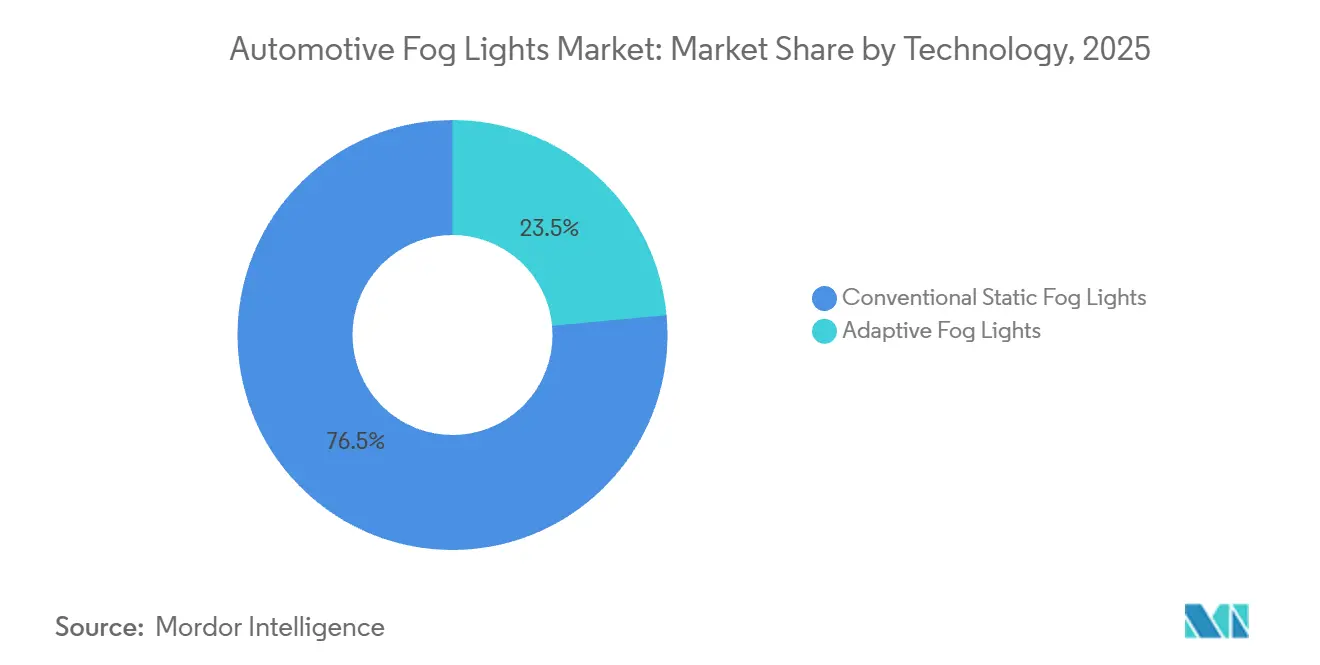
Conventional Systems Face Adaptive DisruptionIn 2025, conventional static fog lights account for 76.47% of the automotive fog light market due to low tooling costs and regulatory familiarity. Their simple circuitry appeals to budget models and vehicles in emerging markets with high price sensitivity. Adaptive systems are projected to grow at a 3.92% CAGR from 2026 to 2031, aligning with OEMs' focus on intelligent, data-driven lighting. Features such as matrix arrays reduce glare for oncoming traffic and enhance illumination in bends. Insurance agencies are incorporating adaptive lamps into risk assessments, potentially driving adoption.
Stanley Electric and Mitsubishi Electric Mobility's 2025 joint venture aims to develop pixel-controlled adaptive modules at competitive costs. By 2031, the market share of adaptive technology in automotive fog lights is expected to double, supported by economies of scale. Software-upgrade pathways offer aftermarket revenue opportunities, enabling owners to unlock advanced beam patterns. Regulators are drafting glare-control metrics for adaptive designs. These developments indicate a shift where static lamps may lose their dominant market position.
By Distribution Channel:
OEM Leadership With Aftermarket InnovationIn 2025, OEM channels accounted for 54.91% of the automotive fog light market. Automakers integrate fog lights with cohesive styling, electrical systems, and global homologation services. In-house validation ensures compliance with photometric standards across regions, supporting global platforms. The aftermarket is projected to grow at a CAGR of 3.06% during the forecast period (2026-2031), driven by LED retrofit kits that enhance older vehicles' performance. Replacement demand increases after severe weather seasons as drivers recognize the benefits of improved visibility. Retailers provide vehicle-specific harnesses to simplify installation and reduce labor time.
Specialized firms offer Bluetooth-controlled RGB fog lamps, tri-color projectors, and laser-inspired spot modules for enthusiasts. Europe’s component certification programs grant street-legal status to many upgrades, reducing regulatory risks. Online tutorials and beam-pattern simulators enhance consumer confidence in self-installation. As fleets adopt retrofit LED kits to meet sustainability goals, the market share gap between OEM and aftermarket is expected to narrow. Suppliers with rapid product refresh capabilities are positioned to capitalize on this growth.
Geography Analysis
APAC Automotive Fog Lights Market
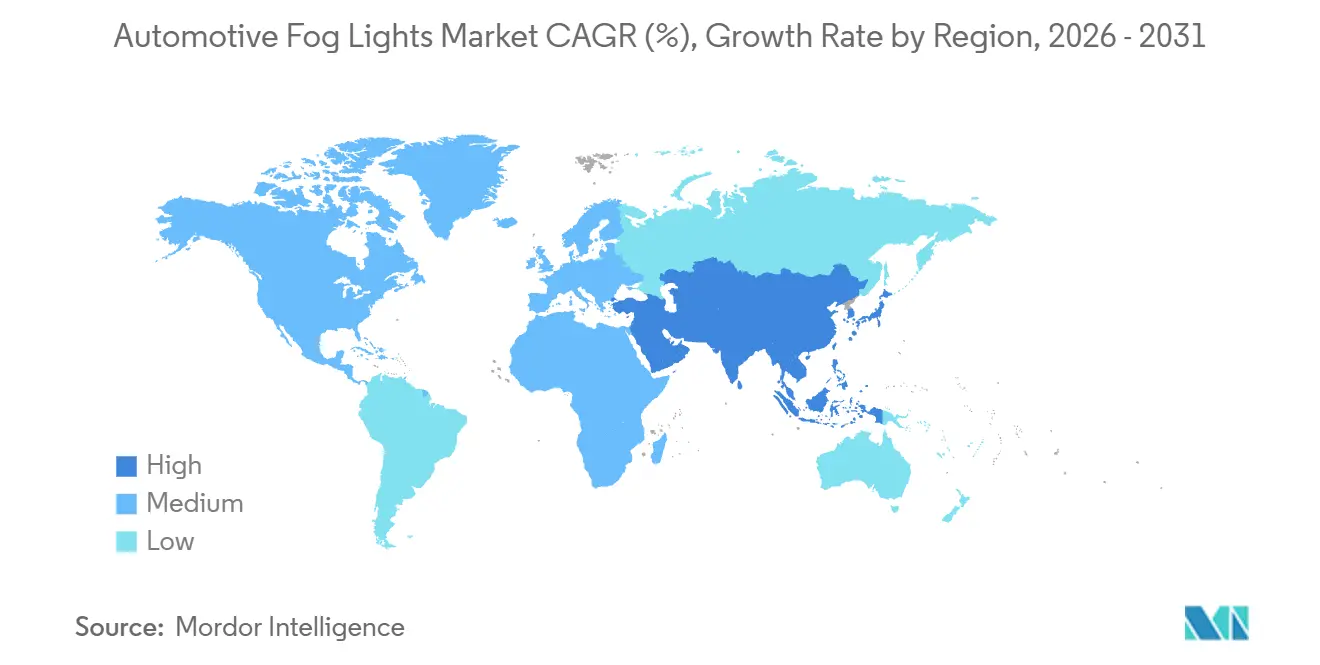
In 2025, the Asia-Pacific region accounted for 37.25% of the market share and recorded a 2.75% CAGR. China's lighting component ecosystem benefits from economies of scale, while India's rear fog mandate increases OEM and retrofit volumes. Local suppliers, due to their proximity to automakers, reduce logistics costs and participate in joint design cycles. Thailand and Indonesia focus on supplier parks integrating die-casting, LED packaging, and assembly lines, strengthening regional dominance.
Europe Automotive Fog Lights Market
Europe remains technologically advanced, adhering to UNECE standards and sustainability policies. Circular-economy initiatives, such as Stellantis-Valeo's remanufactured LED headlamps, reduce CO₂ emissions by 70% and generate secondary revenue streams. EU directives phasing out halogens by 2027 drive LED adoption in OEM and aftermarket segments. Economic challenges limit unit growth, but high per-unit value supports revenue.
North America, LATAM and MEA Automotive Fog Lights Market
North America shows consistent growth due to FMVSS 108 revisions, allowing adaptive driving beams. Consumer demand for LED upgrades supports the aftermarket, while commercial fleet electrification increases low-voltage lighting demand. Mexico's role as a near-shore manufacturing hub enhances supply chain resilience. Latin America and the Middle East and Africa, starting from smaller bases, are expanding as safety regulations tighten and vehicle production rises in Brazil, Turkey, and South Africa.
Competitive Landscape
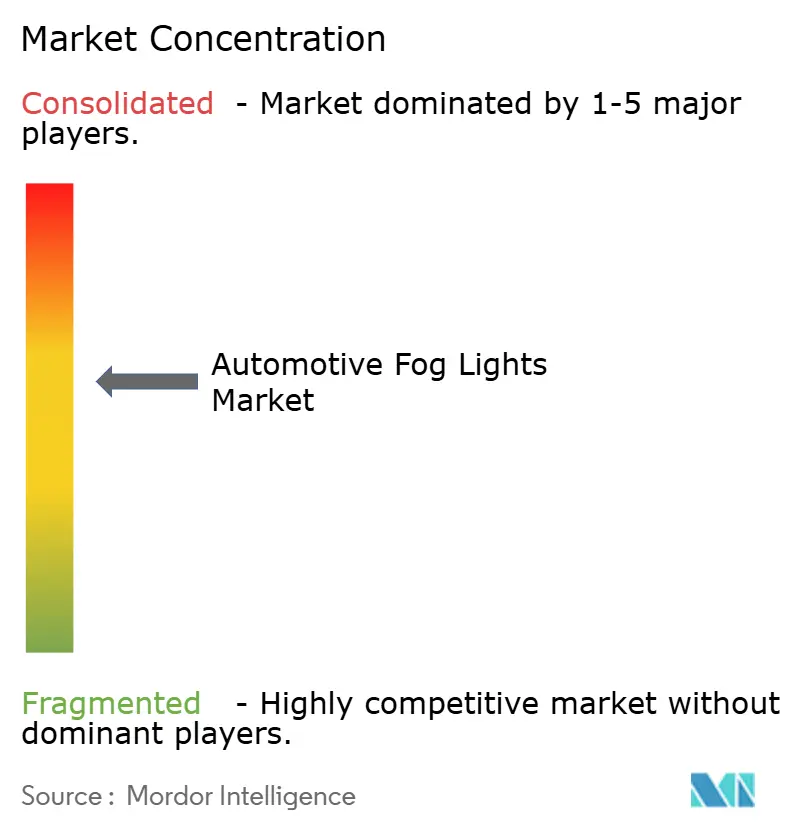
The automotive fog lights market, characterized by moderate concentration, presents opportunities for both established suppliers and emerging technology specialists to achieve growth through innovation and strategic positioning. Koito, leveraging its early adoption of sensor-ready fog lamps and strong relationships with OEMs, leads the market. Valeo follows with a robust adaptive beam intellectual property portfolio and a global presence. Forvia Hella distinguishes itself with modular matrix LED platforms. These companies are significantly investing in software teams, reflecting the industry's transition toward digital lighting ecosystems.
In 2024 and 2025, strategic transactions have reshaped the market landscape. In August 2024, Lumileds sold its lamps and accessories division to First Brands Group for USD 238 million, enabling Lumileds to concentrate on LED dies and phosphors. Stanley Electric and Mitsubishi Electric Mobility established a joint venture focused on next-generation adaptive modules, combining their expertise in optoelectronics and control software. Additionally, start-ups specializing in thermal materials and over-the-air firmware are forming partnerships with tier-one companies, driving innovation in the market.
The competitive landscape is now defined by the depth of patents in pixelated LED arrays and the ability to pass multi-site COP (Conformity of Production) audits. As OEMs increasingly demand consistent quality across global manufacturing operations, these audits are becoming critical. Furthermore, in-house thermal simulation capabilities are essential for optimizing LED performance and longevity, particularly under varying environmental conditions. Mid-sized suppliers are differentiating themselves through rapid retrofit product lines and circular economy credentials. However, barriers to market entry are increasing as compliance testing expands to include glare-control metrics and cybersecurity standards for software-driven lighting systems.
Automotive Fog Lights Industry Leaders
-
Koito Manufacturing Co., Ltd.
-
Valeo SA
-
Forvia Hella
-
Magneti Marelli S.p.A.
-
Stanley Electric Co., Ltd
- *Disclaimer: Major Players sorted in no particular order
Automotive Fog Lights Market Companies Covered in this Report
- Koito Manufacturing Co., Ltd.
- Valeo SA
- Hella GmbH and Co. KGaA (Forvia)
- Magneti Marelli S.p.A.
- Stanley Electric Co., Ltd.
- ZKW Group GmbH
- OSRAM GmbH (ams OSRAM)
- Hyundai Mobis Co., Ltd.
- SL Corporation
- Robert Bosch GmbH
- Phoenix Lamps Limited
- PIAA Corporation
- Flex-N-Gate Corporation
- Warn Industries, Inc.
- Varroc Lighting Systems
- Lumileds Holding B.V.
- TYC Genera
- DLAA Industrial Co. Ltd.
- Blazer International
- Xingyu Automotive Lighting Systems
Recent Industry Developments in Automotive Fog Lights Market
- July 2026: FORVIA HELLA announced the start of series production of its LeanLED II in June 2026, an LED lighting system that can be used for both front and rear applications. The compact lamp is targeted at commercial and special vehicles, including trucks, agricultural machinery, municipal vehicles, and trailers. The development reflects the industry's shift toward modular LED lighting platforms and integrated front-lighting solutions, expanding the addressable value chain beyond conventional headlamps and fog lamps toward multifunctional lighting modules.
- July 2025: Mahindra has introduced the XUV 3XO SUV, which includes features such as LED front fog lights, a panoramic roof, and 17-inch alloy wheels. These additions are designed to enhance both the functionality and aesthetic appeal of the vehicle, aligning with consumer preferences for modern and well-equipped SUVs.
- March 2025: Maruti Suzuki has introduced the eVitara EV, which features matrix LED DRLs as well as LED fog lights. This launch highlights the company's focus on integrating advanced lighting technology into its electric vehicle offerings, aiming to enhance both functionality and design appeal.
Global Automotive Fog Lights Market Report Scope
The scope of the report includes light type, vehicle type, application, technology, distribution channel, and geography. By light type, the market is segmented into halogen, LED, xenon/HID, and laser. By vehicle type, the market is segmented into passenger cars, light commercial vehicles (LCVs), and medium- and heavy-commercial vehicles (MHCVs). By application, the market is segmented into front fog lights and rear fog lights. By technology, the market is segmented into conventional static fog lights and adaptive fog lights. By distribution channel, the market is segmented into OEM and aftermarket. By geography, the market is segmented into North America, South America, Europe, Asia-Pacific, and the Middle East and Africa. The Market Forecasts are Provided in Terms of Value (USD).
Segmentation Overview
| Halogen |
| LED |
| Xenon/HID |
| Laser |
| Passenger Cars |
| Light Commercial Vehicles (LCVs) |
| Medium and Heavy Commercial Vehicles (MHCVs) |
| Front Fog Lights |
| Rear Fog Lights |
| Conventional Static Fog Lights |
| Adaptive Fog Lights |
| OEM |
| Aftermarket |
| North America | United States |
| Canada | |
| Rest of North America | |
| South America | Brazil |
| Argentina | |
| Rest of South America | |
| Europe | United Kingdom |
| Germany | |
| Spain | |
| Italy | |
| France | |
| Russia | |
| Rest of Europe | |
| Asia-Pacific | India |
| China | |
| Japan | |
| South Korea | |
| Rest of Asia-Pacific | |
| Middle East and Africa | United Arab Emirates |
| Saudi Arabia | |
| Turkey | |
| Egypt | |
| South Africa | |
| Rest of Middle East and Africa |
| By Light Type | Halogen | |
| LED | ||
| Xenon/HID | ||
| Laser | ||
| By Vehicle Type | Passenger Cars | |
| Light Commercial Vehicles (LCVs) | ||
| Medium and Heavy Commercial Vehicles (MHCVs) | ||
| By Application | Front Fog Lights | |
| Rear Fog Lights | ||
| By Technology | Conventional Static Fog Lights | |
| Adaptive Fog Lights | ||
| By Distribution Channel | OEM | |
| Aftermarket | ||
| By Geography | North America | United States |
| Canada | ||
| Rest of North America | ||
| South America | Brazil | |
| Argentina | ||
| Rest of South America | ||
| Europe | United Kingdom | |
| Germany | ||
| Spain | ||
| Italy | ||
| France | ||
| Russia | ||
| Rest of Europe | ||
| Asia-Pacific | India | |
| China | ||
| Japan | ||
| South Korea | ||
| Rest of Asia-Pacific | ||
| Middle East and Africa | United Arab Emirates | |
| Saudi Arabia | ||
| Turkey | ||
| Egypt | ||
| South Africa | ||
| Rest of Middle East and Africa | ||
Key Questions Answered in the Report
What is the 2025 value of the automotive fog lights market?
The automotive fog lights market size reached USD 1.12 billion in 2025.
How fast is the market expected to grow?
It is projected to expand at a 2.65% CAGR between 2026 and 2031.
Which light type leads global demand?
LED fog lamps dominate with a 51.96% share.
Which vehicle class is growing the quickest?
Passenger Cars post the fastest CAGR at 9.24% through 2031.
Why are adaptive fog lights gaining traction?
They align with ADAS integration, offer beam control, and can receive over-the-air updates.
Which region contributes the most revenue?
Asia-Pacific holds the largest regional share at 37.25% in 2025.