
Automotive Chromium Finishing Market Size and Share
Market Overview
| Study Period | 2019 - 2031 |
|---|---|
| Market Size (2026) | USD 4.42 Billion |
| Market Size (2031) | USD 5.52 Billion |
| Growth Rate (2026 - 2031) | 4.53 % |
| Fastest Growing Market | Asia Pacific |
| Largest Market | Asia Pacific |
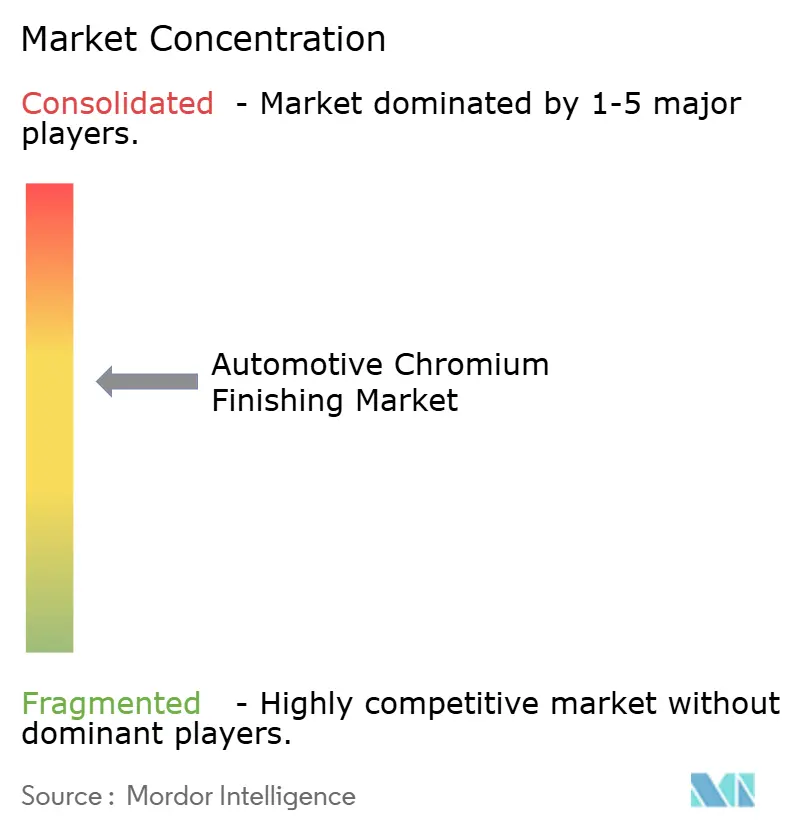
| Market Concentration | Medium |
Major Players *Disclaimer: Major Players sorted in no particular order Image © Mordor Intelligence. Reuse requires attribution under CC BY 4.0. | |
Automotive Chromium Finishing Market Analysis by Mordor Intelligence
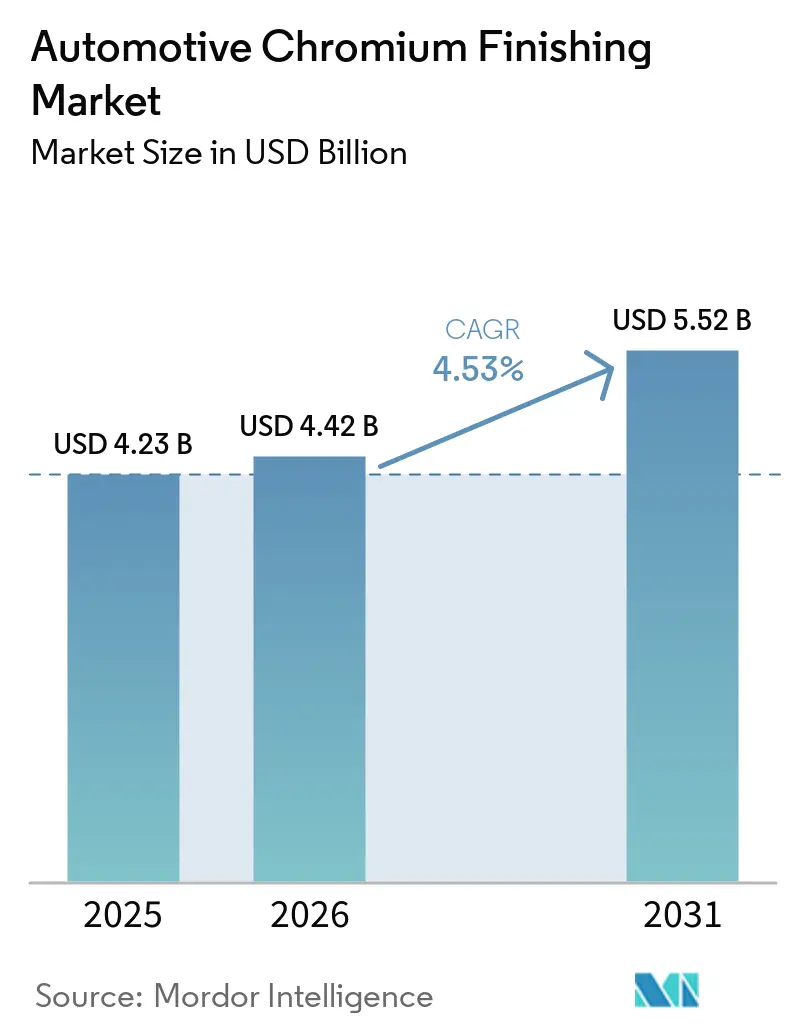
The Automotive Chromium Finishing Market size was valued at USD 4.23 billion in 2025 and is estimated to grow from USD 4.42 billion in 2026 to reach USD 5.52 billion by 2031, at a CAGR of 4.53% during the forecast period (2026-2031). Robust vehicle output recovery, rising electric-vehicle (EV) production, and mandatory shifts toward trivalent chromium systems collectively propel this steady expansion. Automakers continue to specify premium brightwork on exteriors and interiors because chrome remains the most powerful visual cue of craftsmanship and brand identity. Parallel adoption of physical vapor deposition (PVD) allows manufacturers to meet tightening regulations while retaining the signature mirror-like appearance that consumers associate with luxury. Growth headwinds include chromium price volatility, capital-intensive equipment upgrades, and accelerated regulatory timelines in California and the European Union.
Key Report Takeaways
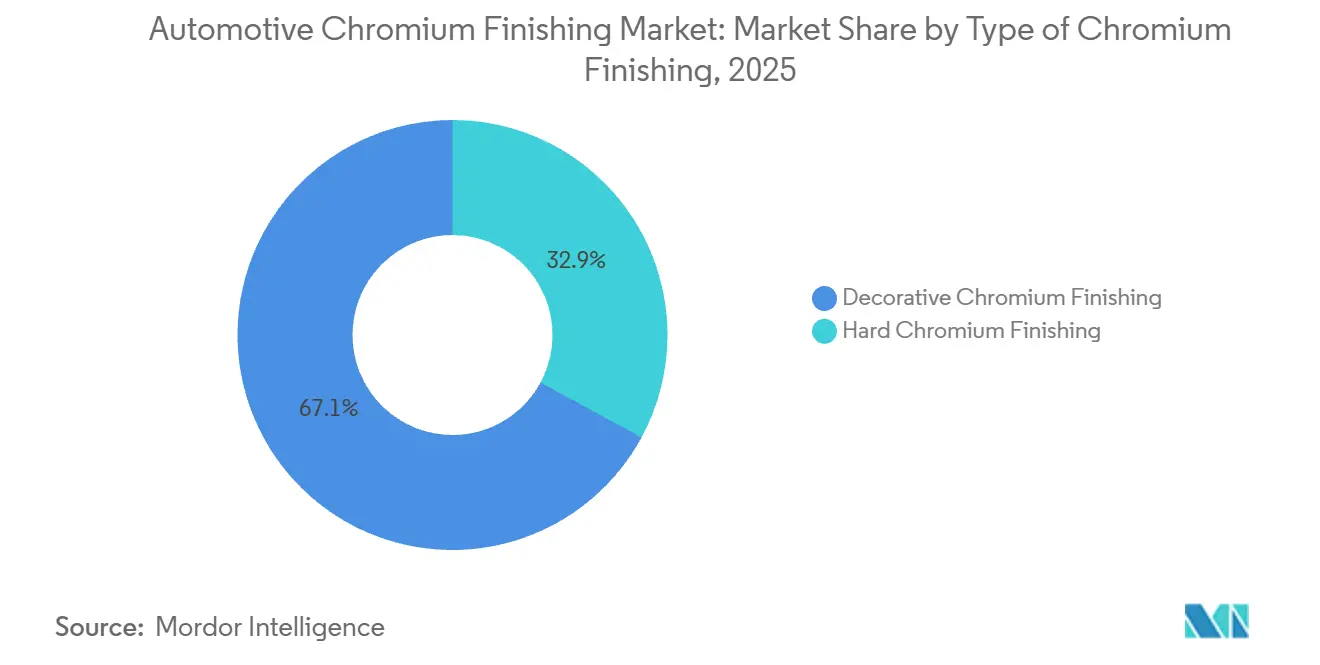
- By chrome-finishing type, decorative chromium accounted for 67.13% of the automotive chromium-finishing market share in 2025. Hard chromium is projected to grow at a 4.95% CAGR to 2031.
- By application, automotive exteriors accounted for a 46.17% share of the automotive chromium finishing market in 2025 and will show the fastest expansion at a 5.18% CAGR through 2031.
- By substrate material, plastics captured 46.81% of the automotive chromium finishing market in 2025, while aluminum substrates registered the highest CAGR at 6.14% through 2031.
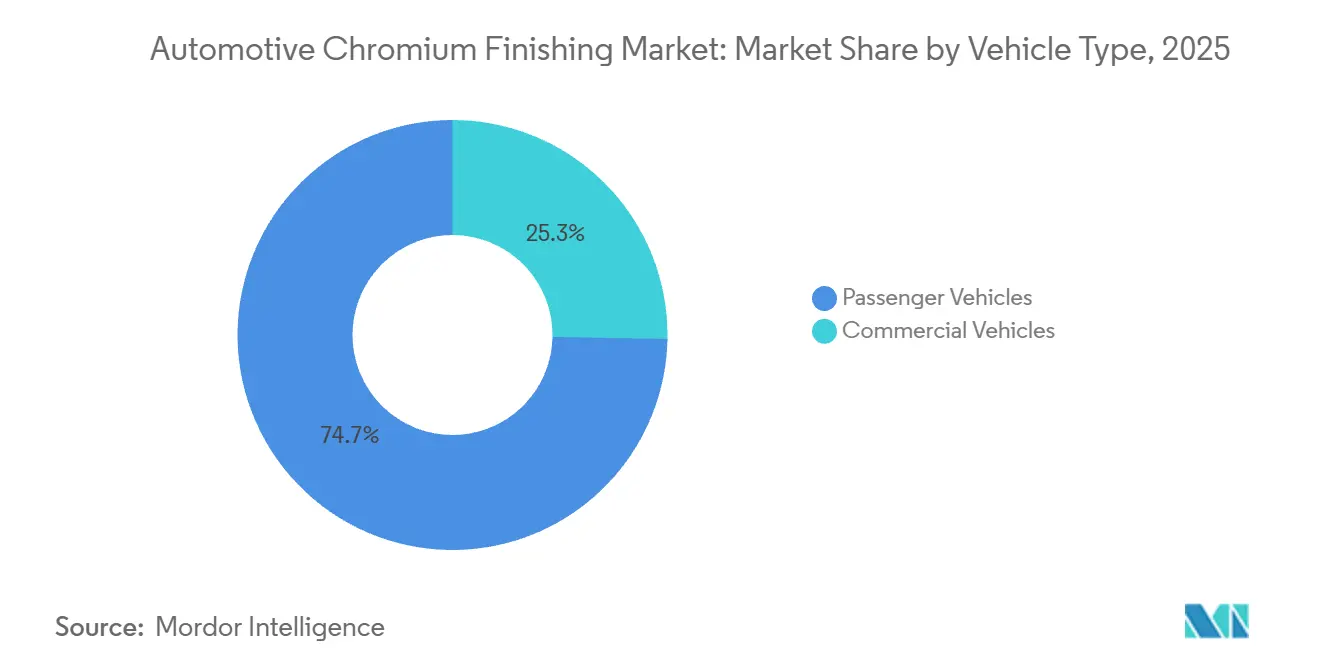
- By vehicle type, passenger cars led with 74.66% of the automotive chromium finishing market share in 2025, and will post a 5.34% CAGR over the forecast window.
- By technology, electroplating-hexavalent held a 68.24% share in 2025, yet electroplating-trivalent is the fastest-growing sub-segment, with a 6.48% CAGR to 2031.
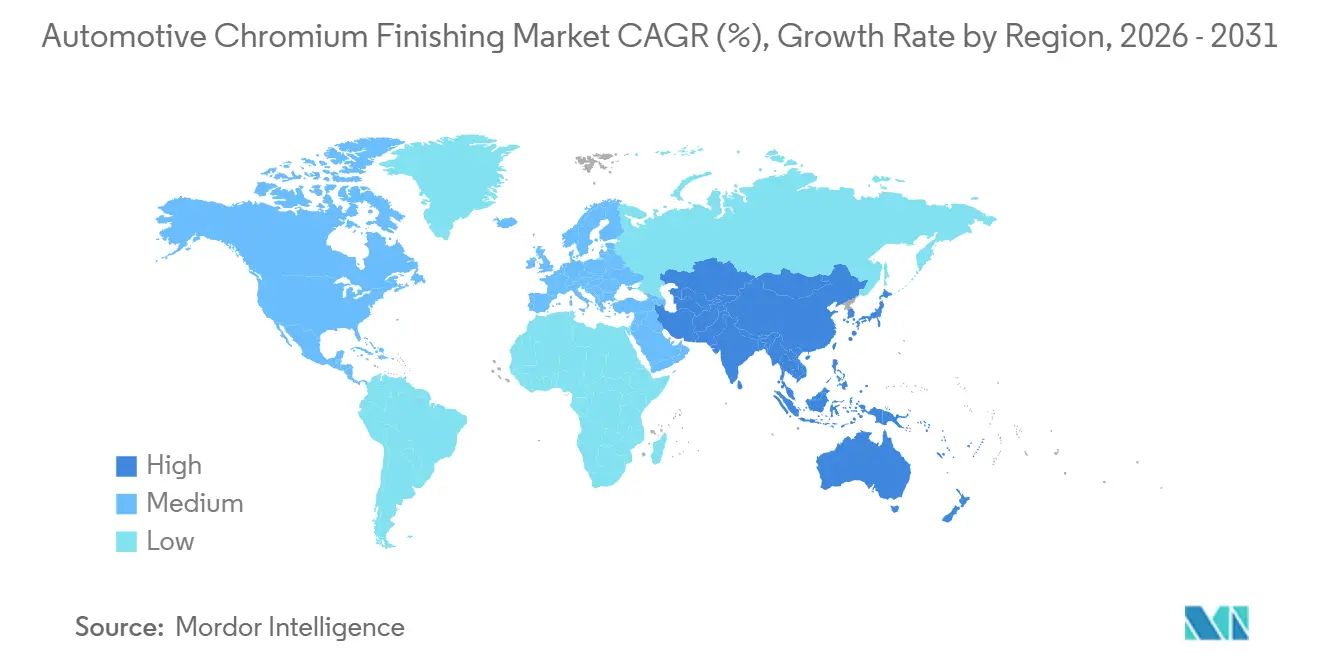
- By geography, Asia-Pacific held a 43.86% share in 2025 and is expected to witness the fastest growth, at a 5.83% CAGR through 2031.
Note: Market size and forecast figures in this report are generated using Mordor Intelligence’s proprietary estimation framework, updated with the latest available data and insights as of January 2026.
Market Trends and Insights
Drivers Impact Analysis of Automotive Chromium Finishing Market*
| Driver | (~) % Impact on CAGR Forecast | Geographic Relevance | Impact Timeline |
|---|---|---|---|
| Premium-Grade Exterior Aesthetics | +1.0% | North America and Europe | Medium term (2-4 years) |
| OEM Mandates for Trivalent Cr and PVD | +0.7% | North America and EU | Medium term (2-4 years) |
| Lightweight Plated Plastics in OEM Trims | +0.6% | Asia-Pacific core, spill-over to North America | Short term (≤ 2 years) |
| Post-Pandemic Rebound in Vehicle Builds | +0.4% | Global, led by Asia-Pacific | Short term (≤ 2 years) |
| Illuminated Chrome Trims for EVs | +0.4% | Global EV hubs, early in premium segments | Long term (≥ 4 years) |
| Chrome-Finished Sensor Housings for L3+ ADAS | +0.3% | North America, EU, Japan | Long term (≥ 4 years) |
| Source: Mordor Intelligence | |||
Surging Demand for Premium-Grade Exterior Aesthetics
Chrome brightwork continues to elevate the perception of vehicles and allows automakers to justify premium pricing. Luxury brands specify multi-layer trivalent stacks that reduce metal usage while preserving deep reflectivity, and mass-market OEMs add selective chrome to grilles and window surrounds to lift perceived value. Magna International's Body Exteriors & Structures segment generated USD 17.0 billion in sales during 2024, maintaining a 7.5 percent adjusted EBIT margin despite program end-of-life headwinds, underscoring sustained demand for exterior finishing services across tier-1 suppliers. Post-pandemic purchasing patterns skewed toward higher-trim models, which lifted per-vehicle chrome content even as regulators restricted the use of legacy electrolytes. Laser-enhanced treatments such as Huf Group’s Signocrom enable brand-specific hues within a chrome layer, demonstrating that innovation is incremental rather than disruptive [1]. Resilient aesthetic demand therefore underwrites volume stability while the sector undergoes technology change.
OEM Mandates for Trivalent Cr and PVD (PFAS-Free Interiors)
California’s updated Airborne Toxic Control Measure blocks new hexavalent permits starting in 2024 and requires decorative shops to convert to trivalent by 2030 [2]. The EU published draft restrictions that target a 17-ton annual emissions cut, and major vehicle groups have internal cut-off dates between 2025 and 2027. The Automotive Industry Action Group's Electroplating Work Group—comprising Ford, General Motors, Toyota, and tier suppliers, including MacDermid Enthone and Flex-N-Gate—focuses explicitly on replacing hexavalent chromium with trivalent chromium and eliminating PFAS in decorative chrome finishing to address carcinogen exposure and workplace safety.
Light-Weight Plated Plastics Adoption in OEM Trims
Weight reduction mandates and fuel-efficiency regulations are driving the substitution of metal substrates with electroplated engineering plastics in exterior and interior trim applications. Atotech's NeoLink® E process enables direct acid copper plating on ABS and ABS/PC blends without electroless nickel or Ni/Cu strike layers, reducing palladium consumption and process steps while meeting global automotive quality standards. Plated plastics offer 40–60 percent weight savings compared with stamped-steel equivalents in grille surrounds, door handles, and emblems, directly supporting fleet-average CO₂ compliance in Europe and CAFE standards in North America, supporting growth in the automotive chromium finishing market.
Post-Pandemic Rebound in Global Vehicle Builds
Global light-vehicle production rebounded during 2024–2026, restoring demand for chromium finishing after semiconductor and supply-chain disruptions had compressed 2021–2023 output. Stellantis consolidated shipments reached 1.4 million units in Q1 2026, up 12 percent year-over-year, with North America (+17 percent), Enlarged Europe (+12 percent), and Middle East and Africa (+11 percent) all posting gains[3]. The rebound in North American SUV and pickup production—segments with higher per-vehicle chrome content—disproportionately benefits decorative chromium finishing. In contrast, compact-car and entry-level EV segments in Europe and China deploy less brightwork, thereby moderating overall gains in intensity.
Restraints Impact Analysis of Automotive Chromium Finishing Market*
| Restraint | (~) % Impact on CAGR Forecast | Geographic Relevance | Impact Timeline |
|---|---|---|---|
| Global Bans on Hexavalent Chromium | -0.9% | California, EU, UK | Short term (≤ 2 years) |
| Chromium Price Volatility and Ferrochrome Risk | -0.5% | Global, cost-sensitive segments | Medium term (2-4 years) |
| Self-healing Clear-Coat Substitutes | -0.4% | North America, Europe, premium models | Long term (≥ 4 years) |
| High CAPEX for Energy-Intensive PVD Lines | -0.3% | Global, impacts smaller suppliers | Medium term (2-4 years) |
| Source: Mordor Intelligence | |||
Tightening Global Bans on Hexavalent Chromium
Regulatory restrictions on hexavalent chromium compounds are compressing the addressable market for traditional electroplating chemistries and forcing capital-intensive process conversions. ECHA's April 2025 proposal to restrict chromium(VI) substances under REACH Annex XVII targets electroplating on metal and plastic substrates with three regulatory options: the strictest (RO3) imposes worker exposure limits of 0.1–0.5 µg/m³ (8-hour TWA), air emissions of 0.025 kg/year, and water releases of 0.15 kg/year, potentially causing significant industry shutdowns due to retrofit costs.
Chromium Price Volatility and Ferrochrome Supply Risk
Chromium feedstock costs exhibit structural volatility driven by concentrated supply, energy-intensive production, and China's dominant role in ferrochrome refining and stainless-steel demand. U.S. Geological Survey data show ferrochrome prices peaked at USD 3.19 per pound (chromium content) in 2022, fell to USD 2.55 in 2023, and eased further to an estimated USD 1.80 in 2024, reflecting Chinese stainless-steel oversupply and weak construction demand. Chromium metal prices followed a similar trajectory: USD 7.20 per pound (gross weight) in 2022, USD 5.05 in 2023, and USD 5.60 per pound (gross weight) estimated for 2024, illustrating persistent volatility that complicates long-term contract pricing for automotive chromium finishing market.
*Our forecasts treat driver/restraint impacts as directional, not additive. The impact forecasts reflect baseline growth, mix effects, and variable interactions.
Automotive Chromium Finishing Market Segment Analysis
By Type of Chromium Finishing:
Decorative Dominance Drives Aesthetic PremiumIn 2025, decorative chrome accounted for a significant 67.13% share of the automotive chromium finishing market. Projections indicate a steady growth at a 4.95% CAGR through 2031, emphasizing its critical role in defining exterior branding. This segment benefits directly from the increasing grille sizes of SUVs and the integration of lighting into brightwork, both of which contribute to higher surface area requirements. Finishing houses employ pulse-reverse rectification techniques to reduce metal thickness while achieving sharper micro-roughness, ensuring the preservation of luster under intense daylight conditions. Although hard chromium represents a smaller segment, it remains essential for applications such as piston rods, bearing races, and battery-cooling plates, where tribological performance is a key determinant. Recent innovations in micro-cracked hard chrome have enhanced fatigue life by 25%, driving its adoption in next-generation e-axle shafts.
Suppliers of decorative chrome are increasingly consolidating their operations to incorporate in-house design services. They are also developing color-tuned PVD stacks that replicate the appearance of copper or anodized aluminum in ultra-thin layers. This capability has attracted electric vehicle startups, which often seek distinctive signature finishes but lack the infrastructure for paint-shop investments. Concurrently, hard chrome specialists are pursuing diversification by offering bundled repair and replate services for remanufactured driveline components, thereby mitigating the impact of declining internal combustion engine volumes. Together, these two segments strengthen the automotive chromium finishing market. However, the decorative segment's ability to balance aesthetic appeal with sustainability ensures its position as the primary value driver within the supply chain.
By Application:
Exteriors Lead Premium Positioning StrategyIn 2025, automotive exteriors accounted for 46.17% of the automotive chromium finishing market, with a projected CAGR of 5.18%. This growth is attributed to the increasing prevalence of SUV grilles and the rising adoption of illuminated fascia bars. Suppliers are now delivering pre-plated large ABS grilles equipped with integrated radar windows. This innovation streamlines the production process, minimizing the need for additional downstream subassemblies by OEMs. The use of coat-within-mold hybrid techniques allows chromium to be sprayed onto warm plastic inserts, eliminating the need for additional tooling and cutting steps. Interior brightwork has also gained prominence, with features such as console knobs, air-vent rings, and shifter bezels becoming standard even in mainstream crossovers, thereby increasing the chrome content per cabin.
Chrome applications are also expanding at the component level. Battery thermal plates and hairpin stators now require thin, hard coatings to withstand dielectric coolants. Achieving weight parity with aluminum remains essential. To address this requirement, trivalent hard-chrome overlays are being utilized. These overlays provide corrosion resistance at a thickness that is 50% of that of traditional hard chrome, thereby optimizing package space. The sustained demand for decorative exterior trims, combined with the increasing functional requirements of electric powertrains, ensures a diverse range of applications within the automotive chromium finishing market.
By Substrate Material:
Plastics Dominance Meets Aluminum InnovationIn 2025, plastic substrates accounted for 46.81% of the automotive chromium finishing market, offering significant design flexibility. Finishing houses utilize low-temperature sputtering on ABS substrates, which prevents heat-induced warpage and ensures their continued relevance. Meanwhile, aluminum, with a 6.14% CAGR, is establishing its importance in battery enclosures, motor housings, and structural strut bars by providing a balance between conductivity and weight reduction. Suppliers, such as JFE Steel, have introduced heat-treatable aluminum sheets that integrate trivalent adhesion layers without requiring chromic acid etching, thereby reducing preparation time by 15%.
Although steel remains a key material for large bumper reinforcements, its market share is declining as original equipment manufacturers focus on weight reduction in preparation for Euro 7 emissions regulations. Composite and glass-fiber substrates are gaining traction in roof rails and spoiler lips, treated with plasma activation to meet the 720-hour salt-spray standard. This expanding range of materials benefits applicators that effectively combine flexible racks, multi-chemistry tanks, and automated optical inspection within a single operational cell.
By Vehicle Type:
Passenger Vehicles Dominate and Lead GrowthIn 2025, passenger models accounted for a dominant 74.66% share of the automotive chromium-finishing market. They are set to lead the market with a robust 5.34% CAGR through 2031. Compact SUVs, utilizing chrome headlamp brows and C-pillar spears for an upscale touch, anchor this volume. Meanwhile, EV sedans, with their illuminated rocker accents, are driving an 8% annual increase in chrome usage per vehicle. Commercial vans, though fewer in number, rely on hard chromium for suspension kingpins and power-take-off shafts, ensuring extended fleet uptime. With regional legislation pushing for zero-emission freight, e-trucks are now incorporating chrome cooling plates. These plates play a crucial role in stabilizing battery temperatures under heavy loads, thereby boosting functional demand.
Looking ahead, the growth of commercial EV buses suggests a shift from traditional decorative chrome to colored PVD bands. These bands, in tune with city branding, may reduce aesthetic chrome volumes but promise higher-margin specialty coatings. The dynamics of the segment reveal that while passenger vehicles will steer decorative trends, commercial platforms are at the forefront of hard-chrome innovations.
By Technology:
Trivalent Transition Accelerates Despite Hexavalent DominanceElectroplating-hexavalent still commanded 68.24% of the automotive chromium finishing market share in 2025 due to entrenched lines and unmatched color uniformity. The regulatory clock, however, has catalyzed a 6.48% CAGR for trivalent chromium finishing baths. Modern formulations exhibit 0.5-micron deposits that pass CASS corrosion tests, meeting OEM Class-A specs without the use of lead anodes. Tier-ones retrofit existing cells with anode cages and revised filtration rather than a greenfield investment, thereby curbing paybacks. PVD, meanwhile, grows in the double digits off a small base, as LEDs in chrome parts mandate the optical edge sharpness only sputtering can deliver.
Some finishers blend chemistries, laying a trivalent strike then sealing with a sputtered clear topcoat to add fingerprint resistance. Future deployments may pair aqueous trivalent lines for high-volume small parts and PVD for oversized trims, preserving scalability while satisfying cosmetic targets. Hexavalent dominance erodes by mid-decade, yet it remains irreplaceable for high-throw deep cavities until additive-based trivalent chemistries advance.
Geography Analysis
APAC Automotive Chromium Finishing Market
In 2025, the Asia-Pacific region accounted for 43.86% of global demand and is projected to experience a 5.83% CAGR through 2031. China, producing over 30 million units, caters to both local and export markets, facilitating multi-shift operations for decorative ABS plating cells in Guangdong and Jiangsu. Japanese suppliers, leading the advancement of micro-crack hard chrome for hydraulic rods, are channeling their innovations to contract shops in ASEAN. In India, industrial parks focused on paint and plating near Pune are attracting interest from both domestic brands and Western EV entrants, all aiming to localize trim supply. Public policies are maintaining a balance by integrating environmental safeguards with practical conversion grants, enabling plating plants to transition to trivalent baths without halting operations.
North America and Europe Automotive Chromium Finishing Market
North America, driven by technological advancements, is experiencing significant regulatory and market shifts. California is accelerating the transition to trivalent methods, while Canadian suppliers are proactively qualifying PFAS-free chemistries to secure contracts with the Detroit Three. Although Chrysler's parent company, Stellantis, has phased out chrome for its upcoming passenger brands, both RAM and Jeep trucks continue to require substantial brightwork, resulting in a divided product strategy. The United States is also witnessing new investments in chrome raw materials, highlighted by AMG's recently approved domestic plant, which aims to reduce reliance on imports. Europe, however, is navigating through increasingly stringent regulations. Proposed revisions to REACH could impose a blanket SVHC classification on decorative applications of hexavalent chromium. In response, German coaters are making significant investments in multi-million-euro PVD cells, complemented by energy-recovery modules, to comply with carbon budgeting mandates. While Scandinavian OEMs are exploring chrome-delete design trends, the demand for chrome remains strong in traditional premium sedans. Eastern Europe's cost-effective plating hubs are catering to Germany and France, but accessing EU-backed modernization funds requires demonstrable compliance with trivalent standards.
MEA and South America Automotive Chromium Finishing Market
In the Middle East and Africa, the automotive sector is expanding from modest beginnings. Turkish suppliers are delivering chrome grilles for both local assemblies and Western European spare parts. After experiencing challenges related to chip shortages, South America is stabilizing, with Brazilian finishers transitioning to trivalent methods in alignment with local regulators who have adopted EU standards. Overall, the automotive chromium finishing market is being shaped by region-specific regulatory frameworks and evolving vehicle preferences.
Competitive Landscape
The automotive chromium finishing market is experiencing consolidation, although it remains moderately fragmented. SRG Global, Atotech, and MacDermid Enthone collectively account for a significant share of the market. These companies distinguish themselves through offerings such as turnkey conversion kits and embedded metallurgical laboratories. In a strategic development, Quaker Houghton invested USD 153 million in Dipsol in 2024, enhancing its trivalent electrolyte portfolio and establishing a presence in the Asian market. Similarly, Axalta's USD 285 million acquisition of the CoverFlexx Group highlights the industry's focus on achieving scale and diversifying surface-engineering capabilities by incorporating specialty PVD and paint-over-chrome technologies.
Future technology roadmaps are increasingly focused on PFAS-free wet processes and large-area sputtering techniques. In January 2025, MacDermid Enthone released a technical guide confirming that its new PFAS-free trivalent line complies with the corrosion specifications of the legacy hexavalent ASTM standards, leading to rapid endorsements from OEMs. Oerlikon has made significant advancements by investing in 2.5-meter-diameter chambers equipped with AI-controlled thickness mapping, resulting in a 20% reduction in cycle time.
Smaller regional facilities face capital constraints, prompting many to pursue joint ventures with chemistry suppliers that offer financing packages. AMG’s ferrochrome plant in the United States reflects a trend of upstream integration, ensuring stable raw material inputs for captive plating networks. New entrants from the paint industry are promoting high-gloss clear coats as alternatives to chrome. However, the optical quality and luxury appeal of genuine metallic layers continue to provide a competitive advantage. Overall, the competitive dynamics of the market are shaped by factors such as regulatory compliance, proximity to customers, and the integration of chemistry and equipment ecosystems, rather than being solely influenced by pricing strategies.
Automotive Chromium Finishing Industry Leaders
-
SRG Global
-
Atotech (MKS Instruments)
-
MacDermid Enthone Industrial Solutions
-
AkzoNobel
-
PPG Industries, Inc.
- *Disclaimer: Major Players sorted in no particular order
Automotive Chromium Finishing Market Companies Covered in this Report
- SRG Global
- Atotech (MKS Instruments)
- MacDermid Enthone Industrial Solutions
- AkzoNobel
- Axalta Coating Systems
- Eakas Corporation
- PPG Industries, Inc.
- Henkel AG & Co. KGaA
- Borough Ltd.
- Nippon Paint Holdings
- Allied Finishing Solutions, Inc.
- U.S. Chrome
- Techmetals Inc.
- Solvay SA
- Kakihara Industries Co., Ltd.
Recent Industry Developments in Automotive Chromium Finishing Market
- March 2026: BMW Group is set to eliminate chrome detailing in its upcoming Neue Klasse electric vehicle lineup, marking a major design shift. The new models will replace traditional chrome elements with illuminated design features, including glowing kidney grilles.
- April 2025: AMG Critical Materials approved a USD 15 million investment in April 2025 to build a chrome metal production facility in New Castle, Pennsylvania, USA. The plant will produce around 6,500 tons of chrome metal annually, supporting domestic industrial supply chains.
Global Automotive Chromium Finishing Market Report Scope
Automotive Chromium Finishing Market Report is Segmented by Type of Chromium Finishing (Decorative Chromium Finishing and Hard Chromium Finishing), Application (Automotive Interiors, Automotive Exteriors, and More), Substrate Material (Steel, Aluminum, and More), Vehicle Type (Passenger Vehicles and Commercial Vehicles), Technology (Electroplating – Hexavalent, Electroplating – Trivalent, and Physical Vapour Deposition (PVD)), and Geography.
Segmentation Overview
| Decorative Chromium Finishing |
| Hard Chromium Finishing |
| Automotive Interiors |
| Automotive Exteriors |
| Automotive Components |
| Steel |
| Aluminum |
| Plastics |
| Other Materials |
| Passenger Vehicles |
| Commercial Vehicles |
| Electroplating – Hexavalent |
| Electroplating – Trivalent |
| Physical Vapour Deposition (PVD) |
| North America | United States |
| Canada | |
| Rest of North America | |
| South America | Brazil |
| Argentina | |
| Rest of South America | |
| Europe | Germany |
| United Kingdom | |
| France | |
| Italy | |
| Spain | |
| Russia | |
| Rest of Europe | |
| Asia-Pacific | China |
| India | |
| Japan | |
| South Korea | |
| Rest of Asia-Pacific | |
| Middle East and Africa | Saudi Arabia |
| United Arab Emirates | |
| South Africa | |
| Rest of Middle East and Africa |
| By Type of Chromium Finishing | Decorative Chromium Finishing | |
| Hard Chromium Finishing | ||
| By Application | Automotive Interiors | |
| Automotive Exteriors | ||
| Automotive Components | ||
| By Substrate Material | Steel | |
| Aluminum | ||
| Plastics | ||
| Other Materials | ||
| By Vehicle Type | Passenger Vehicles | |
| Commercial Vehicles | ||
| By Technology | Electroplating – Hexavalent | |
| Electroplating – Trivalent | ||
| Physical Vapour Deposition (PVD) | ||
| By Geography | North America | United States |
| Canada | ||
| Rest of North America | ||
| South America | Brazil | |
| Argentina | ||
| Rest of South America | ||
| Europe | Germany | |
| United Kingdom | ||
| France | ||
| Italy | ||
| Spain | ||
| Russia | ||
| Rest of Europe | ||
| Asia-Pacific | China | |
| India | ||
| Japan | ||
| South Korea | ||
| Rest of Asia-Pacific | ||
| Middle East and Africa | Saudi Arabia | |
| United Arab Emirates | ||
| South Africa | ||
| Rest of Middle East and Africa | ||
Key Questions Answered in the Report
What is the current value of the automotive chromium finishing market?
The automotive chromium finishing market size reached USD 4.42 billion in 2026 and is projected to rise to USD 5.52 billion by 2031.
Which region leads the automotive chromium finishing market?
Asia-Pacific holds 43.86% share and posts the fastest 5.83% CAGR owing to large-scale vehicle production and integrated supply chains.
Why are automakers shifting toward trivalent chromium?
Trivalent electrolytes meet stringent California and EU regulations, eliminate hexavalent carcinogenic risks, and now match legacy corrosion performance.
Which substrate is growing fastest for chrome finishing?
Aluminum parts register a 6.14% CAGR as EV battery housings and motor casings need lightweight, thermally conductive, corrosion-protected surfaces.