
Austria Telecom MNO Market Size and Share
Market Overview
| Study Period | 2020 - 2031 |
|---|---|
| Forecast Data Period | 2026 - 2031 |
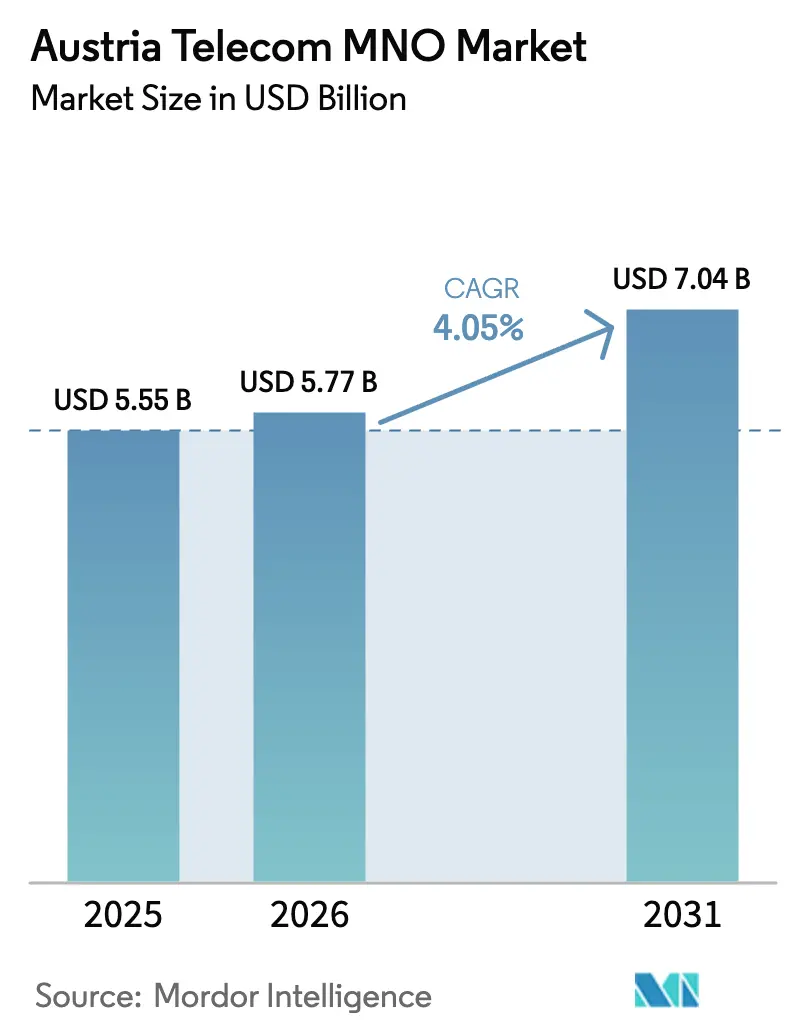
| Base Year Market Size (2025) | USD 5.55 Billion |
| Market Size (2026) | USD 5.77 Billion |
| Market Size (2031) | USD 7.04 Billion |
| Growth Rate (2026 - 2031) | 4.05 % |
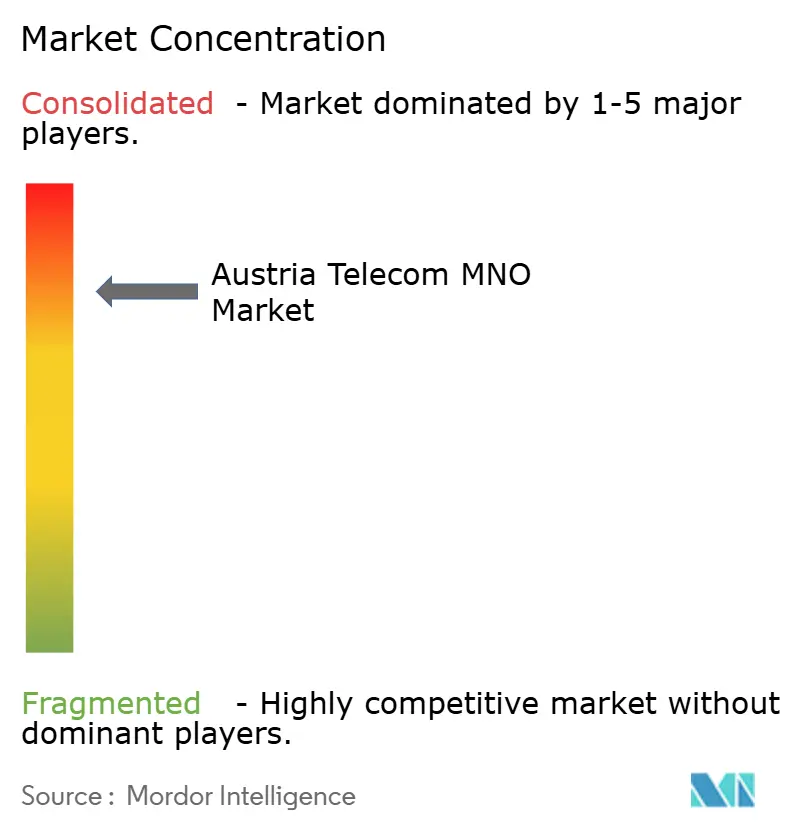
| Market Concentration | High |
Major Players *Disclaimer: Major Players sorted in no particular order Image © Mordor Intelligence. Reuse requires attribution under CC BY 4.0. | |
Austria Telecom MNO Market Analysis by Mordor Intelligence
Austria Telecom MNO Market size in 2026 is estimated at USD 5.77 billion, growing from 2025 value of USD 5.55 billion with 2031 projections showing USD 7.04 billion, growing at 4.05% CAGR over 2026-2031. In terms of subscriber volume, the market is expected to grow from 15.86 million subscribers in 2025 to 18.44 million subscribers by 2030, at a CAGR of 3.06% during the forecast period (2025-2030). Healthy capital outlays for 5G radio access, surging mobile data traffic, and enterprise digitalization underpin this steady uplift. Operators redirect spending from passive towers toward active network elements after Cellnex’s tower divestiture, sharpening their focus on spectral efficiency and energy-saving radios. [1]Cellnex, “Cellnex sells 100 % of its business in Austria,” cellnex.com Energy costs now absorb close to 5% of operator revenue, but network-wide power-optimization projects promise operational savings of 15-30% that help protect EBITDA margins. Meanwhile, a modest –0.1% GDP contraction and 2.9% inflation in 2025 temper household purchasing power, driving demand for bundled, value-oriented plans that blend mobile, fixed, and content services. Competitive intensity escalates as MVNOs leverage mandated wholesale access, while the three national MNOs accelerate 5G standalone roll-outs to sustain differentiation.
Key Report Takeaways
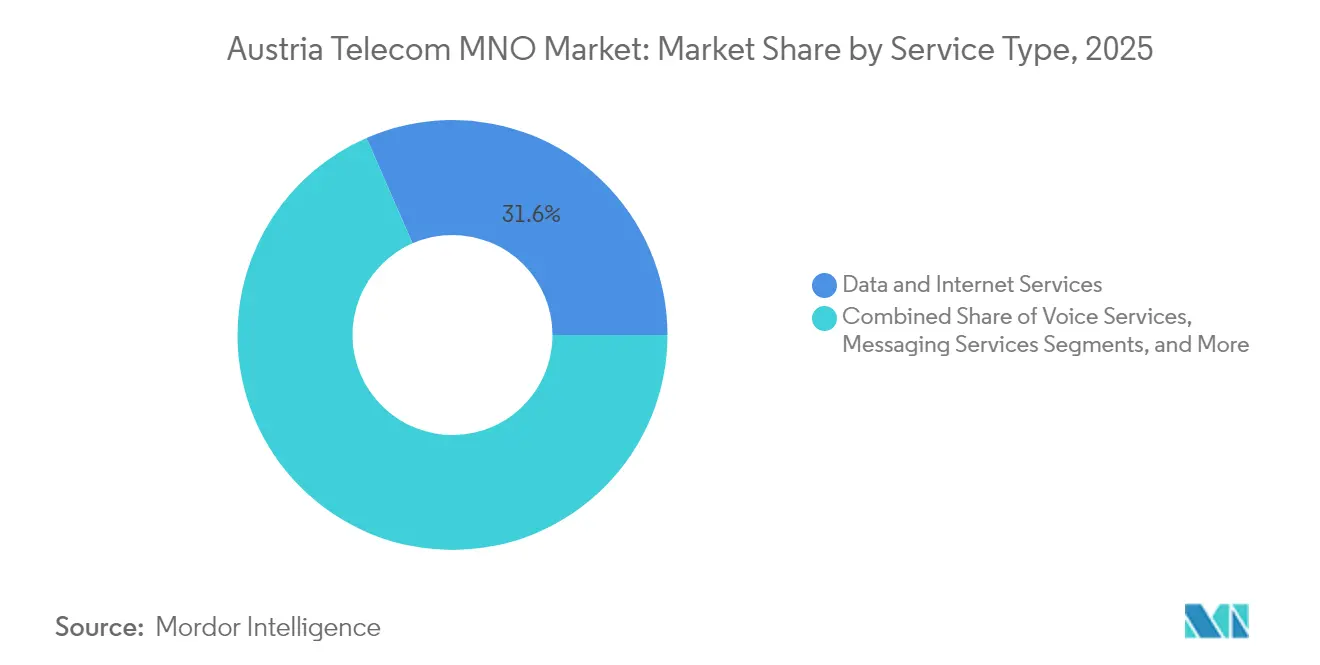
- By service type, data and internet services led with 31.55% revenue share in 2025; IoT and M2M services are projected to post the fastest 4.12% CAGR through 2031.
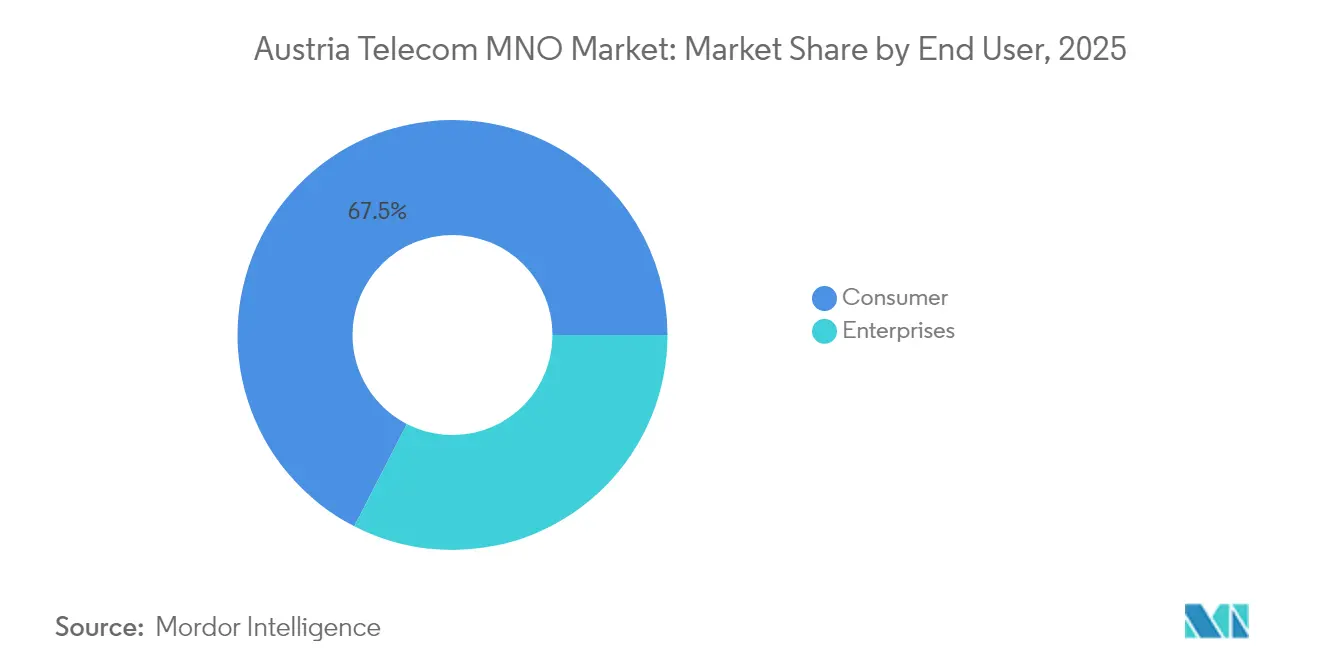
- By end user, the consumer segment controlled 67.45% of 2025 revenue, yet the enterprise segment is advancing at a 4.38% CAGR to 2031.
Note: Market size and forecast figures in this report are generated using Mordor Intelligence’s proprietary estimation framework, updated with the latest available data and insights as of 2026.
Austria Telecom MNO Market Trends and Insights
Drivers Impact Analysis*
| Driver | (~) % Impact on CAGR Forecast | Geographic Relevance | Impact Timeline |
|---|---|---|---|
| Rapid 5G roll-out and device uptake | +1.2% | Urban cores of Vienna, Graz, Linz | Medium term (2-4 years) |
| Surging per-capita mobile data usage | +0.9% | Nationwide, peak in commercial districts | Short term (≤ 2 years) |
| Enterprise demand for IoT / M2M connectivity | +0.7% | Upper Austria, Styria manufacturing corridors | Long term (≥ 4 years) |
| Fixed-mobile convergence bundles | +0.6% | Suburban and rural households | Medium term (2-4 years) |
| EU Digital Decade rural 5G funding | +0.4% | Alpine and low-density communities | Long term (≥ 4 years) |
| Tourism rebound boosting roaming | +0.3% | Vienna, Salzburg, Tyrol tourist areas | Short term (≤ 2 years) |
| Source: Mordor Intelligence | |||
Rapid 5G roll-out and device uptake
Nationwide 5G coverage surpassed 90% of households in 2024 after Hutchison Drei deployed 3,200 macro sites using 2 GHz and 3.4-3.7 GHz bands with peak downlink speeds near 10 Gbps [2]Drei, “5G Netz in Österreich,” drei.at. Magenta and A1 quickly followed, and A1 has begun mmWave trials in Vienna to support campus networks that require multi-gigabit uplinks [3]TelecomTalk, “A1 Austria tests 5G mmWave site,” telecomtalk.info. Affordable 5G-capable handsets across all price tiers accelerate migration from LTE, while a new rule allowing operators to disable high-bandwidth carriers at night trims power consumption without degrading daytime user experience.
Surging per-capita mobile data usage
Cloud gaming, 4K streaming, and collaboration suites lifted Austria’s average monthly smartphone data load by double digits in 2024. To accommodate the spike, A1 laid 1,000 km of new fiber for mobile backhaul and demonstrated 800 Gbps optical transmission on its core network. Operators now market speed-tiered tariffs that guarantee throughput, shifting away from unlimited volume positioning. Nokia-powered edge-cloud trials prove that network slicing can monetise latency-sensitive workloads such as AR maintenance and real-time analytics.
Enterprise demand for IoT / M2M connectivity
Industrial firms in Upper Austria and Styria connect sensors, robots, and logistics assets on LTE CAT-M and NB-IoT, laying the groundwork for 5G massive IoT. Cellular IoT revenue across Europe climbed to EUR 12.4 billion in 2023 and will likely hit EUR 21 billion by 2028, a trend mirrored in Austria’s factory retrofit programs. eSIM and iSIM reduce truck-rolls for device swaps, and local solution-provider Metrilog packages airtime with telemetry hardware for turnkey deployments [4]Metrilog, “Solutions for telemetry,” metrilog.at .
Fixed-mobile convergence bundles
Bundled fixed-fiber, mobile, and TV offers are lifting ARPU and lowering churn. A1’s Family Advantage plan waives six months of broadband fees for customers migrating multiple mobile lines onto a converged invoice, while Magenta leverages Deutsche Telekom’s European footprint to cross-sell cybersecurity and cloud hosting. Fiber builds guarantee 90% of advertised bandwidth, underpinning symmetric gigabit propositions in rural markets that previously relied on DSL.
Restraints Impact Analysis*
| Restraint | (~) % Impact on CAGR Forecast | Geographic Relevance | Impact Timeline |
|---|---|---|---|
| Subscriber saturation limiting organic growth | –0.8% | Nationwide, acute in Vienna | Long term (≥ 4 years) |
| ARPU pressure from MVNO price competition | –0.6% | Price-sensitive prepaid segments | Medium term (2-4 years) |
| Network OPEX exposure to energy-price volatility | –0.5% | More pronounced at rural sites | Short term (≤ 2 years) |
| Rising spectrum fees and strict EMF limits | –0.4% | Nationwide | Medium term (2-4 years) |
| Source: Mordor Intelligence | |||
Subscriber saturation limiting organic growth
With more than 18 million active SIMs serving a population of 9.13 million, mobile penetration exceeds 190%, forcing operators to capture share from rivals rather than grow the base. The shift steers investment toward enterprise verticals and adjacent digital services, while A1 spreads geographic risk through its seven-country footprint.
ARPU pressure from MVNO price competition
Discount brands such as HoT and Spusu, riding on mandated wholesale access to Hutchison Drei, offer 50 GB plans for EUR 9.90, undercutting premium post-paid bundles by more than two-thirds. Incumbents respond by highlighting verified network quality.
*Our forecasts treat driver/restraint impacts as directional, not additive. The impact forecasts reflect baseline growth, mix effects, and variable interactions.
Segment Analysis
By Service Type: Data-centric revenue mix reshapes portfolio
Data and internet offerings captured 31.55% of 2025 revenue, confirming their anchor role within the Austria Telecom MNO market. Voice and SMS continue to decline, while IoT and M2M lines expand at a 4.12% CAGR, redirecting traffic toward low-band spectrum blocks that sustain battery-efficient sensors. OTT and Pay-TV add-ons, including A1’s PlayStation and Samsung bundle, illustrate the pivot from connectivity to content, bolstering cross-selling as screen time migrates to mobile devices. Operators increasingly package cybersecurity, cloud storage, and international data roaming into tiered plans to maintain pricing power in a saturated arena.
Growing industrial automation is generating bespoke IoT contracts that exceed traditional ARPU by a multiple, helping operators offset prepaid price erosion. The Austria Telecom MNO market size for IoT connections is projected to reach USD 0.44 billion by 2031, while data-only plans for tablets and fixed-wireless home routers strengthen suburban coverage economics. Smart city pilots in Vienna and Linz that manage traffic signals and environmental monitoring over NB-IoT further validate diversified service revenue streams.



By End User: Enterprise growth narrows the consumer gap
Consumers still accounted for 67.45% of revenue in 2025, yet enterprise uptake is accelerating faster at 4.38% CAGR, powered by manufacturing, tourism, and logistics digitalization. The Austria Telecom MNO market share for enterprise mobility is forecast to edge up to 38.25% by 2031 as businesses adopt private 5G, edge analytics, and secure mobile workplaces. Deutsche Telekom’s T-Systems arm exemplifies the shift with hybrid-cloud and SAP-hosting packages that ride on Magenta’s radio footprint, targeting Austrian mid-caps seeking turnkey transformation.
Operators bundle managed connectivity, unified communications, and firewall-as-a-service to deepen wallet share. Campus networks using locally licensed 3.7 GHz blocks allow factories to isolate latency-sensitive machine data. Meanwhile, consumer ARPU stabilizes through loyalty-based discounts, family data pools, and streaming partnerships that help blunt MVNO defection.
Geography Analysis
Vienna generates the densest traffic and the highest per-SIM revenue, leveraging nearly contiguous 5G coverage that supports fintech, e-commerce, and media-production customers. The city’s smart-district pilots showcase augmented-reality tourism guides and autonomous shuttle proofs, reinforcing its role as a living lab for advanced mobility. Upper Austria and Styria follow, where export-oriented manufacturers deploy IoT telemetry for predictive maintenance, fueling enterprise line growth.
Rural Alpine areas historically trailed in broadband quality, yet EUR 891 million from Austria’s Recovery and Resilience Plan subsidizes gigabit backhaul to 200,000 households, lowering deployment risk for the Austria Telecom MNO market. The new funding coincides with the EU Digital Decade target of complete 5G coverage by 2030, prompting operators to swap diesel generators for solar-backed power systems that cut running costs on remote sites.
Tourism hubs in Salzburg and Tyrol benefit from the post-pandemic influx of visitors whose roaming usage rebounds under “Roam-Like-at-Home,” adding high-margin inbound roaming traffic without incremental marketing spend. Cross-border corridors toward Germany, Switzerland, and the Czech Republic gain latency advantages after A1 and Sunrise launch a Vienna-Zürich dark-fiber route delivering sub-9 ms round-trip times for cloud workloads. As a transit country, Austria’s enhanced backbone status draws Hyperscalers and gaming platforms seeking resilient, low-jitter connectivity.
Competitive Landscape
The Austria Telecom MNO market operates as a three-player oligopoly wherein A1’s nationwide fiber assets underpin unmatched convergence packages. In 2024, A1 booked EUR 2.8 billion revenue and EUR 1.1 billion EBITDA, reinvesting heavily in 26 GHz licenses to future-proof capacity for fixed-wireless access. Magenta rides Deutsche Telekom’s technology stack, securing 400 MHz of new mmWave spectrum. Customer additions climbed 7.2% year-on-year to 6.5 million by Q1 2025, driven by aggressive handset trade-in programs.
Hutchison Drei champions 5G standalone, delivering sub-10 ms latency for gaming and industrial control while marketing unlimited “Drei Unlimited” speed tiers capped only by network capability. Regulatory obligations to furnish wholesale access temper its retail price leverage, yet tower-sharing and site-de-duplication agreements with Cellnex successors allow opex deflation. MVNO competition stays intense but segmented; premium users gravitate toward coverage assurance, whereas cost-sensitive prepaid subscribers flock to discount brands. Private network deployments, wholesale fibre backhaul, and edge-cloud slices remain key white-space arenas where operators can extract above-market margins and mitigate consumer saturation.
Austria Telecom MNO Industry Leaders
A1 Telekom Austria Group
Magenta Telekom (Deutsche Telekom)
Hutchison Drei Austria GmbH (3)
- *Disclaimer: Major Players sorted in no particular order

Recent Industry Developments
- January 2025: A1 Telekom Austria and Sunrise will establish the fastest dark-fiber route from Vienna to Zürich, enhancing Austria’s role as a regional connectivity hub.
- May 2024: A1 tested its first 26 GHz mm Wave site in Vienna to deliver 2 Gbps peak speeds.
- April 2024: A1 Austria announced acquisition of NTT Austria, strengthening enterprise digital-services capabilities.
- April 2024: A1 and Nokia demonstrated 800 Gbps optical transmission over 1 276 km, showcasing long-haul network innovation.
- March 2024: RTR auctioned 26 GHz and 3600 MHz spectrum, raising EUR 25 million and allocating 600 MHz to Hutchison Drei.
- February 2024: A1 completed a 5G Edge-Cloud slicing trial with Nokia, validating enterprise SLA delivery.
- January 2024: A1 acquired VX Fiber in Dietach, expanding regional fixed infrastructure.


Austria Telecom MNO Market Report Scope
Telecom or telecommunication is the long-range transmission of information by electromagnetic means.
The Austrian telecom MNO market study includes an in-depth trend analysis based on connectivity, such as fixed networks, mobile networks, and telecom towers. Telecom services are divided into voice services (wired and wireless), data and messaging services, and OTT and payTV services. The market sizes and forecasts are provided in terms of value (USD) for all the above segments.
| Voice Services |
| Data and Internet Services |
| Messaging Services |
| IoT and M2M Services |
| OTT and PayTV Services |
| Other Services (VAS, Roaming and Intl., Enterprise and Wholesale, etc.) |
| Enterprises |
| Consumer |
| Service Type | Voice Services |
| Data and Internet Services | |
| Messaging Services | |
| IoT and M2M Services | |
| OTT and PayTV Services | |
| Other Services (VAS, Roaming and Intl., Enterprise and Wholesale, etc.) | |
| End-user | Enterprises |
| Consumer |


Key Questions Answered in the Report
What revenue figure defines the Austria Telecom MNO market in 2026?
The Austria Telecom MNO market stands at USD 5.77 billion in 2026.
How fast is mobile operator revenue expected to grow through 2031?
Aggregate revenue is projected to rise at a 4.05% CAGR, reaching USD 7.04 billion by 2031.
Which service segment is expanding the quickest?
IoT and M2M services lead with a 4.12% CAGR as factories and municipalities digitize operations.
Why are convergence bundles important to operators?
Bundling mobile, fiber, and TV stabilizes ARPU and reduces churn in a saturated subscriber base.
How extensive is 5G coverage in Austria today?
More than 90% of households already fall within a 5G footprint following accelerated roll-outs.
Which player leads network quality rankings?
Independent tests place A1 first for overall coverage, while Magenta tops the 5G Reach category.
Page last updated on:





