
Market Overview
| Study Period | 2020 - 2031 |
|---|---|
| Forecast Data Period | 2026 - 2031 |
| Base Year Market Size (2025) | USD 45.52 Billion |
| Market Size (2026) | USD 47.01 Billion |
| Market Size (2031) | USD 55.23 Billion |
| Growth Rate (2026 - 2031) | 3.28 % |
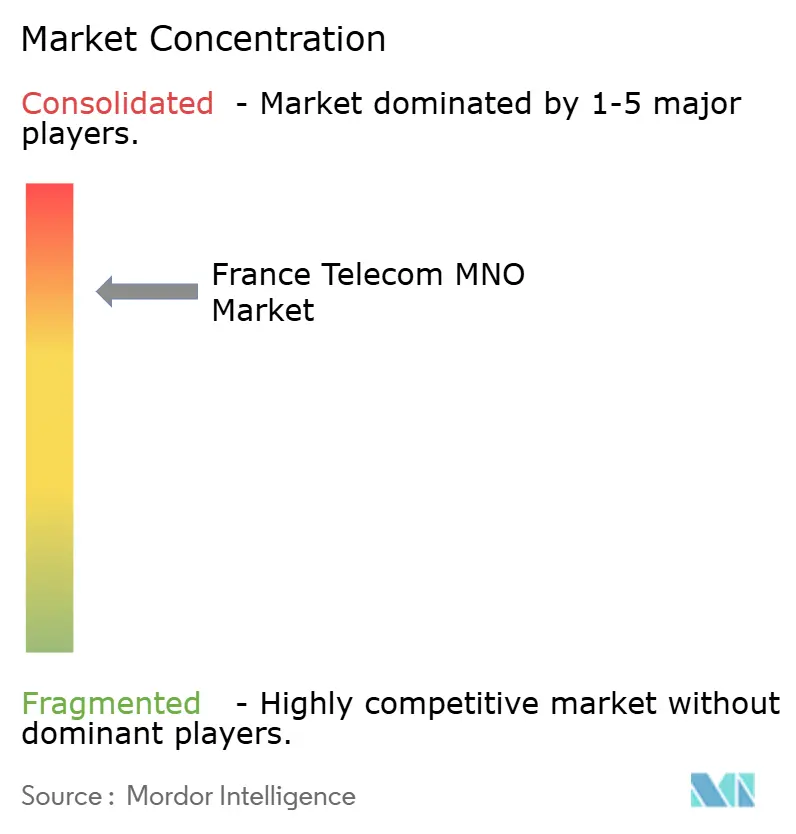
| Market Concentration | High |
Major Players *Disclaimer: Major Players sorted in no particular order Image © Mordor Intelligence. Reuse requires attribution under CC BY 4.0. | |
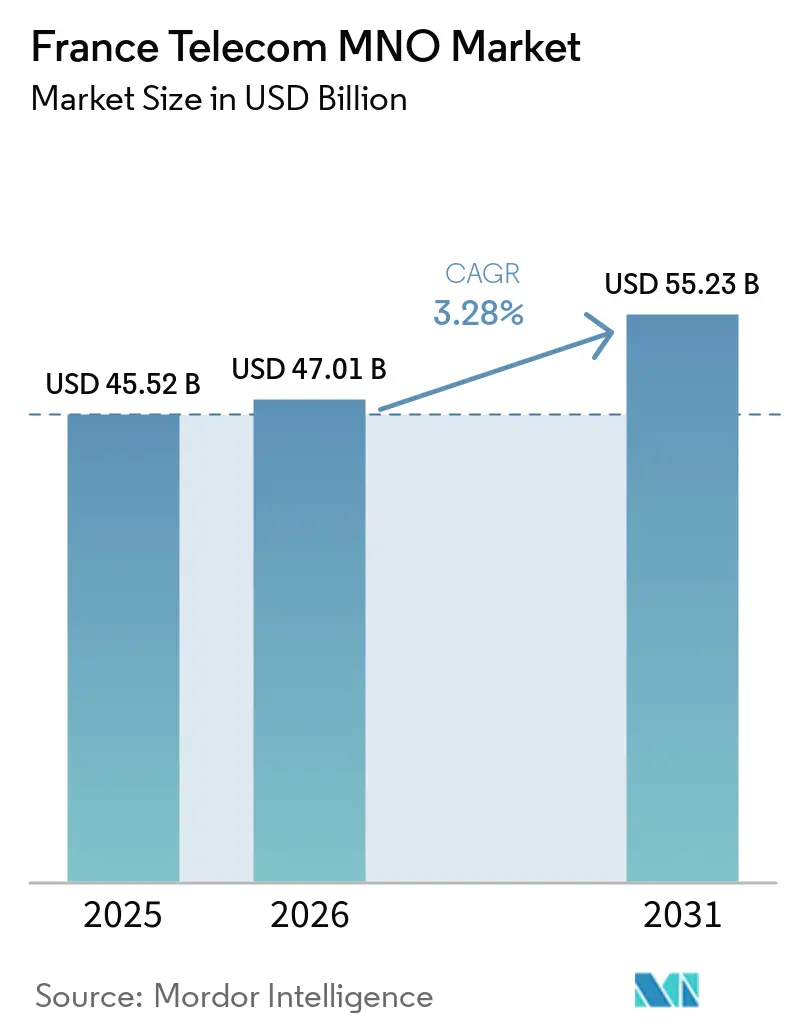
France Telecom MNO Market Analysis by Mordor Intelligence
The France Telecom MNO Market size is projected to be USD 45.52 billion in 2025, USD 47.01 billion in 2026, and reach USD 55.23 billion by 2031, growing at a CAGR of 3.28% from 2026 to 2031. In terms of subscriber volume, the market was valued at 97.34 million subscribers in 2025 and is expected to grow from 99.82 million subscribers in 2026 to 113.22 million subscribers by 2031, at a CAGR of 2.55% during the forecast period (2026-2031).
Near-term momentum comes from rapid 5G standalone rollouts, fiber-backed fixed–mobile bundles, and a pivot toward enterprise digitization services, all of which are reshaping revenue composition. Operators are channeling capital into 3.5 GHz spectrum, private 5G zones, and edge platforms that enable differentiated quality for data-heavy applications. Regulatory directives on network sharing and eco-design are sharpening cost discipline, while cyber resilience and energy efficiency requirements are altering investment priorities. Intensifying competition among Orange, SFR, Bouygues Telecom, and Free Mobile sustains price pressure even as data usage rises, pushing carriers to unlock new value from IoT, cloud connectivity, and managed services.
Key Report Takeaways
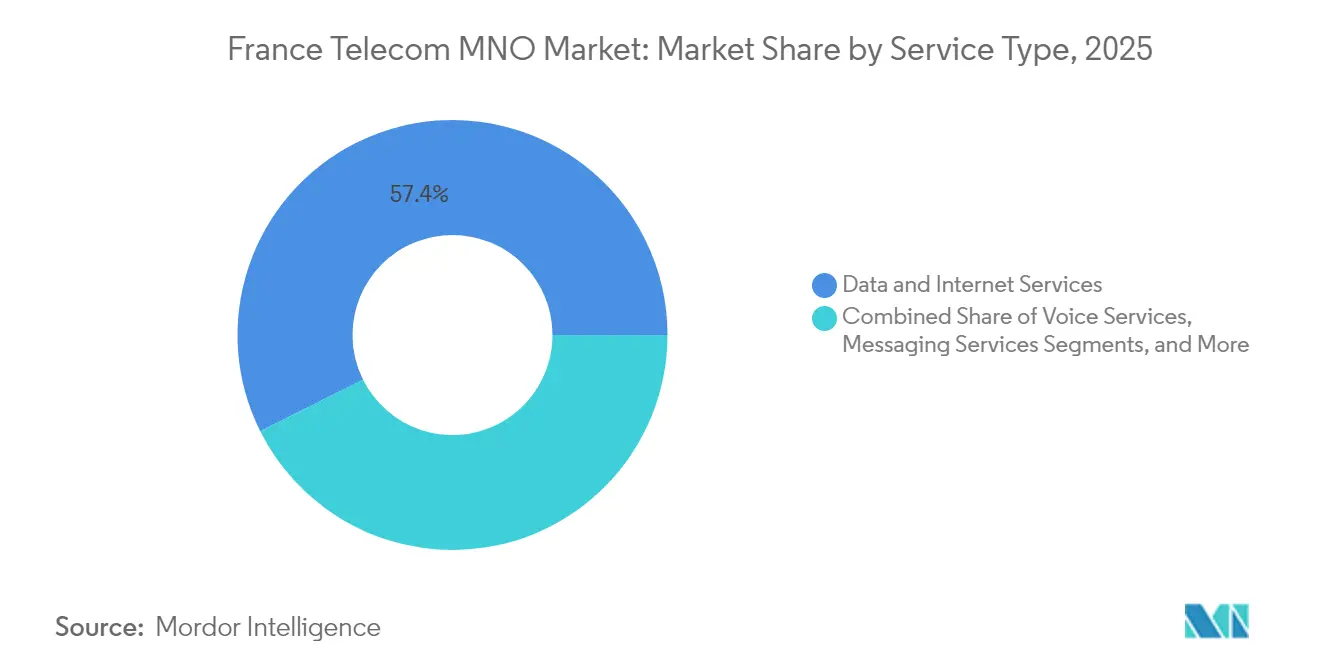
- By service type, data and internet services held 57.39% of the France telecom MNO market share in 2025, while IoT and M2M services are projected to grow at a 3.39% CAGR through 2031.
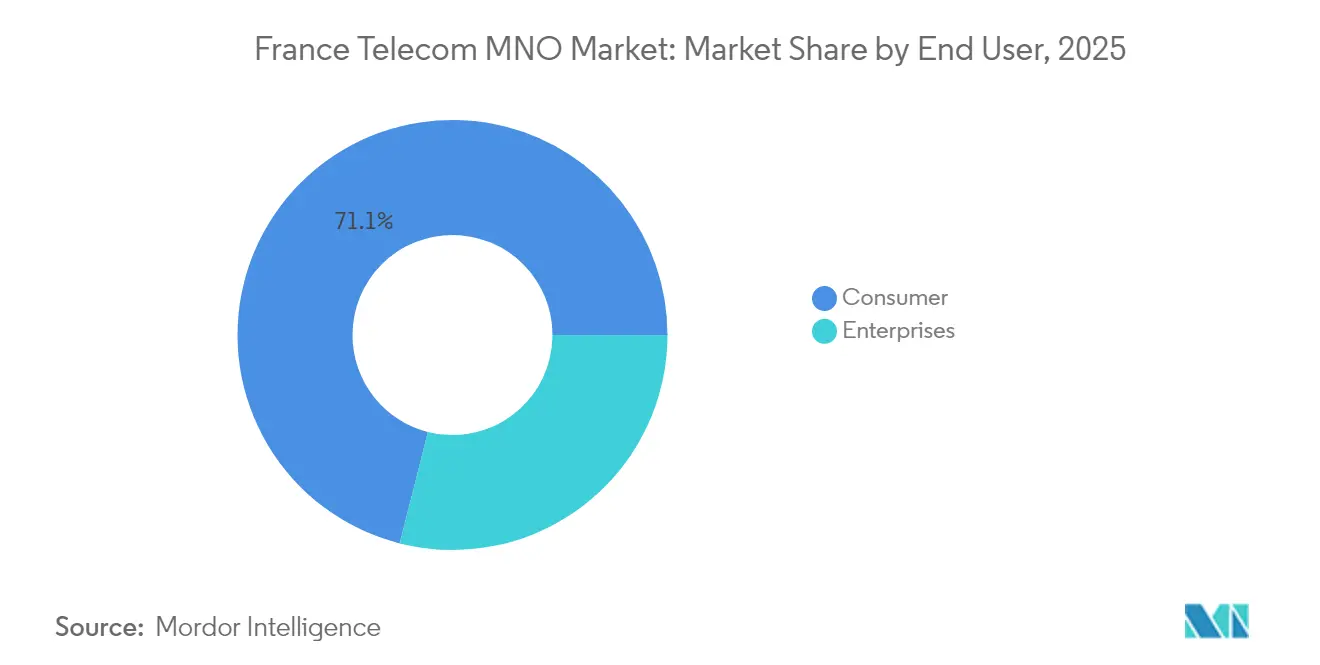
- By end user, the consumer segment accounted for 71.05% of the France telecom MNO market size in 2025; the enterprise segment is advancing at a 3.62% CAGR to 2031.
Note: Market size and forecast figures in this report are generated using Mordor Intelligence’s proprietary estimation framework, updated with the latest available data and insights as of 2026.
Market Trends and Insights
Drivers Impact Analysis of France Telecom MNO Market*
| Driver | (~) % Impact on CAGR Forecast | Geographic Relevance | Impact Timeline |
|---|---|---|---|
| 5G coverage expansion and FWA drives data-centric wallets | +0.8% | National, early gains in Paris, Lyon, Marseille | Medium term (2-4 years) |
| Fiber-backed FMC bundles boost fixed/mobile ARPU uplift | +0.6% | National, accelerated in rural areas | Short term (≤ 2 years) |
| Video-streaming and cloud gaming fuel mobile data demand | +0.5% | National, concentrated in urban centers | Short term (≤ 2 years) |
| Enterprise Industry 4.0 projects accelerate IoT SIM uptake | +0.4% | Industrial regions, Île-de-France, Auvergne-Rhône-Alpes | Medium term (2-4 years) |
| Release of 3.5 GHz spectrum for private 5G SA networks | +0.3% | Major industrial zones | Long term (≥ 4 years) |
| eSIM-only handset channels reduce churn and acquisition cost | +0.2% | National, premium segments | Medium term (2-4 years) |
| Source: Mordor Intelligence | |||
5G Coverage Expansion and FWA Drives Data-Centric Wallets
Early 5G standalone launches are shifting mobile economics as premium network slicing elevates ARPU and alleviates peak-hour congestion [1]. Fixed Wireless Access leverages existing radio assets to serve rural households that lack fiber, enabling carriers to monetize spectrum more efficiently while extending competitive reach. Orange’s 5G Core Network-as-a-Service offer lowers entry costs for regional operators, accelerating nationwide coverage and fostering service innovation. As latency-sensitive workloads migrate to the edge, the France telecom MNO market will favor providers that can pair low-latency access with cloud adjacency.
Fiber-Backed FMC Bundles Boost Fixed/Mobile ARPU Uplift
Seamless bundling of gigabit FTTH and 5G is raising household spend and reducing churn as 20.6 million homes now subscribe to FTTH with a 78% take-up rate [2]. Bouygues Telecom has demonstrated an EUR 33 fixed ARPU while stabilizing mobile prices by promoting all-inclusive plans, confirming that convergent offers can insulate revenue from pure-price plays [3]. Operators that integrate intelligent service orchestration and cross-channel care will capture the highest lifetime value.
Video-Streaming and Cloud Gaming Fuel Mobile Data Demand
Average monthly consumption rose to 14.3 GB per user in 2024, up 18% year on year, with video accounting for the bulk of traffic. Cloud gaming raises latency and jitter requirements, prompting operators to adopt edge caching and satellite backhaul partnerships with Eutelsat to preserve quality of experience [4]. Successful price tiering now depends on guaranteed speeds and bundled content rather than unlimited volume alone, reinforcing the need for granular network analytics in the France telecom MNO market.
Enterprise Industry 4.0 Projects Accelerate IoT SIM Uptake
Manufacturing and logistics firms are piloting private 5G and sensor networks to enable real-time monitoring and automation. Orange Business supports these deployments with its Live Objects platform that combines device management, analytics, and security in one stack. As global cellular IoT lines are expected to reach 6.4 billion by 2029, French operators that master vertical solutions will convert connectivity into multi-layer contracts that boost margin.
Restraints Impact Analysis of France Telecom MNO Market*
| Restraint | (~) % Impact on CAGR Forecast | Geographic Relevance | Impact Timeline |
|---|---|---|---|
| Fierce price competition keeps blended ARPU flat | -0.9% | National, most pronounced in urban areas | Short term (≤ 2 years) |
| >110% SIM penetration limits organic subscriber growth | -0.5% | National, saturation in all regions | Long term (≥ 4 years) |
| Eco-design and energy-efficiency regulation lift opex | -0.3% | National, compliance-driven | Medium term (2-4 years) |
| Uncertainty over mmWave auction timing delays capex plans | -0.2% | National, affects 5G strategy | Short term (≤ 2 years) |
| Source: Mordor Intelligence | |||
Fierce Price Competition Keeps Blended ARPU Flat
Since Free Mobile disrupted pricing, the nominal price of a typical bundle has fallen 45% between 2011 and 2016, and operators still struggle to pass network-quality premiums to consumers. Opensignal continues to rank Orange at the top on download speed and coverage yet its mobile ARPU remains broadly flat because price-sensitive users switch quickly when promotions appear. This perpetual discounting forces carriers to chase efficiency and service diversification rather than headline price increases across the France telecom MNO market.
>110% SIM Penetration Limits Organic Subscriber Growth
There are 83.4 million active SIMs versus 68 million residents, leaving no room for first-time buyers and turning subscriber gains into zero-sum share shifts. SFR’s recent 1.3 million subscriber loss shows how quickly churn can erode scale in a saturated environment. Operators must therefore pivot to ARPU-enhancing products like IoT lines, private networks, and cybersecurity services that uncouple growth from raw SIM counts within the France telecom MNO market.
*Our forecasts treat driver/restraint impacts as directional, not additive. The impact forecasts reflect baseline growth, mix effects, and variable interactions.
France Telecom MNO Market Segment Analysis
By Service Type:
Data Dominance Drives IoT InnovationData and Internet services secured 57.39% of the France telecom MNO market share in 2025, displacing voice as the primary revenue pillar. The France telecom MNO market size for IoT and M2M is set to expand at a 3.39% CAGR through 2031, reflecting enterprise appetite for connected machinery and smart city grids. OTT and PayTV bundles broaden stickiness as carriers integrate Netflix, Disney+, and local streaming apps into unified interfaces that curb out-of-bundle churn. Voice and messaging revenues slide as customers shift to over-the-top alternatives, yet remain relevant for inbound roaming and regulatory emergency obligations.
Continued data traffic growth obliges operators to densify radio sites and introduce edge compute, while IoT project momentum encourages investment in lightweight cores and device-management platforms. As private 5G networks emerge for the Paris Olympics and industrial campuses, the France Telecom MNO market will see higher revenue per bit for specialized slices than for best-effort mobile broadband. Operators that bundle analytics, security, and cloud integration alongside connectivity will capture the bulk of value in this ascending segment of the France telecom MNO market.

By End User:
Enterprise Growth Accelerates Digital TransformationThe consumer segment still contributes 71.05% of 2025 revenue, yet its growth is modest due to price competition and SIM saturation. In contrast, the France telecom MNO market size linked to enterprise services is rising at a 3.62% CAGR owing to Industry 4.0 rollout, SD-WAN adoption, and cloud migration. Orange Business illustrates the shift with its SD-WAN Essentials launch that embeds security and AI-based performance management for smaller offices.
Tech-centric offers such as managed GenAI, hybrid cloud, and zero-trust security are estimated to capture 87% of the B2B telecom wallet by 2027. As enterprises seek unified connectivity and IT stacks, carriers that provide consultative expertise will outperform those that deliver pure bandwidth. The France telecom MNO market, therefore, rewards incumbents that can blend infrastructure resilience with solution-centric go-to-market capabilities tailored to sector-specific needs.
Geography Analysis
Nationwide, the France telecom MNO market benefits from advanced infrastructure and universal 4G coverage, yet regional disparities shape revenue profiles. Île-de-France generates the highest ARPU, fueled by dense urban usage and a concentration of headquarters that adopt premium enterprise connectivity. Auvergne-Rhône-Alpes and Hauts-de-France contribute materially through manufacturing digitalization, logistics hubs, and smart mobility pilots. Rural departments gain coverage through the New Deal for Mobile program, which lifted the 4G footprint from 45% to 88% between 2018 and 2023.
As fiber deployment accelerates, operators leverage Fixed Wireless Access to address isolated villages while maintaining return on spectrum. The France Telecom MNO market size in overseas territories remains smaller but shows outsized growth potential thanks to fresh spectrum releases in Martinique and Guadeloupe that support improved 4G and nascent 5G rollouts. Population-weighted 5G coverage varies sharply: Free Mobile claims 94% reach while Orange focuses on depth in high-traffic corridors, attaining 60% of metropolitan areas with faster mid-band layers.
Copper switch-off plans introduce regional transition complexity because legacy PSTN serves niche enterprise use cases in low-density regions. Operators thus stage migrations alongside fiber build-outs to avoid service gaps and regulatory penalties. Geography, therefore, intersects with service innovation and regulatory duties, steering capital to locales where fixed and mobile synergies maximize lifetime yield within the France telecom MNO market.
Regulatory Landscape
The France telecom MNO market is overseen by Arcep, which sets rules on competition, coverage obligations, interconnection, and market monitoring. Arcep formalized its Ambition 2030 strategy on 21 January 2025, with explicit focus areas spanning Very High Speed broadband deployment, enterprise connectivity, and environmental regulation, shaping operator reporting duties and investment choices.
EU Regulation 2024/1309 (Gigabit Infrastructure Act) takes effect for infrastructure managers on 12 May 2026, reinforcing permitting and infrastructure-access mechanisms that influence fiber and backhaul economics for MNOs. Copper network closures and 2G/3G sunsets remain on schedule, with Orange's copper network closure planned for 2030 and sunsets targeted around 2028-2029, driving migration planning and customer communications.
Competitive Landscape
Four operators dominate the France telecom MNO market, yet none exceed a one-third share, keeping rivalry intense. Orange leads with 31% mobile and 39% fixed share, leveraging superior network metrics and enterprise breadth to command selective premiums. SFR controls 24% but faces debt overhang and recent churn, prompting asset reviews that could catalyze market consolidation. Bouygues Telecom pursues quality-focused differentiation, recently acquiring La Poste Telecom to add 2.3 million customers and enhance retail reach. Free Mobile remains the low-price disruptor, pushing unlimited plans and broad 5G availability to entice switchers.
Strategic initiatives reflect varied strengths. Orange’s satellite alliance with Eutelsat extends coverage to maritime, aviation, and remote government sites, diversifying revenue beyond terrestrial footprints. Bouygues Telecom unveiled its B.IG brand to reinforce family bundles and pursue mid-market upsell. SFR’s network modernization hinges on capex relief from potential spectrum-sharing pacts, while Free Mobile exploits infrastructure-light expansion and competitive wholesale agreements. Diversification into IoT, private 5G, and cybersecurity is common across all players as they seek resilience beyond commodity data in the France telecom MNO market.
France Telecom MNO Industry Leaders
-
Orange S.A.
-
SFR (Altice France)
-
Bouygues Telecom
-
Free Mobile (Iliad)
- *Disclaimer: Major Players sorted in no particular order
France Telecom MNO Market Companies Covered in this Report
- Orange S.A.
- SFR (Altice France)
- Bouygues Telecom
- Free Mobile (Iliad)
Market Opportunities and Future Outlook
Copper closure through 2030 and 2G/3G sunsets around 2028-2029 create room to package migration journeys for SMEs and multi-site enterprises around fiber-backed connectivity, managed security, and fixed-mobile bundles, rather than standalone access. With the Gigabit Infrastructure Act taking effect on 12 May 2026, operators gain a practical lever to reduce deployment friction for gigabit networks, supporting denser backhaul, faster site delivery, and improved economics for 5G standalone and private-network rollouts in industrial zones.
The IPv6 transition reached 94% of fixed customers and 83% of mobile customers enabled by the end of 2025, which supports the rollout of IPv6-only managed services, IoT connectivity, and enterprise network designs that reduce IPv4 dependency. Ongoing regulatory emphasis on energy efficiency and cyber resilience is also shaping network design priorities and reporting requirements.
Recent Industry Developments in France Telecom MNO Market
- July 2026: The Autorite de la concurrence commences review of the proposed acquisition of SFR Altice France assets after European Commission referral. The regulatory review introduces clearance risk and may affect when market structure changes take effect, including implications for capex planning.
- June 2026: Consortium (Bouygues Telecom, Free-Iliad, Orange) signed a Memorandum of Understanding to acquire SFR Altice France. The agreement indicates a consolidation push in the France MNO market, which can shift network investment priorities and pricing dynamics.
- April 2026: Consortium (Bouygues Telecom, Free-Iliad, Orange) entered into exclusive negotiations with Altice France for the acquisition of SFR. The step narrows the path toward a potential three-player structure for national MNOs once the deal completes.
France Telecom MNO Market Report Scope and Research Methodology
Market Definition and Coverage
For this report, the France telecom market is defined as the annual revenue generated from telecom network services sold to customers in France, covering connectivity and related operator services delivered over mobile and fixed networks.
Scope exclusions: We exclude handset and device manufacturing revenues, pure equipment sales, and activities outside France that are booked in other countries.
Segments Covered in This Report
- Overall Telecom Revenue and ARPU
- Service Type
- Voice Services
- Data and Internet Services
- Messaging Services
- IoT and M2M Services
- OTT and PayTV Services
- Other Services (VAS, Roaming and International Services, Enterprise and Wholesale Services, etc.)
- End-user
- Enterprises
- Consumer
Data Sources, Market Sizing, and Validation
Desk Research
Desk research starts with building a clear picture of France telecom demand and price direction, and then matching it to operator-side revenue signals. We leaned on public datasets and official publications such as ARCEP observatories and Telconomics releases, OECD communications statistics, ITU indicators, Eurostat household connectivity tables, and INSEE inflation and household spend series, which help keep assumptions grounded.
On top of that, we reviewed annual reports, investor decks, and press releases to track service launches, migration to fiber, and 4G to 5G adoption, since these shifts can change average revenue per user even when subscriber growth is flat. Where it helped, we used paid subscriptions that track company financials, news and financials coverage, patent activity, and shipment-level trade flows to cross-check timelines and close small data gaps. The sources listed above are illustrative, and we used many other public and paid references for collection, validation, and clarification.
Primary Interviews and Surveys
Primary work was used to stress-test pricing moves, promotion intensity, and the mix shift between fixed broadband, mobile data, and enterprise connectivity. We spoke with operator-side leaders, distribution and channel contacts, and enterprise IT and procurement roles across France to reduce gaps from desk research and to verify that the final assumptions match how services are packaged and priced.
Distribution of primary research fieldwork respondents
| Company type | Respondent position |
|---|---|
| Top tier: 31% | CXOs: 14% |
| Mid tier: 53% | Functional/Unit leaders: 38% |
| Smaller Players: 16% | Managers: 48% |
Market-Sizing & Forecasting
The market is sized using a top-down approach where operator revenue pools are reconstructed from official market totals and then split by service lines based on subscriber mix and usage trends. To keep the totals grounded, we corroborate with selective bottom-up approximations, such as sampled plan pricing multiplied by the subscriber base, and channel checks on effective discounts before totals are adjusted.
The model is driven by practical variables that are visible in public and interview-led signals, including mobile SIM and 5G subscription trends, fixed broadband and fiber take-up, average monthly invoice and ARPU movements, price index changes, and the pace of network investment and rollout that tends to shift data consumption. Forecasting uses scenario analysis with an ARIMA-based time-series layer for the core revenue run-rate, and then we tune scenarios using expert views on pricing discipline, promo cycles, and enterprise contract renewal behavior. Where a detailed split is not reported in public sources, we use proportional allocation anchored to the closest disclosed totals, then validate the split through interviews so it stays consistent with what operators are actually selling.
Data Validation & Update Cycle
Before sign-off, outputs are checked against independent signals such as regulator-published totals, ARPU trends, and subscriber base movements to flag any mismatch that needs a second look. Variance checks are run across years and across service categories so outliers can be traced back to a single assumption like price, mix, or timing.
Where a gap is found, we re-check the desk sources and, if needed, re-contact a few interviewees to confirm what changed. The report is refreshed annually, and interim updates are triggered when a material event shifts the demand or pricing baseline, such as a major tariff reset or a step-change in fiber coverage. Before delivery, a final analyst review pass is completed so the numbers reflect the latest available publications and the most recent market moves.
Mordor Intelligence's France Telecom Market Estimate Compared With Other Published Estimates
It is normal to see different market size numbers for France telecom because each publisher chooses its own timing, currency conversion, and revenue boundary for what gets counted. Even when the same high-level topic is named, differences in whether retail service revenue, adjacent digital services, or device sales are included can shift totals in a meaningful way.
A refresh-led gap is also common because telecom prices move through promotions and bundle changes, and those shifts do not always show up in revenue in the same quarter they are launched. By re-checking ARPU and average bill signals close to the model cut-off, and converting to USD using a consistent exchange-rate window, Mordor Intelligence reduces swings that come from mixing older EUR values with newer subscriber and pricing inputs.
Benchmark comparison
| Source | Market Size | Gaps in Research Methodology |
|---|---|---|
| Mordor Intelligence | USD 45.52 B (2025) | |
| Industry Regulator Brief A | USD 41.10 B (2024) | Often presented as a retail operator revenue total in EUR for a prior year, which can understate the current-year view after USD conversion timing and newer pricing and mix shifts are applied. |
| Trade Journal Summary B | USD 50.80 B (2025) | May fold in adjacent revenue streams (for example, broader digital services or device-related operator sales) and may use a more aggressive ASP uplift assumption without the same level of cross-checking to ARPU and bill trend series. |
The comparison shows that most variance comes from timing, currency treatment, and what is counted as telecom service revenue versus nearby categories. Our approach stays repeatable by linking the size to a clear demand pool, using observed price and subscriber signals, and then checking the output against independent totals before the forecast path is finalized.
Key Questions Answered in the Report
What is the current value of the France telecom MNO market?
The market is worth USD 47.01 billion in 2026 and is projected to rise to USD 55.23 billion by 2031.
How fast is 5G coverage expanding in France?
Free Mobile claims 94% population coverage while Orange focuses on deep mid-band layers that now reach 60% of metropolitan areas.
Which service segment is growing the quickest?
IoT and M2M services are expanding at a 3.39% CAGR through 2031, outpacing voice and messaging segments.
Why is blended ARPU flat despite rising data traffic?
Prolonged price competition among four national operators offsets the impact of higher usage, limiting the ability to raise prices.
What regions present the strongest enterprise connectivity demand?
Île-de-France, Auvergne-Rhône-Alpes, and Hauts-de-France lead due to dense manufacturing and logistics activities that need private 5G and IoT solutions.
How will fiber deployment affect mobile operators?
Fiber-backed FMC bundles raise customer lifetime value and enable cross-selling of premium 5G and OTT services, improving margin resilience.