
Hungary Telecom MNO Market Size and Share
Market Overview
| Study Period | 2020 - 2031 |
|---|---|
| Forecast Data Period | 2026 - 2031 |
| Base Year Market Size (2025) | USD 4.47 Billion |
| Market Size (2026) | USD 4.66 Billion |
| Market Size (2031) | USD 5.71 Billion |
| Growth Rate (2026 - 2031) | 4.17 % |
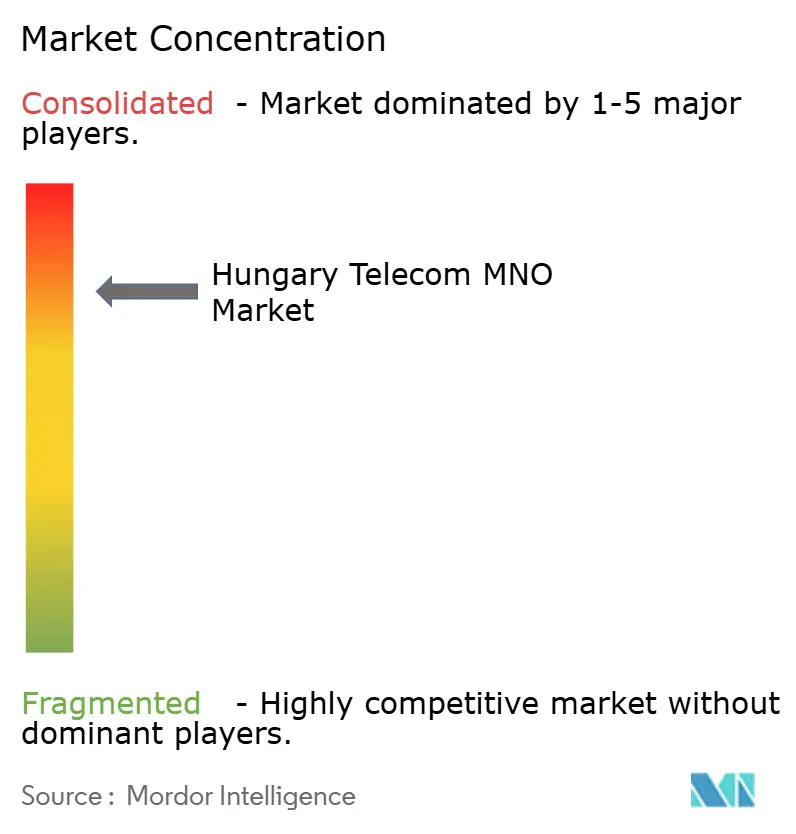
| Market Concentration | High |
Major Players *Disclaimer: Major Players sorted in no particular order Image © Mordor Intelligence. Reuse requires attribution under CC BY 4.0. | |
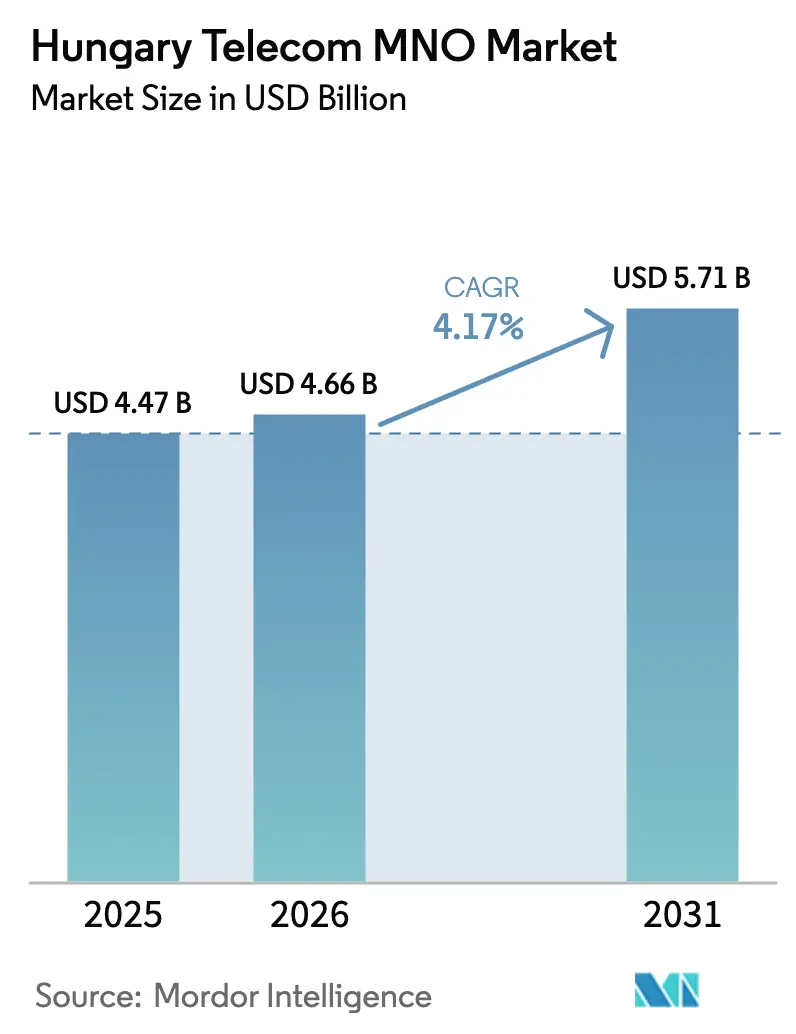
Hungary Telecom MNO Market Analysis by Mordor Intelligence
The Hungary Telecom MNO Market size market is expected to grow from USD 4.47 billion in 2025 to USD 4.66 billion in 2026 and is forecast to reach USD 5.71 billion by 2031 at 4.17% CAGR over 2026-2031.
This steady expansion shows the Hungary telecom MNO market remains resilient despite regulatory tightening, thanks to 5G monetization, enterprise digitalization projects and EU-funded fiber roll-outs. Competitive intensity is high because the Hungary telecom MNO market commands the highest average monthly charge for unlimited 5G data in Europe, yet operators struggle with ARPU pressure created by flat-rate plans. Consolidation, especially the One Hungary merger, signals a strategic pivot toward scale-based cost efficiency that should strengthen balance sheets. Ongoing network-automation programs promise up to 40% opex savings and lower churn, while national digital objectives target 95% gigabit reach and 67% 5G population coverage by 2025.
Key Report Takeaways
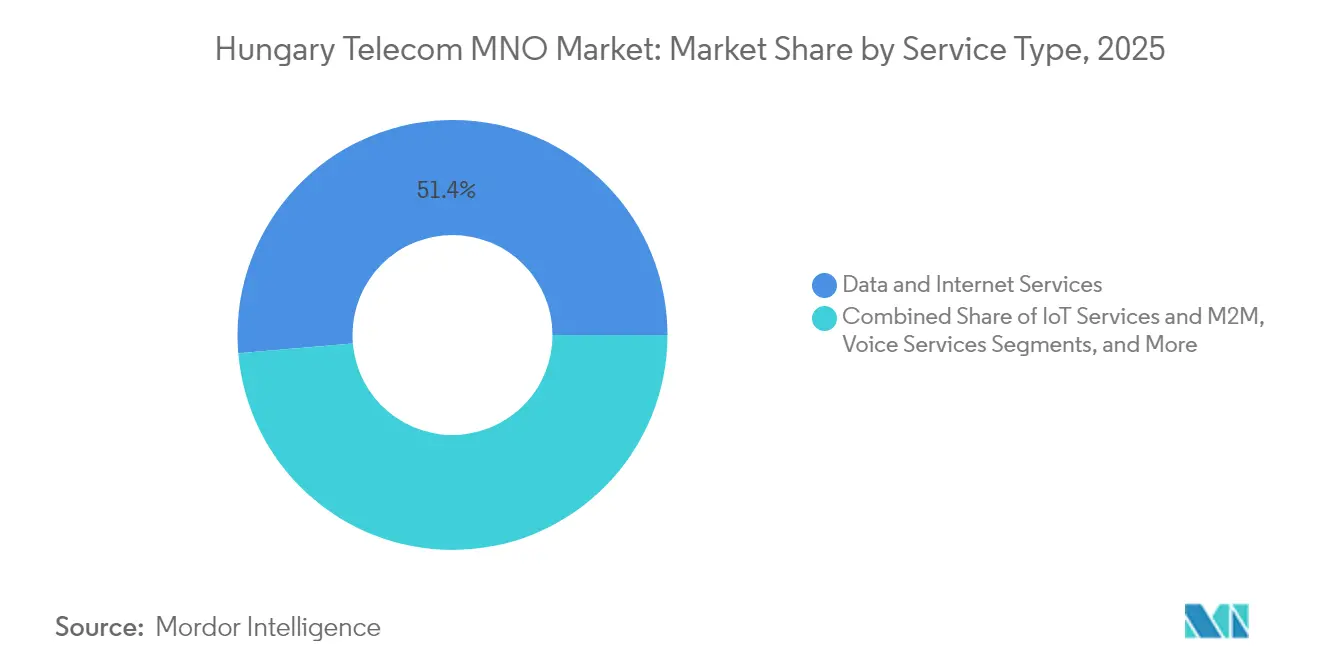
- By service type, data and internet services held 51.35% of Hungary telecom MNO market share in 2025. IoT and M2M services are projected to post the fastest 4.39% CAGR through 2031.
- By end-user, the consumer segment controlled 73.88% share of the Hungary telecom MNO market size in 2025. Enterprise services are set to expand at a 4.63% CAGR between 2026 and 2031.
Note: Market size and forecast figures in this report are generated using Mordor Intelligence’s proprietary estimation framework, updated with the latest available data and insights as of 2026.
Hungary Telecom MNO Market Trends and Insights
Drivers Impact Analysis*
| Driver | (~) % Impact on CAGR Forecast | Geographic Relevance | Impact Timeline |
|---|---|---|---|
| 5G spectrum awards accelerating monetization | +1.2% | Budapest, Debrecen, Szeged | Medium term (2-4 years) |
| EU-funded FTTH roll-outs | +0.8% | Rural and underserved areas | Long term (≥ 4 years) |
| Consolidation (4iG → One Hungary) | +0.6% | National | Short term (≤ 2 years) |
| Private-network demand in Industry 4.0 | +0.4% | Industrial regions, agricultural zones | Medium term (2-4 years) |
| AI-driven network automation | +0.3% | Nationwide | Medium term (2-4 years) |
| Sustainability-linked financing | +0.2% | EU-wide | Long term (≥ 4 years) |
| Source: Mordor Intelligence | |||
5G Spectrum Awards Accelerating Mobile Broadband Monetization
Hungary allocated multi-band 5G spectrum on 15-year terms, giving every mobile network operator the runway to recoup investments through premium data plans and enterprise solutions. Secondary trading rules further improve spectral efficiency, and measured peak speeds above 650 Mbps already support immersive consumer and B2B use cases. [1] CMS Legal Services, “Hungary’s 5G Spectrum Auction—Key Highlights,” cms.law Yettel’s 148 Mbps average download speed illustrates the performance race shaping the Hungary telecom MNO market. Private 5G installations at factories and intermodal terminals prove that low-latency connectivity can command new revenue streams. These industrial deployments position the Hungary telecom MNO market to monetize beyond smartphones by bundling edge computing and AI capabilities.
EU-funded FTTH Roll-outs Driving Fixed-line ARPU Upside
The National Digitalization Strategy earmarked EUR 1.7 billion for fiber, lifting Very-High-Capacity Network coverage to 84.1% in 2023, above the EU average. Magyar Telekom now reaches 80% of its footprint with gigabit speeds, and its fixed broadband ARPU jumped 19% after premium-tier upgrades. Rural grants under the Superfast Internet Programme help operators penetrate low-density areas, broadening the Hungary telecom MNO market. Yet chronic shortages of fiber technicians threaten deployment timetables, illustrating how human-capital gaps can offset funding gains.
Consolidation (4iG → One Hungary) Enabling Scale Efficiencies
The Vodafone–DIGI integration created One Hungary, the second-largest operator with roughly 3 million mobile customers. 4iG’s EBITDA rose 49% in Q1-2024 as store footprints, call centers and back-office systems were rationalized. Network-sharing cuts capex, while broader 5G coverage becomes feasible because duplicated base-stations are decommissioned. The combined entity holds exclusive RTL+ Premium rights that sharpen its converged-service proposition. Scale benefits therefore accelerate cash-flow generation and intensify rivalry within the Hungary telecom MNO market.
Private-network Demand from Smart-agri and Industry 4.0 Pilots
Projects such as 5GAGRIHUB and the East-West Gate Terminal showcase how dedicated 5G slices manage autonomous cranes, precision farming sensors and predictive-maintenance data. More than 800,000 IoT devices rolled out by local vendor WM Systems confirm a domestic skills base that supports complex M2M solutions. [2] Huawei Technologies, “East-West Gate Terminal 5G Case Study,” huawei.com Manufacturing labs at the University of Pannonia validate latency-critical control loops, encouraging enterprises to partner with carriers for managed connectivity. These vertical solutions increase corporate ARPU and diversify the Hungary telecom MNO market.
Restraints Impact Analysis*
| Restraint | (~) % Impact on CAGR Forecast | Geographic Relevance | Impact Timeline |
|---|---|---|---|
| ARPU erosion from unlimited data | –0.9% | National | Short term (≤ 2 years) |
| Strict wholesale-price regulation | –0.5% | EU-wide | Long term (≥ 4 years) |
| Fiber-technician talent shortages | –0.4% | National | Medium term (2-4 years) |
| Cyber-security compliance costs (NIS2) | –0.3% | EU regulatory compliance | Medium term (2-4 years) |
| Source: Mordor Intelligence | |||
ARPU Erosion Amid Aggressive Unlimited-data Pricing
Magyar Telekom’s inflation-linked 15% tariff rise in 2024 partly cushioned margin pressure, yet monthly unlimited-5G plans still cost USD 98.78 PPP, the highest in Europe. [3] Point Topic, “Global 5G Tariff Benchmark Q4 2024,” pointtopic.com One Hungary’s entry with all-you-can-eat bundles risks triggering further price competition. Yettel has temporarily lifted ARPU through selective hikes, but sustained flat-rate rivalry undermines the pricing power that once characterized the Hungary telecom MNO market.
Strict Wholesale Price Regulation Limiting Margin Expansion
EU cost-orientation mandates cap the returns operators can earn from MVNO access and tower leasing. Hungary’s 2020 Electronic Communications Act transposed these rules, empowering NMHH to intervene whenever significant market power exists. Consequently, carriers struggle to mark-up infrastructure services even as 5G roll-out costs climb. Margin compression therefore persists as a structural headwind for the Hungary telecom MNO market.
*Our forecasts treat driver/restraint impacts as directional, not additive. The impact forecasts reflect baseline growth, mix effects, and variable interactions.
Segment Analysis
By Service Type: Data Services Drive Market Evolution
Data and internet services accounted for 51.35% of Hungary telecom MNO market share in 2025, underscoring consumers’ pivot toward high-bandwidth applications. Voice still delivers stable cash flow because bundles include unlimited calls, but usage minutes trend downward as OTT platforms proliferate. IoT and M2M connectivity represents the fastest-growing slice, posting a 4.39% CAGR that will enlarge its contribution to the Hungary telecom MNO market size over 2026-2031. Operators exploit private-network contracts in logistics hubs and smart farms to diversify away from crowded retail offerings. Messaging revenue declines, yet RCS and business-messaging APIs marginally offset the fall by serving enterprise communication needs. Content aggregation—illustrated by One Hungary’s RTL+ Premium tie-up—keeps PayTV subscriptions sticky, while data-center backhaul and international wholesale traffic sustain niche revenue pools. Because 5G stands at 18% population coverage but targets 67% by 2025, additional capacity will translate into richer data bundles and latency-sensitive services.
Second-generation fixed-mobile convergence propositions further deepen wallet share. Magyar Telekom’s gigabit fiber, paired with unlimited 5G mobile, creates household stickiness and cuts churn in the Hungary telecom MNO market. Meanwhile, Yettel and One Hungary compete by offering symmetrical fiber tiers coupled with streaming content, which elevates ARPU in urban catchment areas. The regulatory spectrum-fee holiday for rural gigabit projects reduces opex, enabling sustainable pricing outside large cities. As enterprises migrate SCADA and telemetry traffic onto cellular NB-IoT channels, recurring connection fees will enlarge the Hungary telecom MNO market size for IoT lines. Therefore, service-type diversification remains central to revenue resilience.



By End-User: Enterprise Segment Accelerates Digital Adoption
The consumer base delivered 73.88% of Hungary telecom MNO market revenue in 2025 as smartphone penetration crossed 95%. Households favor multi-play bundles that combine mobile, broadband and TV on a single invoice, raising perceived value while limiting churn. Nonetheless, large data allotments cap growth because incremental gigabytes no longer command premium pricing. Enterprise services, though a smaller absolute pool, are slated to expand at a 4.63% CAGR, outpacing household growth and reinforcing B2B as a strategic priority for carriers. The Hungary telecom MNO industry leverages SD-WAN, cloud voice and managed security to lock-in corporate accounts that value service-level guarantees. Private-5G pilots at the East-West Gate Terminal demonstrate that dedicated slices can slash crane downtime and enhance safety, justifying premium connectivity tariffs.
SMEs accelerate adoption of pay-as-you-go communication suites that integrate IoT dashboards, collaboration apps and cybersecurity, widening the Hungary telecom MNO market. Large manufacturers invest in real-time production analytics, requiring ultralow-latency links that public macro networks cannot always guarantee, driving demand for on-premise small cells. Operators bundle edge servers and network-automation tools to capture additional share of ICT budgets. Educational and health institutions embrace tele-learning and remote diagnostics, pushing enterprise data traffic volumes ever higher. Consequently, the Hungary telecom MNO market size for corporate accounts is expected to grow steadily even as the retail segment approaches saturation.

Geography Analysis
Hungary enjoys one of Central Europe’s densest fixed and mobile footprints, with Very-High-Capacity Network reach hitting 84.1% in 2023 and 5G aiming for 67% population coverage by 2025. Budapest anchors premium adoption, but secondary cities such as Debrecen and Szeged already experience early millimeter-wave trials that will unleash multi-gigabit speeds. Rural communes benefit from EU-funded fiber plans that subsidize last-mile builds otherwise uneconomic for the Hungary telecom MNO market. Cross-border expansion underscores Hungary’s role as a regional springboard. 4iG’s Albanian subsidiary captured 41% mobile share, validating a playbook of MandA-led scale followed by rapid network upgrades. Subsea-cable ties with Egypt will lower latency between Central Europe and the Middle East, making Budapest more attractive as a content-delivery node.
Regulatory obligations require nationwide service availability, prompting carriers to share passive infrastructure along highways and rail corridors. Cell-on-wheels solutions temporarily fill gaps during large festivals and at Lake Balaton’s tourism peak, preventing congestion and preserving quality of service. The ZalaZONE proving ground leverages 5G coverage for autonomous-vehicle testing, attracting automotive RandD teams and reinforcing Hungary’s innovation profile. In border areas, roaming-surcharge waivers under EU rules reduce bill shock and sustain seamless connectivity for commuters, feeding incremental traffic to the Hungary telecom MNO market.
Competitive Landscape
The Hungary telecom MNO market features three full-service operators whose combined share yields a moderately concentrated structure. Magyar Telekom exploits its extensive fiber and corporate customer base to defend leadership, reinforcing brand equity through network-quality awards and loyalty perks. Yettel differentiates on fastest-average 5G speeds and family-plan discounts that deepen multi-SIM adoption. One Hungary leverages merger synergies to match spectrum depth while lowering unit costs, enabling aggressive unlimited-data bundles. Together, these strategies intensify competition yet spur technological progress across the Hungary telecom MNO market.
Investment in AI-driven network orchestration is ubiquitous. Magyar Telekom’s Microsoft 365 Copilot rollout automates back-office tasks, while predictive-maintenance algorithms cut truck rolls. Yettel and Cetin committed HUF 72 billion to lift 5G coverage to 99% of households by 2028, illustrating that scale vendors like Ericsson and Nokia continue to secure radio-access contracts. Infrastructure monetization via tower carve-outs remains limited because regulators cap wholesale rates, but passive-sharing pacts still save capex. Private-network demand draws in ecosystem partners such as Huawei for industrial 5G, though geopolitical scrutiny forces operators to balance vendor diversity with cost efficiency.
Niche challengers complement the field. WM Systems supplies custom IoT gateways that slot into utility meters and agri-sensors, bypassing conventional SIM-card economics yet feeding traffic onto macro networks. Start-ups develop AI-based customer-service bots that incumbent operators license under revenue-share terms, enhancing digital-first engagement. As a result, the Hungary telecom MNO market witnesses collaborative innovation rather than outright disruption, ensuring that incumbents retain scale advantages while absorbing best-of-breed technology through partnerships.
Hungary Telecom MNO Industry Leaders
Magyar Telekom
Yettel Hungary Ltd.
One Hungary
- *Disclaimer: Major Players sorted in no particular order

Recent Industry Developments
- January 2025: One Hungary opened a flagship store in Budapest’s Westend mall and introduced unlimited domestic data plus RTL+ Premium content.
- November 2024: Magyar Telekom posted a 13.8% year-over-year revenue jump as ARPU and subscriber bases climbed, with 94% of its mobile network modernized.
- August 2024: Magyar Telekom sold spectrum blocks to Yettel, optimizing overall 4G and 5G coverage.
- May 2024: Yettel and Cetin signed a HUF 72 billion network-expansion accord with the Hungarian government.


Hungary Telecom MNO Market Report Scope
The Hungarian telecom MNO market study tracks the revenue of major telecom companies in Hungary by selling various services, including data, voice, messaging, and roaming, to end users. The analysis combines insights from both secondary research and primary sources. It delves into the key drivers and restraints shaping the market's growth trajectory.
The study provides an in-depth analysis of the telecommunication MNO industry in Hungary. The Hungarian telecomMNO market is segmented by services (voice services (wired and wireless), data and messaging services, and OTT and PayTV services). The market size and forecasts are provided in terms of value (USD) for all the above segments.
| Voice Services |
| Data and Internet Services |
| Messaging Services |
| IoT and M2M Services |
| OTT and PayTV Services |
| Other Services (VAS, Roaming and International Services, Enterprise and Wholesale Services, etc.) |
| Enterprises |
| Consumer |
| Service Type | Voice Services |
| Data and Internet Services | |
| Messaging Services | |
| IoT and M2M Services | |
| OTT and PayTV Services | |
| Other Services (VAS, Roaming and International Services, Enterprise and Wholesale Services, etc.) | |
| End-User | Enterprises |
| Consumer |


Key Questions Answered in the Report
How big is the Hungary Telecom MNO Market?
The Hungary Telecom MNO Market size is expected to reach USD 4.66 billion in 2026 and grow at a CAGR of 4.17% to reach USD 5.71 billion by 2031.
What is the current Hungary Telecom MNO Market size?
In 2026, the Hungary Telecom MNO Market size is expected to reach USD 4.66 billion.
Who are the key players in Hungary Telecom MNO Market?
AT&T Inc., Yettel Hungary, Magyar Telekom, 4iG Plc and Telefonaktiebolaget LM Ericsson are the major companies operating in the Hungary Telecom MNO Market.
What years does this Hungary Telecom MNO Market cover, and what was the market size in 2025?
In 2025, the Hungary Telecom MNO Market size was estimated at USD 4.66 billion. The report covers the Hungary Telecom MNO Market historical market size for years: 2019, 2020, 2021, 2022, 2023 and 2024. The report also forecasts the Hungary Telecom Market size for years: 2026, 2027, 2028, 2029, 2030 and 2031.
Page last updated on:





