
Market Overview
| Study Period | 2020 - 2031 |
|---|---|
| Forecast Data Period | 2026 - 2031 |
| Base Year Market Size (2025) | USD 18.64 Billion |
| Market Size (2026) | USD 19.27 Billion |
| Market Size (2031) | USD 22.77 Billion |
| Growth Rate (2026 - 2031) | 3.39 % |
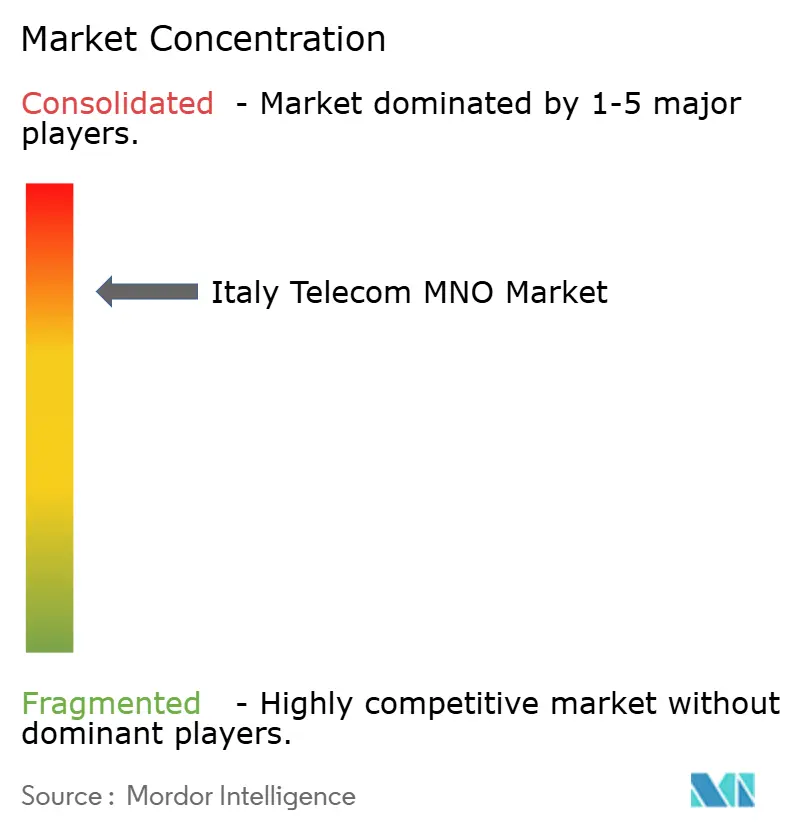
| Market Concentration | High |
Major Players *Disclaimer: Major Players sorted in no particular order Image © Mordor Intelligence. Reuse requires attribution under CC BY 4.0. | |

Italy Telecom MNO Market Analysis by Mordor Intelligence
Italy Telecom MNO Market size in 2026 is estimated at USD 19.27 billion, growing from 2025 value of USD 18.64 billion with 2031 projections showing USD 22.77 billion, growing at 3.39% CAGR over 2026-2031.
This uptrend stems from rising data consumption, expanding 5G coverage, government-backed fiber rollouts, and the shift toward converged fixed-mobile offerings. Consolidation moves, notably Swisscom’s EUR 8 billion (USD 9.22 billion) purchase of Vodafone Italia and KKR’s EUR 18.8 billion (USD 21.66 billion) acquisition of TIM’s NetCo, are reshaping the competitive landscape, improving capital efficiency, and stabilizing average revenue per user. Data and Internet services command the largest revenue share, while IoT connections and enterprise digitalization propel incremental growth. Operators are trimming energy bills through tower sharing and renewable sourcing, easing pressure from high electricity prices. Overall, a maturing yet reforming environment positions the Italy Telecom MNO market for steady, value-focused expansion.
Key Report Takeaways
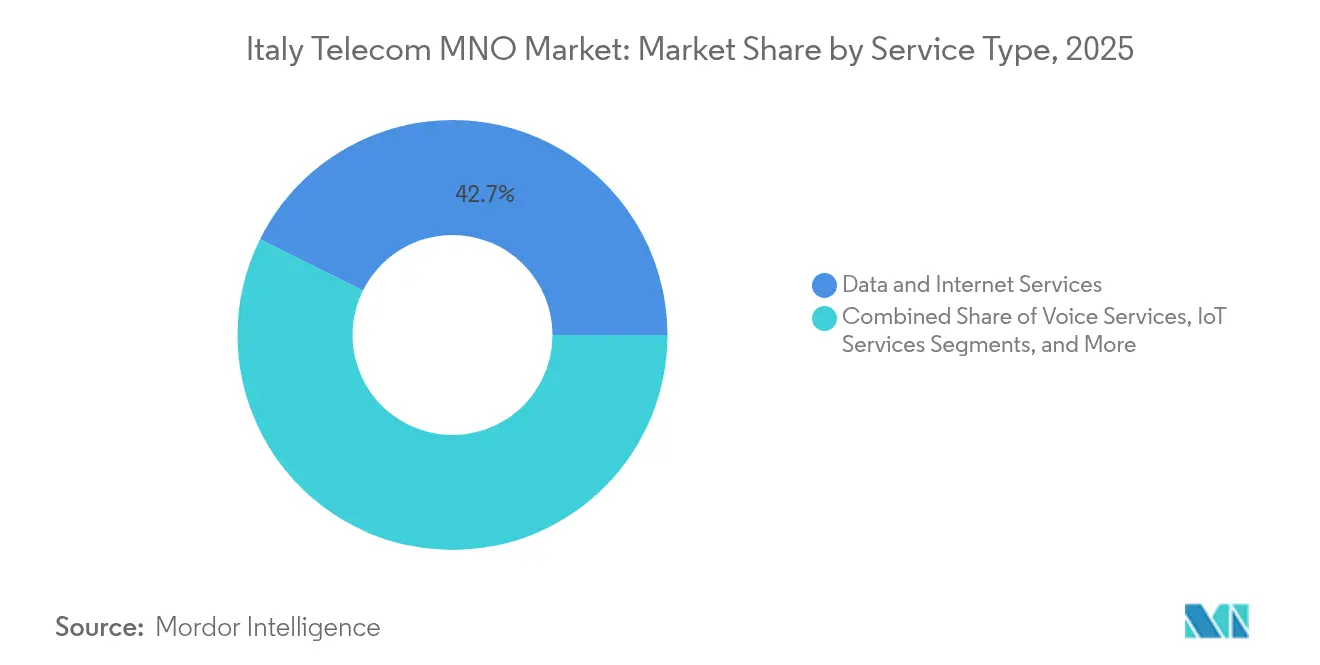
- Data and Internet services led with 42.65% revenue share in 2025, while IoT and M2M services are projected to expand at a 3.46% CAGR to 2031, underscoring the data-centric trajectory of the Italy Telecom MNO market.
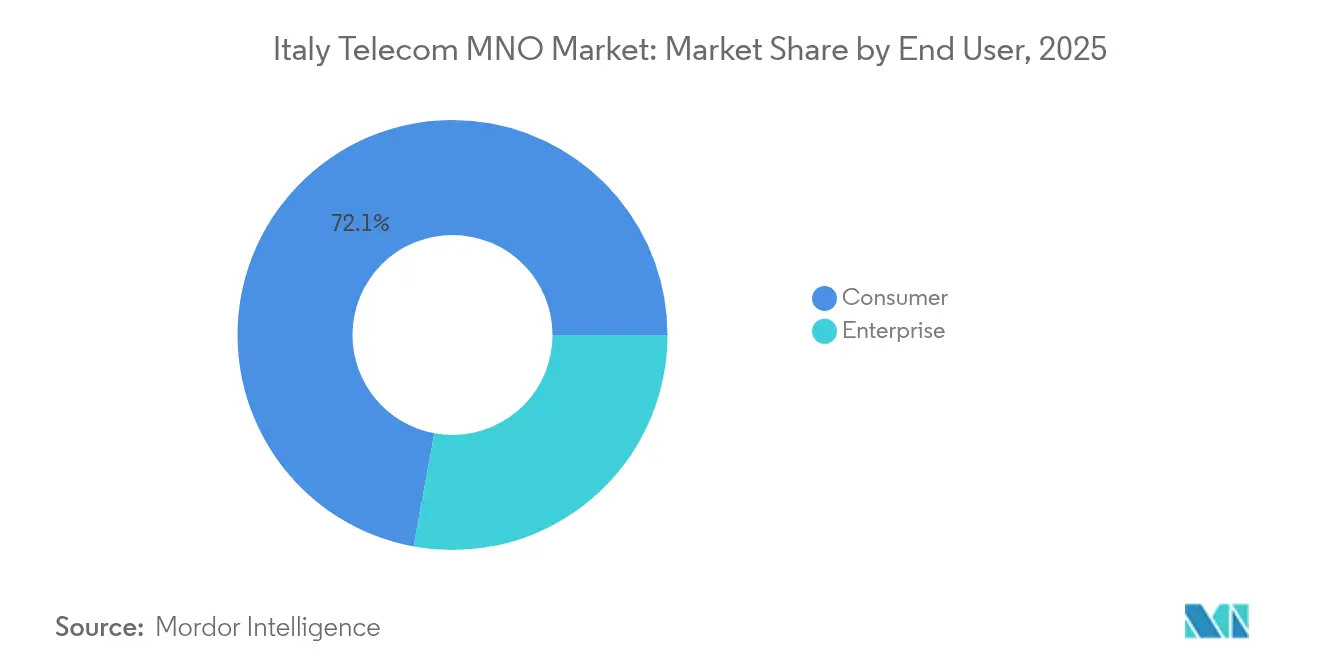
- The consumer segment held 72.10% of Italy Telecom MNO market share in 2025, whereas the enterprise segment is forecast to post the fastest growth at 3.72% CAGR through 2031, buoyed by industrial automation and cloud adoption.
Note: Market size and forecast figures in this report are generated using Mordor Intelligence’s proprietary estimation framework, updated with the latest available data and insights as of 2026.
Italy Telecom MNO Market Trends and Insights
Drivers Impact Analysis*
| Driver | (~) % Impact on CAGR Forecast | Geographic Relevance | Impact Timeline |
|---|---|---|---|
| Increasing 5G subscriber uptake | +1.2% | National, early gains in Milan, Rome, Naples | Medium term (2-4 years) |
| Convergent bundles sustaining ARPU | +0.8% | National, stronger in northern regions | Short term (≤ 2 years) |
| Govt. Italia a 1 Gbps FTTH funding | +0.6% | Rural south and underserved areas | Long term (≥ 4 years) |
| Rising enterprise IoT connectivity demand | +0.9% | Industrial north, expanding centrally | Medium term (2-4 years) |
| Surge in OTT video boosting data usage | +0.7% | National, urban concentration | Short term (≤ 2 years) |
| Tower sharing and NaaS lowering capex | +0.4% | Nationwide networks | Long term (≥ 4 years) |
| Source: Mordor Intelligence | |||
Increasing 5G Subscriber Uptake
5G population coverage already exceeds 90%, placing Italy among the EU front-runners for next-generation access. TIM plans to raise outdoor 5G coverage to 95% by 2026, cutting cost per gigabyte by up to 50% compared with 4G operations. National Recovery and Resilience Plan (NRRP) funds worth EUR 2.02 billion (USD 2.33 billion) subsidize backhaul fiber to 21,900 radio sites, closing gaps where commercial returns are weak.[1]Digital Watch Observatory, “Italy 5G plan,” dig.watch Private 5G networks are gaining traction in factories and ports, raising data intensity and service revenues. Wider 5G adoption will therefore keep the Italy Telecom MNO market on a higher growth slope.
Convergent Bundles Sustaining ARPU
Bundling fixed broadband, mobile service, and content is lifting customer stickiness and supporting average revenue levels, particularly in affluent northern provinces. The Fastweb–Vodafone tie-up promises nationwide, converged propositions that reduce churn and spur cross-sell uptake. Operators leverage fiber footprints to upsell premium mobile data plans, limiting tariff erosion. Early success stories in Milan show a 10 percentage-point uplift in multi-play take-up when fiber and 5G are jointly promoted. Such dynamics keep the Italy Telecom MNO market on a value rather than volume footing.
Govt. Italia a 1 Gbps FTTH Funding
The Italia a 1 Gbps scheme targets universal gigabit-class connectivity by 2026, ahead of EU 2030 objectives. Open Fiber and FiberCop lead rollouts, with 40% of funds earmarked for southern regions to close the digital divide. Wholesale-only access terms encourage MNOs to introduce fiber-linked 5G and fixed-wireless access (FWA). This long-term subsidy raises addressable bandwidth and improves customer experience, underpinning the growth outlook for the Italy Telecom MNO market.
Rising Enterprise IoT Connectivity Demand
The Italian IoT sector generated EUR 8.9 billion (USD 10.25 billion) in 2023, logging 9% annual expansion with 41 million cellular connections. Industrial hubs in Lombardy and Emilia-Romagna deploy private 5G and NB-IoT solutions for robotics, asset tracking, and predictive maintenance. TIM Enterprise aims to double its ICT revenue share to 21% by 2026 by combining connectivity with cloud and cybersecurity offers. This enterprise digitization wave lifts high-margin service uptake and reinforces overall market resilience.
Restraints Impact Analysis*
| Restraint | (~) % Impact on CAGR Forecast | Geographic Relevance | Impact Timeline |
|---|---|---|---|
| Intense MNO price wars compressing margins | -0.9% | National, mainly mobile | Short term (≤ 2 years) |
| Regulatory cuts to mobile termination rates | -0.4% | National framework | Medium term (2-4 years) |
| Rural south fiber take-up lag | -0.3% | Southern regions | Long term (≥ 4 years) |
| High network energy costs vs. green targets | -0.5% | National operations | Medium term (2-4 years) |
| Source: Mordor Intelligence | |||
Intense MNO Price Wars Compressing Margins
Fierce tariff battles since Iliad’s 2018 arrival sliced mobile ARPU and pushed churn upward. Although consolidation is reducing head-to-head discounts, entry-level offers remain aggressive, especially in prepaid segments. Operators respond with upsell tactics such as content bundles and speed tiers. Near-term profitability pressure, therefore, reduces the Italy Telecom MNO market CAGR by almost one percentage point until price equilibrium is reached.
High Network Energy Costs vs. Green Targets
Electricity accounts for a double-digit share of operating expenses, and Italy’s high-power prices tighten cost control. TIM reduced energy use by 28% and increased renewable sourcing to 65% by 2025, while INWIT launched a EUR 100 million (USD 115.21 million) solar program across its tower sites.[2]TowerXchange, “News: INWIT to develop telecommunications infrastructure with EIB financing,” towerxchange.com Network densification for 5G increases power consumption, prompting carriers to adopt more efficient radio units and shared passive infrastructure. Persistently high electricity pricing, therefore, tempers the profitability upside of the Italy Telecom MNO market.
*Our forecasts treat driver/restraint impacts as directional, not additive. The impact forecasts reflect baseline growth, mix effects, and variable interactions.
Segment Analysis
By Service Type: Data Use Dominates, IoT Accelerates
Data and Internet services represented the largest revenue slice, capturing 42.65% of Italy Telecom MNO market share in 2025. IoT and M2M solutions, while still small in absolute terms, deliver the highest 3.46% CAGR, underpinned by industrial automation and smart-city projects. The Italy Telecom MNO market size for data-centric services will expand steadily as streaming, cloud gaming, and remote work heighten gigabyte consumption. Declining voice and SMS uptake continues to free network capacity for richer data packages, while OTT messaging tightens pressure on legacy revenues. Operators monetize traffic growth through speed-tiered 5G plans and content tie-ups with Netflix, Amazon, and DAZN, strengthening average spending levels. Fixed-mobile convergence further cements data dominance by marrying fiber backhaul with 5G spectrum, ensuring robust user experience across devices.
Messaging and traditional voice revenues keep sliding because WhatsApp, Telegram, and similar applications meet most consumer needs at negligible incremental cost. Nonetheless, operators are leveraging rich communication services (RCS) and 5G standalone capabilities to introduce low-latency enterprise voice over New Radio (VoNR) and mission-critical push-to-talk. The Italy Telecom MNO market size, aligned with IoT gains, is expected to experience momentum in sectors such as logistics, smart agriculture, and utilities, where wide-area NB-IoT coverage provides economical and battery-efficient connectivity. Overall, service diversification based on data ecosystems will outweigh the contraction of legacy revenue lines and secure a balanced growth mix.



By End User: Consumers Still Rule, Enterprise Gains Speed
Consumers accounted for 72.10% of total revenue in 2025, retaining the bulk of SIM bases and broadband subscriptions. Attractive family bundles, handset financing, and rising video usage keep consumer lines stable. The enterprise segment, however, exhibits a faster 3.72% CAGR as Industry 4.0 investment accelerates. Demand for managed cloud, cybersecurity, and low-latency private 5G drives incremental spending among manufacturing, healthcare, and public-sector customers. The Italy Telecom MNO market size attributed to enterprise services is bolstered by NRRP incentives that earmark 27% of public funds for digital transformation in government entities.
Small and medium-sized enterprises tap 5G fixed wireless access to circumvent limited fiber availability, especially in industrial parks on city outskirts. Meanwhile, consumers benefit from expanding FWA options powered by millimeter-wave 5G, closing rural coverage gaps where fiber remains impractical. The expanding enterprise mix improves revenue quality because corporate contracts often involve multi-year terms and value-added solutions, dampening churn and reinforcing cash flow. As a result, a balanced split between mass-market connectivity and specialized B2B platforms supports sustainable progress for the Italy Telecom MNO market.
Geography Analysis
Regional divides remain a defining feature. Northern Italy shows the densest fiber footprint and earliest 5G launches, with Milan, Turin, and Bologna all surpassing 90% outdoor 5G population coverage by 2025. Industrial clusters in Lombardy and Emilia-Romagna adopt private 5G, boosting local demand for edge computing and latency-sensitive applications. The Italy Telecom MNO market size linked to these northern provinces, therefore, outpaces the national mean as factories digitize processes to enhance competitiveness.
Central Italy, anchored by Rome, benefits from infrastructure concessions such as INWIT’s 25-year Smart City Roma plan that delivers wholesale 5G across transport nodes. Improved connectivity supports tourism, public safety, and e-government solutions. FiberCop and Open Fiber continue to overbuild and upgrade pre-existing copper loops, attracting premium broadband uptake among households and small enterprises. Consequently, central regions register mid-single-digit growth, modestly above the national average.
Southern Italy still trails on adoption metrics because of sparse population density and lower disposable incomes. The Italia a 1 Gbps program allocates 40% of its EUR 2.02 billion (USD 2.33 billion) budget to the south, subsidizing fiber links to communities where private capital return expectations deter investment. EOLO’s 5G millimeter-wave FWA reaches 700,000 households, offering up to 1 Gbps speeds in mountain and coastal zones where trenching costs run high. While adoption lags, improving affordability and state-funded backhaul accelerate catch-up, raising total addressable demand for the Italy Telecom MNO market.
Regulatory Landscape
Italy’s telecom MNO market operates under the oversight of AGCOM (Autorita per le Garanzie nelle Comunicazioni), which sets key wholesale and interconnection rules that flow through to retail competition. In fixed access, AGCOM’s Delibera n. 114/24/CONS (30 April 2024) defined the framework for access markets and identified significant market power in parts of the country, shaping how operators such as TIM and FiberCop provide access and how converged fixed-mobile propositions get built.
On the mobile side, AGCOM continues to manage interconnection conditions and mobile termination rate oversight via its ongoing review framework (Delibera n. 599/18/CONS), influencing voice economics and operator pricing latitude. Competition scrutiny also affects network strategy: the Italian Competition Authority (AGCM) opened an investigation into the proposed TIM and Fastweb+Vodafone network-sharing arrangement, adding a compliance layer around RAN sharing and spectrum-related cooperation as operators pursue cost efficiencies through shared infrastructure.
Competitive Landscape
Four national operators—TIM, Vodafone-Fastweb (under Swisscom), WindTre, and Iliad—form a moderately concentrated market. The pending integration of Vodafone Italia with Fastweb will create a converged rival, holding robust fiber assets and 22,000 mobile sites, thereby narrowing the scale gap with TIM. TIM’s sale of NetCo to KKR slashes leverage toward the 1.6-1.7× range, freeing capital for 5G densification and cloud expansion within its consumer and enterprise entities.
Network-sharing agreements help curb capex. WindTre and Iliad formed Zefiro Net to build and run 5G coverage across 2,500 rural municipalities, reducing duplication and accelerating time-to-market.[4]Infrastrutture Wireless Italiane, “INWIT unveils 2025-2030 plans,” towerxchange.com Tower companies supply critical passive infrastructure. INWIT tops 25,000 sites, Cellnex follows, and Phoenix Tower International expands via Iliad partnerships. INWIT’s tenancy ratio jumped from 2.26× to 2.35× in 2025, proving the payoff from multi-operator colocation.
The strategic focus is shifting toward enterprise solutions. TIM Enterprise seeks EUR 1 billion (USD 1.15 billion) cloud revenue by 2026, leveraging alliances with Google Cloud, Microsoft Azure, Oracle, and VMware. Vodafone-Fastweb will push integrated offers, using Fastweb’s fiber backbone to cross-sell mobile to its 3.4 million broadband customers. Green-energy agendas also differentiate players: INWIT’s EUR 100 million (USD 115.21 million) solar roll-out lowers carbon output and stabilizes long-term opex. Together, these strategies reinforce a shift from price competition toward innovation, improving the health of the Italy Telecom MNO market.
Italy Telecom MNO Industry Leaders
Telecom Italia (TIM)
WindTre
Iliad Italia
Fastweb + Vodafone
- *Disclaimer: Major Players sorted in no particular order

Market Opportunities and Future Outlook
Converged infrastructure investment creates room for monetization beyond connectivity, particularly where public programs and operator balance-sheet actions expand build capacity. The Italia a 1 Gbps scheme and NRRP-backed fiber backhaul subsidies (EUR 2.02 billion to support connectivity goals, including links to 21,900 radio sites) broaden the base for fiber-fed 5G and FWA offers, supporting new bundling and service tiering in underserved municipalities where pure fiber take-up has lagged.
Enterprise digitalization is also a clear opportunity area, supported by demand indicators such as Italy’s IoT sector reaching EUR 8.9 billion in 2023 and 41 million cellular IoT connections. Operators are already reorganizing around this: TIM Enterprise has outlined a target to lift its ICT revenue mix (and build cloud-related revenue) by combining connectivity with hyperscaler-linked cloud and cybersecurity, while private 5G use cases in factories and ports expand the addressable market for managed edge, low-latency connectivity, and security services. There is a separate, more immediate monetization lever in cost and operational headroom from infrastructure optimization, with INWIT’s solar rollout program (EUR 100 million) and broader tower sharing improving the economics of 5G densification and helping operators sustain differentiated data experiences rather than focusing only on entry-level price points.
Recent Industry Developments
- July 2026: TIM - The Milan Court rejected an application for interim relief filed by Inwit regarding the decision of TIM and Fastweb+Vodafone to terminate tower Master Service Agreements (MSA). The ruling could influence access terms and timing for tower-related negotiations within the MNO landscape. The case underscores regulatory and contractual tensions in tower sharing arrangements.
- July 2026: Agcom - The Italian Communications Authority scheduled a decision for July 29, 2026, concerning the renewal of mobile frequency lots at 900 MHz and 1800 MHz expiring in 2029. This decision shapes spectrum renewal terms and influences capacity deployment and 5G rollout timing. The decision highlights potential shifts in regulatory oversight of spectrum rights for incumbents and challengers alike.
- May 2026: AGCM - The Italian Competition Authority initiated an investigation into a proposed network-sharing agreement between TIM and Fastweb+Vodafone, expressing concerns over market competition, particularly regarding shared Radio Access Network (RAN) components and spectrum holdings. The inquiry points to heightened regulatory scrutiny of consolidation moves among Italian operators. The investigation could affect future collaboration strategies and competitive dynamics in the market.


Research Methodology Framework and Report Scope
Market Definition and Coverage
For this study, the market covers telecom operator revenues generated within Italy from mobile and fixed connectivity services, including supporting digital communication services delivered to consumers and enterprises.
Scope exclusions: We exclude handset and device sales, pure media production revenues, and IT consulting that is not directly tied to telecom service delivery.
Segmentation Overview
- Overall Telecom Revenue and ARPU
- Service Type
- Voice Services
- Data and Internet Services
- Messaging Services
- IoT and M2M Services
- OTT and PayTV Services
- Other Services (VAS, Roaming And International Services, Enterprise And Wholesale Services, etc.)
- End-user
- Enterprises
- Consumer
Data Sources, Market Sizing, and Validation
Desk Research
Desk work starts by building a clean fact base on Italy network scale and usage, and then matching it to what operators can realistically monetize. We referenced public sources such as AGCOM communication observatories, ISTAT price and household indicators, Eurostat connectivity and broadband series, ITU telecom indicators, and OECD digital economy metrics.
To keep assumptions grounded, we also reviewed operator annual reports and investor presentations, spectrum and regulatory updates, and reputable local business press for deal timelines and pricing moves. Where needed, we used paid subscriptions for company financial intelligence, news and financials screening, patent lookups around network technology, and tender notices tied to public connectivity programs. The sources listed above are illustrative, and many other public documents were also used for data collection, validation, and clarification.
Primary Interviews and Surveys
Primary checks were run through expert interviews and structured surveys with operator-side teams, channel partners, enterprise connectivity buyers, and telecom ecosystem specialists. The respondent input was used to validate desk assumptions and to tighten gaps around pricing, bundle composition, and revenue mix for Italy. Discussions were balanced across urban and non-urban coverage realities, and across consumer versus enterprise demand, before final inputs were locked in.
Distribution of primary research fieldwork respondents
| Company type | Respondent position |
|---|---|
| Top tier: 31% | CXOs: 15% |
| Mid tier: 50% | Functional/Unit leaders: 36% |
| Smaller Players: 19% | Managers: 49% |
Market-Sizing & Forecasting
Sizing starts from a top-down build where national telecom revenue pools are reconstructed using regulator and macro series, and then are allocated across service baskets based on subscriptions and usage intensity. The totals are then cross-checked with selective bottom-up approximations, such as sampled operator service revenue splits, plan-level price points, and volume signals like mobile subscriptions and fixed broadband lines, so the model stays practical and consistent.
Key inputs used in the model include subscriber base trends, data traffic growth direction, ARPU movement by major service types, 4G to 5G migration pace, fiber and fixed broadband penetration, and inflation-linked price actions that show up in telecom price indices. When gaps appear in the bottom-up checks, they are handled through conservative ranges and then tightened using interview feedback on mix shifts and discounting. For forecasting, scenario analysis is used, where base case demand and pricing paths are adjusted for changes in coverage expansion and competitive intensity, and then reviewed with primary experts to avoid unrealistic step changes.
Data Validation & Update Cycle
Outputs are validated through triangulation across independent signals, including regulator reported indicators, operator financial consistency checks, and cross-service mix logic, before numbers move to final review. Outliers are flagged, and the drivers are re-tested, which often triggers a re-contact with industry respondents to confirm whether the change is real or data related.
Each report goes through multiple analyst reviews with clear variance thresholds and sign-offs on assumptions that matter most, such as pricing, mix, and subscriber movements. Updates are done annually, and interim refreshes are made when material events occur, such as major regulatory actions or sharp price resets. Before delivery, we run a final update pass so clients receive the latest view supported by the same repeatable steps.
Mordor Intelligence's Italy Telecom Market Estimate Compared With Other Published Estimates
Published estimates for Italy telecom often vary because the scope boundary is not consistent, and because different studies treat bundled services, media add-ons, and wholesale revenues in different ways. Timing also matters since some sources use the latest regulator year, while others anchor to an earlier base year and then extend forecasts using broad macro growth.
By tracking regulator-led revenue pools and subscriber-volume signals, and then refreshing the scope rules for what counts as operator telecom service revenue, Mordor Intelligence reduces mixing of adjacent categories like devices and broader media, which is a common reason totals spread.
Benchmark comparison
| Source | Market Size | Gaps in Research Methodology |
|---|---|---|
| Mordor Intelligence | USD 18.64 B (2025) | |
| Industry Association A | USD 29.44 B (2023) | This figure is based on total sector revenues reported in euros for 2023, and it can reflect a broader revenue perimeter across fixed and mobile, with limited separation of service-only telecom revenues versus adjacent lines. |
| Regulatory Summary B | USD 30.86 B (2024) | The estimate is aligned to a regulator-cited 2024 telecom revenue value in euros and may include a wider electronic communications and internet services perimeter, and the year and FX timing can lift the USD-converted total versus a later base year. |
Overall, the spread mainly comes from what gets counted as telecom service revenue, and which year is treated as the anchor for conversion and comparison. Our approach keeps the boundary tied to operator service economics and repeatable inputs, so users can trace changes back to subscribers, pricing, and mix rather than broad sector roll-ups.


Key Questions Answered in the Report
How large is the Italy Telecom MNO market in 2026?
The Italy Telecom MNO market size stands at USD 19.27 billion in 2026 with a forecast CAGR of 3.39% through 2031.
Which service generates the highest revenue?
Data and Internet services dominate, capturing 42.65% revenue share in 2025 and continuing to outpace voice and messaging lines.
What is the fastest-growing service segment?
IoT and M2M services are set to grow at 3.46% CAGR through 2031, fueled by industrial automation and smart-city projects.
How does regional disparity affect growth?
Northern and central regions advance faster thanks to early 5G and dense fiber networks, while government subsidies help the south narrow its connectivity gap.
Which firms lead tower infrastructure?
INWIT holds the largest portfolio with over 25,000 sites followed by Cellnex, and Phoenix Tower International is expanding through Iliad contracts.
How will consolidation influence competition?
The Swisscom–Vodafone deal and TIM’s NetCo sale are expected to curb price wars, improve investment capacity, and foster value-based competition.
Page last updated on:


 Your data is secure and never sold or shared.


