
Market Overview
| Study Period | 2020 - 2031 |
|---|---|
| Forecast Data Period | 2026 - 2031 |
| Base Year Market Size (2025) | USD 4.09 Billion |
| Market Size (2026) | USD 4.21 Billion |
| Market Size (2031) | USD 4.78 Billion |
| Growth Rate (2026 - 2031) | 2.57 % |
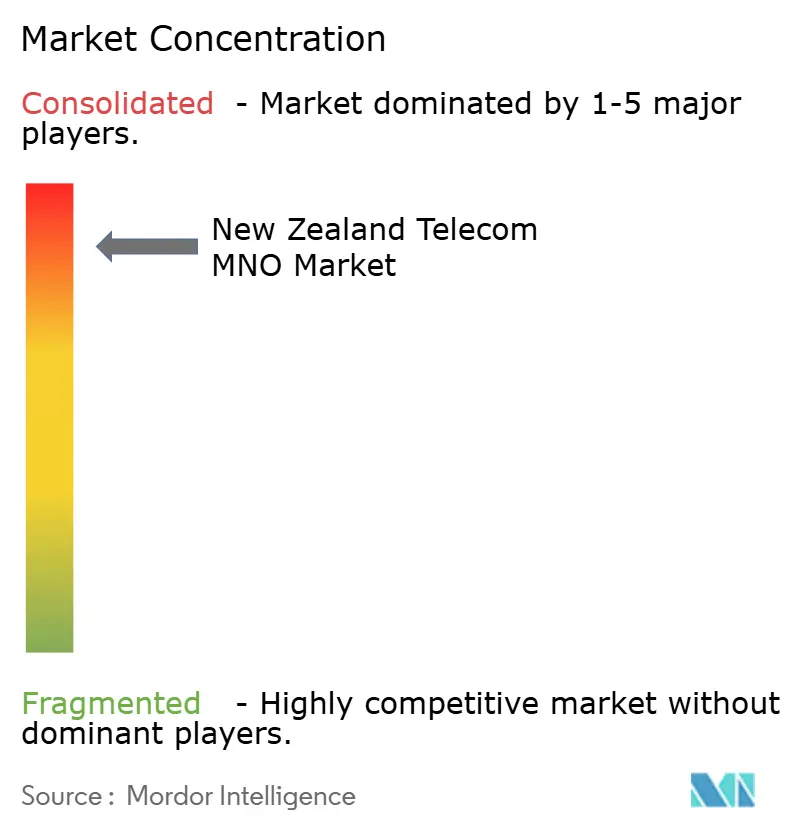
| Market Concentration | High |
Major Players *Disclaimer: Major Players sorted in no particular order Image © Mordor Intelligence. Reuse requires attribution under CC BY 4.0. | |
New Zealand Telecom MNO Market Analysis by Mordor Intelligence
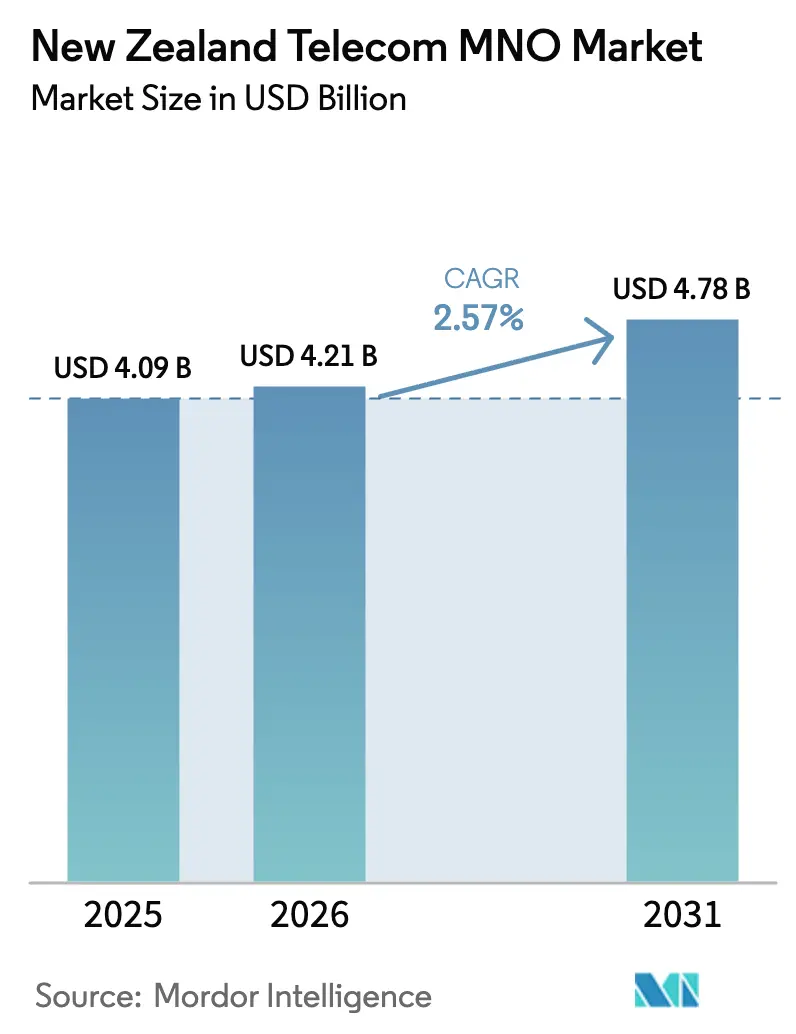
The New Zealand telecom MNO market size is projected to expand from USD 4.09 billion in 2025 and USD 4.21 billion in 2026 to USD 4.78 billion by 2031, registering a 2.57% CAGR between 2026 to 2031. During this horizon, the New Zealand telecom MNO market is pivoting from voice toward data-centric revenue streams as 5G stand-alone (SA) cores reach commercial scale. Incumbent operators are concentrating investment on network slicing, ultra-low-latency services, and edge compute infrastructure so they can price beyond commoditized gigabytes. Wholesale mandates are loosening barriers for mobile virtual network operators (MVNOs), a shift that fosters new-entrant niches and raises pressure on legacy pricing. Meanwhile, resilient backhaul provided by fresh submarine capacity is pulling cloud nodes onshore, propelling enterprise adoption of hybrid deployment models. These forces confirm that the New Zealand telecom MNO market is entering a period where platform capabilities, not subscriber additions, define competitive advantage.
Key Report Takeaways
- By service type, Data and Internet Services led with 52.78% revenue share in 2025, while IoT and M2M Services are projected to expand at a 2.89% CAGR to 2031.
- By end-user, Consumer accounts held 75.64% of the New Zealand telecom MNO market share in 2025, whereas the Enterprise segment is forecast to advance at a 3.04% CAGR through 2031.
Note: Market size and forecast figures in this report are generated using Mordor Intelligence’s proprietary estimation framework, updated with the latest available data and insights as of 2026.
New Zealand Telecom MNO Market Trends and Insights
Drivers Impact Analysis*
| Driver | (~) % Impact on CAGR Forecast | Geographic Relevance | Impact Timeline |
|---|---|---|---|
| Commercial 5G Stand-Alone Core Rollouts Accelerate Enterprise Use-Cases | +0.6% | Auckland, Wellington, Christchurch | Medium Term (2–4 Years) |
| Rural Broadband Initiative Phase-2 Completion Boosts Coverage | +0.4% | Northland, Waikato, Bay of Plenty, Southland | Short Term (≤ 2 Years) |
| Surge in Agritech IoT Deployments for Livestock and Pasture Management | +0.5% | Waikato, Taranaki, Canterbury Plains | Medium Term (2–4 Years) |
| New Trans-Pacific Submarine Cables Reduce International IP Transit Costs | +0.3% | National, Edge Nodes in Auckland and Wellington | Long Term (≥ 4 Years) |
| Rapid Adoption of Secure SD-WAN and Edge Services by SMEs | +0.4% | Auckland and Wellington Business Districts | Short Term (≤ 2 Years) |
| Government Climate-Resilience Funding for Remote Connectivity Solutions | +0.3% | East Cape, West Coast, Fiordland | Medium Term (2–4 Years) |
| Source: Mordor Intelligence | |||
Commercial 5G Stand-Alone Core Rollouts Accelerate Enterprise Use-Cases
Spark’s decision to build its 5G SA core with Ericsson positions the operator to guarantee latency and isolate traffic slices for factories, ports, and logistics yards. CentrePort Wellington, New Zealand’s earliest private 5G site, illustrates the value of this architecture by orchestrating automated straddle carriers across 42 ha while keeping control traffic on-premises.[1]CentrePort, “Private 5G Network Deployment at Wellington Port,” centreport.co.nz SA cores separate control and user planes, trimming round-trip latency by as much as 40% and enabling real-time augmented-reality maintenance workflows. One NZ complements this capability with a self-healing network that reroutes traffic during fiber cuts, proving that automation can contain opex while safeguarding enterprise service-level objectives. Collectively, these moves reinforce why advanced core functions are becoming the anchor product in the New Zealand telecom MNO market rather than last-mile radio coverage.
Rural Broadband Initiative Phase-2 Completion Boosts Coverage
Finishing RBI-2 extended LTE and fixed-wireless service to 84,000 households and 1,200 km of state highways, eliminating many connectivity deserts.[2]Crown Infrastructure Partners, “RBI2 Completion Report,” crowninfrastructure.govt.nz The result was a foundational layer that now supports precision-agriculture platforms monitoring soil moisture and livestock well-being. Government resilience funding tied to climate events keeps momentum strong, paying for tower hardening and battery backups that sustain service during floods. Operators therefore enjoy a prepared rural addressable base for upselling 5G fixed-wireless, an option expected to lift data ARPU even as urban segments saturate. The driver’s influence on the New Zealand telecom MNO market remains immediate because a coverage gap closed today converts into incremental traffic tomorrow.
Surge in Agritech IoT Deployments for Livestock and Pasture Management
The dairy sector is embedding IoT sensors across 1.9 million ha to meet environmental targets and relieve labor shortages, triggering above-market growth for NB-IoT and LTE-M connections. Spark’s platform relays data from collars, soil probes, and weather stations, creating auditable trails for nitrogen-use compliance.[3]Fonterra, “Dairy Sector Export Revenue and IoT Adoption,” fonterra.com As more farms adopt autonomous irrigation systems, monthly data volumes per unit rise, cushioning revenue per gigabyte declines. Industry reports show agriculture as the fastest-growing vertical in domestic IoT spending, a trend that expands the New Zealand telecom MNO market footprint into primary-sector value chains. Cross-sell opportunities in cybersecurity and analytics further amplify revenue beyond connectivity itself.
Rapid Adoption of Secure SD-WAN and Edge Services by SMEs
Small and medium enterprises in Auckland and Wellington are upgrading branch connectivity with operator-managed SD-WAN overlays that route traffic directly to hyperscale clouds. Lower international transit costs, thanks to new submarine routes, cut backbone charges and make usage-based billing viable.[4]Southern Cross Cable Network, “Southern Cross NEXT Activation,” southerncrosscables.com Edge nodes hosted in domestic data centers shrink application latency, allowing operators to bundle compute along with bandwidth. This bundling enlarges the addressable pie for the New Zealand telecom MNO market because operators capture portions of IT budgets previously destined for system integrators.
Restraints Impact Analysis*
| Restraint | (~) % Impact on CAGR Forecast | Geographic Relevance | Impact Timeline |
|---|---|---|---|
| Saturated Mobile-Subscriber Base Limits Organic Growth | -0.5% | Auckland, Wellington, Christchurch | Long Term (≥ 4 Years) |
| Persistent ARPU Erosion from Price Competition and Commerce Act Oversight | -0.6% | National | Short Term (≤ 2 Years) |
| High Backhaul Cost of Remote Fiber Reduces Margin Outside Metros | -0.3% | West Coast, Fiordland, East Cape | Medium Term (2–4 Years) |
| Shortage of Licensed Fiber and 5G Radio Technicians Delays Deployments | -0.2% | National, Rural Build Zones | Medium Term (2–4 Years) |
| Source: Mordor Intelligence | |||
Persistent ARPU Erosion from Price Competition and Commerce Act Oversight
Average revenue per user slid 4% in 2024 as unlimited bundles spread across 78% of consumer plans. The Commerce Commission’s transparency scoring curtails mid-contract price hikes, forcing operators to rely on value-added services for margin recovery.[5]Commerce Commission New Zealand, “Telecommunications Monitoring Report 2024-2025,” comcom.govt.nz 2G and 3G refarming removes legacy tariff ladders, making pricing even flatter. As a result, sustaining network investment requires cost efficiency from automation, private network premiums, and wholesale arrangements. The drag on near-term revenue growth explains part of the subdued New Zealand telecom MNO market CAGR despite continued traffic expansion.
Saturated Mobile-Subscriber Base Limits Organic Growth
SIM penetration surpassed 120% in 2025, leaving scant headroom for connection-driven revenue. Churn hovers near the mid-teens and operators poach each other’s customers with device subsidies that dilute profitability. While MVNO entry promotes choice, it also segments demand and accelerates discount cycles. This maturity stage obliges carriers to pivot toward enterprise IoT, private 5G, and wholesale infrastructure where growth is still incremental. Consequently, overall expansion in the New Zealand telecom MNO market will rely more on average revenue per connection improvements than on subscriber counts.
*Our forecasts treat driver/restraint impacts as directional, not additive. The impact forecasts reflect baseline growth, mix effects, and variable interactions.
Segment Analysis
By Service Type: Data Dominance Masks Voice Decline
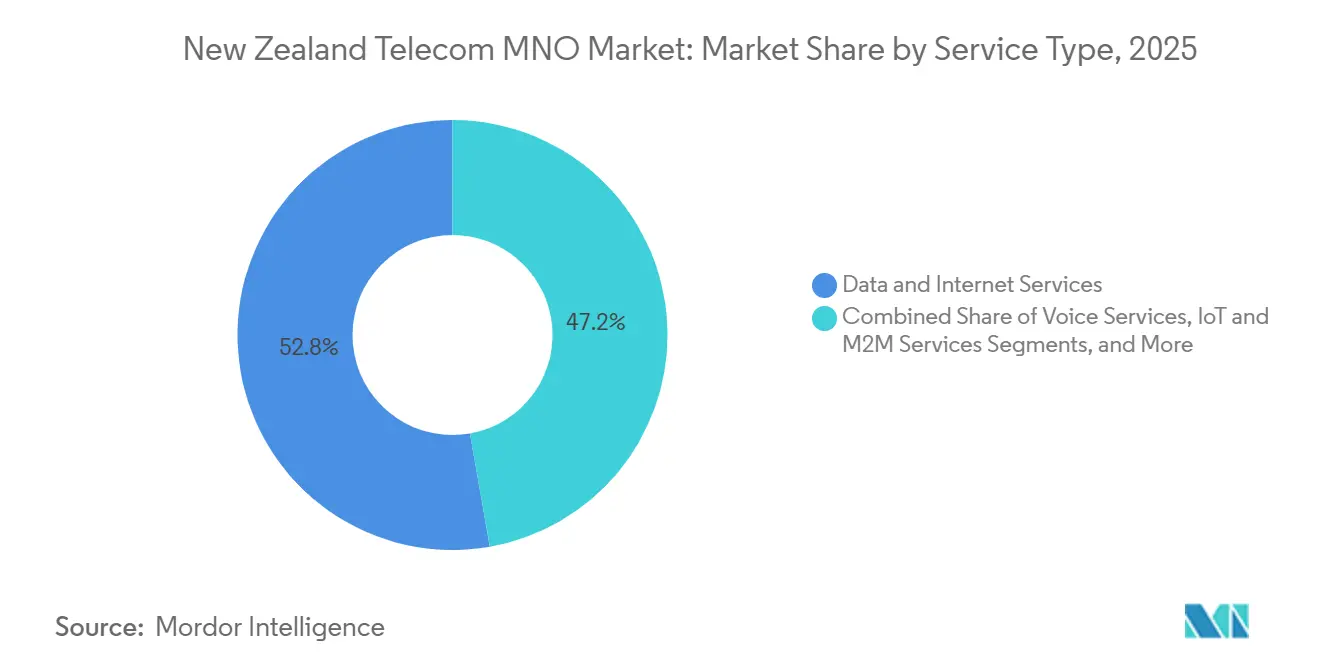
Data and Internet Services controlled 52.78% of the New Zealand telecom MNO market share in 2025 as consumers substituted fixed broadband with 5G fixed-wireless in coverage-gap regions. The New Zealand telecom MNO market size derived from IoT and M2M Services is forecast to expand faster than headline growth at a 2.89% CAGR, propelled by sensor adoption in dairy and logistics. Voice traffic continues to migrate to over-the-top apps bundled into plans, muting tariff differentiation. Messaging revenue shrinks in parallel, while over-the-top content packages find limited headroom given the prevalence of global streaming subscriptions.
Operators therefore pursue network-as-a-service constructs to defend relevance. Spark wholesales backhaul to rural wireless ISPs, monetizing capacity that would otherwise sit idle. One NZ’s Fastter MVNO platform aims to capture 10% of wholesale traffic, turning excess network availability into white-label revenue. Private 5G slices, billed on performance rather than volume, illustrate how the New Zealand telecom MNO market is reframing service boundaries to align with enterprise digital-transformation agendas.



By End-User: Enterprise Growth Outpaces Consumer Saturation
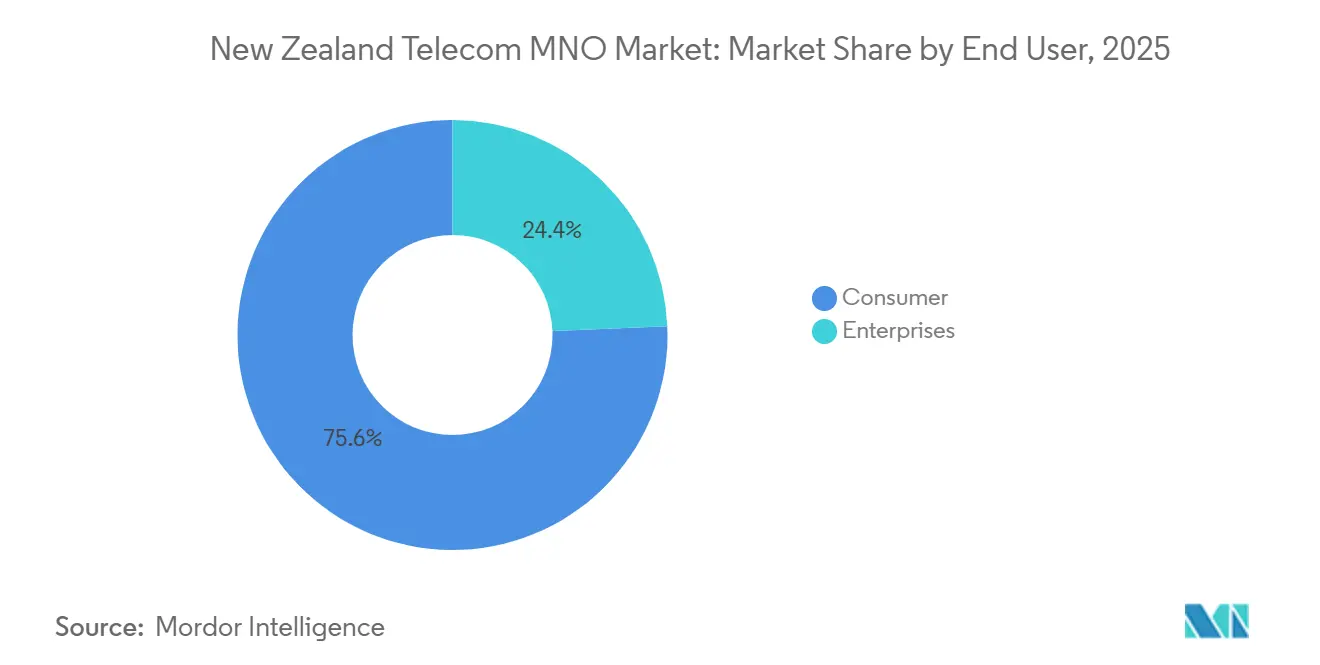
Consumers generated 75.64% of 2025 revenue, yet enterprise accounts are projected to pace the New Zealand telecom MNO market size with a 3.04% CAGR to 2031. Private wireless, SD-WAN, and managed IoT use cases command premium pricing and exhibit lower churn. Spark’s USD 925 million program explicitly prioritizes these services to mitigate consumer ARPU compression.
Regulatory transparency rules constrain operators from extracting additional margin on the consumer side, channeling investment toward business environments where uptime guarantees justify higher fees. Consumer innovations such as satellite-enabled emergency texting nonetheless produce enterprise spillovers, for example enabling forestry crews to maintain backup lines during disasters. This blurring of segment borders reinforces the New Zealand telecom MNO market transition from volume to value.
Geography Analysis
Urban corridors in Auckland, Wellington, and Christchurch absorb the majority of 5G capital expenditure because dense populations offer rapid payback. The New Zealand telecom MNO market in these metros benefits from high device penetration, corporate headquarters, and early enterprise 5G pilots. Rural regions previously underserved are catching up after RBI-2 and climate-resilience grants widened LTE and fixed-wireless footprints, allowing operators to upsell higher-speed tiers without waiting for fiber builds.
North Island dairy provinces such as Waikato and Taranaki are out-performing on IoT adoption, a trend that bolsters the New Zealand telecom MNO market by converting low-ARPU sensor endpoints into high-margin analytics packages. South Island’s Canterbury plains mirror this trajectory in arable farming, while West Coast and Fiordland remain challenged by rugged terrain that inflates tower backhaul costs.
International subsea upgrades with dual Auckland landing stations erase prior latency handicaps versus Sydney routes. This development attracts hyperscale cloud nodes, which in turn encourages Auckland-based multinationals to adopt domestic edge compute. The result is a geography where bandwidth demand and compute placement reinforce each other, sustaining traffic growth even as total SIM counts plateau.
Regulatory Landscape
The New Zealand telecom MNO market is overseen by the Commerce Commission (ComCom) under the Telecommunications Act, with competition settings under the Commerce Act. Annual monitoring shapes retail transparency and wholesale conduct. In its Telecommunications Sector Regulatory Review (final report released March 2026), the Ministry for Regulation set out a package of 22 recommendations to modernize sector rules, including simplifying Telecommunications Development Levy (TDL) calculations and reducing audit-related obligations, with the government framing the reform program as delivering NZD 35-45 million in net benefits over the next decade.
Regulatory settings in 2026 also include active workstreams on legacy service regulation and wholesale access. ComCom's 2026 work plan highlighted upcoming decisions on potential deregulation of Mobile Termination Access Service (MTAS) and voice services (flagged for March 2026) and PSTN services (flagged for May 2026), alongside ongoing monitoring of pricing and bundling practices. In spectrum policy, the government moved in July 2026 to reallocate a portion of mobile spectrum holdings from incumbents Spark and One New Zealand to challenger 2degrees, using spectrum settings as a competition lever that affects capacity economics and 5G deployment options.
Competitive Landscape
The New Zealand telecom MNO market is highly concentrated, with Spark, One NZ, and 2degrees controlling 98.4% of connections. Spark’s legacy fiber assets anchor its 38-40% slice, while One NZ’s NZD 1.8 billion modernization expanded 5G coverage and automated fault recovery. 2degrees focuses on cost-efficient spectrum refarming, completing its 3G shutdown in February 2026 to redeploy 850 MHz and 2100 MHz layers for capacity uplift.
Competition occurs less on retail pricing, which regulators scrutinize, and more on network capability. One NZ touts self-healing routing and AI-driven Network Concierge tools that let enterprises adjust slices in real time.[6]One New Zealand, “Network Modernization and Innovation Initiatives,” one.nz Spark emphasizes Ericsson-based SA core functions and industrial partnerships that showcase deterministic latency. 2degrees plays a challenger role, providing agile wholesale deals to MVNO entrants, which indirectly expands the New Zealand telecom MNO market by addressing micro-segments.
Low-earth-orbit satellite providers such as Starlink add an external threat, already holding 19% of rural broadband lines in 2025. This rivalry accelerates terrestrial rollout plans and drives collaborative initiatives such as One NZ’s satellite-texting offer with SpaceX. Consequently, strategic differentiation now hinges on integrating terrestrial and non-terrestrial assets, automating operations, and packaging vertical solutions rather than simply extending coverage.
New Zealand Telecom MNO Industry Leaders
Spark New Zealand Limited
Two Degrees Mobile Limited
One New Zealand
- *Disclaimer: Major Players sorted in no particular order

Market Opportunities and Future Outlook
A near-term whitespace is wholesale and challenger-led capacity expansion, supported by both spectrum policy and regulatory simplification. The July 2026 government decision to reallocate 30% of mobile spectrum holdings from Spark and One New Zealand to 2degrees, with an emphasis on 2600 MHz, creates room for more competitive wireless broadband and 5G capacity-based offers, especially where fixed alternatives remain constrained. In parallel, the March 2026 Telecommunications Sector Regulatory Review recommendations (including TDL simplification and reduced audit burdens) reduce compliance friction for smaller providers and MVNO-aligned propositions, reinforcing a move toward differentiated niches rather than relying on pure subscriber growth.
Enterprise monetization is clustering around 5G SA capabilities, managed edge connectivity, and vertical IoT, where operators can sell performance and outcomes rather than commoditized gigabytes. Spark is scaling SA-core-led propositions (Ericsson-based) that support network slicing for industrial sites, including early private 5G deployments such as CentrePort Wellington. SMEs continue migrating to operator-managed SD-WAN and domestic edge nodes as additional submarine capacity lowers international transit costs. On the demand side, the Commerce Commission's 2025 Telecommunications Monitoring Report (published June 2026) highlighted rapid expansion of telecommunications bundles sold by energy retailers, with Mercury and Contact cited among providers that together grew to 13% share over five years, pointing to partnership, white-label, and multi-utility bundling as a distribution route without depending on incremental SIM penetration.
Recent Industry Developments
- June 2026: Spark deployed 250 AI-enabled sensors from Dryad Networks in the Waitangi Endowment Forest for early wildfire detection, managed by its subsidiary Adroit. The deployment expands data and edge sensing capabilities for enterprise and critical infrastructure, enabling new edge to cloud service opportunities and greater resilience for the network. It strengthens Spark's automation capabilities and opens potential monetization of edge sensing services.
- May 2026: Spark announced it is exploring the divestment of its 30 percent stake in the mobile tower business Connexa to focus on its data center strategy. The announcement reallocates capital toward data centers and core connectivity, affecting network deployment economics and wholesale competitiveness. It reshapes Spark's asset mix to support cloud-centric infrastructure growth.
- April 2026: Spark launched satellite-to-mobile services via Starlink, offering both data and text connectivity to extend reach beyond traditional cell towers. The expansion adds satellite-enabled mobility capability in the New Zealand market, diversifying coverage and remote connectivity options while impacting terrestrial capital expenditure models.


Research Methodology Framework and Report Scope
Market Definition and Coverage
For this methodology, the New Zealand telecom market is measured as operator-side revenues earned from providing connectivity and related communication services to consumers and enterprises within New Zealand, across mobile and fixed networks.
Scope exclusions: We exclude device hardware sales and one-off construction revenue from network builds unless it is billed as a recurring telecom service.
Segmentation Overview
- Overall Telecom Revenue and ARPU
- Service Type
- Voice Services
- Data and Internet Services
- Messaging Services
- IoT and M2M Services
- OTT and PayTV Services
- Other Services (VAS, Roaming and International Services, Enterprise and Wholesale Services, Rest of Service Type)
- End-User
- Enterprises
- Consumer
Data Sources, Market Sizing, and Validation
Desk Research
Desk research starts with building the demand and supply context for New Zealand telecom, so the model stays anchored to observable connection behavior and operator economics. We typically pull public indicators such as connection counts, broadband migration patterns, and service quality measures from official publications and regulatory monitoring, and then we cross-check how these move alongside operator-reported performance.
For New Zealand telecom, sources used include public documents such as New Zealand Commerce Commission telecommunications monitoring reports, Stats NZ population and household statistics, the Ministry of Business, Innovation and Employment (MBIE) connectivity and digital economy releases, and OECD telecom indicators for cross-checking. We also review operator annual reports, investor presentations, press releases, and network rollout updates to understand pricing movements and subscriber mix. Where needed, paid database subscriptions are used for company financials and news screening, patent lookups for network technology direction, and shipment-level import and export checks for selected equipment signals. The desk sources mentioned above are illustrative and not exhaustive, and many other references are consulted to collect inputs, validate them, and clear up gaps.
Primary Interviews and Surveys
Primary work is used to sanity-check the desk model and translate high level indicators into usable assumptions. We speak with a mix of operator-side leaders, network and product managers, and enterprise buyers to confirm revenue splits, pricing direction, and the expected pace of migration toward higher-speed plans and 5G services across New Zealand.
Distribution of primary research fieldwork respondents
| Company type | Respondent position |
|---|---|
| Top tier: 28% | CXOs: 15% |
| Mid tier: 53% | Functional/Unit leaders: 36% |
| Smaller Players: 19% | Managers: 49% |
Market-Sizing & Forecasting
Sizing is built using a top-down and bottom-up approach, where service revenue pools are first reconstructed from the installed base of connections and typical monthly spend, and then aligned to known sector totals where available. Once the total is shaped, it is corroborated with selective bottom-up checks such as sampled plan pricing times estimated subscriber volumes, and roll-ups of a few disclosed revenue lines that map cleanly into telecom services.
Inputs that materially move the model include mobile connections and usage direction, fixed broadband connections and fiber migration pace, average revenue per user trends, 4G to 5G coverage expansion timing, and the enterprise share of spend versus consumer (along with changes in bundled offers). When a data point is not directly observable, gaps are handled through conservative ranges that are then narrowed using interview feedback and consistency checks across years.
For forecasting, we use scenario analysis supported by a light multivariate regression where it makes sense, since both demand and pricing are influenced by multiple factors. Assumptions are guided by what respondents expect for pricing, network investment cycle timing, and competitive intensity, and then sensitivity checks are applied so one variable cannot distort the full market trajectory.
Data Validation & Update Cycle
Validation is done by cross-checking the model output against independent signals such as connection growth, published operator financial performance, and shifts in service mix that should show up in the revenue split over time. If an outlier shows up, it is traced back to the driver assumptions, and then a second analyst review is performed before sign-off.
The model is also reviewed for currency consistency and year alignment so that time-period mismatches do not create artificial growth or decline. Reports are refreshed annually, and interim updates are done when material events occur that can change pricing, regulation, or network reach. Before delivery, we do a final pass to ensure the numbers and assumptions reflect the latest available information.
Mordor Intelligence's New Zealand Telecom Market Estimate Compared With Other Published Estimates
Different published market values for New Zealand telecom can vary even when everyone is looking at the same country, because the scope and revenue lines counted are not always the same. Common differences come from whether only mobile network operators are included, whether wholesale and retail are both counted, and whether adjacent digital services are treated as telecom revenue.
The spread also reflects modeling choices such as using billed revenues versus service spend, handling prepaid pricing changes, and converting local currency using different average rates for the year. Some estimates lean on stated targets or aggressive 5G monetization assumptions, while others apply conservative adoption curves without re-checking them against connection and plan-mix changes, which is why the numbers can drift.
Benchmark comparison
| Source | Market Size | Gaps in Research Methodology |
|---|---|---|
| Mordor Intelligence | USD 4.09 B (2025) | |
| Industry Association A | USD 5.29 B (2021) | Often reflects total retail telecommunications revenue across fixed and mobile services for the year, which can include broader retail service categories and uses a different year and currency timing than an MNO-focused estimate. |
| Regional Consultancy B | USD 3.80 B (2025) | Typically narrows the scope to mobile service revenue only and applies more conservative ARPU progression, which tends to undercount fixed broadband value and bundled revenue attribution. |
The table suggests that year selection and service coverage drive most of the gap. When totals are tied to connection counts, plan-mix shifts, and a consistent NZD to USD conversion window, mobile-only and total-telecom figures become easier to reconcile, which is why the MNO-only treatment is separated from fixed and broader retail lines in Mordor Intelligence.


Key Questions Answered in the Report
What is the forecast revenue for the New Zealand telecom MNO market in 2031?
It is projected to reach USD 4.78 billion by 2031, reflecting a 2.57% CAGR.
Why are operators prioritizing 5G stand-alone cores?
SA cores enable network slicing and guaranteed-latency services that attract higher-margin enterprise contracts.
Which service type contributes the largest share today?
Data and Internet Services accounted for 52.78% of 2025 revenue.
How fast is the enterprise segment growing?
Enterprise accounts are expected to rise at a 3.04% CAGR through 2031, faster than the overall market.
What role do MVNOs play in New Zealand?
Wholesale access mandates allowed MVNOs to lift connection share from 1.6% to 2.5% year-on-year, adding competitive diversity.
How are rural areas benefiting from recent initiatives?
Completion of RBI-2 expanded LTE coverage to 84,000 households and supports agritech IoT services that improve farm productivity.
Page last updated on:


 Your data is secure and never sold or shared.


