
Market Overview
| Study Period | 2021 - 2031 |
|---|---|
| Forecast Data Period | 2026 - 2031 |
| Base Year Market Size (2025) | USD 3.90 Billion |
| Market Size (2026) | USD 4.09 Billion |
| Market Size (2031) | USD 5.19 Billion |
| Growth Rate (2026 - 2031) | 4.88 % |
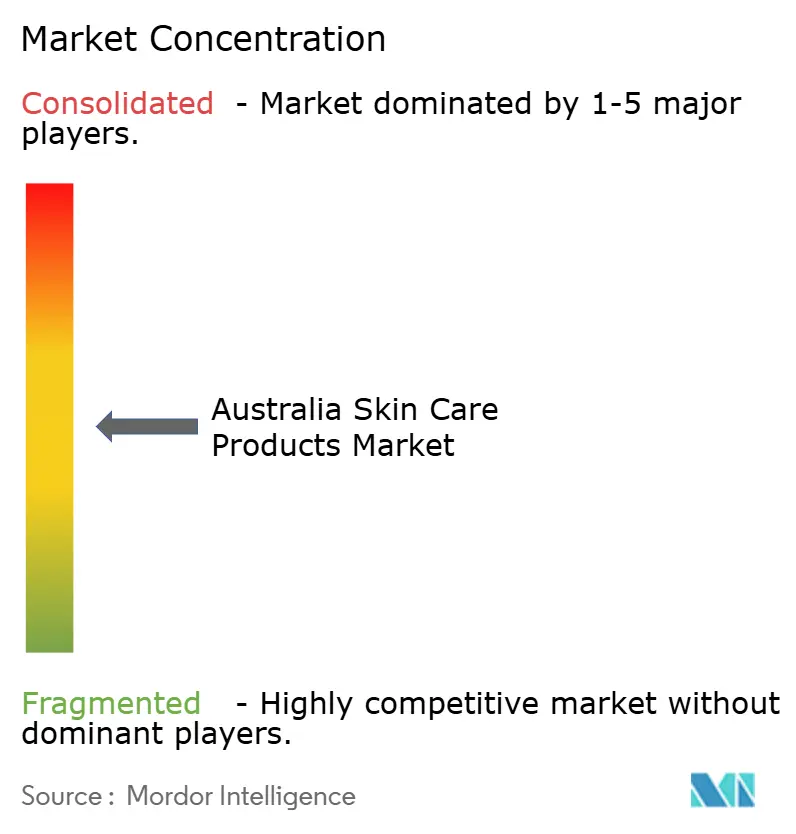
| Market Concentration | Medium |
Major Players
*Disclaimer: Major Players sorted in no particular order Image © Mordor Intelligence. Reuse requires attribution under CC BY 4.0. |
|
Australia Skin Care Products Market Analysis by Mordor Intelligence
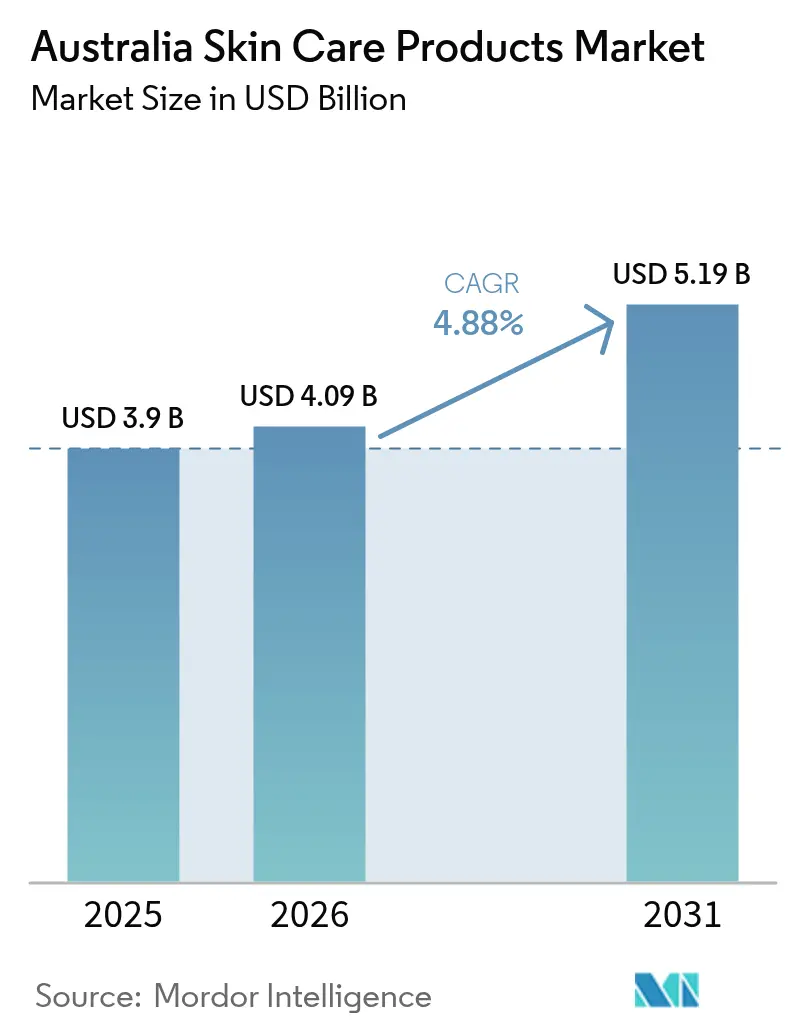
The Australia skin care products market size was valued at USD 3.90 billion in 2025 and estimated to grow from USD 4.09 billion in 2026 to reach USD 5.19 billion by 2031, at a CAGR of 4.88% during the forecast period (2026-2031). This growth reflects a dynamic market driven by increasing consumer awareness about skincare, a preference for natural and organic ingredients, and the rising influence of wellness trends in the Australia skin care products market.. Strict yet innovation-friendly regulations from the Australian Industrial Chemicals Introduction Scheme (AICIS) and the Therapeutic Goods Administration (TGA) are supporting the demand for premium skincare products. By product type, facial care continues to dominate the market, while body care products are gaining popularity. In terms of category, mass-market products maintain their scale, but premium products are growing at a faster pace due to their perceived quality and effectiveness. Natural and organic products are increasingly challenging synthetic options as consumers prioritize clean and sustainable formulations. Adults remain the primary users of skincare products, but there is a growing opportunity to target younger demographics across the Australia skin care products market. Distribution channels are evolving, with physical stores offering expert advice and online platforms providing convenience and accessibility. The market is moderately fragmented, with multinational companies like L’Oréal, Unilever, and Estée Lauder leveraging their global research and development capabilities and significant advertising budgets to maintain a competitive edge in the Australia skin care products industry.
Key Report Takeaways
- By product type, facial care led with 73.02% of the Australian skin care products market share in 2025, whereas body care is tracking a 5.33% CAGR through 2031.
- By category, the mass tier accounted for 65.21% of the Australian skin care products market size in 2025, while premium formulations are expanding at a 6.55% CAGR to 2031.
- By nature, synthetic offerings held a 75.32% share in 2025; the natural/organic tier is advancing at a 6.70% CAGR through 2031, within the Australia skin care products market.
- By end user, adults made up 87.10% of demand in 2025, and the kids segment is gaining at a 4.98% CAGR to 2031.
- By distribution channel, health and beauty stores captured 38.30% of sales in 2025, whereas online retail is expanding at a 6.05% CAGR through 2031, in the Australia skin care products market.
Note: Market size and forecast figures in this report are generated using Mordor Intelligence’s proprietary estimation framework, updated with the latest available data and insights as of 2026.
Australia Skin Care Products Market Trends and Insights
Drivers Impact Analysis*
| DRIVER | (~) % IMPACT ON CAGR FORECAST | GEOGRAPHIC RELEVANCE | IMPACT TIMELINE |
|---|---|---|---|
| Consumers' preference for organic and natural products | +1.2% | Australia-wide, with stronger adoption in urban centers | Medium term (2-4 years) |
| Impact of social media and celebrity endorsements | +0.8% | National, with highest influence in Sydney, Melbourne, Brisbane | Short term (≤ 2 years) |
| Advancements in technology driving product formulation improvements | +0.7% | Local manufacturing benefits in Victoria, NSW | Long term (≥ 4 years) |
| Growing consumer demand for anti-aging products | +0.9% | Australia-wide, concentrated in affluent demographics | Medium term (2-4 years) |
| Rising preference for multifunctional facial care products | +0.6% | National, with early adoption in metropolitan areas | Short term (≤ 2 years) |
| Increasing awareness about skin health concerns | +0.5% | Australia-wide, driven by UV exposure concerns | Long term (≥ 4 years) |
| Source: Mordor Intelligence | |||
Growing consumer demand for anti-aging products
Australia’s anti-aging skin care market is growing due to several factors, including an aging population with higher disposable incomes, constant exposure to strong Ultraviolet radiation, and increasing demand for effective, multifunctional skincare products. The Australian Bureau of Statistics (2024) reports that individuals aged 55 and older represent 26% of the population in capital cities and are more prevalent in regional areas[1]Source: Australian Bureau of Statistics, "Regional Population By Age and Sex", abs.gov.au. This highlights a significant group with unique skincare requirements shaping the Australia skin care products industry. The combination of these demographic trends and environmental challenges is driving the need for advanced anti-aging products and sunscreens with broad-spectrum protection. For example, in March 2024, Medipledge, a premium skincare brand designed by dermatology and beauty experts, was introduced in Australia. The brand offers clinically tested formulas aimed at restoring the skin barrier, reflecting the growing popularity of cosmeceutical and medically focused skincare solutions in the Australia skin care products industry.
Increasing awareness about skin health concerns
Awareness about skin-related issues is growing rapidly in Australia, significantly influencing the skin care market. Eczema, also known as atopic dermatitis, is one of the most common allergy-related skin conditions in the country. The Australasian Society of Clinical Immunology and Allergy (ASCIA, July 2025) highlights that eczema is closely linked to overall immune health[2]Source: Australasian Society of Clinical Immunology and Allergy, "ASCIA Action Plan for Eczema (Atopic Dermatitis)", allergy.org.au. Eczema Support Australia (2023) reports that nearly 3 million Australians are affected by this condition, which can have a severe and widespread impact on their quality of life[3]Source: Eczema Support Australia, "Call For National Eczema Strategy To End ‘Treatment Maze’", eczemasupport.org.au. Efforts such as public health campaigns and increased access to digital education are helping to raise awareness about eczema and other sensitive skin conditions. This growing awareness is driving demand for skincare products that are dermatologist-tested, hypoallergenic, and specifically designed to address these issues. As a result, managing eczema and sensitive skin has become a key factor contributing to the growth of the Australian skin care products market.
Rising preference for multifunctional facial care products
Rising demand for multifunctional facial care products is becoming a key growth driver in Australia, as consumers increasingly seek convenience, value, and efficacy within streamlined routines reflecting broader shifts in the Australia skin care products industry. There is growing interest in products that combine multiple benefits such as hydration, anti-aging, sun protection, and blemish control in a single formulation. Hybrid solutions like moisturizers with SPF, serums with added antioxidants, and tinted sunscreens are gaining traction, especially among younger consumers who value time-saving, minimalist skincare. Reflecting this trend, a survey by Contour Clinics Australia (August 2025) reports that Australians spend an annual USD 25.4 billion across skincare and cosmetic treatments, highlighting the scale and willingness to invest in multifunctional solutions. Retailers and brands are responding by expanding all-in-one ranges, supported by dermatologist input and marketing that emphasizes efficiency, affordability, and clinical validation supporting demand in the Australia skin care products market.
Consumers’ preference for organic and natural products
Australian consumers are increasingly favoring skincare products made with organic and natural ingredients, as they now value knowing exactly what goes into the products they use. Many local brands are gaining attention by incorporating native Australian botanicals like Kakadu plum and desert lime, which are recognized for their unique skincare benefits, such as high antioxidant content and hydration properties. These brands also comply with the Australian Industrial Chemicals Introduction Scheme (AICIS), ensuring their products meet strict safety and transparency standards[4]Source: Australian Industrial Chemicals Introduction Scheme, "Australian Industrial Chemicals Introduction Scheme", industrialchemicals.gov.au. To cater to this growing demand, retailers are expanding their offerings of natural and organic skincare products, aiming to attract consumers who are conscious of both quality and affordability. Sustainability has become a key focus for brands, with practices like using recyclable packaging and adopting eco-friendly production methods becoming essential to appeal to environmentally aware buyers, driving innovation in the Australia skin care products industry.
Restraints Impact Analysis*
| RESTRAINT | (~) % IMPACT ON CAGR FORECAST | GEOGRAPHIC RELEVANCE | IMPACT TIMELINE |
|---|---|---|---|
| Increase in the availability of counterfeit products | -0.4% | National, with higher risk in online channels | Short term (≤ 2 years) |
| Concerns regarding the health impacts of chemical ingredients | -0.3% | Australia-wide, concentrated in health-conscious demographics | Medium term (2-4 years) |
| Growing preference for at-home skin treatment solutions | -0.2% | Urban centers with higher disposable income | Medium term (2-4 years) |
| Volatile raw material costs | -0.5% | Supply chains affecting all manufacturers | Short term (≤ 2 years) |
| Source: Mordor Intelligence | |||
Increase in the availability of counterfeit products
The increasing presence of counterfeit skincare products is a growing concern in Australia. These fake products, often sold online with packaging that closely mimics genuine brands, have led to safety warnings from the Therapeutic Goods Administration (TGA) after incidents like chemical burns were reported. To combat this issue, skincare brands are implementing solutions such as serialisation codes, QR-based verification apps, and tools that allow consumers to directly authenticate products. Despite these efforts, it remains challenging to control the entry of counterfeit goods into the country, as border enforcement and product seizures are not always effective. To tackle this problem further, brands and regulatory bodies are focusing on educating consumers. Campaigns stress the importance of buying from authorised retailers and checking product authenticity to avoid potential health risks. This dual approach of technological measures and consumer awareness aims to protect both customers and brand reputations Australia skin care products market.
Growing preference for at-home skin treatment solutions
The growing trend of at-home skin treatment devices is presenting new challenges for the Australian skin care market. Products like LED masks, micro-needling pens, and chemical peel kits allow consumers to perform treatments at home that were traditionally done by professionals. While these devices offer convenience and cost savings, they also come with risks. Improper use, incorrect application, or lack of professional guidance can lead to skin damage, irritation, or unsatisfactory results. This has caused some consumers to experience negative outcomes, which can impact their trust in such products. The rise of these at-home solutions is creating competition for dermatologists, clinics, and premium skincare brands, as some consumers are opting for DIY alternatives instead of professional services across the Australia skin care products market. Although these devices open up new growth opportunities in the market, they also pose challenges by dividing consumer demand and raising concerns about safety and product reliability within the Australia skin care products industry.
*Our forecasts treat driver/restraint impacts as directional, not additive. The impact forecasts reflect baseline growth, mix effects, and variable interactions.
Segment Analysis
By Product Type: Facial Care Retains Primacy while Body Care Gains Velocity
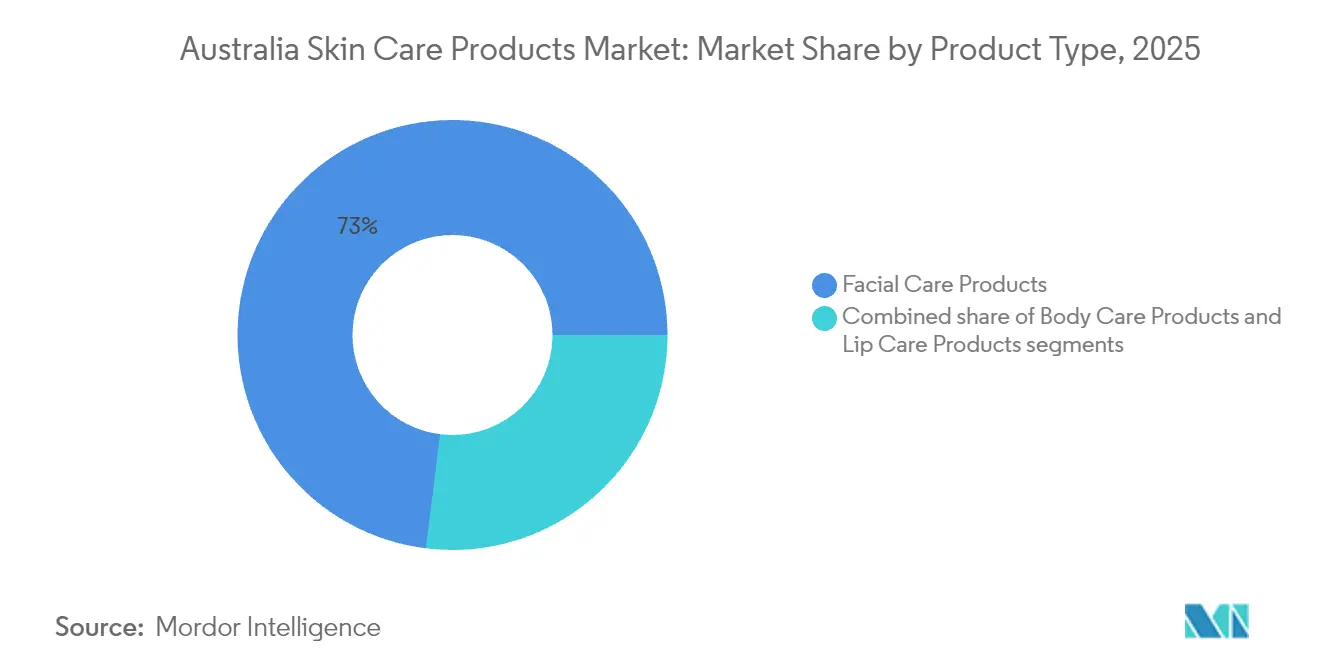
In 2025, facial care remained the largest segment in the Australian skin care products market, contributing 73.02% of the total market share. This highlights the strong consumer focus on face-specific skincare routines, which involve higher spending compared to other body care products. Items like moisturizers, serums, and cleansers are essential parts of daily skincare regimens. The growing awareness of skin health and demand for products with multiple benefits are driving this trend. The preference for dermatologist-tested and clinically proven solutions has further strengthened the dominance of facial care. Brands are innovating by introducing products that combine hydration, sun protection, and corrective properties, catering to consumers who value both convenience and effectiveness within the Australia skin care products market.
The body care segment, while smaller, is expected to grow steadily with a projected CAGR of 5.33% through 2031. This growth is fueled by increasing consumer interest in addressing issues like uneven skin tone, rough texture, and overall skin health. Products such as body lotions enriched with natural ingredients and active compounds are gaining popularity. Consumers are becoming more aware of the importance of sun protection, moisturization, and sensitivity care for the entire body. Retailers are expanding their offerings to include natural and multifunctional body care products, while professional and at-home treatments are complementing traditional routines. This indicates a shift where consumers are investing more in comprehensive skincare focusing on full-body wellness and appearance supporting growth in the Australia skin care products market.



By Category: Mass Holds Scale, Premium Sets Pace
In 2025, mass-priced skin care products made up 65.21% of the Australian market, largely due to their affordability and easy availability in supermarkets, pharmacies, and online stores. These products cater to budget-conscious consumers by offering essential benefits like hydration, sun protection, and basic anti-aging care. Retailers play a significant role in promoting this category through discounts, bundle deals, and prominent shelf placement, ensuring these products remain a staple in daily skincare routines across the Australia skin care products market. The combination of affordability, convenience, and widespread distribution has solidified the dominance of mass-priced skincare in the market.
On the other hand, premium skincare products are expected to grow significantly, with a projected CAGR of 6.55% through 2031. This growth is driven by consumers seeking high-quality, innovative solutions that deliver visible results reshaping the Australia skin care products industry. Premium brands are attracting attention with advanced features like AI-based skin analysis, personalized product recommendations, and luxurious in-store experiences such as skin consultations. These products often include clinically proven formulations and exclusive ingredients, appealing to consumers willing to invest in their skincare. As more people prioritize tailored and effective skincare solutions, the premium segment is set to become a key driver of Australia skin care products market growth in the coming years.
By Nature: Natural Momentum Challenges Synthetic Mainstay
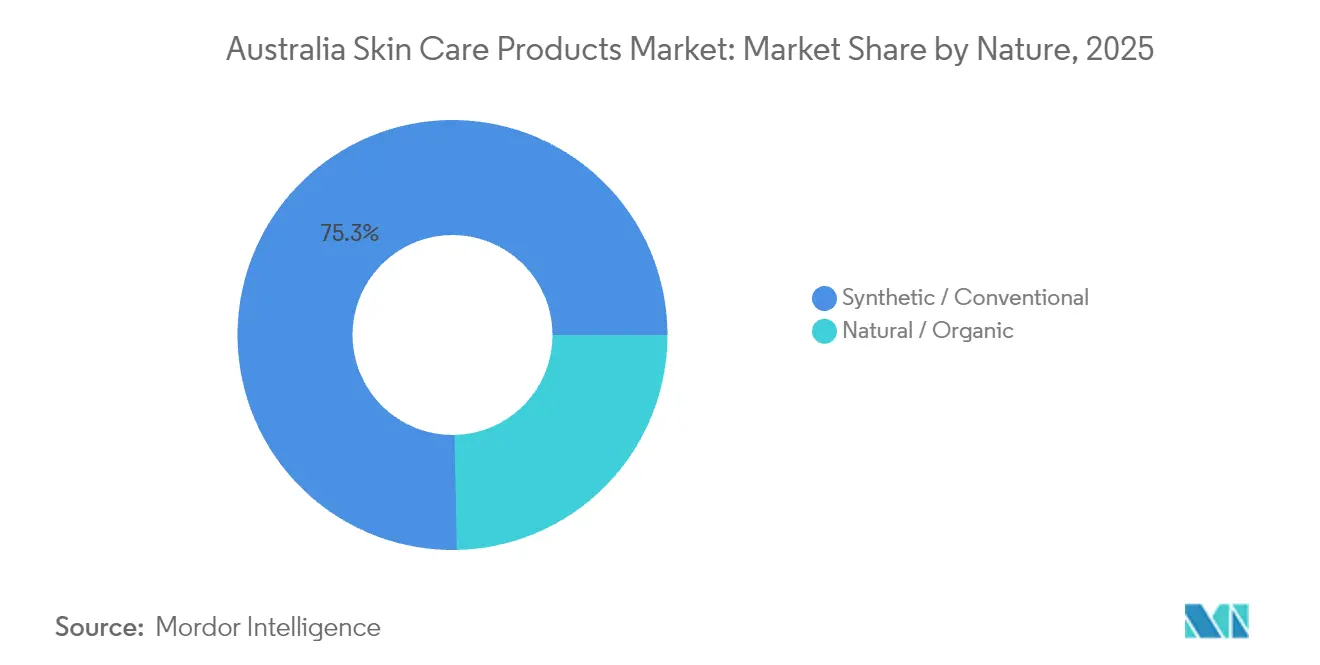
In 2025, synthetic and conventional skin care products held a significant share of the Australian market, accounting for 75.32% of the total. These products remain popular due to their proven effectiveness, affordability, and wide availability across supermarkets, pharmacies, and online platforms. Consumers trust these formulations for their consistent performance in addressing common skincare needs such as moisturization, cleansing, and anti-aging. Their dermatology-backed formulations and cost efficiency make them a preferred choice for everyday use within the Australia skin care products market. Despite the growing interest in natural alternatives, synthetic skincare continues to dominate due to its reliability and accessibility.
On the other hand, natural and organic skin care products are expected to grow at a faster rate, with a projected CAGR of 6.70% through 2031. This growth is driven by increasing consumer demand for eco-friendly and plant-based products that use native Australian ingredients like Kakadu plum, desert lime, and macadamia oil. Many brands are focusing on sustainability by offering eco-certified packaging and transparent ingredient sourcing, which appeals to environmentally conscious buyers. Retailers are also expanding their natural product ranges to cater to this demand. As a result, natural and organic skincare is emerging as a key growth area in the Australian market, aligning with the rising trends of wellness and sustainability in the Australia skin care products market.
By End User: Adult Core with Growing Youth Opportunity
In 2025, adults made up 87.10% of the Australian skin care products market, highlighting their significant contribution to the Australia skin care products industry. This demand is largely driven by the need for anti-aging products, solutions for pigmentation issues, and items that help repair the skin barrier. Many adults are now prioritizing skin health and are drawn to products like serums, moisturizers, and sunscreens that offer multiple benefits and are backed by clinical research. The growing interest in personalized skincare routines, which address both prevention and treatment, has further strengthened the dominance of this segment. Dermatologist-recommended and hybrid products are gaining popularity among adult consumers, reflecting their preference for effective and reliable solutions within the Australia skin care products market.
On the other hand, the children’s skincare segment is expected to grow at a steady rate of 4.98% CAGR through 2031, driven by increasing demand for safe and gentle products. Parents are becoming more conscious of their children’s skin health and are opting for items like sulfate-free cleansers, mineral-based sunscreens, and hypoallergenic moisturizers. These products are specifically designed to cater to sensitive skin and ensure long-term skin health from an early age. Brands are expanding their offerings in this category by focusing on natural ingredients, safety certifications, and dermatologist approvals. This growing attention to children’s skincare presents a promising opportunity for the Australia skin care products market, as more parents seek high-quality products for their kids.
By Distribution Channel: Physical Expertise Meets Online Convenience
In 2025, health and beauty stores made up 38.30% of the Australian skin care products market. These stores attract customers by offering trained staff, personalized consultations, and on-site diagnostics, which help in driving higher-value purchases. Consumers prefer these outlets for expert advice, premium product options, and the ability to test products before buying. The in-store experience, combined with professional recommendations, makes these stores a popular choice, especially for anti-aging products, targeted treatments, and multifunctional skincare solutions. This approach has solidified health and beauty stores as a critical distribution channel in the Australia skin care products market.
On the other hand, online retail is expected to grow at a compound annual growth rate (CAGR) of 6.05% through 2031. This growth is driven by increasing consumer confidence in e-commerce, the availability of authenticity verification seals, and the rise of social-commerce livestreaming. Online platforms allow brands to reach a wider audience while offering features like interactive product demonstrations, customer reviews, and virtual diagnostics that mimic in-store experiences. The convenience of shopping from home, a wide variety of options, and personalized recommendations reflecting digital acceleration in the Australia skin care products industry, are encouraging more consumers, both in urban and regional areas, to shop online across the Australia skin care products market.
Geography Analysis
Australia's high levels of sun exposure make broad-spectrum SPF products an essential part of daily skincare routines. Major urban areas like Sydney, Melbourne, and Brisbane lead in spending on premium skincare and professional clinic treatments, driven by higher incomes and a strong interest in skincare trends. In regions like Western Australia and Queensland, there is significant demand for after-sun repair products and mineral sunscreens due to longer outdoor seasons. Meanwhile, regional towns are improving access to skincare knowledge through e-commerce platforms and dermatologist-led pop-up events, helping to expand the market's reach across the country.
In 2023, Australia imported AUD 1.15 billion worth of beauty products while exporting only AUD 437 million, highlighting its reliance on international supply chains. However, local brands are increasingly looking to expand into Asian markets. Government initiatives, such as Austrade programs that streamline halal certification and logistics partnerships, are helping Australian companies enter regions like the Middle East and Southeast Asia. Diversifying supply chains to countries like Thailand and Vietnam is helping businesses reduce risks related to freight costs and tariff fluctuations.
Regulations play a significant role in shaping the skincare market in Australia. Oversight by AICIS for cosmetic chemicals and TGA for quasi-drug classifications ensures high compliance standards, which boost consumer trust but also increase costs for manufacturers. Seasonal variations in demand create opportunities for innovative products, such as barrier creams for winter and lightweight gel-serums for summer. Skincare formulators must also address Australia's diverse climate, designing products that remain effective and stable across temperature ranges from 5°C to 40°C, catering to the needs of consumers from Darwin to Hobart.
Regulatory Landscape
Australia skin care products operate under a dual-regulator structure that shapes formulation, claims, and go-to-market. Cosmetic ingredients are primarily regulated as industrial chemicals under the Industrial Chemicals Act 2019, administered by the Australian Industrial Chemicals Introduction Scheme (AICIS), while products that cross into therapeutic intent are regulated by the Therapeutic Goods Administration (TGA) and may require inclusion on the Australian Register of Therapeutic Goods (ARTG). The Consumer Goods (Cosmetics) Information Standard 2020 and the Australian Consumer Law are enforced by the Australian Competition and Consumer Commission (ACCC), increasing the focus on compliant ingredient labeling and substantiated marketing claims.
Compliance expectations are also tightening around chemical categorisation and documentation. AICIS requires annual registration for businesses importing or manufacturing industrial chemicals (including cosmetic ingredients), with registration typically due by 31 August, alongside record-keeping for reported introductions. From September 2026, AICIS is implementing updated Industrial Chemicals Categorisation Guidelines (including new entries and corrections to classifications), which elevates the need for accurate ingredient classification and stronger internal regulatory affairs, particularly for premium, active-heavy, and cosmeceutical-positioned skin care lines that sit close to the cosmetic-therapeutic boundary.
Competitive Landscape
The Australian skin care products market is moderately fragmented, with global companies like L’Oréal, Unilever, and Estée Lauder dominating the market by utilizing their extensive research and development capabilities and large advertising budgets. On the other hand, local brands such as Aesop and Rationale focus on promoting their Australian identity and using locally sourced ingredients to differentiate themselves. Instead of competing on price, companies are emphasizing sustainability, omnichannel strategies, and innovative ingredients that can be patented. Recent acquisitions, such as Kao Corporation’s USD 450 million purchase of Bondi Sands, reflect the ongoing consolidation trend in the market.
Technology is playing an increasingly important role in the skin care market. For instance, Estée Lauder is experimenting with AI-powered skin scanners to personalize skincare solutions, while Australian brand Naked Sundays is innovating by incorporating SPF into makeup products. To address growing concerns about greenwashing, many brands are adopting third-party life-cycle audits to ensure transparency and build consumer trust. Subscription models are also gaining traction, enabling companies to gather data on customer purchasing habits and improve product development. The combination of clinically validated products, clean-label trust is shaping the competitive dynamics of the market and influencing consumer preferences across the Australia skin care products industry.
There are several emerging opportunities in the market that remain untapped. These include skincare products specifically designed for menopause, stress-relief formulas using neuro-cosmetic ingredients, and professional-grade at-home laser systems. New entrants with strong, evidence-based claims and effective digital marketing strategies have the potential to quickly establish themselves in these niches. However, they need to act swiftly to capture market share before established players adapt and respond to these trends. By addressing these gaps, companies can cater to evolving consumer needs and drive growth in the market.
Australia Skin Care Products Industry Leaders
-
Unilever PLC
-
Beiersdorf AG
-
L’Oréal SA
-
Estée Lauder Companies Inc.
-
Procter & Gamble Company
- *Disclaimer: Major Players sorted in no particular order

Market Opportunities and Future Outlook
Product and brand whitespace in Australia continues to open where clinical positioning intersects with strict claims governance. The TGA framework for determining whether a product is a cosmetic or a therapeutic good, and ARTG requirements when therapeutic claims apply, creates a premiumization pathway for brands that can support efficacy and advertising compliance across sensitive-skin, barrier-repair, and medically adjacent routines. With facial care already the largest product type in the market (73.02% share in 2025), opportunities are concentrated in high-frequency facial regimens that combine multiple benefits (hydration, anti-aging, SPF, blemish care) while staying within permitted cosmetic claim boundaries.
Digital-first discovery and social-commerce execution are expanding the route-to-market for both mass and premium brands, but they also increase the scrutiny around transparent labeling and defensible claims under ACCC enforcement. A concrete signal of this content and commerce shift is News Corp Australia launching a local version of Glamour in July 2026 as a social-first digital platform, adding another high-reach channel for performance-led skin care education, creator partnerships, and new-product storytelling. For brands, the opportunity is to pair this demand-generation engine with ingredient transparency and traceability practices aligned to AICIS obligations, supporting faster online scaling while managing counterfeit and claim-risk exposure.
Recent Industry Developments
- July 2026: Prestige Consumer Healthcare Inc. completed the acquisition of Australia-based LaCorium Health for about USD 150 million, adding therapeutic skin care brands such as Dermal Therapy and Flexitol. With most sales generated in Australia, the deal strengthens a consumer-health-led route to scale in pharmacy and medically adjacent skin care segments.
- June 2026: Avenir Collective (formerly Olsam Group) acquired Australian silicone skincare patch brand Wrinkles Schminkles. The transaction adds a fast-turn, results-oriented niche category to an international distribution footprint, reinforcing M&A interest in specialized Australian skin care brands with export-ready positioning.
- April 2026: Unilever launched a Vaseline Body Oil range in Australia and supported it with The Afterglow, a short-form vertical micro-reality series distributed on Instagram, TikTok, and YouTube Shorts. The move underscores the shift toward entertainment-led social marketing to drive awareness and conversion for body care innovation as online retail expands in the market.


Research Methodology Framework and Report Scope
Market Definition and Coverage
For this report, the Australia skincare products market is defined as the value of products sold for facial and body skin care that are used to maintain skin condition, improve appearance, and address common concerns like dryness, acne, and early aging.
Scope exclusions: Color cosmetics, fragrances, hair care, and professional in-clinic skin treatments are excluded from this sizing.
Segmentation Overview
-
By Product Type
-
Facial Care Products
- Cleansers
- Moisturizers and creams
- Serums and Essence
- Toners
- Face Masks
- Other Facial Care Products
-
Body Care Products
- Body Lotion
- Foot and Hand Cream
- Other Body Care Products
- Lip Care Products
-
Facial Care Products
-
By Category
- Mass
- Premium
-
By Nature
- Natural/Organic
- Synthetic/Conventional
-
By End User
- Kids
- Adults
-
By Distribution Channel
- Supermarkets/Hypermarkets
- Health and Beauty Stores
- Online Retail Channels
- Other Channels
Data Sources, Market Sizing, and Validation
Desk Research
Desk research was used to frame the demand context in Australia and to set guardrails for the model before assumptions were finalized. We reviewed public sources such as the Australian Bureau of Statistics for household spend signals, the Australian Trade and Investment Commission for category and trade context, and customs and trade statistics where import reliance can influence pricing.
To avoid building the model on a single lens, the desk inputs were cross-checked with sources such as AICIS and TGA guidance for regulatory cues. We also reviewed peer-reviewed dermatology and consumer behavior literature for usage patterns, plus company annual reports, investor decks, and reputable press for channel shifts and portfolio mix. Paid subscriptions were used selectively for company financials and news screening, and patent databases when ingredient and claims activity needed a reality check. These examples are not exhaustive, and many other public and proprietary sources were also referred to for data collection, validation, and research clarification.
Primary Interviews and Surveys
Primary work was done to pressure-test category boundaries and the real split between premium and mass positioning, especially where product bundles and multi-step routines can blur revenue attribution. We spoke with a mix of brand-side leaders, distributors, retail channel specialists, and dermatology-adjacent experts across Australia, so desk assumptions on pricing, online penetration, and promo intensity could be corrected when needed.
Distribution of primary research fieldwork respondents
| Company type | Respondent position |
|---|---|
| Top tier: 31% | CXOs: 13% |
| Mid tier: 52% | Functional/Unit leaders: 29% |
| Smaller Players: 17% | Managers: 58% |
Market-Sizing & Forecasting
The market was sized using a top-down build where national spend and retail sales signals were translated into skincare value pools, then split by product usage and channel structure for Australia. To keep the totals realistic, we corroborated results with selective bottom-up approximations like sampled price per unit across key formats, channel checks on online versus store mix, and roll-ups from a practical set of suppliers and retailers.
Inputs that mattered most included pricing and promotion intensity by channel, premium versus mass mix shifts, sunscreen and moisturization demand patterns (seasonality and UV awareness), the pace of e-commerce adoption, and the rate of new product launches tied to natural and organic claims. When a bottom-up cross-check had gaps, the missing pieces were filled using conservative ranges taken from interviews, then re-tested so the totals stayed consistent with the demand pool.
For forecasting, scenario analysis was used so growth could be flexed based on a few clear levers, mainly price progression, premiumization speed, online share gains, and category-specific momentum in facial care versus body care. The final growth path was aligned to what primary respondents considered achievable under a base case, and then adjusted when a variable moved out of line with recent market behavior.
Data Validation & Update Cycle
Validation was done through a set of cross-checks, followed by a review pass that looks for unrealistic jumps in pricing, mix, or channel shares. Outputs were compared against independent signals such as reported retail performance commentary, trade movements that can affect supply and cost, and consumer demand indicators that show whether usage is expanding or only trading up.
If large variances showed up versus a credible external signal, assumptions were re-opened and relevant experts re-contacted to confirm what changed and why. Reports are refreshed annually, with interim updates when a material event shifts category growth, regulation, or channel behavior, and a final pre-delivery check is completed so clients receive the latest updated view.
Mordor Intelligence's Australia Skincare Product Market Estimate Compared With Other Published Estimates
Published estimates for Australia skincare can differ even when they sound like they cover the same topic, because the market boundary is not always set the same way. Differences in whether the scope is retail-only, whether adjacent personal care items are included, and which year is treated as the base can all move the number.
By tracking retail channel mix, refreshing price-per-unit assumptions by category, and then validating the total with demand signals, Mordor Intelligence keeps the Australia skincare product value tied to what is actually sold in the country during the stated base year. The wider gaps usually come from broader category bundling (for example, adding hand care, broader personal care, or professional services), or from using older base years and applying a single growth rate without re-checking premiumization and online share shifts.
Benchmark comparison
| Source | Market Size | Gaps in Research Methodology |
|---|---|---|
| Mordor Intelligence | USD 3.90 B (2025) | |
| Industry Publisher A | USD 3.00 B (2025) | Uses a broader skincare definition that mixes ingredient and gender views, and can undercount premium price realization if average prices are not re-based by channel and product format each year. |
| Industry Publisher B | USD 1.65 B (2024) | Uses a different base year and a narrower valuation approach, which can exclude parts of facial and body care sold through specialist and online channels, and may apply slower price progression assumptions. |
Across the three views, the spread is mainly explained by where the category line is drawn and how pricing and channel mix are updated over time. Keeping the scope anchored to skincare products sold in Australia, and then re-checking pricing, premium mix, and online share with real-world inputs, helps produce a number that is easier to trace and repeat.


Key Questions Answered in the Report
How large is the Australia skincare products market in 2026?
The Australia skincare products market size records USD 4.09 billion in 2026 with a 4.88% CAGR outlook toward 2031.
Which product type holds the greatest share?
Facial care captures 73.02% of category revenue, thanks to sustained investment in advanced serums and at-home devices.
What drives premium-segment acceleration?
Premium growth stems from clinical-backed actives, AI-powered skin diagnostics, and experiential retail that justifies higher price points.
How fast is natural and organic skincare growing?
Natural and organic ranges show a 6.70% CAGR through 2031 as shoppers prioritise ingredient transparency and eco-packaging.
Page last updated on:





