
Vietnam UEM Market Size and Share
Market Overview
| Study Period | 2020 - 2031 |
|---|---|
| Forecast Data Period | 2026 - 2031 |
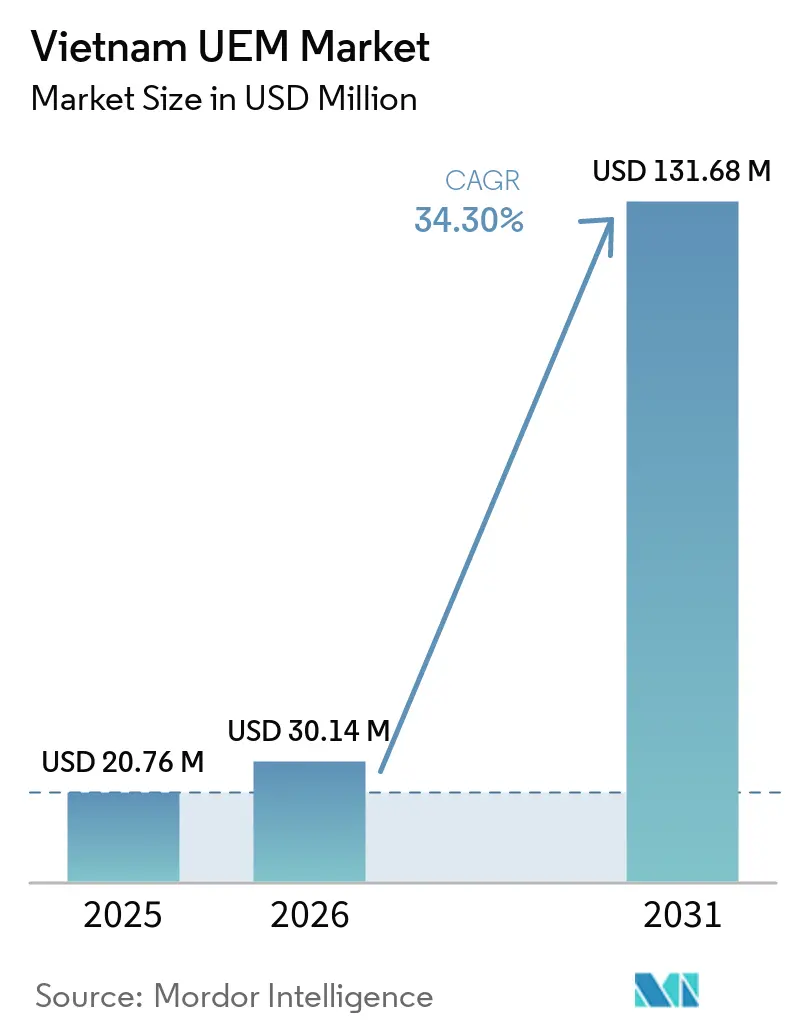
| Base Year Market Size (2025) | USD 20.76 Million |
| Market Size (2026) | USD 30.14 Million |
| Market Size (2031) | USD 131.68 Million |
| Growth Rate (2026 - 2031) | 34.30 % |
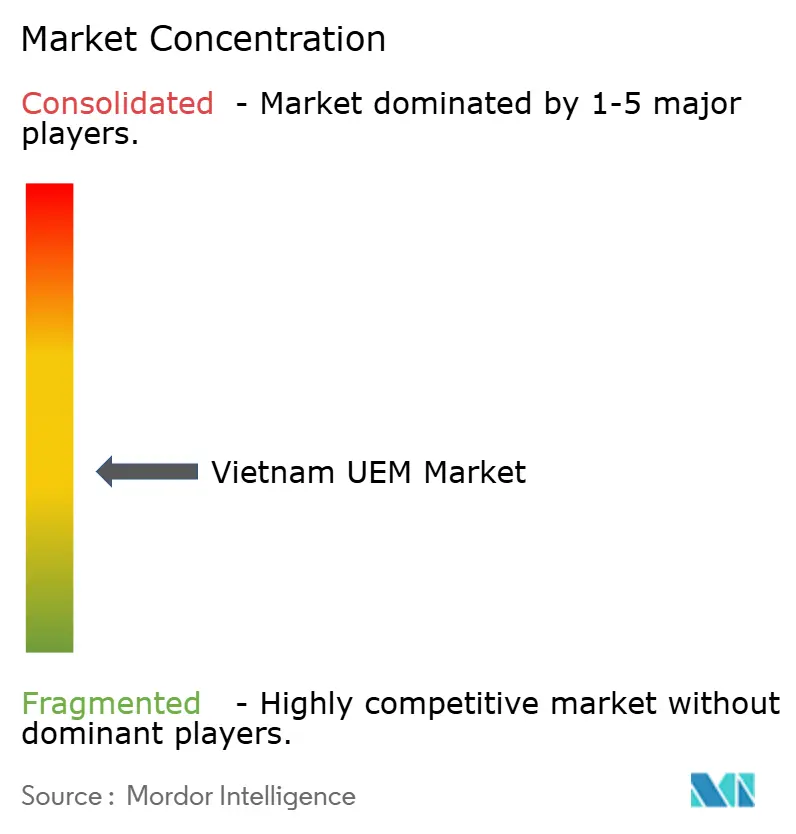
| Market Concentration | Medium |
Major Players *Disclaimer: Major Players sorted in no particular order Image © Mordor Intelligence. Reuse requires attribution under CC BY 4.0. | |
Vietnam UEM Market Analysis by Mordor Intelligence
The Vietnam UEM market size was valued at USD 20.76 million in 2025 and estimated to grow from USD 30.14 million in 2026 to reach USD 131.68 million by 2031, at a CAGR of 34.30% during the forecast period 2026-2031. The Vietnam UEM market is gaining support from tighter cybersecurity obligations, which are pushing endpoint control from an optional IT function into a required operating layer for regulated organizations. Expansion in digital services, mobile work, and device-heavy field operations is also widening the need for unified control across smartphones, tablets, laptops, desktops, and specialized enterprise devices. Data-localization expectations are shaping buying decisions as well, keeping hybrid and on-premises approaches relevant even as cloud-based management grows faster. Vendor competition is increasingly focused on automation, AI-led remediation, zero-touch provisioning, and broader platform integration, favoring providers that can simplify administration for lean IT teams. At the same time, legacy Windows application environments and budget constraints in smaller firms continue to slow adoption, leaving the strongest near-term opportunities in government, healthcare, BFSI, telecom, and other organizations under clear compliance pressure.
Key Report Takeaways
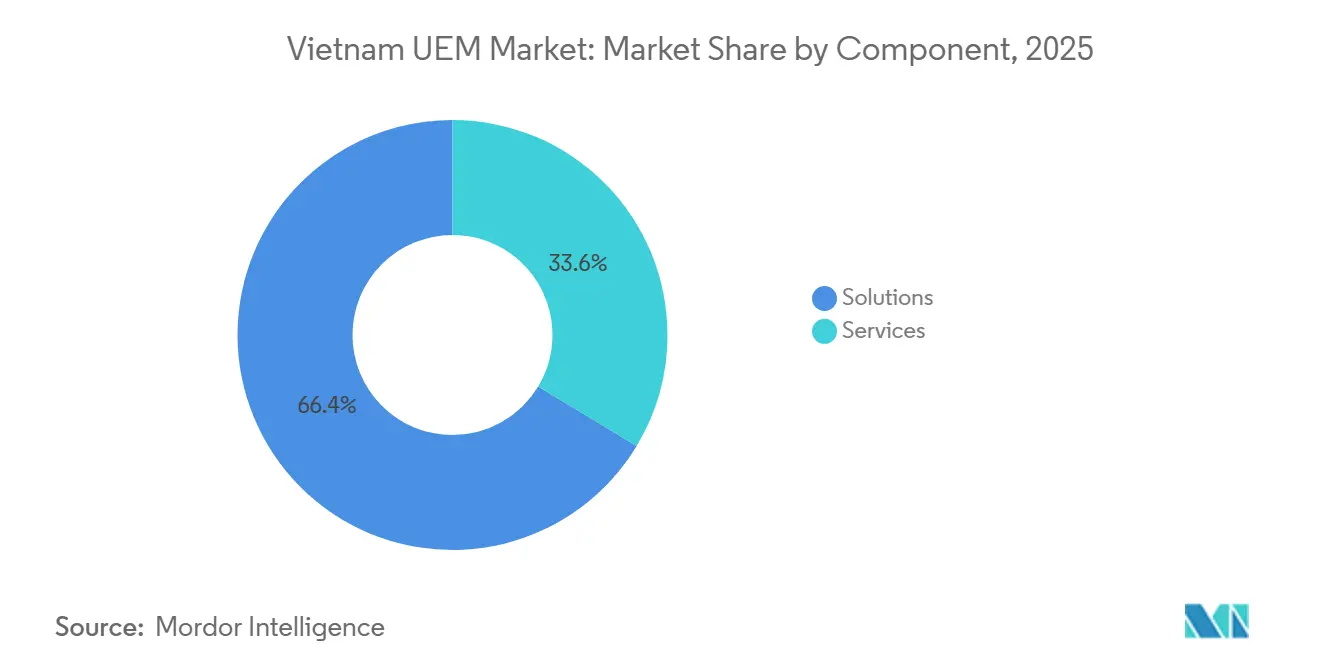
- By component, solutions held 66.37% of the Vietnam UEM market share in 2025, and the same segment is projected to expand at a 35.92% CAGR through 2031.
- By deployment mode, cloud-based deployment accounted for 64.35% of revenue in 2025 and is projected to expand at a 35.49% CAGR through 2031.
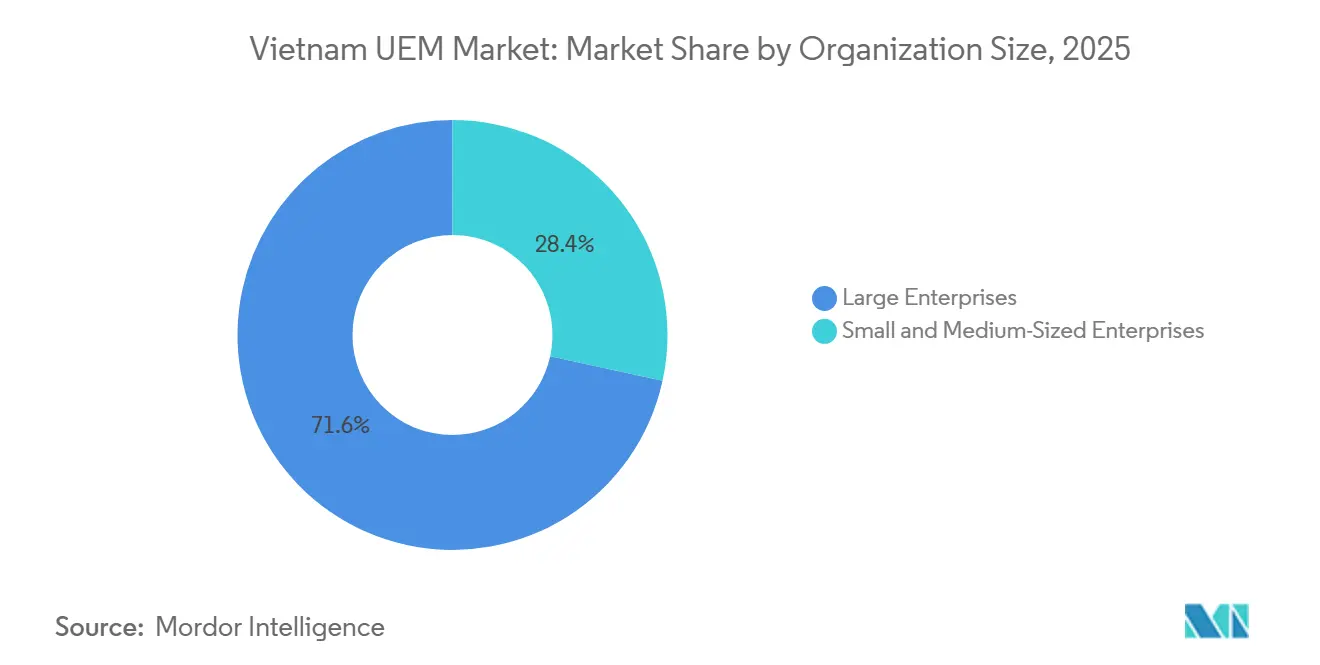
- By organization size, large enterprises held 71.58% of the revenue share in 2025, while Small and Medium-Sized Enterprises are projected to grow at a CAGR of 35.61% through 2031.
- By end-user industry, IT and telecommunications accounted for 20.16% revenue share in 2025, while healthcare is projected to expand at a 35.74% CAGR through 2031.
Note: Market size and forecast figures in this report are generated using Mordor Intelligence’s proprietary estimation framework, updated with the latest available data and insights as of January 2026.
Vietnam UEM Market Trends and Insights
Drivers Impact Analysis*
| Driver | (~) % Impact on CAGR Forecast | Geographic Relevance | Impact Timeline |
|---|---|---|---|
| Rising Enterprise Mobility In Vietnam | +6.8% | National, with early intensity in Ho Chi Minh City and Hanoi | Medium term (2-4 years) |
| Rapid BYOD and COPE Adoption Across Knowledge Workforces | +6.5% | National | Short term (≤ 2 years) |
| Accelerating Cybersecurity and Data Protection Requirements | +6.2% | National, with compliance pressure most acute in Hanoi and Ho Chi Minh City | Short term (≤ 2 years) |
| Expansion of Public Sector Digitization and Endpoint Standardization | +4.8% | National, with infrastructure mandates covering all provinces and municipalities | Medium term (2-4 years) |
| Android Enterprise and Kiosk Device Growth in Retail and Logistics | +3.2% | Ho Chi Minh City and surrounding provinces, Mekong Delta logistics corridors | Medium term (2-4 years) |
| Fragmented Device Estates Increasing Need for Unified Policy Control | +2.5% | National, with concentration in major enterprise clusters | Long term (≥ 4 years) |
| Source: Mordor Intelligence | |||
Rising Enterprise Mobility in Vietnam
Enterprise mobility is expanding the addressable market for the Vietnam UEM market, as more organizations now manage devices beyond traditional office laptops. Mobile endpoints are becoming part of daily operations across sales, service, logistics, healthcare, and public administration, underscoring the need for a single policy layer across multiple operating systems and usage models. This shift matters because device growth is outpacing internal policy standardization in many organizations, so governance gaps can widen even when digital adoption appears positive. The need is not limited to employee smartphones, as tablets, rugged handhelds, shared devices, and field terminals also require provisioning, access control, patching, and remote support. Vendors that can automate enrollment, compliance checks, and remediation are better placed to capture this demand, especially where IT teams cannot scale headcount at the same pace as device fleets. Recent platform updates from leading vendors show that the category is moving toward lower-touch management rather than manual administration, which supports broader deployment across the Vietnam UEM market.
Rapid BYOD and COPE Adoption Across Knowledge Workforces
The Vietnam UEM market is also benefiting from the spread of BYOD and COPE models across knowledge workforces, as these arrangements reduce hardware costs but increase control requirements. Once personal or mixed-use devices connect to enterprise apps, data separation, access policy, app distribution, and device posture become harder to manage without a unified control plane. This creates a practical opening for UEM platforms, as point tools can protect parts of the endpoint environment but often do not cover the full workflow of enrollment, policy management, compliance, and support. The demand pattern is especially relevant in sectors that handle regulated or sensitive data, where organizations need a workable balance between employee flexibility and employer control. Shared- and mixed-device environments also require tighter automation, as manual policy assignment becomes more difficult as users, apps, and device roles change. Vendor releases in 2026 reflected this shift through stronger compliance automation and simpler management of Android and Apple fleets, which supports more organic adoption across the Vietnam UEM market.
Accelerating Cybersecurity and Data Protection Requirements
Stronger cybersecurity and data protection requirements are turning endpoint governance into a more direct budget priority in the Vietnam UEM market. The core effect is that organizations increasingly need centralized visibility into devices, users, applications, and policy status to enforce controls and respond faster to incidents. This is especially relevant when sensitive workloads move across mobile endpoints, laptops, and shared devices, as weak endpoint controls can undermine broader security investments. As a result, compliance and security are becoming harder to separate from device management, which increases the strategic weight of UEM platforms in procurement decisions. Sovereign cloud and jurisdiction-aware deployment models are also gaining relevance as buyers seek greater control over where telemetry, policy data, and operational records are processed. Ivanti’s June 2026 sovereign cloud launch shows how vendors are adapting their products to stricter compliance settings, a direction that aligns well with the evolving needs of the Vietnam UEM market.
Expansion of Public Sector Digitization and Endpoint Standardization
Public sector digitization is expanding the long-term base of the Vietnam UEM market by adding more connected endpoints across ministries, local agencies, and public services. When large administrative programs move to digital delivery, the device estate usually becomes more dispersed, more standardized, and more dependent on central policy enforcement. Vietnam’s push to expand VNeID and digital public services adds to that need because identity workflows, service access, and administrative operations depend on reliable endpoint control across many locations.[1] By January 2026, the VNeID platform had already deployed more than 34 million electronic health records, demonstrating the scale of the state-led digital rollout already underway. The same pattern is visible in healthcare, where electronic medical record implementation is widening the number of managed clinical and administrative devices that require software distribution, security enforcement, and centralized oversight. That combination makes public-sector programs one of the steadier demand anchors for the Vietnam UEM market over the forecast period.
Restraints Impact Analysis*
| Restraint | (~) % Impact on CAGR Forecast | Geographic Relevance | Impact Timeline |
|---|---|---|---|
| Budget Sensitivity Among Small and Medium Enterprises | -5.5% | National, most acute in secondary cities and rural provinces | Long term (≥ 4 years) |
| Complex Integration with Legacy Windows and Industry-Specific Applications | -4.0% | National, concentrated in manufacturing hubs and government agencies | Medium term (2-4 years) |
| Cloud Sovereignty Concerns for Sensitive Government and BFSI Workloads | -2.8% | Hanoi and Ho Chi Minh City | Medium term (2-4 years) |
| Limited Endpoint Security and UEM Administration Skills in Mid-Market Firms | -2.2% | National | Long term (≥ 4 years) |
| Source: Mordor Intelligence | |||
Budget Sensitivity Among Small and Medium Enterprises
Budget sensitivity remains one of the clearest limits on near-term expansion in the Vietnam UEM market because most smaller firms still approach endpoint management through cost control first and governance second. The challenge is structural, since annual software spending of VND 50 million (USD 1,970) to VND 200 million (USD 7,880) can be difficult for firms with modest revenue bases and limited IT staff. This matters because compliance pressure may exist, but purchasing power and implementation capacity do not always move at the same speed. Smaller organizations often respond by choosing basic endpoint protection or delaying broader management tools, which slows revenue conversion even when the need for unified control is real. BYOD can also deepen this gap by reducing hardware costs while leaving policy and data risks unresolved until a company adopts stronger management tools. As a result, the SME opportunity in the Vietnam UEM market is large and fast growing, but it is still likely to build from a low base rather than deliver immediate scale.
Complex Integration with Legacy Windows and Industry-Specific Applications
Integration complexity is another important restraint on the Vietnam UEM market, as many enterprises still run older Windows-based environments and specialized line-of-business applications. These environments can make enrollment, policy rollout, application packaging, and device coexistence more difficult than in greenfield cloud-first settings. The result is longer deployment cycles, more testing, and a greater need for local implementation support, which can weaken the business case for mid-sized buyers. This issue is especially relevant in manufacturing, BFSI, and government, where operations often depend on systems that cannot be changed quickly without service risk. Vendor product development has addressed this problem, as shown by Ivanti’s Q3 2025 release, which added automation for Windows 11 migration and broader endpoint management enhancements. Even so, the Vietnam UEM market is likely to reward vendors that can support gradual co-management and low-disruption rollout rather than pushing customers into a full platform replacement.
*Our forecasts treat driver/restraint impacts as directional, not additive. The impact forecasts reflect baseline growth, mix effects, and variable interactions.
Segment Analysis
By Component: Solutions Anchor Vietnam UEM Market Revenue
Solutions held a 66.37% share of the Vietnam UEM market in 2025, indicating that buyers still place greater value on the software control layer than on standalone external support. That preference reflects demand for one platform that can manage devices, applications, content, security, compliance, analytics, and automation in a coordinated way. Within this mix, device management and security functions remain central because organizations need to control enrollment, access, patching, and policy enforcement across a widening endpoint base. The category is also moving beyond basic control into automation, as shown by Ivanti’s Q2 2026 Neurons update that added AI-driven workflow features and autonomous endpoint management capabilities.
Services still matter in the Vietnam UEM market, even though they trail solutions in revenue share, because many deployments require implementation support, administrator training, and managed support after rollout. This is particularly true when organizations have limited internal endpoint expertise or when they must connect a new UEM layer to older application environments. The Vietnam UEM industry is therefore seeing a practical overlap between platform sales and service-led adoption, with local partners often acting as the bridge between product capability and day-to-day execution. The shift toward analytics, automation, and AI-led remediation may raise the value of managed services further, since some buyers will prefer outcomes and ongoing support over full in-house administration. That dynamic helps explain why solutions dominate current revenue while services remain important to expansion across the broader Vietnam UEM market.
By Deployment Mode: Cloud Leads as Sovereignty Shapes On-Premises Strategy
Cloud-based deployment accounted for 64.35% of revenue in 2025, putting it at the center of Vietnam's UEM market share in the current adoption mix. Cloud platforms appeal because they support faster implementation, continuous feature delivery, lower upfront infrastructure needs, and easier support for distributed devices. Samsung’s June 2026 Knox Cloud Services release, which added more direct fleet enrollment and management functions, illustrates how cloud-based administration is getting easier to scale in high-volume Android environments.[2] Those features are valuable in the Vietnam UEM market when organizations manage mobile endpoints, remote teams, and shared devices across multiple sites.
On-premises deployment still holds strategic relevance in the Vietnam UEM market, as government and BFSI buyers may be more sensitive to workloads and data handling. That is why hybrid environments are emerging as a practical middle path, allowing less sensitive endpoints to stay under cloud administration while regulated workloads remain under tighter local control. The strongest vendors are likely to be those that present one administrative view across both settings rather than forcing customers into a binary choice. Ivanti’s sovereign cloud launch in June 2026 provides a useful product example of how the category is adapting to jurisdiction and compliance concerns without abandoning the core benefits of centralized endpoint management. This balance between flexibility and control should keep cloud in the lead while preserving a durable place for hybrid and on-premise models in the Vietnam UEM market.
By Organization Size: Large Enterprises Anchor Demand, SMEs Accelerate
Large enterprises commanded a 71.58% revenue share in 2025, making them the primary base of Vietnam UEM market size in the current period. Their lead reflects larger device estates, more formal IT procurement processes, and a greater need for centralized control across business units, offices, and field operations. Many large organizations also have stronger internal capacity to handle rollout, policy design, and integration, which reduces deployment friction compared with smaller firms. In the Vietnam UEM market, multinational subsidiaries are especially important because group-level governance standards often push endpoint management decisions from headquarters into local operations.
Small and Medium-Sized Enterprises are projected to grow at a CAGR of 35.61% through 2031, making them the fastest-expanding segment by organization size in the Vietnam UEM market. Lower-entry cloud subscriptions and broader endpoint use are opening the category to smaller buyers, but budget discipline still shapes how quickly spending converts into revenue. At the same time, SME use of personal and mixed-use devices creates governance needs that basic security tools do not fully solve, so demand can build even before budgets fully catch up. This leaves the Vietnam UEM market with a clear pattern where large enterprises anchor present revenue and SMEs contribute more to forward growth.
By End-User Industry: Healthcare Outpaces as IT And Telecom Anchor Demand
IT and telecommunications maintained a 20.16% revenue share in 2025, giving the segment the leading position in Vietnam UEM market share among end-user industries. The segment’s scale reflects high device density, diverse operating environments, and ongoing operational pressure to maintain secure access across offices, networks, customer support channels, and field teams. Telecom and digital service operators often manage a blend of employee laptops, service tablets, field engineer devices, and shared terminals, which makes centralized policy control especially valuable. This mix supports steady demand in the Vietnam UEM market because endpoint reliability and security directly affect service continuity.
Healthcare is projected to expand at a 35.74% CAGR through 2031, making it the fastest-growing vertical in the Vietnam UEM market. The Ministry of Health has set a nationwide electronic medical record rollout path through 2030, which is widening the number of clinical, administrative, and shared devices that must be centrally managed. Early progress was already visible in 2026, when 1,210 of 1,650 public and private hospitals had begun deploying electronic medical records. Government and defense, BFSI, and retail also remain meaningful demand pools, but healthcare stands out because digitization is expanding both the number of devices and the need for controlled application and data access. This combination is helping healthcare gain speed within the Vietnam UEM market while IT and telecom continue to supply the largest installed revenue base.
Geography Analysis
Ho Chi Minh City and Hanoi remain the main centers of demand in the Vietnam UEM market because they combine large enterprises, financial institutions, public agencies, and high-value digital operations. Ho Chi Minh City is the stronger private-sector node, where enterprise IT, finance, logistics, and commercial mobility programs create broad demand for endpoint control across offices and field teams. Hanoi plays a different role in the Vietnam UEM market because central government programs, administrative digitization, and public service delivery create a large need for standardized management of public endpoints. The push to expand VNeID and digital public services by 2026 reinforces that pattern, while the platform had already supported more than 34 million electronic health records by January 2026.
Secondary cities represent the next layer of opportunity for the Vietnam UEM market, but their demand profiles are more specialized. Da Nang is building a stronger base in digital services and knowledge work, which supports steady uptake of device administration tools as enterprise operations spread beyond the two main hubs. Hai Phong has a different mix, where logistics and port-linked operations create practical demand for rugged Android devices, barcode scanners, kiosks, and shared terminals. Can Tho is more relevant through public administration digitization and regional service delivery, where central programs can extend endpoint standardization into local agencies over time. Enforcement and procurement intensity still tend to concentrate first where large enterprises and ministries are most active, so the Vietnam UEM market is likely to remain weighted toward Ho Chi Minh City and Hanoi through much of the forecast period.
Vietnam also stands out in Southeast Asia because the endpoint mix is unusually varied across office, operational, and field settings. In manufacturing and logistics, organizations often need to govern Windows-based administrative devices and Android-based operational devices within the same policy framework, which increases technical demands on vendors. Samsung’s 2026 Knox updates and Ivanti’s autonomous management push both point to the importance of streamlined control in large mixed-device estates.[3] This multi-OS complexity favors providers that can unify support, provisioning, analytics, and remediation across the full device estate, which should remain a defining feature of the Vietnam UEM market.
Competitive Landscape
The Vietnam UEM market is still nascent and moderately fragmented, with global platforms competing largely through channel partners, system integrators, and managed service providers rather than only through direct enterprise sales. Competition is moving toward greater platform depth, where vendors need to combine UEM, automation, analytics, compliance workflows, and low-touch administration into a single offering. Ivanti has leaned into this direction through its Q2 2026 Neurons update, which introduced AI-driven innovations and autonomous endpoint management features designed to reduce manual effort at scale. Samsung remains strategically important in the Vietnam UEM market because Knox acts as a device-level control foundation for large Android fleets, and its June 2026 cloud services update improved direct enrollment into Knox E-FOTA and Knox Asset Intelligence from a common device list.
SOTI also remains relevant in the Vietnam UEM market, especially where organizations need practical management of Android and Apple fleets with less manual effort. It's 2026, MobiControl 1.0 release added automation for compliance enforcement, migration tools, and security enhancements, meeting the needs of buyers who want simpler administration across mixed device estates. Common strategy pattern across leading vendors is the effort to reduce the burden on understaffed IT teams through automation, policy consistency, and faster enrollment. Another common pattern is support for complex deployment models, since buyers increasingly value products that can handle cloud, hybrid, and sovereignty-sensitive environments without breaking the operating model.
The competitive opening in the Vietnam UEM market is strongest where customers need cross-platform management with local execution support rather than just a global product name. Vendors that can pair strong product capabilities with local deployment partners are better placed to win in regulated verticals and mixed-device environments. Strategic moves since 2025 support that view, including Ivanti’s sovereign cloud launch, Samsung’s fleet enrollment enhancements, and SOTI’s compliance automation updates, all of which target easier control at scale.[4] In that sense, the Vietnam UEM market is less a race for a single dominant vendor today and more a contest over who can best convert complex endpoint estates into manageable, compliant, and lower-touch operations.
Vietnam UEM Industry Leaders
-
Microsoft Corporation
-
Ivanti, Inc.
-
Samsung Electronics Co., Ltd.
-
SOTI Inc.
-
IBM Corporation
- *Disclaimer: Major Players sorted in no particular order
Recent Industry Developments
- June 2026: Ivanti launched Ivanti Neurons for MDM - Sovereign Edition - EU, a cloud-based autonomous endpoint management solution managing iOS, Android, macOS, Windows, ChromeOS, and industrial devices through a unified console. The product runs through sector27, a European IT services firm operating from BSI-certified data centers, establishing an operational boundary between Ivanti as the software vendor and the cloud operator.
- June 2026: Samsung released Knox Cloud Services 26.06, enabling direct enrollment of in-use devices into Knox E-FOTA and Knox Asset Intelligence from the common device management list and adding Google Workspace resource sync for Knox Manage.
- May 2026: Ivanti Neurons for Autonomous Endpoint Management received the 2026 Product of the Year Award from Cloud Computing Magazine, recognizing its AI-powered approach to replacing manual endpoint remediation with continuous automated monitoring, detection, and remediation at enterprise scale.
- February 2026: Microsoft integrated Endpoint Privilege Management support into Azure Virtual Desktop within the Microsoft Intune admin center. This enhancement enables elevation policies for single-session virtual machines, tightening least-privilege security controls across distributed cloud architectures.
Vietnam UEM Market Report Scope
The Vietnam UEM market report provides a comprehensive analysis of the market dynamics, trends, and growth opportunities within the country. The scope of the report includes an in-depth examination of UEM solutions that integrate and manage various endpoint devices, including smartphones, tablets, laptops, and desktops. It evaluates the adoption of UEM technologies across industries, the impact of digital transformation, and the role of government initiatives in driving market growth.
The Vietnam UEM Market Report is Segmented by Component [Solutions (Device Management, Application Management, Content Management, Security and Compliance Management, and Analytics and Automation), and Services], Deployment Mode (Cloud-Based, On-Premise, and Hybrid), Organization Size (Large Enterprises, and Small and Medium Enterprises), and End-User Industry (IT and Telecommunications, BFSI, Government and Defense, Healthcare and Life Sciences, Manufacturing, Retail and E-Commerce, Education, Transportation and Logistics, Energy and Utilities, and Other End-User Industries). The Market Forecasts are Provided in Terms of Value (USD).
| Solutions | Device Management |
| Application Management | |
| Content Management | |
| Security and Compliance Management | |
| Analytics and Automation | |
| Services |
| Cloud-Based |
| On-Premise |
| Hybrid |
| Large Enterprises |
| Small and Medium Enterprises |
| IT and Telecommunications |
| BFSI |
| Government and Defense |
| Healthcare and Life Sciences |
| Manufacturing |
| Retail and E-Commerce |
| Education |
| Transportation and Logistics |
| Energy and Utilities |
| Other End-User Industries |
| By Component | Solutions | Device Management |
| Application Management | ||
| Content Management | ||
| Security and Compliance Management | ||
| Analytics and Automation | ||
| Services | ||
| By Deployment Mode | Cloud-Based | |
| On-Premise | ||
| Hybrid | ||
| By Organization Size | Large Enterprises | |
| Small and Medium Enterprises | ||
| By End-User Industry | IT and Telecommunications | |
| BFSI | ||
| Government and Defense | ||
| Healthcare and Life Sciences | ||
| Manufacturing | ||
| Retail and E-Commerce | ||
| Education | ||
| Transportation and Logistics | ||
| Energy and Utilities | ||
| Other End-User Industries |
Key Questions Answered in the Report
What is the Vietnam UEM market size in 2026 and how large will it be by 2031?
The Vietnam UEM market size stands at USD 30.14 million in 2026 and is forecast to reach USD 131.68 million by 2031, growing at a CAGR of 34.30%.
Which deployment model leads adoption in Vietnam UEM?
Cloud-based deployment led with 64.35% revenue share in 2025 and is also the faster-expanding model, with a projected 35.49% CAGR through 2031.
Why are large enterprises still the main buyers of unified endpoint management in Vietnam?
Large enterprises held 71.58% of revenue in 2025 because they manage broader device fleets, have stronger IT procurement capacity, and face heavier governance demands.
Which end-user vertical is growing the fastest in Vietnam UEM?
Healthcare is the fastest-growing vertical, with a projected 35.74% CAGR through 2031, supported by the nationwide rollout of electronic medical records.
What is driving demand for unified endpoint management tools in Vietnam?
The main demand factors are stronger cybersecurity obligations, wider use of mobile and mixed-device fleets, public-sector digitization, and the need to manage cloud and hybrid endpoints through one control layer.