
Market Overview
| Study Period | 2021 - 2031 |
|---|---|
| Forecast Data Period | 2026 - 2031 |
| Historical Data Period | 2021 - 2024 |
| Growth Rate | 15.24 % |
| Market Concentration | Low |
Major Players *Disclaimer: Major Players sorted in no particular order Image © Mordor Intelligence. Reuse requires attribution under CC BY 4.0. | |
Asia-Pacific Lithium-ion Battery Market Analysis by Mordor Intelligence
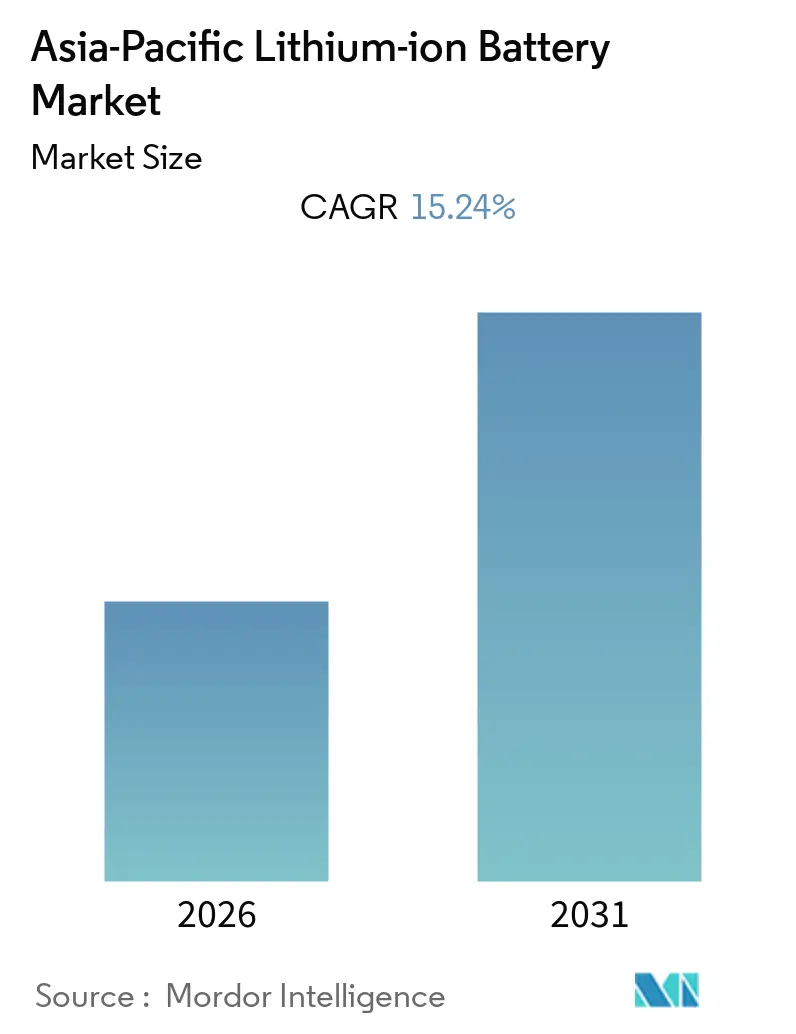
The Asia-Pacific Lithium-ion Battery Market size is expected to register a CAGR of greater than 15.24% during the forecast period.
The automotive sector is expected to be one of the major end-user segments for lithium-ion batteries in the near future. The penetration of electric vehicles is anticipated to provide a massive impetus for the lithium-ion battery industry growth.
A significant fraction of Asia-Pacific's population is estimated to be living without access to electricity and is dependent on conventional fuels, such as kerosene and diesel, for their lighting and mobile phone charging needs. Lithium-ion battery integrated energy storage solutions are likely to witness an increasing rate of adoption due to the technical benefits associated with them and declining lithium-ion battery prices. This, in turn, is expected to create a significant number of opportunities for the Li-ion battery manufacturers in the near future.
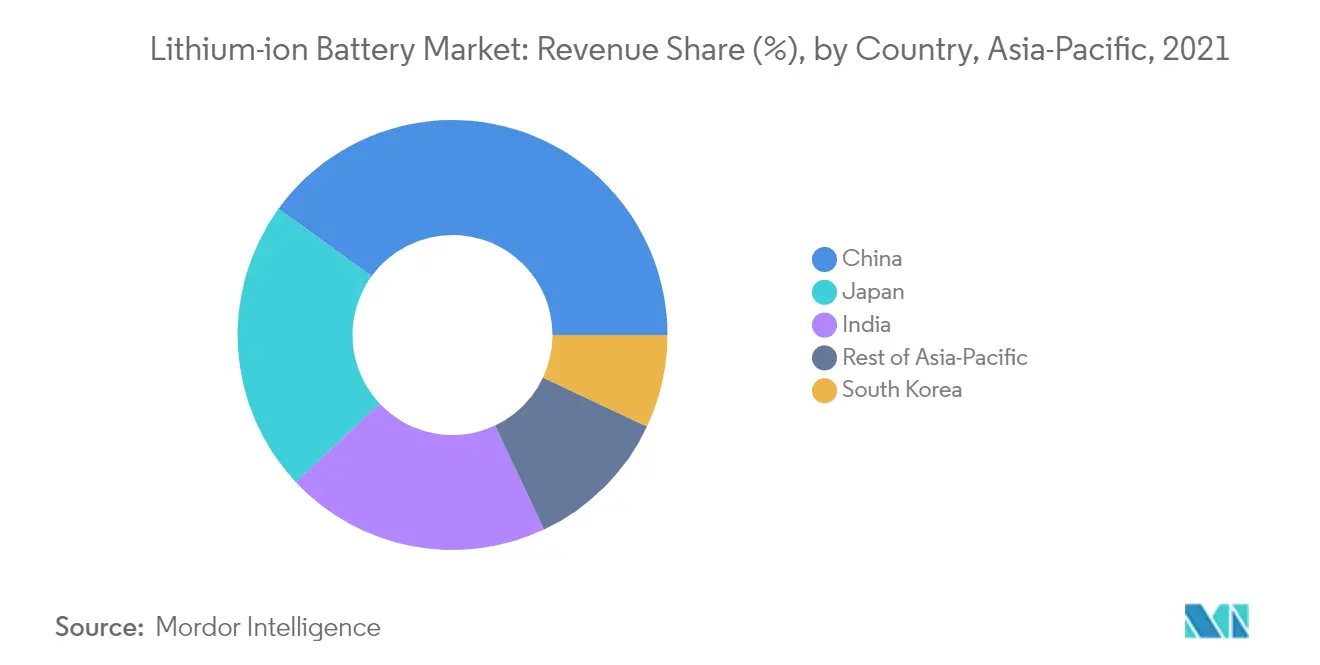
China is likely to be the dominant player in the Asia-Pacific lithium-ion battery market, supported by increasing urbanization, consumer spending, and electric vehicle (EV) market growth.
Note: Market size and forecast figures in this report are generated using Mordor Intelligence’s proprietary estimation framework, updated with the latest available data and insights as of 2026.
Asia-Pacific Lithium-ion Battery Market Trends and Insights
The Automotive Batteries Segment is Expected to be the Fastest-growing Segment
The automotive sector is expected to be one of the major end-user segments for lithium-ion batteries in the near future. The penetration of electric vehicles is anticipated to provide a massive impetus for the lithium-ion battery industry growth in Asia-Pacific.
A range of different vehicle types is now available, featuring increasing degrees of hybridization and electrification. There are various types of vehicles, including hybrid electric vehicles (HEVs), plug-in hybrid electric vehicles, and electric vehicles (EVs).
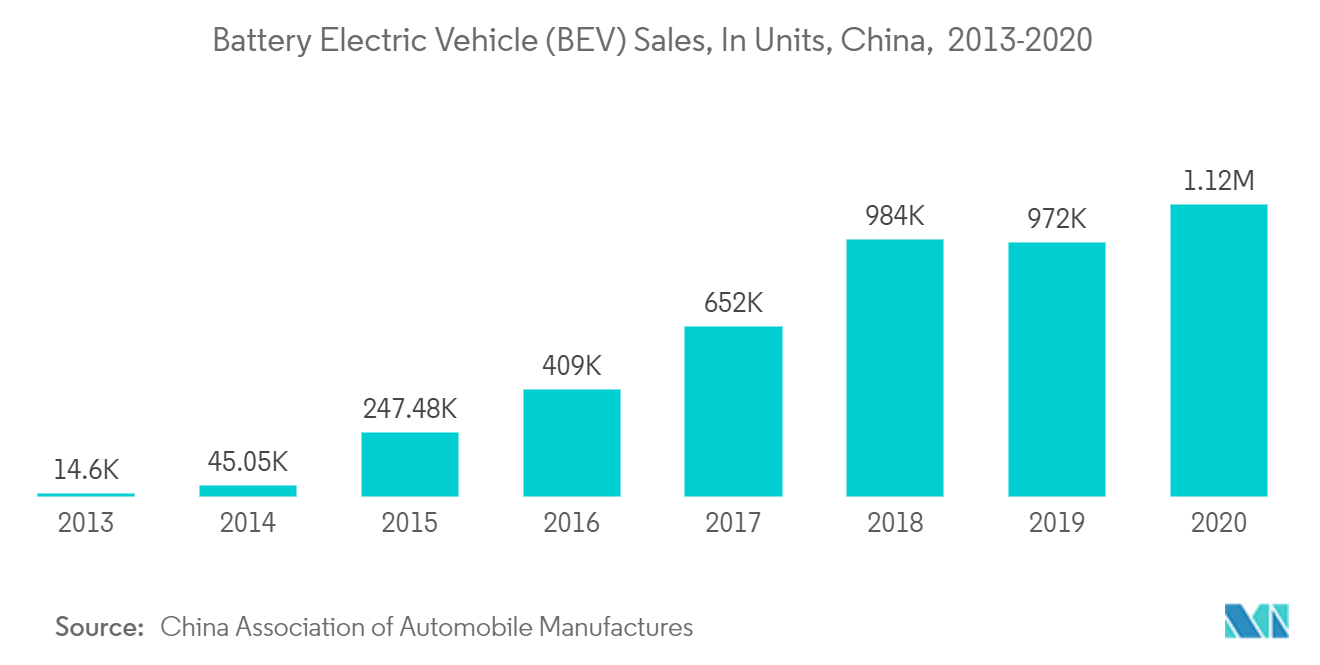
In developed and developing economies, both alike, the adoption of electric vehicles is increasing at a high growth rate. For instance, according to the China Association of Automobile Manufacturers (AMMA), in 2020, China was the largest market for electric vehicles (EV), with an estimated 1.12 million battery electric vehicles (BEVs) being sold, and it is expected to remain the world's largest electric car market during the forecast period.
Similarly, as of 2021, India is already among the countries leading in global EV sales, along with other developing economies, and it has already begun transforming its public transportation infrastructure for EVs.
India has been witnessing a surge in the manufacturing of lithium-ion batteries locally due to the government's thrust on e-mobility. The Indian government aims to achieve a 30% electric fleet by 2030. Also, in July 2019, the Indian government announced income tax exemptions for prospective EV buyers and reduced goods and services tax (GST) on EVs from 12% to 5%. In March 2019, the country's government approved setting up a National Mission on Transformative Mobility and Battery Storage to drive clean and sustainable mobility initiatives with a 5-year phased manufacturing program (PMP) till 2024.
The battery-electric vehicles market in Asia-Pacific has been heavily fueled by the presence of several competitors, backed up by the generous support of the government, supporting demand for asia-pacific ev battery pack solutions. For instance, China extended the incentives related to the purchase of new energy vehicles (NEVs) till 2022.
Some non-automotive companies, like Alibaba, are also entering the rapidly growing EV market in the country. For instance, in January 2021, Alibaba Group introduced two electric models in the country, under the IM label (Intelligence in Motion), in partnership with SAIC Motor. Battery cells for these vehicles are supplied by CATL.
Of the two models launched, one is an electric sedan, and the other is an electric SUV. The sedan is expected to be launched first, with the presale starting at Auto China 2021 in April, and the SUV may hit the market in 2022. The company has informed that the vehicles may be offered with a 93 kWh battery, while a 115 kWh battery will be available as an option. Hence, the sedan may provide a range of up to 874 km in the NEDC cycle. Thus, such upcoming electric vehicles are likely to increase the demand for lithium-ion batteries in the region during the forecast period.
In the current market scenario, policy support is expected to play a crucial role in driving the adoption of electric vehicles. Policy support enables market growth by making vehicles appealing to consumers, reducing risks for investors, and encouraging manufacturers to develop electric vehicles on a large scale. This, in turn, is expected to boost the demand for lithium-ion batteries in the Asia-Pacific region during the forecast period.


China is Driving the Market Demand
The Asia-Pacific region has multiple growing economies with substantial natural as well as human resources. China and India are expected to be major investment hotspots for lithium-ion battery companies in the coming years on account of policy-level support from the governments for both renewables and EVs and a growing middle-class population creating demand for consumer electronics.
India has been witnessing a surge in manufacturing lithium-ion batteries locally, owing to the government's thrust on e-mobility. The Indian government aims to achieve a 30% electric fleet by 2030 and has been formulating policies and programs to achieve the target. For instance, in 2021, the government amended the ongoing FAME-II (Faster Adoption and Manufacturing of Electric Vehicles-II) scheme to increase the subsidy rate for electric vehicles from INR 10,000/kWh to INR 15,000/kWh to reduce the gap between petrol-powered two-wheelers and electric powered.
According to the China Association of Automobile Manufacturers (AMMA), in 2020, China was the largest market for electric vehicles (EV), with an estimated 0.251 million plug-in hybrid Electric vehicles (PHEVs) and 1.12 million battery electric vehicles (BEVs) being sold. It is expected to remain the world's largest electric car market during the forecast period.
China is further expected to dominate, with a 57% share of the global EV market by 2030. The adoption of EVs in the country is further being propelled by the development of charging infrastructure. According to IEA, China had aimed to deploy 1,200 stations for swapping batteries and 500,000 publicly accessible chargers to serve 5 million EVs by 2020.
The increasing adoption of electric vehicles is in line with the clean energy policy. In order to reduce the demand-supply gap, the government of China is planning to ease restrictions on automakers importing cars into the country.
This is expected to ramp up the demand for technically advanced devices and vehicles due to the benefits provided by the same, leading to a growth in demand for lithium-ion batteries.
Regulatory Landscape
Asia-Pacific lithium-ion battery compliance still relies largely on country-specific safety and end-of-life rules, rather than a harmonized regional framework. In China, regulators have moved recycling oversight toward more formal requirements: in January 2026, the Ministry of Industry and Information Technology (MIIT) and five other departments issued Interim Measures for the Recycling and Comprehensive Utilization of Waste Power Batteries from NEVs, which increases reporting and management requirements across collection, tracing, and treatment.
Product safety and in-service assessment standards are also tightening, particularly for electric-vehicle traction batteries. China began implementing GB 38031-2025 in July 2026 (replacing the 2020 version) with stricter safety test requirements, and GB/T 47136-2026 in May 2026 for health and safety state assessment of traction batteries. In India, the Bureau of Indian Standards (BIS) updated compliance expectations for lithium cells and batteries under the Compulsory Registration Scheme (CRS), including February 2026 guidelines on verifying rated capacity for portable sealed secondary lithium cells and batteries, and a December 2025 deadline to implement Amendment No 1 to IS 16270:2023 for batteries used in solar PV applications.
Value Chain Analysis
The regional value chain covers upstream mining and refining of lithium, nickel, cobalt, and graphite, followed by production of active materials (cathode and anode), separators and electrolytes. It then moves into cell manufacturing and module/pack integration, with downstream demand from automotive, industrial, and consumer electronics applications. China anchors multiple stages of the chain, including a dominant share of cathode and anode active material capacity, while South Korea and Japan contribute substantial cell and component manufacturing capability and act as alternative supply bases for some OEMs.
Recent investments and partnerships show continued efforts to localize and vertically integrate beyond China. For example, Hyundai Motor Company and Kia Corporation signed an MoU with Exide Energy Solutions in April 2024 to localize LFP battery production in India for EVs, linking automotive OEM demand with domestic battery manufacturing. In Southeast Asia, CATL and partners (including ANTAM and Indonesia Battery Corporation) broke ground in July 2025 on a battery integration project in Indonesia designed to cover nickel mining through battery manufacturing, while Volkswagen Group China partnered with CATL in February 2025 to develop bespoke lithium batteries for Volkswagen models in China, reinforcing co-development between OEMs and cell makers across the region.
Competitive Landscape
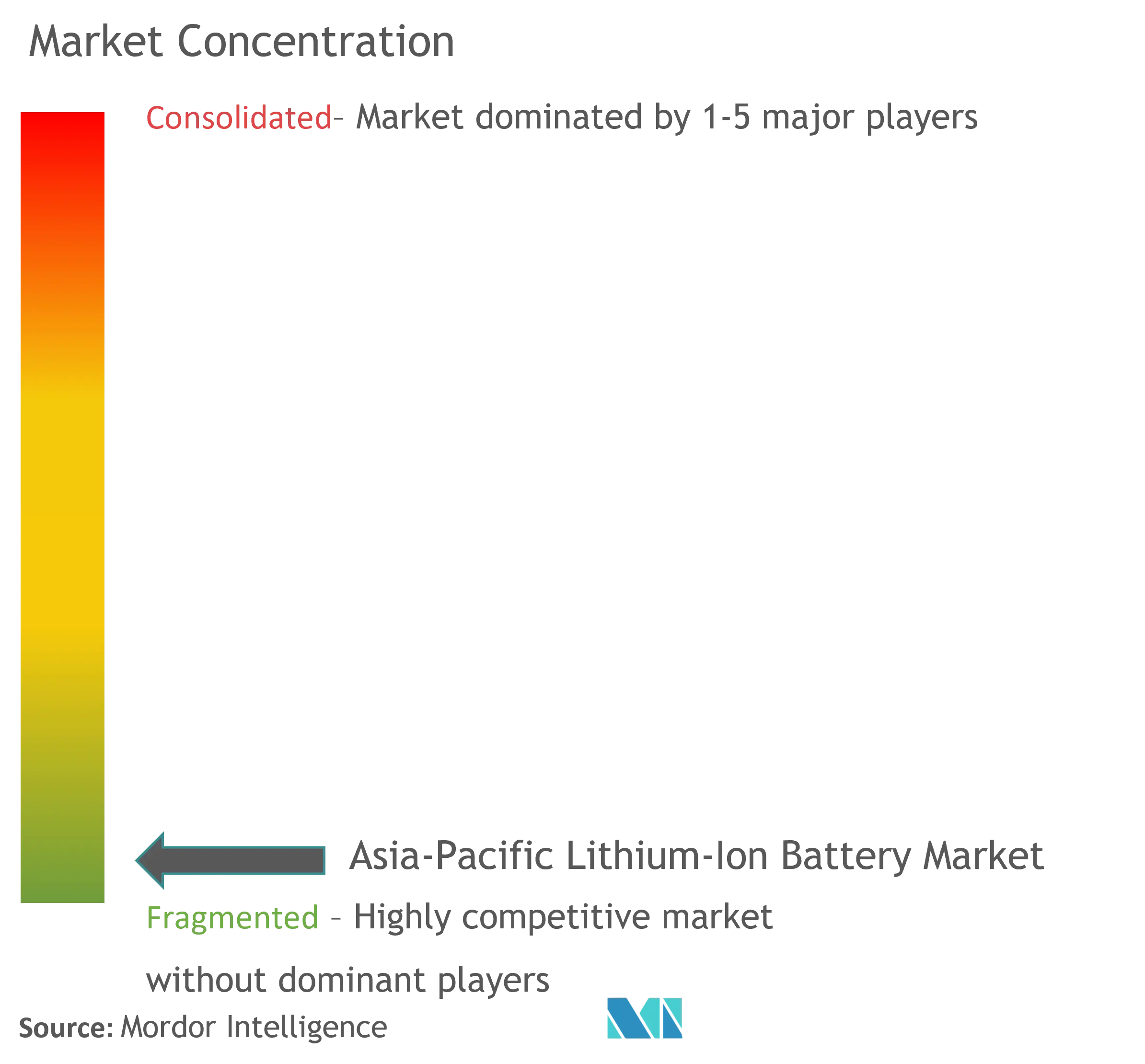
The Asia-Pacific lithium-ion battery market is fragmented. Some of the key players in this market are Contemporary Amperex Technology Co. Limited, BYD Co. Ltd, Samsung SDI Co. Ltd, Panasonic Corporation, and EnerSys, among others.
Asia-Pacific Lithium-ion Battery Industry Leaders
Samsung SDI Co. Ltd.
Panasonic Corporation
Contemporary Amperex Technology Co Ltd.
EnerSys
BYD Co. Ltd.
- *Disclaimer: Major Players sorted in no particular order

Market Opportunities and Future Outlook
A near-term opportunity across Asia-Pacific is the expansion of local cell and pack manufacturing capacity tied to domestic EV and stationary storage programs, with a particular focus on India and Southeast Asia. India is adding manufacturing stepping-stones that reduce the qualification cycle for local OEM supply. In July 2026, Amara Raja Advanced Cell Technologies commissioned a 60 MWh customer qualification plant at Divitipally, Telangana (reported as a INR 500 crore investment) to validate cells ahead of its planned GWh-scale commercial output. Exide Industries also disclosed a first-phase investment plan of INR 1,400 crore for a multi-gigawatt-hour lithium-ion cell project in Bengaluru (announced July 2026), which supports additional supplier diversification within India’s battery ecosystem.
Stationary storage and next-generation chemistries create further gaps for manufacturers that can connect R&D, safety compliance, and localization. In July 2026, Vikram Solar signed an MoU with the Tamil Nadu government to set up a battery energy storage systems (BESS) manufacturing plant in Tirunelveli (reported investment of INR 15,037 crore), adding an industrial anchor for storage-oriented demand. In Northeast Asia, Samsung SDI announced in July 2026 a 25 trillion won investment plan through 2040, split between Ulsan for mass production and Cheonan for R&D and pilot lines, targeting solid-state, LFP, and sodium-ion development and reinforcing technology diversification alongside capacity expansion.
Recent Industry Developments
- July 2026: Samsung SDI announced a 25 trillion won investment plan through 2040, splitting spending between Ulsan for mass production and Cheonan for R&D and pilot production lines. The program covers next-generation technologies including solid-state, LFP, and sodium-ion batteries, strengthening its roadmap beyond current NCM portfolios. This raises competitive pressure on regional suppliers to match both technology depth and scale while meeting tightening safety requirements.
- February 2025: Volkswagen Group China announced a collaboration with CATL to develop bespoke lithium batteries for Volkswagen models in China. The tie-up deepens OEM-cell maker co-development and can accelerate the translation of vehicle platform requirements into cell design, pack integration, and cost targets. It also reinforces China-centric supply chains for global OEMs that sell at scale in the region.
- April 2024: Hyundai Motor Company and Kia Corporation signed a memorandum of understanding with Exide Energy Solutions to localize LFP battery production in India for electric vehicles. The partnership links a major automotive demand base with a domestic battery supplier, supporting localization of cell-to-pack supply for the Indian market. It also increases competitive intensity for incumbent import-based suppliers as India expands local manufacturing depth.


Research Methodology Framework and Report Scope
Market Definition and Coverage
This market covers the value of lithium-ion batteries sold and used across Asia Pacific, counted at the point where battery products are supplied to end-use applications in the region. The sizing reflects demand from major battery-consuming industries and tracks value in USD.
Scope exclusions: Excludes non-lithium rechargeable chemistries (such as lead-acid and NiMH) and used or repurposed packs traded in secondary markets.
Segmentation Overview
- Application
- Automotive Batteries
- Industrial Batteries
- Consumer Electronics Batteries
- Other Applications
- Geography
- India
- China
- Japan
- South Korea
- Rest of Asia-Pacific
Data Sources, Market Sizing, and Validation
Desk Research
Desk research was used to map the demand pool, policy direction, and supply footprint across Asia Pacific before any assumptions were applied in the model. We used public sources such as IEA EV and battery supply chain statistics, IRENA energy storage releases, UN Comtrade trade data for cells and packs, and national statistics offices and customs portals for large countries in the region.
We also reviewed technical and market signals, including peer-reviewed journals on cell chemistry trends and safety standards, plus investor presentations, annual reports, and exchange filings from listed battery and materials companies. In a few cases, paid subscriptions for company financials and an import-export shipment-level database were used to cross-check reported revenues, shipment patterns, and country-to-country movement of battery products. These examples are not exhaustive, and other public documents and datasets were referenced to collect, validate, and clarify inputs.
Primary Interviews and Surveys
Primary interviews and short surveys were used to validate parts of the analysis that desk research could not confirm cleanly, such as application split logic, pricing movement, and the speed of chemistry mix shifts. Discussions covered manufacturers, distributors, integrators, and large buyers across APAC markets. The respondent feedback was then used to confirm base-year inputs and tighten forecast variables.
Distribution of primary research fieldwork respondents
| Company type | Respondent position |
|---|---|
| Top tier: 29% | CXOs: 12% |
| Mid tier: 51% | Functional/Unit leaders: 38% |
| Smaller Players: 20% | Managers: 50% |
Market-Sizing & Forecasting
For sizing, we use top-down and bottom-up methods. The top-down build starts from Asia Pacific battery demand indicators and reconstructs value by application using penetration and usage patterns. When country EV sales, consumer electronics output, and stationary storage additions are combined, the market total becomes visible at the end.
To keep the model practical, we track and update a defined set of inputs, including EV and two-wheeler electrification rates, battery capacity deployed in GWh, average pack prices by key applications, local manufacturing capacity additions, and trade flows of cells and packs. These variables help separate real demand growth from temporary inventory builds, and they also show when pricing is driving value more than volume.
Forecasts are produced using scenario analysis, with short trend fitting on the key drivers. Results are then reviewed against what interviewees expect for adoption speed and price decline. A selective bottom-up check is done through sampled supplier revenue splits, channel checks, and ASP multiplied by estimated volumes in key applications. Where direct data is missing, gaps are handled using conservative proxy ratios from similar countries.
Data Validation & Update Cycle
Outputs are checked through triangulation across independent signals, and then the largest variances are investigated before sign-off. We compare implied GWh and value results against trade movements, stated capacity ramps, and downstream indicators such as EV production and grid storage commissioning. Unusual jumps are flagged for a second review.
We follow a multi-step internal review, and interview follow-ups are triggered when pricing, policy, or shipment patterns materially change the demand picture. Reports are refreshed annually, and interim updates are made when major events occur, followed by a final pre-delivery pass so clients receive the latest updated view.
Mordor Intelligence's Asia Pacific Lithium Ion Battery Market Sizing Compared With Other Published Estimates
Published market size numbers for Asia Pacific lithium-ion batteries often differ because the scope is not identical, and because pricing and application splits are treated differently across studies. Differences are usually tied to what is counted as a battery product versus adjacent categories, what year is used as the base, and how currency and pricing changes are carried through the forecast.
Second-life packs and other secondary-market transactions sit outside Mordor Intelligence's scope, and that alone can pull published totals apart in a region where repurposing and resale activity exists alongside new battery demand. Another common gap is the pricing path, where some sources keep a flatter ASP curve or use mix different pack and cell price points without aligning them to the same application demand weights and timing.
Benchmark comparison
| Source | Market Size | Gaps in Research Methodology |
|---|---|---|
| Mordor Intelligence | USD 0.00 B (2024) | |
| Regional Consultancy A | USD 45.00 B (2023) | Uses a different base year and can blend broader energy and power definitions, which may include adjacent battery value chain activities that are not counted as battery market value in this scope. |
| Industry Publisher B | USD 14.40 B (2023) | Often reflects a narrower application mix and may undercount industrial and stationary demand, and it can apply a simplified price trend that does not fully adjust for chemistry and pack-level shifts. |
The spread in the table mainly comes from scope edges and how price and demand weights are applied across applications and years. By tying assumptions back to observable demand signals and repeating the same checks each cycle, we keep a balanced estimate that can be explained and recalculated when new data points emerge.


Key Questions Answered in the Report
What is the current Asia-Pacific Lithium-ion Battery Market size?
The Asia-Pacific Lithium-ion Battery Market is projected to register a CAGR of greater than 15.24% during the forecast period (2026-2031)
Who are the key players in Asia-Pacific Lithium-ion Battery Market?
Samsung SDI Co. Ltd., Panasonic Corporation, Contemporary Amperex Technology Co Ltd., EnerSys and BYD Co. Ltd. are the major companies operating in the Asia-Pacific Lithium-ion Battery Market.
What years does this Asia-Pacific Lithium-ion Battery Market cover?
The report covers the Asia-Pacific Lithium-ion Battery Market historical market size for years: 2020, 2021, 2022, 2023 and 2024. The report also forecasts the Asia-Pacific Lithium-ion Battery Market size for years: 2026, 2027, 2028, 2029, 2030 and 2031.
Page last updated on:


 Your data is secure and never sold or shared.


