
Lithium-ion Battery Market Analysis by Mordor Intelligence
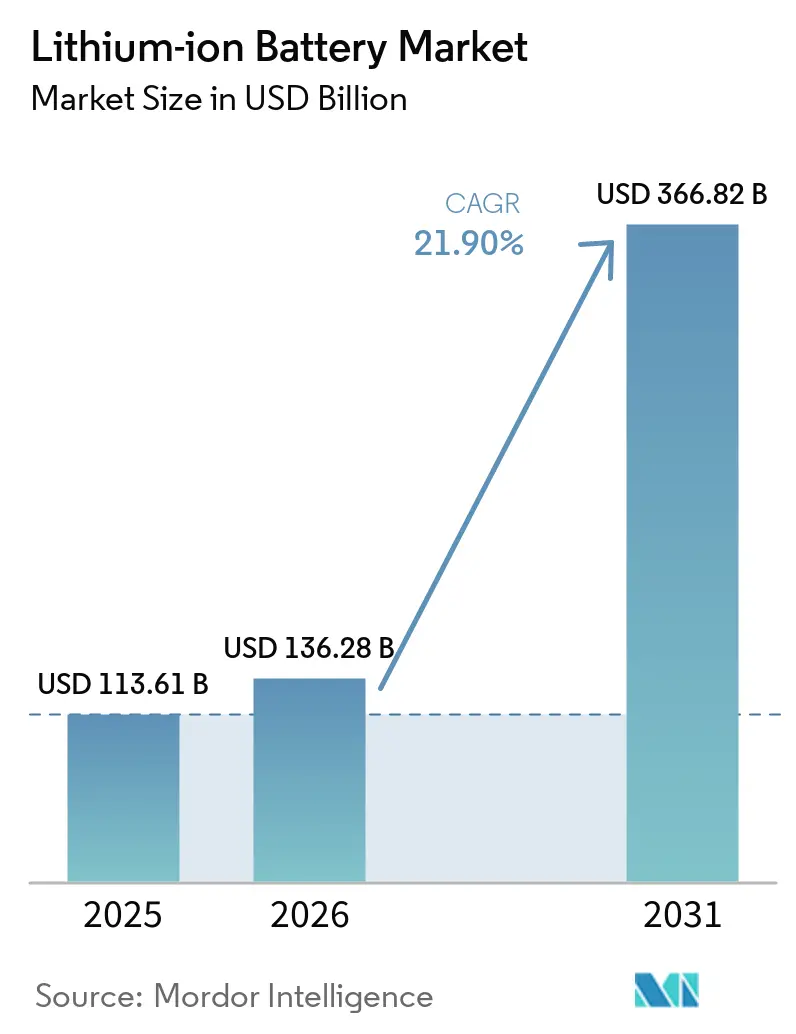
The lithium-ion battery market size is expected to increase from USD 136.3 billion in 2026 to USD 166.1 billion in 2027 and reach USD 438.1 billion by 2032, growing at a CAGR of 21.4% over 2027-2032.
Demand from electric-vehicle (EV) platforms and grid-storage projects creates distinct requirements for cells and completed battery systems. In China, manufacturing policy and production-base investment can expand supply capability across a wider range of battery applications. Pouch batteries serve vehicle and stationary applications, linking cell production with both automotive programs and project-level storage customers. Manufacturers respond by extending regional production and using systems integration to reach storage customers. Cell makers that can ship both vehicle cells and integrated storage systems can serve either channel, while higher electrolyte-additive and anode feedstock costs in China put supplier margins under pressure.
Key Report Takeaways
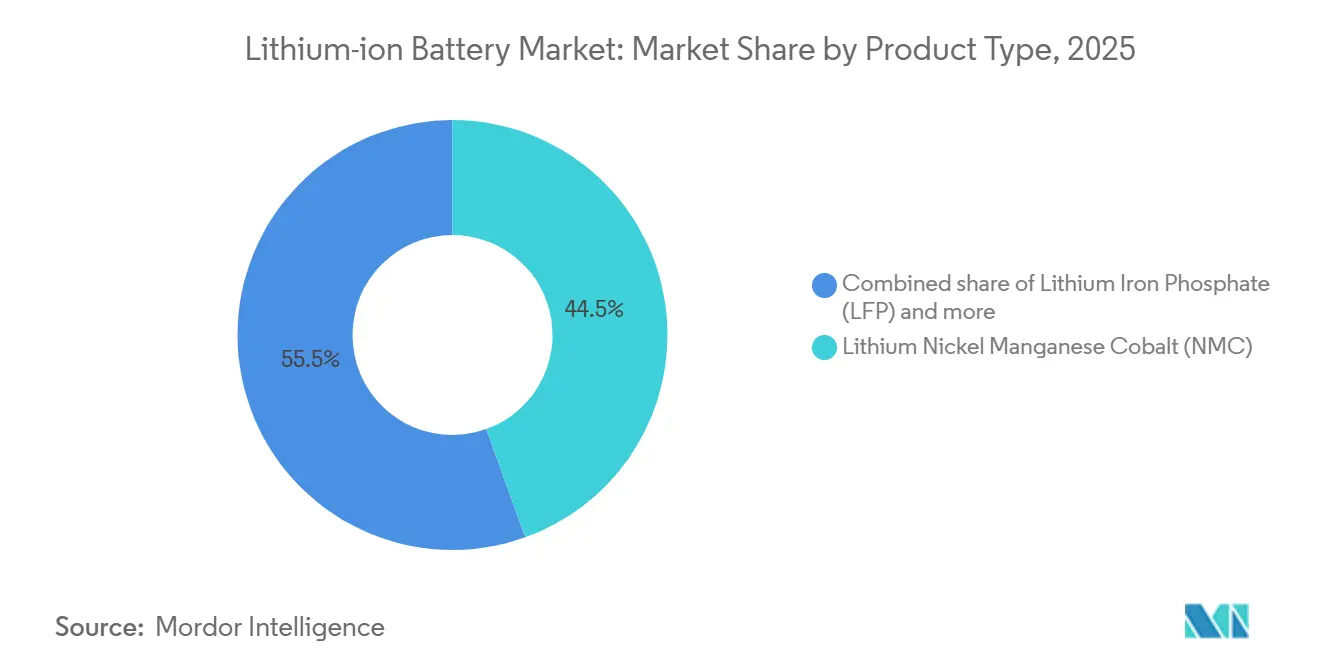
- By product type, lithium nickel manganese cobalt (NMC) led with a 44.42% lithium-ion battery market share in 2026, while lithium iron phosphate (LFP) is forecast to grow fastest at a 23% CAGR over 2027-2032.
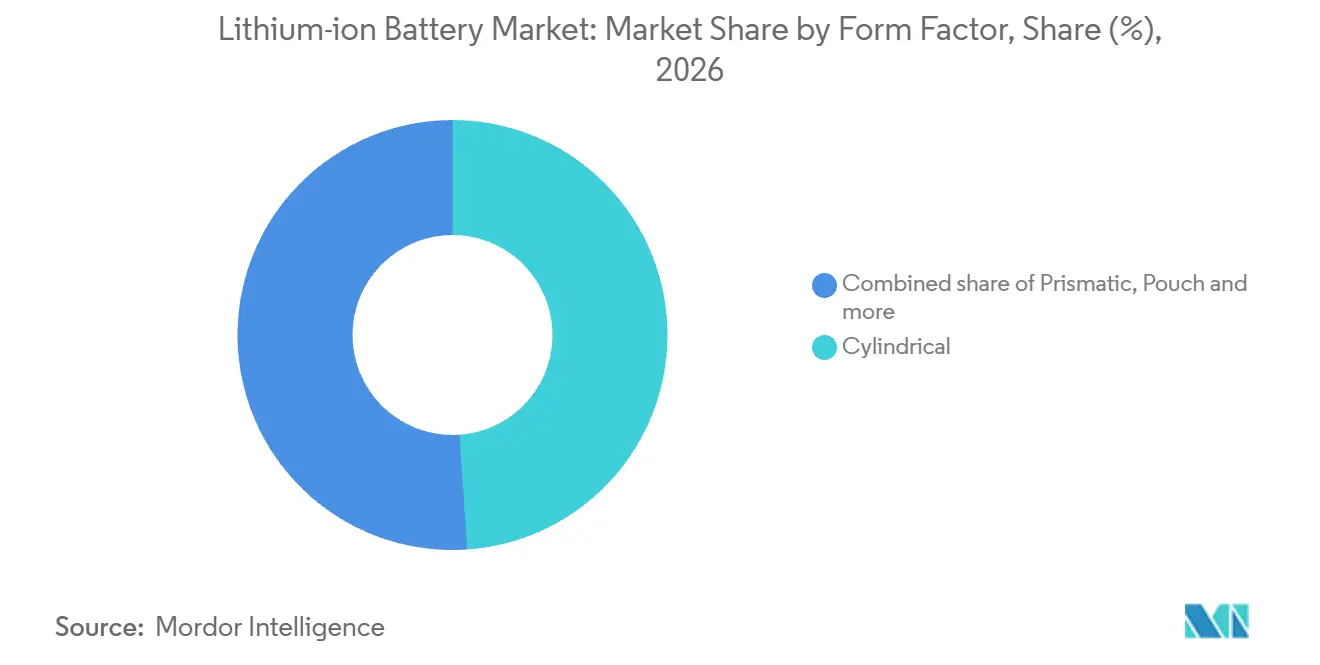
- Across form factors, cylindrical cells held a 48.9% share of the lithium-ion battery market size in 2026, with pouch batteries forecast to grow fastest at a 22.2% CAGR over 2027-2032.
- Within power-capacity categories, batteries rated 3,000 to 10,000 mAh led with 35.36% of market revenue in 2026, while those above 60,000 mAh are forecast to grow fastest at a 27.4% CAGR over 2027-2032.
- For end-use industries, automotive applications held 55.37% of market revenue in 2026, and stationary energy storage is forecast to grow fastest at a 28.9% CAGR over 2027-2032.
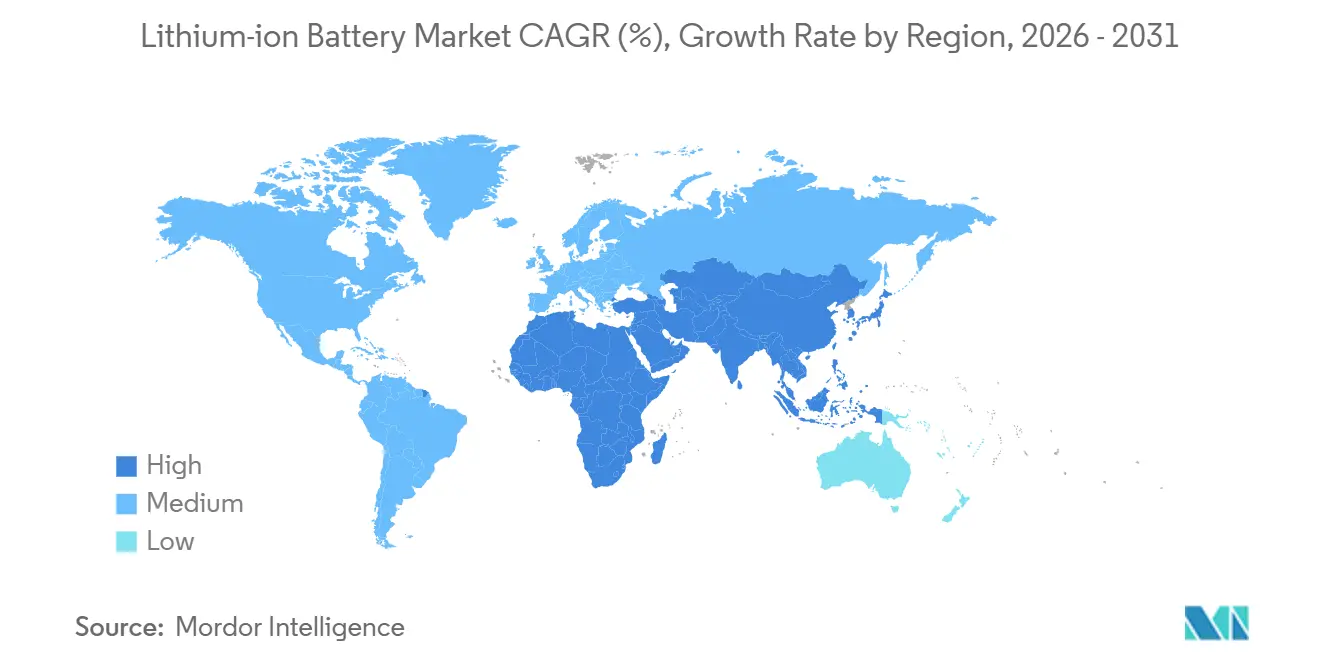
- Geographically, Asia-Pacific led with 57.65% of market revenue in 2026 and is forecast to be the fastest-growing region at a 30.2% CAGR over 2027-2032.
Note: Market numbers in this report are based on Mordor Intelligence's proprietary estimation framework, which combines nine months of actuals with Q4 projections for base year 2026.
Market Trends and Insights
Drivers Impact Analysis of Lithium-ion Battery Market*
| Driver | (~) % Impact on CAGR Forecast | Geographic Relevance | Impact Timeline |
|---|---|---|---|
| Surging Demand for High-Energy-Density Batteries in Long-Range EV Platforms | +8.8% | Asia-Pacific, North America and Europe | Medium term (2-4 years) |
| China's Industrial Policy ("Made in China 2025") Accelerating Domestic Li-ion Gigafactory Build-out | +7.4% | Yangtze River Delta, Guangdong-Hong Kong-Macao Greater Bay Area | Long term (≥ 4 years) |
| Rapid Roll-out of Utility-Scale Battery Energy Storage Procurements in the United States | +5.8% | United States of America | Medium term (2-4 years) |
| Stationary Data-center Backup Migration from VRLA to Lithium-ion in Nordic Countries | +0.9% | Nordic Countries (Europe) | Short term (≤ 2 years) |
| Maritime IMO GHG targets Driving Marine-Grade Li-ion Adoption in Europe | +0.6% | Europe, including Denmark | Medium term (2-4 years) |
| OEM Shift to LFP Chemistry for Cost-Sensitive Entry-Level EVs in India | +0.5% | India (Asia-Pacific region) | Short term (≤ 2 years) |
| Source: Mordor Intelligence | |||
Surging Demand for High-Energy-Density Batteries in Long-Range EV Platforms
Long-range EV platforms make usable battery energy within a constrained vehicle package a source of commercial differentiation. Global sales-weighted battery-electric car range rose roughly 10% between 2020 and 2025, while average range plateaued in recent years. Within a long-range platform, greater energy per unit of battery mass can support a given travel target with less battery weight. Where buyers want more range inside a fixed vehicle package, cell energy per kilogram and per liter decides how much range a platform can offer. This creates a potential demand channel for higher-density cells through the design of individual vehicle programs. A cell supplier therefore turns a density advantage into volume only when selected for a long-range vehicle program.
China's Industrial Policy ("Made in China 2025") Accelerating Domestic Li-ion Gigafactory Build-out
Chinese cell producers face a policy agenda linking manufacturing clusters to wider downstream battery applications. A plan issued by 7 ministries in September 2026 sets a broader new-battery industry agenda, with growth and application objectives through 2030. [1] The plan also seeks to strengthen lithium-battery manufacturing clusters through differentiated regional development, connecting production capabilities with local industrial advantages. Contemporary Amperex Technology Co., Ltd. (CATL) reported increased domestic and overseas production-base construction investment in the first half of 2026, including continued work at Jining. Battery manufacturing equipment suppliers have a nearer-term commercial opening from this construction spending, while cell buyers depend on subsequent commissioning to turn investment in production bases into additional battery supply.
Rapid Roll-out of Utility-Scale Battery Energy Storage Procurements in the United States
Utility-scale storage creates battery demand through operating grid-service projects as well as longer-term resource plans. On February 11, 2026, Plus Power announced that its 175 MW/350 MWh Cross Town facility in Gorham, Maine, was operating. Cianbro identified the project as lithium-ion and reported 156 battery containers and 40 power converter units in its April 2026 construction-completion report. Separately, PacifiCorp's 2025 resource plan update identified 1,265 MW of 4-hour lithium-ion storage as required for Oregon by the end of 2030. The Maine project connects battery demand to container-scale system delivery, while the Oregon plan adds a defined future lithium-ion requirement. For manufacturers, repeated battery-container supply and its integration into grid assets become commercial capabilities alongside the cells themselves.
Stationary Data-center Backup Migration from VRLA to Lithium-ion in Nordic Countries
Nordic colocation and enterprise data-center operators can create replacement demand when they compare lithium-ion backup with valve-regulated lead-acid (VRLA) systems. The retrofit case depends on whether the required backup duration can be delivered in less floor space or with fewer replacement cycles. Any higher initial battery cost must be offset by service-life and maintenance savings over the facility's operating horizon. For an existing Nordic facility, that comparison makes lifecycle cost per protected load more useful than the price of replacement batteries alone. A lithium-ion supplier's route into these retrofit tenders therefore depends on demonstrating a lifecycle advantage for the operator's specific backup duty.
Restraints Impact Analysis of Lithium-ion Battery Market*
| Restraint | (~) % Impact on CAGR Forecast | Geographic Relevance | Impact Timeline |
|---|---|---|---|
| Graphite Anode Supply Tightness Owing to Chinese Environmental Curtailments | -1.2% | People's Republic of China | Short term (≤ 2 years) |
| High-Voltage Electrolyte Additive Cost Inflation Post-Ukraine Conflict | -0.8% | People's Republic of China | Short term (≤ 2 years) |
| US-EU Trade Barriers on Critical Minerals Undermining Trans-Atlantic Supply Chains | -0.4% | United States and European Union | Short term (≤ 2 years) |
| Recycling Infrastructure Lag Delaying Circular Material Flows in Oceania | -0.2% | Australia (Oceania region) | Long term (≥ 4 years) |
| Source: Mordor Intelligence | |||
Graphite Anode Supply Tightness Owing to Chinese Environmental Curtailments
Feedstock costs weighed on synthetic-anode producers at the start of 2025. China's needle-coke market price reached USD 750 per metric ton during that period, while higher material input costs and falling anode prices squeezed synthetic-anode producer margins. The IEA attributed the feedstock price surge to refinery exposure to sanctioned crude suppliers, port measures, and tax policies. Producers earning less per unit of anode have less room to absorb further feedstock increases. Battery makers' graphite anode costs therefore remain exposed to suppliers' limited capacity to absorb additional input costs.
High-Voltage Electrolyte Additive Cost Inflation Post-Ukraine Conflict
Electrolyte suppliers face a concentrated cost exposure when a specialty additive becomes sharply more expensive. Shanghai Securities News reported that China's average price for lithium-battery electrolyte additive vinylene carbonate (VC) rose 400% year over year by August 6, 2026. [2] That increase raises the cost of the VC component in affected formulations, with the exposure depending on how much they use. If electrolyte suppliers pass the increase through, cell manufacturers face higher formulation costs before any finished-cell price adjustment. If suppliers absorb it, the input shock compresses the margin available from supplying those formulations. Either route leaves the affected electrolyte supply costlier to sustain, which raises the cost of profitable cell delivery.
*Our forecasts treat driver/restraint impacts as directional, not additive. The impact forecasts reflect baseline growth, mix effects, and variable interactions.
Lithium-ion Battery Market Segment Analysis
By Product Type:
NMC Manufacturing Scale Meets LFP AdoptionLithium nickel manganese cobalt (NMC) accounted for a 44.42% share of the lithium-ion battery market size in 2026, making it the largest segment. NMC represented 55% of European battery-cell production capacity in 2025, with that capacity measure based on company announcements. PowerCo SE, Volkswagen Group's cell-producing subsidiary, commissioned its Salzgitter gigafactory and produced its first NMC Unified Cells in December 2025 for final road tests by Group brands. Volkswagen Group said the cells delivered around 10% more energy density than previous cells. Performance gains of that kind give automakers a reason to build NMC capacity themselves, which can narrow the vehicle programs open to independent cell suppliers.
Lithium iron phosphate (LFP) is forecast to be the fastest-growing segment, with a 23% CAGR over 2027-2032. In China, LFP power-battery installed capacity reached 625.3 GWh in 2025, up 52.9% year over year. Globally, LFP accounted for over 55% of battery capacity in newly registered electric vehicles in 2025. Uptake was also expanding in emerging and developing economies outside China. LFP's next stage of growth therefore depends on supplier access to vehicle markets outside China.

By Form Factor:
Regional Cylindrical Production Supports Wider Pouch ApplicationsCylindrical cells represented a 48.9% lithium-ion battery market share in 2026, making them the largest segment. Panasonic Energy Co., Ltd. began mass-producing 2170 cylindrical lithium-ion cells for electric vehicles at its Kansas factory in July 2025. Its July 2025 plan envisioned annual capacity of approximately 32 GWh for automotive 2170 cells at the new site. The regional production route gives automotive buyers an additional manufacturing option for the cylindrical format, while the planned scale makes the site's production ramp important to its commercial reach.
Pouch batteries are forecast to be the fastest-growing segment, with a 22.2% CAGR over 2027-2032. LG Energy Solution Ltd. reported that increased pouch-type EV battery shipments to Europe supported its quarterly revenue growth in the second quarter of 2026. The producer also began large-scale LFP pouch production for energy storage at Holland, Michigan, on June 1, 2025. LG Energy Solution Vertech, its wholly owned systems-integration subsidiary, was the contract party for confirmed Terra-Gen and Delta supply. Systems integration is therefore part of the storage growth mechanism in this example, with the contracting relationship held by Vertech alongside the producer's pouch-cell capacity.
By Power Capacity:
Consumer Accessory Cells and Large Storage ContractsThe 3,000 to 10,000 mAh band was the largest segment, with 35.36% of market revenue in 2026. Sichuan Changhong Newenergy Technology Co., Ltd. reported in its 2025 business results that controlled subsidiary Changhong Sanjie NewEnergy Co., Ltd.'s 5,000 mAh lithium battery had entered Anker's supply chain. The battery was used in Anker's MagGo Power Bank, connecting the supplied unit to a branded consumer-accessory application. In this band, a supplier reaches branded accessory platforms by qualifying a specification for the finished product.
Batteries above 60,000 mAh are forecast to be the fastest-growing segment, with a 27.4% CAGR over 2027-2032. By August 2025, Narada Power had signed a contract for 230 MWh of UK energy-storage systems built around its 314 Ah cells. The order concerned Center L Plus 5 MWh liquid-cooled containerized systems, whose 314 Ah (314,000 mAh) LFP cells sit far above the 60,000 mAh threshold. Narada was both the cell developer and manufacturer and the contracted system supplier, linking its cell design with a complete-system supply commitment. Cells of this size reach buyers inside integrated containerized systems, so the cell maker's order book depends on system-level contracts.
By End-use Industry:
Automotive Volume Meets Contracted Storage ServicesAutomotive applications, which include electric vehicles, conventional hybrids, and plug-in hybrids, were the largest segment with a 55.37% share of market revenue in 2026. Global EV battery deployment reached 1.2 TWh in 2025, and light-duty vehicles, which include passenger and light commercial vehicles, accounted for more than 85% of it. In EV battery deployment, light-duty programs therefore set the volume that cell suppliers compete for.
Stationary energy storage is forecast to be the fastest-growing segment, with a 28.9% CAGR over 2027-2032. BloombergNEF reported 112 GW of global energy-storage additions, excluding pumped hydro, in 2025, up 48% from 2024, with 307 GWh of batteries added worldwide. Arevon's 300 MW/1,200 MWh Nighthawk LFP project entered operation in Poway, California, on August 12, 2026, under a long-term agreement with Pacific Gas and Electric Company. Arevon owns and operates the project, which can power up to 385,000 homes for as long as 4 hours during peak demand. For storage cell suppliers, orders can therefore scale with the energy capacity needed to sustain peak-time delivery under project agreements.
Geography Analysis
Asia-Pacific Lithium-ion Battery Market
Asia-Pacific accounted for 57.65% of the lithium-ion battery market size in 2026 and is forecast to be the fastest-growing region, with a 30.2% CAGR over 2027-2032. China accounted for over 80% of global battery-cell production in 2025, providing an in-region manufacturing base. Across Asia-Pacific countries outside China, about 450,000 electric cars were sold in the first quarter of 2026, up 80% from the first quarter of 2025. The region's growth mechanism therefore combines concentrated cell production in China with expanding vehicle demand elsewhere, giving suppliers exposure to both a large production center and additional automotive buyers.
North America's grid-storage business is illustrated by Oneida Energy Storage Limited Partnership, which began commercial operations in Ontario on May 7, 2025, with 278 lithium-ion battery units. Its announced revenue model combined fixed payments under a 20-year capacity-services contract with Ontario's Independent Electricity System Operator with energy sales and ancillary services. The Ontario model gives storage assets contracted capacity income alongside other grid-service revenue, broadening the commercial role of battery availability. The EU's automotive demand channel expanded as registrations of new battery-only electric passenger cars rose 29.7% from 2024 to 1.89 million in 2025. EU registration growth points cell and pack suppliers toward passenger-vehicle programs and their new-car deployment requirements.
In South America, BYD Auto do Brasil produced 10,000 vehicles at Camaçari, Bahia, by November 2025, including the electric Dolphin Mini, and supplied locally produced models to dealerships nationwide. Brazil's example links potential battery business with a vehicle maker's national dealership reach. In Hungary, CATL began trial production at its Debrecen cell factory on September 22, 2026, ahead of series production. In the Middle East and Africa, Saudi Electric Company's Bisha facility in southwestern Saudi Arabia entered operation in January 2025 with 500 MW/2,000 MWh of storage using BYD-supplied lithium iron phosphate modules. The Saudi facility demonstrates a module-supply route into a utility-owned storage asset.
Regulatory Framework and Outlook
The comparison assesses selected jurisdictions from the perspective of producers and importers supplying finished lithium-ion batteries. The requirements span transport testing, producer registration, traceability, and end-of-life responsibility, placing commercial obligations at different points in the battery supply chain. A transport-conformity rule and a recycling obligation create different operating requirements even when they concern the same type of battery product.
Regulatory Table of Lithium-ion Battery Market
| Decision factor | United States | Germany | China | India | Brazil | United Arab Emirates |
|---|---|---|---|---|---|---|
| Primary authority | Department of Transportation through PHMSA | stiftung ear for registration; German Environment Agency oversight | Ministry of Industry and Information Technology with partner departments | Ministry of Environment, Forest and Climate Change | Ministry of Environment and Climate Change for Sisrev-BR | Ministry of Climate Change and Environment |
| Key instruments or direction | 49 CFR 173.185 type testing; older transport mark permitted through December 31, 2026 | BattDG; applicable EU battery due diligence from August 18, 2027 | New-energy-vehicle battery traceability measures; draft recovery standards guide | Battery Waste Management Rules; domestic recycled-material requirements from FY 2027-28 | National Solid Waste Policy; CONAMA Resolution 401, Article 5; Sisrev-BR reporting | Federal Law 12 of 2018; July 2025 battery-inclusive producer-responsibility pilot agreement |
| Commercial effect | Type-test compliance for lithium batteries offered for transport | Register before first placement; fulfill producer responsibility through an organization or individually | Lifecycle-traceability requirements for covered vehicle power batteries | Producer and importer collection and recycling or refurbishment targets | Reverse logistics and shared collection; annual system reporting | Product-return and post-use waste costs as specified by executive regulation |
| Current policy attractiveness | Medium | Medium | Medium | Medium | Medium | Medium |
| Future direction of policy attractiveness | No change | Hardening | No change | Hardening | No change | No change |
| Source: Mordor Intelligence | ||||||
For producers and importers, compliance costs arise before shipment and first placement as well as after sale, with UAE return costs specified by executive regulation. The EU Battery Regulation adds due diligence for covered operators placing batteries on the EU market, including Germany, from August 18, 2027, while India's domestic recycled-material requirements begin in FY 2027-28. China's operative traceability framework supports continuity because the September 2026 recovery-standards guide is a proposal without an adopted implementation date. The US transport-mark transition ending December 31, 2026, Brazil's reporting consolidation, and the UAE's pilot agreement support continuity in underlying duties rather than a new battery-specific collection mandate.
Value Chain Stages
The value chain compares how suppliers earn revenue from lithium conversion, cathode materials, battery manufacturing, and materials recovery. Albemarle converts lithium resources into battery-grade chemicals, while LG Chem manufactures cathode materials for electric vehicles and energy storage systems. BASF Battery Materials and CATL signed a global cathode active-materials framework agreement in July 2025, providing a commercial link between material supply and battery production.
Value Chain Analysis Table of Lithium-ion Battery Market
| Primary activity | Key participants | Value capture | Bottleneck | Resilience response |
|---|---|---|---|---|
| Lithium conversion | Lithium converters such as Albemarle | Battery-grade chemical sales | Meeting the required lithium chemical grade | Qualify conversion routes against the required grade |
| Cathode-material production | Cathode-material manufacturers such as LG Chem and BASF Battery Materials | Cathode active-material sales | Coordination of material supply with battery production | Use supplier frameworks to align production commitments |
| Cell and battery manufacturing | Battery manufacturers such as CATL; cylindrical-cell manufacturers such as Panasonic Energy | Cell and battery sales | Exposure to a single supply-chain cooperation model | Diversify supply-chain cooperation models |
| Materials recovery and regeneration | Battery and materials recyclers such as Guangdong Brunp Recycling | Recovery services and regenerated-material sales | Converting recovered batteries and materials into usable inputs | Match recovery throughput with regeneration capability |
| Source: Mordor Intelligence | ||||
CATL reported recycling 210,000 metric tons of end-of-life batteries and materials in 2025 and regenerating 24,000 metric tons of lithium salts. [3] This creates a potential feedstock stream whose value depends on conversion into inputs suitable for further production. CATL also described diversified supply-chain cooperation models in 2025 as a means of reducing dependence on a single model and strengthening resilience. The structural opportunity is to connect recovered materials with production requirements while retaining multiple cooperation routes into battery manufacturing.
Competitive Landscape
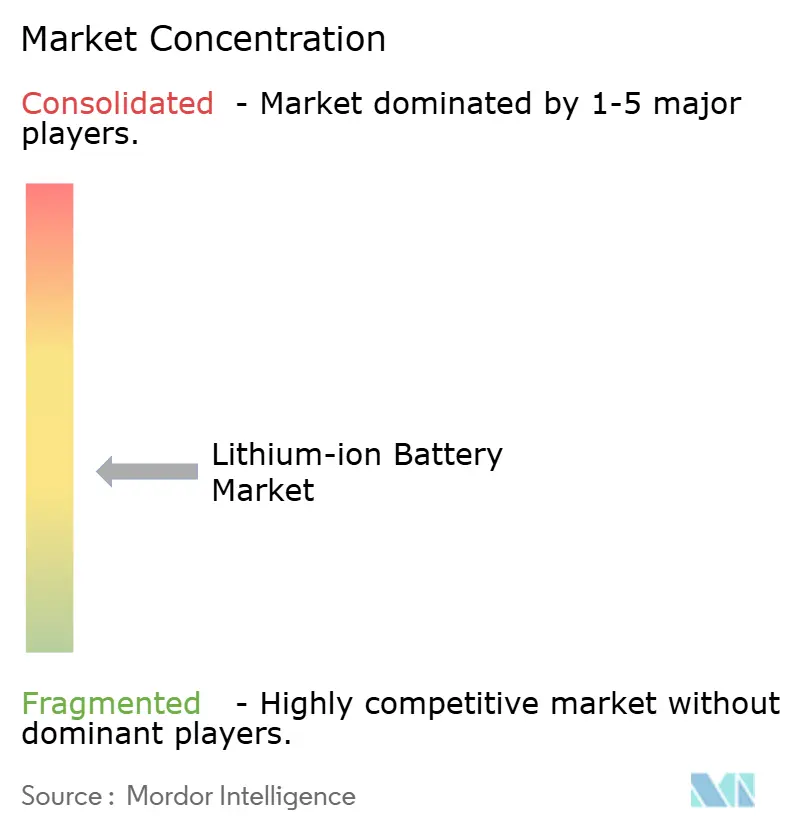
Large established manufacturers give the supplier field a concentrated core, although their routes to battery demand differ. Contemporary Amperex Technology Co., Ltd. (CATL), BYD Company Limited, LG Energy Solution Ltd., Panasonic Energy Co., Ltd., and SK On Co., Ltd. participate through cell and battery businesses. CATL reported 661 GWh of lithium-ion battery sales in 2025, up 39% year over year. LG Energy Solution reported reallocating capacity between EV and energy-storage batteries in 2025 to limit new investment and increase use of idle lines. Established factories can thus compete through both delivered volume and changes in application mix, raising the capability hurdle for a new entrant.
LG Energy Solution Ltd. started producing 46-Series cylindrical batteries at Ochang, South Korea, in 2025 and reported an order backlog exceeding 300 GWh for that series at year-end. BYD Company Limited's 2025 report described power-battery supply first meeting its own new-energy-vehicle needs and then serving external strategic automaker customers. These 2 demand structures give customer orders and internal vehicle programs different roles in supporting battery production. When a producer also builds vehicles, outside automakers can compete with its own programs for cell allocation.
In May 2026, SK On Co., Ltd. said it and Nissan were renegotiating a previously agreed 99.4 GWh battery-supply contract for 2028-2033. SK Battery America was the contract party and Nissan North America the counterparty, and SK On said that no decision had been made. For tax years beginning after July 4, 2025, Section 45X credit-eligibility restrictions apply to specified foreign entities and covered foreign-influenced producers of qualifying battery components. The contract negotiation exposes future-volume uncertainty, while the tax rule makes entity structure a commercial consideration for covered US battery-component operations. Contract certainty and incentive eligibility therefore decide the contest alongside capacity, with ownership and control conditions shaping eligibility for covered producers.
Lithium-ion Battery Industry Leaders
-
Contemporary Amperex Technology Co., Ltd. (CATL)
-
BYD Company Limited
-
LG Energy Solution Ltd.
-
Panasonic Energy Co., Ltd.
-
SK On Co., Ltd.
- *Disclaimer: Major Players sorted in no particular order
Lithium-ion Battery Market Companies Covered in this Report
- Contemporary Amperex Technology Co., Ltd. (CATL)
- BYD Company Limited
- LG Energy Solution Ltd.
- Panasonic Energy Co., Ltd.
- Samsung SDI Co., Ltd.
- SK On Co., Ltd.
- AESC (Envision AESC Group)
- CALB Co., Ltd.
- Gotion High-Tech Co., Ltd.
- EVE Energy Co., Ltd.
- Farasis Energy (Ganzhou) Co., Ltd.
- Sunwoda Electronic Co., Ltd.
- Murata Manufacturing Co., Ltd.
- VARTA AG
- Toshiba Corporation
- Saft Groupe SAS
- Northvolt AB
- Microvast Holdings, Inc.
- A123 Systems LLC
- Hitachi Energy Ltd.
- Reliance Lithium Werks BV
- Tesla, Inc. (Battery Division)
Key Opportunities for Market Participants
These opportunities compare lithium-ion battery supply offers for operators bringing covered electric-vehicle, light-mobility, and industrial batteries to the EU market. From February 18, 2027, passports will be required for each electric-vehicle and light-means-of-transport battery and each industrial battery over 2 kWh placed on the market or put into service. Required information will include model-level and individual-battery data, including information arising from use as applicable to the battery category. The responsible placing operator must keep the record accurate, complete, and up to date, although it may authorize another operator in writing to act on its behalf.
Market Opportunities Table of Lithium-ion Battery Market
| Opportunity | Why now | Buyer / lead segment | Recommended play | Main barrier | Likely beneficiaries |
|---|---|---|---|---|---|
| EV batteries paired with maintained product records | Scheduled passport duty covers EV batteries | Operators placing lithium-ion EV batteries on the EU market | Pair battery supply with applicable model and individual-unit records | Keeping records complete through battery use | EV-battery manufacturers supplying responsible market operators |
| Light-mobility batteries with matched model and unit records | LMT batteries are within the scheduled passport scope | Operators placing lithium-ion light-mobility batteries | Supply batteries with records that connect each unit to its model | Matching model information with individual-battery records | Light-mobility battery producers and importers |
| Industrial storage batteries above 2 kWh with record support | Covered industrial batteries require passports | Operators supplying covered industrial storage batteries | Link battery delivery with applicable use-related information and ongoing record support | Maintaining record continuity after battery delivery | Industrial-battery suppliers with record-management capability |
| Source: Mordor Intelligence | |||||
The central opening is to make battery delivery and the information needed for lawful market placement part of one commercial offer. Written authorization can let suppliers support practical passport tasks while the placing operator retains legal responsibility. Product differentiation therefore turns on accurate, maintainable battery records and a clear division of responsibility, with the scheduled obligation creating a product-readiness need.
Recent Industry Developments in Lithium-ion Battery Market
- Sep 2026: CATL began trial production on the first 2 lines of its cell factory in Debrecen, Hungary, on September 22.
- Aug 2026: LG Energy Solution Ltd. started LFP cell production in Lansing, Michigan, on August 18. LG Energy Solution Vertech integrates these cells into systems for utility, grid-scale, commercial, and industrial storage applications.
- Aug 2026: Quinbrook's Supernode project in Queensland, Australia, completed Stage 2 commercial operation using CATL-supplied EnerC Plus LFP lithium-ion battery systems.
Lithium-ion Battery Market Report Scope and Research Methodology
Market Definition and Coverage
The lithium-ion battery market measures annual sales value of newly manufactured rechargeable lithium-ion cells and integrated battery packs sold in the Global market. It covers mobility, electronics, industrial, stationary energy storage, aerospace, defense, and marine uses.
Scope exclusions: Lead-acid and nickel-metal hydride batteries, lab-stage solid-state prototypes, battery recycling revenues, and battery metal trading activity are excluded.
Segments Covered in This Report
- By Product Type
- Lithium Cobalt Oxide (LCO)
- Lithium Iron Phosphate (LFP)
- Lithium Nickel Manganese Cobalt (NMC)
- Lithium Nickel Cobalt Aluminum (NCA)
- Lithium Manganese Oxide (LMO)
- Lithium Titanate (LTO)
- By Form Factor
- Cylindrical
- Prismatic
- Pouch
- By Power Capacity
- 0 to 3,000 mAh
- 3,000 to 10,000 mAh
- 10,000 to 60,000 mAh
- Above 60,000 mAh
- By End-use Industry
- Automotive (EV, HEV, PHEV)
- Consumer Electronics
- Industrial and Power Tools
- Stationary Energy Storage
- Aerospace and Defense
- Marine
- By Geography
- North America
- United States
- Canada
- Mexico
- Europe
- United Kingdom
- Germany
- France
- Spain
- Nordic Countries
- Russia
- Rest of Europe
- Asia-Pacific
- China
- India
- Japan
- South Korea
- Malaysia
- Thailand
- Indonesia
- Vietnam
- Australia
- Rest of Asia-Pacific
- South America
- Brazil
- Argentina
- Colombia
- Rest of South America
- Middle East and Africa
- United Arab Emirates
- Saudi Arabia
- South Africa
- Egypt
- Rest of Middle East and Africa
- North America
Data Sources, Market Sizing, and Validation
Desk Research
Public information such as the U.S. Geological Survey's Mineral Commodity Summaries, international energy outlooks, customs trade records, and peer-reviewed battery research can inform supply, demand, trade, and technology context. Government energy statistics and industry association shipment data can help check adoption and manufacturing trends.
Company filings, annual reports, investor presentations, and reputable press coverage can clarify announced capacity, application exposure, pricing conditions, and commercial developments, with each item checked against the market's cell and pack sales boundary. These sources are illustrative and not exhaustive, and further sources inform collection, validation and clarification.
Primary Interviews and Surveys
Interviews and structured surveys with cell and pack producers, vehicle and equipment buyers, storage integrators, and industry specialists can test secondary-source interpretations of demand, pricing, capacity utilization, and channel activity. Analysts can use follow-up questions to resolve gaps and triangulate conflicting evidence across applications and regions without treating any single respondent as representative.
Distribution of primary research fieldwork respondents
| Company type | Respondent position | Region |
|---|---|---|
| Top tier: 35% | CXOs: 20% | APAC: 45% |
| Mid tier: 45% | Functional/Unit leaders: 35% | EMEA: 30% |
| Smaller Players: 20% | Managers: 45% | Americas: 25% |
Market-Sizing & Forecasting
The estimate starts with a top-down assessment of global sales value for newly manufactured lithium-ion cells and integrated packs, using reported producer sales, application demand, production capacity and utilization, battery shipment volumes, and average cell and pack prices. Analysts derive chemistry, form-factor, capacity, end-use, and regional shares from reported shipment and sales mixes, then check selected totals with supplier roll-ups and sampled average selling price times volume. A multivariate regression can relate historical sales value to EV battery deployment, stationary storage installations, electronics demand, manufacturing output, and pack prices, while scenario analysis tests policy, capacity-ramp, and cost paths over 2027-2032. Missing observations can be bridged with adjacent-year evidence and checked against primary input, with experts reviewing the direction and plausibility of variable-level forecasts.
Data Validation & Update Cycle
Analysts triangulate reported sales, shipment and deployment indicators, filings, and regional evidence, then investigate outliers and material variances before sign-off. A second review checks definitions, units, calculations, segment shares, and forecast assumptions, with respondent re-contact triggered by conflicting or incomplete explanations. The evidence base is refreshed annually, updated between cycles for material market events, and reviewed again immediately before delivery.
Mordor Intelligence's Lithium Ion Battery Market Size Versus Other Published Estimates
Published estimates can differ in the transactions and products they count and the inputs used to model demand. The lithium-ion battery market measures annual sales value of newly manufactured rechargeable lithium-ion cells and integrated battery packs sold in the Global market.
Key Gap Drivers include the study's defined coverage and market-specific modeling choices. Missing observations can be bridged with adjacent-year evidence and checked against primary input, with experts reviewing the direction and plausibility of variable-level forecasts.
Benchmark comparison
| Source | Market Size | Gaps in Research Methodology |
|---|---|---|
| Mordor Intelligence | USD 166.1 B (2027) | |
| Global Consultancy A | USD 151 B (2025) | At its 2025 base, this estimate is 9.1% below this report's 2027 value of USD 166.1 B, 2 years later. The 2025 base year precedes the report's 2027 reference year. |
| Industry Journal B | USD 87.1 B (2025) | At its 2025 base, this estimate is 47.6% below this report's 2027 value of USD 166.1 B, 2 years later. The 2025 base year precedes the report's 2027 reference year. |
Mordor Intelligence's analysts triangulate reported sales, shipment and deployment indicators, filings, and regional evidence, then investigate outliers and material variances before sign-off.
Key Questions Answered in the Report
What is the lithium-ion battery market size and forecast growth?
The size is expected to reach USD 166.1 billion in 2027 and USD 438.1 billion by 2032, growing at a CAGR of 21.4% over 2027-2032.
What drives demand for lithium-ion batteries?
China's 2026-2030 plan targets battery applications and manufacturing clusters. Plus Power also announced a 175 MW/350 MWh operating storage facility in Maine in February 2026.
Which lithium-ion battery chemistry leads revenue?
Lithium nickel manganese cobalt (NMC) led with 44.42% of market revenue in 2026, while lithium iron phosphate (LFP) is forecast to grow at a 23% CAGR over 2027-2032.
Which companies are major lithium-ion battery suppliers?
Major suppliers include CATL, BYD Company Limited, LG Energy Solution Ltd., Panasonic Energy Co., Ltd., and SK On Co., Ltd.
What input-cost challenge affects lithium-ion battery suppliers?
China's average price for electrolyte additive vinylene carbonate rose 400% year over year by August 6, 2026, exposing affected formulations to higher input costs.
Which region leads lithium-ion battery demand and forecast growth?
Asia-Pacific held 57.65% of market revenue in 2026 and is forecast to grow at a 30.2% CAGR over 2027-2032, making it the fastest-growing region.