
Asia-Pacific Savoury Ingredients Market Size and Share
Market Overview
| Study Period | 2021 - 2031 |
|---|---|
| Forecast Data Period | 2026 - 2031 |
| Base Year Market Size (2025) | USD 4.28 Billion |
| Market Size (2026) | USD 4.66 Billion |
| Market Size (2031) | USD 7.12 Billion |
| Growth Rate (2026 - 2031) | 8.85 % |
| Market Concentration | Medium |
Major Players *Disclaimer: Major Players sorted in no particular order Image © Mordor Intelligence. Reuse requires attribution under CC BY 4.0. | |
Asia-Pacific Savoury Ingredients Market Analysis by Mordor Intelligence
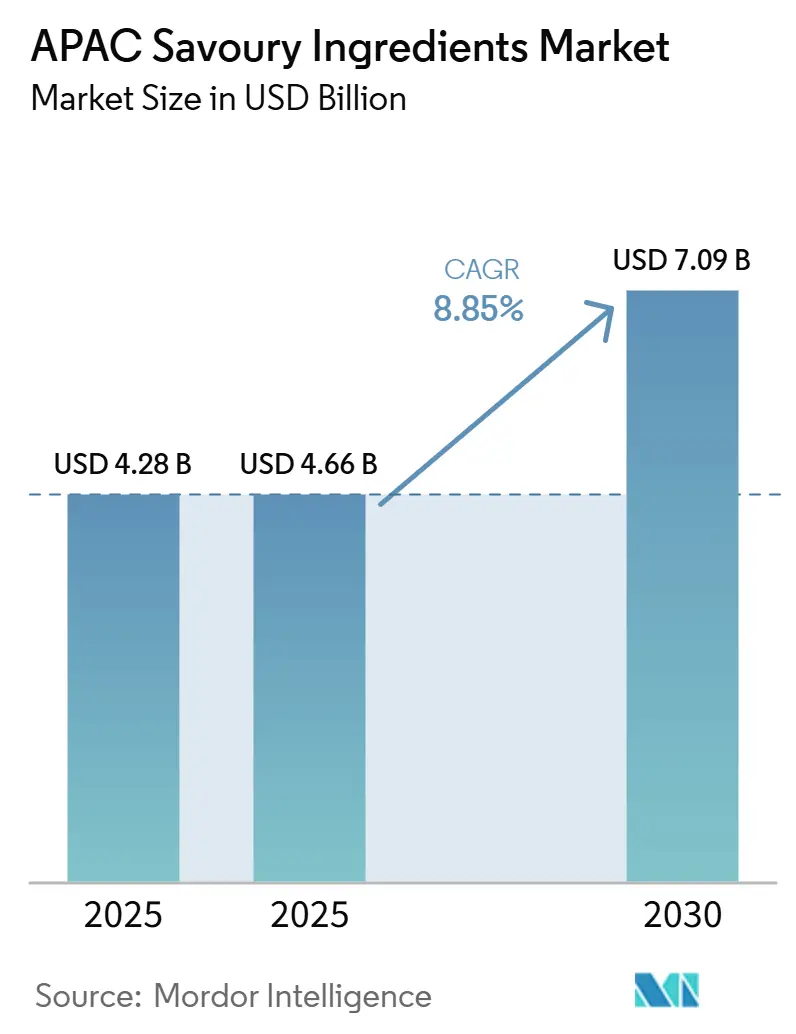
The Asia-Pacific savory ingredients market size is expected to grow from USD 4.28 billion in 2025 to USD 4.66 billion in 2026 and is forecast to reach USD 7.12 billion by 2031 at an 8.85% CAGR over 2026-2031. The Asia-Pacific savory ingredients market is moving higher because urbanization is supporting greater demand for processed and convenience foods across South Asia and Southeast Asia. The region also benefits from a long-standing preference for layered umami taste profiles, which keeps demand broad across condiments, snacks, soups, sauces, and ready meals. China remains central to regional supply because its fermentation infrastructure in provinces such as Shandong and Jiangsu supports both domestic demand and cross-border ingredient flows into other Asian food manufacturing bases. Cost improvements in fermentation and membrane separation have narrowed the gap between MSG and fermentation-derived systems, which is shifting more mid-tier formulations toward yeast extract and nucleotide blends. Companies with broad fermentation portfolios and direct sourcing links for spice inputs are better placed to manage input volatility and serve food makers that are balancing cost, taste, and sodium reformulation needs.
Key Report Takeaways
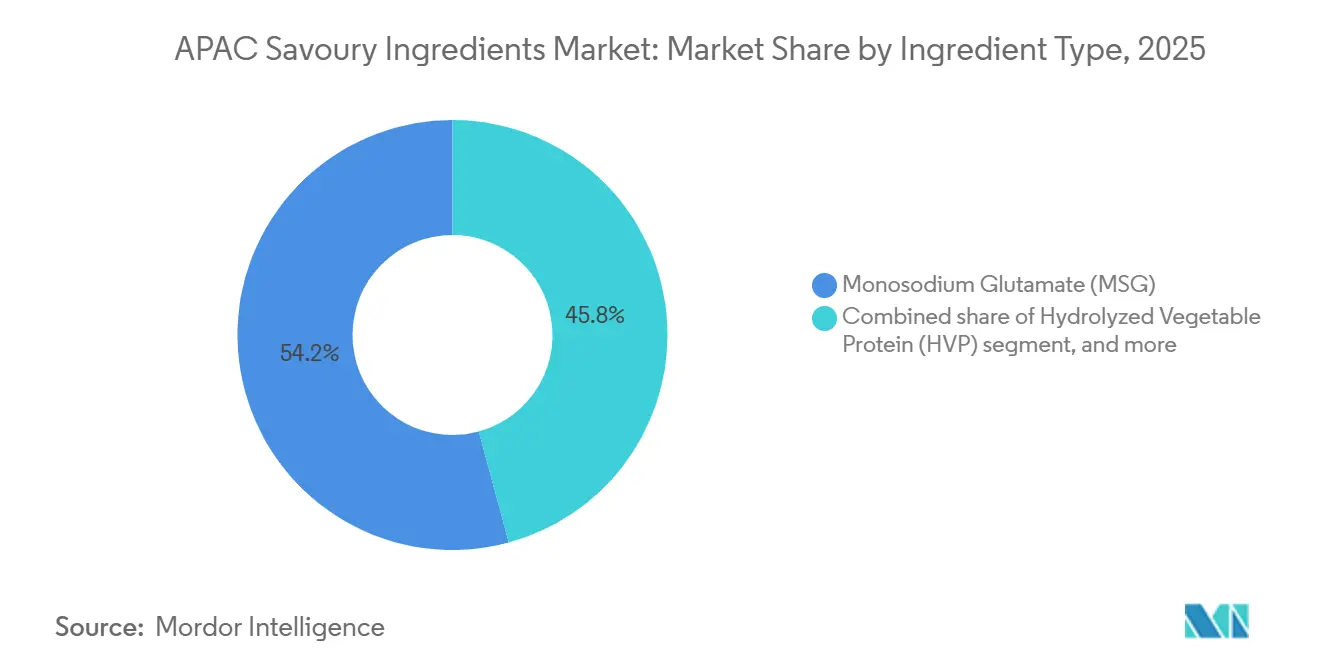
- By ingredient type, Monosodium Glutamate (MSG) held 54.21% of the segment in 2025, while Hydrolyzed Vegetable Protein (HVP) is projected to record the fastest CAGR of 10.45% through 2031.
- By origin, natural-origin ingredients accounted for 64.34% of the segment in 2025, while synthetic ingredients are forecast to grow fastest at a 9.45% CAGR through 2031.
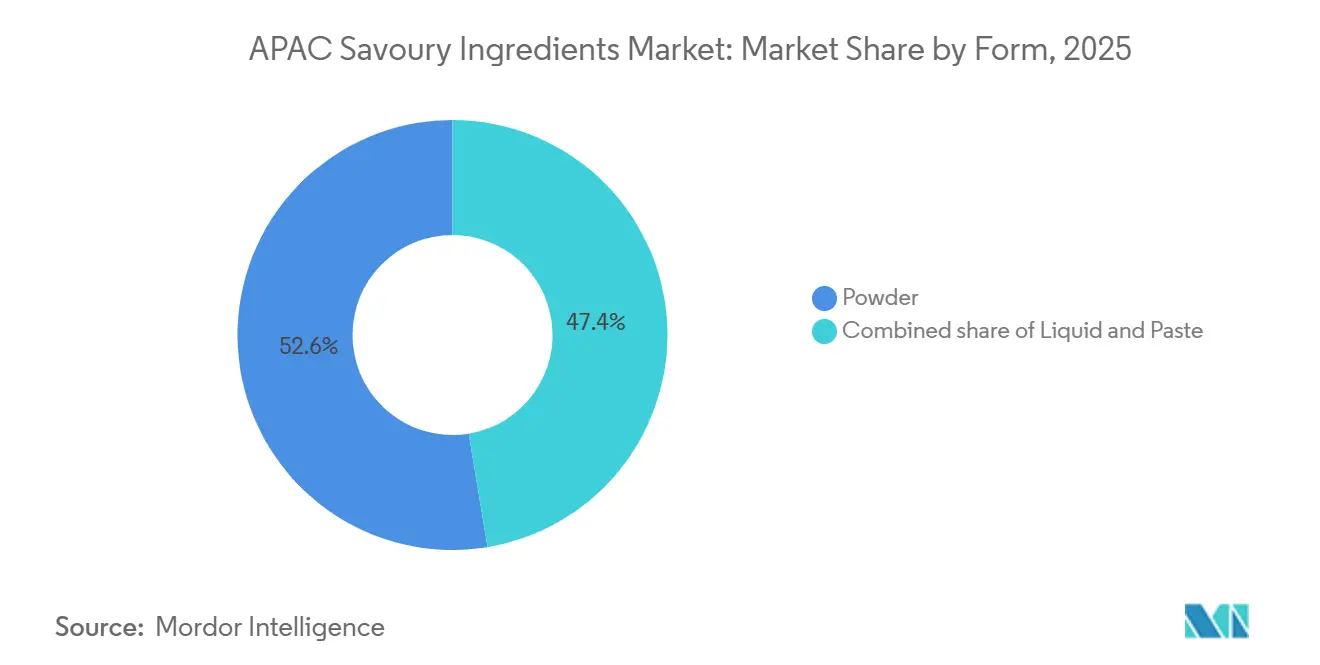
- By form, powder captured 52.60% of the segment in 2025, while paste is expected to advance at the highest CAGR of 9.12% through 2031.
- By application, soups, sauces, and condiments represented 39.12% of the segment in 2025, while ready meals are projected to expand fastest at an 11.45% CAGR through 2031.
- By geography, China held 36.14% of regional revenue in 2025, while India is forecast to record the fastest CAGR of 10.05% through 2031.
Note: Market size and forecast figures in this report are generated using Mordor Intelligence’s proprietary estimation framework, updated with the latest available data and insights as of January 2026.
Worldwide, activity is shaped by contributions from multiple regions, with Asia representing one of the more structurally developed among them. The global report on savory ingredients market by Mordor Intelligence reflects how these regional layers combine into a single system.
Market Trends and Insights
Drivers Impact Analysis of Asia-Pacific Savoury Ingredients Market*
| Driver | (~) % Impact on CAGR Forecast | Geographic Relevance | Impact Timeline |
|---|---|---|---|
| Rising demand for processed and convenience foods | +1.9% | China, India, Indonesia, Thailand | Medium term (2-4 years) |
| Growing preference for clean-label and natural ingredients | +1.4% | Japan, Australia, South Korea, Singapore | Long term (≥ 4 years) |
| Expansion of instant noodles and ready-to-eat meal production | +1.2% | China, Indonesia, Thailand, India | Short term (≤ 2 years) |
| Increasing adoption of fermentation-based Umami ingredients | +1.0% | Global Asia-Pacific, with concentration in Japan, China | Medium term (2-4 years) |
| Advancements in precision fermentation and flavor technologies | +0.8% | Singapore, Japan, Australia, South Korea | Long term (≥ 4 years) |
| Expanding applications of hydrolyzed vegetable protein | +0.6% | China, India, Thailand, Indonesia | Medium term (2-4 years) |
| Source: Mordor Intelligence | |||
Rising Demand for Processed and Convenience Foods
The Asia-Pacific savory ingredients market is experiencing sustained growth, driven by the increasing consumption of processed and convenience foods across rapidly urbanizing economies. As consumers seek greater convenience and reduced meal preparation time, food manufacturers are expanding their portfolios of ready-to-eat meals, instant foods, and packaged seasonings. India is emerging as a key growth market, supported by the expansion of its organized food-processing industry, rising domestic consumption, and growing export-oriented manufacturing. The rise in dual-income households and longer working hours has accelerated this shift, particularly among young urban professionals. Indonesia consumed 12-13 billion servings of instant noodles annually as of 2024, making it the second-largest market globally and increasing the demand for MSG, yeast extracts, and spice oleoresins in manufacturing[1]. This demographic transition creates consistent volume growth for savory ingredient suppliers, especially those providing cost-effective solutions that preserve authentic tastes across different regional preferences.
Increasing Adoption of Fermentation-Based Umami Ingredients
Fermentation-based umami ingredients are gaining wider adoption across the Asia-Pacific savory ingredients market, supported by improvements in production efficiency and cost competitiveness. According to Angel Yeast’s 2025 sustainability disclosures, the adoption of automated bioreactor systems reduced energy consumption per kilogram of yeast extract by 18%, helping narrow the cost difference between yeast extract and conventional MSG-based flavor systems. These efficiency improvements are making fermentation-derived ingredients increasingly viable beyond premium food products, supporting their incorporation into mid-range and value-oriented product formulations across markets such as Indonesia, Vietnam, and India. Additionally, Kerry reported in its Q1 2026 update that bio-fermented ingredients and enzymatic flavor systems achieved above-market performance across snack, meat, and dairy applications, with savory taste technologies demonstrating particularly strong momentum. As fermentation-derived ingredients become more cost-competitive, food manufacturers are expected to increasingly incorporate these solutions into mainstream product formulations, potentially reducing their reliance on conventional MSG-based flavor enhancers.
Advancements in Precision Fermentation and Flavor Technologies
The Asia-Pacific savory ingredients market is increasingly benefiting from advancements in precision fermentation and next-generation flavor technologies. These innovations are particularly significant for the production of high-value ingredients such as nucleotides, enzyme-modified yeast extracts, and reaction flavors, where enhanced functionality and product differentiation justify greater technological investment. In 2025, DSM-Firmenich introduced Vertis™ TVPs with ModulaSENSE®, integrating taste optimization with plant-based protein systems to reduce the need for additional flavor-masking processes. During the same year, Symrise announced a strategic investment in Cellibre to accelerate the commercialization of precision-fermented natural flavor ingredients, reinforcing its innovation pipeline for specialty taste solutions. Although advanced production capacity is currently concentrated in countries such as Japan, Singapore, and Australia, ongoing technological improvements and declining production costs are expected to support wider adoption of precision fermentation across the Asia-Pacific savory ingredients industry.
Growing Preference for Clean-Label and Natural Ingredients
The Asia-Pacific savory ingredients market is increasingly influenced by growing consumer preference for natural, recognizable, and clean-label ingredients.This shift is encouraging food manufacturers, particularly in premium and export-oriented segments, to reformulate traditional seasoning systems using more consumer-friendly ingredient solutions. In response, ingredient suppliers are expanding their portfolios with advanced fermentation-based alternatives. For example, Angel Yeast introduced moisture-resistant yeast extract solutions in 2025 that enable manufacturers to achieve up to 20% sodium reduction while maintaining flavor performance[2]. Consequently, specialty fermentation ingredients such as yeast extracts are gaining stronger adoption and pricing power in premium applications, whereas conventional commodity ingredients like MSG are increasingly concentrated in cost-sensitive, high-volume food categories.
Restraints Impact Analysis of Asia-Pacific Savoury Ingredients Market*
| Restraint | (~) % Impact on CAGR Forecast | Geographic Relevance | Impact Timeline |
|---|---|---|---|
| Regulatory concerns over MSG and sodium levels | -0.8% | Global Asia-Pacific, particularly Australia, Japan, South Korea | Short term (≤ 2 years) |
| Competition from traditional seasonings and condiments | -0.6% | China, India, Thailand, Indonesia | Medium term (2-4 years) |
| Supply chain volatility for spice extracts and oleoresins | -0.5% | India, China, Indonesia, Thailand | Short term (≤ 2 years) |
| High cost of natural savory ingredients | -0.5% | Japan, Australia, South Korea, Singapore | Long term (≥ 4 years) |
| Source: Mordor Intelligence | |||
Stringent Regulatory Scrutiny on MSG and Sodium Content
Regulatory and reputational scrutiny surrounding sodium and monosodium glutamate (MSG) is reshaping product development priorities across the Asia-Pacific savory ingredients market. Food manufacturers are increasingly reformulating products to meet evolving health expectations, strengthen clean-label positioning, and comply with tightening regulatory standards. In August 2024, the U.S. Food and Drug Administration (FDA) issued draft voluntary sodium reduction targets covering 163 processed food categories, influencing ingredient suppliers serving multinational food manufacturers and export-oriented markets. A 2025 study published in the Journal of Nutritional Science reported that over 50% of processed food products assessed in Malaysia contained MSG, with an average sodium content of 2,812 mg per 100 g, highlighting growing concerns over sodium intake and ingredient transparency. Trade policies are also adding complexity to the market. In January 2025, the U.S. Federal Register published antidumping rulings on MSG manufactured in Malaysia using Chinese-origin glutamic acid, increasing compliance requirements for manufacturers operating in international supply chains [3]. Although MSG continues to be approved for use across most global markets, the combined impact of regulatory developments, consumer health awareness, and trade-related compliance is accelerating the industry's shift toward alternative flavor-enhancing solutions such as yeast extracts, hydrolyzed vegetable proteins (HVPs), and other natural umami ingredients, enabling manufacturers to reduce sodium content while maintaining flavor performance and clean-label positioning.
Supply Chain Volatility for Spice Extracts and Oleoresins
Raw material sourcing for spice extracts and oleoresins has emerged as a significant operational challenge across the Asia-Pacific savory ingredients market. Manufacturers are facing persistent cost inflation, supply disruptions, and raw material volatility, requiring more resilient sourcing and procurement strategies. In March 2026, Plant Lipids reported that geopolitical disruptions increased the cost of extraction solvents and polymer inputs by 50–60%, while constrained LPG availability and extended logistics lead times further intensified production pressures. Similarly, Mane Kancor highlighted that Indian chili oleoresin processors were reallocating production capacity toward turmeric and curcumin as raw chili prices doubled year-on-year, while increasing competition from lower-cost Chinese suppliers continued to compress margins. Adding to these challenges, Citrus and Allied Essences reported that reduced crop acreage, adverse weather conditions, and elevated logistics costs have evolved into long-term structural issues rather than temporary disruptions. As a result, manufacturers relying on chili oleoresins for heat and flavor profiles are increasingly diversifying sourcing locations, qualifying alternative suppliers, and evaluating synthetic or nature-identical substitutes to strengthen supply resilience, manage input cost volatility, and ensure business continuity.
*Our forecasts treat driver/restraint impacts as directional, not additive. The impact forecasts reflect baseline growth, mix effects, and variable interactions.
Asia-Pacific Savoury Ingredients Market Segment Analysis
By Ingredient Type:
MSG Anchors Revenue While HVP Drives the Fastest GrowthMSG held 54.21% of the Asia-Pacific savory ingredients market share in 2025, and that position reflected its cost efficiency, strong solubility, and widespread use in high-volume processed food categories. Its adoption remains particularly strong in China, Indonesia, and Vietnam, where large-scale food processing industries continue to rely on affordable and consistent flavor enhancement solutions. Yeast extract represented the second-largest ingredient segment and continues to gain momentum as food manufacturers across Japan, South Korea, and Singapore increasingly reformulate products to meet clean-label and reduced-sodium consumer preferences. Nucleotides are also emerging as a high-value ingredient category due to their synergistic flavor-enhancing properties. By enabling manufacturers to reduce MSG usage by 20–30% without compromising taste, nucleotides help achieve sodium reduction objectives while maintaining product flavor. Reflecting their growing strategic importance, CJ CheilJedang established a dedicated Technology Materials division for nucleic-acid seasonings in 2026, reinforcing the increasing commercial significance of these specialty ingredients.
Among all ingredient categories, Hydrolyzed Vegetable Protein (HVP) is projected to register the fastest CAGR of 10.45% through 2031, supported by rising demand from plant-based meat alternatives, ready meals, processed seafood, and functional seasoning applications. Continued innovation in fermentation and hydrolysis technologies has also enhanced HVP's flavor profile and umami intensity, further expanding its application potential across premium food formulations. While spice and herb oleoresins continue to command the highest value within the savory ingredients portfolio, their near-term growth remains constrained by raw material price volatility, supply chain disruptions, and sourcing challenges.

By Origin:
Natural-Led Demand Coexists with Strong Synthetic GrowthNatural-origin ingredients accounted for 64.34% of the Asia-Pacific savory ingredients market in 2025, driven by the widespread use of fermentation-derived MSG, yeast extracts, and plant-based hydrolyzed vegetable proteins (HVPs) across the region's food manufacturing industry. Their strong market position reflects growing consumer preference for recognizable, naturally derived ingredients, particularly in Japan, Australia, South Korea, and Singapore, where clean-label purchasing behavior continues to influence product development. According to Cargill's APAC IngredienTracker 2025, ingredients perceived as natural received the highest consumer ratings for healthfulness and purchase intent across key Asian markets, reinforcing their importance in premium, export-oriented, and brand-sensitive food categories. As a result, fermentation- and plant-based savory ingredients remain central to manufacturers' reformulation strategies focused on clean labels, sodium reduction, and product differentiation.
Despite this trend, synthetic ingredients are projected to register a CAGR of 9.45% through 2031, outpacing the growth of the natural segment. Demand continues to be supported by large-scale, cost-sensitive food manufacturers, particularly in emerging Asia-Pacific markets, where synthetic flavor enhancers deliver comparable functional performance at 30–40% lower cost than many natural alternatives. Natural-origin ingredients continue to drive innovation in premium and health-focused products, while synthetic systems remain essential for value-oriented, high-volume food applications. Consequently, suppliers offering a balanced portfolio of both natural and synthetic savory ingredients are better positioned to address the diverse pricing, functionality, and formulation requirements of the Asia-Pacific food manufacturing industry.
By Form:
Powder Leads Current Volume While Paste Gains Share in Premium UsesPowder remained the leading form in the Asia-Pacific savory ingredients market, accounting for 52.60% of market share in 2025, owing to its ease of handling, extended shelf life, cost efficiency, and compatibility with large-scale industrial manufacturing processes. These advantages are particularly significant across Southeast Asia, where ambient-temperature distribution networks and decentralized food production continue to favor stable dry ingredients. Markets such as Indonesia, Vietnam, and Thailand remain strong adopters of powdered savory ingredients due to established processing practices and limited dependence on temperature-controlled supply chains. Liquid savory ingredients continue to hold a significant position, driven by their rapid solubility and ease of incorporation into aqueous food systems such as soups, sauces, marinades, gravies, and meat processing applications.
Among all product forms, paste is projected to register the fastest CAGR of 9.12% through 2031, supported by increasing demand for enhanced viscosity control, uniform flavor distribution, and consistent product performance in premium foodservice and prepared meal applications. Japan, South Korea, and Australia are at the forefront of this transition, where foodservice operators and premium food manufacturers increasingly utilize concentrated paste formulations to improve portion control, operational efficiency, and flavor consistency. This evolving demand indicates that format diversification is expanding market opportunities rather than replacing existing product forms.
By Application:
Ready Meals Accelerate While Traditional Categories Keep ScaleSoups, sauces, and condiments accounted for 39.12% of the Asia-Pacific savory ingredients market in 2025, making them the largest application segment. Their dominance is driven by the region's extensive production and consumption of bouillons, cooking sauces, seasoning pastes, and condiments, which serve both household and foodservice demand across diverse culinary traditions. In addition, savory snacks and meat, poultry, and seafood processing continue to generate stable demand, supported by snack premiumization and the growing use of hydrolyzed vegetable protein (HVP) and other flavor enhancers to improve taste, texture, and nutritional value. By comparison, dairy applications represent a relatively smaller segment, with savory ingredients primarily used in processed cheese products, cheese-flavored coatings, and dairy alternatives.
Among all application areas, ready meals are projected to register the fastest CAGR of 11.45% through 2031, driven by rapid urbanization, changing lifestyles, and rising demand for convenient, ready-to-eat food solutions. The continued expansion of e-commerce grocery platforms and modern retail channels is further accelerating category growth. Reflecting this trend, Ajinomoto Thailand introduced its UMAI frozen ready-to-eat meal range in 2026, leveraging Japanese culinary expertise to address growing consumer demand for premium convenience foods.
These developments highlight a broader shift in the Asia-Pacific savory ingredients market toward value-added applications that require integrated flavor systems rather than single-function taste enhancers. As manufacturers increasingly focus on delivering authentic taste, sodium reduction, and clean-label formulations, demand is expected to rise for advanced umami solutions that combine multiple functional ingredients to enhance flavor, texture, and overall product performance.
Geography Analysis
China Savoury Ingredients Market
China accounted for 36.14% of the Asia-Pacific savory ingredients market in 2025, maintaining its leadership through its extensive fermentation capacity, large-scale food manufacturing base, and continued investment in biotechnology. The country's dominance is reinforced by major domestic producers such as Fufeng Group, whose 2025 performance highlighted MSG and food additives as its core revenue contributors, and ongoing capacity expansion projects, including Meihua Holdings' 300,000-tonne-per-year fermentation facility in Inner Mongolia. Although China's growth is expected to moderate as the market matures, it will remain the region's primary production hub, supplying both domestic demand and neighboring export markets through its well-established manufacturing ecosystem.
India Savoury Ingredients Market
India is projected to register the fastest CAGR of 10.05% through 2031, driven by rapid urbanization, expanding organized retail, increasing quick-service restaurant penetration, and supportive government initiatives promoting food processing. Continued investments by global ingredient manufacturers, including DSM-Firmenich's expansion of its seasoning facility in Kerala and the development of a new taste manufacturing plant in Vadodara, reflect strong confidence in India's long-term demand potential and growing importance within the regional supply chain.
APAC Savoury Ingredients Market
While Japan and South Korea represent relatively mature markets, they continue to play a pivotal role in driving innovation through advanced taste technologies, clean-label ingredient development, and premium flavor solutions. Investments in specialty platforms, such as CJ CheilJedang's dedicated nucleotide business, further reinforce the region's leadership in high-value savory ingredient innovation. Beyond the major markets, Indonesia, Thailand, Singapore, and Australia play strategic roles in the Asia-Pacific savory ingredients market. Indonesia is emerging as a high-growth market, driven by its large consumer base and expanding packaged food industry. Thailand serves as a key regional manufacturing and export hub for processed foods, supporting steady demand for savory ingredients. Singapore leads in biotechnology and precision fermentation, while Australia drives premium product innovation through its emphasis on clean-label formulations and high food quality standards. Together, these markets are strengthening the region's growth, innovation, and supply chain capabilities.
Competitive Landscape
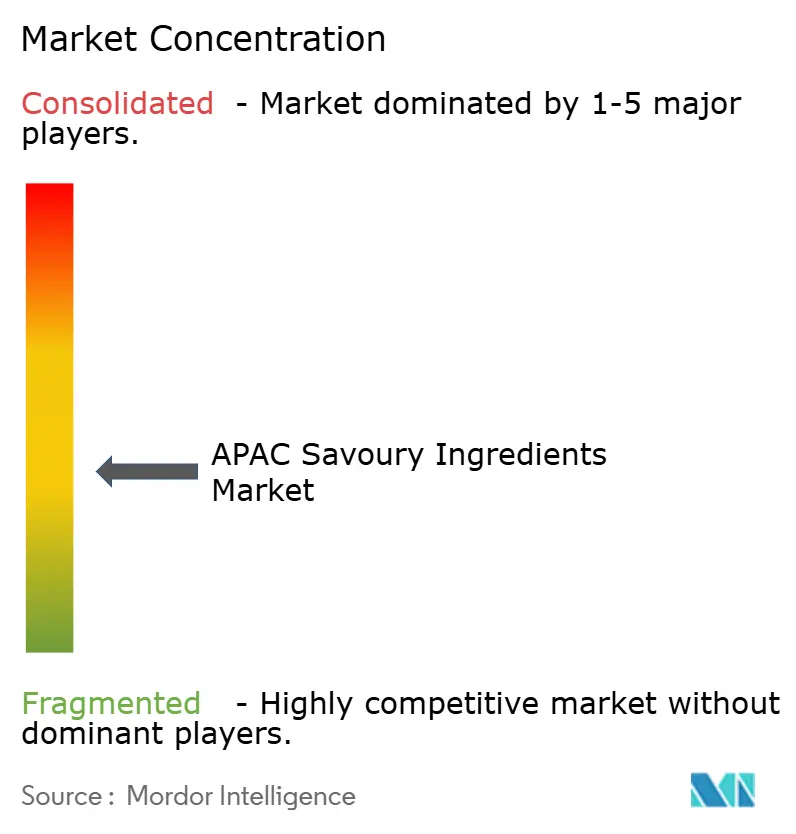
The Asia-Pacific savory ingredients market remains moderately fragmented, with competition spanning global flavor houses, regional companies, and numerous local manufacturers. Global players primarily compete through proprietary technologies, formulation expertise, and application support, while regional producers leverage large-scale fermentation capacity, cost efficiency, and reliable supply to serve high-volume food manufacturers.
Technology and innovation are becoming key differentiators in premium applications. Investments in advanced fermentation, taste modulation, and bio-based ingredient technologies are enabling manufacturers to deliver enhanced flavor, sodium reduction, and clean-label solutions while improving production efficiency. Companies with integrated capabilities in flavor optimization and functional ingredient development are increasingly strengthening their position in premium food and beverage applications.
Recent strategic developments also highlight the evolving competitive landscape. Portfolio restructuring, investments in precision fermentation, and expansion of regional manufacturing facilities demonstrate the industry's focus on innovation, localization, and supply chain resilience. While the market is expected to remain fragmented, competition is likely to intensify in high-value segments such as specialty fermented ingredients, reaction flavors, and advanced taste modulation systems.
Asia-Pacific Savoury Ingredients Industry Leaders
-
Associated British Foods plc
-
Ajinomoto Co., Inc.
-
Angel Yeast Co., Ltd.
-
Lesaffre et Compagnie
-
Meihua Holdings
- *Disclaimer: Major Players sorted in no particular order
Asia-Pacific Savoury Ingredients Market Companies Covered in this Report
- Ajinomoto Co., Inc.
- Angel Yeast Co., Ltd.
- Fufeng Group Limited
- DSM-Firmenich AG
- Kerry Group plc
- Givaudan SA
- Lesaffre et Compagnie
- Meihua Holdings Group Co., Ltd.
- Symrise AG
- International Flavors & Fragrances Inc.
- Sensient Technologies Corporation
- Vedan International (Holdings) Limited
- CJ CheilJedang Corporation
- Kikkoman Corporation
- Dohler Group SE
- Takasago International Corporation
- Lee Kum Kee Company Limited
- Archer Daniels Midland Company (ADM)
- Hugli Holding AG
Recent Industry Developments in Asia-Pacific Savoury Ingredients Market
- July 2026: Givaudan inaugurated a CHF 50 million (approximately USD 60 million) production facility in Cikarang, West Java, Indonesia, spanning 24,000 sqm, dedicated to manufacturing savory, sweet, and snack flavor powders for domestic Indonesian demand and Southeast Asian export markets. The facility creates approximately 60 jobs with capacity designed for future expansion, and represents Givaudan's most consequential single manufacturing investment in Asia-Pacific to date.
- October 2025: Symrise announced a strategic equity investment in US-based biotech company Cellibre, integrating Cellibre's microorganism-engineering platform with Symrise's global flavor and fragrance expertise to accelerate commercialization of precision-fermented natural flavor ingredients applicable to its savory and taste portfolios.
- July 2024: Lesaffre introduced a yeast extract product line in the Asia-Pacific region in July 2025. The product range focuses on enhancing flavor and nutritional content in savory foods, targeting food manufacturers and culinary applications, with an emphasis on natural ingredients and clean-label solutions.
Asia-Pacific Savoury Ingredients Market Report Scope
The Asia-Pacific Savory Ingredients Market comprises ingredients used to enhance the taste, aroma, and umami profile of processed foods, foodservice products, and culinary applications. The market is segmented by Ingredient Type into Monosodium Glutamate (MSG), Yeast Extract, Hydrolyzed Vegetable Protein (HVP), Nucleotides, Spice & Herb Oleoresins, and Others. Based on Origin, the market is classified into Natural and Synthetic ingredients. By Form, the market is categorized into Powder, Liquid, and Paste, while by Application, it is segmented into Savory Snacks, Soups, Sauces, Seasonings & Dressings, Meat, Poultry & Seafood Products, Ready Meals, Dairy Products, and Others. Geographically, the study covers China, India, Japan, South Korea, Indonesia, Thailand, Vietnam, Australia, Singapore, Malaysia, and the Rest of Asia-Pacific. The market size and forecasts are provided in value (USD Million) and Volume (in tons) for all segments throughout the study period.
Segmentation Overview
| Monosodium Glutamate (MSG) |
| Yeast Extract |
| Hydrolyzed Vegetable Protein (HVP) |
| Nucleotides |
| Spice and Herb Oleoresins |
| Others |
| Natural |
| Synthetic |
| Powder |
| Liquid |
| Paste |
| Savory Snacks |
| Dairy Products |
| Meat, Poultry and Seafood |
| Soups, Sauces and Condiments |
| Ready Meals |
| Others |
| China |
| India |
| Japan |
| Australia |
| South Korea |
| Indonesia |
| Thailand |
| Singapore |
| Rest of Asia-Pacific |
| By Ingredient Type | Monosodium Glutamate (MSG) |
| Yeast Extract | |
| Hydrolyzed Vegetable Protein (HVP) | |
| Nucleotides | |
| Spice and Herb Oleoresins | |
| Others | |
| By Origin | Natural |
| Synthetic | |
| By Form | Powder |
| Liquid | |
| Paste | |
| By Application | Savory Snacks |
| Dairy Products | |
| Meat, Poultry and Seafood | |
| Soups, Sauces and Condiments | |
| Ready Meals | |
| Others | |
| By Geography | China |
| India | |
| Japan | |
| Australia | |
| South Korea | |
| Indonesia | |
| Thailand | |
| Singapore | |
| Rest of Asia-Pacific |
Key Questions Answered in the Report
What is the current size of the Asia-Pacific savory ingredients market?
The Asia-Pacific savory ingredients market stands at USD 4.66 billion in 2026 and is forecast to reach USD 7.12 billion by 2031 at an 8.85% CAGR.
Which ingredient type leads regional revenue?
MSG led ingredient type revenue with a 54.21% share in 2025 because of its cost efficiency, solubility, and wide use in processed foods across China, Indonesia, and Vietnam.
Why is China so important in this space?
China held 36.14% of regional revenue in 2025 and remains the main fermentation base for the region, supported by scale, feedstock access, and continued capacity investment.
What is driving faster adoption of yeast extract and other fermentation-based systems?
Cost improvements in fermentation, clean-label demand, and sodium reformulation needs are making yeast extract and related systems more attractive across premium and mid-tier food products.