
Aircraft Towbar Market Size and Share
Market Overview
| Study Period | 2019 - 2031 |
|---|---|
| Market Size (2026) | USD 4.91 Billion |
| Market Size (2031) | USD 6.45 Billion |
| Growth Rate (2026 - 2031) | 5.60 % |
| Fastest Growing Market | Asia Pacific |
| Largest Market | North America |
| Market Concentration | Low |
Major Players *Disclaimer: Major Players sorted in no particular order Image © Mordor Intelligence. Reuse requires attribution under CC BY 4.0. | |
Aircraft Towbar Market Analysis by Mordor Intelligence
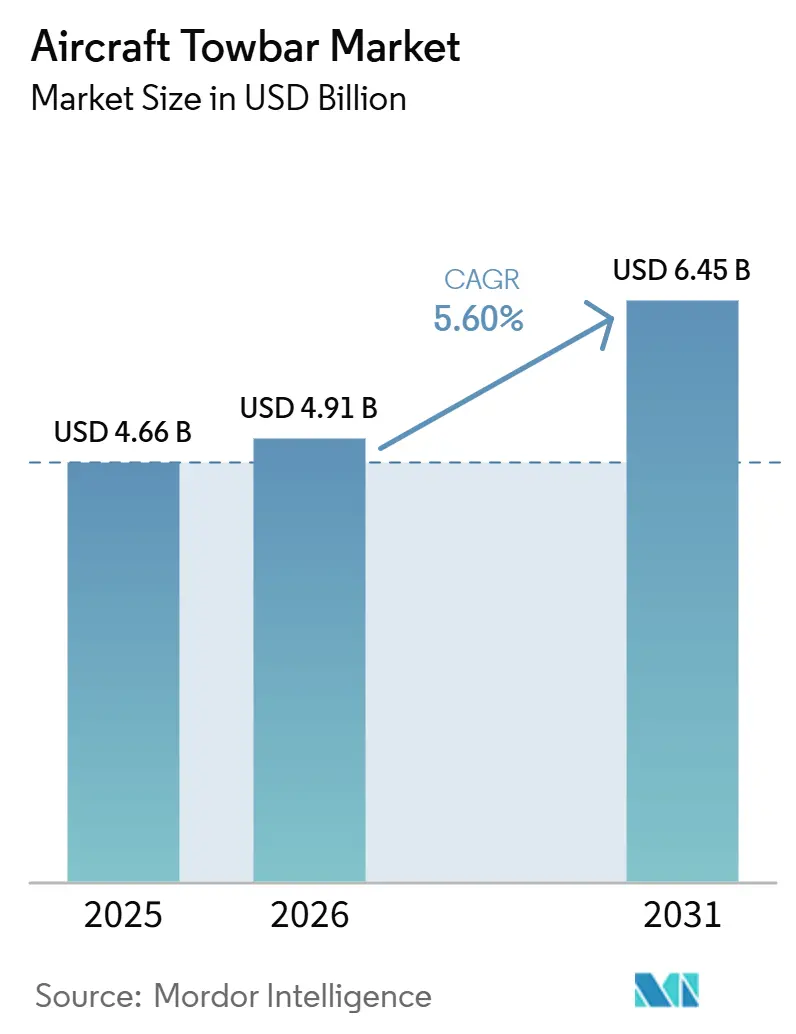
The aircraft towbar market size was valued at USD 4.66 billion in 2025 and estimated to grow from USD 4.91 billion in 2026 to reach USD 6.45 billion by 2031, at a CAGR of 5.60% during the forecast period (2026-2031). The aircraft towbar market remains closely linked to commercial fleet growth because each newly delivered aircraft requires type-specific towing equipment across airlines, ground handlers, and MRO operators. That connection is reinforced by strong delivery activity and a large production backlog. The aircraft towbar market is also supported by airport expansion programs in Asia-Pacific and the Middle East, where large capital commitments are creating fresh demand for ramp equipment inventories at both new and upgraded airports. A second layer of demand is coming from the shift toward electric ground support equipment, which is raising replacement activity and moving procurement toward higher-value equipment categories. The aircraft towbar market is still challenged by the spread of towbarless tractors at major hubs and by delivery bottlenecks in aircraft production. Still, those pressures remain concentrated in selected operating environments rather than across the full addressable base. The aircraft towbar market also remains open to opportunity because competition is fragmented, and vendors can still build position through electric models, multi-head systems, and region-specific aircraft compatibility.
Key Report Takeaways
- By towbar type, rigid and standard towbars led with 40.54% revenue share in 2025, while electric and self-powered towbars are forecast to expand at a 7.24% CAGR through 2031.
- By aircraft type, commercial aviation held 56.27% revenue share in 2025, while eVTOL and light electric aircraft are forecast to grow at an 8.91% CAGR through 2031.
- By end user, airport ground handling companies held 37.79% revenue share in 2025, while cargo operators are forecast to grow at a 6.34% CAGR through 2031.
- By material, high-strength steel and chromoly accounted for 32.25% revenue share in 2025, while composite-fiber towbars are projected to grow at a 7.18% CAGR through 2031.
- By geography, North America held 41.98% of the aircraft towbar market share in 2025, while Asia-Pacific is projected to grow at a 6.52% CAGR through 2031.
Note: Market size and forecast figures in this report are generated using Mordor Intelligence’s proprietary estimation framework, updated with the latest available data and insights as of January 2026.
Market Trends and Insights
Drivers Impact Analysis of Aircraft Towbar Market*
| Driver | (~) % Impact on CAGR Forecast | Geographic Relevance | Impact Timeline |
|---|---|---|---|
| Rapid growth in global commercial aircraft fleet and MRO demand | 1.40% | Global | Short term (≤ 2 years) |
| Airport infrastructure expansion across emerging economies | 1.00% | Asia-Pacific, Middle East and Africa core, spill-over to South America | Medium term (2-4 years) |
| Accelerating shift toward electric ground support equipment mandates | 0.90% | Global, led by Europe and North America | Medium term (2-4 years) |
| OEM push for mixed-fleet compatible multi-head towbars | 0.70% | Global | Medium term (2-4 years) |
| eVTOL and light electric aircraft ground handling requirements | 0.60% | North America and Europe, expanding to Asia-Pacific | Long term (≥ 4 years) |
| Towbar leasing and equipment-as-a-service adoption | 0.50% | North America and Europe | Long term (≥ 4 years) |
| Source: Mordor Intelligence | |||
Rapid Growth in Global Commercial Aircraft Fleet
Fleet expansion remains the clearest near-term driver of demand for the aircraft towbar market. Global commercial aircraft deliveries rose 25% year over year in 2025 to 1,411 units, while widebody deliveries increased 43% to 246 aircraft, and ADS pointed to continued momentum into 2026. The return of widebody production growth and the entry of aircraft such as the A321XLR are creating new orders for larger-frame towing systems that had seen limited renewal for several years. Each aircraft delivery entails procurement not only at induction but also throughout the aircraft's operating life, because most commercial towbar setups remain aircraft-type-specific. SAE ARP1915E, reaffirmed in February 2026, continues to guide tow bar connection dimensions by mass category, and that standard keeps procurement tightly aligned with OEM and operator requirements.[1]
Airport Infrastructure Expansion Across Emerging Markets
Large airport construction programs are widening the installed base for the aircraft towbar market because every new stand, terminal, and remote bay requires supporting ramp equipment. ACI Asia-Pacific and Middle East placed airport investment at USD 240 billion for 2025-2035, including USD 136 billion for brownfield modernization and USD 104 billion for greenfield development. Dubai’s Al Maktoum International Airport moved ahead with AED 55 billion (USD 15 billion) in contracts to be awarded in 2026 for Phase 1 works, indicating a long procurement cycle for ground support equipment. Greenfield sites are especially valuable because they lack legacy equipment pools and therefore start with higher initial towbar inventories than established airports. IATA ground handling frameworks and civil aviation operating rules also support baseline equipment ratios, which help maintain procurement demand even when airline preferences differ.
Accelerating Shift Toward Electric Ground Support Equipment
The move toward eGSE is creating a replacement cycle that is adding momentum to the aircraft towbar market alongside normal renewal demand. ACI World issued its Electric Ground Support Equipment Implementation Guidance for Airports in 2026, giving airports a formal roadmap for electric fleet planning and execution. Hawaiian Airlines lifted the electric share of its Honolulu ground fleet to 73% in June 2026 with 116 battery-electric units supported by 30 charging stations and 60 charging points. Electric towbars typically sell at a 20-35% premium over conventional steel models, so even modest adoption can drive value growth faster than unit growth. Commission Delegated Regulation (EU) 2025/20 and the related EASA compliance material are also raising the standards environment around ground handling organizations in Europe, which is likely to keep electric fleet programs moving.[2]
OEM Push for Mixed-Fleet Compatible Multi-Type Towbars
Mixed-fleet operators are pushing the aircraft towbar market toward modular designs that can serve multiple aircraft families from a common platform. Airlines and ground handlers want single-bar systems with interchangeable tow heads because they reduce capital spending and cut storage pressure on the apron. Product ranges from HYDRO Systems, Tronair, and Langa Industrial show that a single main tube can support more than 60 attachment configurations, making universal systems more attractive for mixed commercial fleets. ISO 8267-2:2023 standardizes the attachment interface for regional aircraft with a maximum ramp mass of up to 50,000 kg, helping expand the practical use of multi-type solutions within defined mass classes. The trade-off is that operators become more dependent on vendor-specific tow heads and spare availability, making aftermarket support a more important part of supplier selection in the aircraft towbar market.
Restraints Impact Analysis of Aircraft Towbar Market*
| Restraint | (~) % Impact on CAGR Forecast | Geographic Relevance | Impact Timeline |
|---|---|---|---|
| Towbar-less tractor adoption at major hubs | -0.60% | Global hub airports, led by Europe and North America | Medium term (2-4 years) |
| Cyclic volatility in aircraft production and deliveries | -0.40% | Global | Short term (≤ 2 years) |
| Regulatory qualification burden for load testing and fatigue validation | -0.20% | Global | Medium term (2-4 years) |
| Supply constraints for aerospace-grade lightweight materials | -0.30% | Global, acute in North America and the European Union | Medium term (2-4 years) |
| Source: Mordor Intelligence | |||
Towbar-Less Tractor Adoption at Major Hubs
Towbarless systems remain the clearest structural restraint on the aircraft towbar market at large hub airports. Goldhofer introduced the all-electric Atlas 2 in September 2025 as a towbarless platform capable of handling aircraft ranging from the ERJ-170 to the B777-300ER, thereby widening the addressable range for zero-emission towbarless operations.[3] KLM also deployed electric Goldhofer Phoenix AST2E tow tractors at Amsterdam Schiphol in December 2025 under a lease arrangement with TCR, indicating that major carriers are already replacing towbar-dependent ramp setups in select operations. The effect is strongest at high-throughput narrowbody gates. At the same time, regional airports, cargo ramps, military sites, and MRO facilities still rely heavily on conventional systems due to cost and operational flexibility. EASA’s current ground handling framework also supports continued backup capability during transition periods, which limits the immediate reach of full displacement.
Supply Constraints for Aerospace-Grade Lightweight Materials
Material availability is another constraint because the aircraft towbar market is moving toward composite and lightweight products faster than supply chains can adjust. Composite-fiber towbars depend on aerospace-grade carbon fiber precursors and aluminum inputs that remain exposed to concentrated production and geopolitical risk. A 2024 peer-reviewed study in Sustainable Materials and Technologies confirmed the performance and weight benefits of filament-wound composite towbars but also noted greater supply chain complexity than with metallic alternatives. The five-year Syensqo and Toray agreement, which took effect in January 2026, helps improve carbon fiber security for aerospace applications, yet towbar makers still lag behind airframe programs in many allocation chains. These constraints are likely to keep lead times elevated and slow adoption among regional airports, charter operators, and other price-sensitive buyers in the aircraft towbar market.
*Our forecasts treat driver/restraint impacts as directional, not additive. The impact forecasts reflect baseline growth, mix effects, and variable interactions.
Aircraft Towbar Market Segment Analysis
By Towbar Type:
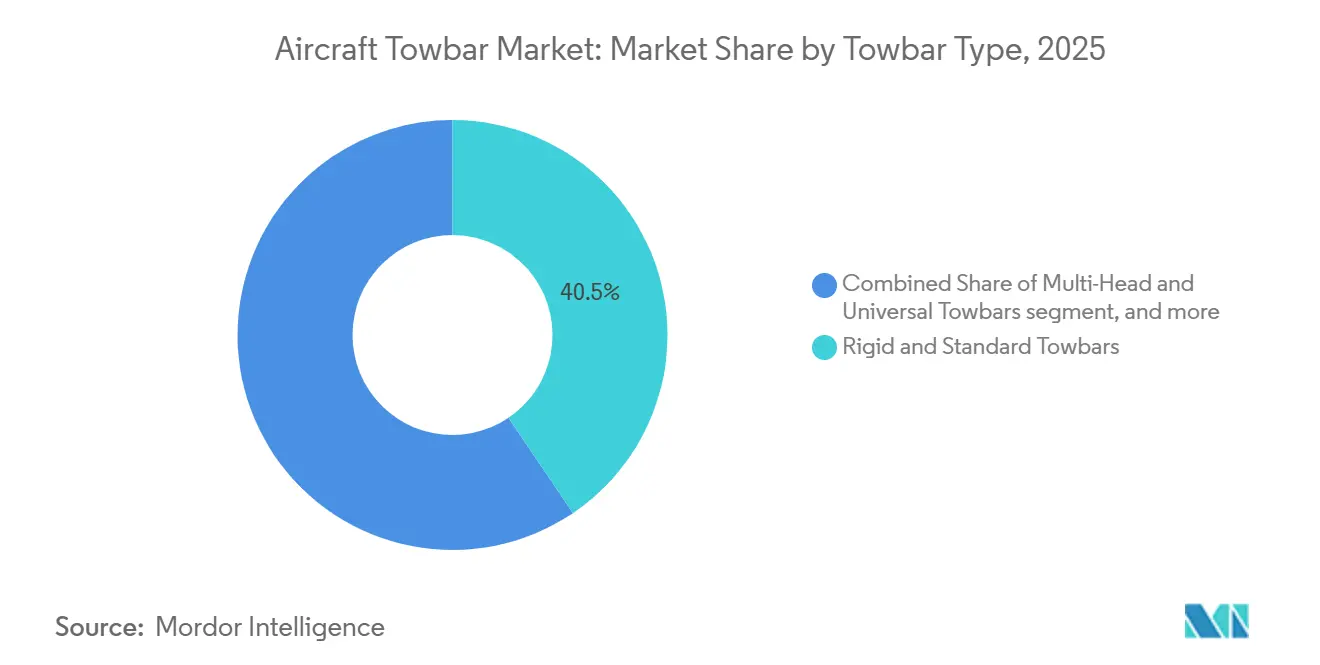
Rigid Towbars Lead, Electric Variants Outpace the MarketRigid and standard towbars held 40.54% of the aircraft towbar market share in 2025, which kept them in the lead across towbar type demand. Their position reflects low unit cost, broad operator familiarity, straightforward compliance with established towing standards, and a deep aftermarket for replacement parts and service. The segment also benefits from the narrowbody bias of global commercial hub operations, where standardized procedures still favor proven conventional equipment. Adjustable and telescopic variants remain smaller in volume. Still, they continue to play a practical role in remote-stand use and maintenance environments where nose gear height variation matters more than fleet throughput.
Multi-head and universal products are gaining ground as the aircraft towbar market shifts toward mixed-fleet efficiency and lower apron storage needs. A single main bar with interchangeable tow heads can support dozens of aircraft attachment points, making these systems useful for operators that cover both widebody and narrowbody traffic from the same ramp base. The aircraft towbar market size for electric and self-powered towbars is projected to expand at a 7.24% CAGR through 2031, making this the fastest-growing type segment. That growth is tied to airport and ground handler electrification programs, while battery integration is also opening aftermarket revenue in chargers, battery packs, controls, and software support.

By Aircraft Type:
Commercial Aviation Anchors Demand, eVTOL Opens a New Equipment TierCommercial aviation accounted for 56.27% of segment demand in 2025, which made it the largest aircraft category in the aircraft towbar market. Narrowbody platforms such as the A320 family and B737 MAX create the highest daily towbar usage rates, so they remain the largest volume base for routine procurement and replacement. Widebody aircraft generate fewer units but higher-value orders because larger compatible systems carry higher selling prices and stricter operating requirements. Regional jets also remain relevant because network growth into secondary cities continues to support new deliveries and demand for related ground equipment in several developing aviation markets.
Military and general aviation present a more fragmented demand pattern in the aircraft towbar market because specifications vary more widely across platforms and mission profiles. Military work often requires custom towbar designs and certification pathways, which protect revenue for vendors that already hold defense-related approvals. The aircraft towbar market size for eVTOL and light electric aircraft is projected to grow at an 8.91% CAGR through 2031, making it the fastest-growing aircraft-type segment. That category is still small in revenue terms today. Still, low coupling heights, lighter structures, and differing tow interfaces are creating a new equipment tier that could turn into a stronger procurement cycle once certifications become more common.
By End User:
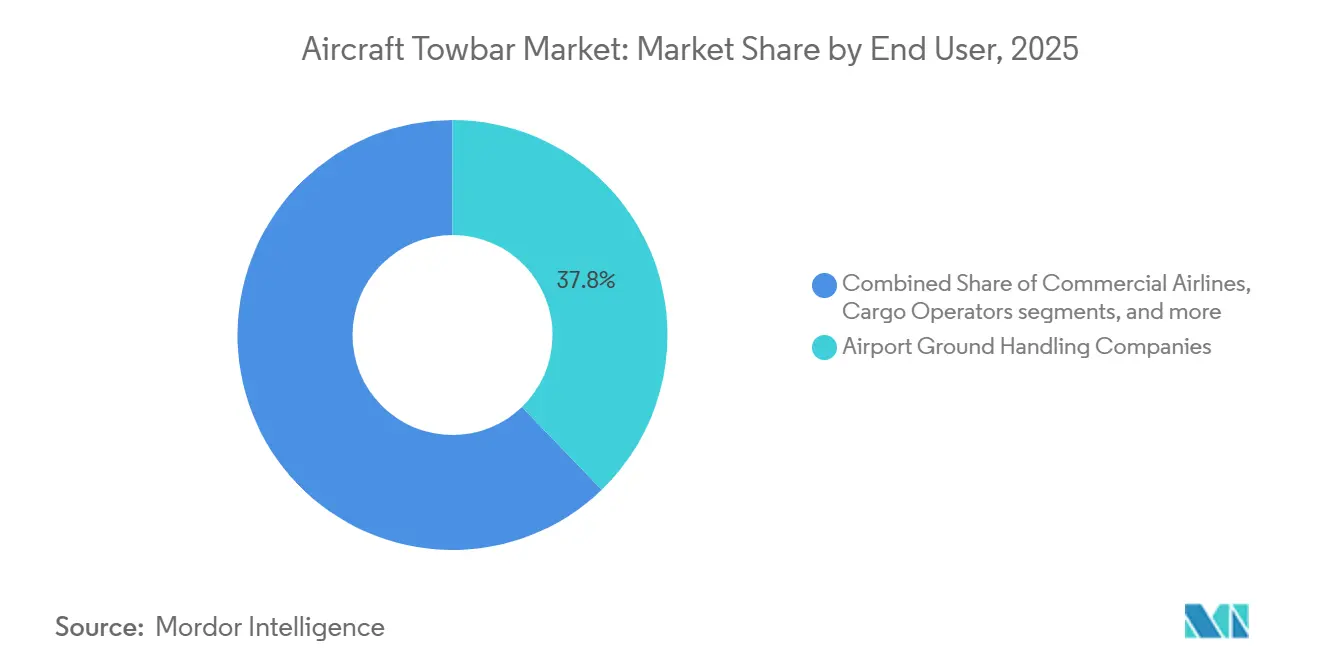
Ground Handlers Dominate, Cargo Operators Gain Strategic MomentumAirport ground handling companies accounted for 37.79% of end-user demand in 2025, giving them the largest customer position in the aircraft towbar market. Their scale matters because a single supplier agreement with a large handler can deploy equipment across many airport stations at once. Commercial airlines form the next major customer group, especially when they retain in-house ramp operations and keep fleet-specific inventories under direct control. MRO and line maintenance facilities add stable demand through hangar towing, positioning work, and maintenance-grade towbar purchases, all of which require flexibility across different aircraft families.
Cargo operators are the fastest-growing end-user group, with a 6.34% CAGR expected through 2031 in the aircraft towbar market. Their momentum comes from freighter fleet growth and the continued conversion of passenger widebodies into cargo aircraft, both of which expand equipment needs at specialized ramps and converted facilities. Cargo operations also tend to run intensive movement schedules, which can increase towbar wear and shorten replacement intervals relative to nominal product life assumptions. FBOs, charter operators, and government aviation agencies remain a fragmented but meaningful customer base, especially for general aviation and military applications.
By Material:
Steel Alloys Retain Volume Share, Composites Redefine Lifecycle ValueHigh-strength steel and chromoly towbars accounted for 32.25% of segment demand in 2025, maintaining their position as the leading material class in the aircraft towbar market. Their continued strength comes from cost competitiveness, broad OEM acceptance, familiar maintenance practices, and an established service network. Load testing history also matters because steel-based designs fit easily within the certification habits and inspection routines already used by many operators. Aluminum-alloy products sit just below steel-based options in practical use, especially in portable and fly-away setups where lower handling weight improves ramp safety and ease of movement.
Composite-fiber towbars are the fastest-growing material segment in the aircraft towbar market, with a 7.18% CAGR projected through 2031. The 2024 Sustainable Materials and Technologies study showed that filament-wound carbon-fiber-reinforced polymer towbars can deliver meaningful weight savings while maintaining load compliance.[4] The same study also highlighted higher supply chain complexity, which is one reason adoption remains uneven across operator groups. The April 2026 Syensqo-Toray supply agreement should ease some raw material pressure over time. However, operators still need updated inspection routines and retrained maintenance teams before composite products can scale more quickly.
Geography Analysis
North America and Europe Aircraft Towbar Market
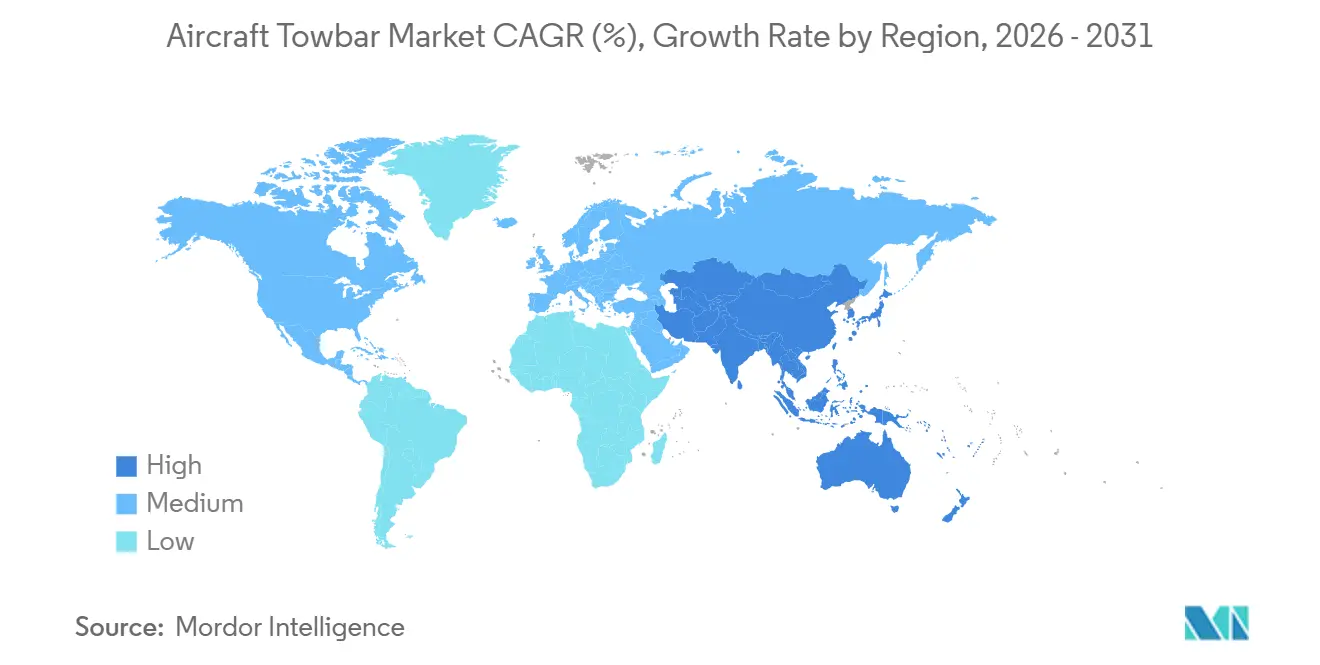
North America accounted for 41.98% of the aircraft towbar market share in 2025, making it the largest regional base in the market. The region benefits from dense commercial flight activity, large hub networks, and a mature ecosystem of OEMs, service providers, and aftermarket support, heavily centered in the US. Suppliers such as Tronair, HALL Industries, and AERO Specialties also gain from proximity to airline customers and long-established procurement channels tied to US aviation operations. Leasing remains a useful differentiator because North America accounts for only 10% of GSE assets under lease models. In contrast, Europe accounts for roughly half of all GSE assets under lease structures, often with maintenance bundled in full-service agreements. Europe remains a mature and high-value region for the aircraft towbar market, and stricter compliance expectations under Commission Delegated Regulation (EU) 2025/20 continue to drive demand for certified, higher-specification equipment.
APAC Aircraft Towbar Market
The aircraft towbar market size for Asia-Pacific is projected to expand at a 6.52% CAGR through 2031, making it the fastest-growing regional segment. ACI Asia-Pacific and the Middle East identified USD 240 billion in airport investment across the region for 2025-2035, providing the aircraft towbar market with a strong pipeline of future ground support procurement. China, India, Japan, and South Korea remain the main demand centers, and China’s domestic aircraft programs add a specific opening for COMAC-compatible towbar configurations that are still underpenetrated by many Western suppliers. Vietnam’s Long Thanh International Airport remained on track for commercial operations in December 2026, while Taiwan Taoyuan Airport’s Terminal 3 project, budgeted at TWD 128.7 billion (USD 4.02 billion), also moved toward completion, and Narita’s Level 4 autonomous towing deployment shows how quickly some Asia-Pacific operators are folding automation into ramp strategy.
MEA, South America and Turkey Aircraft Towbar Market
South America brings steadier, more measured growth to the aircraft towbar market, with Brazil at the center due to its large domestic aviation base and ongoing airport upgrade activity. The Middle East and Africa show a more capital-intensive profile, with Dubai’s Al Maktoum expansion and Riyadh’s King Salman International Airport both pointing to multi-year procurement waves for new and replacement GSE. Riyadh’s third runway groundbreaking in January 2026 is expected to increase hourly movement capacity by 31%, directly supporting future demand for towing equipment. Dedienne Aerospace’s decision to expand its Dubai facility to 5,000 sqm in 2026 also shows that established suppliers are positioning early for the next procurement cycle across the Middle East, Africa, and Turkey.
Competitive Landscape
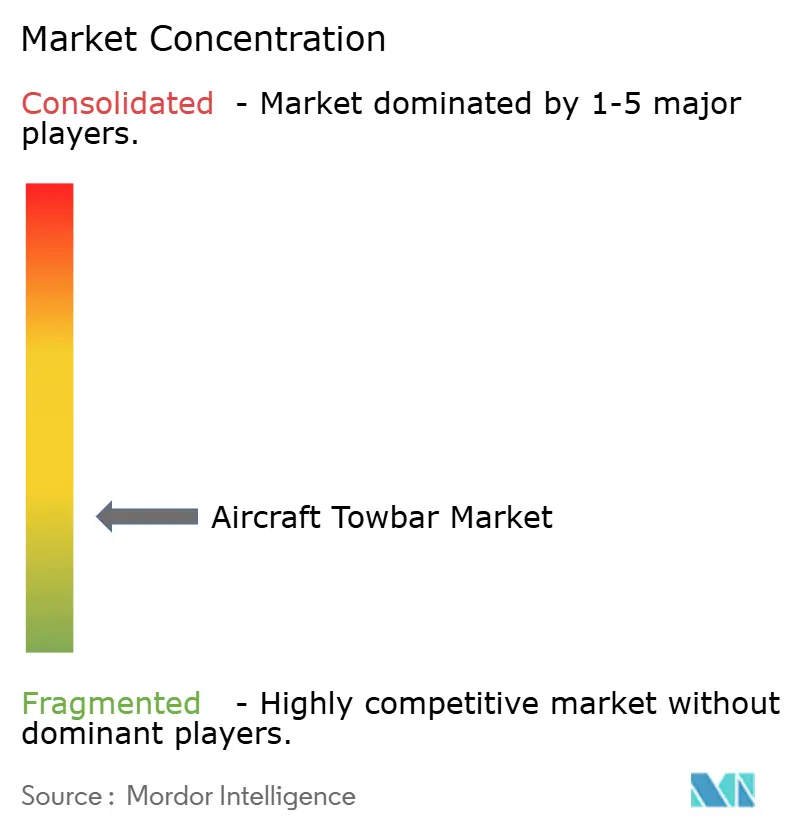
The aircraft towbar market remains fragmented, and no single company appears to hold a dominant position across all regions and product categories. European suppliers such as Tronair Inc., AERO Specialties, Inc., Clyde Machines Inc., HYDRO Systems GmbH and Co. KG, and Dedienne Aerospace SAS compete strongly in engineering precision, compliance with standards, and lifecycle support. North American companies, including Tronair, HALL Industries, and AERO Specialties, leverage close ties to airlines, broad product catalogs, and established OEM approval lists to defend their business in the aircraft towbar market. Asian suppliers are gaining share in regional and military-linked demand by competing on cost and local responsiveness. A broader strategic divide is evident in product design, with several European companies emphasizing modular and multi-type architectures. At the same time, many North American players maintain a stronger focus on high-volume, fleet-specific programs. RH Aero Systems’ formation in April 2025 points to consolidation toward broader portfolio depth.
Competition in the aircraft towbar market is also shifting beyond hardware into service models, financing, and system integration. The low leasing penetration in North America, compared with Europe, leaves room for leasing-led entrants to stimulate replacement demand through flexible fleet-financing programs. Towbarless tug makers such as Mototok and TowFLEXX put pressure on the market because their products can replace conventional towbar-tractor combinations at busy narrowbody gates. At the same time, white-space opportunities remain open in eVTOL towing solutions and COMAC-specific configurations, where standards and supplier positions are still less settled than in mainstream Airbus and Boeing fleets.
Strategic moves by leading companies show how the aircraft towbar market is evolving. RH Aero Systems emerged from the merger of Rhinestahl CTS and HYDRO Systems in April 2025, which widened its product reach across ground support equipment and maintenance tooling and strengthened its bid for integrated contracts. Goldhofer’s September 2025 launch of the all-electric Atlas 2 extended towbarless competition into widebody-compatible operations and raised the threat to conventional towing at major hub gates. Dedienne Aerospace’s Dubai expansion adds another signal, because it shows established European suppliers increasing regional footprint ahead of expected MEA demand growth rather than waiting for orders to appear first.
Aircraft Towbar Industry Leaders
-
Tronair Inc.
-
HYDRO Systems GmbH and Co. KG
-
AERO Specialties, Inc.
-
Clyde Machines Inc.
-
Dedienne Aerospace SAS
- *Disclaimer: Major Players sorted in no particular order
Aircraft Towbar Market Companies Covered in this Report
- Tronair Inc.
- AERO Specialties, Inc.
- Clyde Machines Inc.
- HYDRO Systems GmbH and Co. KG
- TowFLEXX GmbH
- HALL Industries, Inc.
- Dedienne Aerospace SAS
- GROUND SUPPORT EQUIPMENT COMPOUND SYSTEMS SLU
- Langa Industrial S.A.U.
- Panus Assembly Co., Ltd.
- Mototok International GmbH
- Brackett Aircraft Company, Inc.
- TUG TECHNOLOGIES CORPORATION (Textron Inc.)
- Advanced Ground Systems Engineering, LLC
- TECHMAN-HEAD
- K&M airporttechnik GmbH
- Goldhofer AG
Recent Industry Developments in Aircraft Towbar Market
- February 2026: SAE International reaffirmed Aerospace Recommended Practice ARP1915E (Aircraft Tow Bar), the governing dimensional and physical standard for tow bar connections for commercial transport category aircraft, providing regulatory continuity for OEM qualification processes globally.
- November 2025: Dedienne Aerospace announced the expansion of its Dubai operation in Jebel Ali Free Zone to a new 5,000 sqm facility in 2026, designed to capture growing demand across the Middle East, Africa, and Turkey, with a specific focus on GE9X, B777X, Trent XWB, and LEAP engine tooling and GSE.
- September 2025: Goldhofer unveiled the all-electric ATLAS 2 towbarless pushback tractor, compatible with aircraft ranging from the ERJ-170 to the B777-300ER, with a maximum takeoff weight (MTOW) of 352 tons. Built upon the architecture of Goldhofer's proven PHOENIX platform and featuring automated nose-gear recognition, the zero-emission system represents a major advancement in scalable, zero-emission widebody gate and pushback operations.
Global Aircraft Towbar Market Report Scope
The aircraft towbar market includes equipment used to tow aircraft on the ground during parking, pushback, and maintenance operations. The scope excludes towbarless tractors and other non-towbar aircraft towing alternatives unless they are explicitly covered as a separate segment in the report.
The aircraft towbar market is segmented by towbar type, aircraft type, end user, material, and geography. By towbar type, the market is segmented into rigid and standard towbars; multi-head and universal towbars; adjustable and telescopic towbars; electric and self-powered towbars; and other towbar types. By aircraft type, the market is segmented into commercial aviation, military aviation, general aviation, and eVTOL and light electric aircraft. By end user, the market is segmented into commercial airlines, cargo operators, airport ground handling companies, MRO and line maintenance facilities, and other end users. By material, the market is segmented into steel-alloy towbars, aluminum-alloy towbars, high-strength steel and chromoly towbars, composite-fiber towbars, and other materials. The report also covers the market sizes and forecasts for the aircraft towbar market in major countries across different regions. For each segment, the market size is provided in terms of value (USD).
| Rigid and Standard Towbars |
| Multi-Head and Universal Towbars |
| Adjustable and Telescopic Towbars |
| Electric and Self-Powered Towbars |
| Other Towbar Types |
| Commercial Aviation | Narrowbody Aircraft |
| Widebody Aircraft | |
| Regional Jets | |
| Military Aviation | Fighter Jets |
| Special Mission Aircraft | |
| Transport Aircraft | |
| Rotorcraft | |
| General Aviation | |
| eVTOL and Light Electric Aircraft |
| Commercial Airlines |
| Cargo Operators |
| Airport Ground Handling Companies |
| MRO and Line Maintenance Facilities |
| Other End Users |
| Steel-Alloy Towbars |
| Aluminum-Alloy Towbars |
| High-Strength Steel and Chromoly Towbars |
| Composite-Fiber Towbars |
| Other Materials |
| North America | United States | |
| Canada | ||
| Mexico | ||
| Europe | United Kingdom | |
| France | ||
| Germany | ||
| Russia | ||
| Rest of Europe | ||
| Asia-Pacific | China | |
| India | ||
| Japan | ||
| South Korea | ||
| Rest of Asia-Pacific | ||
| South America | Brazil | |
| Rest of South America | ||
| Middle East and Africa | Middle East | Saudi Arabia |
| United Arab Emirates | ||
| Rest of Middle East | ||
| Africa | South Africa | |
| Rest of Africa | ||
| By Towbar Type | Rigid and Standard Towbars | ||
| Multi-Head and Universal Towbars | |||
| Adjustable and Telescopic Towbars | |||
| Electric and Self-Powered Towbars | |||
| Other Towbar Types | |||
| By Aircraft Type | Commercial Aviation | Narrowbody Aircraft | |
| Widebody Aircraft | |||
| Regional Jets | |||
| Military Aviation | Fighter Jets | ||
| Special Mission Aircraft | |||
| Transport Aircraft | |||
| Rotorcraft | |||
| General Aviation | |||
| eVTOL and Light Electric Aircraft | |||
| By End User | Commercial Airlines | ||
| Cargo Operators | |||
| Airport Ground Handling Companies | |||
| MRO and Line Maintenance Facilities | |||
| Other End Users | |||
| By Material | Steel-Alloy Towbars | ||
| Aluminum-Alloy Towbars | |||
| High-Strength Steel and Chromoly Towbars | |||
| Composite-Fiber Towbars | |||
| Other Materials | |||
| By Geography | North America | United States | |
| Canada | |||
| Mexico | |||
| Europe | United Kingdom | ||
| France | |||
| Germany | |||
| Russia | |||
| Rest of Europe | |||
| Asia-Pacific | China | ||
| India | |||
| Japan | |||
| South Korea | |||
| Rest of Asia-Pacific | |||
| South America | Brazil | ||
| Rest of South America | |||
| Middle East and Africa | Middle East | Saudi Arabia | |
| United Arab Emirates | |||
| Rest of Middle East | |||
| Africa | South Africa | ||
| Rest of Africa | |||
Key Questions Answered in the Report
What is the 2031 value expected for the aircraft towbar space?
The aircraft towbar market is forecast to reach USD 6.45 billion by 2031, up from USD 4.91 billion in 2026, at a 5.60% CAGR.
Which towbar type is growing the fastest through 2031?
Electric and self-powered towbars are expected to grow the fastest, with a projected 7.24% CAGR through 2031.
Which aircraft category generates the most demand today?
Commercial aviation held the largest share in 2025 at 56.27%, supported by the scale of narrowbody and widebody airline fleets.
Why is Asia-Pacific expanding faster than other regions?
Asia-Pacific is projected to grow at 6.52% CAGR because the region is backed by USD 240 billion in airport investment and active fleet and infrastructure expansion.
Who buys the most aircraft towbars?
Airport ground handling companies were the largest end-user group in 2025 with 37.79% share because they manage centralized GSE fleets across multiple airline customers.
What is the main competitive risk to conventional towbar suppliers?
Towbarless tractor adoption at large hub airports is the clearest structural risk, especially as electric systems move into wider aircraft compatibility ranges.