
Aircraft Mounts Market Size and Share
Market Overview
| Study Period | 2021 - 2031 |
|---|---|
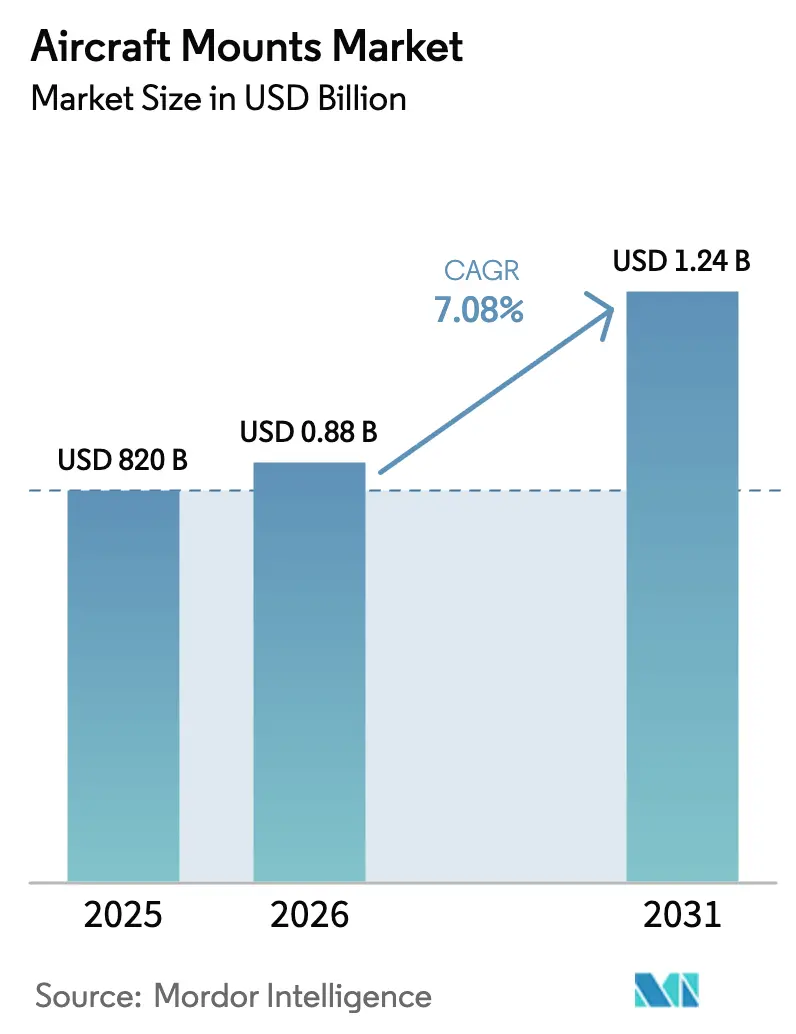
| Market Size (2026) | USD 0.88 Billion |
| Market Size (2031) | USD 1.24 Billion |
| Growth Rate (2026 - 2031) | 7.08 % |
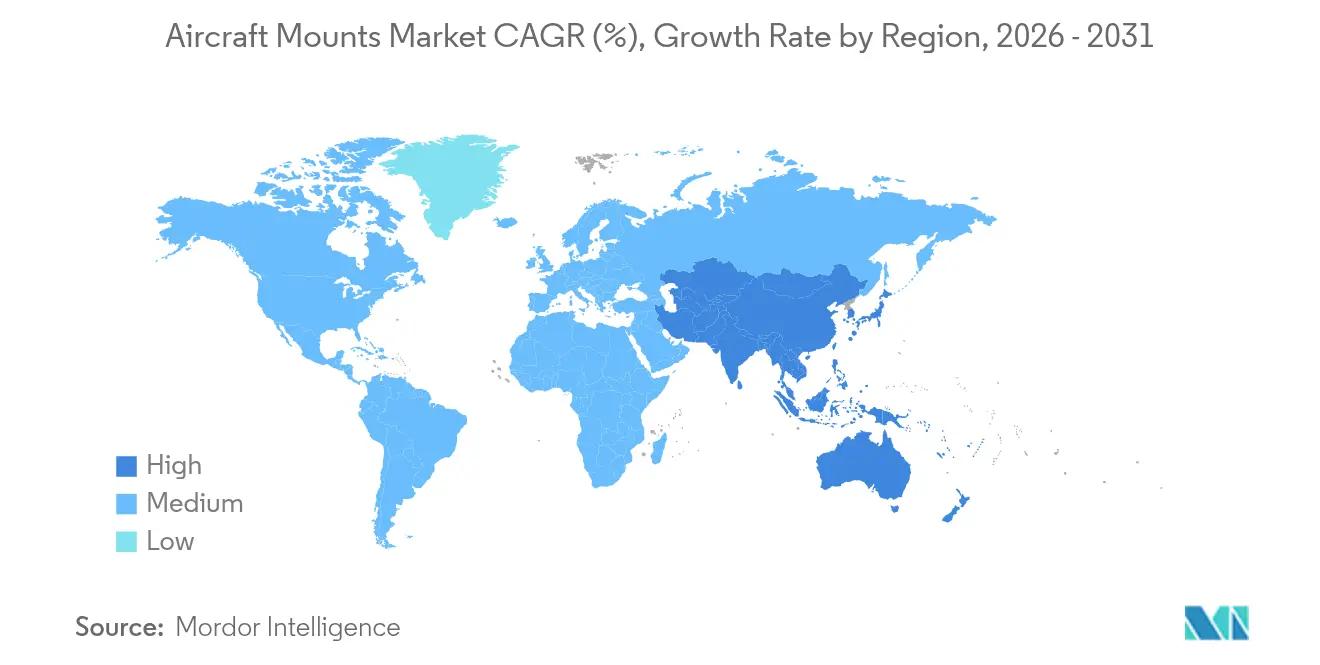
| Fastest Growing Market | Asia-Pacific |
| Largest Market | North America |
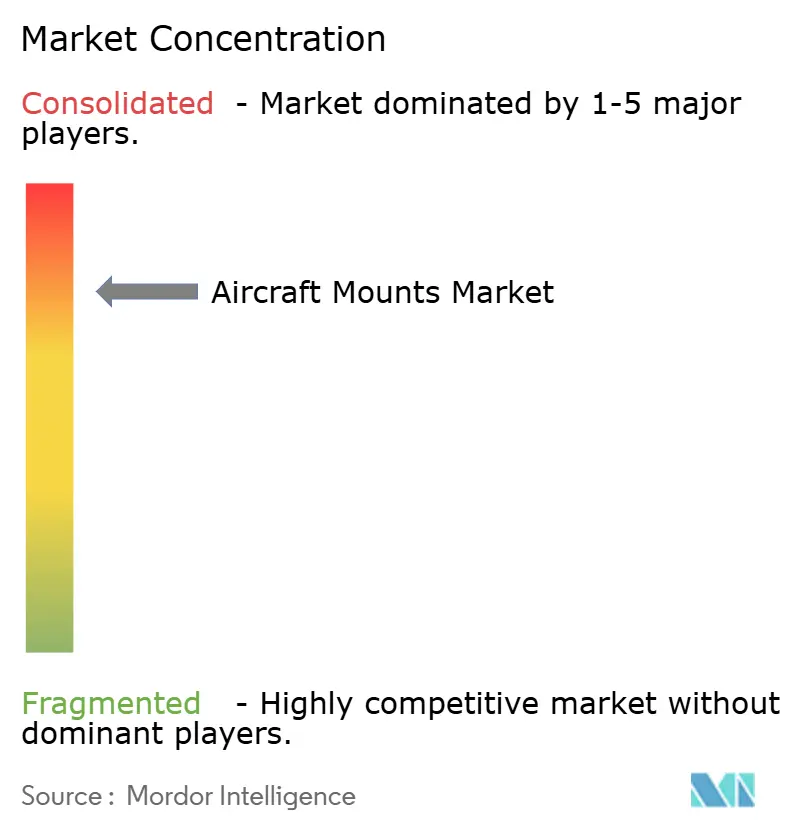
| Market Concentration | High |
Major Players *Disclaimer: Major Players sorted in no particular order Image © Mordor Intelligence. Reuse requires attribution under CC BY 4.0. | |
Aircraft Mounts Market Analysis by Mordor Intelligence
The aircraft mount market size was valued at USD 820 million in 2025 and estimated to grow from USD 880 million in 2026 to reach USD 1.24 billion by 2031, at a CAGR of 7.08% during the forecast period (2026-2031). Elevated commercial aircraft build rates, expanding electrified-propulsion programs, and the surge in premium-cabin retrofits collectively lifted demand for mount systems that balance vibration isolation with rising thermal-management loads. Boeing’s plan to lift B737 output from 38 to around 50 jets a month by 2026 and Airbus’ ramp of A350 production to 12 units a month highlighted how OEM production intensity has eclipsed pre-2020 levels. Electrified propulsion placed new design pressure on mounts because battery packs generated 75% of total thermal loads during take-off and cruise transitions. At the same time, raw-material cost swings in titanium and specialty steels compressed supplier margins and extended lead times
Key Report Takeaways
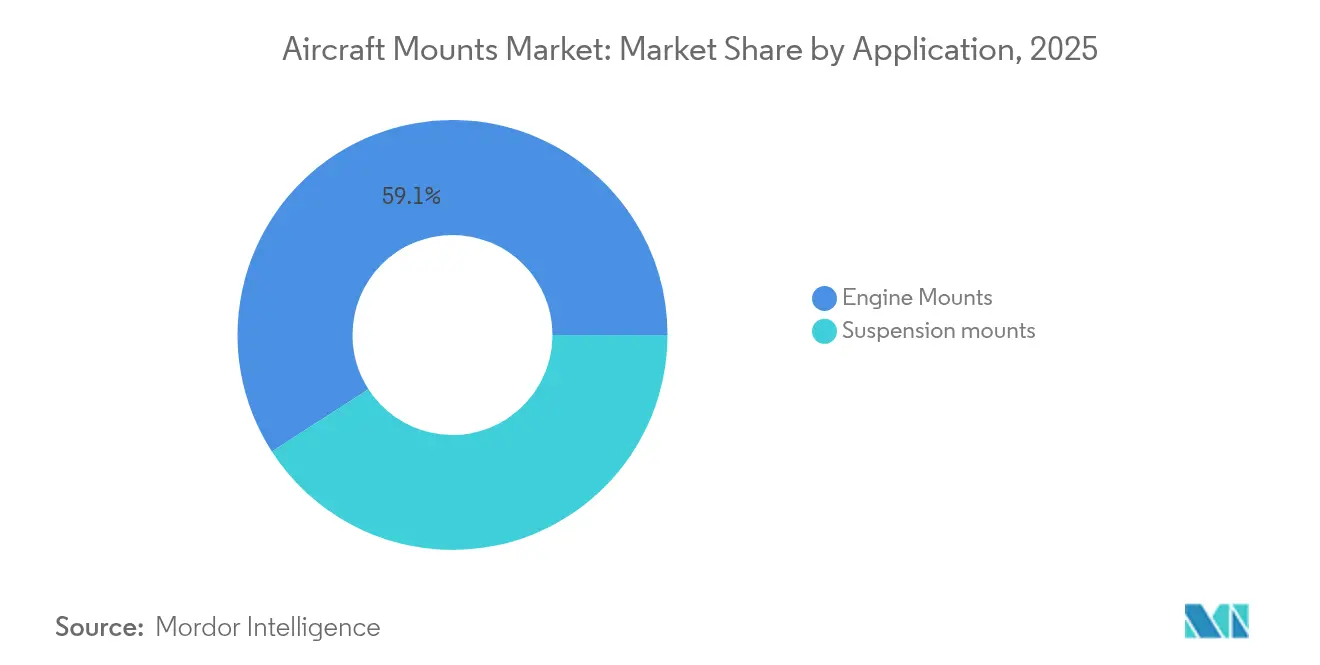
- By application, engine mounts led with 59.12% revenue share in 2025; suspension mounts are projected to expand at a 7.45% CAGR to 2031.
- By mount type, exterior applications captured 64.92% of the aircraft mount market share in 2025; interior mounts are advancing at a 7.85% CAGR through 2031.
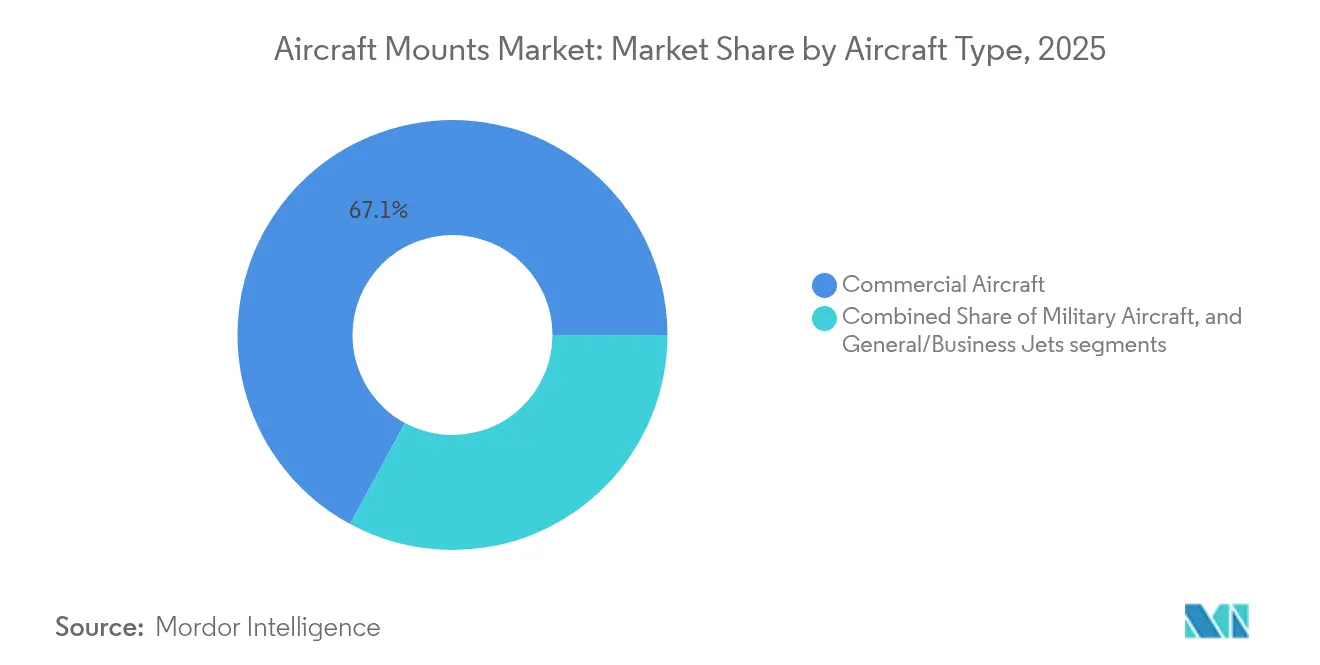
- By aircraft type, commercial platforms held 67.10% of the aircraft mount market size in 2025; general/business jets record the highest projected CAGR at 7.62% to 2031.
- By end user, OEM channels controlled 69.60% of the aircraft mount market in 2025; retrofit demand is growing at an 7.90% CAGR.
- By geography, North America accounted for 42.10% revenue share in 2025, while Asia-Pacific is forecast to see an 8.15% CAGR through 2031.
Note: Market size and forecast figures in this report are generated using Mordor Intelligence’s proprietary estimation framework, updated with the latest available data and insights as of 2026.
Market Trends and Insights
Drivers Impact Analysis of Aircraft Mounts Market*
| Driver | (~) % Impact on CAGR Forecast | Geographic Relevance | Impact Timeline |
|---|---|---|---|
| Commercial aircraft build-rate surge | +2.1% | Global, focus in North America and Europe | Short term (≤ 2 years) |
| Shorter replacement cycle of legacy mounts | +1.3% | Global, especially North America and Europe | Medium term (2-4 years) |
| Tight vibration and cabin-noise regulations | +0.9% | Global, led by FAA and EASA | Long term (≥ 4 years) |
| Premium-cabin retrofit boom | +0.8% | Global, premium carriers in North America and Europe | Medium term (2-4 years) |
| Electrified propulsion thermal-load profiles | +1.1% | Global, early adoption in North America and Europe | Long term (≥ 4 years) |
| Additive-manufactured lattice mounts | +0.6% | Global, led by advanced manufacturing hubs | Long term (≥ 4 years) |
| Source: Mordor Intelligence | |||
Commercial aircraft build-rate surge
Commercial jet programs accelerated beyond pre-pandemic volumes, creating a demand spike for engine, suspension, and equipment mounts across narrow-body and wide-body fleets. Airlines ordered replacements to cut fuel burn and meet emissions targets, pushing order backlogs to roughly 10 years on many platforms. Higher utilization rates shortened maintenance cycles, lifting aftermarket demand for replacement mounts. OEMs asked suppliers to align capacity with rolling production-rate targets, rewarding firms that could guarantee on-time delivery. These conditions sustained a dependable baseline for the aircraft mount market.
Electrified propulsion creating new thermal-load profiles
Hybrid-electric and full-electric powertrains shifted mount design priorities by introducing continuous thermal loading and vibration isolation. NASA analysis showed thermal-management systems consumed 9% of propulsion power at take-off, with batteries as the dominant heat source.[1]Source: NASA, “Thermal management considerations for electrified aircraft,” nasa.gov Research on series-hybrid architectures suggested centralized cooling could cut system weight by 12 kg versus decentralized solutions.[2]Source: The Aeronautical Journal, “Thermal-management system design for a series hybrid-electric propulsion architecture,” cambridge.org Mount suppliers began integrating heat-sink channels and conductive lattice skins to dissipate battery-induced heat while preserving acoustic dampening. This integration opened fresh revenue streams and widened the aircraft mount market addressable base.
Tight vibration and cabin-noise regulations
Revisions to FAA and EASA interior-noise directives compelled airframe builders to demand mounts that smooth high-frequency vibrations from new geared-turbofan engines. Compliance tests required suppliers to validate mount damping across broader frequency ranges, extending qualification cycles but locking premium pricing for compliant solutions. Airlines viewed quieter cabins as a brand differentiator on long-haul routes, sustaining a structural demand pull for next-generation mounts.
Premium-cabin retrofit boom
Major carriers reinstated high-end cabin refits to capture premium revenue. Airbus expected 390 A350s to undergo cabin upgrades by 2028, each project involving heavy seat-frame and IFEC hardware swaps that rely on specialized interior mounts. Lufthansa and Qantas unveiled flagship suites demanding mounts capable of supporting 2,000 lb seat loads while meeting slimline weight budgets. As retrofit wave volume intensified, dedicated retrofit-grade mount kits featuring simplified installation hardware emerged as a profitable sub-segment of the aircraft mount market.
Restraints Impact Analysis of Aircraft Mounts Market*
| Restraint | (~) % Impact on CAGR Forecast | Geographic Relevance | Impact Timeline |
|---|---|---|---|
| Raw-material cost swings | -1.4% | Global, titanium-dependent regions | Short term (≤ 2 years) |
| Lengthy FAA/EASA certification cycles | -0.9% | North America and Europe | Medium term (2-4 years) |
| Specialty-silicone supply crunch | -0.6% | Advanced manufacturing regions | Short term (≤ 2 years) |
| Longer-life composite airframes | -0.5% | Next-generation platforms worldwide | Long term (≥ 4 years) |
| Source: Mordor Intelligence | |||
Lengthy FAA/EASA certification cycles
Regulators heightened scrutiny of structural systems following recent safety directives, extending new-design certification to 18–24 months on average. Mandated failure-mode analyses and separate environmental compliance reports pushed non-recurring engineering spend by nearly 20% for bespoke mounts. While bilateral agreements cut duplicate testing, smaller suppliers faced resource bottlenecks that limited product-launch cadence and tempered the overall aircraft mount market growth rate.
Raw-material cost swings
Titanium ingot prices spiked after sanctions disrupted Russian supply, compelling buyers to dual-source or stockpile material at elevated cost. Airbus noted that steel lead times had lengthened beyond 45 weeks, complicating production schedules. Procurement surveys showed a 60% jump in working capital tied up in safety stock among Tier 2 machinists, eroding profitability and delaying shipment commitments.
*Our forecasts treat driver/restraint impacts as directional, not additive. The impact forecasts reflect baseline growth, mix effects, and variable interactions.
Aircraft Mounts Market Segment Analysis
By Application:
Engine mounts sustain leadershipEngine mounts accounted for 59.12% of the aircraft mount market in 2025 because they integrate high-value titanium, elastomer, and composite linkages that manage thrust loads while isolating vibration. The aircraft mount market size for engine-related hardware is projected to expand steadily, supported by narrow-body production surges and the introduction of ultra-high bypass geared-turbofan engines. Although smaller today, Suspension mounts are pegged for a 7.45% CAGR as cabins add heavier monuments and larger IFEC racks requiring upgraded vibration dampers.
Second-generation electric powertrains presented fresh design envelopes. Electric motors produce high-frequency harmonics, prompting suppliers to redesign elastomer stacks and add integral cooling fins that bleed heat into surrounding airflow. NASA simulations showed that integrated cooling slashed the combined propulsion-mount system weight by half compared to legacy discrete architectures. Early adopters in demonstrator programs contracted mount makers for prototype lots, seeding longer-term demand once type certification arrives.



By Mount Type:
Exterior hardware dominatesExterior mounts held 64.92% market share in 2025, driven by their role on engines, pylons, landing gear, and external antennae. These mounts faced temperature swings from -60 °C at altitude to 200 °C near bleed-air ducts, dictating exotic alloy solutions and multilayer elastomer stacks. The segment delivered predictable volume because every new airframe required a baseline of four to six engine mounts plus dozens of ancillary fittings. The aircraft mount market share of interior applications is poised to climb as airlines retrofit connectivity routers, wide-screen IFEC, and smart-galley inserts, all of which need vibration-safe attachment.
Interior mounts posted an 7.85% CAGR outlook, aided by lightweight composite skins and quick-change bracket systems that reduce downtime during cabin modifications. Cabin-electronics suppliers collaborated with mount makers to develop vibration-tuned brackets that isolate 20–600 Hz bands common to fuselage flexure, safeguarding sensitive SSD-based servers.
By Aircraft Type:
Commercial jets remain anchor demandCommercial programs contributed 67.10% of 2025 revenue as Boeing and Airbus raised single-aisle output and reopened wide-body lines. The commercial jet aircraft mount market holds the largest market share, driven by record order backlogs, highlighting the growing demand for new aircraft. This trend underscores the increasing reliance on advanced mounting systems to support the expanding global aviation industry, ensuring operational efficiency and safety standards are met. General/business jets deliver the fastest 7.62% CAGR, reflecting the premium-travel rebound and the influx of super-mid-size models with higher-thrust engines and advanced vibration requirements.
Defense programs stabilized revenue through rotorcraft and surveillance-platform vibration-isolation projects. The US Army’s HADES high-altitude ISR initiative relied on customized mounts for sensor pallets, demonstrating defense-driven niche opportunities.
By End User:
OEM supply dominates but retrofit acceleratesOEM channels commanded 69.60% of revenue in 2025 because mounts are usually designed into the airframe and co-qualified with engines. Long-term agreements protected capacity allocations, delivering visibility over multi-year horizons. The retrofit market is experiencing an 7.90% CAGR as airlines increasingly extend fleet lifespans beyond 20 years and prioritize more frequent cabin upgrades to enhance passenger experience and operational efficiency.
Retrofit growth accelerated after IATA released best-practice guides simplifying Supplemental Type Certificate paths for cabin retrofit, which cut downtime by up to 30%. Mount suppliers responded with modular kits that bundle bracketry, elastomer inserts, and load-path shims, shortening labor hours and reducing re-certification paperwork.
Geography Analysis
North America Aircraft Mounts Market
North America retained a 42.10% share in 2025, underpinned by Boeing’s single-aisle production surge and robust defense procurement budgets. The region also led early adoption of additive manufacturing for lattice-structured mounts, supported by a dense network of powder-bed fusion facilities and metal-powder suppliers. Supply-chain partnerships between Parker-Hannifin and major OEMs streamlined qualification, enabling quick transition from prototype mounts to full-rate production.
APAC Aircraft Mounts Market
Asia-Pacific generated the fastest 8.15% CAGR outlook through 2031 as regional carriers expanded fleets and airframe OEMs localized more work packages. Singapore’s Seletar Aerospace Park attracted USD 810 million of manufacturing investment, including GE Aerospace’s smart-factory upgrade and Pratt & Whitney’s capacity increases for GTF turbine disks. Workforce pipelines delivered 1,800 aerospace graduates annually, ensuring talent supply for mount design, machining, and nondestructive testing roles.
Europe Aircraft Mounts Market
Europe sustained a meaningful share through Airbus’ industrial footprint and a robust Tier 1 ecosystem in France, Germany, and the UK. Airbus disclosed longer steel lead times and titanium scarcity issues, but also expanded A350 output to 12 aircraft monthly, sustaining mounting demand. The region’s advanced composites and additive-manufacturing capabilities positioned European suppliers to supply weight-optimized mounts for next-generation hybrid-electric concepts. Harmonized FAA-EASA certification protocols reduced duplicative test campaigns, easing market access for transatlantic suppliers.

Regulatory Landscape
Aircraft mounts are treated as safety-critical airframe and powerplant interfaces, with certification and continued airworthiness oversight led by the FAA and EASA for transport-category aircraft and aligned across civil standards frameworks. For shock mounts and bush-equipped mount assemblies, European aerospace standards such as EN 4841-1:2022 and EN 4841-2:2022 specify requirements for specification, inspection methods, and qualification, while environmental qualification commonly references RTCA DO-160G conditioning (including the temperature categories used in equipment qualification). In cabin and interior-adjacent mounting applications, flammability and fireworthiness requirements are assessed against FAR/JAR/CS 25.853 burn behavior criteria, shaping elastomer selection and composite or polymer mount designs.
For the supply base, quality management system compliance is a gating requirement for approved production and distribution, with AS9100 used broadly for manufacturing, AS9110 for maintenance organizations, and AS9120 for distributors handling aviation and space parts. These requirements affect process control (including weld and nondestructive testing where applicable), documentation traceability, and inspection planning for engine mounts and vibration isolation hardware, which can extend qualification timelines when introducing new materials, additive-manufactured geometries, or sensor-integrated mount variants.
Value Chain Analysis
The aircraft mounts value chain starts with raw materials and semi-finished inputs (including titanium and specialty steels, elastomers, and bonded interfaces), then moves into design, analysis, and test work to meet damping, load, and environmental requirements. Specialized engineering support firms typically contribute to early-stage mount sizing and vibration isolation modeling, and they often support integrated product teams working alongside engine and airframe programs (including design and testing services tied to major engine OEM work packages). Manufacturing covers machining and forming of metallic components, elastomer compounding and bonding, assembly, and qualification testing aligned to aerospace standards and environmental and fireworthiness constraints.
After production, mounts go through OEM installation channels and the aftermarket, supported by stocking distributors and MRO-aligned partners for replacement demand and line maintenance needs, especially for legacy mount refresh cycles and cabin retrofit work. The value chain also includes repair and niche manufacturing providers that extend mount life through rework or replacement of specific subcomponents for vintage and light aircraft fleets. Across tiers, traceability, approved supplier status, and audit readiness under aerospace QMS frameworks remain central for sustaining participation in both OEM and aftermarket supply.
Competitive Landscape
Industry competition remained consolidated. Parker-Hannifin’s aerospace segment posted USD 1.57 billion sales in Q3 2025 with a 23.7% operating margin, highlighting scale advantages and broad aftermarket reach. Hutchinson delivered over 3,000 vibro-acoustic products for engines and cabins, benefiting from proprietary elastomer formulations.
Strategic mergers and acquisitions reshape portfolios. In February 2025, TriMas acquired GMT Aerospace to deepen vibration-control expertise and extend the European footprint. Honeywell partnered with Vertical Aerospace to certify VX4 eVTOL systems, underscoring the value of mount solutions tailored to electric-propulsion layouts.
Innovation focus shifted to additive-manufactured lattice structures, thermal-conductive elastomers, and digital twins that predict remaining useful life. Suppliers investing in in-house printing lines and model-based qualification frameworks secured early design wins on demonstrator programs, planting seeds for long-term revenue as electrified propulsion matures.
Aircraft Mounts Industry Leaders
GMT Rubber-Metal-Technic Ltd.
Mayday Manufacturing Co.
HUTCHINSON AEROSPACE & INDUSTRY INC.
ITT Inc.
Shock Tech, Inc.
- *Disclaimer: Major Players sorted in no particular order
Aircraft Mounts Market Companies Covered in this Report
- Parker-Hannifin Corporation
- HUTCHINSON AEROSPACE & INDUSTRY INC.
- GMT Rubber-Metal-Technic Ltd.
- ITT Inc.
- Shock Tech, Inc.
- Mayday Manufacturing Co.
- VibraSystems Inc.
- Singapore Aerospace Manufacturing Group
- ACE Stoßdämpfer GmbH

Market Opportunities and Future Outlook
Product whitespace is emerging for mounts that combine vibration isolation with thermal-management functionality for electrified propulsion architectures. The RD context points to battery packs driving a dominant share of thermal loads during key flight phases, which increases design focus on integrated heat-dissipation features (such as conductive paths, fins, or lattice skins) while preserving damping performance. Additive manufacturing supports this shift by enabling complex geometries and weight-optimized structures for custom engine and equipment mounts, particularly where tight packaging and multi-axis load paths limit conventional designs.
A second opportunity is the move toward more data-rich, maintainable mounting systems across both OEM and retrofit channels. Instrumented shock mounts, along with mounts designed for digital qualification and analytical toolchains, fit the need to reduce downtime and shorten troubleshooting cycles as utilization rises and cabin retrofits add sensitive electronics. As OEM production intensity increases and retrofit activity expands, suppliers that can provide standardized, certifiable mount kits (including simplified installation hardware and documented compliance to relevant environmental and interior requirements) can compete on lead time, repeatability, and lifecycle support rather than relying only on bespoke engineering.
Recent Industry Developments in Aircraft Mounts Market
- July 2026: Mayday Manufacturing (ESCO Technologies) scheduled occupancy of a new 44,259-square-foot facility in Denton, Texas following an $8 million expansion investment, reflecting aerospace component manufacturing capacity expansion. Expands production footprint to support aviation mount demand and mitigate supply-chain tightness.
- March 2026: GMT Rubber-Metal-Technic Ltd. conducted a strategic alignment meeting with European partners to coordinate 2026/27 operational goals. The collaboration improves regional supply assurances for anti-vibration mounts and broadens GMT access to European markets.
- February 2026: ESCO Technologies reported that Mayday Manufacturing remains an operating unit within its portfolio following the fiscal 2026 first-quarter results filing. This supports portfolio-wide alignment on aerospace mount supply and cross-sell opportunities.


Aircraft Mounts Market Report Scope and Research Methodology
Market Definition and Coverage
The aircraft mount market is defined as the revenue generated from mounts installed on aircraft to hold systems and isolate vibration and shock during flight and ground operation, across OEM fitment and retrofit needs, and counted in US dollars.
Scope exclusions: We exclude general industrial vibration isolators that are not qualified or sold for aircraft use.
Segments Covered in This Report
- By Application
- Suspension Mounts
- Engine Mounts
- By Mount Type
- Interior Mounts
- Exterior Mounts
- By Aircraft Type
- Commercial Aircraft
- Military Aircraft
- General/Business Jets
- By End User
- OEM
- Retrofit
- By Geography
- North America
- United States
- Canada
- Mexico
- Europe
- United Kingdom
- Germany
- France
- Russia
- Rest of Europe
- Asia-Pacific
- China
- India
- Japan
- South Korea
- Rest of Asia-Pacific
- South America
- Brazil
- Rest of South America
- Middle East and Africa
- Middle East
- Saudi Arabia
- United Arab Emirates
- Turkey
- Rest of Middle East
- Africa
- South Africa
- Rest of Africa
- Middle East
- North America
Data Sources, Market Sizing, and Validation
Desk Research
Desk research was used to set the market boundaries, build the initial demand indicators, and avoid double counting across aircraft programs and aftermarket activity. We referenced public sources such as FAA aircraft registration and airworthiness information, EASA safety publications, ICAO air transport statistics, and the World Bank macro indicators to understand fleet growth and operating intensity.
To connect demand to spend, we also used OEM and airline public disclosures (annual reports, investor presentations), as well as aerospace association releases and reputable press coverage on production rates, backlogs, and MRO activity. Patent databases were selectively reviewed to understand the direction of mount designs (for example, higher temperature and vibration isolation needs), and paid subscriptions focused on company financials and news were used only to validate supplier exposure and program-level momentum. The sources listed here are illustrative, and many other public documents were used to collect data, validate assumptions, and clarify definitions during the work.
Primary Interviews and Surveys
Primary interviews and surveys were used to confirm what gets counted as an aircraft mount in real procurement, and to pressure test pricing and replacement behavior across platforms. We spoke with a balanced mix of OEM-facing stakeholders, MRO and retrofit specialists, and component channel participants across major aviation regions so gaps from desk research could be closed and assumptions could be corrected.
Distribution of primary research fieldwork respondents
| Company type | Respondent position | Region |
|---|---|---|
| Top tier: 38% | CXOs: 14% | APAC: 40% |
| Mid tier: 48% | Functional/Unit leaders: 27% | EMEA: 33% |
| Smaller Players: 14% | Managers: 59% | Americas: 27% |
Market-Sizing & Forecasting
Market sizing is built by using a top-down approach where aircraft production, active fleet, and maintenance activity are reconstructed by aircraft type and region, and then converted into mount demand using fitment and replacement logic. The model is then corroborated with selective bottom-up approximations, like sampling mount counts per aircraft zone, checking typical replacement triggers during heavy checks, and using sampled pricing ranges to sanity check the totals.
Inputs used in the model include aircraft deliveries and backlog signals, active fleet size and utilization, the share of retrofit versus line-fit activity, typical mount replacement intervals by system location, and average selling price movement tied to material mix (rubber-metal, elastomer, and higher temperature designs). Where data is thin for smaller aircraft programs, we fill gaps through peer-program proxies and then validate the implied spend with interview feedback.
For forecasting, we rely on scenario analysis supported by variable-level expectations gathered from experts, and we tie the forward curve to production ramp plans, fleet growth, and MRO cycle normalization. Short-term steps are reviewed with a simple smoothing check to avoid overreacting to one-time delivery swings, and assumptions are kept traceable so the same steps can be repeated when new public data is released.
Data Validation & Update Cycle
Validation is handled through stepwise checks that compare the model output against independent signals, such as delivery trends, fleet utilization direction, and public program updates, and then differences are investigated before sign-off. We also run variance checks by region and aircraft type to catch outliers, and we re-contact sources when a key input, like a production ramp or retrofit cycle, looks inconsistent with multiple references.
Each report is refreshed annually, and interim updates are made when material events change the demand picture, such as major production rate shifts or supply constraints that affect pricing. Before delivery, an analyst completes a fresh final review so clients receive an updated view that is consistent with the latest available public information.
Mordor Intelligence's Aircraft Mount Market Size Compared With Other Published Estimates
Published market values for aircraft mounts can look far apart because groups define the product boundary differently and they also pick different base years and forecast windows. Differences also show up when one estimate leans on broad aerospace components spend, while another estimate ties the total to aircraft builds and maintenance cycles.
The key gap drivers usually come from what is counted as a mount (for example, whether brackets and other adjacent hardware are included), how aftermarket replacement is treated versus line-fit, and how pricing is updated when material mix shifts. Currency timing and the use of aggressive or conservative production ramp scenarios can further widen the spread, especially when wide-body and narrow-body output expectations are not aligned with public guidance.
Benchmark comparison
| Source | Market Size | Gaps in Research Methodology |
|---|---|---|
| Mordor Intelligence | USD 0.82 B (2025) | |
| Industry Publisher A | USD 0.71 B (2024) | Uses an earlier base year and a shorter runway to 2030, and its type-based segmentation suggests pricing and fitment may be averaged broadly across aircraft programs, which can understate retrofit-driven spend. |
| Research Outlet B | USD 3.60 B (2025) | Applies a wider interpretation of mounts across applications and end uses, which can pull in non-aircraft-specific mounting products and inflate totals relative to aircraft-qualified mount demand. |
The table shows that a tighter definition tied to aircraft-qualified mounts and an explicit split between OEM fitment and replacement can pull the total down compared with broader component interpretations, and that the base year choice matters when production is ramping. By keeping pricing updates linked to material mix and by checking replacement cadence against MRO cycles, the estimate stays closer to observable aviation demand signals, which is the approach applied by Mordor Intelligence.


Key Questions Answered in the Report
What is the current size of the aircraft mount market?
The aircraft mount market was valued at USD 880 million in 2026 and is expected to reach USD 1.24 billion by 2031, reflecting a 7.08% CAGR.
Which segment holds the largest share of the aircraft mount market?
Engine mounts led with 59.12% revenue share in 2025, reflecting their critical role in powerplant integration.
Which region is growing fastest?
Asia-Pacific shows the highest growth with an anticipated 8.15% CAGR through 2031, driven by expanding fleets and manufacturing investments.
How is electrification affecting mount design?
Hybrid-electric and electric aircraft create higher thermal loads, pushing suppliers to integrate heat-dissipation features alongside vibration isolation.
Why are certification cycles considered a restraint?
Enhanced FAA and EASA requirements extend approval times to up to two years, delaying new mount introductions and raising non-recurring engineering costs.
What technological trends are shaping future mount systems?
Additive-manufactured lattice structures, thermal-conductive elastomers, and predictive-maintenance digital twins are emerging as key differentiators.
Page last updated on:





