
Aircraft Thrust Reverser Actuation Systems Market Size and Share
Market Overview
| Study Period | 2020 - 2032 |
|---|---|
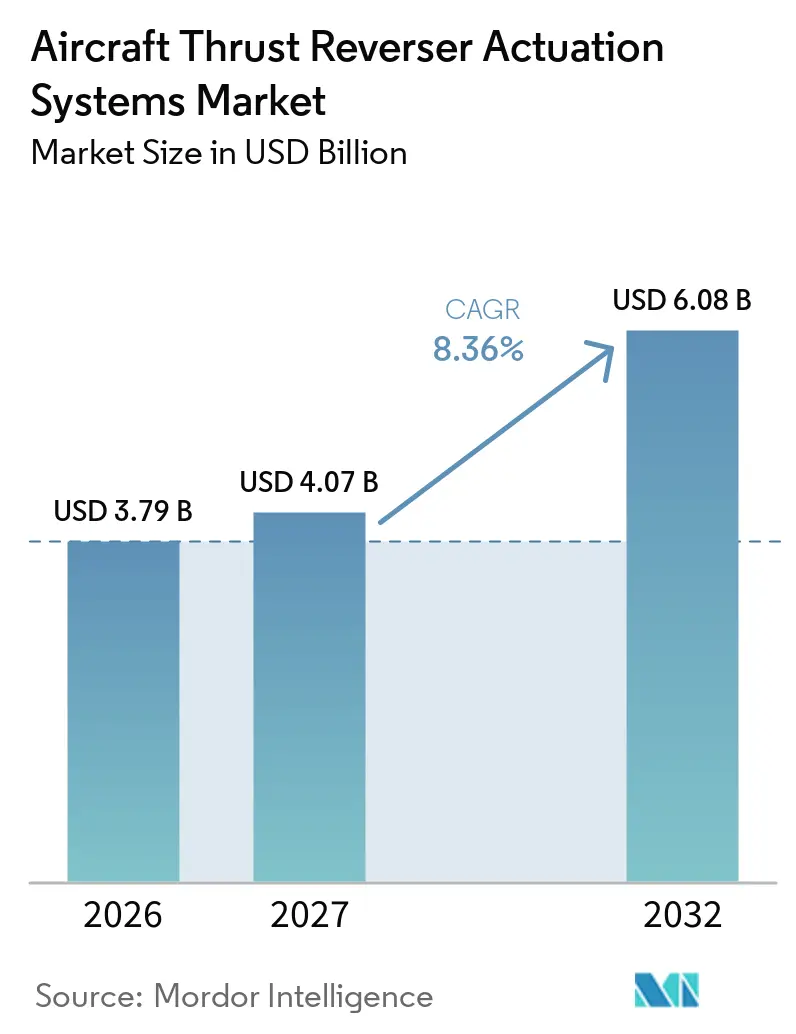
| Market Size (2027) | USD 4.07 Billion |
| Market Size (2032) | USD 6.08 Billion |
| Growth Rate (2027 - 2032) | 8.36 % |
| Fastest Growing Market | Asia-Pacific |
| Largest Market | North America |
| Market Concentration | Medium |
Major Players *Disclaimer: Major Players sorted in no particular order Image © Mordor Intelligence. Reuse requires attribution under CC BY 4.0. | |
Aircraft Thrust Reverser Actuation Systems Market Analysis by Mordor Intelligence
The aircraft thrust reverser actuation systems market size was valued at USD 3.79 billion in 2026 and is forecast to grow from USD 4.07 billion in 2027 to USD 6.08 billion by 2032, registering an 8.36% CAGR between 2027 and 2032. Commercial aircraft production, fleet utilization, and maintenance cycles support recurring demand for certified actuation equipment. The market benefits from mandatory fitment on certified turbofan commercial aircraft, making the system a required part of aircraft operation rather than an optional upgrade. Suppliers can therefore address original equipment programs and long-running repair demand from the same installed fleet. Production constraints at major airframe manufacturers also keep older aircraft in service longer, thereby supporting maintenance requirements. Electric actuation is gaining attention because it can reduce weight while preserving redundancy and locking requirements required for safe deployment.
Key Report Takeaways
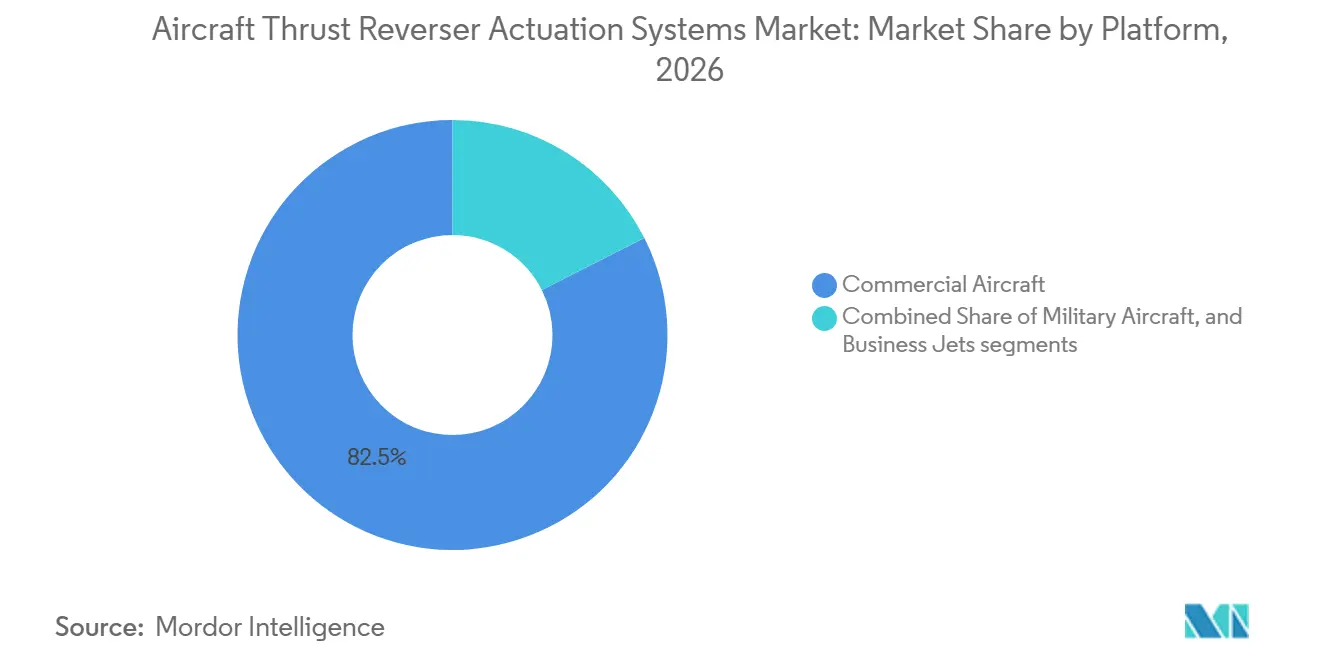
- By platform, commercial aircraft held 82.45% of the aircraft thrust reverser actuation systems market share in 2026, while business jets are forecast to grow at a 9.80% CAGR through 2032.
- By mechanism, hydraulic systems held 66.30% of the aircraft thrust reverser actuation systems market share in 2026, while electric systems are forecast to grow at a 10.24% CAGR through 2032.
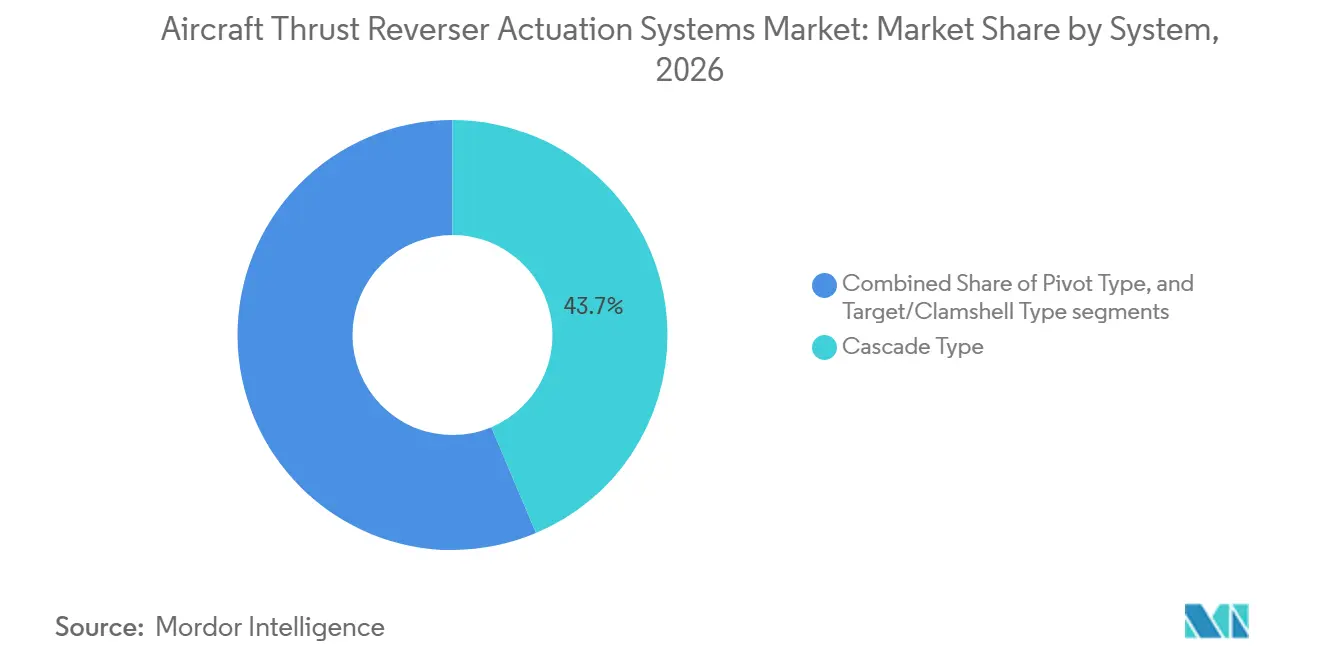
- By system, cascade-type systems held 43.65% of the aircraft thrust reverser actuation systems market share in 2026, while pivot-type systems are forecast to grow at a 10.22% CAGR through 2032.
- By end user, OEMs held 69.47% of the aircraft thrust reverser actuation systems market share in 2026, while the aftermarket is forecast to grow at a 10.14% CAGR through 2032.
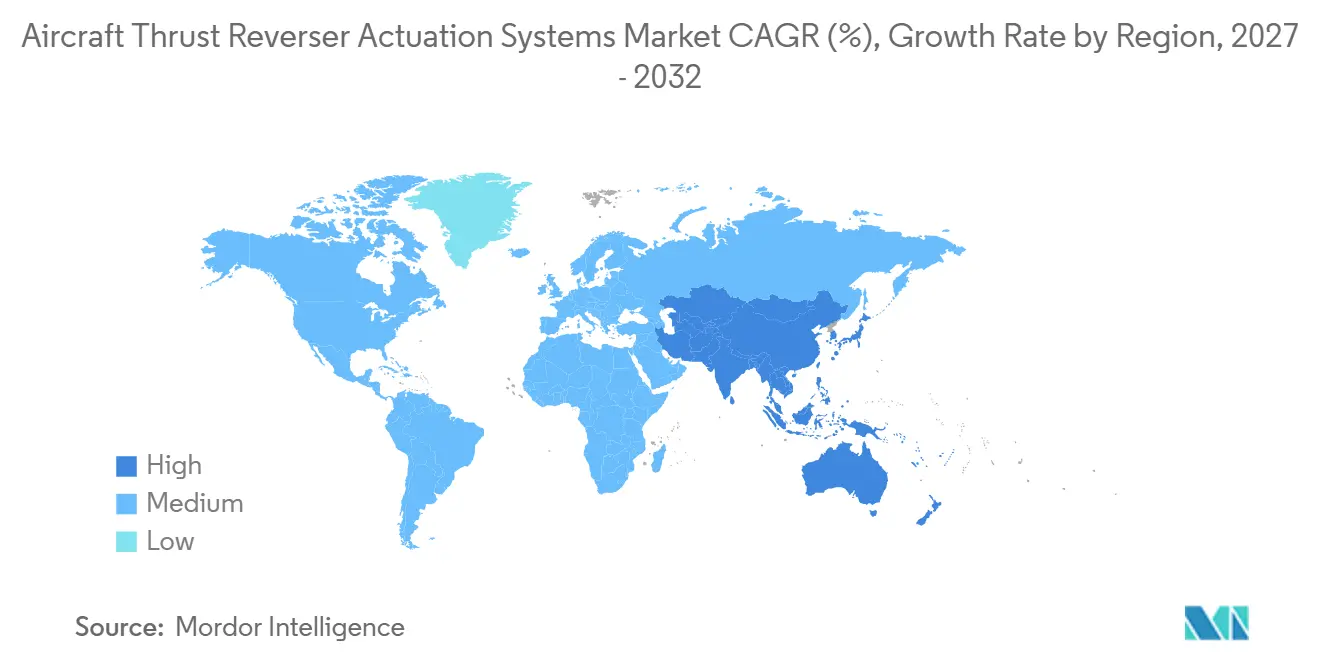
- By geography, North America held 35.90% of the aircraft thrust reverser actuation systems market share in 2026, while Asia-Pacific is forecast to grow at a 10.05% CAGR through 2032.
Note: Market numbers in this report are based on Mordor Intelligence's proprietary estimation framework, which combines nine months of actuals with Q4 projections for base year 2026.
Market Trends and Insights
Drivers Impact Analysis of Aircraft Thrust Reverser Actuation Systems Market*
| Driver | (~) % Impact on CAGR Forecast | Geographic Relevance | Impact Timeline |
|---|---|---|---|
| Commercial fleet renewal accelerates thrust reverser demand | +2.00% | Global | Medium term (2-4 years) |
| Rising narrowbody production drives cascade thrust reverser installations | +1.50% | North America and Europe | Short term (≤ 2 years) |
| Lightweight composite thrust reversers support aircraft efficiency | +0.90% | Global | Medium term (2-4 years) |
| Electric actuation advancements reshape thrust reverser system designs | +1.30% | Europe and North America | Long term (≥ 4 years) |
| Next-generation engine platforms drive thrust reverser innovation | +0.80% | Global | Long term (≥ 4 years) |
| Expanding aircraft fleets strengthen thrust reverser aftermarket demand | +1.10% | Asia-Pacific and Middle East and Africa, with spillover to North America | Medium term (2-4 years) |
| Source: Mordor Intelligence | |||
Commercial Fleet Renewal Accelerates Thrust Reverser Demand
Airlines are renewing their fleets while continuing to operate older aircraft because of delivery delays and supply chain constraints. This dynamic creates parallel demand for new thrust reverser systems and maintenance services for existing equipment. In June 2026, IATA reported that the global aircraft order backlog exceeded 18,000 units and that the average fleet age reached 15.2 years.[1] These conditions are expected to extend the operational life of existing aircraft, sustaining demand for thrust reverser inspections, repairs, and replacement components. Fleet renewal also drives demand for original equipment as new aircraft enter production and service. Suppliers with established aircraft program certifications, manufacturing capabilities, and maintenance networks are well-positioned to address both requirements. This combination supports demand from new aircraft deliveries and the continued operation of mature commercial fleets.
Rising Narrowbody Production Drives Cascade Thrust Reverser Installations
Narrowbody aircraft production supports demand for cascade thrust reversers, particularly on modern commercial aircraft programs such as the LEAP-1A-powered A320neo. Airbus reported an A320 Family backlog of 7,577 aircraft at the end of August 2026 and maintains its target of producing 70–75 aircraft per month by the end of 2027. These production plans are expected to support long-term demand for thrust reverser components, including cascades, translating cowls, and actuation systems. Safran Nacelles and ST Engineering’s Middle River Aerostructure Systems supply thrust reverser structures and actuation equipment for the A320neo LEAP-1A program. Aircraft-specific integration and certification requirements also favor established suppliers with approved manufacturing capabilities. As narrowbody production expands, demand for thrust reversers will remain closely linked to aircraft delivery rates, engine configurations, and supplier production capacity.
Lightweight Composite Systems Support Aircraft Efficiency
The adoption of lightweight composite materials supports the aircraft thrust reverser actuation systems market by reducing structural weight while maintaining aerodynamic and operational performance. Manufacturers use composite materials in thrust reverser cascades, translating cowls, and other nacelle structures, which require specialized manufacturing and repair capabilities. Safran Nacelles confirms the use of composite cascades and translating cowls on the LEAP-1A-powered A320neo. Manufacturers also incorporate composite structures into thrust reversers for business aircraft, including the Dassault Falcon 7X and Falcon 8X. These materials reduce aircraft weight while meeting structural and certification requirements. Their integration creates opportunities for suppliers specializing in advanced composites, precision manufacturing, and structural repair services. However, manufacturers must balance weight optimization with durability, actuation reliability, and compliance with approved aircraft operating requirements.
Electric Actuation Advancements Reshape Thrust Reverser System Designs
Electric actuation technology is influencing the development of thrust reverser systems as aircraft manufacturers seek alternatives to conventional hydraulic architectures. In June 2025, Collins Aerospace reported that its elecTRAS system had accumulated approximately 11 million flight hours and 1.8 million flight cycles of operational experience, with more than 600 A350 aircraft in service at the end of 2024.[2] In December 2025, Safran Nacelles and ESIGELEC established the ePRISME research laboratory to advance electric thrust reverser actuation through system simulation, equipment integration, and predictive maintenance research. These developments indicate continued investment in electrically actuated systems and supporting technologies. Electric architectures require reliable power management, locking mechanisms, and validated failure-protection systems, creating opportunities for suppliers with advanced electrical engineering, controls, and system integration capabilities, as well as extensive test resources.
Expanding Aircraft Fleets Strengthen Thrust Reverser Aftermarket Demand
The expanding global aircraft fleet supports recurring demand for thrust reverser maintenance, repair, replacement components, and exchange services. Thrust reverser systems require periodic inspections and maintenance to preserve structural integrity, actuation performance, and operational reliability. In April 2025, Safran Nacelles signed a NacelleLife service agreement with Republic Airways covering thrust reverser maintenance and spare-parts support for more than 200 E170 and E175 aircraft. The agreement includes maintenance and repair services through Safran’s Indianapolis facility, demonstrating continued investment in dedicated aftermarket capabilities. As aircraft accumulate operating hours and cycles, operators require access to approved repairs and replacement components to minimize maintenance-related downtime. These requirements create long-term opportunities for OEM-affiliated service networks and qualified independent MRO providers with established technical capabilities.
Restraints Impact Analysis of Aircraft Thrust Reverser Actuation Systems Market*
| Restraint | (~) % Impact on CAGR Forecast | Geographic Relevance | Impact Timeline |
|---|---|---|---|
| Stringent deployment safety requirements increase certification costs | -0.80% | Global | Long term (≥ 4 years) |
| Specialized actuator and composite component shortages constrain production | -0.60% | North America and Europe | Short term (≤ 2 years) |
| Aircraft-specific nacelle integration limits thrust reverser retrofits | -0.50% | Global | Medium term (2-4 years) |
| Electric thrust reversers face power and fail-safe challenges | -0.40% | Europe and North America | Long term (≥ 4 years) |
| Source: Mordor Intelligence | |||
Stringent Deployment Safety Requirements Increase Certification Costs
Thrust reverser systems must meet stringent safety and certification requirements because unintended in-flight deployment can create hazardous operating conditions. The aircraft thrust reverser actuation systems market requires extensive qualification processes, including structural testing, locking mechanism validation, failure analysis, and system-level verification. FAA regulations under 14 CFR 25.933 and 25.1309 establish safety requirements for thrust reverser systems and aircraft equipment. Before entering commercial service, new thrust reverser configurations must demonstrate compliance with applicable safety standards. Electrically actuated systems also require comprehensive validation of power management, control systems, and failure-protection mechanisms. These requirements increase development costs and extend qualification timelines, particularly for suppliers introducing new technologies or entering established aircraft programs. The associated engineering and certification expenses pose significant barriers for manufacturers lacking established aerospace testing and regulatory capabilities.
Specialized Actuator And Composite Component Shortages Constrain Production
Thrust reverser manufacturing relies on specialized actuators, composite structures, precision-engineered components, and aerospace-qualified materials sourced through established supplier networks. Constraints affecting these inputs can disrupt production schedules, particularly during commercial aircraft manufacturing ramp-ups. In June 2026, IATA identified raw material shortages, production bottlenecks, tight labor markets, and geopolitical disruptions as continuing challenges affecting the aerospace supply chain. These broader constraints can also affect thrust reverser manufacturers that depend on specialized components and qualified production capacity. Limited supplier availability and extended procurement lead times may restrict manufacturers’ ability to respond quickly to changes in aircraft production schedules. Smaller suppliers may face additional challenges in securing components and maintaining inventory levels. These conditions increase supply chain exposure and may delay thrust reverser production and the availability of replacement parts.
*Our forecasts treat driver/restraint impacts as directional, not additive. The impact forecasts reflect baseline growth, mix effects, and variable interactions.
Aircraft Thrust Reverser Actuation Systems Market Segment Analysis
By Platform:
Commercial Aircraft Anchors Nearly All OEM RevenueCommercial aircraft held 82.45% of the aircraft thrust reverser systems market share in 2026 because turbofan-powered commercial jets require thrust reverser actuation equipment. Commercial aircraft represent a major source of demand in the aircraft thrust reverser actuation systems market, supported by the large installed base of thrust reverser-equipped narrowbody and widebody aircraft. Narrowbody programs generate substantial demand for equipment due to their high production volumes and extensive commercial operations. Widebody aircraft also require specialized actuation systems that integrate with aircraft-specific nacelle architectures. Airbus reported an A320 Family backlog of 7,577 aircraft by the end of August 2026, supporting future demand for thrust reverser equipment across applicable engine configurations. Military transport aircraft and other specialized platforms generate additional demand through procurement and fleet maintenance activities. Commercial fleet renewal and the continued operation of existing aircraft sustain opportunities for qualified actuation system manufacturers across original equipment and replacement applications.
The business jet segment is forecast to grow at a CAGR of 9.80% through 2032, making it the fastest-growing platform segment in the aircraft thrust reverser actuation systems market. Business aviation provides additional opportunities for thrust reverser equipment manufacturers as aircraft deliveries increase and suppliers develop specialized actuation technologies. IBA forecasts 884 business jet deliveries in 2026, which could expand the installed base of aircraft requiring maintenance and component support. Thrust reverser adoption varies across business jet models, with system configurations determined by engine architecture and aircraft requirements.[3] Commercial aircraft also continue to generate substantial aftermarket activity through recurring inspections, repairs, and component replacements. These requirements support suppliers with established aircraft program expertise and approved maintenance capabilities.



By Mechanism:
Hydraulic Thrust Reverser Leads While Electric Redefines New ProgramsHydraulic systems held 66.30% of the aircraft thrust reverser actuation systems market share in 2026, reflecting their large installed base across active aircraft fleets. Hydraulic thrust reverser actuation systems remain important across commercial and business aircraft fleets because of their established applications and long operating histories. These systems use hydraulic power to control actuator movement and thrust reverser deployment, supported by established maintenance procedures and specialized repair capabilities. Manufacturers such as Woodward and Parker Hannifin supply hydraulic actuation equipment, including locking actuators, control valves, and related components. Existing aircraft configurations continue to generate demand for replacement parts, inspections, and overhaul services throughout their operating lives. Aircraft-specific integration and certification requirements also limit the feasibility of replacing existing actuation architectures. Consequently, hydraulic systems are expected to remain relevant in the aftermarket even as manufacturers introduce electrically actuated solutions on newer platforms.
Electric systems are projected to expand at a 10.24% CAGR through 2032, driven by interest in lighter, more integrated aircraft architectures. Electric actuation systems are gaining importance as aircraft manufacturers pursue more integrated and potentially lighter nacelle architectures. In June 2025, Collins Aerospace reported that its elecTRAS system had accumulated approximately 11 million flight hours and 1.8 million flight cycles of operational experience, with more than 600 A350 aircraft in service by the end of 2024. The company is also expanding its electric actuation capabilities through a production line in Colomiers, France, and an engineering center in Wolverhampton, UK. Safran Nacelles is advancing its ETRAS technology through the ePRISME research laboratory, which it established with ESIGELEC in December 2025. These developments support continued investment in electric actuation, although adoption depends on aircraft program selection, system integration, and certification requirements.
By System:
Cascade Architecture Leads But Pivot Type Gains GroundCascade-type systems accounted for 43.65% of the aircraft thrust reverser actuation systems market share in 2026 because they are widely used on high-bypass turbofan aircraft. Cascade-type thrust reversers are widely used on commercial aircraft powered by high-bypass turbofan engines, supporting demand for associated actuation equipment. These configurations typically use translating cowls, cascade vanes, and coordinated actuation mechanisms to redirect engine bypass airflow during landing. The LEAP-1A-powered A320neo incorporates a cascade-type thrust reverser, with Middle River Aerostructure Systems supplying composite cascades, transcowls, and actuation equipment to Safran Nacelles. Continued production and maintenance of compatible aircraft generate demand for actuators, controls, and approved replacement components. The integration of cascade systems with specific nacelle and engine designs also creates barriers to equipment interchangeability. These requirements support established suppliers with aircraft program qualifications, system testing capabilities, and long-term aftermarket support networks.
Pivot-type systems are projected to grow at a 10.22% CAGR through 2032 and are important in business aviation applications. Pivot-door thrust reversers are used in selected commercial aircraft configurations and remain an area of technology development in business aviation. The Rolls-Royce Trent 700-powered A330ceo uses a pivot-door thrust reverser, demonstrating the architecture's established application in widebody aircraft. In February 2026, ST Engineering MRAS presented a full-scale pivot-door demonstrator for business aviation that incorporates lightweight composite structures and integrated electric actuation. This development reflects continued engineering interest in aerodynamic performance, structural efficiency, and system integration. Other configurations, including target/bucket and clamshell arrangements, remain relevant for specific aircraft applications, although their classification requires careful consideration because terminology may overlap. Across these architectures, aftermarket requirements depend on installed fleet size, aircraft-specific certifications, and the availability of specialized repair capabilities.

By End User:
OEM Channel Leads But Aftermarket Is Outpacing in GrowthOEMs held 69.47% of the aircraft thrust reverser actuation systems market share in 2026 because system contracts are usually awarded during aircraft program development. Original equipment manufacturers (OEMs) and their qualified suppliers are a major distribution channel for thrust reverser actuation systems, as equipment selection and integration occur during aircraft program development. Suppliers must coordinate with nacelle, engine, and airframe manufacturers to meet structural, mechanical, and operational requirements. These programs require extensive testing, certification, and production qualification before equipment enters commercial service. Established suppliers benefit from long-term participation in aircraft programs and experience with approved system designs. Original equipment demand remains linked to aircraft production schedules, engine configurations, and new platform development. The extensive qualification process also creates barriers for companies seeking to enter existing programs, reinforcing the importance of technical capabilities, manufacturing reliability, and established relationships with aircraft manufacturers.
The aftermarket is forecast to grow at a 10.14% CAGR through 2032 as aircraft utilization and fleet age support repair work. The aftermarket generates recurring demand through thrust reverser inspections, repairs, component exchanges, and spare-parts support. In April 2025, Safran Nacelles signed a NacelleLife agreement with Republic Airways covering thrust reverser maintenance and spare-parts support for more than 200 E170 and E175 aircraft. The agreement includes repair services at Safran's Indianapolis facility, highlighting the role of OEM-linked maintenance programs. Independent MRO providers also participate in newer aircraft programs through approved repair capabilities and licensing arrangements. Competition depends on turnaround times, technical documentation, availability of replacement parts, and certification approvals. As aircraft operate over extended service lives, ongoing maintenance requirements, and the need to maintain equipment availability support aftermarket demand.
Geography Analysis
North America Aircraft Thrust Reverser Actuation Systems Market
North America held 35.90% of the aircraft thrust reverser actuation systems market share in 2026, supported by airframe manufacturing, defense demand, and a broad MRO base. The region has a dense concentration of aircraft operators, component suppliers, and qualified repair facilities. Woodward completed its acquisition of Safran’s North American electromechanical actuation business in July 2025, adding relevant operations in the US, Mexico, and Canada. The transaction illustrates continuing consolidation among suppliers of aircraft actuation capabilities. Woodward also announced a USD 200 million manufacturing facility in South Carolina for aircraft spoiler actuation systems, with operations targeted for 2027.
Europe Aircraft Thrust Reverser Actuation Systems Market
Europe is a major center for aircraft integration and electric actuation development. The aircraft thrust reverser actuation systems market in the region benefits from Airbus assembly activity and from the engineering presence of key system suppliers. Collins Aerospace expanded European electrification capability through its Wolverhampton engineering center and Colomiers production line. Safran and ESIGELEC established a research laboratory in Rouen to study the actuation of electric thrust reversers. This concentration of engineering, assembly, and research resources supports long-term innovation. It also raises barriers for suppliers without comparable testing, design, and certification capabilities.
APAC, South America and MEA Aircraft Thrust Reverser Actuation Systems Market
Asia-Pacific is projected to grow at a 10.05% CAGR through 2032, making it the fastest-growing region in the aircraft thrust reverser actuation systems market. Growth is linked to expanding carrier fleets, rising maintenance activity, and an increasing need for regional repair capacity. The region’s aircraft operators create recurring demand for approved support as utilization rises. Its airframe and engine programs also broaden the potential base of future actuation work. South America contributes steady demand through regional and commercial aviation activity, while the Middle East and Africa benefit from high-utilization hub operations. Across these regions, access to certified repair capability and original parts will influence the pace at which aftermarket demand can be served. Local capacity will remain an important factor for operators.
Competitive Landscape
Market Concentration
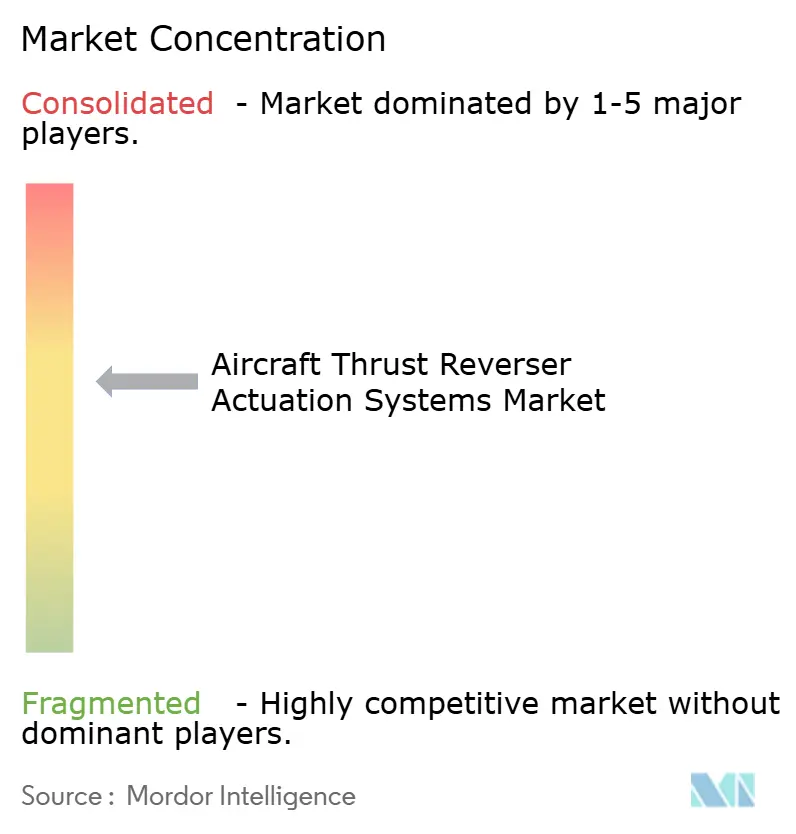
The aircraft thrust reverser actuation systems market is moderately concentrated at the systems-integration level. Safran and Collins Aerospace are important suppliers of original equipment content for commercial aircraft programs. Parker Hannifin, Woodward, Liebherr-Aerospace, Eaton, and other suppliers participate in related hydraulic and electromechanical actuation activities. Competition is shaped by program qualification, engineering depth, production reliability, and the ability to support long service lives. Multi-year testing and certification requirements make system-level entry difficult for smaller firms. The industry is, therefore, more concentrated in original equipment integration than in specialized repair and component support. This structure makes established program credentials an important competitive factor. It also rewards consistent execution across production and service.
Safran has reinforced its position through investment in electric actuation research. The ePRISME laboratory, with ESIGELEC, focuses on fault detection, electromagnetic compatibility, and near-real-condition simulation. Collins Aerospace also opened an engineering center in Wolverhampton and an elecTRAS production line in Colomiers during June 2025. Woodward’s acquisition of Safran’s North American electromechanical actuation business is another strategic move that broadened its regional actuation capability. These actions show that suppliers are investing in engineering capacity, product development, and control of strategic production assets.
The aftermarket remains less concentrated than original equipment integration because repair providers can compete on service responsiveness and approved capability. Safran’s agreement with Republic Airways demonstrates an OEM-linked approach to retaining revenue from thrust reverser maintenance. Independent providers can remain competitive in markets where fleets use mature hydraulic systems, and operators need local repair support. However, access to technical data, parts, and licenses can shape the work they can address. The aircraft thrust reverser actuation systems market also provides opportunities in business jet exchanges and platform-specific retrofit support. These areas require qualified inventory and approved technical capability. Service speed can further differentiate providers.
Aircraft Thrust Reverser Actuation Systems Industry Leaders
-
Safran SA
-
Collins Aerospace (RTX Corporation)
-
Woodward, Inc.
-
Parker-Hannifin Corporation
-
Liebherr-International Deutschland GmbH (Liebherr-International AG)
- *Disclaimer: Major Players sorted in no particular order
Aircraft Thrust Reverser Actuation Systems Market Companies Covered in this Report
- Safran SA
- Collins Aerospace (RTX Corporation)
- Woodward, Inc.
- Parker-Hannifin Corporation
- O.M.A. S.p.A.
- Liebherr-International Deutschland GmbH (Liebherr-International AG)
- Arkwin Industries, Inc. (TransDigm Group Inc.)
- Eaton Corporation plc
- Ontic Engineering & Manufacturing UK Limited
- ST Engineering MRAS (Singapore Technologies Engineering Ltd.)
- The NORDAM Group LLC
- S.S. White Technologies, Inc.
- SEPAC, Inc.
- Elliott Manufacturing (CentroMotion)
Recent Industry Developments in Aircraft Thrust Reverser Actuation Systems Market
- July 2026: Collins Aerospace, an RTX business, and Etihad Engineering announced a joint venture to provide nacelle and thrust reverser MRO services in Abu Dhabi. The facility will support A350 and B787 fleets operated by regional and international carriers. Collins Aerospace will relocate its UAE nacelle operations to Etihad Engineering’s maintenance complex, doubling its nacelle MRO footprint in the Middle East. The 3,250-square-meter facility is expected to commence operations in Q1 2027. It will expand thrust reverser maintenance capacity and strengthen aftermarket support for commercial aircraft operators.
- February 2026: ST Engineering MRAS presented its next-generation business aviation thrust reverser at the Singapore Airshow 2026. Developed through an internally funded R&D program, the pivot-door thrust reverser targets long-duct mixed-flow configurations in business aircraft. The lightweight composite system aims to improve aerodynamic efficiency, acoustic performance, and operational reliability in high-temperature conditions. This development reflects the company’s efforts to expand its thrust-reverser portfolio and advance composite technologies for business-aviation applications.
- December 2025: Safran Nacelles and ESIGELEC established the ePRISME joint research laboratory to advance electric thrust reverser actuation systems (ETRAS). The collaboration focuses on developing a testing platform to evaluate the integration of electrical systems under representative operating conditions. It also includes a predictive maintenance research platform that uses advanced algorithms and hardware solutions to identify potential faults in electrical and actuation systems. This initiative enhances the technological maturity and reliability of next-generation electric thrust reverser systems.
Global Aircraft Thrust Reverser Actuation Systems Market Report Scope
Aircraft thrust reverser actuation systems are braking systems that redirect engine airflow during landing or a rejected takeoff, reducing landing distance and brake wear. These systems use mechanical structures and actuation mechanisms, including hydraulic, electric, and electro-hydraulic technologies, to enable the controlled deployment and retraction of thrust reversers.
The global aircraft thrust reverser actuation systems market is segmented by platform, mechanism, system, end user, and geography. By platform, the market is segmented into commercial aircraft, military aircraft, and business jets. By mechanism, the market is segmented into hydraulic, electric, and electro-hydraulic. By system, the market is segmented into cascade type, pivot type, and target/clamshell type. By end user, the market is segmented into original equipment manufacturers (OEMs) and the aftermarket. The report also covers the market sizes and forecasts for the aircraft thrust reverser actuation systems market in major countries across different regions. For each segment, the market size is provided in terms of value (USD).
Segmentation Overview
| Commercial Aircraft |
| Military Aircraft |
| Business Jets |
| Hydraulic |
| Electric |
| Electro-Hydraulic |
| Cascade Type |
| Pivot Type |
| Target/Clamshell Type |
| Original Equipment Manufacturer (OEM) |
| Aftermarket |
| North America | United States | |
| Canada | ||
| Mexico | ||
| Europe | United Kingdom | |
| France | ||
| Germany | ||
| Italy | ||
| Rest of Europe | ||
| Asia-Pacific | China | |
| Japan | ||
| India | ||
| South Korea | ||
| Rest of Asia-Pacific | ||
| South America | Brazil | |
| Rest of South America | ||
| Middle East and Africa | Middle East | United Arab Emirates |
| Saudi Arabia | ||
| Qatar | ||
| Rest of Middle East | ||
| Africa | South Africa | |
| Rest of Africa | ||
| By Platform | Commercial Aircraft | ||
| Military Aircraft | |||
| Business Jets | |||
| By Mechanism | Hydraulic | ||
| Electric | |||
| Electro-Hydraulic | |||
| By System | Cascade Type | ||
| Pivot Type | |||
| Target/Clamshell Type | |||
| By End User | Original Equipment Manufacturer (OEM) | ||
| Aftermarket | |||
| By Geography | North America | United States | |
| Canada | |||
| Mexico | |||
| Europe | United Kingdom | ||
| France | |||
| Germany | |||
| Italy | |||
| Rest of Europe | |||
| Asia-Pacific | China | ||
| Japan | |||
| India | |||
| South Korea | |||
| Rest of Asia-Pacific | |||
| South America | Brazil | ||
| Rest of South America | |||
| Middle East and Africa | Middle East | United Arab Emirates | |
| Saudi Arabia | |||
| Qatar | |||
| Rest of Middle East | |||
| Africa | South Africa | ||
| Rest of Africa | |||
Key Questions Answered in the Report
What is the forecast value for aircraft thrust reverser actuation systems by 2032?
The aircraft thrust reverser actuation systems market is forecast to reach USD 6.08 billion by 2032, expanding from USD 4.07 billion in 2027 at an 8.36% CAGR.
Which platform leads demand for aircraft thrust reverser actuation systems?
Commercial aircraft lead with 82.45% share in 2026 because thrust reverser actuation is required on turbofan commercial aircraft.
Why are electric thrust reverser actuators gaining adoption?
Electric systems are projected to grow at a 10.24% CAGR through 2032 as manufacturers pursue lower-weight aircraft architectures and validated fault-tolerant designs.
Which region is growing fastest for thrust reverser systems?
Asia-Pacific is forecast to grow at a 10.05% CAGR through 2032, supported by fleet expansion and a growing need for certified maintenance capacity.
What is driving aftermarket demand for thrust reverser systems?
High aircraft utilization, fleet aging, and the need for approved repair, inspection, exchange, and parts support are increasing aftermarket activity.
How concentrated is competition among thrust reverser actuation system suppliers?
The market is moderately consolidated because leading integrators have strong OEM positions while qualified MRO and component providers remain dispersed.