
Aircraft Switches Market Size and Share
Market Overview
| Study Period | 2020 - 2031 |
|---|---|
| Market Size (2026) | USD 2.68 Billion |
| Market Size (2031) | USD 3.27 Billion |
| Growth Rate (2026 - 2031) | 4.02 % |
| Fastest Growing Market | Asia Pacific |
| Largest Market | North America |
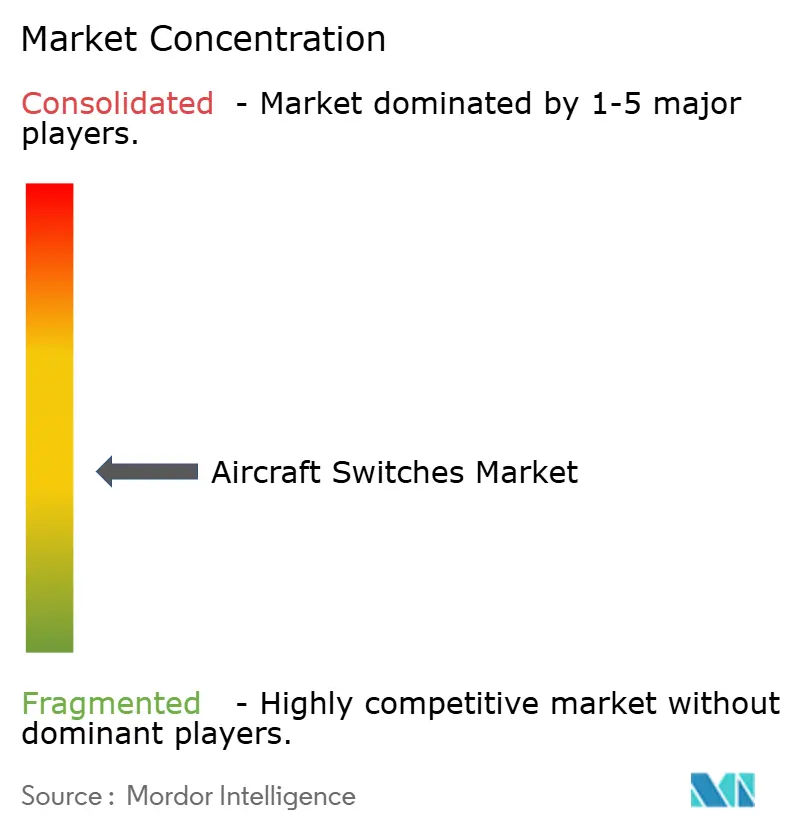
| Market Concentration | Medium |
Major Players *Disclaimer: Major Players sorted in no particular order Image © Mordor Intelligence. Reuse requires attribution under CC BY 4.0. | |
Aircraft Switches Market Analysis by Mordor Intelligence
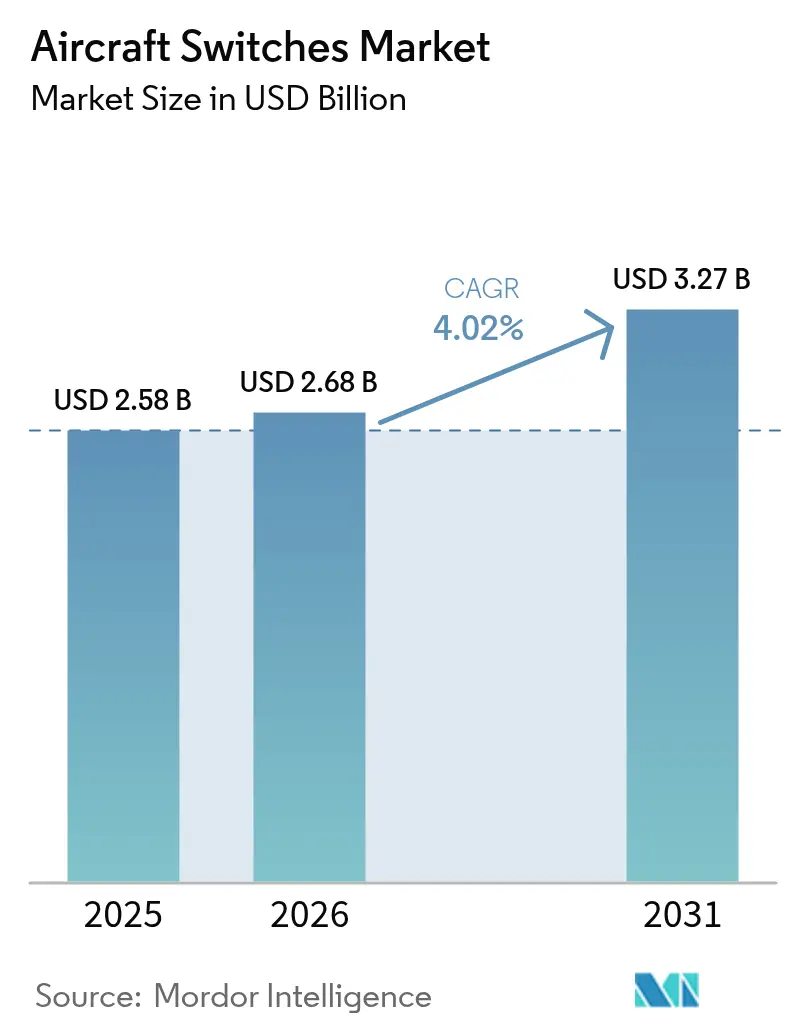
The aircraft switches market size is expected to grow from USD 2.58 billion in 2025 to USD 2.68 billion in 2026 and is forecast to reach USD 3.27 billion by 2031 at 4.02% CAGR over 2026-2031. This trajectory mirrors the aviation sector’s steady pivot toward more-electric architectures, where electrical subsystems replace legacy mechanical and hydraulic components, multiplying the number of switching points across each airframe. Airlines’ fleet-renewal schedules and defense modernization programs ensured a consistent order flow for both commercial and military platforms in 2024 and early 2025. Solid-state power controllers, silicon-carbide devices, and smart switches with built-in diagnostics became mainstream as the emphasis shifted from discrete electromechanical parts to software-defined, data-sharing modules capable of predictive maintenance integration. Vendor selection criteria increasingly include cybersecurity compliance and supply-chain integrity, forcing mid-tier suppliers either to invest in certification upgrades or accept consolidation offers from larger peers. Across regions, North America retained the revenue lead owing to sustained defense spending. Yet, Asia-Pacific posted the fastest growth as China and India accelerated aircraft production and MRO capacity expansion.[1]
Key Report Takeaways
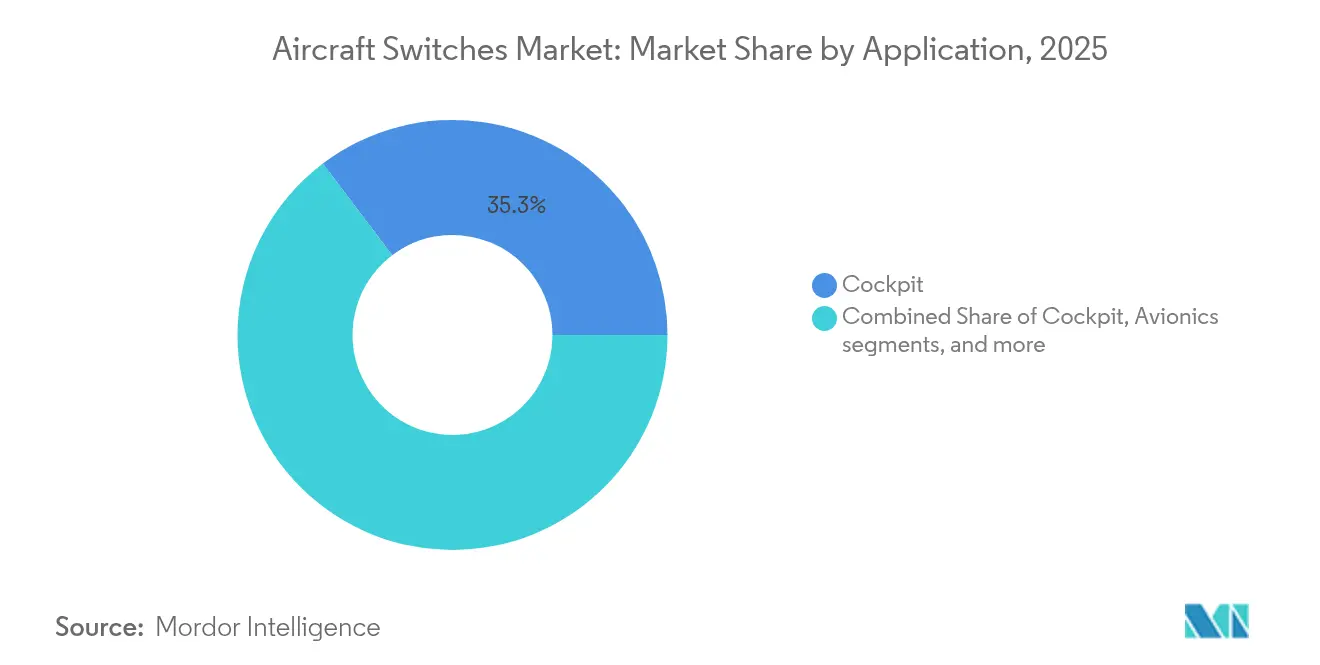
- By application, cockpit systems led the aircraft switches market with 35.30% of the share in 2025, while avionics switches are projected to record a 4.89% CAGR through 2031.
- By switch type, manual switches retained 65.10% revenue share in 2025; automatic switches are set to grow at a 5.72% CAGR to 2031.
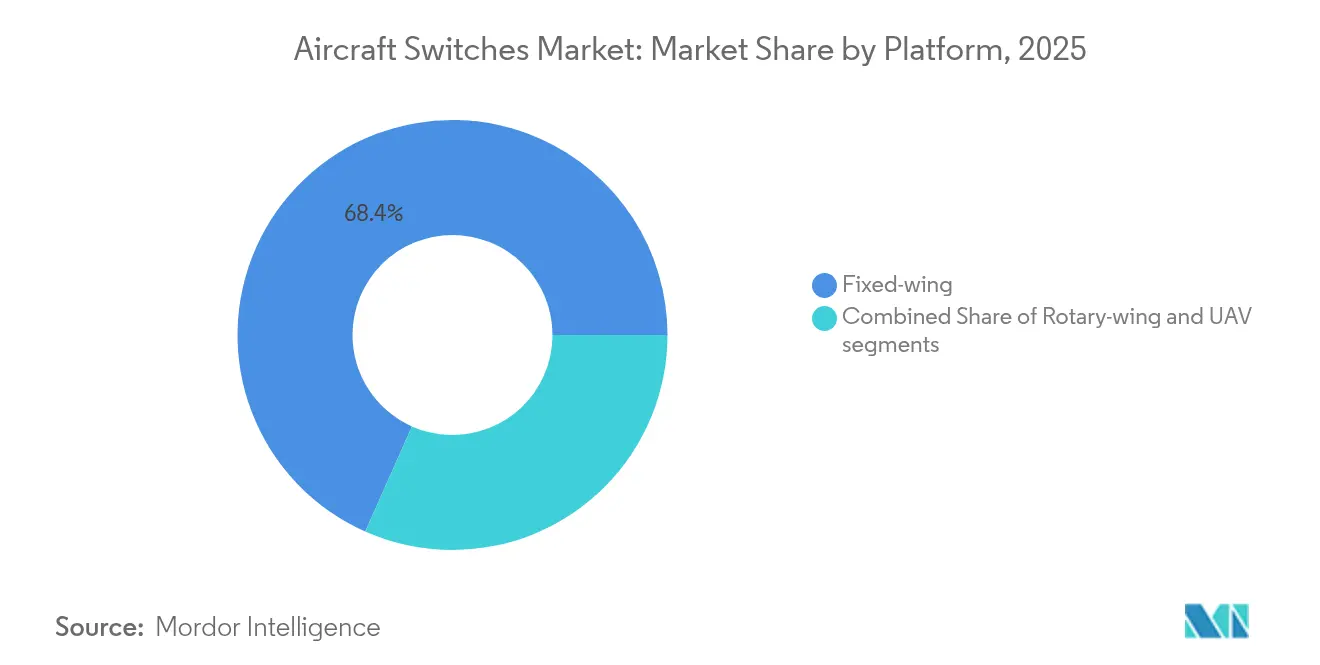
- By platform, fixed-wing aircraft held 68.35% of the aircraft switches market size in 2025; unmanned aerial vehicles are poised for the highest 6.24% CAGR.
- By end user, OEM programs commanded 60.10% of 2025 revenue, whereas the aftermarket is forecasted to expand at a 4.43% CAGR.
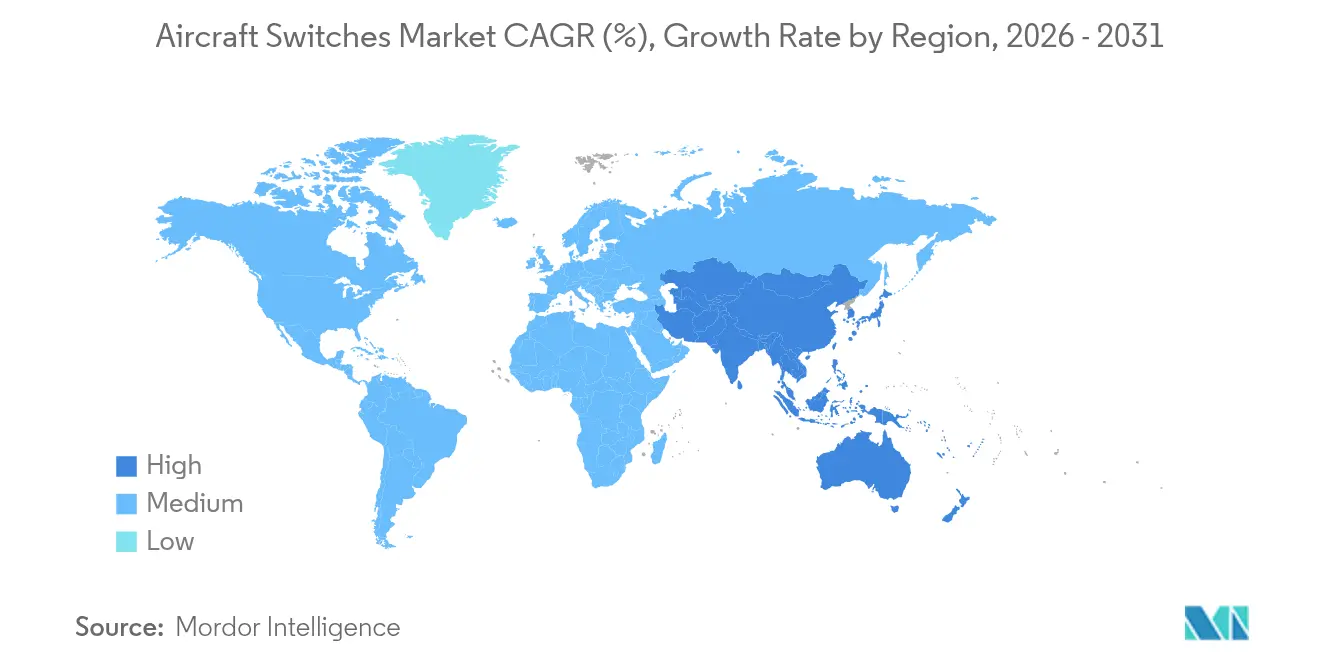
- By geography, North America accounted for 37.40% of the 2025 revenue base, and Asia-Pacific is expected to post the strongest 5.43% CAGR.
Note: Market size and forecast figures in this report are generated using Mordor Intelligence’s proprietary estimation framework, updated with the latest available data and insights as of 2026.
Market Trends and Insights
Drivers Impact Analysis of Aircraft Switches Market*
| Driver | (~) % Impact on CAGR Forecast | Geographic Relevance | Impact Timeline |
|---|---|---|---|
| Fleet renewal wave in next-gen narrow-body programs | +0.8% | Global, high in North America and Asia-Pacific | Medium term (2-4 years) |
| Surge in more-electric subsystems needing solid-state switching | +1.2% | Global, led by North America and Europe | Long term (≥ 4 years) |
| Cabin-retrofit boom for IFEC and lighting upgrades | +0.6% | Global, strong in North America and Europe | Short term (≤ 2 years) |
| Rapid military rotorcraft recapitalization budgets | +0.5% | North America, Europe, Asia-Pacific defense markets | Medium term (2-4 years) |
| Data-driven predictive-maintenance contracts bundling smart switches | +0.4% | Global, early adoption in North America | Long term (≥ 4 years) |
| Silicon-on-insulator (SOI) power‐device breakthroughs enabling ultra-compact relays | +0.3% | Global, tech hubs in North America and Europe | Long term (≥ 4 years) |
| Source: Mordor Intelligence | |||
Fleet Renewal Wave in Next-Gen Narrow-Body Programs
Airlines accelerated replacement of aging single-aisle fleets in 2024, specifying electrical architectures that require denser switching networks for power distribution and flight-deck controls. Boeing’s B777X certification effort and Air India’s large multitype order packages typified how every new delivery triggered bundled switch installations spanning cockpit, avionic bay, and cabin zones.[2]Operators insisted on future-proof hardware able to accommodate software upgrades across the 20-year airframe life, favoring suppliers offering configurable solid-state units with health-monitoring outputs.
Surge in More-Electric Subsystems Requiring Solid-State Switching
Aircraft electrification expanded from secondary systems to high-power actuation lines, pushing switch ratings beyond 500A and 1,000V. Collins Aerospace prototyped megawatt-class power-distribution modules under the Clean Aviation SWITCH program, validating silicon-carbide devices for continuous high-temperature operation. Honeywell’s silicon-on-insulator CMOS processes supported components rated to 300°C, enabling power-conversion bays to migrate closer to engines and reducing harness weight. These advances underpinned the aircraft switches market as platform OEMs shifted to distributed electrical propulsion concepts.
Cabin-Retrofit Boom for IFEC and Lighting Upgrades
Cabin interior refresh cycles peaked in 2024–2025, with airlines upgrading LED lighting, Bluetooth audio, and high-bandwidth connectivity. Airbus prepared A350 retrofit kits as nine-year-old airframes entered heavy maintenance visits, creating immediate demand for low-profile rocker and rotary switches integrated into passenger-service units. Studies indicating 68% energy savings from LED substitution strengthened the business case, and smart switches capable of linking to cabin-management systems through ARINC 429 or CAN bus interfaces became standard. Vendors supplying configurable switch panels won multi-airline contracts tied to harmonized cabin branding initiatives.
Rapid Military Rotorcraft Recapitalization Budgets
The US Army’s Future Long Range Assault Aircraft contract and parallel Apache modernization drove new build and retrofit activity for helicopter fleets, each aircraft using hundreds of sealed switches for avionics, weapons release, and environmental control. Bell’s V-280 Valor and GE Aerospace’s integrated power systems required fly-by-wire compatible switching modules hardened for vibration and sand-ingress environments. Similar recapitalization programs in Europe and Asia-Pacific sustained double-digit order growth for military-grade toggle, guarded, and automatic contactor assemblies.
Restraints Impact Analysis of Aircraft Switches Market*
| Restraint | (~) % Impact on CAGR Forecast | Geographic Relevance | Impact Timeline |
|---|---|---|---|
| Qualified-component certification queue delays at FAA and EASA | -0.7% | Global, mostly North America and Europe | Short term (≤ 2 years) |
| Raw-material price volatility for silver-cadmium oxide contacts | -0.4% | Global supply chain | Medium term (2-4 years) |
| Counterfeit part infiltration in MRO supply chains | -0.3% | Global, concentrated in secondary markets | Short term (≤ 2 years) |
| Cyber-hardening requirements raising BOM cost of smart switche | -0.5% | Global, led by North America and Europe | Long term (≥ 4 years) |
| Source: Mordor Intelligence | |||
Qualified-Component Certification Queue Delays
FAA and EASA engineering directorates faced case backlogs as cybersecurity and software assurance reviews deepened, stretching component approval lead times from 12 months to more than 24 months. Boeing’s B777X program delays highlighted the cascading impact on tier-1 and tier-2 suppliers waiting for type-certification data to finalize production release. [3]Smaller switch vendors lacking dedicated certification teams risked losing line-fit positions, tempering overall aircraft switches market momentum.
Cyber-Hardening Requirements Raising BOM Cost of Smart Switches
Regulatory proposals issued in 2024 mandated embedded encryption engines, secure boot, and continual threat-monitoring within network-connected components. Airbus positioned cyber-secure design as a strategic imperative after noting that 64% of aviation cyber incidents targeted ground and airborne connectivity gateways. Implementing hardware root-of-trust circuits and tamper-evident enclosures added up to 12% material cost per smart switch, pressuring price-sensitive retrofit campaigns and capping short-term adoption rates.
*Our forecasts treat driver/restraint impacts as directional, not additive. The impact forecasts reflect baseline growth, mix effects, and variable interactions.
Aircraft Switches Market Segment Analysis
By Application:
Cockpit Leadership Amid Avionics SurgeCockpit switches retained 35.30% of 2025 revenue as pilots relied on tactile pushbuttons, guarded toggles, and rotary selectors for flight-critical tasks. Manual designs dominated because regulators required physical backup control lines in case of display or data bus failure. The segment benefited from sustained deliveries of single-aisle aircraft, where standardized overhead panels simplified integration and lowered per-unit costs.
Avionics installations generated the fastest 4.89% CAGR forecast through 2031. Multi-function displays, flight-management computers, and health-monitoring units demanded high-density, low-bounce automatic relays linked over Ethernet-based backbones. Airlines embedded smart switches that streamed usage data into predictive-maintenance platforms, improving dispatch reliability. Overall, avionics growth supported incremental additions to the aircraft switches market size for integrated modular avionics suites.

By Switch Type:
Manual Core, Automatic AscendancyManual units supplied 65.10% revenue in 2025, led by pushbutton assemblies preferred for clear tactile affirmation and straightforward line maintenance. Rocker variants won cabin positions where design language and illumination effects improved passenger perception. Manual demand preserved manufacturing economies of scale and stable replacement part numbers across multiple fleets.
Automatic switches are projected to climb at a 5.72% CAGR as more-electric architectures substitute electromechanical contactors with solid-state controllers. Hybrid relays that pair arc-free semiconductor paths with mechanical redundancy entered serial production, combining low voltage drop with fail-safe positioning. This migration enlarges the aircraft switches market as each power-distribution center now contains dozens of intelligent, addressable switches instead of a handful of legacy breakers.
By Platform:
Fixed-Wing Mass, UAV MomentumFixed-wing programs, ranging from regional jets to strategic airlifters, accounted for 68.35% of the 2025 aircraft switches market share. Widebody development restarted after pandemic-era pauses, and narrow-body backlogs returned to pre-2020 levels, ensuring high order stability. Mature qualification documents allowed suppliers to reuse approved parts across derivative models, sustaining volume.
Unmanned aerial vehicles (UAVs) are forecasted to record a 6.24% CAGR, supported by autonomous surveillance, cargo, and combat missions. Each UAV demands weight-optimized, hermetically sealed miniature switches resistant to temperature extremes and electromagnetic interference. GE Aerospace’s small-engine roadmap and Kratos’ airframe pipeline signal escalating volumes that will diversify the platform mix within the aircraft switches market.
By End User:
OEM Base, Aftermarket UpswingOEM lines commanded 60.10% of 2025 sales as every delivery aircraft incorporated customized switch suites validated at type certification. Long production cycles secured predictable multi-year demand, and risk-sharing partnerships locked in pricing frameworks.
Aftermarket orders are set to advance at a 4.43% CAGR as aging fleets require life-extension upgrades. Cabin retrofits, avionics modernization, and condition-based replacement campaigns broaden part numbers in circulation. Safran recorded 17.7% year-on-year equipment and defense aftermarket growth in early 2025, illustrating how MRO networks lift recurring revenue for switch vendors. Expanding inventory pools positively influence the aircraft switches market size by adding service and repair contracts to traditional hardware sales.
Geography Analysis
North America Aircraft Switches Market
North America generated 37.40% of 2025 revenue, underpinned by comprehensive defense budgets and active commercial production lines. Boeing, Honeywell, Curtiss-Wright, and Eaton anchored the regional supplier ecosystem, while FAA certification expertise concentrated program approvals within the United States borders. Several USD 10 billion-plus contracts for NGAD and helicopter upgrades ensured consistent switch demand across fighter, tanker, and rotorcraft categories.
APAC Aircraft Switches Market
Asia-Pacific, forecast to expand at 5.43% CAGR, benefited from China’s climb up the MRO value chain and India’s surging aircraft orders. Airbus projected China’s services segment to reach USD 61 billion by 2043, with maintenance representing 83%—a switch-intensive activity. India’s government earmarked USD 12 billion for airport expansion and encouraged local component production, prompting Western suppliers to establish joint ventures, as seen in Eaton’s partnership with SIAEC. The region’s focus on indigenization opened opportunities for mid-sized players to license technology and capture domestic content quotas.
Europe Aircraft Switches Market
Europe remained stable, supported by Airbus assembly, defense cooperation under GCAP, and R&D projects backed by EU climate funds. Collins Aerospace’s Clean Aviation SWITCH prototypes in France and Ireland validated high-voltage distribution strategies for hybrid-electric demonstrators, elevating regional intellectual-property stakes. Simultaneously, EASA’s cybersecurity mandates heightened certification complexity, favoring suppliers with in-house compliance resources and thus maintaining moderate barriers to entry within the aircraft switches market.
Regulatory Landscape
Aircraft switches are regulated as part of aircraft electrical systems and wiring, with airworthiness compliance anchored in FAA 14 CFR Part 25 (Subpart F) for transport-category aircraft and EASA CS-25 requirements covering Electrical Wiring Interconnection Systems (EWIS). In practice, switch installations also have to be supported by EWIS Instructions for Continuing Airworthiness (ICA) documentation under EASA guidance, which makes lifecycle maintenance and traceability requirements a working compliance gate alongside initial qualification.
On the technical qualification side, RTCA DO-160 (aligned internationally with EUROCAE ED-14) is used to demonstrate environmental robustness of airborne equipment such as switches, while FAA guidance on High-Intensity Radiated Fields (HIRF) testing (AC 20-158A) references DO-160 methods. In May 2025, the FAA updated acceptance of certain ASTM consensus standards via the Federal Register, reinforcing that novel electric propulsion-related compliance can require project-specific Means of Compliance under Part 23 pathways, increasing the need for early regulator engagement for higher-voltage and software-enabled switching architectures.
Value Chain Analysis
The value chain starts with suppliers of conductive metals and contact materials (including plated precious metals), as well as aerospace-grade polymers and seals. Switch manufacturers then produce manual and automatic devices, ranging from cockpit toggles and pushbuttons to relay/contactor assemblies and sensor-integrated units. These parts move to tier-1 system integrators and electrical power specialists (for example, Honeywell and Safran) that design and qualify assemblies and panels for avionics bays, cockpit consoles, power distribution, and cabin systems, before final integration by airframe OEMs such as Airbus and Boeing.
Qualification and certification drive long lead times and working-capital intensity across the chain, and software-enabled or networked switching can add firmware assurance tasks and extend development cycles. Key friction points include semiconductor availability for smart or sensor-integrated switches, volatility in contact and plating inputs, and the need to support dual certification expectations across FAA and EASA programs. Distribution into the aftermarket typically flows through approved MRO channels and OEM-approved parts networks, where traceability and counterfeit-avoidance practices influence supplier selection and stocking strategies.
Competitive Landscape
The aircraft switches market exhibited moderate fragmentation throughout 2024, with roughly a dozen multinational corporations eclipsing hundreds of niche specialists. Safran pursued portfolio expansion by acquiring Collins Aerospace’s actuation and flight-control assets, bringing complementary electromechanical expertise under one roof. Honeywell invested in silicon-on-insulator fabrication to differentiate its high-temperature solid-state offerings and announced the spin-off of its aerospace division, signaling a strategic focus on next-generation avionics and power systems. Eaton leveraged cash flow to fund hydrogen-aircraft research consortia, aiming to position its contractor line for emerging zero-emission platforms.
Technology leadership increasingly hinged on embedded diagnostics and cyber-secure design. Vendors integrating cryptographic authentication, real-time health monitoring, and field-programmable logic captured premium line-fit slots on the latest Boeing and Airbus variants. Supply-chain integrity emerged as a key differentiator after counterfeit titanium and seal incidents prompted the formation of the Aviation Supply Chain Integrity Coalition. Companies able to prove part traceability through blockchain-enabled certificates improved their win ratio during competitive tendering. Simultaneously, white-space opportunities opened in UAV-specific, SWaP-optimized switch modules, where smaller firms could commercialize rapid prototypes without the legacy burdens borne by incumbent conglomerates.
Strategic alliances complemented acquisitions. Curtiss-Wright secured a USD 80 million IDIQ with the US Air Force for high-speed data-acquisition hardware, cross-selling embedded switch cards into instrumentation racks. Collins Aerospace partnered with the US Army to develop modular open-systems avionics for the UH-60M, locking in future retrofit streams featuring standard-format power-distribution switchboards. Such collaborations underlined how integration capability—as much as hardware performance—determined bidding success in the aircraft switches market.
Aircraft Switches Industry Leaders
-
Honeywell International Inc.
-
Eaton Corporation plc
-
Safran SA
-
RTX Corporation
-
TE Connectivity Corporation
- *Disclaimer: Major Players sorted in no particular order
Aircraft Switches Market Companies Covered in this Report
- Safran SA
- Honeywell International Inc.
- Eaton Corporation plc
- TE Connectivity Corporation
- RTX Corporation
- AMETEK, Inc.
- ITT Inc.
- CandK COMPONENTS LLC
- Electro-Mech Components, Inc.
- Unison Industries, LLC.
- Hydra-Electric Company
- Sensata Technologies, Inc.
- Vishay Intertechnology, Inc.
- Curtiss-Wright Corporation
- Schurter Holding AG
- Cygnet Aerospace Corp.
- Barantech
- Pressure Controls, Inc.
- AstroNova, Inc.
Market Opportunities and Future Outlook
White space is forming around higher-voltage, higher-power switching and protection designed for more-electric architectures, where smart switching with built-in diagnostics supports condition-based maintenance and more stringent dispatch reliability targets. Hybrid-electric and electrified subsystems are widening the need for compact, thermally capable switching modules and contactor/relay solutions that integrate with power electronics and aircraft data networks. This setup tends to reward suppliers that can deliver qualified building blocks rather than discrete electromechanical parts.
Capacity and localization initiatives in aerospace electrical systems also create avenues for switch suppliers to align with expanding wiring and power-distribution footprints and secure preferred sourcing positions. For example, Safran Electrical and Power inaugurated a new electrical wiring factory in Chihuahua, Mexico in February 2026, indicating investment in industrial capacity around aircraft electrical architectures where switching content scales with harnessing and distributed power. In parallel, airline and regulator focus on inspection and continued airworthiness of critical cockpit controls supports certified replacement parts, upgraded switch variants with improved reliability, and documentation-ready retrofit kits sold through OEM and approved MRO channels.
Recent Industry Developments in Aircraft Switches Market
- July 2026: Safran and Electra reached a development and production agreement covering Safran’s TG600 turbogenerator to power the EL9 hybrid-electric aircraft, including an initial order for 250 units. The life-of-program structure links Safran’s electrical power roadmap to an emerging hybrid-electric platform category. It also reinforces demand for higher-voltage, higher-power electrical system content where qualified switching and protection components become more integral.
- July 2026: RTX’s Collins Aerospace opened an Engineering Center of Excellence in Wolverhampton, United Kingdom, focused on advancing next-generation electric thrust reverser actuation systems (elecTRAS). The facility expands engineering and validation capability aligned with more-electric aircraft architectures. Such investments increase the pull for qualified electrical subsystem components, including ruggedized switching and control elements integrated into actuation and power-distribution designs.
- May 2026: India’s DGCA ordered an inspection of fuel control switches on an Air India Boeing 787-8 after pilots reported a malfunction, with checks conducted at the OEM facility. The action highlights continued regulatory scrutiny of flight-critical switch performance and documentation. It also elevates the importance of certified spares availability and robust quality systems for suppliers serving both OEM and in-service fleets.
Aircraft Switches Market Report Scope and Research Methodology
Market Definition and Coverage
This market is counted as the revenue earned from aircraft-qualified electrical switches that control power flow or signals across aircraft systems, including cockpit controls, avionics panels, cabin functions, engine and APU interfaces, and other on-board uses.
Scope exclusions: We exclude general industrial switches not designed and certified for aircraft use, along with unrelated electrical items such as wiring harnesses, connectors, and full power distribution units.
Segments Covered in This Report
- By Application
- Cockpit
- Cabin
- Engine and Power Auxiliary Power Unit (APU)
- Avionics
- Others
- By Switch Type
- Manual
- Pushbutton Switches
- Toggle Switches
- Rocker Switches
- Rotary Switches
- Others
- Automatic
- Pressure Switches
- Temperature Switches
- Flow Switches
- Relays and Contactor Switches
- Others
- Manual
- By Platform
- Fixed-wing Aircraft
- Rotary-wing Aircraft
- Unmanned Aerial Vehicles (UAV)
- By End User
- OEM
- Aftermarket
- By Geography
- North America
- United States
- Canada
- Mexico
- Europe
- Germany
- United Kingdom
- France
- Italy
- Rest of Europe
- Asia-Pacific
- China
- Japan
- India
- South Korea
- Australia
- Rest of Asia-Pacific
- South America
- Brazil
- Rest of South America
- Middle East and Africa
- Middle East
- United Arab Emirates
- Saudi Arabia
- Rest of Middle East
- Africa
- South Africa
- Rest of Africa
- Middle East
- North America
Data Sources, Market Sizing, and Validation
Desk Research
Desk work starts with mapping the aircraft build and maintenance cycle that creates switch demand, and then aligning it to what is actually shipped and installed. Public sources are used to anchor the base demand pool, such as FAA and EASA airworthiness and fleet information, ICAO and IATA traffic indicators, and OEM and MRO association publications that discuss fleet deliveries and shop visit patterns.
We also use sources such as UN Comtrade for trade signals in relevant electrical components, aerospace standards and guidance documents (for example, qualification and reliability expectations), and peer reviewed papers on aircraft electrification and cockpit human machine interfaces. Company filings, investor presentations, product catalogs, and reputable aerospace press help confirm product mix and typical use cases. For cross checks, we refer to paid subscriptions limited to company financials and intelligence, aerospace and aviation databases with aircraft level program details, and patent databases to understand how technology shifts may change switch mix over time. These are illustrative sources, and many other public references are reviewed for data collection, validation, and clarification.
Primary Interviews and Surveys
Primary discussions are used to confirm what gets counted as an aircraft switch in practice, and to separate OEM fitment demand from aftermarket replacement volumes. We spoke with a mix of component suppliers, aircraft and subsystem integrators, MRO focused stakeholders, and engineering focused experts across APAC, EMEA, and the Americas so assumptions on unit content, pricing progression, and replacement cycles could be checked and adjusted.
Distribution of primary research fieldwork respondents
| Company type | Respondent position | Region |
|---|---|---|
| Top tier: 27% | CXOs: 13% | APAC: 44% |
| Mid tier: 56% | Functional/Unit leaders: 41% | EMEA: 37% |
| Smaller Players: 17% | Managers: 46% | Americas: 19% |
Market-Sizing & Forecasting
For sizing, we first use a top-down build that reconstructs demand from aircraft production and in-service activity, and then translates those platforms into switch needs by typical fitment and replacement behavior. Inputs that commonly move the model include aircraft delivery volume by major platform class, the share of electrical and cockpit upgrades on new programs, average switch content per aircraft zone (cockpit, cabin, and systems panels), replacement and overhaul intervals tied to flight hours and cycles, and average selling price bands by switch family and qualification level.
To keep the totals realistic, the output is then corroborated using selective bottom-up approximations, such as sampled price points multiplied by estimated unit volumes for a short list of high-usage switch families, and channel checks on OEM versus aftermarket contribution. When a bottom-up view has gaps, we fill them using clearly stated assumptions tied to fleet size and maintenance cadence, and those assumptions are rechecked in follow-up calls. Forecasting is done using scenario analysis supported by a light multivariate regression, where fleet growth, aircraft deliveries, and MRO activity indicators are the main drivers, and adoption of more-electric architectures is treated as a separate sensitivity that changes mix and ASPs.
Data Validation & Update Cycle
Validation is done through a set of cross checks that look for mismatches between the model and independent signals such as aircraft deliveries, fleet utilization, and maintenance throughput. If a segment swings beyond reasonable ranges, the inputs are reviewed again, and the assumptions that caused the variance are traced back to the source and recalculated before sign-off.
A second analyst review is performed to confirm that definitions, conversions, and math are consistent across years and regions. If new aircraft program updates, certification developments, or major supply chain disruptions are observed, we re-contact relevant respondents and update the model inputs. Reports are refreshed annually, and a final pre-delivery sweep is done so clients receive the latest updated view.
Mordor Intelligence's Aircraft Switches Market Estimate Compared With Other Published Estimates
Published market values for aircraft switches often differ because the included product set and the counted demand events are not the same across studies, even when the title looks identical. The year used, the treatment of OEM versus aftermarket, and the way pricing is moved across the forecast also tend to create visible gaps.
Some published figures fold in adjacent aircraft electrical content or treat broader control hardware as part of the same bucket, which pushes the total up, and others focus mainly on line-fit shipments and undercount replacement demand that follows fleet aging. In our work, Mordor Intelligence limits the count to aircraft-qualified electrical switches used to open, close, or route electrical signals and power on the aircraft, and it separates OEM fitment from aftermarket replacement using fleet utilization and maintenance interval checks.
Benchmark comparison
| Source | Market Size | Gaps in Research Methodology |
|---|---|---|
| Mordor Intelligence | USD 2.58 B (2025) | |
| Industry Publisher A | USD 2.40 B (2025) | Reported sizing appears to rely more on OEM build activity and may apply a narrower aftermarket replacement factor, which can pull down the current-year total in a fleet with rising maintenance events. |
| Global Publisher B | USD 2.50 B (2026) | The figure is stated for a different current year and can also reflect a faster ASP progression assumption tied to electrification, which shifts the value even if unit volumes are similar. |
The spread in values is mainly explained by year alignment and what gets included next to switches, followed by how OEM and aftermarket are balanced in the same model. By keeping the scope tied to aircraft-qualified switch functions and then checking it against fleet activity and maintenance cadence, the estimate stays traceable to inputs that can be reviewed and repeated.
Key Questions Answered in the Report
What is the current value of the aircraft switches market?
The aircraft switches market stood at USD 2.68 billion in 2026 and is projected to reach USD 3.27 billion by 2031, advancing at a 4.02% CAGR.
Which application segment holds the largest revenue share?
Cockpit systems led with 35.30% of 2025 revenue due to the concentration of safety-critical controls in the flight deck.
Why are automatic switches growing faster than manual designs?
Automatic switches integrate solid-state technology and embedded diagnostics that support more-electric architectures, driving a 5.72% CAGR to 2031.
Which region is expected to grow the fastest?
Asia-Pacific is forecasted to record a 5.43% CAGR through 2031, spurred by Chinese MRO expansion and Indian aircraft orders.
How are cybersecurity mandates affecting switch design?
New FAA and EASA rules require encryption, secure boot, and continuous monitoring, increasing bill-of-materials cost by up to 12% for smart switches.
What factors influence supplier selection today?
Operators prioritize proven certification status, integrated diagnostics, cybersecurity compliance, and traceable supply chains when choosing switch vendors.