
Aircraft Actuators Market Size and Share
Market Overview
| Study Period | 2019 - 2031 |
|---|---|
| Market Size (2026) | USD 10.86 Billion |
| Market Size (2031) | USD 14.84 Billion |
| Growth Rate (2026 - 2031) | 6.45 % |
| Fastest Growing Market | Asia Pacific |
| Largest Market | North America |
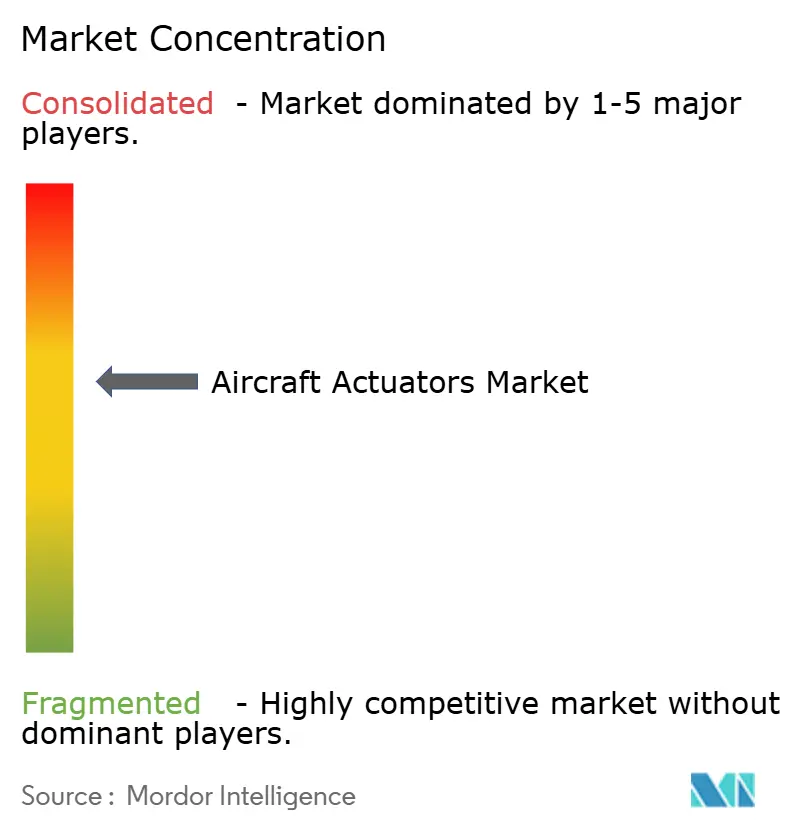
| Market Concentration | Medium |
Major Players *Disclaimer: Major Players sorted in no particular order Image © Mordor Intelligence. Reuse requires attribution under CC BY 4.0. | |
Aircraft Actuators Market Analysis by Mordor Intelligence
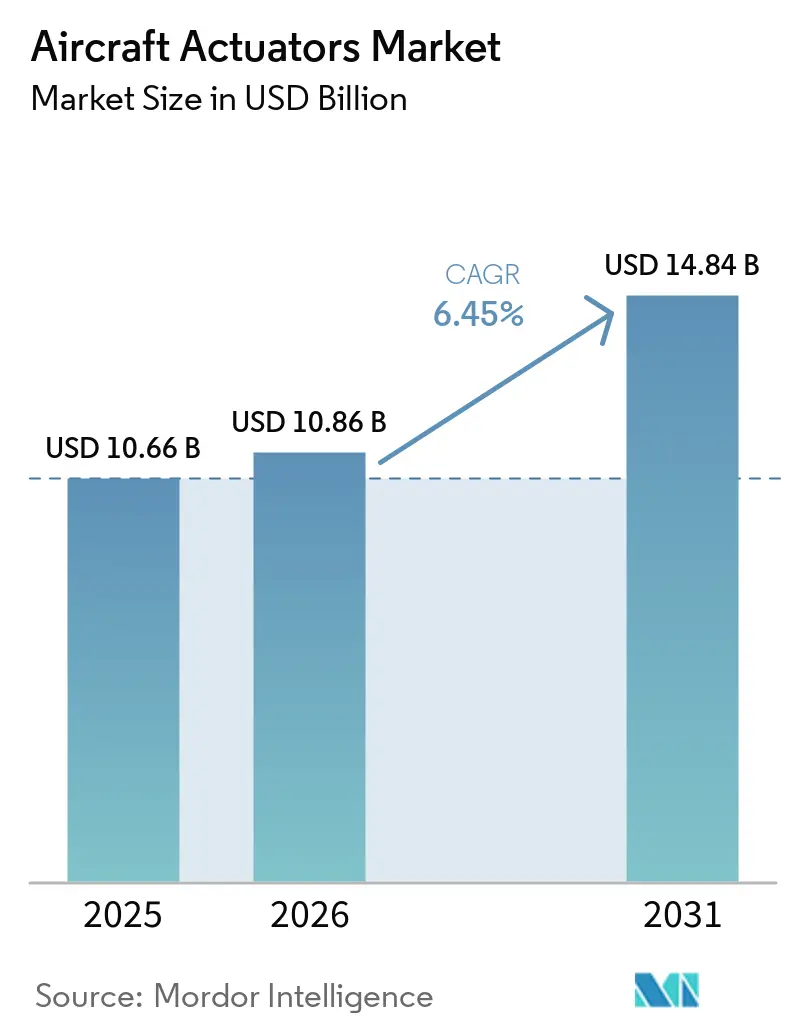
The aircraft actuators market size is expected to grow from USD 10.66 billion in 2025 to USD 10.86 billion in 2026 and is forecasted to reach USD 14.84 billion by 2031 at a 6.45% CAGR over 2026-2031. Persistent narrowbody backlogs at Airbus and Boeing, the march toward more-electric architectures, and the shift toward predictive-maintenance-ready components are the primary drivers of this expansion. Electromechanical technologies are gaining market share because they eliminate hydraulic leakage, reduce empty weight, and stream health data to operators. Thermal-management hurdles still restrict their role in high-speed primary controls. Airlines remain cautious about complete retrofits, but regulatory moves, such as FAA Advisory Circular 25-19A, have created a compliance path for smart actuators. Meanwhile, sustainability programs around SAF and hydrogen are spawning new design cycles that further expand actuator content per aircraft. On the competitive front, the aircraft actuators market is moderately concentrated, as the top five suppliers leverage digital twin platforms and vertical integration, while niche specialists court eVTOL and UAV programs with ultra-light, electro-hydrostatic designs.
Key Report Takeaways
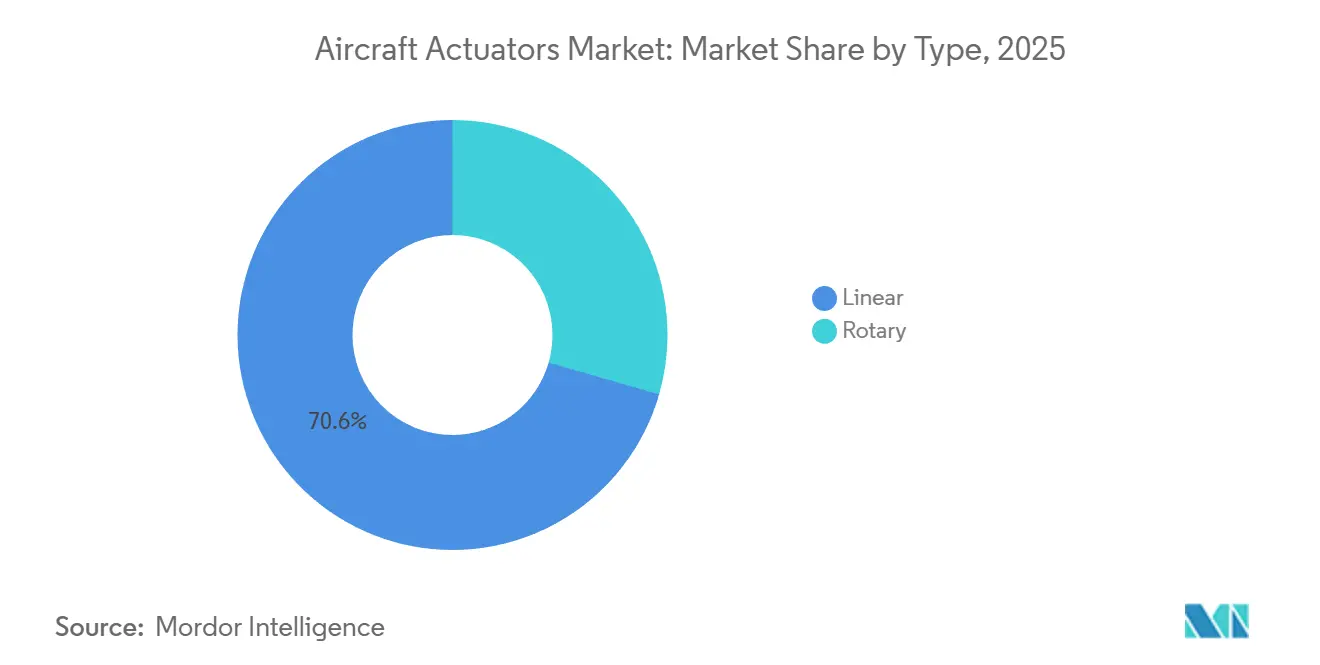
- By type, linear actuators held 70.55% of the aircraft actuators market share in 2025, whereas rotary units are projected to post the fastest 6.90% CAGR through 2031.
- By system, hydraulic actuators retained 44.90% of the revenue in 2025; electrical and electromechanical units are on track for the highest 7.10% CAGR through 2031.
- By application, flight-control surfaces accounted for 47.20% of 2025 revenue, while cabin and seat systems are forecasted to expand at a 7.85% CAGR.
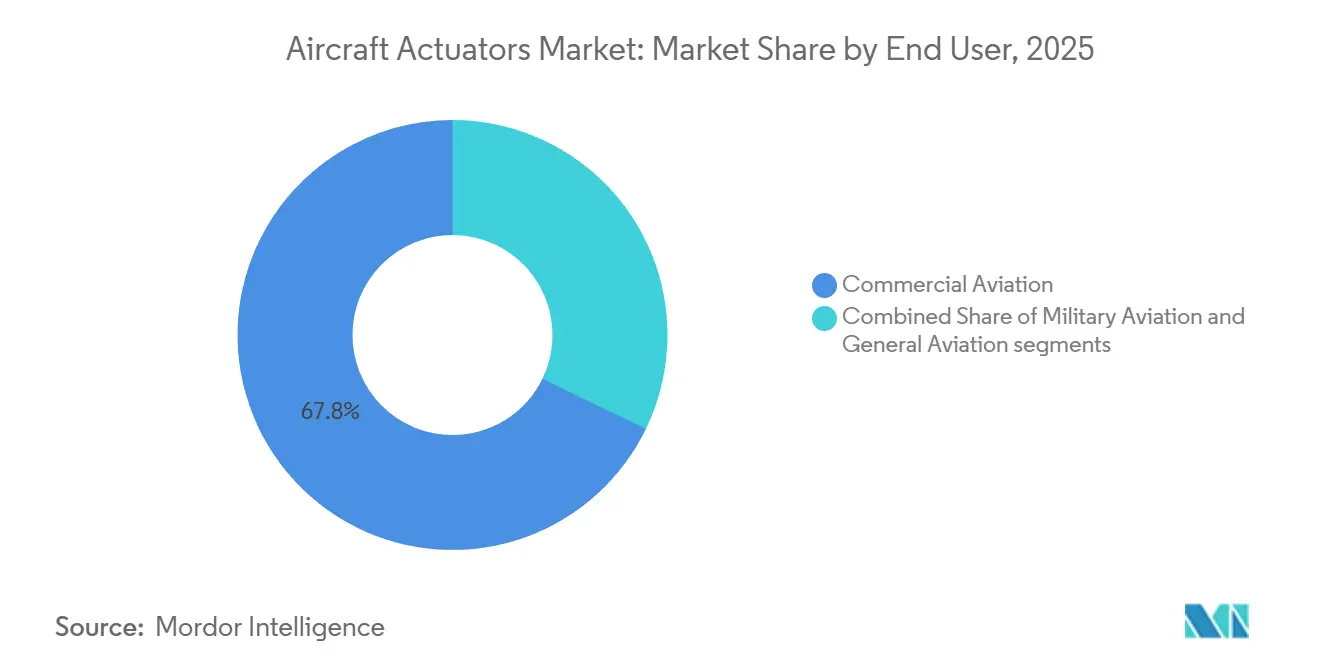
- By end user, commercial aviation led with 67.80% revenue in 2025; military aviation is expected to grow at the fastest rate, with an 8.10% CAGR through 2031.
- By fit, the aftermarket captured 56.90% of the 2025 value, whereas OEM installations are expected to rise at a 6.85% CAGR as production rates recover.
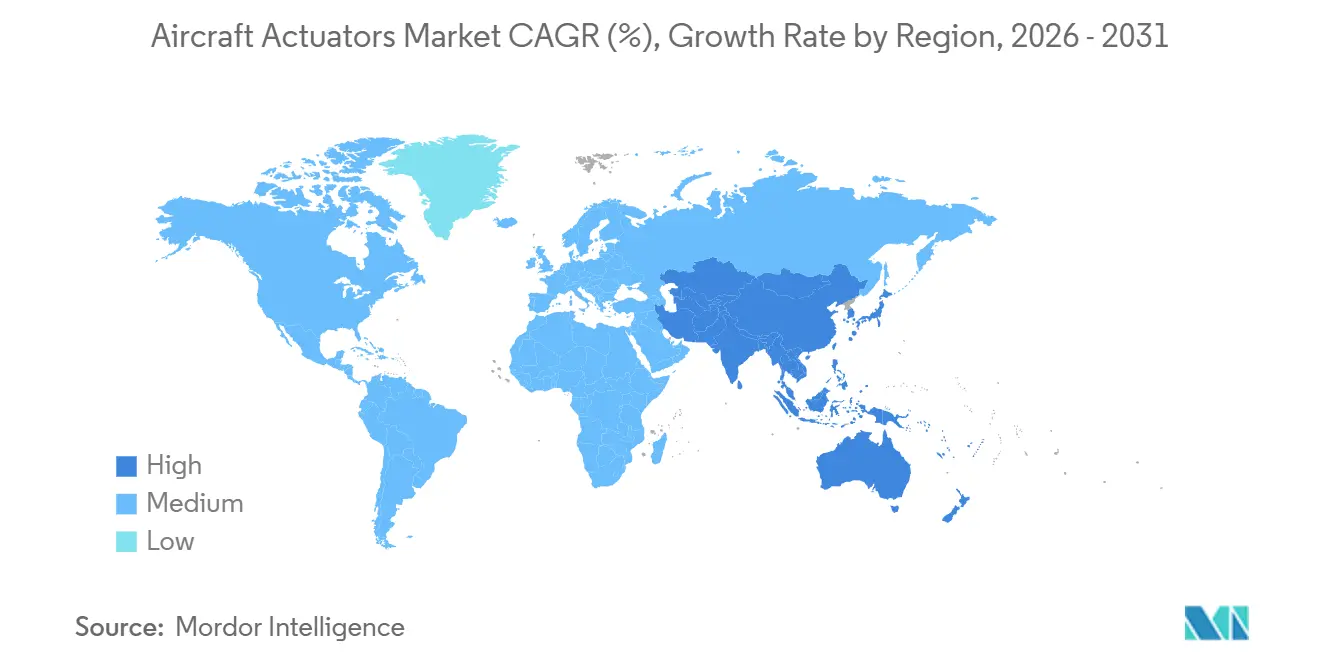
- By geography, North America generated 36.85% of 2025 sales, but Asia-Pacific will deliver the strongest 7.25% CAGR until 2031.
Note: Market size and forecast figures in this report are generated using Mordor Intelligence’s proprietary estimation framework, updated with the latest available data and insights as of January 2026.
Market Trends and Insights
Drivers Impact Analysis of Aircraft Actuators Market*
| Driver | ( ~ ) % Impact on CAGR Forecast | Geographic Relevance | Impact Timeline |
|---|---|---|---|
| Surge in narrowbody production backlog | +1.2% | Global, North America and Europe | Medium term (2–4 years) |
| Increased electrification of secondary flight systems | +0.9% | Global, led by North America and Europe | Long term (≥ 4 years) |
| Rising retrofit demand for health-monitoring smart actuators | +0.7% | Global, early adoption in North America and Europe | Short term (≤ 2 years) |
| More-electric and hybrid-electric aircraft programs | +0.8% | Global, North America & Europe | Long term (≥ 4 years) |
| Light-weight electro-hydrostatic actuator (EHA) adoption in UAVs and eVTOLs | +0.5% | Global, APAC and North America | Medium term (2–4 years) |
| Government support for SAF and hydrogen driving redesign of actuation loads | +0.4% | Global, Europe and North America | Long term (≥ 4 years) |
| Source: Mordor Intelligence | |||


Surge in Narrowbody Production Backlog
Airbus and Boeing ended 2024 with a combined backlog exceeding 14,000 single-aisle jets. Each narrowbody requires 80–120 actuators for flight controls, landing gear, thrust reversers, and cabin systems, translating into more than 1 million linefit units through 2031.[1]Source: “Aircraft,” Airbus, airbus.com Production bottlenecks at fuselage and wing suppliers have stretched delivery schedules, forcing operators to keep aging fleets in service longer and elevating aftermarket pulls for health-monitoring linear actuators that can warn of failure 500 flight hours in advance. Asia-Pacific and Middle East low-cost carriers (LCCs), such as IndiGo and Flynas, have collectively ordered nearly 1,000 A320neo family aircraft in 2024 and are contributing to global volume while concentrating new-build deliveries at airports where MRO capacity remains limited. These dynamics elevate the value proposition of predictive maintenance-ready electromechanical systems that can transmit real-time health data over existing ACARS links. Regulatory momentum reinforces the shift; FAA Advisory Circular 25-19A now requires extended-range jets to incorporate actuator health monitoring, nudging both linefit and retrofit buyers toward sensor-rich electromechanical options.[2]Source: “Regulations & Policies,” Federal Aviation Administration, faa.gov
Increased Electrification of Secondary Flight Systems
Airlines are rapidly replacing hydraulic cylinders with electromechanical actuators (EMAs) on spoilers, cabin doors, flap panels, and environmental-control valves because EMAs eliminate leakage risk, weigh less, and reduce scheduled maintenance labor by nearly one-third. Airbus proved the concept when the A321XLR entered Iberia service in 2025, featuring electromechanical units on every cabin door, which reduced empty operating weight by 6% and enhanced cargo payload flexibility on transatlantic routes. NASA’s Electrified Powertrain Flight Demonstration program added technical validation, recording 95% efficiency for electromechanical flight-control units compared with 65% for hydraulics during 2025 sorties over California’s Mojave Desert. Rotary thrust-reverser EMAs from Parker now deploy in less than two seconds, a safety gain that airlines value for rejected-take-off scenarios. Certification cost has been the principal brake on wider adoption. EASA’s 2025 rule revision permits EMAs on primary controls when dual thermal sensors and fully segregated power feeds are present, narrowing the regulatory gap with hydraulics and clearing a smoother runway for the next tranche of electrical upgrades.
Rising Retrofit Demand for Health-Monitoring Smart Actuators
Unscheduled AOG events still cost widebody operators around USD 150,000 per aircraft per day; therefore, carriers are turning to sensor-equipped actuators that stream vibration, temperature, and current-draw data to airline maintenance centers in near real-time. Honeywell’s Forge analytics platform, now resident on more than 2,400 aircraft, merges those telemetry feeds with digital-twin models to predict remaining useful life within a 95% confidence band, trimming spare-parts inventory by 22% and lifting parts-availability assurance to 95%. Lessors and insurers are reinforcing adoption by increasingly rewarding predictive maintenance compliance with lower redelivery penalties, while underwriters offer premium discounts of 3-5% to fleets operating continuous-monitoring regimes. The economics stack up because airlines can convert a lumpy USD 300,000 hardware retrofit into a pay-as-you-fly subscription that aligns expense with flight hours and keeps capital budgets intact. Suppliers also win: recurring software fees smooth quarterly revenue and lift gross margin by eight percentage points compared with traditional spare-parts models.
More-Electric and Hybrid-Electric Aircraft Programs
The A321XLR and all-electric Eviation Alice illustrate complementary pathways toward higher onboard electrification. Airbus fitted its stretched A321 with electromechanical spoilers, cabin-door units, and horizontal-stabilizer trim, removing 180 kg of hydraulic plumbing and unlocking a 4,700-nautical-mile range that bridges mid-continent hubs with secondary European airports. Alice goes further, eliminating hydraulics by pairing Parker EMAs on primary controls with Curtiss-Wright rotary units on the landing gear. While certification was delayed to 2028 after high-altitude thermal tests overheated motor windings, the effort has led to the development of dual-fan cooling solutions and next-generation wire insulation, which are now being evaluated for Boeing's ecoDemonstrator projects. Each new program raises the actuator count, as Alice uses more than 200 per airframe, and demands higher power density, thereby tightening the link between electrical architecture advances and actuator innovation. As sustainable aviation fuel (SAF) and hydrogen propulsion gain traction, these more-electric baselines will become the platform of record rather than niche demonstrators.
Restraints Impact Analysis of Aircraft Actuators Market*
| Restraint | ( ~ ) % Impact on CAGR Forecast | Geographic Relevance | Impact Timeline |
|---|---|---|---|
| Persistent reliability concerns vs. hydraulics in primary flight controls | −0.8% | Global, North America and Europe | Medium term (2–4 years) |
| Thermal management limits for high-power EMAs on supersonic platforms | −0.4% | Global, North America | Long term (≥ 4 years) |
| Rare-earth magnet supply-chain concentration | −0.6% | Global, APAC and Europe | Short term (≤ 2 years) |
| AOG-driven cost pressure in long-life retrofit programs | −0.3% | Global, North America and Europe | Medium term (2–4 years) |
| Source: Mordor Intelligence | |||
Persistent Reliability Concerns versus Hydraulics in Primary Flight Controls
Hydraulics still dominate elevators, ailerons, and rudders because a Boeing 777 hydraulic unit regularly exceeds 50,000 flight-hour MTBF. In contrast, first-generation EMAs on the Airbus A380 spoiler family averaged only 22,000 hours, opening a lifecycle-cost delta of roughly USD 340,000 per wide-body airframe over 25 years. Electromechanical failure modes, such as motor-winding shorts, power-supply transients, and ball-screw jamming, can drive hard-over scenarios that hydraulics mitigate via passive pressure relief. The FAA Special Airworthiness Information Bulletin CE-24-03 now requires shielded wiring and ferrite filtering within two meters of passenger Wi-Fi to mitigate electromagnetic interference, following 14 uncommanded movement incidents reported in 2024. Airlines such as Delta continue to specify hydraulics on new B737 MAX and A321neo orders to simplify certification, sidestep insurer surcharges, and leverage established MRO networks. Until dual-redundant EMA logic and higher-temperature motor insulation are adopted for civil platforms, hydraulics will remain the default for primary controls.
Thermal Management Limits for High-Power EMAs on Supersonic Platforms
Supersonic platforms face extreme thermal stress: Mach 1.7 cruise drives skin temperatures to 120 °C, and resistive losses add another 85 °C inside actuator motors, enough to demagnetize neodymium and soften aluminum housings. Boom Supersonic, pursuing a 2026 first flight, initially specified Parker EMAs but reverted to hydraulics for elevons after flux density fell 18% during 205 °C soak tests, cutting force output below certification minima. Forced-air cooling would add 2.3 kg per actuator and consume 450 W, negating weight savings; liquid cooling reintroduces leak hazards that EMAs aim to avoid. Research into samarium-cobalt magnets that retain 90% of their flux at 250 °C is at the Technology Readiness Level 4, with commercial volumes unlikely to occur before 2029.[3]Source: “Standards Development,” SAE International, sae.org Military NGAD projects echo the issue, specifying hydraulics on primary controls while reserving EMAs for lower-temperature weapon-bay and inlet-ramp duties.
*Our forecasts treat driver/restraint impacts as directional, not additive. The impact forecasts reflect baseline growth, mix effects, and variable interactions.
Aircraft Actuators Market Segment Analysis
By Type:
Linear Actuators Retain Dominance yet Rotary Units AccelerateLinear units commanded a 70.55% market share of the aircraft actuators market in 2025, driven by the need for long-stroke requirements on landing gear, flaps, and horizontal stabilizers. They will continue to grow at a 6.90% CAGR, thanks to the ramp-up of narrowbody production, although cooling demands for extended ball-screws add design complexity. Rotary actuators, while representing a smaller slice of the aircraft actuators market size today, benefit from 15% better power-to-weight ratios, passive cooling advantages, and regulatory allowances for single-string sensing on secondary systems. That profile suits thrust-reverser cascades, eVTOL tilt-rotors, and UAV pintle-steering, where Moog’s 180 °C-capable EHAs already operate without active cooling. These rotary actuator technologies are also increasingly being integrated into aircraft thrust reverser actuation systems, where compact designs, rapid deployment, and thermal resilience can support efficient thrust-reversal operations. Looking forward, rotary formats will capture incremental share as emerging platforms prize compact footprints and thermal resilience, eroding but not overturning linear supremacy.
A certification asymmetry reinforces the divergence. FAA rules updated in 2024 require dual sensors on linear units used in primary controls, allowing for simpler architectures in rotary devices for secondary applications. This halves validation costs for rotary designs and accelerates entry on weight-sensitive aircraft. Suppliers are sizing the opportunity; Parker-Hannifin’s modular EMA family reuses 70% of parts across both formats, enabling rapid tailoring without retooling. Collins Aerospace’s next-gen rotary EMA for A321XLR thrust reversers shaved deploy time by 19% in cold soak trials, and gains airlines translate directly into runway safety margins.

By System:
Electrification Push Chips Away at Hydraulic IncumbencyHydraulic architectures still account for 44.90% of 2025 revenue, as airlines and regulators trust their 50,000-hour MTBF record on primary surfaces. However, electrical and electromechanical solutions are leading the field with a 7.10% CAGR as more-electric aircraft gain certification. Airbus’ A321XLR validated EMAs on spoilers and horizontal stabilizer trim, carving 180 kg of hydraulic plumbing from the airframe and demonstrating embedded-sensor health monitoring that hydraulics cannot match. Mechanical and pneumatic formats persist in backup and environmental systems. Even here, the weight penalty of central bleed air is steering future programs toward localized electric actuation.
Suppliers blend portfolios accordingly. Parker-Hannifin’s electro-hydrostatic landing-gear package for the A320neo retains hydraulic force density in a self-contained loop, eliminating the need for fleet-wide hydraulic reservoirs and reducing the weight by 85 kg per aircraft. Moog’s defense line adopts a dual-string electrical core with hydraulic lock-pins for primary controls, satisfying military reliability thresholds while nudging systems toward all-electric roadmaps. As reliability data matures and certification agencies become more comfortable with electromechanical redundancy logic, the aircraft actuators market will witness a gradual, irreversible shift toward electrical content in both secondary and, eventually, primary domains.
By Application:
Cabin and Seat Systems Deliver the Fastest UpsideFlight control surfaces generated 47.20% of the 2025 value and will continue to dominate gross revenue because safety-critical units carry higher margins and longer qualification cycles. The fastest-growing application is cabin and seat systems, with a 7.85% CAGR, driven by airline efforts to densify premium economy and refresh lie-flat business cabins. Each new seat features six to eight compact EMAs that control recline, leg-rest, and massage functions, transforming the cabin from a hydraulic enclave into a fully electric environment. Those retrofit programs align closely with passenger-experience strategies, allowing airlines to spread capex across seats instead of whole airframes.
Landing gear actuators sit in the mid-pack; electrification is quickening here, too. Safran’s electro-hydrostatic main-gear actuator sliced system weight by 85 kg and won a 250-shipset deal for A320neo deliveries through 2028. Thrust-reverser actuation is transitioning to rotary EMAs, reducing viscosity drag during cold soak and enhancing deployment speed. Environmental and fuel systems, although smaller in revenue, are at the forefront of SAF and hydrogen conversions, driving advancements in seal technology and thermal cycling standards that will eventually permeate mainstream actuation designs.
By End User:
Military Outpaces Commercial Growth TrajectoryCommercial operators controlled 67.80% of the 2025 value due to their sheer fleet size, but military programs are expected to expand at an 8.10% CAGR through 2031. The NGAD fighter, F-35 Block 4, and multiple UCAV lines require actuators capable of operating at 180 °C, with a power density of less than 2 kW/kg, and achieving blistering response times of 50 ms. Defense schedules prioritize performance over cost, allowing suppliers to introduce cutting-edge EHAs and high-temperature magnet materials ahead of commercial adoption. Meanwhile, commercial buyers continue to focus on total-cost-of-ownership metrics, favoring retrofit pathways and predictive-maintenance functionality that lock in aftermarket revenue.
General aviation remains a modest and steady contributor as business-jet OEMs migrate to fly-by-wire technology. Gulfstream’s G700 introduced all-EMA secondary controls, trimming maintenance costs by 18% while providing a technical demonstrator for wider commercial adoption. Over the long term, the aircraft actuators industry will benefit from cross-pollination between military high-performance requirements and commercial sustainability mandates.

By Fit:
Aftermarket Dominates, but OEM Pull StrengthensThe aftermarket delivered 56.90% of 2025 turnover because actuators undergo multiple replacements over an aircraft’s 25-year life and because smart-sensor retrofits now generate annuity software revenue. Each widebody houses 180-plus units with overhaul cycles ranging from 8,000 to 25,000 flight hours, driving dependable demand. Honeywell’s Forge platform exemplifies the shift to service-oriented models, billing USD 12 per flight hour for actuator health analytics and boosting supplier margins by eight percentage points.
OEM demand rebounds on the back of Airbus and Boeing rate recoveries and the ramp-up of COMAC’s C919. OEM installations are expected to grow at a rate of 6.85% annually through 2031, while fleet growth (3.5% per year) continues to underpin incremental aftermarket demand alongside linefit deliveries (2.8% per year). Lessors’ insistence on OEM-approved components also sustains replacement revenue and cements lock-in for tier-one suppliers.
Geography Analysis
North America Aircraft Actuators Market
North America contributed 36.85% of 2025 revenue, buoyed by Boeing production hubs in Washington State and USD 842 billion in US defense outlays that funnel actuator demand into F-35 Block 4, NGAD prototypes, and UCAVs. The region also leads in electromechanical adoption; NASA’s Electrified Powertrain flights and the FAA’s health-monitoring mandates have reduced certification friction, stimulating uptake across commercial narrowbody aircraft. A mature installed base of more than 18,000 aircraft drives robust aftermarket turnover, particularly as United Airlines and American Airlines retrofit widebody aircraft with sensor-ready linear actuators to reduce AOG costs. Supply-chain risk, however, looms large because over 90% of neodymium magnets originate from China, amplifying price and lead-time volatility.
Europe and Middle East Aircraft Actuators Market
Europe remains a steady growth state, anchored by Airbus’ Toulouse and Hamburg lines, as well as defense programs like FCAS and Tempest. The A321XLR’s all-EMA secondary controls shaved 180 kg of hydraulic mass and set a precedent that reverberates through EASA’s certification files. Sustainability policies, such as ReFuelEU, catalyze the retrofitting of fuel-system actuators compatible with higher-lubricity SAF blends. Meanwhile, EASA guidelines, which demand dual-sensor thermal oversight, add USD 45,000 per primary-control EMA, yet accelerate familiarity with smart-actuation setups. Middle East carriers provide another vector; Qatar Airways adopted Safran’s ZEPHYR seats, injecting 8 EMAs per passenger and elevating premium-cabin actuator density.
APAC, South America and Africa Aircraft Actuators Market
The Asia-Pacific region is the fastest-growing market, with a projected 7.25% CAGR through 2031. COMAC’s C919 targets 150 deliveries a year by 2028, embedding roughly 110 actuators per aircraft sourced from both local and western brands. India’s Tejas Mk1A and AMCA programs will collectively require millions of actuators across flight controls, weapons bays, and landing gear by 2030, reinforcing the momentum in military aviation. The region has upgraded its overhaul capacity. ST Engineering’s USD 180 million Changi site now cuts actuator turnaround times in half, reducing reliance on North American service centers and intensifying local competition. South America and Africa represent smaller but accelerating bases as Embraer jets and regional carriers add fleets and build indigenous MRO footprints.

Regulatory Landscape
Aircraft actuator design, production, and continued airworthiness are shaped by FAA and EASA certification pathways for transport-category aircraft, with cross-border approvals supported by the FAA-EASA Technical Implementation Procedures (TIP) Revision 7. For new electromechanical and smart actuator introductions, the report scope also reflects FAA Advisory Circular 25-19A as a compliance reference for actuator health-monitoring readiness, which tightens documentation and verification requirements for sensorized actuation on applicable aircraft.
Access to global OEM and MRO supply chains is reinforced by widely adopted industry standards used in qualification and procurement: RTCA DO-160 for environmental qualification of airborne equipment, IAQG 9100 for quality management systems across the aerospace supply base, ISO 22072:2011 for electrohydrostatic actuator procurement characteristics, and SAE ARP5812 (reaffirmed January 2025) for linear mechanical actuator design and test guidance. On the trade side, a US Federal Register action effective September 25, 2025 implemented tariff-related elements of the US-EU framework, applying only MFN tariff treatment to aircraft and aircraft parts, supporting a zero-tariff environment for transatlantic aircraft-part flows relevant to actuator shipments and spares positioning.
Value Chain Analysis
The aircraft actuators value chain begins with upstream inputs (titanium, specialty steels, superalloys, rare-earth magnets for motors, seals, electronics) and moves to tier-two component manufacturing (machined housings, ball screws, gears, hydraulic cylinders, servo valves, motor controllers). Tier-one actuation integrators such as Moog, Collins Aerospace, and Woodward then assemble and qualify the systems, with environmental testing aligned to DO-160 and software assurance for control electronics acting as a gating step before delivery into OEM linefit channels and the aftermarket rotable pool.
Downstream, actuators cycle through airframe OEM installation and airline and MRO repair and overhaul, where repair capacity, overhaul schedules, and spares availability affect aircraft-on-ground exposure. Industry signals point to machining and fabrication constraints affecting high-pressure hydraulic cylinder work in established aerospace clusters, including Wichita, Kansas and Toulouse-Blagnac, along with delays tied to software certification for motor-control algorithms on electromechanical designs. As repair-cycle delays reduce serviceable rotable material availability, airlines and MROs are leaning on improved forecasting, expanded repair capability, and closer coordination with OEM-approved suppliers to stabilize turnaround times for high-removal-rate actuators in narrowbody fleets.
Competitive Landscape
The market concentration is moderate, with a few leading players holding significant positions. Key companies include Honeywell, Collins Aerospace (RTX), Parker-Hannifin, Moog, and Safran. These companies secure long-term supply agreements and utilize digital-twin analytics to enhance aftermarket revenue. For instance, Honeywell’s Forge platform predicts actuator wear 500 hours in advance and generates USD 12 per flight hour, shifting profitability toward service offerings. Parker-Hannifin’s modular EMA achieves 70% parts commonality, reducing certification costs by USD 8 million per variant and enabling faster customization across commercial and defense applications.
Smaller challengers, such as Nabtesco, Electromech Technologies, and Curtiss-Wright, are gaining traction in UAV and eVTOL markets by offering lightweight EHAs with power densities exceeding 2 kW/kg. Joby Aviation has adopted vertically integrated actuator designs to meet stringent mass requirements, signaling a potential trend toward OEM-designed systems in the urban air mobility (UAM) segment. Patent activity also highlights emerging areas of competition. For example, Parker filed 14 patents in 2024 related to rare-earth-lean hybrid-reluctance motors, while Collins Aerospace’s HealthAware monitoring service now incorporates machine-learning algorithms, resulting in a 22% reduction in spare-parts inventory.
Regulations are shaping competitive dynamics in the market. The FAA Advisory Circular 25-19A mandates extended-range airframes to include health-monitoring systems, benefiting suppliers with sensor-integrated product portfolios while creating barriers for low-tech entrants. Consolidation trends continue, as evidenced by RTX’s acquisition of a precision motion-control specialist in 2024, which expanded its rotary actuator offerings for thrust-reverser programs, a segment growing at an annual rate of 8%. Looking forward, advancements in rare-earth diversification and high-temperature magnet technologies are expected to redefine sourcing strategies, making materials science a critical factor alongside mechanical innovation in maintaining market share within the aircraft actuators industry.
Aircraft Actuators Industry Leaders
Honeywell International Inc.
Parker-Hannifin Corporation
Moog Inc.
Safran SA
Collins Aerospace (RTX Corporation)
- *Disclaimer: Major Players sorted in no particular order
Aircraft Actuators Market Companies Covered in this Report
- Honeywell International Inc.
- RTX Corporation
- Parker-Hannifin Corporation
- Moog Inc.
- Eaton Corporation plc
- Safran SA
- Woodward, Inc.
- Triumph Group, Inc.
- Liebherr-International Deutschland GmbH (Liebherr Group)
- Nabtesco Corporation
- Crane Company
- Curtiss-Wright Corporation
- Electromech Technologies (TransDigm Group)
- BAE Systems plc
- Servotecnica SpA
- SAM GmbH
- ITT Inc.
- Héroux-Devtek Inc.

Market Opportunities and Future Outlook
Military sustainment and modernization activity creates near-term whitespace for actuator repair, remanufacture, and component-level support, along with line-replaceable upgrades that improve reliability and maintainability. This shows up in 2026 US defense-side procurement actions, including Moog Military Aircraft LLC receiving a May 2026 contract for repair of V-22 bladefold actuators and power modules, and a February 2026 delivery order tied to remanufacturing flight-control actuators for the B-2 fleet, while DLA Aviation issued a February 2026 solicitation for a multi-year IDIQ covering F-16 electro-mechanical canopy actuator components. These actions reward suppliers with repair networks, test capability, and configuration control across long-lived platforms.
Electrification programs in commercial and advanced air mobility also support opportunities around electromechanical actuation families, thermal management, and embedded health monitoring, particularly when airlines prioritize maintenance-driven value rather than full-system retrofits. The October 2025 selection of Liebherr-Aerospace by Wisk for Generation 6 eVTOL electro-mechanical actuation highlights demand for certifiable electric actuation architectures in new airframe categories. In parallel, localization initiatives are opening sourcing and partnership routes, such as HAL's June 2026 transfer-of-technology license agreement with RCI to establish manufacturing facilities for indigenous flight control actuators for the LCA-Tejas program, expanding regional production capacity and generating qualification and supply-chain integration work for materials, subcomponents, and test infrastructure.
Recent Industry Developments in Aircraft Actuators Market
- June 2026: Hindustan Aeronautics Limited (HAL) signed a license agreement for transfer of technology with Research Centre Imarat (RCI) to establish manufacturing facilities for indigenous flight control actuators for the LCA-Tejas program. The move strengthens local actuator production capability and shifts more qualification, test, and sub-tier sourcing activity into India for a safety-critical component class.
- October 2025: Wisk Aero selected Liebherr-Aerospace as a strategic supplier for the Generation 6 autonomous, all-electric eVTOL actuation system. This award anchors an electromechanical actuation win in advanced air mobility and raises demand for redundancy, certifiable electronics, and high power-density designs aligned to all-electric architectures.
- June 2025: Collins Aerospace expanded its electric thrust reverser actuation systems (elecTRAS) footprint by adding dedicated engineering and production capability in the UK (Wolverhampton) and France (Colomiers). The investment supports higher-rate industrialization of electric thrust reverser actuation and reinforces the shift from hydraulic architectures toward electrified systems on in-production widebody platforms.


Aircraft Actuators Market Report Scope and Research Methodology
Market Definition and Coverage
For this study, the market covers revenue earned from aircraft actuators that convert a command into controlled motion inside an aircraft, across hydraulic, electric, electromechanical, pneumatic, and mechanical designs, including OEM and aftermarket demand.
Scope exclusions: We exclude passenger-seat adjustment mechanisms and ground test rigs.
Segments Covered in This Report
- By Type
- Linear
- Rotary
- By System
- Hydraulic Actuators
- Electrical/Electromechanical Actuators (EMAs)
- Pneumatic Actuators
- Mechanical Actuators
- By Application
- Flight Control Surfaces
- Landing Gear and Braking
- Thrust Reverser Actuation System
- Cabin and Seat Systems
- Environmental and Utility Systems
- Fuel Storage and Distribution System
- By End User
- Commercial Aviation
- Military Aviation
- General Aviation
- By Fit
- Original Equipment Manufacturer (OEM)
- Aftermarket
- By Geography
- North America
- United States
- Canada
- Mexico
- Europe
- United Kingdom
- France
- Germany
- Russia
- Rest of Europe
- Asia-Pacific
- China
- India
- Japan
- South Korea
- Rest of Asia-Pacific
- South America
- Brazil
- Rest of South America
- Middle East and Africa
- Middle East
- Saudi Arabia
- United Arab Emirates
- Rest of Middle East
- Africa
- South Africa
- Egypt
- Rest of Africa
- Middle East
- North America
Data Sources, Market Sizing, and Validation
Desk Research
To build the first cut of the market, we start with public aerospace production and fleet signals, then align them with actuator content per platform and replacement patterns. Common references include aircraft delivery and backlog disclosures, civil aviation statistical releases, defense budget documents, and regulator airworthiness and maintenance guidance that affects parts replacement schedules.
We also review sources such as customs trade statistics for aerospace components, patent databases that show the pace of electromechanical adoption, peer-reviewed aerospace engineering journals, and association publications that discuss maintenance intervals and reliability trends. Company annual reports, investor presentations, and reputable press coverage are used to cross-check where revenue is being generated across OEM fitment versus aftermarket support. For normalization, we use a paid subscription for company financials and a news and financials feed to keep entity-level context consistent. The sources listed above are illustrative only, and many other documents are reviewed for data collection, validation, and clarification.
Primary Interviews and Surveys
Primary work is used to test the desk assumptions that drive the model the most, especially actuator content per aircraft, retrofit intensity, and price movement by technology. We speak with participants across the value chain, including component suppliers, aircraft and subsystem integrators, MRO-focused teams, and procurement and engineering roles on the buyer side, which helps reconcile differences by region and by aircraft platform.
Distribution of primary research fieldwork respondents
| Company type | Respondent position | Region |
|---|---|---|
| Top tier: 36% | CXOs: 16% | APAC: 38% |
| Mid tier: 45% | Functional/Unit leaders: 34% | EMEA: 37% |
| Smaller Players: 19% | Managers: 50% | Americas: 25% |
Market-Sizing & Forecasting
Sizing starts with a top-down build where aircraft deliveries, installed fleet, and flight-hour utilization are translated into actuator demand pools by platform and by major system touchpoints. Those demand pools are then adjusted using practical inputs such as OEM production rates, retrofit and modernization timing, typical shipset counts for key control and utility functions, and an aftermarket replacement factor tied to maintenance cycles and removal rates.
To keep the totals realistic, we corroborate the output with selective bottom-up checks, such as sampled average selling price ranges by actuator system type, channel checks on aftermarket mix, and supplier-side revenue splits where disclosures exist. When gaps show up, they are handled through conservative proxying, where missing platform detail is filled using the closest comparable aircraft family and then verified through expert feedback.
For forecasting, scenario analysis is used so growth is not driven by a single trend line, and then each scenario is anchored to expected aircraft build rates and fleet growth. The forward view is influenced by indicators like electrification share shift (hydraulic to electromechanical), defense procurement stability, MRO activity and shop visit cycles, and unit price movement from material and certification costs, with those assumptions tightened through what interviewees see in current programs.
Data Validation & Update Cycle
Validation is done through multiple checks so the final number stays consistent with real-world aircraft activity. We compare modeled results against independent signals such as delivery totals, fleet-in-service direction, and OEM versus aftermarket mix expectations, and then we look for unusual jumps in prices or volumes that do not match program cycles.
Before sign-off, outputs are reviewed by another analyst for logic consistency, unit alignment, and currency treatment, and any large variance triggers a re-check of the underlying assumptions and a targeted re-contact with sources. Reports are refreshed annually, and interim updates are made when material events occur, such as sharp production changes, major platform delays, or step-changes in actuator technology adoption. Just before delivery, a fresh final pass is completed so clients receive the latest updated view.
Mordor Intelligence's Aircraft Actuators Market Size Versus Other Published Estimates
Published market values for aircraft actuators can look far apart because each publisher draws the line differently on what counts as an actuator sale and how OEM versus aftermarket demand is timed. Differences also come from how fast price increases are applied and whether the model is built from aircraft activity signals or from broader aerospace component revenue pools.
The main gap comes from including adjacent actuation hardware like seat mechanisms and non-aircraft ground equipment. In contrast, Mordor Intelligence counts revenue only for actuators installed on aircraft systems, supported through OEM fit or aftermarket replacement, and keeps conversion and pricing tied to aircraft deliveries, fleet usage, and technology mix.
Benchmark comparison
| Source | Market Size | Gaps in Research Methodology |
|---|---|---|
| Mordor Intelligence | USD 10.86 B (2026) | |
| Industry Publisher A | USD 19.71 B (2025) | The estimate appears to use a wider component scope and may bundle broader aircraft actuation categories, which can lift totals when adjacent mechanisms are included and when the base year differs. |
| Industry Publisher B | USD 8.64 B (2024) | The figure is presented with an earlier base year and is likely anchored more to manufacturer revenue coverage assumptions, which can understate totals if aftermarket intensity and current production recovery are not fully reflected. |
The table shows that the spread is mainly explained by scope choices, base-year timing, and how aftermarket intensity is treated. By keeping the model tied to aircraft deliveries, fleet activity, and a clear OEM plus aftermarket demand loop, our sizing stays traceable to inputs that can be checked and repeated year to year.


Key Questions Answered in the Report
What is the projected value of the aircraft actuators market in 2031?
The aircraft actuators market is forecasted to reach USD 14.84 billion by 2031, reflecting a 6.45% CAGR.
Which actuator type currently dominates new deliveries?
Linear units dominate, holding 70.55% market share in 2025 due to long-stroke applications on landing gear and flaps.
Which region will grow fastest over the next five years?
Asia-Pacific is set to advance at a 7.25% CAGR through 2031, propelled by COMAC C919 and Indian defense programs.
Why are airlines adopting smart actuators?
Sensor-embedded actuators enable predictive maintenance that can cut unscheduled events by more than 30% and lower AOG costs.
How are sustainability mandates influencing actuator design?
SAF and hydrogen initiatives require fuel-system actuators with new seal materials and longer strokes, sparking fresh design cycles.
What is the major supply-chain risk for electromechanical actuators (EMAs)?
Dependence on Chinese rare-earth magnets exposes manufacturers to price spikes and delivery delays, prompting research into alternative motor chemistries.
Page last updated on:


 Your data is secure and never sold or shared.


