
Egypt Foodservice Market Size and Share
Egypt Foodservice Market Analysis by Mordor Intelligence
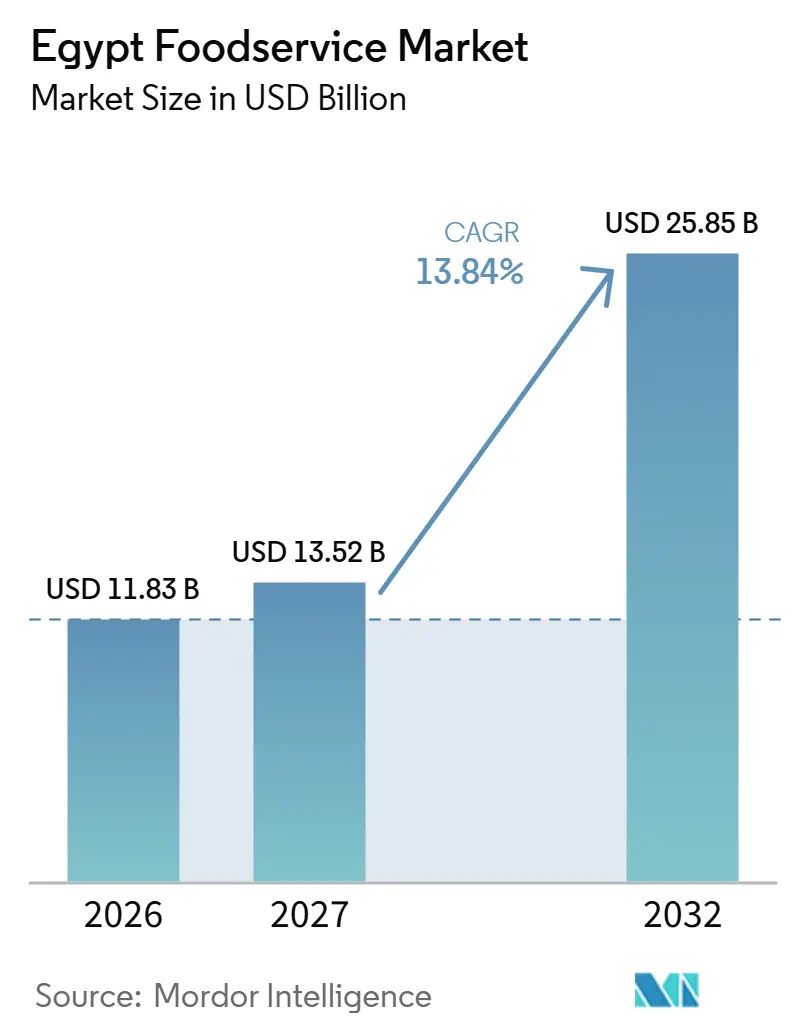
The Egypt foodservice market size is estimated at USD 11.83 billion in 2026 and is projected to be USD 13.52 billion in 2027, reaching USD 25.85 billion by 2032, growing at a CAGR of 13.84% from 2027 to 2032.
Household consumption recovery and tourism support meal demand in Egypt, while food inflation constrains menu pricing and customers' room for discretionary restaurant visits. App-based ordering extends kitchen reach beyond the dining venue, and hotel restaurants can serve repeated meal occasions across a guest's stay. Operators can respond through menu development and concept-led partnerships, with coastal seasonality making the number of commercially useful service days critical to recovering outlet costs. Seat-bound outlets without an app channel or a hotel guest base therefore bear more of the effect of food-price pressure on discretionary visits.
Key Report Takeaways
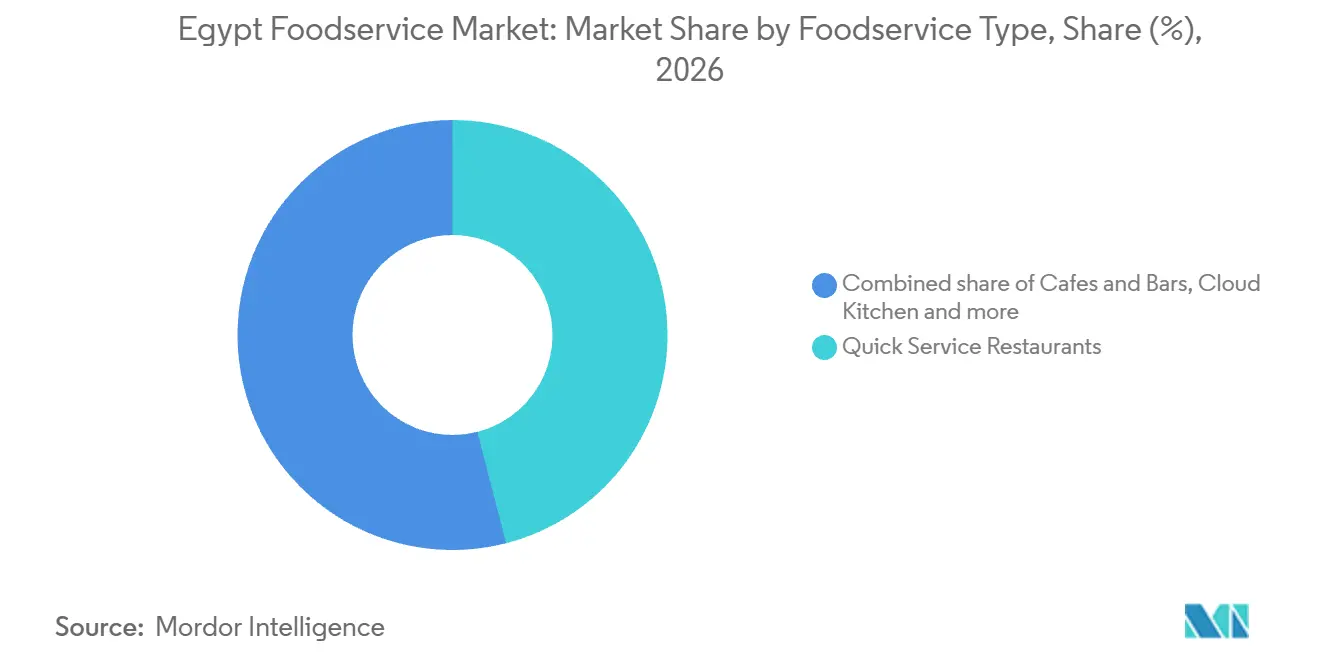
- By foodservice type, quick service restaurants led with a 45.99% Egypt foodservice market share in 2026, while cloud kitchens are forecast to grow fastest at a CAGR of 12.85% from 2027 to 2032.
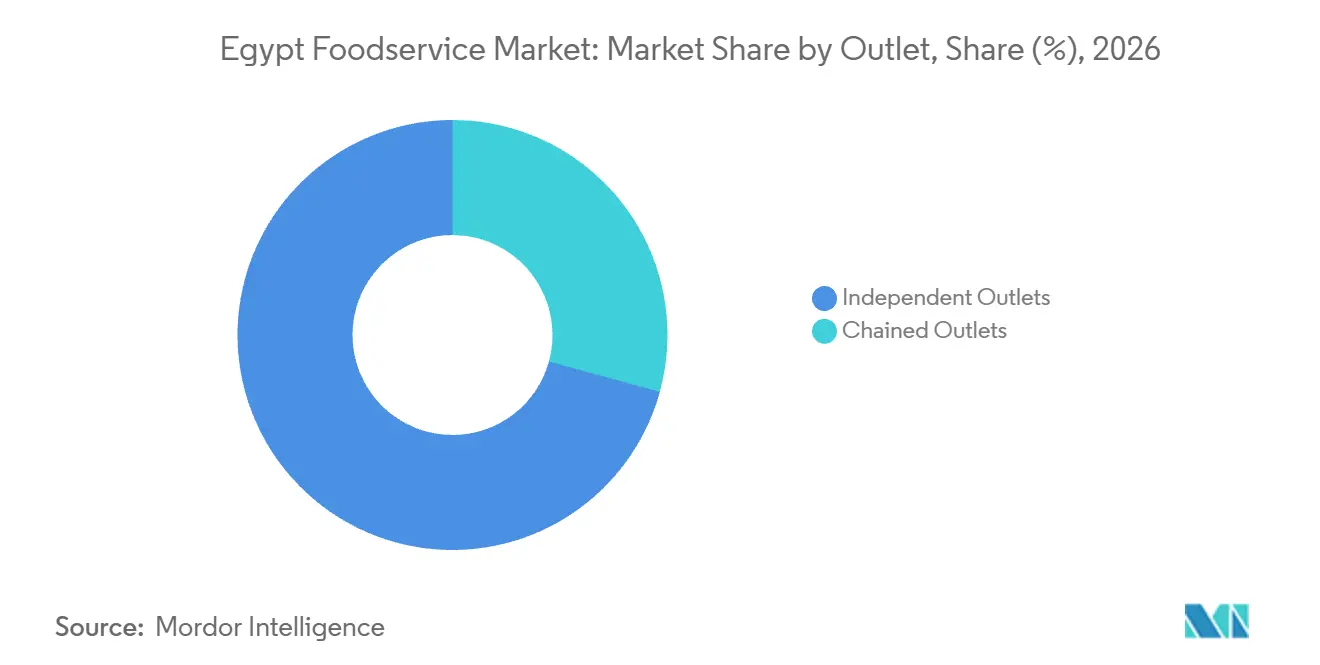
- Across outlet formats, independent outlets held a 70.74% share of the Egypt foodservice market size in 2026, whereas chained outlets have the fastest projected CAGR of 7.75% from 2027 to 2032.
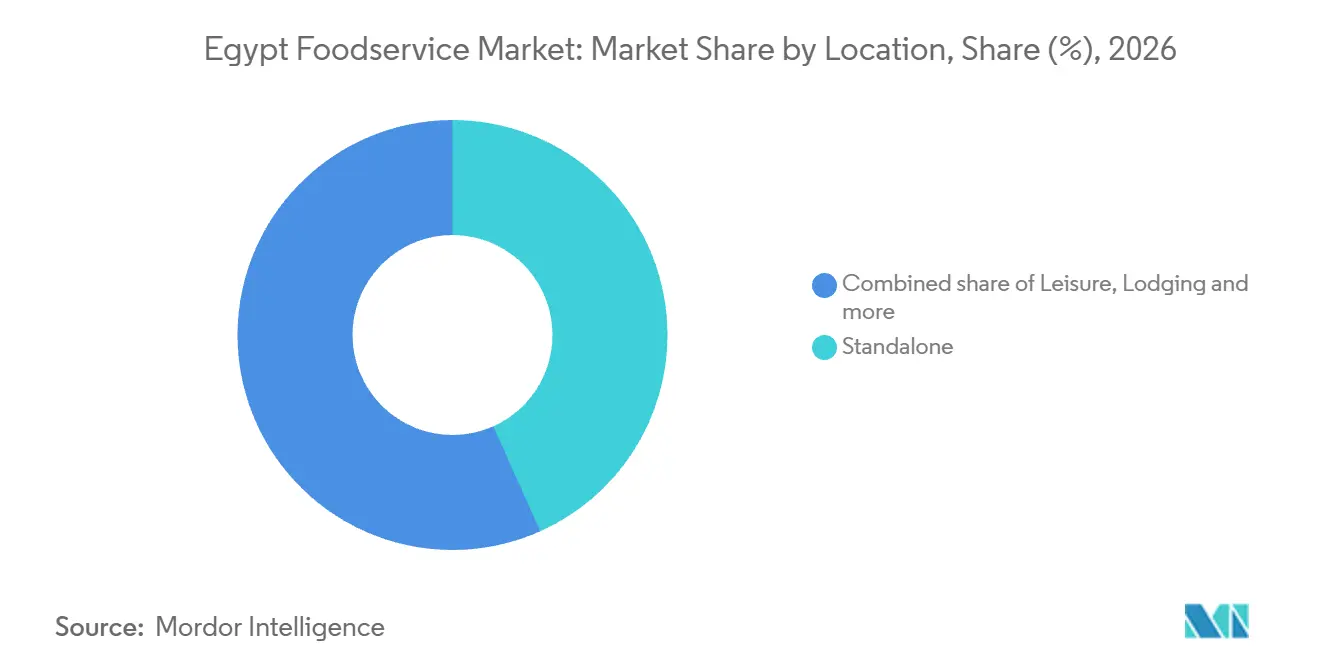
- By location, standalone venues accounted for 43.31% of market value in 2026, and travel venues have the fastest projected CAGR of 11.1% from 2027 to 2032.
- Within service types, dine-in held 58.67% of market value in 2026, with delivery forecast to grow fastest at a CAGR of 14.1% from 2027 to 2032.
Note: Market numbers in this report are based on Mordor Intelligence's proprietary estimation framework, which combines nine months of actuals with Q4 projections for base year 2026.
Egypt Foodservice Market Trends and Insights
Drivers Impact Analysis*
| Driver | (~) % Impact on CAGR Forecast | Geographic Relevance | Impact Timeline |
|---|---|---|---|
| Growing disposable income & urban middle-class expansion | +4% | Nationwide | Medium term (2-4 years) |
| Proliferation of third-party delivery platforms | +4.8% | Nationwide | Short term (≤ 2 years) |
| Post-COVID tourism rebound & Egypt, Safe & Ready campaign | +5% | Hurghada and Sharm El-Sheikh | Short term (≤ 2 years) |
| Government formalization of street-food vendors | +2% | Nationwide | Medium term (2-4 years) |
| Surge in ghost-kitchen capacity linked to dark-store networks | +1.4% | Nationwide | Medium term (2-4 years) |
| GCC franchisors' accelerated entry after 2023 currency devaluations | +1.1% | Park Street East, Cairo | Medium term (2-4 years) |
| Source: Mordor Intelligence | |||
Growing disposable income & urban middle-class expansion
A recovery in household purchasing activity gives restaurants a broader base of consumer spending to compete for. Real final consumption expenditure per capita by households and nonprofit institutions serving households in Egypt grew 7.5% in 2025. Because this measure removes price effects, the increase represents stronger purchasing activity rather than inflation alone.
Proliferation of third-party delivery platforms
Adding restaurant meals to an everyday convenience app can make prepared food part of a broader ordering relationship. In September 2026, Egypt-based Breadfast launched Breadfast Food, adding delivery from selected restaurants to its app after a beta period.[1] This gives participating restaurants an ordering channel that can serve customers without requiring a separate visit to the dining venue. Talabat reported that its Egypt marketplace GMV, covering restaurants and other vendors including talabat mart, grew well over 50% in 2025. For restaurants, an app listing lets kitchen output rather than seat count set the ceiling on orders served.
Post-COVID tourism rebound & Egypt, Safe & Ready campaign
Inbound tourism supports foodservice through the time visitors spend in Egypt, giving meal demand a duration as well as an arrival count. Egypt welcomed about 19 million tourists in 2025, 21% more than in 2024. Tourist nights rose 13.8% to 58.7 million in July-September 2025, from 51.6 million in the same period of 2024.[2] In August 2026, Egyptian Tourism Federation chairman Hossam El-Shaer said hotel occupancy in the main resort destinations, led by Hurghada and Sharm El-Sheikh, averaged above 75%. Occupied resort rooms can generate repeated meal occasions for hotel restaurants throughout a trip.
Government formalization of street-food vendors
Licensing gives mobile food vendors a defined legal route to prepare and sell meals from a regulated point of sale. Egypt's Law No. 92 of 2018 requires food preparation, cooking, and sales through a mobile food unit to be licensed by the competent administrative authority. Operators must also display that authority's activity license and the National Food Safety Authority's separate food-trading license on the unit. In September 2026, Youm7 reported that this standing framework provides renewable 3-year licenses. A defined license term gives a vendor a horizon against which to assess equipment-cost recovery before committing to a mobile unit.
Restraints Impact Analysis*
| Restraint | (~) % Impact on CAGR Forecast | Geographic Relevance | Impact Timeline |
|---|---|---|---|
| High food inflation & EGP depreciation | -2.3% | Nationwide | Short term (≤ 2 years) |
| Volatile import supply chains & ingredient cost spikes | -1.4% | Nationwide | Short term (≤ 2 years) |
| Intermittent power outages raising generator OPEX | -0.5% | Nationwide | Short term (≤ 2 years) |
| Chef talent drain to GCC pushing wage inflation | -0.3% | Nationwide | Short term (≤ 2 years) |
| Source: Mordor Intelligence | |||
High food inflation & EGP depreciation
Food and non-alcoholic beverage prices across Egypt were 7.9% higher in September 2026 than in September 2025, according to the Central Agency for Public Mobilization and Statistics. Higher food prices absorb a larger share of household budgets, which leaves less for routine meals away from home. Raising menu prices can intensify that affordability pressure, while holding prices limits the revenue available from each transaction. Outlets that depend on repeat local customers face the sharpest version of that choice.
Volatile import supply chains & ingredient cost spikes
Import exposure can make food-production costs respond to currency movements and freight charges even when meals are prepared locally. In April 2026, Misr Food Preparations chairman Mohamed Shukri said imported dry milk and Tetra Pak packaging accounted for 54% to 70% of costs in some food industries. He attributed higher input costs to movements in the dollar exchange rate. Shukri also reported higher freight and insurance costs, with a 20- or 40-foot container from China costing nearly USD 6,000. These upstream pressures can narrow the room for food suppliers to offer stable prices to restaurant buyers. Operators exposed to those inputs face a cost risk that local meal preparation alone cannot remove, complicating the economics of maintaining a consistent menu price.
*Our forecasts treat driver/restraint impacts as directional, not additive. The impact forecasts reflect baseline growth, mix effects, and variable interactions.
Segment Analysis
By Foodservice Type: Established Brands Support Quick Service Scale
Quick service restaurants accounted for a 45.99% share of the Egypt foodservice market size in 2026. Americana Restaurants reported 171 KFC restaurants in Egypt as of June 30, 2026.[3] Its portfolio also included 40 Hardee's and 94 Pizza Hut restaurants in the country on that date. Such established networks provide a framework for repeating meal preparation and service across a substantial number of outlets. Together, the 3 brands accounted for 305 restaurants in Egypt on that date, so one operator's quick service portfolio runs to hundreds of outlets.
Cloud kitchens are the fastest-growing segment, with a projected CAGR of 12.85% from 2027 to 2032. In May 2026, EnterpriseAM reported that delivery-only cloud restaurants and bakeries were appearing across Egypt, with more making their presence known. It named Kitchinco and Food Nation among cloud-kitchen service providers. These provider roles offer a route for food entrepreneurs to separate kitchen support from ownership of a conventional dining venue. Expansion can therefore revolve around production support and menu demand, with each concept needing a workable route from preparation to the customer.

By Outlet: Founder-Led Concepts Coexist With Multi-City Networks
Independent outlets represented a 70.74% Egypt foodservice market share in 2026. Socks cafe, founded by Rania Abd Al Aziz and Alaa El Masry, opened in Al Korba, Cairo, in mid-August 2025. An owner can develop a focused menu or service style at a single venue, keeping the commercial decision close to the people preparing and serving the food. Changes need to work for that outlet's customer occasion and kitchen, rather than fit a uniform proposition across a multi-city branded network. Each venue's growth is bounded by what its owner can staff and supply at that site.
Chained outlets are the fastest-growing segment, with a projected CAGR of 7.75% from 2027 to 2032. Manfoods, the local McDonald's licensee and developer, reported more than 194 restaurants across multiple Egyptian cities in 2026. A multi-city network can make a recognizable restaurant proposition available across different urban locations, giving geographical reach an organized brand framework. For customers, that format can simplify choosing a meal when the operator reproduces its preparation and service promise. A network spanning multiple cities shows that chained growth can come from extending one licensed brand geographically.
By Location: Direct Destination Dining Meets Travel Opportunities
Standalone locations held 43.31% of market value in 2026, making them the largest segment. Site selection and operating hours can be set around the restaurant's intended meal occasion, rather than around a host venue's visitor schedule. That control allows a breakfast-led concept or an evening-focused restaurant to align staffing and preparation with a clearly defined service window. The venue must attract enough customers directly to sustain those choices, because no host property supplies footfall.
Travel locations are the fastest-growing segment, with a projected CAGR of 11.1% from 2027 to 2032. Egypt's Ministry of Civil Aviation reported 2025 development of a 4,200-square-meter Terminal 3 area for international travel and restaurants at Cairo International Airport. Placing restaurants within the passenger journey can make the available service window part of the meal proposition. For retail locations, Majid Al Futtaim unveiled ELMNT33° at Mall of Egypt on September 27, 2026, combining dining concepts with lifestyle offerings and coworking. A terminal restaurant sells to a passenger with a fixed departure time, while a mall venue competes for how long a visitor chooses to stay.
By Service Type: On-Premises Capacity Anchors Dining Demand
Dine-in accounted for 58.67% of market value in 2026, making it the largest segment. Yasser El-Tagouri, chair of Egypt's Chamber of Tourism Establishments and Restaurants, reported 1,700 licensed tourist restaurants in a June 2026 interview. This licensed tourist-restaurant base gives operators an established setting in which service, surroundings, and meal preparation contribute to the dining proposition. Seated service allows a restaurant to offer an occasion that extends beyond the food itself through the time customers spend at the venue. Seats earn revenue only while occupied, so the venue's fixed commitments rest on filling them across meal periods.
Delivery is the fastest-growing segment, with a projected CAGR of 14.1% from 2027 to 2032. In February 2026, Talabat announced a partnership with Vodafone Egypt to include Talabat Pro in RED bundles, offering eligible customers unlimited free delivery and offers across restaurants, Talabat Mart, and other categories. Such bundling can place restaurant delivery within an existing mobile-service relationship, although the meal's condition at arrival also shapes the customer experience. Menu design can address the interval between preparation and consumption through dishes suited to packing, handoff, and the final journey to the customer. Dishes that lose quality in transit narrow what a delivery kitchen can sell, so reach beyond the dining room is capped by the menu itself.
Geography Analysis
Greater Cairo's hotel dining and Giza's monument-adjacent venues create different reasons for customers to visit a restaurant. In February 2025, Hilton announced the opening of Hilton Cairo Nile Maadi with 4 food-and-drink outlets, including international and Levantine restaurants, a pool bar and restaurant, and a lobby lounge. Khufu's Bistro operates on the Giza Plateau in Nazlet El-Semman, offering open-air dining in the evening. The hotel configuration can serve several occasions within one property, while the plateau setting makes the venue part of a destination visit. For operators, the distinction is whether dining supports a guest's stay or becomes a reason to visit the site.
The North Coast offers a concentrated opportunity for foodservice concept trials, but the seasonal operating model can make cost recovery demanding. In July 2026, EnterpriseAM described North Coast visitors as more willing to spend and try new food-and-beverage concepts during a roughly 3-month vacation window. Mariolino Beach House's founder said in August 2026 that North Coast operators faced housing costs, peak-season salaries, and suppliers charging twice as much because supplies came from Cairo. A concept that attracts trial must earn enough per service day to pay seasonal labor and housing commitments before the vacation audience disperses.
The opening of Crowne Plaza Alexandria Mirage illustrates the commercial role of covering meal occasions beyond conventional restaurant hours. IHG Hotels & Resorts announced the opening of Crowne Plaza Alexandria Mirage in Smouha in September 2025. Its opening offer included around-the-clock international and local cuisine at The Curve, plus light bites and live piano at Harp Bar and Lounge. Continuous meal availability can serve guests with different itineraries, while the lounge creates a separate evening occasion within the same property. The operating challenge is to match staffing and preparation to those different service periods, making reliable coverage of less concentrated demand part of the hotel's dining proposition.
Regulatory Framework and Outlook
The comparison covers selected jurisdictions from the perspective of restaurant and cafe operators seeking to formalize an outlet. The central commercial distinction is between national food-safety controls and the local process for permission to operate. Electronic applications and temporary licensing create routes to reduce administrative friction while keeping completion of required approvals central to the operator's business case.
Regulatory Table
| Decision factor | Egypt | Cairo Governorate |
|---|---|---|
| Primary authority | National Food Safety Authority; local public-shop licensing centers | Cairo Governorate public-shop licensing centers |
| Key instruments or direction | Law No. 1/2017 food-handling controls; Law No. 154/2019 public-shop framework; March 2026 electronic licensing measure | August 2026 digital public-shop licensing process |
| Commercial effect | One-year temporary license pending necessary permanent-license approvals, as reported in March 2026 | Immediate temporary operating license while approvals are completed within 3 months; reduction in applicable fees |
| Current policy attractiveness | Medium | High |
| Future direction of policy attractiveness | Easing | Easing |
| Source: Mordor Intelligence | ||
Egypt's Medium rating reflects the combination of an administrative route into formal operation and continuing food-handling and permanent-approval responsibilities. Cairo Governorate's High rating reflects its immediate temporary-permit procedure and announced 50% reduction in applicable fees coordinated with relevant authorities. The Easing judgments follow the national measure reported activated in March 2026 and Cairo's August 2026 rollout, with the commercial benefit depending on completing the necessary approvals rather than treating temporary permission as permanent authorization.
Value Chain Stages
The value chain compares how equipment providers, restaurant operators, and ordering platforms earn revenue from turning kitchen capacity into delivered or on-premises meals. Manfoods-McDonald's Egypt sources products from local suppliers, including meat, poultry, dairy, baked goods, vegetables, and packaging materials. Talabat collects commissions in Egypt to support delivery-partner pay and its online ordering and delivery services, placing a separate revenue claim on the route between restaurant and customer.
Value Chain Analysis Table
| Primary activity | Key participants | Value capture | Bottleneck | Resilience response |
|---|---|---|---|---|
| Kitchen equipment provision | Equipment suppliers such as Al-Aqsa Youssef Diab; equipment manufacturers such as MAS | Equipment sales | Mismatch between cooking and preparation capacity | Size the cookline around peak meal throughput |
| Meal preparation and restaurant service | Restaurant operators such as Manfoods-McDonald's Egypt and Americana Restaurants International PLC | Prepared-meal and beverage sales | Ingredient consistency across suppliers | Specify ingredient acceptance criteria and qualify alternatives |
| Online ordering and delivery | Ordering and delivery platforms such as Talabat | Platform commissions | Coordination between kitchen completion and rider handoff | Align dispatch timing with meal readiness |
| Source: Mordor Intelligence | ||||
Revenue capture therefore depends on which part of the meal transaction a participant controls, while restaurant economics must accommodate the platform's commission. Equipment capacity alone cannot resolve a slow handoff, and faster dispatch cannot compensate for meals that are not ready. The structural opportunity lies in coordinating preparation and delivery around the same service promise, allowing additional ordering channels to use kitchen capacity without overwhelming the meal-production stage.
Competitive Landscape
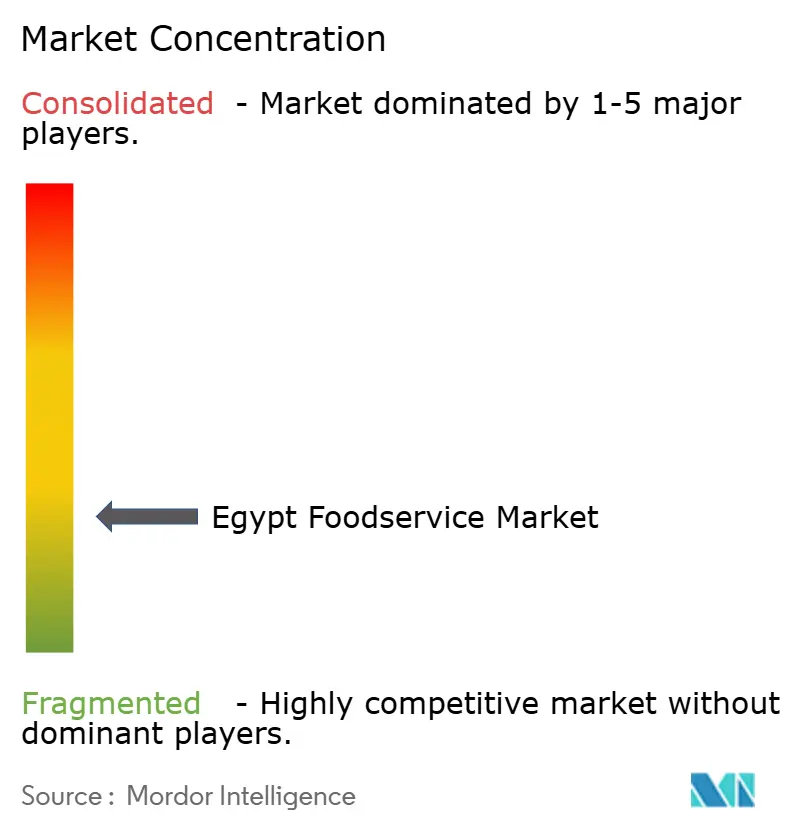
Competition is dispersed across independent operators and branded networks. Major players include Alamar Foods Company, Americana Restaurants International PLC, Mansour Group, Mo'men Group, and The Olayan Group. Americana reported 447 restaurants in Egypt as of June 30, 2026. The Olayan Group participates through Olayan Food Services Co., which oversees Burger King franchise operations in Egypt, while Mo'men Group owns the Mo'men, Planet Africa, Pizza King, and Three Chefs brands. Network scale can support consistency across locations, but an extensive portfolio still needs each restaurant to meet the meal occasion and price expectations of its local customers.
Alamar reported North Africa revenue growth of 25.8% in Q2 2025 compared with Q2 2024. It attributed the result to strong Dunkin' Egypt sales, new product development, and the fading impact of Egyptian pound devaluation. Of the factors Alamar named, new product development is the one the company controls directly, while the fading devaluation effect came from the currency. Rivals can respond through menu changes, so the product-development component of Alamar's result points to competition over the offer customers can buy.
Competition at destination venues can also depend on the combination of a specific restaurant concept and a development partnership. In June 2026, SODIC and Nobu marked Nobu New Cairo's arrival at Eastown District New Cairo with a preview before its planned July 20 public debut. Nobu New Cairo operates there, with SODIC as development partner and Nobu providing the Japanese-Peruvian dining brand. For venues such as Nobu New Cairo, development partnerships do not replace the food-handling licensing and inspection remit assigned to Egypt's National Food Safety Authority under Law No. 1 of 2017. For destination restaurants, the developer relationship can determine where a cuisine concept reaches diners, making site access another basis for competition alongside menu differentiation.
Egypt Foodservice Industry Leaders
-
Alamar Foods Company
-
Americana Restaurants International PLC
-
Mansour Group
-
Mo'men Group
-
The Olayan Group
- *Disclaimer: Major Players sorted in no particular order
Recent Industry Developments
- Sep 2026: Majid Al Futtaim unveiled ELMNT33° at Mall of Egypt on September 27, combining dining concepts with lifestyle offerings and coworking.
- Sep 2026: Breadfast launched Breadfast Food in Egypt after a beta period, adding delivery from selected restaurants through its app.
Scope and Methodology
| Cafes & Bars | By Cuisine | Bars & Pubs |
| Cafes | ||
| Juice/Smoothie/Desserts Bars | ||
| Specialist Coffee & Tea Shops | ||
| Cloud Kitchen | ||
| Full Service Restaurants | By Cuisine | Asian |
| European | ||
| Latin American | ||
| Middle Eastern | ||
| North American | ||
| Other FSR Cuisines | ||
| Quick Service Restaurants | By Cuisine | Bakeries |
| Burger | ||
| Ice Cream | ||
| Meat-based Cuisines | ||
| Pizza | ||
| Other QSR Cuisines |
| Chained Outlets |
| Independent Outlets |
| Leisure |
| Lodging |
| Retail |
| Standalone |
| Travel |
| Dine-in |
| Takeaway |
| Delivery |
| By Foodservice Type | Cafes & Bars | By Cuisine | Bars & Pubs |
| Cafes | |||
| Juice/Smoothie/Desserts Bars | |||
| Specialist Coffee & Tea Shops | |||
| Cloud Kitchen | |||
| Full Service Restaurants | By Cuisine | Asian | |
| European | |||
| Latin American | |||
| Middle Eastern | |||
| North American | |||
| Other FSR Cuisines | |||
| Quick Service Restaurants | By Cuisine | Bakeries | |
| Burger | |||
| Ice Cream | |||
| Meat-based Cuisines | |||
| Pizza | |||
| Other QSR Cuisines | |||
| By Outlet | Chained Outlets | ||
| Independent Outlets | |||
| By Location | Leisure | ||
| Lodging | |||
| Retail | |||
| Standalone | |||
| Travel | |||
| By Service Type | Dine-in | ||
| Takeaway | |||
| Delivery | |||
Market Definition
- FULL-SERVICE RESTAURANTS - A foodservice establishment where customers are seated at a table, give their order to a server and are served food at a table.
- QUICK SERVICE RESTAURANTS - A foodservice establishment that provides customers convenience, speed, and food offerings at lower prices. Customers usually help themselves and carry their own food to their tables.
- CAFES & BARS - A type of foodservice business that include bars and pubs that are licensed to serve alcoholic drinks for consumption, cafes that serve refreshments and light food items, as well as specialty tea and coffee shops, dessert bars, smoothie bars, and juice bars.
- CLOUD KITCHEN - A foodservice business that utilizes a commercial kitchen for the purpose of preparing food for delivery or takeout only, with no dine-in customers.
| Keyword | Definition |
|---|---|
| Albacore Tuna | It is one of the smallest species of tuna found in the six distinct stocks known globally in the Atlantic, Pacific, and Indian oceans, as well as the Mediterranean Sea. |
| Angus beef | It is beef derived from a specific breed of cattle indigenous to Scotland. It requires certification from the American Angus Association to receive the "Certified Angus Beef" quality mark. |
| Asian cuisine | It includes full-service offerings in restaurants that serve cuisines from cultures such as Chinese, Indian, Korean, Japanese, Bengali, Southeast Asian, etc. |
| Average Order Value | It is the average value of all orders made by the customers at a foodservice establishment. |
| Bacon | It is salted or smoked meat that comes from the back or sides of a pig. |
| Bars & Pubs | It is a drinking establishment that is licensed to serve alcoholic drinks for consumption on the premises. |
| Black Angus | It is beef derived from a black-hided breed of cows that don't have horns. |
| BRC | British Retail Consortium |
| Burger | It is a sandwich consisting of one or more cooked beef patties, placed inside a sliced bread roll or bun roll. |
| Café | It is a foodservice establishment serving various refreshments (mainly coffee) and light meals. |
| Cafes & Bars | It is a type of foodservice business that include bars and pubs that are licensed to serve alcoholic drinks for consumption, cafes that serve refreshments and light food items, as well as specialty tea and coffee shops, dessert bars, smoothie bars, and juice bars. |
| Cappuccino | It is an Italian coffee drink that is traditionally prepared with equal parts double espresso, steamed milk, and steamed milk foam. |
| CFIA | Canadian Food Inspection Agency |
| Chained Outlet | It refers to a foodservice establishment that shares brands, operates in several locations, has central management, and standardized business practices. |
| Chicken Tender | It refers to chicken meat prepared from the pectoralis minor muscles of a chicken bird. |
| Cloud Kitchen | It is a foodservice business that utilizes a commercial kitchen for the purpose of preparing food for delivery or takeout only, with no dine-in customers. |
| Cocktail | It is an alcoholic mixed drink made with either a single spirit or a combination of spirits, mixed with other ingredients such as juices, flavored syrups, tonic water, shrubs, and bitters. |
| Edamame | It is a Japanese dish prepared with soybeans (harvested before they ripen or harden) and cooked in its pod. |
| EFSA | European Food Safety Authority |
| ERS | Economic Research Service of the USDA |
| Espresso | It is a concentrated form of coffee, served in shots. |
| European cuisine | It includes full-service offerings in restaurants that serve cuisines from cultures such as Italian, French, German, English, Dutch, Danish, etc. |
| FDA | Food and Drug Administration |
| Fillet Mignon | It is a cut of meat taken from the smaller end of the tenderloin. |
| Flank Steak | It is a cut of beef steak taken from the flank, which lies forward of the rear quarter of a cow. |
| Foodservice | It refers to the part of the food industry which includes businesses, institutions, and companies which prepare meals outside the home. It includes restaurants, school and hospital cafeterias, catering operations, and many other formats. |
| Franks | Also known as frankfurter or Würstchen, it is a type of highly seasoned smoked sausage popular in Austria and Germany. |
| FSANZ | Food Standards Australia New Zealand |
| FSIS | Food Safety and Inspection Service |
| FSSAI | Food Safety and Standards Authority of India |
| Full service restaurant | It refers to a foodservice establishment where customers are seated at a table, give their order to a server, and are served food at a table. |
| Ghost Kitchen | It refers to a cloud kitchen. |
| GLA | Gross Leasable Area |
| Gluten | It is a family of proteins found in grains, including wheat, rye, spelt, and barley. |
| Grain-fed beef | It is beef derived from cattle that have been fed a diet supplemented with soy and corn and other additives. Grain-fed cows can also be given antibiotics and growth hormones to fatten them up more quickly. |
| Grass-fed beef | It is beef derived from cattle that have only been fed grass as feed. |
| Ham | It refers to the pork meat taken from the leg of a pig. |
| HoReCa | Hotels, Restaurants and Cafes |
| Independent Outlet | It refers to a foodservice establishment that operates with a single outlet or is structured as a small chain with no more than three locations. |
| Juice | It is a drink made from the extraction or pressing of the natural liquid contained in fruit and vegetables. |
| Latin American | It includes full-service offerings in restaurants that serve cuisines from cultures such as Mexican, Brazilian, Argentinian, Colombian, etc. |
| Latte | It is a milk-based coffee that is made up of one or two shots of espresso, steamed milk, and a thin layer of frothed milk. |
| Leisure | It refers to foodservice offered as a part of a recreation business, such as sports arenas, zoos, movie theaters, and museums. |
| Lodging | It refers to foodservice offerings at hotels, motels, guesthouses, holiday homes, etc. |
| Macchiato | It is an espresso coffee drink with a small amount of milk, usually foamed. |
| Meat-based cuisines | This inlcudes food items like fried chicken, steak, ribs, etc. where meat is the primary ingredient for the dish. |
| Middle Eastern cuisine | It includes full-service offerings in restaurants that serve cuisines from cultures such as Arabic, Lebanese, Iranian, Israeli, etc. |
| Mocktail | It is an non-alcoholic mixed drink. |
| Mortadella | It is a large Italian sausage or luncheon meat made of finely hashed or ground heat-cured pork, which incorporates at least 15% small cubes of pork fat. |
| North American | It includes full-service offerings in restaurants that serve cuisines from cultures such as American, Canadian, Caribbean, etc. |
| Pastrami | It refers to a highly seasoned smoked beef, typically served in thin slices. |
| PDO | Protected Designation of Origin: It is the name of a geographical region or specific area that is recognized by official rules to produce certain foods with special characteristics related to location. |
| Pepperoni | It is an American variety of spicy salami made from cured meat. |
| Pizza | It is a dish made typically of flattened bread dough spread with a savory mixture usually including tomatoes and cheese and often other toppings and baked. |
| Primal cuts | It refers to the major sections of the carcass. |
| Quick service restaurant | It refers to a foodservice establishment that provides customers convenience, speed, and food offerings at lower prices. Customers usually help themselves and carry their own food to their tables. |
| Retail | It refers to a foodservice outlet inside a mall. shopping complex or a commercial real estate building, where there are other businesses operating as well. |
| Salami | It is a cured sausage consisting of fermented and air-dried meat. |
| Saturated fat | It is a type of fat in which the fatty acid chains have all single bonds. It is generally considered unhealthy. |
| Sausage | It is a meat product made of finely chopped and seasoned meat, which may be fresh, smoked, or pickled and which is then usually stuffed into a casing. |
| Scallop | It is an edible shellfish that is a mollusk with a ribbed shell in two parts. |
| Seitan | It is a plant-based meat substitute made out of wheat gluten. |
| Self-service kiosk | It refers to a self-order point-of-sale (POS) system through which customers place and pay for their own orders at kiosks, enabling totally contactless and frictionless service. |
| Smoothie | It is a beverage made by placing all the ingredients in a container and processing them together, without removing the pulp. |
| Specialty coffee & tea shops | It refers to a foodservice establishment that serves only various types of tea or coffee. |
| Standalone | It refers to a restaurants that have an independent infrastructure setup and not connected to any other business. |
| Sushi | It is a Japanese dish of prepared vinegared rice, usually with some sugar and salt, accompanied by a variety of ingredients, such as seafood—often raw—and vegetables. |
| Travel | It refers to foodservice offerings such as airplane food, dining on long-distance trains, and foodservice on cruise ships. |
| Virtual Kitchen | It refers to a cloud kitchen. |
| Wagyu Beef | It is beef derived from any of four strains of a breed of black or red Japanese cattle that are valued for their highly marbled meat. |
Research Methodology
Mordor Intelligence follows a four-step methodology in all our reports.
- Step-1: Identify Key Variables: In order to build a robust forecasting methodology, the variables and factors identified in Step 1 are tested against available historical market numbers. Through an iterative process, the variables required for the market forecast are set, and the model is built on the basis of these variables.
- Step-2: Build a Market Model: Market size estimations for the forecast years are in nominal terms. Inflation is considered for average order value, and it is forecasted as per predicted inflation rates in the countries.
- Step-3: Validate and Finalize: In this important step, all market numbers, variables, and analyst calls are validated through an extensive network of primary research experts from the market studied. The respondents are selected across levels and functions to generate a holistic picture of the market studied.
- Step-4: Research Outputs: Syndicated Reports, Custom Consulting Assignments, Databases & Subscription Platforms


