
United Kingdom Mortgage/Loan Broker Market Size and Share
Market Overview
| Study Period | 2020 - 2031 |
|---|---|
| Forecast Data Period | 2026 - 2031 |
| Base Year Market Size (2025) | USD 3.16 Billion |
| Market Size (2026) | USD 3.37 Billion |
| Market Size (2031) | USD 4.62 Billion |
| Growth Rate (2026 - 2031) | 6.53 % |
| Market Concentration | Medium |
Major Players *Disclaimer: Major Players sorted in no particular order Image © Mordor Intelligence. Reuse requires attribution under CC BY 4.0. | |
United Kingdom Mortgage/Loan Broker Market Analysis by Mordor Intelligence
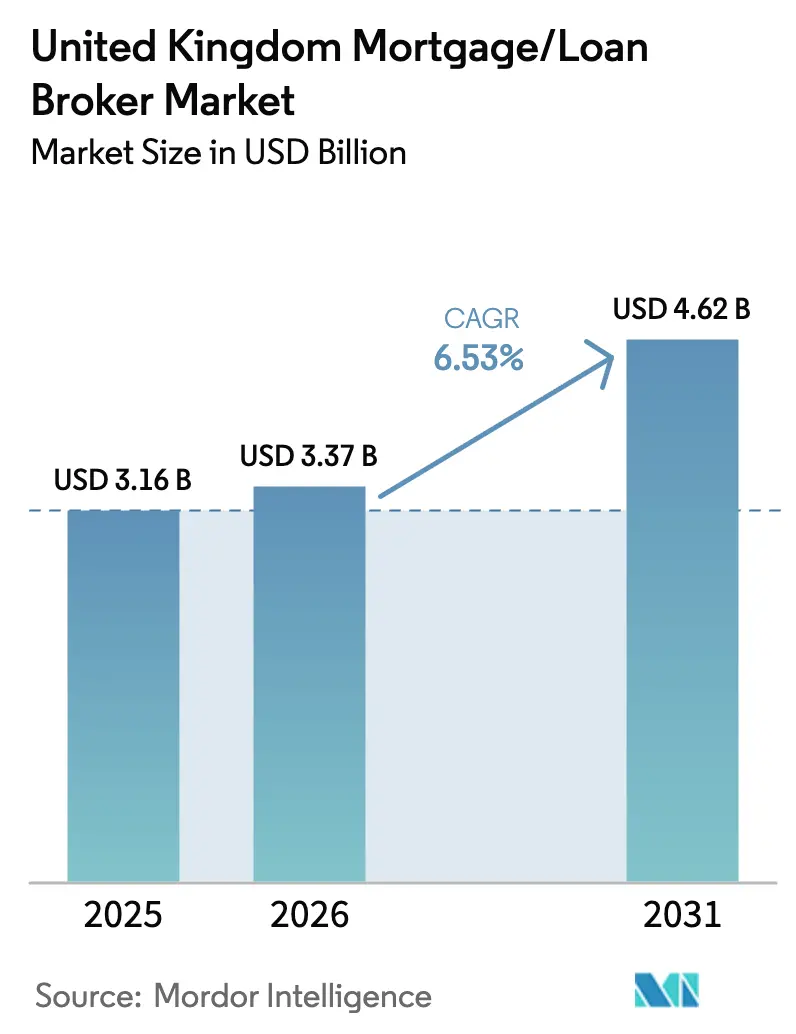
The United Kingdom Mortgage/Loan Broker Market size in 2026 is estimated at USD 3.37 billion, growing from 2025 value of USD 3.16 billion with 2031 projections showing USD 4.62 billion, growing at 6.53% CAGR over 2026-2031.
Technology-enabled onboarding, Consumer Duty compliance, and embedded-finance partnerships are enlarging the professional advice channel as borrowers seek tailored solutions across more than 200 active lenders. Hybrid service models that blend in-person guidance with digital convenience improve engagement and fuel repeat business, while scale economies allow large brokers to absorb compliance costs and negotiate superior procuration fees. Niche specialists capture complex cases—buy-to-let, self-employed, near-prime—where data-driven matching delivers high approval rates. Rising professional-indemnity premiums and a shortage of CeMAP-qualified advisers create capacity gaps, yet strategic automation and apprenticeship programs offset the drag, sustaining momentum in the United Kingdom mortgage broker market [1].
Key Report Takeaways
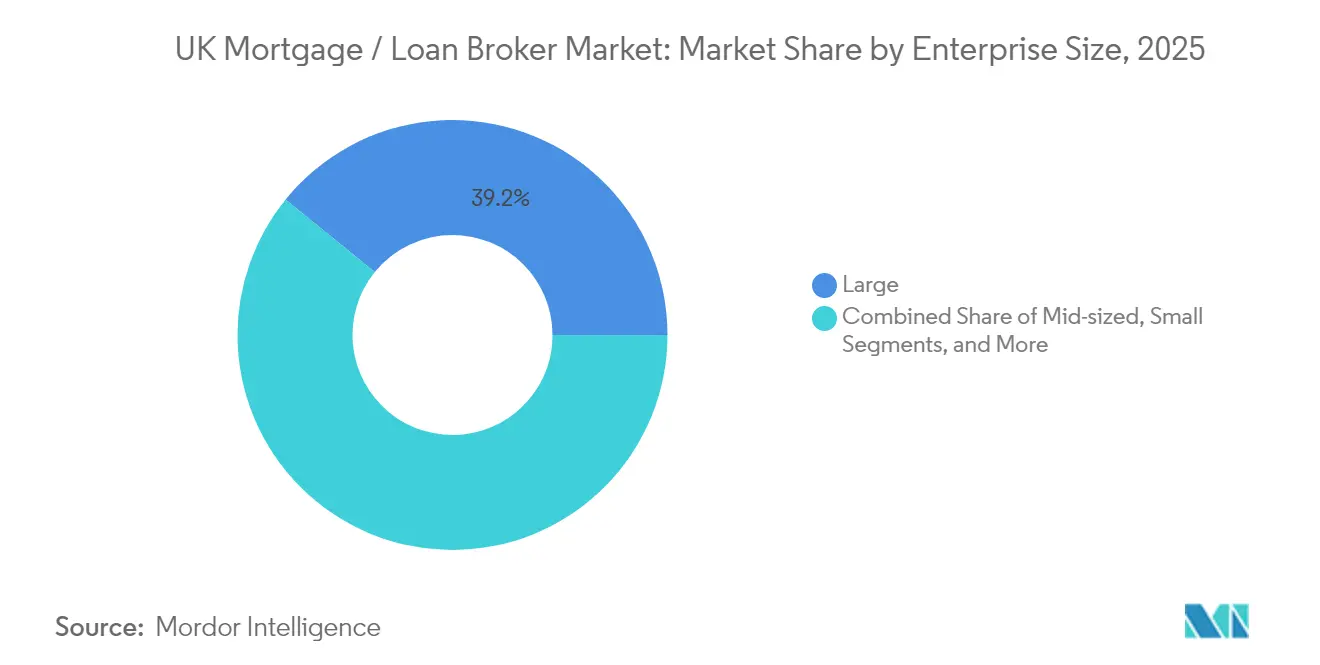
- By enterprise size, large brokers led with 39.15% of the United Kingdom mortgage broker market share in 2025; small brokers are projected to have a 7.62% CAGR through 2031.
- By application, home loans represented 55.90% of the United Kingdom mortgage broker market size in 2025, while commercial and industrial loans are projected to expand at an 7.88% CAGR to 2031.
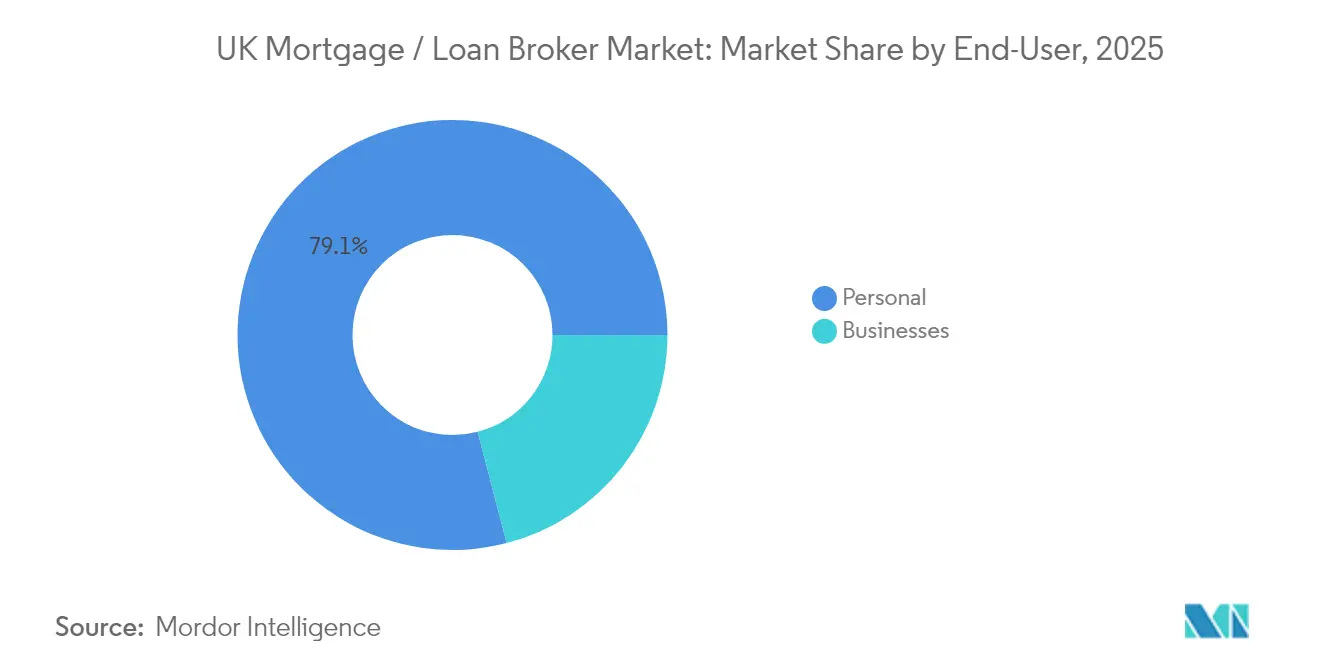
- By end-user, personal borrowers commanded 79.05% of the United Kingdom mortgage broker market share in 2025; business customers are expected to rise at a 8.72% CAGR over the forecast horizon.
- By distribution channel, offline advice retained 66.20% share of the United Kingdom mortgage broker market in 2025; online platforms are expected to grow at 9.85% CAGR through 2031.
Note: Market size and forecast figures in this report are generated using Mordor Intelligence’s proprietary estimation framework, updated with the latest available data and insights as of 2026.
United Kingdom Mortgage/Loan Broker Market Trends and Insights
Drivers Impact Analysis*
| Driver | (~) % Impact on CAGR Forecast | Geographic Relevance | Impact Timeline |
|---|---|---|---|
| Surging intermediary share of mortgage originations | +1.2% | United Kingdom-wide; strongest in London & Southeast | Medium term (2–4 years) |
| FCA Consumer-Duty rules elevating advice quality standards | +0.8% | United Kingdom-wide | Short term (≤ 2 years) |
| Rapid digital-ID & Open-Banking-based onboarding | +1.0% | United Kingdom-wide; early uptake in urban centers | Medium term (2–4 years) |
| Embedded-finance partnerships with estate-agent chains | +0.7% | United Kingdom-wide; dense transaction corridors | Long term (≥ 4 years) |
| AI-driven risk-tiering unlocking near-prime borrower pool | +0.9% | United Kingdom-wide; underserved cohorts | Long term (≥ 4 years) |
| Tokenized real-estate pilots creating novel lending niches | +0.4% | London & major cities | Long term (≥ 4 years) |
| Source: Mordor Intelligence | |||
Surging Intermediary Share of Mortgage Originations
Borrowers now route a majority of new mortgage business through brokers as product complexity grows across more than 200 active lenders[2]. Lenders favor broker channels that lower acquisition costs and deliver pre-qualified cases, a dynamic that intensified during 2024’s rate swings. Specialist advisers excel in buy-to-let, self-employed, and near-prime segments where direct-to-consumer models struggle to map nuanced risk appetites. Larger networks overlay data analytics on pipeline flows to spot emerging lender criteria in real time, further widening their competitive moat. This structural shift cements brokers as the primary gatekeepers of United Kingdom mortgage distribution.
FCA Consumer-Duty Rules Elevating Advice Quality Standards
The Consumer Duty demands that brokers to evidence of fair value and positive customer outcomes, raising compliance thresholds throughout 2025[3]. Firms with robust audit trails and outcome monitoring platforms turn regulation into a competitive advantage, while smaller practices weigh merger or exit. Mandatory closed-book reviews trigger proactive engagement with legacy clients, opening opportunities to refinance on improved terms. Enhanced professionalism bolsters consumer trust and strengthens brokers’ leverage in procuration-fee negotiations with lenders. Collectively, these factors lift service quality and support market expansion.
Rapid Digital-ID & Open-Banking-Based Onboarding
Open-Banking APIs allow instant income verification, shrinking application cycles from weeks to days. Tandem Bank’s tie-up with Sikoia illustrates how automated document capture slashes back-office costs and accelerates approvals. Brokers harness these tools to submit cleaner cases, raising conversion rates for borderline applicants. Customers appreciate friction-free journeys, driving word-of-mouth referrals that lower lead-generation spend. Firms that neglect digital onboarding risk marginalization as service benchmarks rise.
Embedded-Finance Partnerships with Estate-Agent Chains
Integrated property ecosystems embed mortgage advice at the viewing stage, boosting capture rates and shortening completion timelines. Connells Group links 1,200 estate branches with 1,000+ advisers to funnel warm leads into its brokerage arm. Shared CRM data synchronizes milestones across search, offer, and financing, reducing fall-throughs. The model extends to new-build developers, conveyancers, and insurers, unlocking multi-product revenue per client. Private-equity investors favor these capital-light, high-recurrence platforms, signaling sustained growth.
Restraints Impact Analysis*
| Restraint | (~) % Impact on CAGR Forecast | Geographic Relevance | Impact Timeline |
|---|---|---|---|
| Mortgage-rate volatility compressing broker commissions | -1.1% | United Kingdom-wide; acute in refinancing | Short term (≤ 2 years) |
| Stricter LTV/LTI stress-testing curbing loan eligibility | -0.7% | United Kingdom-wide | Medium term (2–4 years) |
| Rising professional-indemnity premiums for brokers | -0.5% | United Kingdom-wide; heavier on small firms | Short term (≤ 2 years) |
| Shortage of CeMAP-qualified advisers (aging talent pool) | -0.8% | United Kingdom-wide; rural gaps | Long term (≥ 4 years) |
| Source: Mordor Intelligence | |||
Mortgage-Rate Volatility Compressing Broker Commissions
Bank of England rate moves narrowed lender margins, leading to leaner procuration fees and shorter fixed-rate life cycles. Advisers mitigate income swings by levying flat advice fees, upselling protection policies, and chasing volume bonuses. Larger networks negotiate tiered grids, while independents pivot toward specialist segments with higher fee tolerance. Greater revenue variability complicates cash-flow planning, yet diversification strategies cushion the blow.
Stricter LTV/LTI Stress-Testing Curbs Loan Eligibility
Enhanced affordability buffers introduced post-pandemic mean borrowers must clear tougher loan-to-value and loan-to-income hurdles. First-time buyers and self-employed applicants feel the pinch, shrinking brokerable volumes. Advisers adapt by exploring guarantor structures, joint borrower-sole proprietor models, and shared-ownership schemes, albeit at greater advisory effort. Some borrowers delay purchases, extending case pipelines and heightening fall-through risk.
*Our forecasts treat driver/restraint impacts as directional, not additive. The impact forecasts reflect baseline growth, mix effects, and variable interactions.
Segment Analysis
By Enterprise Size: Scale Advantages Drive Consolidation
Large brokers captured 39.15% of the United Kingdom mortgage broker market share in 2025, propelled by enterprise-grade compliance systems and data-driven case allocation that lift approval odds. Robust negotiation power secures preferential procurement grids even as commission spreads narrow, anchoring margins. Mid-sized networks cultivate a balance of personal service and infrastructure heft, outsourcing white-label platforms to match big-broker functionality without full capex. Solo advisers leverage hyper-local relationships to win referral loyalty unavailable to national chains.
Small brokers hold a modest slice of the United Kingdom mortgage broker market size yet register a 7.62% CAGR through 2031. Entrepreneurial agility lets them specialize in expatriate lending, later-life equity release, and complex income structures where premium advisory fees offset scale deficits. Franchise affiliations pool compliance costs and technology access, preserving independence while meeting Consumer Duty obligations.

By Application: Commercial Lending Drives Growth Acceleration
The home loans segment controlled 55.90% of the United Kingdom mortgage broker market size in 2025 as advisers manage affordability tests and rapid product repricing. Residential stability rests on household formation and cultural preference for ownership, while the broker role intensifies around product switching at fixed-rate expiries. Buy-to-let remains active, but prudential tightening caps leverage.
The commercial and industrial loans segment is projected to advance at 7.88% CAGR, diversifying revenue beyond cyclical residential flows. SME owners tap brokers for property purchases and expansion capital as rate stabilization revives business confidence. Lenders value broker-packaged deals that arrive with audited accounts and robust service coverage, cementing broker relevance across the expanding United Kingdom mortgage broker market.
By End-User: Business Segment Accelerates Despite Personal Dominance
The personal customers segment accounted for 79.05% of % the United Kingdom mortgage broker market size in 2025. First-time buyers demand detailed guidance through high loan-to-value schemes, while remortgagers seek cost-efficient switches amid payment-shock concerns. High-net-worth borrowers rely on specialist structuring for cross-border income streams.The business borrowers segment is expected to grow at a 8.72% CAGR, driven by property acquisition and refinancing of pandemic-era debt. Brokers curate lender panels eager for yield and structure complex covenants into digestible credit narratives. Digital deal rooms widen lender bidding, trimming spreads and enhancing adviser fee potential.
By Distribution Channel: Digital Transformation Accelerates Online Growth
Offline advice kept 66.20% of the United Kingdom mortgage broker market share in 2025, serving clients who value in-person reassurance for six-figure liabilities. Face-to-face channels ease coordination with surveyors and solicitors, smoothing chains in complex cases.
Online platforms are projected to rise at a 9.85% CAGR as borrowers embrace 24/7 eligibility engines and video consultations. Habito, Trussle, and similar pioneers combine algorithms with human advisers for nuanced guidance. Hybrid models deliver digital speed plus personal touch, setting service expectations across the United Kingdom mortgage broker market.
Geography Analysis
London and the Southeast dominate transaction value as high asset prices magnify fee income. Brokers adept in international-buyer compliance manage complex documentation for cross-border clients, deepening metropolitan concentration. Average loan sizes stretch margins, reinforcing capital steering toward these hubs.Northern England and Scotland display resilient volumes due to diversified regional economies and moderate price-to-income ratios. Mutual-bank partnerships and community ties allow advisers to secure fast approvals, sustaining throughput even during macro volatility.
Wales and Northern Ireland emerge as frontier territories as digital platforms extend coverage. Cross-border protocol nuances in Northern Ireland introduce documentation complexity, boosting demand for specialist advice. Satellite offices and partner arrangements embed local knowledge, enhancing geographic diversification for the United Kingdom mortgage broker market.
Regulatory Landscape
The UK mortgage and loan broking channel operates under Financial Conduct Authority (FCA) conduct and prudential-related rules for mortgage intermediaries, with Consumer Duty embedded as a core supervisory focus through 2025-2026. Alongside ongoing supervision of Appointed Representatives (ARs), principal firms face heightened expectations on oversight of AR business mix and volumes. This is pushing larger networks to formalize monitoring, audit trails, and outcome testing, while adding compliance load for smaller firms.
In 2026, the FCA Mortgage Rule Review has continued via consultation activity, including CP26/18 on responsible lending. The review maintains responsible-lending and affordability assessment requirements in active focus. It has also reinforced attention on conflicts of interest in distribution, including situations where estate agents steer consumers toward in-house advisers, and it has increased emphasis on evidencing fair value and suitable outcomes at the point of advice and across the customer journey.
Value Chain Analysis
The value chain starts with borrower lead generation (estate-agent referrals, online platforms, introducers, and broker-owned content funnels), then moves through fact-find, affordability assessment, product sourcing across panels, and lender application packaging. Broker networks and clubs sit between advisers and lenders by providing compliance frameworks, lender access, technology stacks, and procuration fee grids, while lenders use these intermediary channels to lower acquisition costs and receive pre-qualified cases. This structure supports the broker role as the main interface between lenders and consumers across a broad lender universe.
Downstream, conveyancers, surveyors, and property-transaction platforms influence completion speed and fall-through rates, which in turn shapes broker workload and customer experience. A shift toward tighter integration across the homebuying workflow is underway, highlighted by the Lloyds, Connells, and LMS partnership to launch a fully digital homebuying service (April 2026). By linking mortgage, legal, and transaction steps more closely, the initiative raises the premium on brokers that can operate inside data-connected ecosystems rather than relying on fragmented document handoffs.
Competitive Landscape
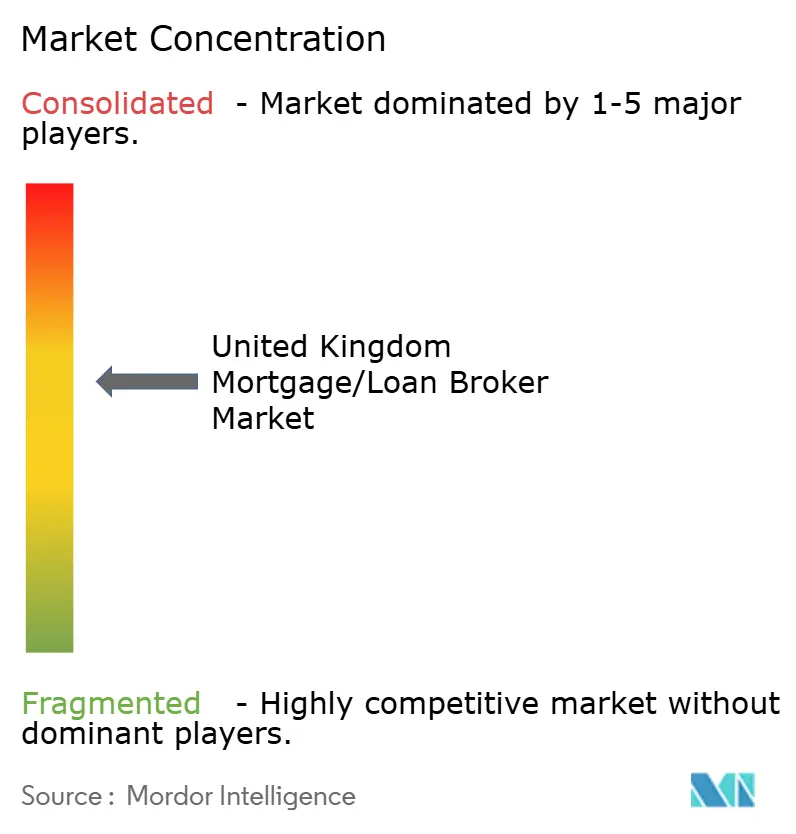
The market concentration is moderately fragmented, with the landscape featuring national chains, digital pure-plays, and regional boutiques. Sesame Bankhall Group’s 2025 stake in New Homes Mortgage Services adds 40 advisers and 45,000 clients, illustrating consolidation trends. National networks pursue bolt-ons to gain specialist skills and new-build exposure.
Competitive differentiation flows from data analytics, embedded partnerships, and talent. Connells Group leverages estate-agency referrals; MQube’s chatbot resolves 90% lender-criteria queries, freeing advisers for relationship work. High street incumbents invest in AI to maintain efficiency parity with digital natives.
Private-equity attention intensifies around scalable brokerages with recurring revenue. Technology vendors license modular onboarding stacks to adviser networks, while niche players exploit underserved segments—self-employed borrowers, near-prime credit, later-life lending—where bespoke structuring beats algorithmic templates. Moderate fragmentation persists, yet consolidation steadily progresses across the United Kingdom mortgage broker market.
United Kingdom Mortgage/Loan Broker Industry Leaders
-
London & Country (L&C)
-
Mortgage Advice Bureau
-
Connells Group / Countrywide MS
-
Habito
-
Trussle Lab Limited
- *Disclaimer: Major Players sorted in no particular order
Market Opportunities and Future Outlook
Regulatory change and supervisory emphasis are creating whitespace for brokers that can evidence outcomes and streamline affordability proof for harder-to-serve cohorts. The FCA Mortgage Rule Review, including CP26/18, targets responsible-lending adjustments relevant to first-time buyers, borrowers with variable income, and older borrowers. That expands the addressable advice-and-packaging work for firms that can operationalize digital income verification, case notes, and suitability documentation at scale.
Capturing earlier-stage customer attention is also becoming a more direct opportunity, since broker economics improve when firms secure intent before formal mortgage comparison. Mortgage Advice Bureau's January 2026 move to acquire full ownership of Dashly (data analytics and mortgage monitoring), and its April 2026 completion of the HomeOwners Alliance acquisition, reflect investment in lead origination and retention tools that sit upstream of application submission. Separately, integrated digital homebuying initiatives such as the Lloyds, Connells, and LMS collaboration (April 2026) support broker participation in end-to-end transaction journeys, where reducing friction (document collection, verification, legal progress tracking) can improve completion rates and free adviser capacity. This interacts with constraints already shaping the market, including the shortage of CeMAP-qualified advisers and higher professional-indemnity costs.
Recent Industry Developments
- April 2026: Mortgage Advice Bureau completed acquisition of HomeOwners Alliance (HOA) to extend reach into early stages of the home-moving process. The arrangement expands the company's presence in the home-moving ecosystem, enabling vertical integration to capture borrowers earlier in the mortgage journey.
- March 2026: Mortgage Advice Bureau finalized full-year 2025 results. The results connect to the firm's investment and acquisition strategy, reflecting the pace and scale of strategic investments and acquisitions in 2025/26.
- January 2026: Mortgage Advice Bureau acquired full ownership of Dashly for £2.8 million. The deal strengthens data analytics and mortgage monitoring capabilities, supporting recurring revenue and data-driven lead generation and client monitoring.
Research Methodology Framework and Report Scope
Market Definition and Coverage
This market covers the revenues earned by UK-based mortgage and loan brokers for arranging and advising on home finance and closely related secured lending, including commissions and client-paid fees tied to completed placements.
Scope exclusions: We exclude lender-originated direct sales where the broker has no involvement, as well as non-lending services such as conveyancing, surveying, and property agency fees.
Segmentation Overview
- By Enterprise Size
- Large
- Mid-sized
- Small
- Solo Practitioners
- By Application
- Home Loans
- Commercial and Industrial Loans
- Vehicle Loans
- Other Loans
- By End-User
- Personal
- Businesses
- By Distribution Channel
- Online
- Offline
Data Sources, Market Sizing, and Validation
Desk Research
Desk work starts by mapping the regulated broking activity and revenue pools, then checking them against housing and lending conditions that move demand up or down. We reviewed public sources to anchor the model, including FCA RMAR intermediary market data, Bank of England mortgage approvals and interest rate series, and official UK government datasets on housing transactions.
To avoid relying on a single angle, we also used reference points such as Office for National Statistics releases on household finances, HM Land Registry price and transaction indicators, and trade association publications on intermediary distribution trends. Company annual reports, investor presentations, and reputable business press were used to understand fee models and mix shifts (for example, purchase versus remortgage, and new build versus existing stock). Where company disclosures are limited, paid subscriptions for company financials and news intelligence, plus a patent database to track digital broking workflow signals, helped fill gaps and cross-check timelines. These examples are not exhaustive, and many other sources were also used for data collection, validation, and clarification.
Primary Interviews and Surveys
Primary work was used to test what the public data cannot fully show, such as how commissions reset after lender repricing and how broker productivity changes when application volumes soften. We spoke with a balanced mix of brokers, networks, aggregators, lenders, and supporting service providers across the UK, and we used the input to confirm assumptions on conversion rates, average revenue per case, and the share of mortgages flowing through intermediaries.
Distribution of primary research fieldwork respondents
| Company type | Respondent position |
|---|---|
| Top tier: 38% | CXOs: 14% |
| Mid tier: 47% | Functional/Unit leaders: 37% |
| Smaller Players: 15% | Managers: 49% |
Market-Sizing & Forecasting
Sizing starts with a top-down build where UK mortgage and related loan flow is reconstructed through lending activity indicators, then filtered by the share arranged through intermediaries. That intermediary share is translated into broker revenue using typical commission and fee ranges. The totals are then stress-tested with selective bottom-up checks, such as sampling listed and private broker financials, running case volume times average revenue per case for a set of channels, and validating the implied revenue per adviser against interview feedback.
Key inputs used in the model include mortgage approvals and originations trends, remortgage versus purchase mix, average loan size and house price movement, lender pricing and rate volatility, and the observed shift toward digital journeys that changes lead conversion and completion timing. Where company disclosures are limited, gaps are handled by using peer benchmarks by broker type and then adjusting for scale, product mix, and regional footprint.
Forecasts are produced using scenario analysis supported by variable-by-variable expectations from market participants, so rate paths, transaction volumes, and intermediary penetration can be flexed without breaking the logic of the model. A final pass checks that the growth path stays consistent with the UK housing cycle and broker revenue mechanics.
Data Validation & Update Cycle
Model outputs are checked against independent signals such as regulated revenue disclosures, housing transaction direction, and lender pipeline commentary, then reviewed for outliers before sign-off. When large variances appear, assumptions are re-tested, and targeted re-contacts are triggered to confirm whether the change is structural or temporary.
The report is refreshed annually, and interim updates are made when material events occur, such as major policy shifts, rate shocks, or notable changes in intermediary share. Before delivery, an analyst performs a fresh data pass so clients get the most current view available at the time of publication.
Mordor Intelligence's UK Mortgage Loan Broker Market Size Compared Against Other Published Estimates
It is normal to see different market size numbers for UK mortgage broking because sources do not always measure the same thing, and the timing also differs. Some estimates focus on firm-reported revenue only, while others expand scope to wider housing services or treat lender-paid commissions differently.
The biggest gap drivers are usually scope and measurement basis. This includes whether only regulated mortgage broking revenue is counted, whether loan broker activity beyond mortgages is included, and how multi-year forecasts treat changes in intermediary penetration after rate moves. Currency conversion timing also matters, since GBP to USD movements can change the stated size even when underlying activity is steady, and these choices explain why the spread shows up clearly, a modeling choice applied by Mordor Intelligence.
Benchmark comparison
| Source | Market Size | Gaps in Research Methodology |
|---|---|---|
| Mordor Intelligence | USD 3.37 B (2026) | |
| Regulatory Dataset A | USD 1.78 B (2024) | Uses firm-reported UK mortgage broking revenue from regulatory returns, which can understate total addressable broker income if some fees fall outside the reporting bucket and it does not project forward as a market forecast. |
| Trade Journal B | USD 3.18 B (2030) | Cites an annual revenue forecast in GBP derived from an industry source and reported through a secondary article, with limited disclosure on included product scope and on how commission rate changes and completion lags are treated. |
Taken together, the differences mainly come from what is being counted (regulated revenue versus a broader broker income pool) and how future years are built from activity drivers. Our approach keeps the estimate traceable to approvals, transactions, intermediary share, and realistic revenue-per-case ranges, so each adjustment can be followed and re-checked.
Key Questions Answered in the Report
What is the current size of the UK mortgage broker market?
The UK mortgage broker market stands at USD 3.37 billion in 2026 and is forecast to reach USD 4.62 billion by 2031.
Which segment is growing fastest within the UK mortgage broker market?
Commercial and industrial loans show the highest growth, expanding at an 7.88% CAGR as SME borrowing rebounds.
How is regulation influencing mortgage brokers?
The FCA’s Consumer Duty raises advice quality standards and compliance costs, favoring well-capitalized networks while driving consolidation.
Why are online mortgage brokers gaining share?
Digital onboarding, 24/7 eligibility engines, and video consultations deliver convenience, propelling online platforms at a 9.85% CAGR.
What challenges do mortgage brokers face?
Commission compression from rate volatility, rising professional-indemnity premiums, and a shortage of CeMAP-qualified advisers create headwinds.
How concentrated is the UK mortgage broker market?
The top five players hold a considerable share of the market, indicating moderate consolidation with ample scope for regional and digital specialists.