
Market Overview
| Study Period | 2020 - 2031 |
|---|---|
| Forecast Data Period | 2026 - 2031 |
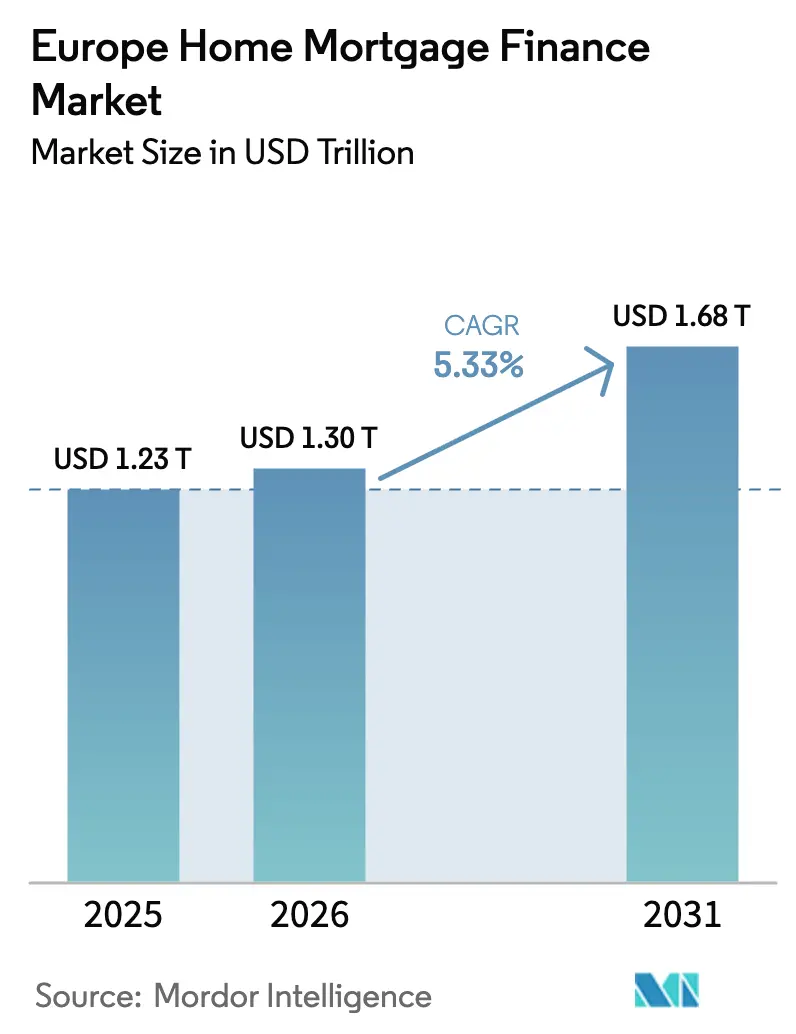
| Base Year Market Size (2025) | USD 1.23 Trillion |
| Market Size (2026) | USD 1.3 Trillion |
| Market Size (2031) | USD 1.68 Trillion |
| Growth Rate (2026 - 2031) | 5.33 % |
| Market Concentration | Medium |
Major Players *Disclaimer: Major Players sorted in no particular order Image © Mordor Intelligence. Reuse requires attribution under CC BY 4.0. | |
Europe Home Mortgage Finance Market Analysis by Mordor Intelligence
The Europe home mortgage finance market size is expected to grow from USD 1.23 trillion in 2025 to USD 1.30 trillion in 2026 and is forecast to reach USD 1.68 trillion by 2031 at 5.33% CAGR over 2026-2031. Relaxation in European Central Bank (ECB) policy, expanding green-mortgage incentives, and persistent housing-supply shortages underpin this steady growth[1]European Central Bank, “Monetary Policy Decisions Press Release,” ecb.europa.eu. Divergent monetary transmission across member states produces mixed rate environments: variable-rate borrowers in Italy and Spain feel rapid cost adjustments, whereas fixed-rate borrowers in France and Germany experience a slower pass-through. Government-backed guarantees such as Poland’s Bezpieczny Kredyt 2% or Germany’s KfW climate-retrofit loans continue to buffer affordability shocks and stimulate niche segments. Consolidation—illustrated by Santander’s pending takeover of TSB—reshapes competitive dynamics, while fintech entrants leverage open-banking rails to compress underwriting times and attract digitally savvy borrowers. Tighter climate-risk rules simultaneously restrict lending in flood-prone regions and unlock pricing advantages of 10–25 basis-point discounts for high-efficiency properties.
Key Report Takeaways
- By loan purpose, Purchase (New/Existing) held 67.21% of the European home mortgage finance market share in 2025, while Home Improvement/Renovation is projected to grow at a 6.55% CAGR through 2031.
- By provider, Banks accounted for 83.05% of the European home mortgage finance market size in 2025; Housing Finance Companies are expected to record the highest projected CAGR at 7.14% to 2031.
- By interest rates, Fixed Interest Rates led with a 77.02% share of the European home mortgage finance market in 2025, whereas Floating Interest Rates are forecasted to expand at 6.92% CAGR over 2026-2031.
- By loan tenure, mortgages exceeding 20 years represented 46.01% of the European home mortgage finance market size in 2025 and will advance at a 5.82% CAGR.
- By country, the United Kingdom captured 22.74% of the European home mortgage finance market share in 2025; Rest of Europe is the fastest-growing region, at a 6.28% CAGR through 2031.
Note: Market size and forecast figures in this report are generated using Mordor Intelligence’s proprietary estimation framework, updated with the latest available data and insights as of 2026.
Market Trends and Insights
Drivers Impact Analysis of Europe Home Mortgage Finance Market*
| Driver | (~) % Impact on CAGR Forecast | Geographic Relevance | Impact Timeline |
|---|---|---|---|
| Low-interest-rate environment prior to ECB tightening | +1.2% | Eurozone core, UK spillover | Short term (≤ 2 years) |
| Government-backed mortgage guarantee schemes | +0.8% | Poland, Germany, UK | Medium term (2-4 years) |
| Rising household disposable income in core EU economies | +0.9% | Germany, France, Netherlands, Nordics | Medium term (2-4 years) |
| Housing-supply shortage in key urban centres | +1.1% | London, Paris, Amsterdam, Stockholm, Munich | Long term (≥ 4 years) |
| Growth of green mortgages tied to energy-efficient homes | +0.6% | Netherlands, Germany, France | Long term (≥ 4 years) |
| Open-banking-enabled instant underwriting | +0.4% | UK, Netherlands, Nordics | Short term (≤ 2 years) |
| Source: Mordor Intelligence | |||
Low low-interest-rate environment prior to the ECB tightening
Originated sub-2% loans still cover about 60% of outstanding balances, creating a two-tier borrower pool in the European home mortgage finance market. Households locked into ultra-cheap debt maintain spending power even as new entrants face rates near 4%. Borrowers in Italy and Spain with shorter fixed periods confront payment jumps of 150–200 basis points, whereas 77% of French mortgages carry fixed rates exceeding 15 years[2]Banque de France, “Retail Banking Survey 2025,” banque-france.fr. Lenders offset margin compression by repricing new loans and accelerating hedging strategies. Portfolio optimization—selling seasoned fixed-rate blocks and originating hybrids—strengthens risk-adjusted returns while preserving presence in the European home mortgage finance market.
Government-backed mortgage guarantee schemes
Poland’s Bezpieczny Kredyt 2% lowers effective rates from 8.46% to 2% for a decade, halving monthly payments and invigorating first-time-buyer demand. Germany’s KfW allocates EUR 762 million in 2025 toward energy-retrofit mortgages that blend fiscal support with climate goals. The United Kingdom’s scheme backed 39,000 purchases after its 2024 expansion, though proposed 99% LTV loans invite overheating concerns. Such programs narrow risk spreads, catalyze construction in eligible brackets, and inject countercyclical stability into the European home mortgage finance market.
Rising household disposable income in core EU economies
Spain posted an 8.2% jump in household disposable income for 2024 on broad wage gains. German inflation moderated to 1.3%, keeping real earnings positive despite construction-sector headwinds. Denmark’s 3.6% GDP growth, fueled by pharmaceuticals, lifted Nordic income trajectories. Debt-to-income ratios thus stabilized, anchoring sustainable origination volumes and underpinning growth across the European home mortgage finance market.
Housing supply shortage in key urban centers
German permits fell 31.9% year-on-year to 21,200 in April 2024, deepening a projected 700,000-unit deficit by 2025. London and Amsterdam see median first-time-buyer ages touching 34 and a tight rental vacancy, respectively. Lenders respond by stretching tenures beyond 25 years and rolling out income-stretch products that meet prudent affordability tests. Persistent scarcity keeps property values firm, enlarging collateral buffers and supporting asset-quality metrics across the European home mortgage finance market.
Restraints Impact Analysis of Europe Home Mortgage Finance Market*
| Restraint | (~) % Impact on CAGR Forecast | Geographic Relevance | Impact Timeline |
|---|---|---|---|
| ECB interest-rate hikes raising borrowing costs | -1.8% | Eurozone; Italy & Spain variable-rate pools | Short term (≤ 2 years) |
| Tighter mortgage-affordability stress tests | -0.7% | UK, Netherlands, Nordics | Medium term (2-4 years) |
| Housing-price overvaluation risk in select markets | -0.5% | London, Amsterdam, Stockholm, Munich | Medium term (2-4 years) |
| Climate-risk regulations limiting lending in flood zones | -0.3% | Netherlands, Germany, UK coastal regions | Long term (≥ 4 years) |
| Source: Mordor Intelligence | |||
ECB interest-rate hikes are raising borrowing costs
Average Italian payments climbed EUR 200–300 on EUR 150,000 loans in 2024, pushing 46% of mortgagors to cut consumption[3]BNP Paribas, “Italian Mortgage Outlook 2024,” group.bnpparibas. Floating-rate uptake reached 60.9% in Italy as fixed-rate premiums widened to 96 bps. As the ECB trims policy rates through 2025, refinancing appetites return yet remain above the ultra-low era’s benchmarks, re-anchoring price expectations across the European home mortgage finance market.
Tighter mortgage-affordability stress tests
Dutch rules capping loan-to-income upset decades-high demand even amid wage growth. UK lenders now stress at 300 bps above prevailing rates[4]Bank of England, “Mortgage Lender Statistics Q4 2024,” bankofengland.co.uk. Nordic supervisors monitor debt at 235% of disposable income in Norway. These prudential screens suppress marginal approvals but lift portfolio resilience, tempering expansion of the European home mortgage finance market without jeopardizing stability.
*Our forecasts treat driver/restraint impacts as directional, not additive. The impact forecasts reflect baseline growth, mix effects, and variable interactions.
Europe Home Mortgage Finance Market Segment Analysis
By Loan Purpose:
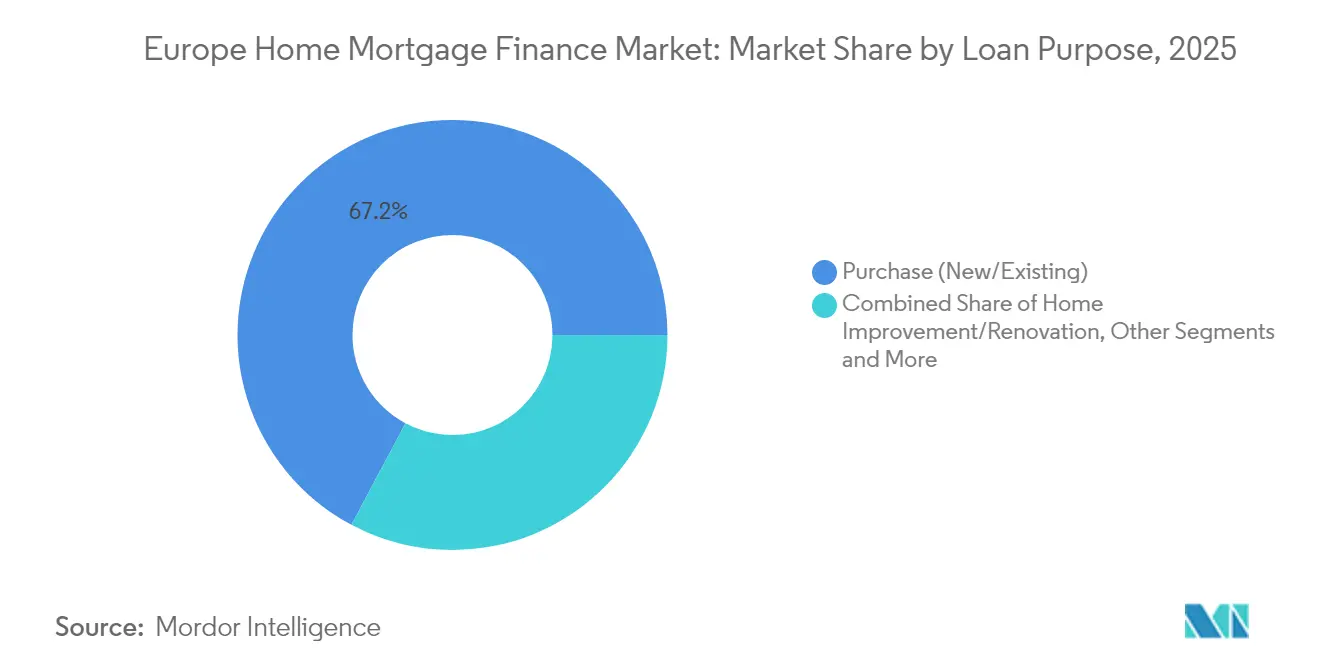
Renovation Finance Accelerates Energy GoalsPurchase (New/Existing) mortgages accounted for 67.21% of the European home mortgage finance market in 2025. The share reflects entrenched owner-occupation culture and a steady resale pipeline. Home Improvement/Renovation, however, carries a 6.55% CAGR outlook, outpacing all other purposes as EU energy-efficiency mandates channel households toward retrofits. The European home mortgage finance market size for renovation finance is poised to rise materially over 2026-2031, supported by EUR 150 billion yearly investment requirements under the Energy Performance Building Directive.
Demand for retrofit loans reshapes underwriting. Lenders must evaluate both future energy savings and collateral uplift. The EIB–Deutsche Bank program, worth EUR 600 million, illustrates how concessional capital crowd-in narrows borrowing costs for qualifying projects. Bundling renovation loans with subsidies underpins risk-adjusted returns, further embedding sustainability into the European home mortgage finance market.



By Provider:
Agile Housing Finance Companies Erode Bank HegemonyBanks retained 83.05% of the European home mortgage finance market size in 2025, leveraging deposit funding and multi-product cross-selling. Yet Housing Finance Companies eye a 7.14% CAGR thanks to specialized underwriting and digital origination. AI-powered platforms cut cost-to-income ratios and improve risk segmentation, letting newcomers capture niche borrowers overlooked by universal banks.
Incumbents counter with partnerships and core-banking upgrades. Santander’s cloud-native origination stack, deployed after the TSB integration, aims to process applications in under 48 hours. Fintech alliances provide speed and customer experience gains that help incumbent volumes grow alongside rising competition in the European home mortgage finance market.
By Interest Rates:
Floating-Rate Revival Reflects Monetary Cycle ExpectationsFixed-rate mortgages commanded a 77.02% share of the European home mortgage finance market size in 2025. As traders price sequential ECB cuts, floating-rate loans forecast a 6.92% CAGR. The European home mortgage finance market share for floating products surged in Italy, moving from 15.8% to 60.9% in 12 months as spreads between fixed and variable widened to almost 100 bps.
Borrowers hedge via capped-rate options that limit upside risk while preserving downside participation. French culture still favors long fixed terms, maintaining stability within the European home mortgage finance market. Lenders manage basis risk through dynamic hedging and loan covenants that permit later rate conversions once policy easing materializes.

By Loan Tenure:
Longer Terms Offset Affordability StrainsLoans beyond 20 years hold 46.01% of 2025 volumes and outpace other buckets at a 5.82% CAGR. Extended amortization pushes monthly payments down, supporting entry-level ownership even as prices climb. In costly capitals such as London, the median price-to-income exceeds 9x, making 30-year schedules commonplace.
Lengthening terms raises lifetime interest expense and duration risk. Supervisors now scrutinize borrowers’ retirement-age repayment capacity. Lenders adopt staged repayment features—stepped escalations or balloon options—to align cash-flows with life-cycle income, safeguarding credit quality across the European home mortgage finance market.
Geography Analysis
United Kingdom Home Mortgage Finance Market
The United Kingdom leads with a 22.74% slice of the European home mortgage finance market. A diverse product landscape—tracker, offset, lifetime—supports granular segmentation, while mergers such as Santander–TSB augment scale. Regulatory reforms post-Brexit harmonize capital charges with Basel III, giving large lenders balance-sheet flexibility. Despite 2024 affordability stress testing, UK origination volumes remain resilient due to robust labor markets and pent-up housing demand.
Germany, France and Nordics Home Mortgage Finance Market
Germany and France are structural pillars. Germany’s supply bottleneck, evidenced by permit collapse, intensifies competition for scarce stock and prolongs price appreciation. French markets benefit from a progressive decline in average mortgage rates—from 4.21% to 3.60% through 2024—stimulating refinancing even amid cautious consumer sentiment. Nordic lenders grow volumes despite subdued price rises; Nordea posted 6% growth in Q1 2025 mortgages, proving the region’s appetite for digitally enabled lending.
Southern and Eastern Europe Home Mortgage Finance Market
Spain and Italy provide cyclical upside. Spain’s 3.2% GDP expansion in 2024 bolstered house sales by 15% year-on-year. Italian credit conditions soften as banks deploy consolidation synergies; Intesa Sanpaolo facilitated EUR 30 billion medium/long-term lending over nine months of 2024, spurring mortgage growth. Rest of Europe, spanning Central and Eastern states, is the fastest growing at a 6.28% CAGR through 2031. Guarantee programs and EU funds accelerate formal credit penetration, widening the European home mortgage finance market reach. EIB-backed schemes in Latvia and large cross-border takeovers—like Erste Group’s stake in Santander Polska—provide capital and technology essential for rapid expansion.
Regulatory Landscape
Europe home mortgage finance regulation is shaped by EU-level prudential and consumer-credit frameworks, alongside country-specific borrower-based measures. In 2026, the European Banking Authority (EBA) published final Guidelines for Acquisition, Development and Construction (ADC) exposures to residential property, including a lower equity threshold of 20% for certain public housing projects. This affects construction-linked mortgage risk weights and bank capital planning across member states. In parallel, the European Mortgage Federation-European Covered Bond Council (EMF-ECBC) has continued advocacy around CRR treatment for low-risk residential mortgages, including discussion of Article 465(5) transitional arrangements, reflecting the sector focus on harmonized capital outcomes and funding market continuity.
The United Kingdom follows a distinct post-Brexit supervisory path led by the Financial Conduct Authority (FCA) and the Prudential Regulation Authority (PRA). The FCA amended mortgage rules in July 2025 to allow more flexibility around affordability assessments and remortgaging pathways, including term reductions, while lenders continue to apply stress testing and responsible lending controls. Across Europe, national authorities also use borrower-based tools such as debt-service-to-income limits and fixed-rate requirements in selected markets, which helps manage interest-rate transmission and household leverage during rate-cycle shifts.
Value Chain Analysis
The European home mortgage finance value chain begins with borrower acquisition (branches, brokers, and online journeys) and data gathering, increasingly supported by open-banking inputs for income and affordability verification. Underwriting and pricing then incorporate regulatory constraints (stress tests, LTV/LTI limits, capital rules), property valuation, and fraud and ID checks, before moving to offer issuance, conveyancing and notary workflows, and completion. Servicing (collections, arrears management, forbearance) and portfolio management sit downstream, with banks and specialist lenders using analytics to manage fixed versus floating exposures and to steer repricing and refinancing propositions.
Funding and risk distribution are central to the chain. Lenders originate on balance sheet using deposits and wholesale funding, then optimize capital and liquidity through secured funding, including covered bond frameworks championed by EMF-ECBC members, plus capital relief techniques such as synthetic risk transfer (SRT) and term issuance where applicable. Strategic consolidation also reshapes the chain by internalizing scale in origination and servicing, illustrated by Santander UK growing its mortgage platform via the acquisition of TSB, which expands operational leverage across underwriting, servicing, and funding programs.
Competitive Landscape
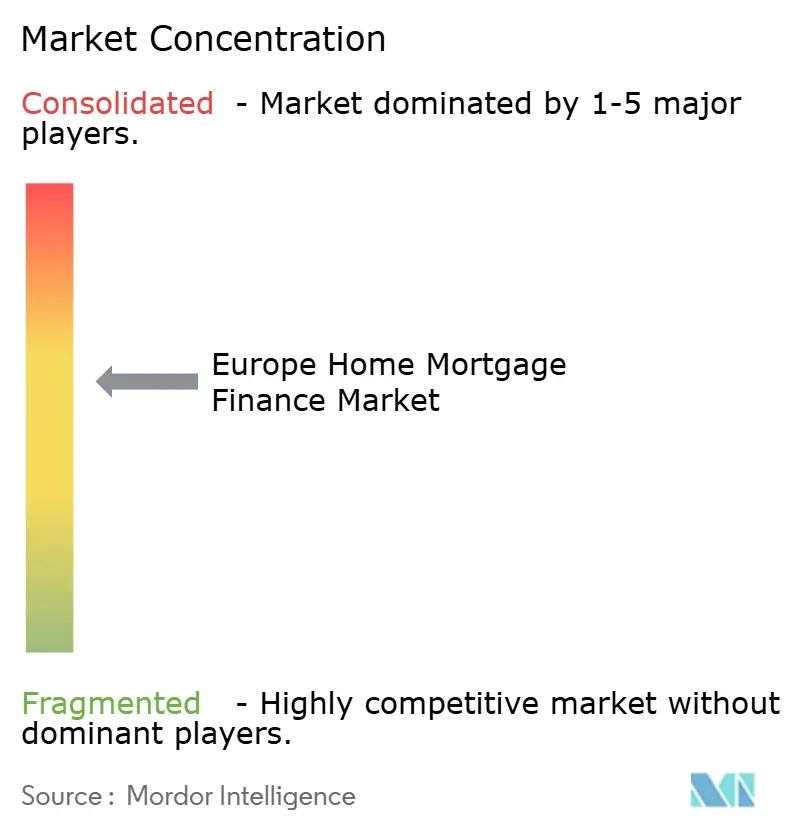
The European mortgage market exhibits moderate concentration with intensifying competitive dynamics driven by strategic consolidation and technological disruption. Santander’s USD 2.65 billion TSB deal lifts its UK mortgage assets to USD 45 billion, granting a 6% local share and better funding diversification. Nationwide’s proposed Virgin Money purchase would vault the mutual to second in deposits and mortgages, indicating that consolidation remains a favored route to cost efficiency. Cross-border acquisitions such as Erste Group’s EUR 6.8 billion stake in Santander Polska emphasize regional convergence aimed at digital infrastructure alignment.
Fintech challengers intensify pressure. Revolut intends to launch AI-assisted mortgages in 2025, combining open-banking data pulls with instant decision-making that undercuts incumbents on user experience. Traditional banks answer with internal buildouts: Legal & General Home Finance’s API rollout streamlines lifetime-mortgage processing, while ING’s granular green-pricing tool differentiates on sustainability.
White-space innovation also shapes rivalry. Lifetime and equity-release products address aging demographics, green mortgages command premium LTV pricing, and instant underwriting attracts younger borrowers. Institutions able to integrate ESG analytics and machine learning into credit models stand to gain a share of the European home mortgage finance market.
Europe Home Mortgage Finance Industry Leaders
Lloyds Banking Group
Banco Santander
BNP Paribas
Crédit Agricole
Barclays plc
- *Disclaimer: Major Players sorted in no particular order
Europe Home Mortgage Finance Market Companies Covered in this Report
- Lloyds Banking Group
- Banco Santander
- BNP Paribas
- Crédit Agricole
- Barclays plc
- HSBC UK
- ING Group
- Rabobank
- Deutsche Bank
- Commerzbank
- UniCredit
- Intesa Sanpaolo
- Nordea Bank
- Danske Bank
- Swedbank
- CaixaBank
- Nationwide Building Society
- Aareal Bank
- DNB ASA
- Bank of Ireland

Market Opportunities and Future Outlook
Renovation and energy-efficiency finance is a specific whitespace within European mortgage lending because underwriting and product design have to connect property condition, retrofit scope, and expected efficiency gains. Evidence already shows this direction through bank-led green pricing programs, including ING launching tiered energy-label mortgage pricing in the Netherlands in May 2025. Scaled retrofit ambitions such as BNP Paribas targeting 400,000 energy-efficient home renovations in Europe by the end of 2026 support demand for linked mortgage-plus-renovation structures, contractor-payment solutions, and valuation models that account for post-retrofit collateral uplift.
A second opportunity involves faster, lower-cost origination and servicing built on open banking and automation, particularly where refinancing cycles are active and affordability constraints are tightening. BNP Paribas has moved to electronic issuance of mortgage offers using AI, with around 20% of the simplest applications processed without back-office intervention, which supports competition on time-to-yes, document capture, and operational cost per loan. On the policy and capital side, EMF-ECBC proposals for a harmonized "28th regime" mortgage guarantee concept outline an approach to mobilize private capital and reduce fragmentation, while platform modernization is reinforced by incumbent integrations, including Santander UK integrating TSB, which can standardize broker connectivity and product sets across larger books.
Recent Industry Developments in Europe Home Mortgage Finance Market
- May 2026: Lloyds Banking Group Launched a first-time buyer mortgage product requiring a 5,000 GBP deposit, available via Lloyds Bank, Halifax, and Bank of Scotland for homes valued up to 300,000 GBP. The offering expands access for first-time buyers in the UK housing market and could capture incremental share in the UK housing finance segment. This move signals a shift toward affordability-focused options in the competitive UK mortgage landscape.
- May 2026: Lloyds Banking Group Launched a first-time buyer mortgage product requiring a 5,000 GBP deposit, available through Lloyds Bank, Halifax, and Bank of Scotland for homes valued up to 300,000 GBP. The program targets affordability in the UK market and could capture incremental share in the housing finance segment. The initiative underscores Lloyds broader push to broaden entry points for younger borrowers in a tight housing market.
- January 2026: BNP Paribas Commenced electronic issuance phase for mortgage offers using AI to process about 20% of the simplest applications without back-office intervention. The move accelerates digital underwriting across the euro area and could reduce processing times and costs. It sets a baseline for further AI enabled mortgage processing in the European market.


Europe Home Mortgage Finance Market Report Scope and Research Methodology
Market Definition and Coverage
For this study, the Europe home mortgage finance market is defined as the value of residential mortgage lending provided to households for house purchase and other home-related needs across European countries.
Scope exclusions: This sizing excludes commercial real estate lending and unsecured consumer credit that is not linked to a residential home loan.
Segments Covered in This Report
- By Loan Purpose
- Purchase (New/Existing)
- Home Improvement/Renovation
- Loan Against Property
- Others (Construction, Refinance, etc.)
- By Provider
- Banks
- Housing Finance Companies
- Others
- By Interest Rates
- Fixed Interest Rates
- Floating Interest Rates
- By Loan Tenure
- ≤ 10 Years
- 11 – 20 Years
- More than 20 Years
- By Country
- United Kingdom
- Germany
- France
- Spain
- Italy
- Benelux (Belgium, Netherlands, and Luxembourg)
- Nordics (Sweden, Norway, Denmark, Finland, and Iceland)
- Rest of Europe
Data Sources, Market Sizing, and Validation
Desk Research
Desk research starts with building a consistent picture of housing finance across Europe using public statistics and regulator disclosures, and then converting those series into comparable country time series.
We mainly refer to sources such as European Mortgage Federation (Hypostat) tables, European Central Bank lending statistics, national central bank releases, national statistics offices for household and housing indicators, and land registry or official house price index publications where available.
Those series are complemented with lender disclosures such as annual reports, investor presentations, and banking association commentary, which helps interpret shifts in origination volumes, refinancing cycles, and product mix over time. Select paid databases are used carefully for company financials and news screening. Patent databases are also checked when mortgage process digitization is discussed at a broad level.
The sources named above are illustrative only, and many other public and paid references were used for data collection, validation, and clarification.
Primary Interviews and Surveys
Primary work is used to test the desk model assumptions, especially around what is treated as new lending versus stock, and how rate moves and tenure shifts are influencing borrower behavior. We speak with lenders, mortgage intermediaries, and industry advisors across major European markets so local product structures are not averaged into a single assumption.
Distribution of primary research fieldwork respondents
| Company type | Respondent position |
|---|---|
| Top tier: 29% | CXOs: 20% |
| Mid tier: 49% | Functional/Unit leaders: 30% |
| Smaller Players: 22% | Managers: 50% |
Market-Sizing & Forecasting
Sizing is built using a top-down approach where official lending stocks and new lending flows are reconstructed by country, then normalized into USD under the same timing rules. To keep totals realistic, results are corroborated with selective bottom-up checks such as sampled lender balance sheet roll-ups, channel checks on origination direction, and sampled average loan size multiplied by transaction and approval volumes when a country series has reporting lags.
Key inputs used in the model include outstanding residential loan stock, gross residential mortgage lending, mortgage interest rate levels and resets (fixed versus floating share), typical loan tenor distribution, and housing signals such as transaction volumes and house price indices. For forecasting, scenario analysis is applied around rate paths and housing turnover, and then country outlooks are consolidated into a Europe total after consistency checks.
Where bottom-up benchmarks are not available for smaller markets, gaps are handled through proportional allocation based on observable lending stocks and the historical relationship between stocks and new lending in comparable countries.
Data Validation & Update Cycle
Validation is done in steps so outliers are caught early and rechecked before release. Model outputs are compared with independent signals such as central bank lending aggregates, reported mortgage production trends, and country movements in loan purpose and interest-type mix. Large variances are investigated through additional desk checks and follow-up conversations.
A second analyst review is used to confirm that assumptions on exchange rates, country weights, and timing align with the market definition. Then a final review is completed prior to publication.
Reports are refreshed annually, with interim updates when material events shift rate expectations or lending momentum. Before delivery, a fresh data pass is completed so clients receive the latest updated view available at that time.
Mordor Intelligence's Europe Home Mortgage Finance Market Size Versus Other Published Estimates
Published values for Europe home mortgage finance often diverge because each publisher may size a different base, such as new originations, outstanding balances, or a blended lending view. Publishers may also apply different currency timing.
Differences also show up when refinancing treatment varies and when country coverage is expanded or narrowed.
Key gap drivers in this market are usually whether the number reflects stock versus flow, how fixed and floating rate repricing is captured in the period selection, and how quickly assumptions are refreshed when rates and housing transactions move within the year.
Benchmark comparison
| Source | Market Size | Gaps in Research Methodology |
|---|---|---|
| Mordor Intelligence | USD 1.23 T (2025) | |
| Industry Association A | USD 11.40 T (2023) | Typically presented as total outstanding residential mortgage loans across a broader country set and reported in EUR, which can lift the converted USD figure and can also reflect a stock-only view rather than lending activity over the year. |
| Global Consultancy B | USD 0.86 T (2025) | Often closer to annual new mortgage production and may net out refinancing and portfolio transfers, which lowers the value compared with approaches that count a wider set of home loan financing activity. |
The table shows the spread is largely explained by stock-based totals on one side and origination-focused totals on the other. Under Mordor Intelligence's scope, the 2025 value is built from country lending series that count residential mortgage finance tied to home purposes while excluding commercial property lending and unrelated consumer credit before USD conversion.


Key Questions Answered in the Report
What is the current value of the European home mortgage finance market?
The market is valued at USD 1.30 trillion in 2026 and is projected to reach USD 1.68 trillion by 2031.
Which country holds the largest share of the European home mortgage finance market?
The United Kingdom leads with a 22.74% share as of 2025.
Why are renovation loans growing faster than purchase loans?
EU energy-efficiency mandates and green-mortgage discounts of up to 25 basis points drive a 6.55% CAGR for Home Improvement/Renovation loans.
How do government guarantee schemes influence mortgage affordability?
Programs like Poland’s Bezpieczny Kredyt 2% cut effective rates from 8.46% to 2%, reducing monthly payments by about 50% for qualifying borrowers.
What technological changes are reshaping mortgage underwriting?
Open-banking integration and AI-powered platforms lower approval times from weeks to hours, improving borrower experience and risk assessment accuracy.
Are floating-rate mortgages becoming more popular?
Yes, as borrowers expect ongoing ECB rate cuts, floating-rate products are forecast to grow at 6.92% CAGR through 2031, particularly in Italy and Spain.
Page last updated on:





