
Malaysia Foodservice Market Size and Share
Malaysia Foodservice Market Analysis by Mordor Intelligence
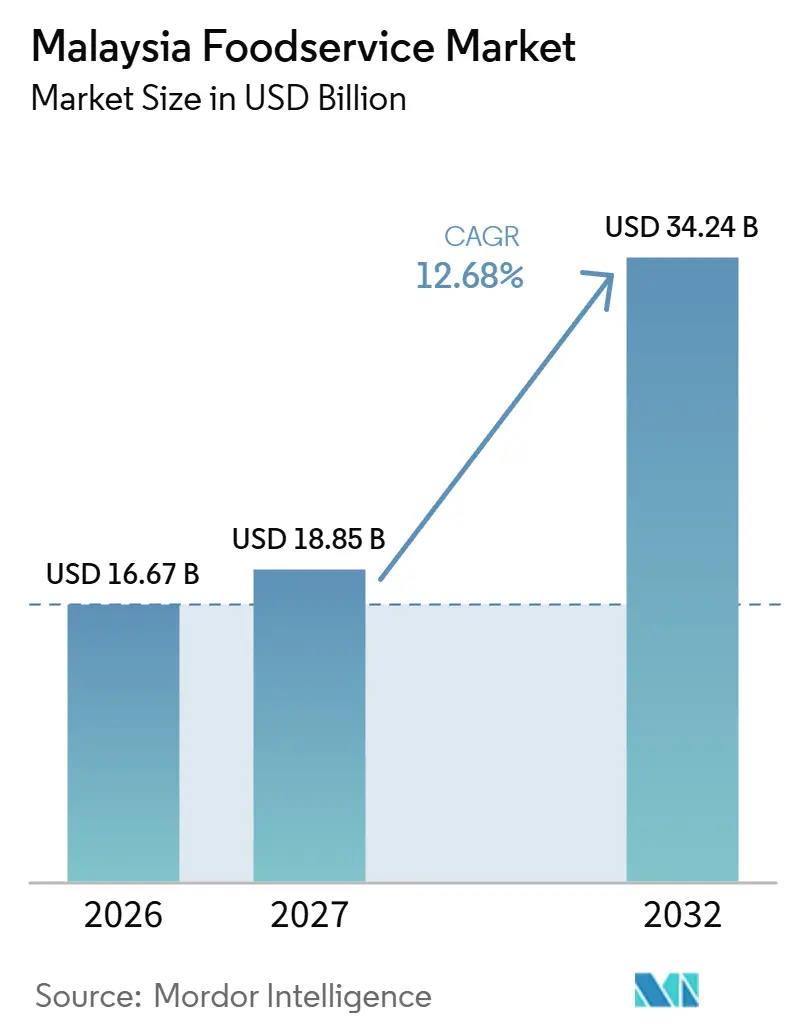
The Malaysia foodservice market size is projected to expand from USD 16.67 billion in 2026 and USD 18.85 billion in 2027 to USD 34.24 billion by 2032, registering a CAGR of 12.68% between 2027 and 2032.
In Malaysia, mobile ordering, transport investment, and prepared-meal venues can extend restaurant access across residential areas and transport locations. Shared kitchens give smaller meal producers equipped facilities for online selling, broadening participation in prepared-food commerce. Networks and venue partnerships can add customer access, while individual restaurants must sustain a useful role within the operating footprint. Ingredient disruptions and price competition limit menu continuity and the room available to recover operating costs. For smaller meal producers, added reach through platforms and transport sites supports growth only where ingredient supply keeps their menus available at prices competitive with international chains.
Key Report Takeaways
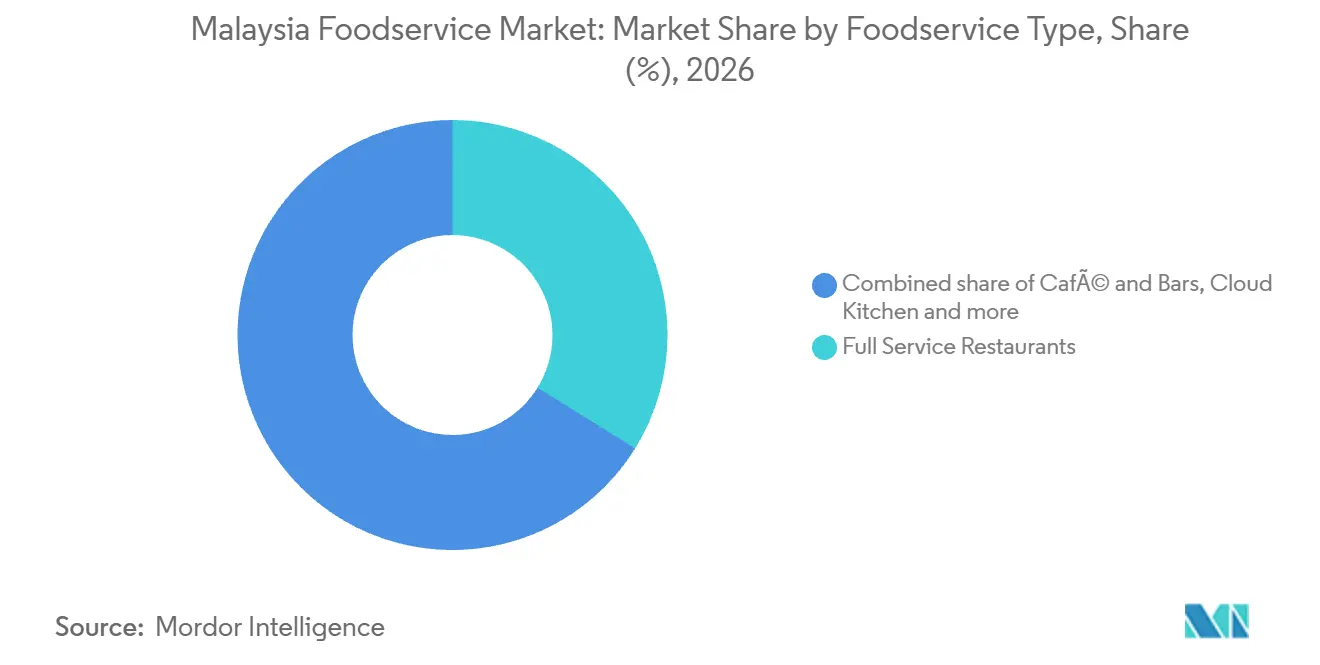
- By foodservice type, full-service restaurants held a 33.84% Malaysia foodservice market share in 2026, while cloud kitchens are forecast to grow fastest at a 15.4% CAGR between 2027 and 2032.
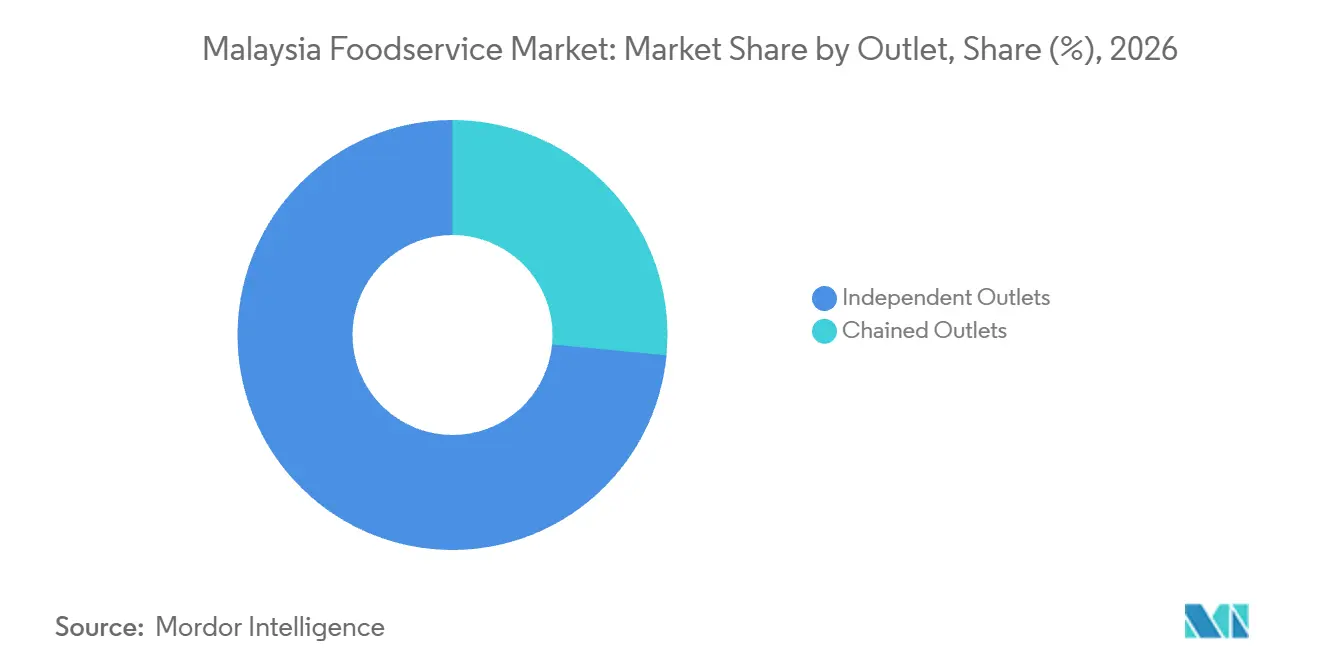
- Across outlet types, independent outlets accounted for a 73.49% share of the Malaysia foodservice market size in 2026, and chained outlets lead projected growth with a 12.8% CAGR between 2027 and 2032.
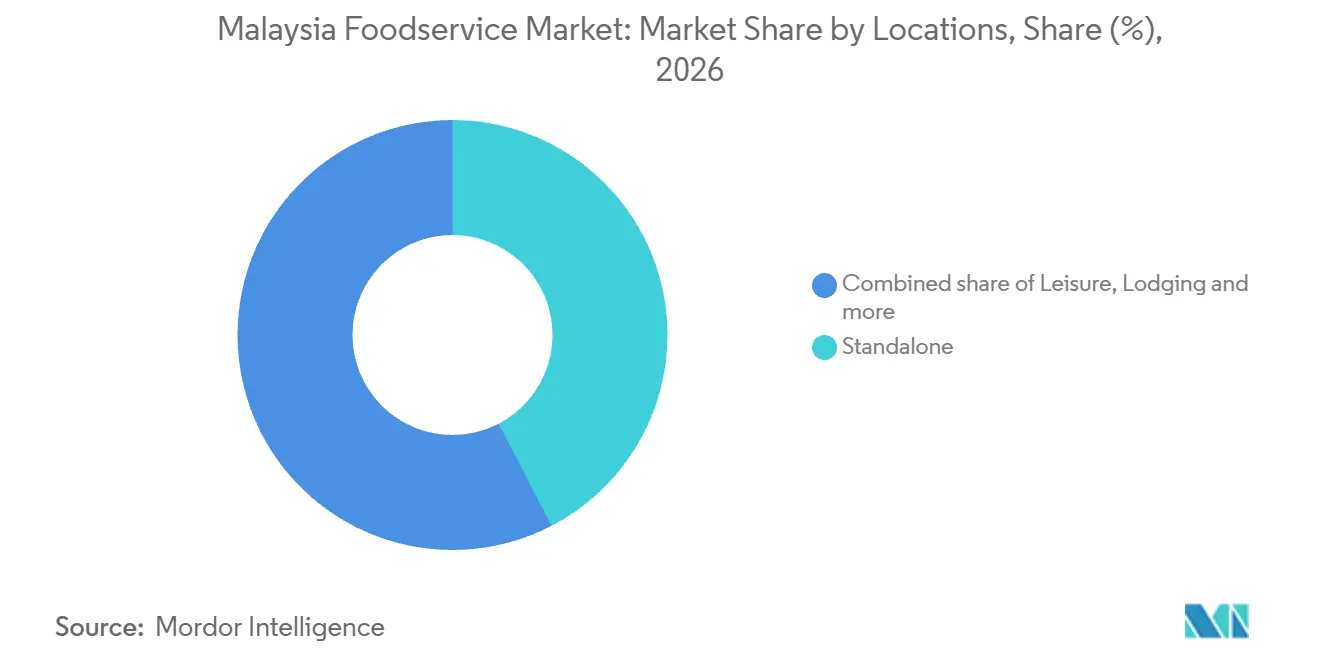
- Within foodservice locations, standalone outlets led with 42.37% of foodservice spending in 2026, while travel is the fastest-growing segment at a 15.45% CAGR between 2027 and 2032.
- By service type, dine-in held 63.17% of foodservice spending in 2026, and delivery is forecast to grow fastest at a 15.3% CAGR between 2027 and 2032.
- Geographically, Klang Valley leads the foodservice landscape, with demand for western pastries and specialty beverages supporting café openings alongside closures of unsustainable businesses in 2025.
Note: Market numbers in this report are based on Mordor Intelligence's proprietary estimation framework, which combines nine months of actuals with Q4 projections for base year 2026.
Market Trends and Insights
Drivers Impact Analysis of Malaysia Foodservice Market*
| Driver | (~) % Impact on CAGR Forecast | Geographic Relevance | Impact Timeline |
|---|---|---|---|
| Expansion and modernization of urban infrastructure | +3.1% | Seremban in Negeri Sembilan | Short term (≤ 2 years) |
| Rapid digitization and mobile app adoption for ordering | +3.6% | Putrajaya, Kuala Lumpur, Selangor and Johor Bahru | Short term (≤ 2 years) |
| Rise of cloud kitchens and virtual-only brands | +2.9% | Kuala Lumpur public-housing areas | Medium term (2-4 years) |
| Increasing consumer preference for convenience and ready-to-eat food | +3.7% | Sepang in Selangor | Short term (≤ 2 years) |
| Strong coffee and café culture | +2.1% | Nationwide | Medium term (2-4 years) |
| Expansion of quick-service and fast-casual restaurant chains | +2.4% | Nationwide | Medium term (2-4 years) |
| Source: Mordor Intelligence | |||
Expansion and modernization of urban infrastructure
On July 21, 2026, Transport Minister Anthony Loke reported that the Seremban Sentral station project was about 35% complete.[1] The project was expected to integrate the existing KTM Seremban station with a modern terminal and commercial spaces by March 2027, providing capacity for around 30,000 passengers daily upon completion. For foodservice operators, combining passenger access with commercial premises can create opportunities to serve meals within a transport journey. Integration with an existing rail station anchors this opportunity to established transport infrastructure rather than requiring a wholly new destination. With completion targeted for March 2027, the near-term opportunity concerns foodservice site planning, while meal sales depend on the terminal becoming operational.
Rapid digitization and mobile app adoption for ordering
Mobile ordering can bring local prepared-food sellers into a wider commercial network without requiring them to build their own ordering platform. In September 2025, Grab Malaysia and the Federal Agricultural Marketing Authority (FAMA) extended their partnership to a new Putrajaya market, with food and beverage merchants available on GrabFood. By that announcement, the partnership had digitalized nearly 300 merchants across more than 30 markets since 2023, including fresh-produce businesses. For small food businesses, the relevant demand opportunity is access beyond customers who physically visit their trading location, while the platform supplies the ordering channel. Each food and beverage merchant added to GrabFood gives customers another prepared-meal option to order without visiting the market, so the channel's reach grows with the number of onboarded vendors that sell prepared food.
Rise of cloud kitchens and virtual-only brands
Shared kitchens can expand prepared-meal supply by separating a food entrepreneur's entry decision from establishing an individual production facility. By March 2026, Pepper Labs’ Dapur Digital had opened 15 shared-kitchen hubs since September 2024 in Kuala Lumpur public-housing areas, where low-income entrepreneurs sold home-cooked meals online. The initiative provided equipped shared kitchens and business facilities for these entrepreneurs. In March 2026, Pepper Labs also outlined nationwide expansion, which would test the model beyond its Kuala Lumpur public-housing locations. Such expansion would need to bring equipped kitchens within reach of prospective sellers, because a digital storefront alone does not provide the production space this model supplies.
Increasing consumer preference for convenience and ready-to-eat food
A prepared-meal offer inside a transport food hall can serve customers who want to fit eating into the journey itself. On July 4, 2025, Santan, Capital A’s food and beverage brand, opened an outlet at gateway@klia2’s Food District in Sepang serving prepared meals for on-site consumption. Its menu included nasi lemak, chicken rice, and Thai green curry with rice. Bringing several meal choices into one food-hall location can accommodate different tastes within a traveling party. By opening in a newly launched gateway food hall, Santan could draw demand from travelers already on site rather than depend solely on customers making a separate dining trip.
Restraints Impact Analysis of Malaysia Foodservice Market*
| Restraint | (~) % Impact on CAGR Forecast | Geographic Relevance | Impact Timeline |
|---|---|---|---|
| Supply chain fragility and ingredient sourcing challenges | -2.2% | Kuala Lumpur and several Malaysian states | Short term (≤ 2 years) |
| Pressure from multinational and domestic chains on smaller operators | -1.6% | Nationwide | Medium term (2-4 years) |
| Quality consistency issues and lack of standardized operating procedures among independents | -0.9% | Nationwide | Long term (≥ 4 years) |
| Frequent policy/tax changes on food and beverage products | -0.5% | Nationwide | Short term (≤ 2 years) |
| Source: Mordor Intelligence | |||
Supply chain fragility and ingredient sourcing challenges
Ingredient availability can limit menu breadth even when a foodservice outlet has the capacity to serve more customers. In June 2026, Ground FLAW café in Kuala Lumpur reported temporarily pausing its miso-soup side dish after its usual paste had been unavailable for several months.[2] The café had been unable to find another brand with the same taste profile. Separately, the Department of Statistics Malaysia (DOSM) reported that extreme weather and monsoon-driven flooding caused vegetable shortages and price increases in several Malaysian states toward the end of 2025. Kuala Lumpur café KLCG switched the pasta used in one dish after local suppliers could no longer provide it, according to the June 2026 report. Ground FLAW's lack of a taste-compatible substitute therefore turned a missing input into a product withdrawal, leaving restoration of that menu item dependent on supply recovery or an acceptable replacement.
Pressure from multinational and domestic chains on smaller operators
Smaller foodservice operators face a difficult expansion decision when competing products establish a price level that their own cost structure cannot easily match. In January 2026, the Ministry of Entrepreneur and Cooperatives Development (KUSKOP) acknowledged challenges to Malaysian micro, small, and medium enterprises, particularly in franchising. It linked those challenges to international food and beverage companies' lower-priced products backed by scale and global supply chains. That disadvantage can restrict the pricing room available to fund additional outlets while preserving an affordable offer. In March 2026, KUSKOP described Pernas's Business in Transformation program to help local businesses develop franchise operations. Franchise development can improve an operator's growth options, but price competition leaves smaller businesses facing a narrower margin for financing that expansion.
*Our forecasts treat driver/restraint impacts as directional, not additive. The impact forecasts reflect baseline growth, mix effects, and variable interactions.
Malaysia Foodservice Market Segment Analysis
By Foodservice Type:
Dining Networks and Production-Only Formats Serve Different NeedsFull-service restaurants accounted for a 33.84% share of the Malaysia foodservice market size in 2026. Berjaya Roasters (M) Sdn Bhd, Berjaya Food's wholly owned subsidiary and Kenny Rogers Roasters master franchisee, operated 48 Malaysian restaurants, including sub-franchisee outlets, as of June 30, 2025. Berjaya Food subsequently reported lower Malaysian Kenny Rogers Roasters revenue for the quarter ended June 30, 2026, following rationalization and closure of non-performing stores. Substantial capacity and selective closures can therefore coexist within the largest segment, making the productivity of individual full-service restaurants central to how operators allocate their footprint.
Cloud kitchens are the fastest-growing segment, with a projected CAGR of 15.4% between 2027 and 2032. By mid-2026, Hakshan operated 13 kitchens across the Klang Valley and Ipoh, comprising 10 outlets and 3 cloud kitchens. The combination illustrates how a foodservice operator can maintain customer-facing premises while using production-only locations to extend its meal offer. With 3 of its 13 kitchens operating as cloud kitchens, Hakshan had most of its kitchen locations in customer-facing outlets, showing how production-only sites can supplement an outlet network rather than require its replacement.

By Outlet:
Independent Scale Coexists With Organized Chain ExpansionIndependent outlets represented a 73.49% Malaysia foodservice market share in 2026. A worker at a Kuantan coffee roastery supplying local businesses, cited by The Straits Times, estimated that Kuala Lumpur had nearly 800 independent cafés in June 2026. This city-level café base illustrates how independent foodservice can comprise many individual propositions within a single urban setting. Single-outlet differentiation therefore has commercial importance within such an urban base, allowing a business in the largest segment to compete through a recognizable menu and a clearly defined local dining occasion.
Chained outlets are the fastest-growing segment, with a projected CAGR of 12.8% between 2027 and 2032. Envictus reported that Texas Chicken's Malaysian store count grew from 101 to 107 during FY2026 through June 30, 2026. For the quarter ended June 30, 2026, Envictus also described a competitive environment for Texas Chicken as consumers remained selective in their spending. The resulting commercial task is to expand access while winning choices from selective consumers, making the relevance of the meal offer at each additional store central to converting new capacity into spending.
By Locations:
Standalone Flexibility Meets Journey-Based FoodserviceStandalone outlets were the largest location segment, accounting for 42.37% of foodservice spending in 2026. By October 3, 2025, A&W had opened its standalone outlet at Parklane City Benoni in Sabah, with capacity for about 120 diners and 4 drive-in bays. The outlet also featured a drive-through, combining dining-room, drive-in, and drive-through service at one site. Allocating room to both seating and dedicated car bays makes the balance of service formats a site-design decision, with each use competing for space within the standalone footprint.
Travel is the fastest-growing location segment, with a projected CAGR of 15.45% between 2027 and 2032. Ahead of Visit Malaysia 2026, Malaysia Airports expanded its airport network's food and beverage offering with local and international brands and experiential pop-ups. By April 2026, Keretapi Tanah Melayu Berhad managed ETS onboard meals and drinks in-house under Stesen, offering passengers a wider range. Leisure foodservice gained a venue on January 8, 2025, when Resorts World Genting opened Kool Grill, a barbecue restaurant with local offerings, at Genting SkyWorlds' entrance. Airport concessions and in-house train service present different routes to serve passengers, making the host transport operator's delivery model a central commercial consideration for food providers.
By Service Type:
The Dining Experience and Solo Delivery Address Different OccasionsDine-in was the largest service segment, accounting for 63.17% of foodservice spending in Malaysia in 2026. Benihana Malaysia opened its first Malaysian outlet at Suria KLCC in Kuala Lumpur on May 8, 2025, with a main dining area and a limited-seat teppanyaki station. The station gave diners a front-row view of the chefs' cooking, making preparation part of the on-premises offer. Because the cooking station seats a limited number of guests, its front-row experience makes physical attendance part of the purchase, tying this dine-in proposition to an occasion that delivery cannot reproduce.
Delivery is the fastest-growing segment, with a projected CAGR of 15.3% between 2027 and 2032. As of April 2025, GrabFood for One was available in Malaysia, offering one-person meal options with no small-order fees and a fixed, low delivery fee. Removing the small-order charge can make a single meal a more practical delivered purchase, because the customer does not need a larger basket to avoid that particular fee. Solo-meal delivery therefore opens an individual dining occasion for participating restaurants, linking the appeal of the fee structure to the operator's ability to prepare and fulfill a small basket economically.
Geography Analysis
Klang Valley Foodservice Market
Klang Valley is the largest foodservice geography in Malaysia. Pavilion REIT reported café openings driven by high demand for western pastries and specialty beverages in the region in 2025. The product-specific demand favors an offer built around a defined eating or drinking occasion. A pastry or specialty-beverage concept can therefore attract initial interest, but the 2025 closures linked to unsustainable business make a viable operating cost base essential to keeping an outlet trading.
Shopping was the main purpose of domestic visitor travel in Penang in 2025. In Penang, CCH Holdings opened its 888 Family Food Court on June 26, 2025. A food court can organize different meal choices within a single venue, giving CCH Holdings a format that could fit a meal stop within a shopping-oriented trip. Converting that fit into sales depends on the venue earning a place in the visitor's route, so the commercial question is how well meal choice and location work together during the trip.
Domestic visitors in Sabah stayed an average of 3.15 nights in 2025, while Sarawak averaged 3.10 nights, compared with 2.56 nights nationally. In Kuching, Hilton Kuching completed a dining-venue renovation in 2025 that included halal-certified Cantonese restaurant Toh Yuen and all-day River View Café. Longer stays create potential for repeated meal occasions across a visit, which can make all-day access and a distinct restaurant format complementary. Hilton Kuching's Toh Yuen incorporated local ingredients and Sarawak influences into its Cantonese offering. That combination allows a property to seek repeat meal spending through both all-day availability and a cuisine-specific offer, making variety within a stay the commercial opening.
Regulatory Framework and Outlook
Selected national and Penang Island rules are compared from the perspective of an operator opening an indoor restaurant. National food-premises registration and food-handler duties sit alongside the City Council of Penang Island's local composite-license pathway. The council's Licensing Department processes food-establishment licenses and inspects premises. For an entrant, preparing the premises and staff for operation must therefore accompany the application work, making compliance part of the opening sequence.
Regulatory Table of Malaysia Foodservice Market
| Decision factor | Malaysia | Penang, within Penang Island jurisdiction |
|---|---|---|
| Primary authority | Ministry of Health | City Council of Penang Island, Licensing Department |
| Key instruments or direction | Food Hygiene Regulations 2009 and amendment effective December 1, 2026 | uLesen composite-license application pathway |
| Commercial effect | Premises registration and handler training, medical examination, and vaccination before December 1, 2026 | Food-establishment license application and premises inspection |
| Current policy attractiveness | Medium | Medium |
| Future direction of policy attractiveness | Easing | No change |
| Source: Mordor Intelligence | ||
Both current Medium ratings reflect defined entry processes requiring premises and staff preparation before opening. The national Easing direction reflects removal of food handlers' medical-examination requirement from December 1, 2026, while training and vaccination duties remain. Penang Island's No change direction concerns the composite application and inspection pathway for indoor restaurant premises. The council's 2026 amended guidance concerns permits for chairs and tables outside food premises, a separate application question from the indoor licensing route.
Value Chain Stages
Value capture shifts from ingredient distribution to meal preparation and delivery, with a different earnings basis at each stage. Lee’s Frozen Food imports and distributes meat, dairy, seafood, frozen food, and other imported food in Southeast Asia, with delivery services in its Malaysian operations. GrabFood connects Malaysian restaurants with consumers through online delivery and charges merchants service fees. These roles create separate commercial responsibilities for getting usable ingredients to kitchens and completed orders to consumers.
Value Chain Analysis Table of Malaysia Foodservice Market
| Primary activity | Key participants | Value capture | Bottleneck | Resilience response |
|---|---|---|---|---|
| Ingredient import and distribution | Food importers and distributors such as Lee’s Frozen Food | Ingredient distribution sales | Exposure to ingredient and logistics costs | Qualify equivalent inputs and alternative supply routes |
| Meal preparation and outlet service | Café-chain operators such as Secret Recipe | Prepared food and beverage sales | Raw-material, packaging, gas, and utility cost pressure | Redesign preparation and portion specifications around sustainable meal economics |
| Ordering and last-mile fulfillment | Food-ordering and delivery platforms such as GrabFood | Merchant service fees | Service fees constrain merchant channel returns | Set delivery offers using contribution after platform charges |
| Source: Mordor Intelligence | ||||
In March 2026, the Malaysian Muslim Restaurant Owners Association (PRESMA) said restaurant operators faced cost increases of 10% to 30% associated with supply-chain disruptions, higher logistics costs, and global uncertainty. The Ministry of Domestic Trade and Cost of Living (KPDN) said price adjustments must be based on actual costs. Together, the reported pressures make the distribution-to-kitchen handoff commercially significant, because higher delivered costs reach the operator before a meal is sold. Adding delivery extends the sales channel but also introduces a separate fee claim on the transaction, so greater reach needs to support a viable return at the kitchen.
Competitive Landscape
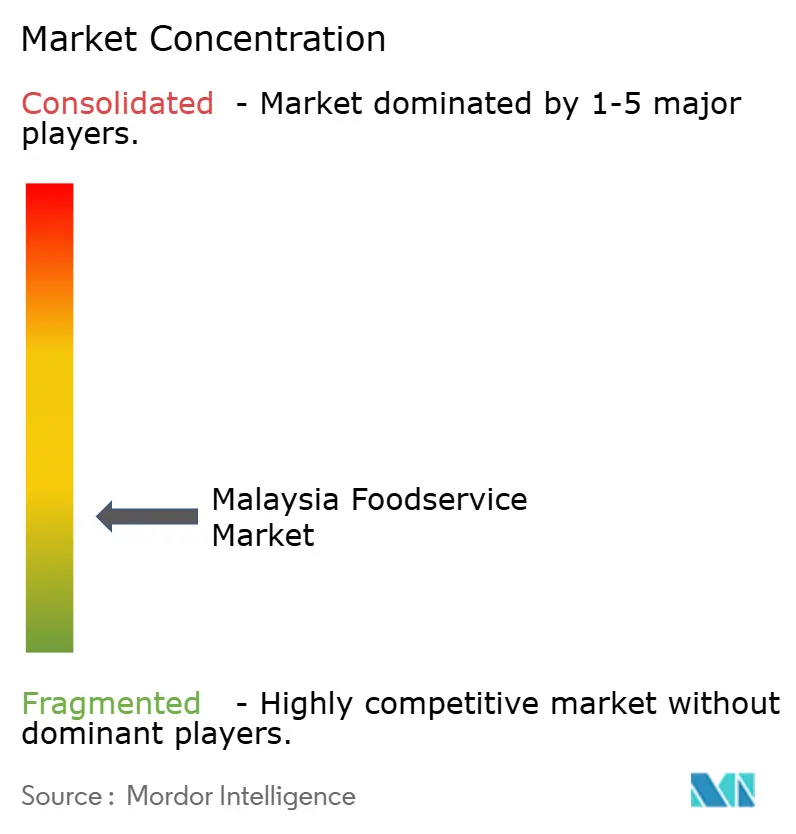
Competition is fragmented, with independent outlets operating alongside organized restaurant and café networks, including Gerbang Alaf Restaurants Sdn Bhd, which fully owns and operates McDonald’s Malaysia. Berjaya Starbucks Coffee Company Sdn Bhd operated 301 Malaysian stores as of June 30, 2025, while Berjaya Food said Starbucks operations in Malaysia performed better in the quarter ended June 30, 2026 than a year earlier, despite a reduced number of operating stores. Domino’s Pizza Enterprises Ltd participates through its Malaysian pizza business, while Marrybrown Sdn Bhd and Secret Recipe Cakes & Café Sdn Bhd add restaurant and café competition. These networks make repeatable outlet execution a competitive resource, while the broad independent presence leaves space for operators with a clearly defined local dining proposition.
On January 6, 2026, Domino’s Pizza Malaysia reported more than 270 stores nationwide and announced franchise opportunities across Malaysia. On December 31, 2025, Marrybrown launched its first outlet in collaboration with MESRA Retail & Café at PETRONAS Seksyen 15 in Shah Alam.[3] The moves use different expansion mechanisms, with franchise recruitment bringing operating partners into a network and the collaboration placing a restaurant offer at a partner's retail location. For a restaurant network, these approaches make partner selection and location fit part of how access is expanded, with the commercial value depending on each additional outlet securing a useful trading role.
Future competition can turn on how consistently a chain connects outlet access, ordering convenience, and halal certification. MIXUE Malaysia reported that more than 100 outlets obtained halal certification from the Department of Islamic Development Malaysia (JAKIM) in 2025. Domino’s Pizza Malaysia described its business as digitally driven in January 2026. For buyers, JAKIM halal certification identifies certified outlets, while digital ordering can make a restaurant's menu accessible through another route to purchase. Challengers that extend halal certification across outlets while improving digital access can compete through a consistently accessible, certified offer alongside the physical reach gained from opening additional restaurants.
Malaysia Foodservice Industry Leaders
-
Gerbang Alaf Restaurants Sdn Bhd
-
Berjaya Starbucks Coffee Company Sdn Bhd
-
Domino’s Pizza Enterprises Ltd
-
Marrybrown Sdn Bhd
-
Secret Recipe Cakes & Café Sdn Bhd
- *Disclaimer: Major Players sorted in no particular order
Malaysia Foodservice Market Companies Covered in this Report
- Gerbang Alaf Restaurants Sdn Bhd
- Berjaya Starbucks Coffee Company Sdn Bhd
- Domino’s Pizza Enterprises Ltd
- Marrybrown Sdn Bhd
- Secret Recipe Cakes & Café Sdn Bhd
- A&W (Malaysia) Sdn Bhd
- Revenue Valley Sdn Bhd
- Nando’s Chickenland Malaysia Sdn Bhd
- OldTown Bhd
- San Francisco Coffee Sdn Bhd
- Texchem Resources Bhd
- Craveat International Sdn Bhd
- Loob Holding Sdn Bhd (Tealive)
- KyoChon Sdn Bhd
- Big Apple Donuts & Coffee
- Sushi King Sdn Bhd
- The Chicken Rice Shop Sdn Bhd
- Papparich Group International Sdn Bhd
- Kenny Rogers Roasters
- Baskin Robbins Malaysia Sdn Bhd
Recent Industry Developments in Malaysia Foodservice Market
- May 2026: Little Caesars opened its first Malaysian pizza restaurant in Damansara Utama, Petaling Jaya, on May 24.
- Apr 2026: Slim Chickens Malaysia opened its second outlet at NU Sentral in Kuala Lumpur, following its first Malaysian outlet at SS15, Subang Jaya, which opened in June 2025.
- Feb 2026: McDonald’s Malaysia, fully owned and operated by Gerbang Alaf Restaurants Sdn Bhd, announced a 5-year plan to open 100 restaurants, modernize more than 150 existing outlets, and strengthen its technology and digital capabilities.
Scope and Methodology
Segmentation Overview
| Café and Bars | By Cuisine | Bars & Pubs |
| Café | ||
| Juice/Smoothie/Desserts Bars | ||
| Specialist Coffee and Tea Shops | ||
| Cloud Kitchen | ||
| Full Service Restaurants | By Cuisine | Asian |
| European | ||
| Latin American | ||
| Middle Eastern | ||
| North American | ||
| Other FSR Cuisines | ||
| Quick Service Restaurants | By Cuisine | Bakeries |
| Burger | ||
| Ice Cream | ||
| Meat-based Cuisines | ||
| Pizza | ||
| Other QSR Cuisines |
| Chained Outlets |
| Independent Outlets |
| Leisure |
| Lodging |
| Retail |
| Standalone |
| Travel |
| Dine-in |
| Takeaway |
| Delivery |
| By Foodservice Type | Café and Bars | By Cuisine | Bars & Pubs |
| Café | |||
| Juice/Smoothie/Desserts Bars | |||
| Specialist Coffee and Tea Shops | |||
| Cloud Kitchen | |||
| Full Service Restaurants | By Cuisine | Asian | |
| European | |||
| Latin American | |||
| Middle Eastern | |||
| North American | |||
| Other FSR Cuisines | |||
| Quick Service Restaurants | By Cuisine | Bakeries | |
| Burger | |||
| Ice Cream | |||
| Meat-based Cuisines | |||
| Pizza | |||
| Other QSR Cuisines | |||
| By Outlet | Chained Outlets | ||
| Independent Outlets | |||
| By Locations | Leisure | ||
| Lodging | |||
| Retail | |||
| Standalone | |||
| Travel | |||
| By Service Type | Dine-in | ||
| Takeaway | |||
| Delivery | |||
Market Definition
- FULL-SERVICE RESTAURANTS - A foodservice establishment where customers are seated at a table, give their order to a server and are served food at a table.
- QUICK SERVICE RESTAURANTS - A foodservice establishment that provides customers convenience, speed, and food offerings at lower prices. Customers usually help themselves and carry their own food to their tables.
- CAFES & BARS - A type of foodservice business that include bars and pubs that are licensed to serve alcoholic drinks for consumption, cafes that serve refreshments and light food items, as well as specialty tea and coffee shops, dessert bars, smoothie bars, and juice bars.
- CLOUD KITCHEN - A foodservice business that utilizes a commercial kitchen for the purpose of preparing food for delivery or takeout only, with no dine-in customers.
| Keyword | Definition |
|---|---|
| Albacore Tuna | It is one of the smallest species of tuna found in the six distinct stocks known globally in the Atlantic, Pacific, and Indian oceans, as well as the Mediterranean Sea. |
| Angus beef | It is beef derived from a specific breed of cattle indigenous to Scotland. It requires certification from the American Angus Association to receive the "Certified Angus Beef" quality mark. |
| Asian cuisine | It includes full-service offerings in restaurants that serve cuisines from cultures such as Chinese, Indian, Korean, Japanese, Bengali, Southeast Asian, etc. |
| Average Order Value | It is the average value of all orders made by the customers at a foodservice establishment. |
| Bacon | It is salted or smoked meat that comes from the back or sides of a pig. |
| Bars & Pubs | It is a drinking establishment that is licensed to serve alcoholic drinks for consumption on the premises. |
| Black Angus | It is beef derived from a black-hided breed of cows that don't have horns. |
| BRC | British Retail Consortium |
| Burger | It is a sandwich consisting of one or more cooked beef patties, placed inside a sliced bread roll or bun roll. |
| Café | It is a foodservice establishment serving various refreshments (mainly coffee) and light meals. |
| Cafes & Bars | It is a type of foodservice business that include bars and pubs that are licensed to serve alcoholic drinks for consumption, cafes that serve refreshments and light food items, as well as specialty tea and coffee shops, dessert bars, smoothie bars, and juice bars. |
| Cappuccino | It is an Italian coffee drink that is traditionally prepared with equal parts double espresso, steamed milk, and steamed milk foam. |
| CFIA | Canadian Food Inspection Agency |
| Chained Outlet | It refers to a foodservice establishment that shares brands, operates in several locations, has central management, and standardized business practices. |
| Chicken Tender | It refers to chicken meat prepared from the pectoralis minor muscles of a chicken bird. |
| Cloud Kitchen | It is a foodservice business that utilizes a commercial kitchen for the purpose of preparing food for delivery or takeout only, with no dine-in customers. |
| Cocktail | It is an alcoholic mixed drink made with either a single spirit or a combination of spirits, mixed with other ingredients such as juices, flavored syrups, tonic water, shrubs, and bitters. |
| Edamame | It is a Japanese dish prepared with soybeans (harvested before they ripen or harden) and cooked in its pod. |
| EFSA | European Food Safety Authority |
| ERS | Economic Research Service of the USDA |
| Espresso | It is a concentrated form of coffee, served in shots. |
| European cuisine | It includes full-service offerings in restaurants that serve cuisines from cultures such as Italian, French, German, English, Dutch, Danish, etc. |
| FDA | Food and Drug Administration |
| Fillet Mignon | It is a cut of meat taken from the smaller end of the tenderloin. |
| Flank Steak | It is a cut of beef steak taken from the flank, which lies forward of the rear quarter of a cow. |
| Foodservice | It refers to the part of the food industry which includes businesses, institutions, and companies which prepare meals outside the home. It includes restaurants, school and hospital cafeterias, catering operations, and many other formats. |
| Franks | Also known as frankfurter or Würstchen, it is a type of highly seasoned smoked sausage popular in Austria and Germany. |
| FSANZ | Food Standards Australia New Zealand |
| FSIS | Food Safety and Inspection Service |
| FSSAI | Food Safety and Standards Authority of India |
| Full service restaurant | It refers to a foodservice establishment where customers are seated at a table, give their order to a server, and are served food at a table. |
| Ghost Kitchen | It refers to a cloud kitchen. |
| GLA | Gross Leasable Area |
| Gluten | It is a family of proteins found in grains, including wheat, rye, spelt, and barley. |
| Grain-fed beef | It is beef derived from cattle that have been fed a diet supplemented with soy and corn and other additives. Grain-fed cows can also be given antibiotics and growth hormones to fatten them up more quickly. |
| Grass-fed beef | It is beef derived from cattle that have only been fed grass as feed. |
| Ham | It refers to the pork meat taken from the leg of a pig. |
| HoReCa | Hotels, Restaurants and Cafes |
| Independent Outlet | It refers to a foodservice establishment that operates with a single outlet or is structured as a small chain with no more than three locations. |
| Juice | It is a drink made from the extraction or pressing of the natural liquid contained in fruit and vegetables. |
| Latin American | It includes full-service offerings in restaurants that serve cuisines from cultures such as Mexican, Brazilian, Argentinian, Colombian, etc. |
| Latte | It is a milk-based coffee that is made up of one or two shots of espresso, steamed milk, and a thin layer of frothed milk. |
| Leisure | It refers to foodservice offered as a part of a recreation business, such as sports arenas, zoos, movie theaters, and museums. |
| Lodging | It refers to foodservice offerings at hotels, motels, guesthouses, holiday homes, etc. |
| Macchiato | It is an espresso coffee drink with a small amount of milk, usually foamed. |
| Meat-based cuisines | This inlcudes food items like fried chicken, steak, ribs, etc. where meat is the primary ingredient for the dish. |
| Middle Eastern cuisine | It includes full-service offerings in restaurants that serve cuisines from cultures such as Arabic, Lebanese, Iranian, Israeli, etc. |
| Mocktail | It is an non-alcoholic mixed drink. |
| Mortadella | It is a large Italian sausage or luncheon meat made of finely hashed or ground heat-cured pork, which incorporates at least 15% small cubes of pork fat. |
| North American | It includes full-service offerings in restaurants that serve cuisines from cultures such as American, Canadian, Caribbean, etc. |
| Pastrami | It refers to a highly seasoned smoked beef, typically served in thin slices. |
| PDO | Protected Designation of Origin: It is the name of a geographical region or specific area that is recognized by official rules to produce certain foods with special characteristics related to location. |
| Pepperoni | It is an American variety of spicy salami made from cured meat. |
| Pizza | It is a dish made typically of flattened bread dough spread with a savory mixture usually including tomatoes and cheese and often other toppings and baked. |
| Primal cuts | It refers to the major sections of the carcass. |
| Quick service restaurant | It refers to a foodservice establishment that provides customers convenience, speed, and food offerings at lower prices. Customers usually help themselves and carry their own food to their tables. |
| Retail | It refers to a foodservice outlet inside a mall. shopping complex or a commercial real estate building, where there are other businesses operating as well. |
| Salami | It is a cured sausage consisting of fermented and air-dried meat. |
| Saturated fat | It is a type of fat in which the fatty acid chains have all single bonds. It is generally considered unhealthy. |
| Sausage | It is a meat product made of finely chopped and seasoned meat, which may be fresh, smoked, or pickled and which is then usually stuffed into a casing. |
| Scallop | It is an edible shellfish that is a mollusk with a ribbed shell in two parts. |
| Seitan | It is a plant-based meat substitute made out of wheat gluten. |
| Self-service kiosk | It refers to a self-order point-of-sale (POS) system through which customers place and pay for their own orders at kiosks, enabling totally contactless and frictionless service. |
| Smoothie | It is a beverage made by placing all the ingredients in a container and processing them together, without removing the pulp. |
| Specialty coffee & tea shops | It refers to a foodservice establishment that serves only various types of tea or coffee. |
| Standalone | It refers to a restaurants that have an independent infrastructure setup and not connected to any other business. |
| Sushi | It is a Japanese dish of prepared vinegared rice, usually with some sugar and salt, accompanied by a variety of ingredients, such as seafood—often raw—and vegetables. |
| Travel | It refers to foodservice offerings such as airplane food, dining on long-distance trains, and foodservice on cruise ships. |
| Virtual Kitchen | It refers to a cloud kitchen. |
| Wagyu Beef | It is beef derived from any of four strains of a breed of black or red Japanese cattle that are valued for their highly marbled meat. |
Research Methodology
Mordor Intelligence follows a four-step methodology in all our reports.
- Step-1: Identify Key Variables: In order to build a robust forecasting methodology, the variables and factors identified in Step 1 are tested against available historical market numbers. Through an iterative process, the variables required for the market forecast are set, and the model is built on the basis of these variables.
- Step-2: Build a Market Model: Market size estimations for the forecast years are in nominal terms. Inflation is considered for average order value, and it is forecasted as per predicted inflation rates in the countries.
- Step-3: Validate and Finalize: In this important step, all market numbers, variables, and analyst calls are validated through an extensive network of primary research experts from the market studied. The respondents are selected across levels and functions to generate a holistic picture of the market studied.
- Step-4: Research Outputs: Syndicated Reports, Custom Consulting Assignments, Databases & Subscription Platforms


