
Singapore Plant-Based Food And Beverages Market Analysis by Mordor Intelligence
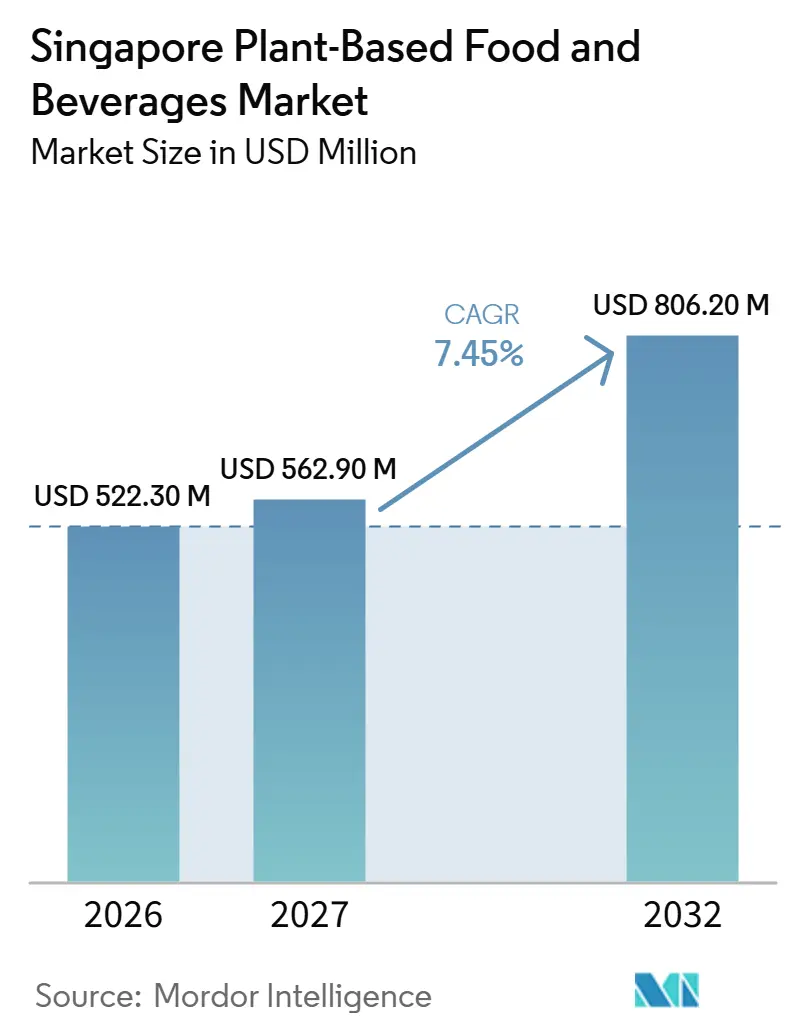
The Singapore plant-based food and beverages market size was valued at USD 522.3 million in 2026 and estimated to grow from USD 562.9 million in 2027 to reach USD 806.2 million by 2032, at a CAGR of 7.45% during the forecast period (2027-2032).
In Singapore, grocery access brings selective plant-based substitution into ordinary food shopping, where taste and value determine its appeal. Public research support can widen formulation options by connecting ingredient development with commercial product needs. Suppliers can respond with focused meat replacements and beverage portfolios combining recognizable plant bases with specific nutritional profiles. The commercial test is whether a finished alternative offers a convincing taste-and-value trade-off within the meal or drink it replaces.
Key Report Takeaways
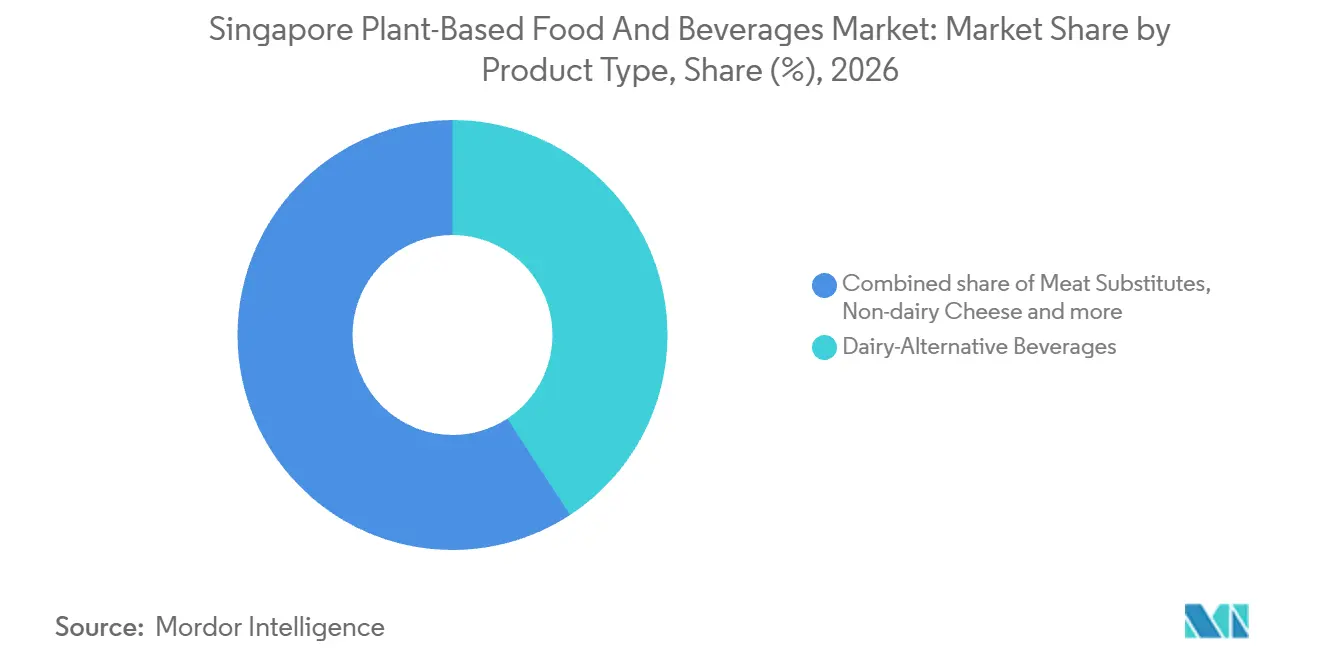
- Dairy-alternative beverages led product types with a 40.78% Singapore plant-based food and beverages market share in 2026, while meat substitutes are forecast to be the fastest-growing segment at a CAGR of 10.5% during 2027-2032.
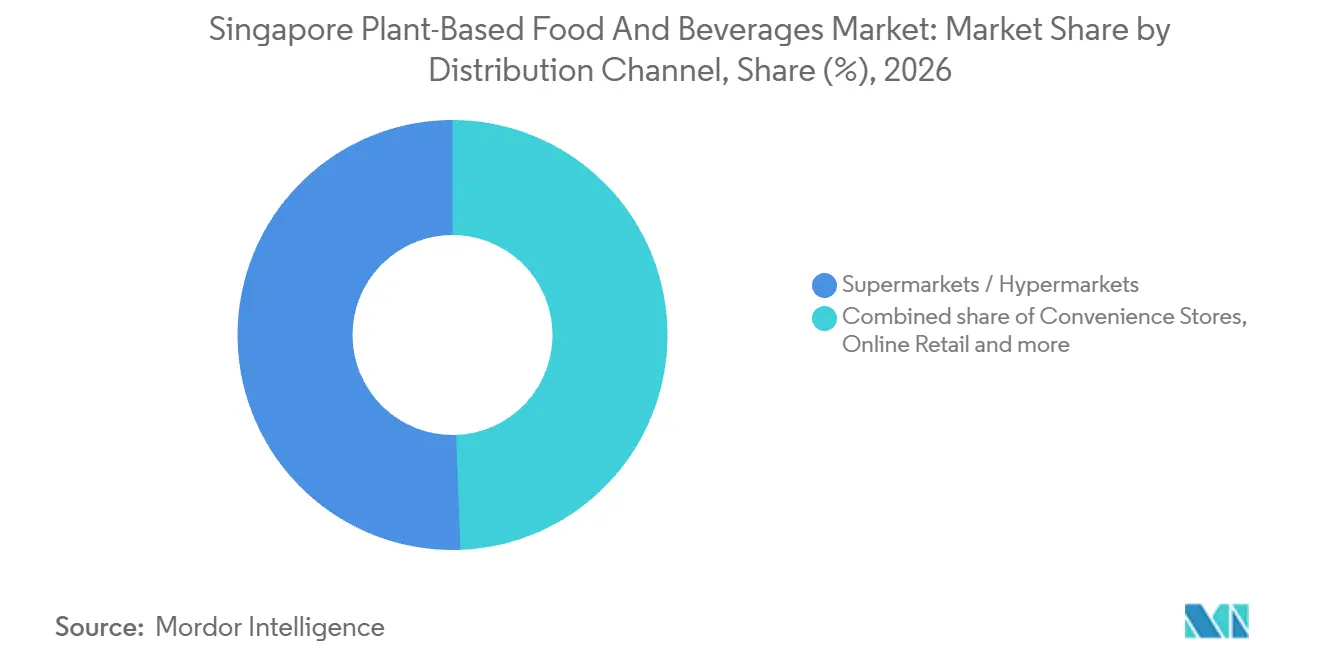
- By distribution channel, supermarkets / hypermarkets held a 50.59% share of the Singapore plant-based food and beverages market size in 2026, and online retail is forecast to be the fastest-growing segment at a CAGR of 13.6% during 2027-2032.
Note: Market numbers in this report are based on Mordor Intelligence's proprietary estimation framework, which combines nine months of actuals with Q4 projections for base year 2026.
Singapore Plant-Based Food And Beverages Market Trends and Insights
Drivers Impact Analysis*
| Driver | (~) % Impact on CAGR Forecast | Geographic Relevance | Impact Timeline |
|---|---|---|---|
| Rising flexitarian and health-conscious consumer base | +3.2% | Nationwide | Short term (≤ 2 years) |
| Government food-security push for alt-proteins | +2.7% | Nationwide | Medium term (2-4 years) |
| Supermarket and quick-commerce shelf expansion | +2.4% | Nationwide | Short term (≤ 2 years) |
| Precision-fermentation research and development incentives attracting alt-dairy start-ups | +1.6% | Nationwide | Long term (≥ 4 years) |
| Zero-waste valorization of okara and spent grains into new SKUs | +0.8% | Nationwide | Medium term (2-4 years) |
| Canada–Singapore Asia-Pacific Market Entry Program preparing import pipeline | +0.5% | Nationwide | Medium term (2-4 years) |
| Source: Mordor Intelligence | |||
Rising flexitarian and health-conscious consumer base
For a buyer seeking to replace only some animal-based foods, the useful offer is a product that serves a familiar meal or drinking occasion. A peer-reviewed Singapore survey found plant-based protein the most accepted of 4 alternative protein types, alongside mycoprotein, cultured meat, and insect-based protein. Familiarity, positive taste expectations, and perceived healthfulness were associated with acceptance. A plant-based beverage or meat substitute can address those factors within an existing meal while leaving the rest of the diet open to individual choice. Health positioning alone leaves the taste-expectation question unresolved, making recognizable use and formulation complementary routes to acceptance.
Government food-security push for alt-proteins
Government research support can make plant-based product development more commercially feasible by supporting capabilities that individual suppliers would otherwise need to develop or acquire. In a February 2026 written reply, the Ministry of Sustainability and the Environment reported that the Singapore Food Agency had awarded 21 multiyear R&D projects since 2024.[1] The projects build alternative-protein process development, nutrition, and functionality capabilities at higher-learning and research institutions. For plant-based developers within this broader field, processing advances can help translate an ingredient concept into a reproducible food product. Nutrition and functionality research can also help develop formulations differentiated by specific uses. Because the awards go to higher-learning and research institutions rather than to food suppliers, the benefit reaches finished products only after suppliers adopt the resulting methods.
Supermarket and quick-commerce shelf expansion
Retail access can turn interest in plant-based eating into purchases made alongside conventional groceries. In 2025, FairPrice, RedMart and Cold Storage stocked various plant-based food and beverage options in Singapore. That combination provided suppliers with routes into supermarket shopping and online grocery orders. It can reduce the extra search required when consumers replace only part of their usual diet. For brands, the commercial opportunity is to make a replacement available at the same decision point as the food it substitutes. Because FairPrice and Cold Storage serve shoppers in stores and RedMart serves them online, a brand’s listing has to hold in both an aisle and an online order to reach the same household.
Precision-fermentation research and development incentives attracting alt-dairy start-ups
Precision-fermentation incentives fund ingredient research that alternative-dairy developers could draw on for new formulations. In November 2025, the Singapore Food Agency awarded additional funding to the Centre for Precision Fermentation and Sustainability to translate research on high-value ingredients, including lipids and functional proteins, into market-ready solutions. It also awarded a Future Foods grant to A*STAR, Singapore Polytechnic and the National University of Singapore for precision-fermentation research on omega-3-enriched phospholipids for alternative proteins. For an alternative-dairy developer, that broader ingredient work can create options for specifying nutritional or functional properties in a future formulation. The awards fund a pipeline of ingredient research, and market demand depends on those ingredients reaching finished dairy alternatives that shoppers choose.
Restraints Impact Analysis*
| Restraint | (~) % Impact on CAGR Forecast | Geographic Relevance | Impact Timeline |
|---|---|---|---|
| Premium pricing versus animal products | -1.7% | Nationwide | Short term (≤ 2 years) |
| Taste/texture fidelity gaps | -1.1% | Nationwide | Short term (≤ 2 years) |
| Saturation risk in small domestic consumer base | -0.6% | Nationwide | Medium term (2-4 years) |
| Labeling and regulatory fragmentation for novel vs plant-based foods | -0.4% | Nationwide | Short term (≤ 2 years) |
| Source: Mordor Intelligence | |||
Premium pricing versus animal products
Premium prices constrain the frequency with which Singapore consumers can substitute plant-based foods for animal products. In Rakuten Insight’s 2025 survey, 51% of Singapore respondents cited cost as a reason for not consuming plant-based alternatives.[2] That share was up 6 percentage points from 45% in 2024. A February 2026 supermarket check found that a 383-gram packet of Impossible chicken nuggets cost about SGD 11 (USD 8.64), roughly the same as a 1-kilogram bag of chicken nuggets. Households that replace chicken nuggets regularly rather than try them once bear that price gap at every purchase, so cost presses on repeat buying more than on first trial.
Taste/texture fidelity gaps
Taste fidelity can limit how successfully a supplier of plant-based alternatives converts interest into regular consumption. In Rakuten Insight’s 2025 Singapore survey, 30% of respondents answering why they did not eat plant-based alternatives cited that the alternatives did not taste as good as the original. The issue is consequential for a product sold as a replacement, because its reference point is built into the proposition. Suppliers must earn repeat consumption through the eating experience itself, even when a product meets a dietary preference. An unsatisfactory comparison can leave a plant-based brand with the expense of generating trial without the recurring meal choices needed to sustain demand.
*Our forecasts treat driver/restraint impacts as directional, not additive. The impact forecasts reflect baseline growth, mix effects, and variable interactions.
Segment Analysis
By Product Type: Beverage Scale and Meat-Substitute Growth
Dairy-alternative beverages accounted for a 40.78% share of the Singapore plant-based food and beverages market size in 2026. As the largest segment, they encompass established soya-milk brands as well as other plant bases. Fraser and Neave identified F&N NutriSoy as the No. 1 soya milk brand in Singapore in its 2025 annual report. That company-attributed position shows an established branded offering within soya milk, one part of the broader beverage segment. A supplier entering soya milk therefore needs a product distinction that gives buyers a reason to choose its drink over NutriSoy within the same plant base.
Meat substitutes are forecast to be the fastest-growing segment, at a CAGR of 10.5% during 2027-2032. In July 2025, Mottainai Food Tech produced Jiro Meat, its okara-based plant-based minced meat, to order for small food providers under a Singapore Food Agency license. Supply to small food providers gives the segment a food-service demand route alongside retail. Non-dairy ice-cream faces a different formulation constraint, with Oishi’s co-owner reporting in June 2026 that its vegan options often require coconut or cashew bases, raising production costs and prices. Made-to-order meat-substitute supply lets a producer match output to food providers’ orders, linking expansion to kitchen demand rather than speculative production.

By Distribution Channel: Supermarket Reach and Online Replenishment
Supermarkets / hypermarkets represented a 50.59% Singapore plant-based food and beverages market share in 2026. In May 2025, Oatbedient reported that its oat-milk powders and ready-to-drink beverages were available through e-commerce and supermarkets including NTUC FairPrice and Cold Storage. FairPrice Group told CNA in February 2026 that it offered around 80 plant-based meat products and had seen demand decline over the preceding 2 to 3 years. Distribution across multiple chains illustrates the largest segment’s grocery access, while FairPrice’s observation qualifies the outlook for its own meat assortment. A meat-alternative supplier gains access to an established grocery channel but must earn shelf space against alternatives already offered.
Online retail is forecast to be the fastest-growing segment, at a CAGR of 13.6% during 2027-2032. In June 2026, Foodpanda reported that grocery-order frequency on its Singapore platform had risen 7% since 2023. That grocery measure signals more occasions for digital food shopping, a relevant channel mechanism for suppliers seeking household use. Plant-based brands can compete for a place within those orders through an identifiable meal or drink application. The opportunity is replenishment through an existing grocery service, with product selection determining whether wider platform activity becomes brand demand.
Geography Analysis
The Urban Redevelopment Authority describes Downtown Core as Singapore’s economic and cultural center. Prime office space is supported by complementary uses and a live-in population. The combination gives the urban core district both employment and residential functions within a mixed-use setting. Its office-led character distinguishes this setting from the residential-township context of neighborhood centers.
Singapore’s neighborhood centers anchor local retail within residential townships and support decentralization from the city center. The Centre for Liveable Cities describes their role in making neighborhoods more self-contained. In suburban Bukit Batok Central, Sunnychoice operates a vegetarian- and vegan-friendly cafe and healthy-option store with a plant-based food mission. That combination places a cafe and a healthy-option store at one suburban address, giving the plant-based mission a local outlet away from the central business district.
Bukit Timah’s former Turf City site adds a planned housing estate to this geographic comparison. The Urban Redevelopment Authority’s Master Plan describes the former racecourse site as planned for transformation into a new housing estate. Elsewhere in Bukit Timah, The Living Cafe serves plant-based dishes, including burgers, pizzas, desserts, juices, and smoothies, at its Bukit Timah Road cafe. The cafe’s Bukit Timah Road address, next to 6th Avenue MRT station, places it in Bukit Timah’s Sixth Avenue suburb. An operating cafe offers an immediate food-service route in Bukit Timah, whereas Turf City’s planned housing concerns a future residential footprint.
Regulatory Framework and Outlook
The comparison of selected jurisdictions covers Singapore’s national regime and its application in Bukit Timah and Downtown Core. The participant perspective is a supplier of prepacked plant-based foods and beverages selling through Singapore-based businesses. Novel-food classification creates a separate entry requirement for qualifying products, while the Food Regulations govern labeling of prepacked foods. The Food (Amendment) Regulations 2025 changed those labeling requirements from January 30, 2026, incorporating provisions from 3 Codex food-labeling standards.
Regulatory Table
| Decision factor | Singapore | Bukit Timah | Downtown Core |
|---|---|---|---|
| Primary authority | Singapore Food Agency | Singapore Food Agency under the national regime | Singapore Food Agency under the national regime |
| Key instruments or direction | Novel-food approval where applicable; Food Regulations | National novel-food and prepacked-labeling framework | National novel-food and prepacked-labeling framework |
| Commercial effect | Approval before novel-food supply; compliant prepacked labels | Same national product-classification and labeling duties | Same national product-classification and labeling duties |
| Current policy attractiveness | Medium | Medium | Medium |
| Future direction of policy attractiveness | No change | No change | No change |
| Source: Mordor Intelligence | |||
Singapore’s assessment balances an established approval route with the work required to address novel-food classification and prepacked-label compliance. For Singapore-based businesses serving Bukit Timah or Downtown Core, the compliance workload depends on novel-food classification and prepacked selling format, with the same national framework applying in both locations. The January 2026 labeling transition is already operative, and those standing duties anchor the continuity judgment.
Value Chain Stages
Value capture differs between manufacturing plant-based products and selling them through groceries or prepared meals. Growthwell Foods operates a Singapore plant-based production line that the company describes as the country’s first fully automated large-scale line. Manufacturing value therefore rests partly with operators able to execute production at scale, linking their earnings to the processing capability behind a formulation. Grocery and food-service routes create separate commercial tests, because a reproducible product must also justify its place in a household purchase or a restaurant dish.
Value Chain Analysis Table
| Primary activity | Key participants | Value capture | Bottleneck | Resilience response |
|---|---|---|---|---|
| Product manufacturing | Plant-based food manufacturers such as Growthwell Foods | Finished-product sales | Reproducible product batches | Standardize process controls |
| Grocery retail | Grocery retailers such as FairPrice Group | Packaged-product retail sales | Repeat demand for stocked products | Review assortment against sell-through |
| Meal preparation and service | Plant-based eateries such as Veganburg | Prepared-meal sales | Ingredient costs can displace a branded patty | Retain alternative patty formulations |
| Source: Mordor Intelligence | ||||
By February 2026, Veganburg had stopped offering Impossible plant-based meat because of cost considerations. It had also expanded its whole-food options by then. An eatery’s cost decision can therefore remove a branded patty supplier’s sale while retaining plant-based meals, making the chosen recipe the manufacturer’s commercial foothold.
Competitive Landscape
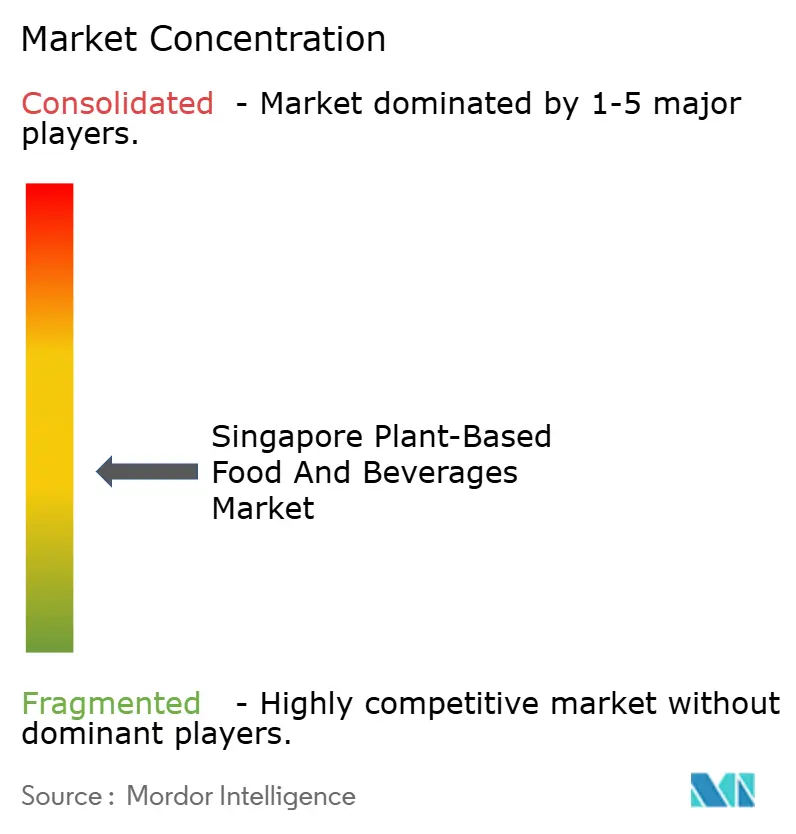
The competitive field is moderately fragmented across meat-alternative specialists and plant-based beverage portfolios. Impossible Foods supplies Impossible Beef, and Beyond Meat supplies Beyond Burger patties through FairPrice’s in-store purchase route. Vitasoy International’s Singapore business includes tofu, while Danone SA’s Alpro brand offers almond and oat beverages in Singapore, giving its beverage range more than one plant base. OATSIDE is a Singaporean oat milk brand, adding a supplier with a local brand origin to this beverage field. For buyers, this creates a choice between specialists built around a meat-replacement format and beverage suppliers offering several plant bases within a comparable drinking use.
Beyond Meat launched Beyond Steak Pieces in 650 Tesco stores across the UK in May 2025, illustrating distribution through a supermarket network in that country. Vitasoy’s Singapore revenue rose 9% in FY2025/26, mainly on stronger tofu sales, and its Singapore business reported restored profitability. Vitasoy attributed that turnaround to volume expansion, product and cost optimization, lower raw material costs and transportation savings. Challengers in tofu therefore face a Singapore incumbent whose profitability has been restored through volume growth and lower raw material and transportation costs, making cost competitiveness part of their challenge in winning business.
OATSIDE’s expansion offers a competitive route combining additional plant bases with product-specific nutrition positioning. On March 9, 2026, it launched Nobo Soy and Nobo Almond Soy drinks in Singapore. Nobo Soy earned a B Nutri-Grade at launch, with 4.2 grams of protein and 4.8 grams of sugar per 100 milliliters.[3] That profile gives retailers a concrete formulation attribute to communicate alongside the soy base, while the almond-soy version extends the ingredient choice. Beverage suppliers can compete through the combination of plant base and nutrition-label positioning, while each formulation must justify its own taste and value proposition.
Singapore Plant-Based Food And Beverages Industry Leaders
-
Impossible Foods
-
Beyond Meat
-
Vitasoy International
-
Danone SA
-
OATSIDE
- *Disclaimer: Major Players sorted in no particular order
Key Opportunities for Market Participants
The opportunities compare institutional meal components with gluten-free plant-based replacements for household and prepared-food use. Singapore’s participating school canteen vendors follow guidelines calling for protein in every main meal and saying products used should carry the Healthier Choice Symbol (HCS) or meet its guidelines. From January 30, 2026, gluten-free or reduced-gluten foods intended to replace a source of a key nutrient must contain approximately the same amount of that nutrient as the replaced food. These conditions set the entry bar for suppliers able to meet a defined nutritional specification in a useful replacement format.
Market Opportunities Table
| Opportunity | Why now | Buyer / lead segment | Recommended play | Main barrier | Likely beneficiaries |
|---|---|---|---|---|---|
| School-meal protein components | Main-meal protein and product-health criteria | Participating school canteen vendors | Develop plant-based components meeting HCS or its guidelines | Demonstrating fit with applicable nutrition criteria | Qualifying plant-based meal-component developers |
| Gluten-free dairy-replacement beverages | Operative nutrient-replacement requirement | Households seeking qualifying dairy replacements | Match replaced key nutrients in a qualifying gluten-free beverage | Gluten-claim eligibility and approximate nutrient equivalence | Beverage developers and brands such as Alpro |
| Nutrient-matched gluten-free meal components | Operative requirement for qualifying food replacements | Food-service operators serving gluten-free meals | Develop plant-based components with a defined key-nutrient replacement role | Maintaining approximate nutrient equivalence | Specialist plant-based food formulators |
| Source: Mordor Intelligence | |||||
A replacement product needs a documented nutritional fit before these channels become a viable opportunity. Participating school canteen vendors work to a guideline calling for protein in every main meal, making a component’s protein contribution a concrete basis for assessing its usefulness. For gluten-free or reduced-gluten foods replacing key nutrient sources, approximate nutrient parity with the replaced food is the test. Developers who document composition against the applicable criterion have a clearer entry route than those relying on plant-based positioning alone.
Recent Industry Developments
- Jun 2026: Vitasoy reported on June 25 that its Singapore revenue rose 9% in FY2025/26, mainly on stronger tofu sales, and profitability was restored in its Singapore business.
- Mar 2026: Singaporean brand OATSIDE launched Nobo Soy and Nobo Almond Soy on March 9, expanding its plant-based milk range into soy and almond-soy drinks.
Research Methodology Framework and Report Scope
Market Definition and Coverage
The Singapore plant-based food and beverages market measures annual consumer spending on plant-based foods and beverages positioned as alternatives and sold in Singapore. Values are counted at the point of sale through retail, food-service and other distribution channels.
Scope exclusions: Conventional animal-based foods and beverages, general vegan pantry staples that are not positioned as alternatives, and ingredient-only commodities sold mainly for manufacturing use are excluded.
Segmentation Overview
- By Product Type
- Meat Substitutes
- Textured Vegetable Protein (TVP)
- Tofu
- Tempeh
- Seitan
- Plant-based Seafood
- Plant-based Eggs
- Other Meat Substitutes
- Dairy-Alternative Beverages
- Soy Milk
- Almond Milk
- Oat Milk
- Other Plant Milks
- Non-dairy Cheese
- Non-dairy Yogurt
- Non-dairy Ice-cream
- Non-dairy Spreads
- Other Plant-based Products
- Meat Substitutes
- By Distribution Channel
- Supermarkets / Hypermarkets
- Convenience Stores
- Online Retail
- Food-service (HoReCa)
- Other Channels
Data Sources, Market Sizing, and Validation
Desk Research
Public research such as the Singapore Food Agency's novel-food guidance and the Ministry of Sustainability and the Environment's parliamentary reply helps define regulatory conditions and public research support relevant to food alternatives in Singapore. The USDA Foreign Agricultural Service's Singapore retail foods report describes retail and food-service channel structure, while the U.S. Soybean Export Council's Asia Soy Foods report and the Good Food Institute's state-of-industry analysis provide product, ingredient, availability and innovation context for plant-based categories.
Company annual reports, regulatory filings, investor materials and reputable business and food-industry reporting can supplement those sources with product launches, distribution, pricing and business developments that help interpret category signals. These named sources are illustrative and not exhaustive, and further sources inform collection, validation and clarification.
Primary Interviews and Surveys
A structured interview and survey approach would include Singapore-based food and beverage manufacturers, importers, retailers, online sellers and food-service operators, with commercial, category, procurement and finance leaders able to discuss local sales and prices. Respondents would be asked to check secondary findings on product positioning, channel coverage, price and availability, while differences between reported sales and public evidence would be investigated through follow-up questions and triangulation across independent sources.
Distribution of primary research fieldwork respondents
| Company type | Respondent position | Region |
|---|---|---|
| Top tier: 30% | CXOs: 20% | |
| Mid tier: 45% | Functional/Unit leaders: 35% | |
| Smaller Players: 25% | Managers: 45% |
Market-Sizing & Forecasting
A top-down estimate would start with Singapore consumer expenditure on plant-based alternatives and allocate it across product groups and sales channels, using observed Singapore retail availability, public food-service and retail indicators, import and product data, category pricing, and reported company activity as illustrative checks. Product shares would reflect the relative presence and sales evidence for meat substitutes, dairy-alternative beverages, non-dairy cheese, yogurt, ice cream, spreads and other alternatives. Channel shares would use evidence on supermarkets, convenience, online, food-service and other routes, with each set reconciled to the full market.
Forecasts would use a multivariate regression where a consistent time series supports it, with scenario analysis for categories or channels where launches, pricing, adoption or food-service listings create less stable patterns. Relevant drivers include household food spending, category price and mix, retail assortment and online access, food-service menu adoption, and the availability of locally sold alternatives. Selective bottom-up checks would compare sampled selling prices and volumes or supplier and retailer roll-ups with the top-down totals, while gaps in coverage would be bounded using the closest public channel or product evidence and checked with Singapore market specialists. Experts would assess whether the assumed variables and forecast directions fit local trading conditions.
Data Validation & Update Cycle
Analysts would triangulate category and channel estimates against independent signals such as retail assortment, food-service listings, import and company disclosures, and public spending or price indicators. They would investigate outliers and variance from prior periods, trace discrepancies to product scope, timing, price or channel treatment, and document how each adjustment changes the estimate before a multi-step analyst review and sign-off. Re-contact would be triggered when a material assumption changes or respondent and desk evidence remain inconsistent. The model would be refreshed annually, updated between annual cycles when a material market, regulatory or pricing event changes the outlook, and checked again in a fresh pre-delivery review.
Mordor Intelligence's Singapore Plant Based Food and Beverages Market Size Measured Against Other Published Estimates
Published estimates can differ in the transactions and products they count and the inputs used to model demand. The Singapore plant-based food and beverages market measures annual consumer spending on plant-based foods and beverages positioned as alternatives and sold in Singapore.
Key Gap Drivers include the study's defined coverage and market-specific modeling choices. A top-down estimate would start with Singapore consumer expenditure on plant-based alternatives and allocate it across product groups and sales channels, using observed Singapore retail availability, public food-service and retail indicators, import and product data, category pricing, and reported company activity as illustrative checks.
Benchmark comparison
| Source | Market Size | Gaps in Research Methodology |
|---|---|---|
| Mordor Intelligence | USD 562.9 M (2027) | |
| Regional Consultancy A | USD 130 M (2024) | At its 2024 base, this estimate is 76.9% below this report's 2027 value of USD 562.9 M, 3 years later. Its published value uses a 2024 base, which predates the comparison year and the subsequent forecast period. |
| Industry Association A | USD 20.72 M (2028) | At its 2028 base, this estimate is 96.3% below this report's 2027 value of USD 562.9 M, 1 year earlier. The estimate covers Singapore meat substitutes alone, a narrower product category than the full food and beverage market. |
Mordor Intelligence's analysts would triangulate category and channel estimates against independent signals such as retail assortment, food-service listings, import and company disclosures, and public spending or price indicators.
Key Questions Answered in the Report
What is the Singapore plant-based food and beverages market size and growth outlook?
The market was valued at USD 522.3 million in 2026 and is forecast to grow from USD 562.9 million in 2027 to USD 806.2 million by 2032, at a CAGR of 7.45% during 2027-2032.
What supports demand for plant-based alternatives in Singapore?
Government-backed R&D and grocery access support product development and availability. In February 2026, the Ministry of Sustainability and the Environment reported that the Singapore Food Agency had awarded 21 multiyear alternative-protein R&D projects since 2024.
Which plant-based product type holds the largest share?
Dairy-alternative beverages held 40.78% of the market in 2026. Meat substitutes are forecast to grow at a CAGR of 10.5% during 2027-2032.
Which companies compete in Singapore’s plant-based food and beverage sector?
Major players include Impossible Foods, Beyond Meat, Vitasoy International, Danone SA, and OATSIDE.
What is a key challenge for plant-based alternative foods and beverages in Singapore?
Premium pricing is a key hurdle. In Rakuten Insight’s 2025 survey, 51% of Singapore respondents cited cost as a reason for not consuming plant-based alternatives.
What geographic planning context frames Singapore’s plant-based food and beverage sector?
Singapore’s Downtown Core combines offices and residents, while neighborhood centers support retail in residential townships.