
Malaysia E-commerce Market Analysis by Mordor Intelligence
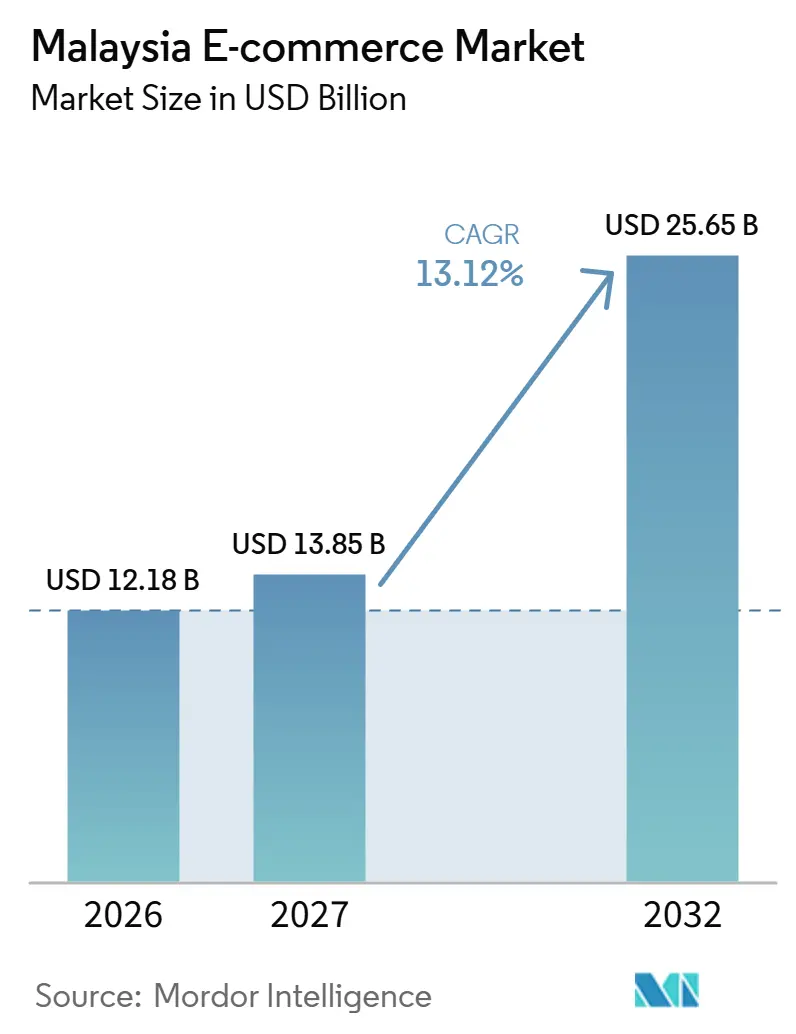
The Malaysia e-commerce market size is projected to expand from USD 12.18 billion in 2026 and USD 13.85 billion in 2027 to USD 25.65 billion by 2032, registering a CAGR of 13.12% between 2027 and 2032.
Broad digital access and payment acceptance in Malaysia give mobile storefronts a foundation for reaching prospective buyers. Turning that reach into purchases depends on connecting checkout, product information, and fulfillment as a coherent selling service. Seller support and cross-border assortment initiatives extend platform competition into the merchant's operating relationship. Fraud exposure and East Malaysia's shipping disadvantage make transaction credibility and delivered pricing central to realizing that potential. Shared payment rails and courier networks let smaller sellers widen distribution without building their own collection or sorting systems.
Key Report Takeaways
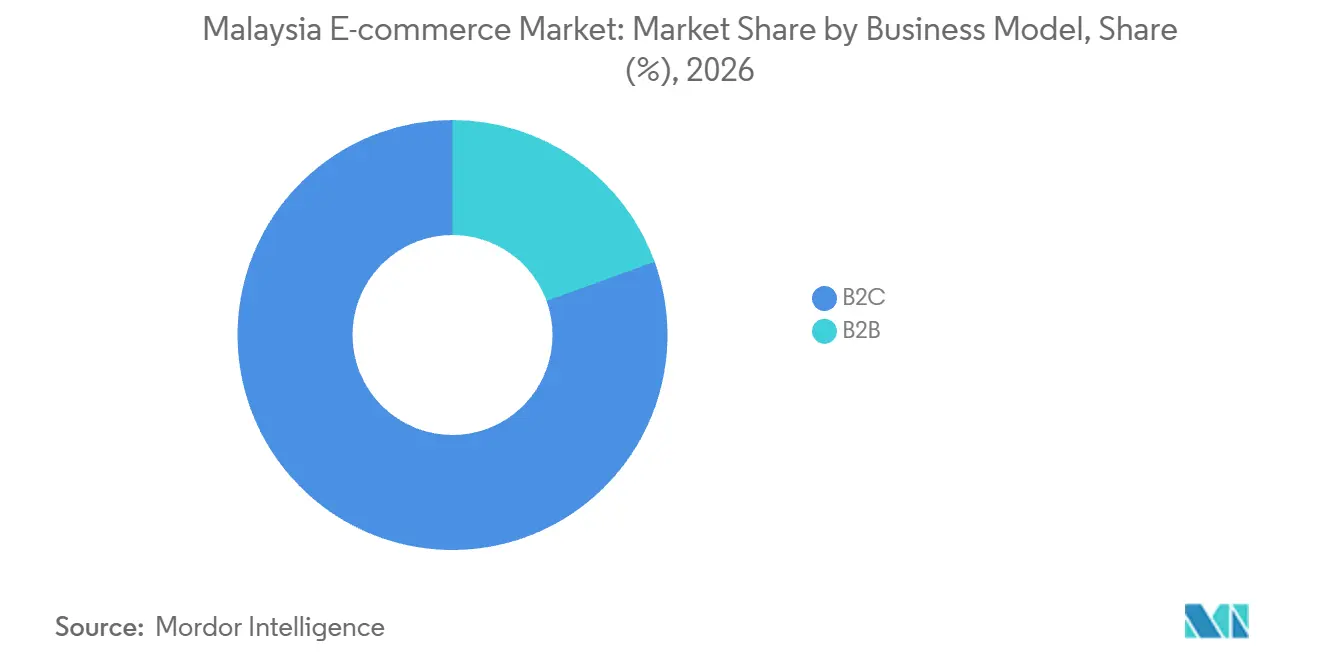
- By business model, B2C accounted for an 80.53% share of the Malaysia e-commerce market size in 2026, while B2B is forecast to be the fastest-growing segment at a CAGR of 15.18% between 2027 and 2032.
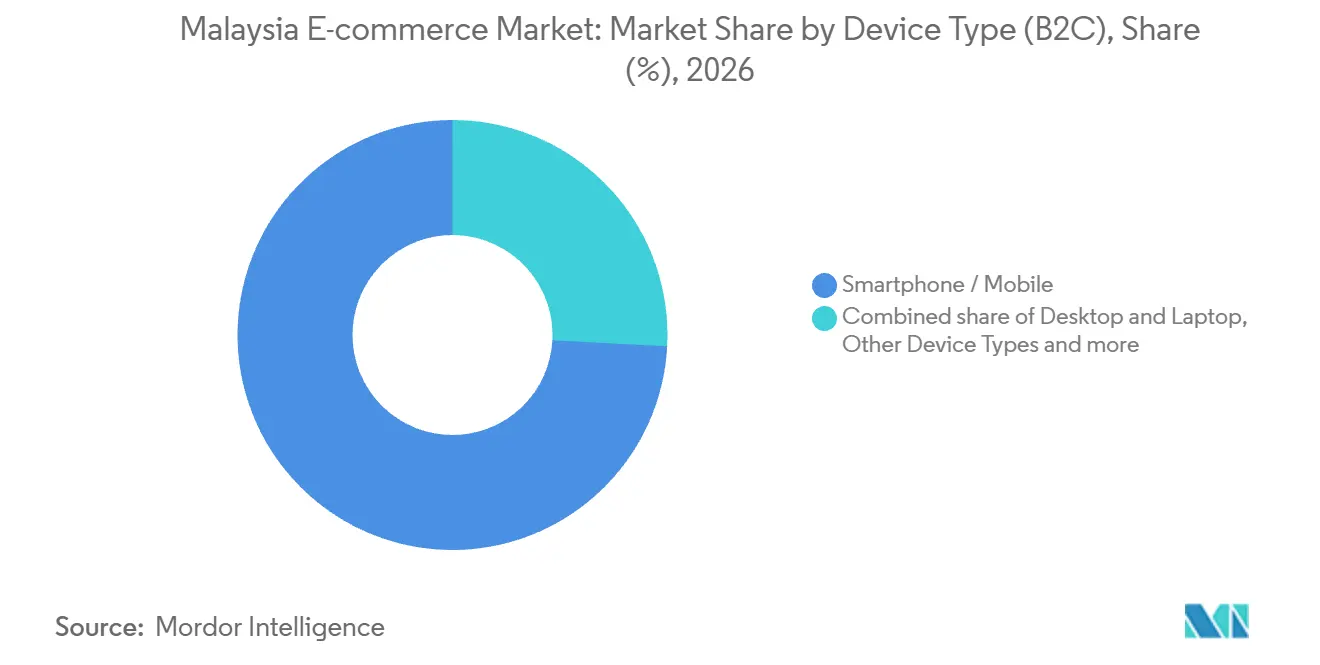
- Smartphone and mobile commerce led the device breakdown with a 74.16% Malaysia e-commerce market share in 2026 and is forecast to be the fastest-growing segment at a CAGR of 15.38% between 2027 and 2032.
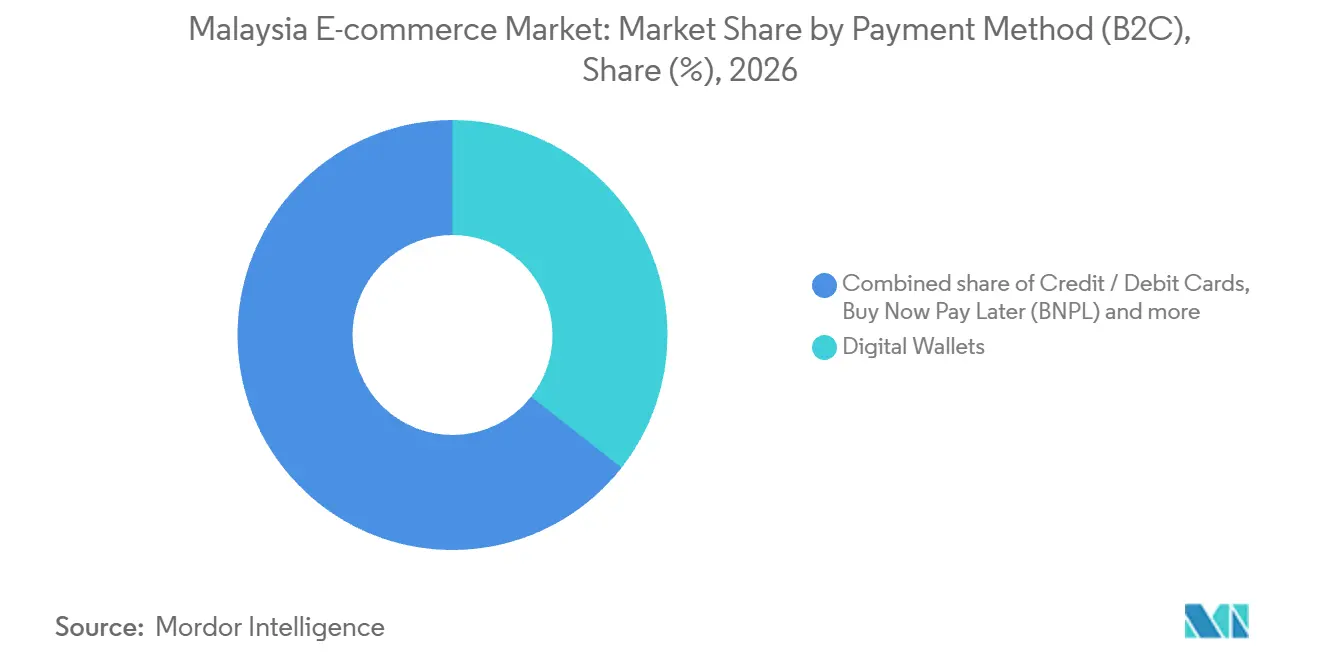
- Digital wallets led payment methods with a 35.59% share in 2026, while the buy now pay later segment is forecast to grow fastest at a CAGR of 16.68% between 2027 and 2032.
- Fashion and apparel held the largest product-category share at 26.46% in 2026, whereas the food and beverages segment is forecast to be the fastest-growing at a CAGR of 15.96% between 2027 and 2032.
- Geographically, Peninsular Malaysia held a 74.8% share of e-commerce transactions in 2026.
Note: Market numbers in this report are based on Mordor Intelligence's proprietary estimation framework, which combines nine months of actuals with Q4 projections for base year 2026.
Malaysia E-commerce Market Trends and Insights
Drivers Impact Analysis*
| Driver | (~) % Impact on CAGR Forecast | Geographic Relevance | Impact Timeline |
|---|---|---|---|
| Government Digitalization Agendas (NESR 2.0, MyDIGITAL) | +3% | Nationwide | Long term (≥ 4 years) |
| Smartphone Ownership and 5G Coverage Boosting M-Commerce | +4.2% | Nationwide | Medium term (2-4 years) |
| Rapid E-Wallet Adoption and Interoperable DuitNow QR | +3.7% | Nationwide | Short term (≤ 2 years) |
| Dense Third-Party Logistics and On-Demand Delivery Build-Out | +3.3% | Nationwide | Medium term (2-4 years) |
| Live-Stream and Social-Commerce (TikTok Shop) Sales Surge | +2.4% | Nationwide | Short term (≤ 2 years) |
| Halal-Certified Online Shelves Unlocking Rural and Export Demand | +0.9% | Nationwide | Long term (≥ 4 years) |
| Source: Mordor Intelligence | |||
Government Digitalization Agendas (NESR 2.0, MyDIGITAL)
Government support can extend online sellers' reach by organizing digital export access beyond their domestic customer base. The Malaysia External Trade Development Corporation (MATRADE) reported that eBizLink benefited 1,855 Malaysian companies through 37 digital export-promotion activities in international markets from 2023 to 2025. Malaysia launched the Malaysia Digital 2030 Action Plan in June 2026 as a continuation of its 2021-2025 Malaysia Digital Economy Blueprint. For export-oriented small and medium-sized enterprises (SMEs), publicly organized digital promotion offers a way to test overseas demand before funding a separate foreign sales operation.
Smartphone Ownership and 5G Coverage Boosting M-Commerce
Smartphone access and expanding 5G coverage strengthen the distribution base available to merchants selling through mobile channels. In 2025, 98.2% of Malaysian households had access to a smartphone, compared with 97.9% in 2024.[1] On October 6, 2026, U Mobile Sdn Bhd announced that its ULTRA5G network had achieved 90% coverage of populated areas nationwide. The operator reported reaching that milestone more than 9 months ahead of its July 2027 commitment. Household access supplies the device base, while U Mobile's rollout extends the footprint in which its 5G service is available.
Rapid E-Wallet Adoption and Interoperable DuitNow QR
Broad wallet use and QR acceptance give small businesses an established base for digital collection across the Malaysian economy. In 2025, Malaysia recorded 6.4 billion e-money transactions, with e-wallets accounting for 71% of that volume. Separately, DuitNow QR transaction volume doubled from 1.5 billion in 2024 to 3 billion in 2025 across individuals and merchants using banks and non-bank financial institutions.[2] Registered DuitNow QR touchpoints in Malaysia reached almost 3 million at end-2025, with small businesses making up the majority and benefiting from lower acceptance costs. The concentration of touchpoints among small businesses gives this expansion particular relevance to sellers seeking lower-cost digital collection.
Dense Third-Party Logistics and On-Demand Delivery Build-Out
Shared logistics matters to merchants because new parcel-processing capacity lets them ship through courier networks rather than build their own. J&T Express Malaysia commissioned its Setia Alam Logistics Hub in March 2025 and opened it in June 2025.[3] The facility had a maximum designed capacity of 1.2 million parcels in 24-hour operations and connected to all Malaysian states. In November 2025, Shopee reported a 40% year-over-year increase in sellers using its local courier partners across West and East Malaysia. For sellers accepting orders beyond their local delivery area, courier partnerships can connect that order intake to a wider network.
Restraints Impact Analysis*
| Restraint | (~) % Impact on CAGR Forecast | Geographic Relevance | Impact Timeline |
|---|---|---|---|
| Rising Cyber-Fraud and Data-Breach Incidents Eroding Trust | -1.8% | Nationwide | Short term (≤ 2 years) |
| High Last-Mile Cost to East Malaysia and Remote Islands | -1.4% | Sabah and Sarawak | Long term (≥ 4 years) |
| Escalating CAC From Urban Market Saturation | -0.8% | Nationwide | Medium term (2-4 years) |
| Emerging Data-Localization and Cross-Border Compliance Risk | -0.4% | Nationwide | Medium term (2-4 years) |
| Source: Mordor Intelligence | |||
Rising Cyber-Fraud and Data-Breach Incidents Eroding Trust
Fraud exposure adds a credibility hurdle to online transactions for orders paid in advance. Reported cases of online fraud classified as e-commerce crime in Malaysia rose from 7,662 in 2024 to 13,979 in 2025. For a legitimate seller seeking advance payment, that documented risk makes establishing the recipient's identity commercially important. Because reported cases nearly doubled in a single year, sellers without an established record face a higher bar in proving legitimacy before a buyer pays.
High Last-Mile Cost to East Malaysia and Remote Islands
A shipping-cost disadvantage can weaken a merchant's online offer even when its product price matches a competitor's. In its February 2026 market review, the Malaysia Competition Commission (MyCC) reported logistical challenges for East Malaysian merchants. West Malaysian sellers in that comparison benefited from more established networks and lower shipping costs. For an East Malaysian merchant quoting a delivered price, absorbing the higher shipping cost leaves a thinner margin on each order. Passing the additional cost to the buyer instead makes the complete offer harder to match against a lower-cost seller's quotation. This creates a constraint on expanding sales from East Malaysia because either the seller's margin or the delivered-price comparison must bear the logistics differential.
*Our forecasts treat driver/restraint impacts as directional, not additive. The impact forecasts reflect baseline growth, mix effects, and variable interactions.
Segment Analysis
By Business Model: Consumer Discovery and Enterprise Procurement Create Different Routes
B2C accounted for an 80.53% share of the Malaysia e-commerce market size in 2026, making it the largest segment. In July 2025, TikTok Shop reported more than 100 million daily general product searches by local online shoppers in Malaysia. Product-search activity gives retailers opportunities to present individual items within a shared discovery channel. For a focused retailer, the opening is to compete for item-level interest without first replicating the breadth of a general marketplace or building a separate branded shopping destination.
B2B is forecast to be the fastest-growing segment, registering a CAGR of 15.18% between 2027 and 2032. At its 2025 partner summit in Miri, Shell launched 2 dedicated Borong marketplace channels for regional procurement across Sabah and Sarawak. Borong provided the B2B marketplace, while Shell acted as the enterprise buyer using the channels. For platform operators, such a relationship organizes commercial participation around an enterprise's procurement activity and its regional operating needs. One enterprise buyer procuring across Sabah and Sarawak gives a B2B platform a defined counterparty from which to develop regional business.

By Device Type (B2C): Mobile Access Supports Complete Storefronts
Smartphone and mobile commerce was the largest segment with a 74.16% share in 2026 and is forecast to be the fastest-growing segment at a CAGR of 15.38% between 2027 and 2032. In 2025, 99.4% of Malaysian internet users aged 15 and older used a mobile phone for internet access in the 3 months before their interview. Phone use within this internet-using population gives merchants an established audience for mobile selling. Phone use at this level makes mobile a baseline channel for a retailer's storefront, not a specialized add-on.
In May 2026, Ipsos found that 62% of Malaysian online shoppers who had purchased from an e-commerce platform in the previous 6 months reported buying from TikTok Shop, up from 43% in 2024. The platform brings product discovery, evaluation, and purchase into one place. For merchants serving phone-first shoppers, this format offers a way to connect product presentation directly with the opportunity to order. The commercial choice is how much selling activity to conduct within that destination, rather than treating content only as a route to a separate storefront.
By Payment Method (B2C): Wallet Checkout and Deferred Payment Widen Choice
Digital wallets represented a 35.59% Malaysia e-commerce market share in 2026, making them the largest segment. In June 2026, TNG Digital, the operator of TNG eWallet, reported 13.5 million monthly active users in Malaysia. In April 2025, Google announced a Malaysian checkout integration allowing Android users to pay selected participating online merchants with ShopeePay or TNG eWallet without switching apps. For merchants eligible for the integration, wallet acceptance can build on an existing user base while keeping checkout within the shopping flow. The immediate commercial benefit is continuity between choosing goods and authorizing payment, giving wallet acceptance a role in the buying experience itself.
The buy now pay later (BNPL) segment is forecast to be the fastest-growing segment, with a CAGR of 16.68% between 2027 and 2032. Non-bank BNPL users in Malaysia made 140.3 million transactions in the second half of 2025, compared with 102.6 million in the first half. Active accounts at non-bank BNPL providers rose from 6.5 million in June 2025 to 7.5 million at end-December 2025. An active account had at least one transaction in the prior 12 months, and a consumer could hold accounts with multiple providers. Transaction activity outpaced growth in active accounts, pointing to more intensive use of this financing route and an opening for merchants seeking repeat checkout activity alongside account adoption.
By Product Category (B2C): Fashion Partnerships and Grocery Integration Extend Reach
Fashion and apparel was the largest segment, accounting for a 26.46% share of the market in 2026. In May 2026, Ipsos found that 67% of Malaysian e-commerce purchasers reported a fashion purchase in the prior 6 months, making fashion the leading online purchase category. On March 28, 2026, PGMall onboarded Zalora Official Store in Malaysia, adding selected fashion collections such as Zalia and Lubna to its marketplace. PGMall reported serving over 3 million shoppers nationwide across its platform, giving the new store access to a broader shopper base. Such a partnership extends a fashion retailer's distribution through selected collections without requiring it to build another marketplace.
The food and beverages segment is forecast to be the fastest-growing segment, registering a CAGR of 15.96% between 2027 and 2032. In February 2026, Grab reported that Jaya Grocer's online grocery penetration rose from under 1% to over 10% after the supermarket chain's integration into Grab's ecosystem. That integration included GrabRewards loyalty and matching online and in-store pricing. Using the same price framework across channels gives a grocer a way to develop online service without requiring customers to evaluate a separate pricing proposition. Grocery retailers can extend an established customer relationship into online ordering through loyalty and price continuity, leaving room to differentiate the digital channel through service.
Geography Analysis
Peninsular Malaysia E-commerce Market
Peninsular Malaysia accounted for a 74.8% share of transactions in the Malaysia e-commerce market in 2026, making it the largest geography. In 2025, Pos Fulfill operated 8 fulfillment sites across the peninsula, covering 170,000 square feet with an average occupancy rate of 65% throughout the year. SPX Express opened its Bukit Raja Selatan sorting center in Shah Alam on October 22, 2025. Fulfillment providers can develop business-to-business and consumer-facing services through fuller use of operating space and additional sorting infrastructure, making utilization and network development distinct routes to supporting online merchants.
East Malaysia's digital-selling development also depends on the merchandise and channel used to connect local producers to buyers. By September 3, 2026, Ko-Nelayan's e-KAN marketplace had received 11,916 orders and sold 594,188 units of seafood and local food products from Sabah fishing-community entrepreneurs. Sarawak Digital Mall generated more than 250,000 TikTok Shop orders across 10,000 livestream hours in 2025. These operating models put different demands on merchant support, from presenting specialized food assortments to sustaining a livestream selling schedule. Operating a shared selling channel gives these local producers a route to buyers beyond maintaining their own individual online destinations.
In September 2025, Pos Fulfill said its Kota Kinabalu and Kuching hubs could fulfill local SME orders directly from East Malaysia, with Tawau parcels using a daily last-mile linehaul from Kota Kinabalu. On July 10, 2026, Metrohub 4 opened at Bandar Bukit Raja in the Klang Valley as a multi-tenant warehouse spanning approximately 1.38 million square feet. Bandar Bukit Raja's Metrohub 1 and 2 served e-commerce, third-party logistics, and supply-chain tenants. Pos Fulfill contrasted its local capability with earlier Tawau orders routed from the Klang Valley and said the change significantly reduced delivery time and cost. For East Malaysian SMEs in that account, the commercial value came from a different fulfillment origin, distinct from the additional warehouse space offered to Klang Valley tenants.
Regulatory Framework and Outlook
The comparison covers selected jurisdictions from the perspective of a marketplace operator maintaining business premises, with policy direction assessed over the near term. National rules impose duties on online suppliers and platform operators, while Sabah's local bylaws require licenses for scheduled premises uses within local-authority areas. For an operator opening premises in Sabah, national platform duties and local licensing for scheduled premises uses apply side by side.
Regulatory Table
| Decision factor | Malaysia | Sabah |
|---|---|---|
| Primary authority | Ministry of Domestic Trade and Cost of Living (KPDN) | Local authorities, including Kota Kinabalu City Hall within the city |
| Key instruments or direction | Consumer Protection (Electronic Trade Transaction) Regulations 2024; replacement-law policy process | Uniform Licensing By-Laws 2022 for scheduled premises uses |
| Commercial effect | Sellers disclose offers and allow pre-finalization order corrections; operators provide complaint channels and retain supplier records for 3 years | Scheduled premises uses require local licenses; authorities may impose license conditions within their jurisdictions |
| Current policy attractiveness | Medium | Medium |
| Future direction of policy attractiveness | No change | No change |
| Source: Mordor Intelligence | ||
Malaysia's Medium rating and No change direction reflect the operative 2024 marketplace duties, including complaint handling and 3-year supplier-record retention. On September 19, 2026, KPDN said it had approved a policy decision to replace the Electronic Commerce Act 2006, with coordination, stakeholder engagement, and regulatory impact assessment remaining. On October 18, 2026, Deputy Minister Fuziah Salleh said the completed initial E-Commerce Bill draft was being refined for tabling at Parliament's first 2027 meeting, making tabling the next checkpoint rather than enacted duties. Sabah's Medium rating reflects local licensing for scheduled premises uses and possible license conditions, while Kota Kinabalu's Licensing Department receives applications and offers online renewals.
Value Chain Stages
The value chain compares how marketplace access, payment processing, and fulfillment earn revenue from an online order. MyCC's 2025 review described category-specific commission schedules for Shopee, Lazada, and TikTok Shop, distinguishing marketplace and mall services. Billplz's per-transaction payment-gateway charging adds a separate collection cost for Malaysian businesses. These distinct charges mean a seller's commercial channel is also a choice about which activities it pays others to perform.
Value Chain Analysis Table
| Primary activity | Key participants | Value capture | Bottleneck | Resilience response |
|---|---|---|---|---|
| Marketplace access and order placement | Marketplace operators such as Shopee, Lazada, and TikTok Shop | Category-based commissions in 2025 schedules | Platform charges reduce merchant proceeds | Allocate assortment using channel-level net receipts |
| Payment processing | Payment-gateway providers such as Stripe, eGHL, and Billplz | Transaction-processing fees | Per-transaction charges weigh on small baskets | Combine compatible purchases within one checkout |
| Fulfillment and delivery | Logistics providers such as Pos Malaysia, GDEX, and DHL | Shipping fees at agreed rates in MyCC's transaction example | Assigned parcel mix can undermine delivery target achievement | Agree service commitments by route and parcel mix |
| Source: Mordor Intelligence | ||||
MyCC reported that marketplaces set delivery performance targets and allocate parcels, so partners may miss targets depending on their assigned parcel mix. DHL Supply Chain Malaysia reported a new southern Malaysian warehouse and the opening of Penang Logistics Hub 5 in June 2025. Additional warehousing can expand handling capacity without changing who controls the delivery workload. Route-specific service terms would align accountability more closely with the work carriers are assigned, making operational coordination as important as facility expansion.
Competitive Landscape
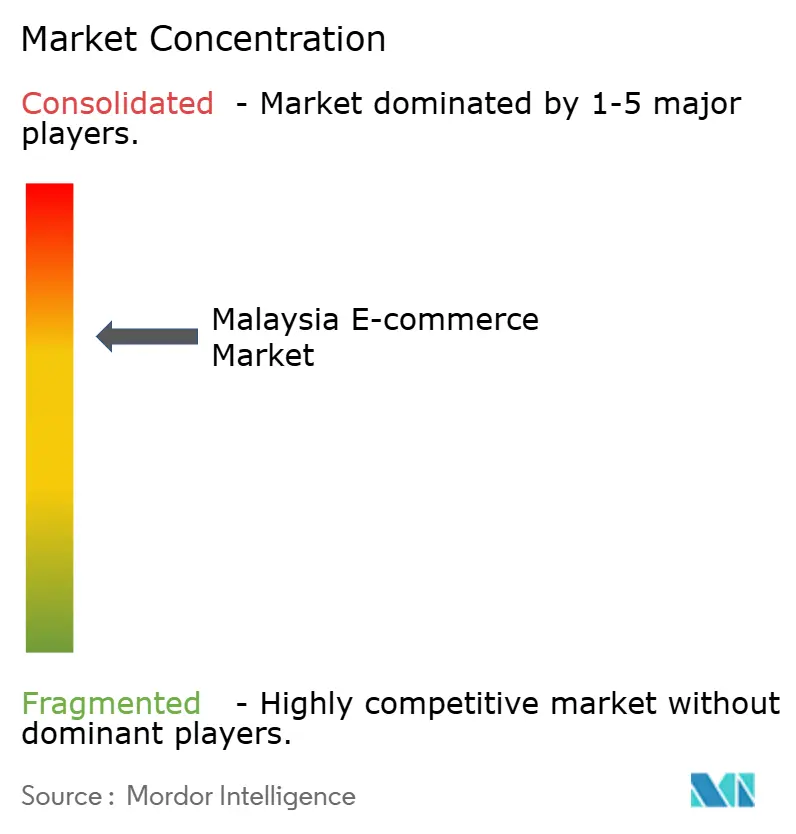
MyCC's February 2026 review described a concentrated Malaysian retail marketplace sector led by Shopee (Sea Ltd.), whose Fulfilled by Shopee service offers warehousing, shipping, and returns through its own infrastructure. Lazada Group (Alibaba) operates a marketplace serving Malaysian consumers and linking them with third-party sellers. Lelong.my connects Malaysian buyers and sellers, while Zalora (Global Fashion Group) acts as both an online platform and retailer for fashion, beauty, and lifestyle products. In MyCC's estimates, TikTok Shop ranked ahead of Lazada by retail marketplace GMV and was gaining share through short-form video and influencer-led sales. Merchants choosing among these channels weigh TikTok Shop's content-led reach against the integrated fulfillment Shopee runs on its own infrastructure.
Shopee launched Shopee Lindung Niaga in Malaysia on April 29, 2026, designed to support micro, small, and medium-sized enterprises through shipping, working-capital, and fulfillment measures. Lazada announced a Gmarket partnership on September 29, 2025, to offer 20 million products from South Korean sellers in Malaysia and 4 other Southeast Asian markets. These actions address different sides of platform participation, with seller operating support in one case and access to additional merchandise in the other. A smaller marketplace offering access alone must contend with an incumbent supporting seller operations and another broadening cross-border merchandise choice.
New platforms need to establish buyer and seller relationships alongside the resources required to run transactions. MyCC's 2026 review identified high capital requirements, complex operations, entrenched user bases, and limited visibility as challenges for new retail marketplace entrants. In February 2026, MyCC proposed 18 recommendations across the broader digital economy, including stronger regulatory frameworks, transparency, and data access to protect consumers and micro, small, and medium-sized enterprises. The 18 recommendations remain proposals, so they have not become new operating rules for entrants. Entry decisions must therefore accommodate the capital, operational, and user-base barriers identified in the review, with no enacted relief from these proposed measures.
Malaysia E-commerce Industry Leaders
-
Shopee (Sea Ltd.)
-
Lazada Group (Alibaba)
-
Lelong.my
-
Zalora (Global Fashion Group)
-
GoShop (Astro GS Shop Sdn Bhd)
- *Disclaimer: Major Players sorted in no particular order
Key Opportunities for Market Participants
The opportunities compare domestic onboarding, overseas digital distribution, and adaptable selling operations for Malaysian merchants. Malaysia's 2027 budget, announced on October 9, 2026, planned JOM MALAYSIA support to bring rural products and high-value services onto digital platforms and overseas markets. The government also plans to table an E-Commerce Bill at Parliament's first meeting in 2027 to strengthen regulation of online transactions. These initiatives create different openings for providers that can connect merchant participation with workable order execution while retaining flexibility as legislation develops.
Market Opportunities Table
| Opportunity | Why now | Buyer / lead segment | Recommended play | Main barrier | Likely beneficiaries |
|---|---|---|---|---|---|
| Rural-product digital storefronts | Planned support for rural-product digitization | Rural producers seeking domestic online buyers | Combine merchant onboarding with consistent product information | Coordinating onboarding and order execution | Rural retailers and storefront operators |
| Overseas digital distribution for rural goods | Overseas reach forms part of the planned support | Rural merchants pursuing overseas buyers | Build a focused export assortment and cross-border order process | Coordinating orders and delivery across borders | Export-ready rural merchants and cross-border platforms |
| Adaptable online-selling operations | Online-transaction bill planned for the first 2027 Parliament meeting | Marketplace operators and online sellers | Use modular seller records and transaction workflows | Legislative sequencing before implementation | Commerce-software providers and marketplace operators |
| Source: Mordor Intelligence | |||||
For the planned rural-product push, the central opening is a repeatable operating model spanning onboarding and order execution. A domestic storefront offers an initial route to buyers, while overseas distribution requires a separate execution plan. Providers able to connect those stages could earn a broader merchant relationship than providers offering only account creation. Adaptable transaction workflows could also help that service accommodate policy changes if they are enacted.
Recent Industry Developments
- Oct 2026: Deputy Domestic Trade and Cost of Living Minister Fuziah Salleh said Malaysia planned to table its draft E-Commerce Bill at Parliament's first meeting in 2027, with the draft being refined.
- Aug 2026: Carousell Malaysia announced a delivery partnership with SPX Express Malaysia, expanding access to more than 1,000 SPX service points across West Malaysia. SPX would offer label-less shipping through Carousell Official Delivery.
- Apr 2026: Shopee launched Shopee Lindung Niaga to support Malaysian micro, small, and medium-sized enterprises through shipping, working-capital, and fulfillment measures.
Research Methodology Framework and Report Scope
Market Definition and Coverage
Malaysia e-commerce market measures annual spending on goods and fee-based services purchased online from sellers registered in Malaysia. It covers consumer and business orders placed through internet-enabled websites or mobile apps, classified by business model, with consumer orders also classified by device used, payment method and product category.
Scope exclusions: Pure peer-to-peer resale activity, online travel bookings and streaming subscriptions are excluded.
Segmentation Overview
- By Business Model
- B2C
- B2B
- By Device Type (B2C)
- Smartphone / Mobile
- Desktop and Laptop
- Other Device Types
- By Payment Method (B2C)
- Credit / Debit Cards
- Digital Wallets
- Buy Now Pay Later (BNPL)
- Other Payment Methods
- By Product Category (B2C)
- Beauty and Personal Care
- Consumer Electronics
- Fashion and Apparel
- Food and Beverages
- Furniture and Home
- Toys, DIY and Media
- Other Product Categories
Data Sources, Market Sizing, and Validation
Desk Research
Desk research draws on sources such as the Department of Statistics Malaysia's ICT and e-commerce releases for establishment income and digital adoption, Bank Negara Malaysia's annual report for payment infrastructure and transaction indicators, MDEC's National E-Commerce Strategic Roadmap for policy targets and reported progress, the Malaysian Competition Commission's digital economy review for marketplace structure, and J&T Express Malaysia's facility release for logistics capacity. These sources help establish market context and identify indicators that can be checked against the defined transaction boundary.
Company filings, annual reports, investor materials, and reputable Malaysian business reporting can supplement public statistics by clarifying channel activity, service changes, and material events. The named sources are not exhaustive, and further sources inform collection, validation and clarification.
Primary Interviews and Surveys
Interviews and structured surveys would include Malaysian marketplace and retailer executives, payment and fulfillment specialists, and business buyers, with functional leaders and managers able to explain channel and transaction details. Respondents would be asked to check secondary-source interpretations of order value, seller location, and segment activity and to clarify the population and transaction counted when definitions or market figures conflict. Unresolved gaps would be documented and triangulated with additional Malaysia-focused sources before an estimate is carried into the model.
Distribution of primary research fieldwork respondents
| Company type | Respondent position | Region |
|---|---|---|
| Top tier: 33% | CXOs: 20% | |
| Mid tier: 42% | Functional/Unit leaders: 35% | |
| Smaller Players: 25% | Managers: 45% |
Market-Sizing & Forecasting
The estimate starts with a top-down measure of annual online order value from Malaysia-registered sellers, then checks selected totals against supplier and channel evidence, including sampled average order value times order volume where data are available. Market drivers include household internet access and smartphone use for the reachable buyer base, e-payment transaction activity for checkout adoption, parcel volumes and fulfillment capacity for order throughput, and household spending and retail activity for demand context. Segment shares are built from the observed mix of business-to-consumer and business-to-business activity, and consumer order evidence by device, payment method, and product category. Each order is counted once at its buyer-paid value. A time-series forecast can extend the market history, with scenario adjustments for changes in digital payments, logistics access, and online-shopping activity, while primary experts check whether each variable's projected direction fits Malaysian operating conditions. Where sampled channel totals or order-value inputs are incomplete, the model uses the best supported market indicators, records the coverage gap, and tests the result against independent totals rather than treating partial supplier data as a full-market count.
Data Validation & Update Cycle
Analysts triangulate official statistics, company disclosures, market indicators, and selected channel checks, then investigate outliers, year-to-year breaks, and material variances between sources. When a discrepancy could change a segment or forecast assumption, the multi-step review checks definitions and units, reconciles anomalies against independent indicators, and returns to relevant respondents. The evidence is refreshed annually, reviewed between cycles when regulation, payments, or fulfillment conditions materially change, and checked again in a fresh pre-delivery review.
Mordor Intelligence's Malaysia Ecommerce Market Size Measured Against Other Published Estimates
Published estimates diverge because they use different transaction boundaries, market measures, and reference years. This report counts buyer-paid online orders from sellers registered in Malaysia, while Global Market Research Publisher A defines e-commerce as B2C physical-goods revenue and Regional Market Research Publisher B publishes a B2C value across travel, food service, media, and other digital categories.
Key Gap Drivers: Global Market Research Publisher A's definition covers B2C physical goods and leaves out B2B orders and digitally distributed services. Its omission of business orders and qualifying non-travel fee-based service purchases that this report counts, together with its earlier measurement year, can contribute to a lower estimate. Regional Market Research Publisher B's published segment list includes travel and hospitality, taxi and ride-hailing, online food service, streaming services, and consumer-to-consumer transactions. Travel and streaming purchases and peer-to-peer resale fall outside this report's boundary and can contribute to its larger total, although the estimate also lists online food service and taxi and ride-hailing, which this report does not exclude. Mordor Intelligence's sizing counts qualifying Malaysia-registered seller orders and uses Malaysian payment and fulfillment indicators to check activity within that boundary.
Benchmark comparison
| Source | Market Size | Gaps in Research Methodology |
|---|---|---|
| Mordor Intelligence | USD 13.85 B (2027) | |
| Global Market Research Publisher A | USD 8.95 B (2025) | At its 2025 base, this estimate is 35.4% below this report's 2027 value of USD 13.85 B, 2 years later. Its stated definition covers B2C physical goods and excludes B2B, travel bookings, digital media, and other digitally distributed services. |
| Regional Market Research Publisher B | USD 25.31 B (2026) | At its 2026 base, this estimate is 82.7% above this report's 2027 value of USD 13.85 B, 1 year later. Its reported coverage includes travel, online food service, streaming, and consumer-to-consumer transactions beyond this report's boundary. |
The estimates describe different online activity pools: the lower external figure omits qualifying business orders and qualifying non-travel fee-based service purchases, while the higher one includes travel, streaming, and peer-to-peer resale that this market definition leaves out.
Key Questions Answered in the Report
What is the Malaysia e-commerce market size and growth outlook?
The market is projected to grow from USD 13.85 billion in 2027 to USD 25.65 billion by 2032, at a CAGR of 13.12% between 2027 and 2032.
What is driving online commerce in Malaysia?
Broad smartphone access, digital payments, and shared logistics support merchant reach. In 2025, 98.2% of Malaysian households had smartphone access.
Which business model leads Malaysian e-commerce?
B2C was the largest segment with an 80.53% share in 2026. B2B is forecast to be the fastest-growing segment at a CAGR of 15.18% between 2027 and 2032.
Which companies compete in Malaysian online commerce?
Participants include Shopee (Sea Ltd.), Lazada Group (Alibaba), Lelong.my, and Zalora (Global Fashion Group). MyCC's February 2026 review identified TikTok Shop as a leading retail marketplace with a content-led sales model.
What could constrain online sellers' growth in Malaysia?
Fraud risk and East Malaysia's merchant shipping-cost disadvantage can constrain online growth. Malaysia recorded 13,979 reported online-fraud cases classified as e-commerce crime in 2025.
Which region leads Malaysian e-commerce transactions?
Peninsular Malaysia held the largest share, accounting for 74.8% of transactions in 2026. Sabah's e-KAN and Sarawak Digital Mall illustrated distinct local online selling channels.