
Bank Kiosk Market Size and Share
Market Overview
| Study Period | 2020 - 2031 |
|---|---|
| Market Size (2026) | USD 24.56 Billion |
| Market Size (2031) | USD 50.54 Billion |
| Growth Rate (2026 - 2031) | 15.53 % |
| Fastest Growing Market | Asia Pacific |
| Largest Market | North America |
| Market Concentration | Medium |
Major Players *Disclaimer: Major Players sorted in no particular order Image © Mordor Intelligence. Reuse requires attribution under CC BY 4.0. | |
Bank Kiosk Market Analysis by Mordor Intelligence
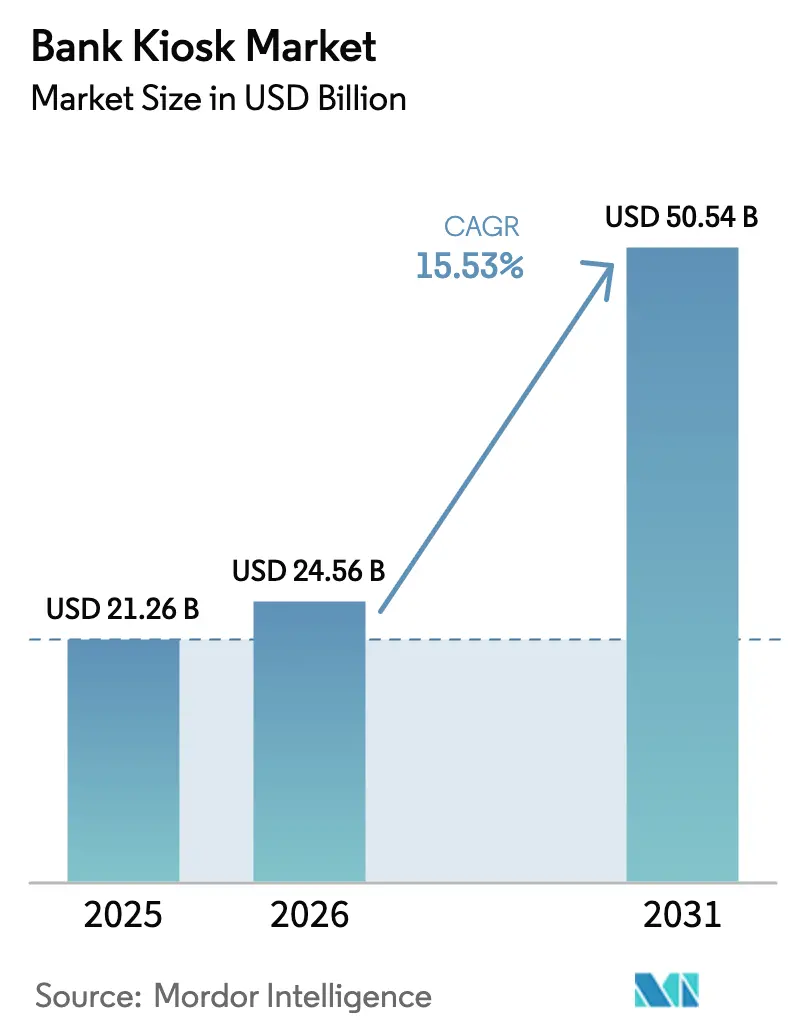
The bank kiosk market size was valued at USD 21.26 billion in 2025 and estimated to grow from USD 24.56 billion in 2026 to reach USD 50.54 billion by 2031, at a CAGR of 15.53% during the forecast period (2026-2031). Branch-transformation programs, accelerating financial inclusion initiatives, and sustained demand for self-service channels anchor this momentum. Deployments now blend AI-enabled predictive maintenance, biometric authentication, and cloud-native software to boost uptime, reduce fraud, and personalize customer journeys. Multi-function platforms able to perform 90% of teller tasks are lowering per-transaction costs, freeing staff for advisory duties, and opening new service points in previously underserved areas. Intensifying competition from fintech firms and hardware commoditization are driving incumbents to pivot toward software and recurring services, reshaping monetization models across the ecosystem.
Key Report Takeaways
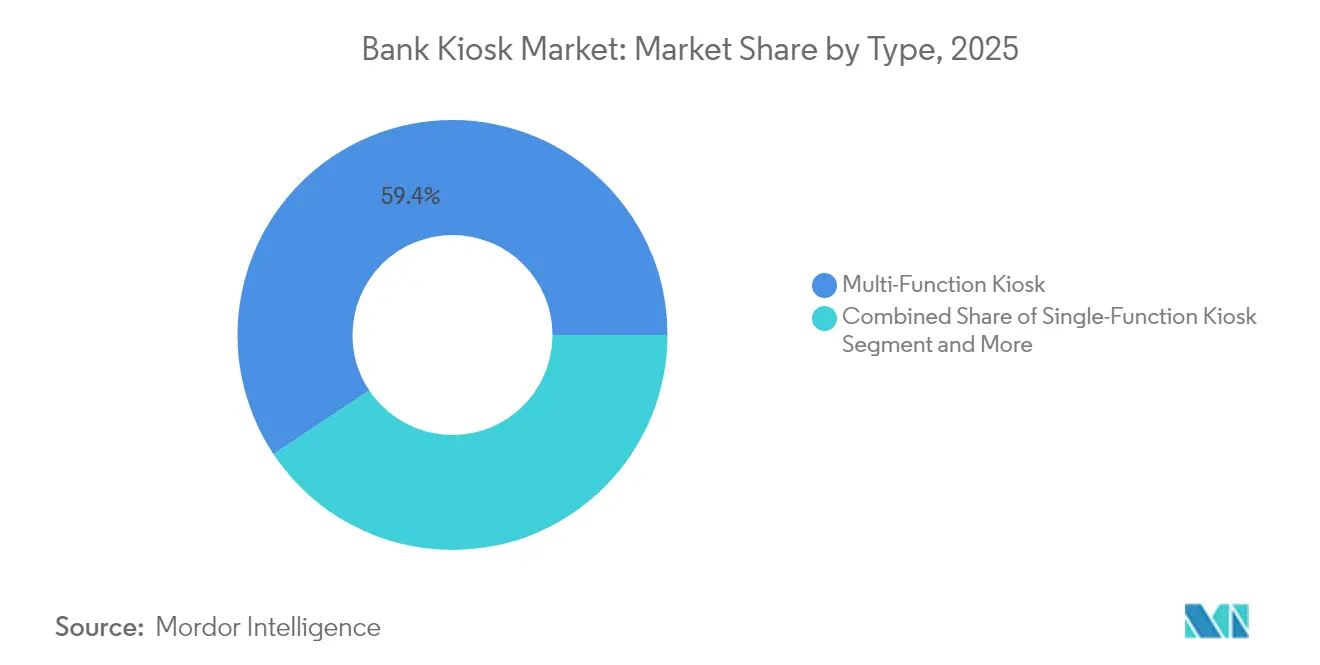
- By type, Multi-Function Kiosks led with 59.35% revenue share of the bank kiosk market in 2025; Virtual/Video Teller Machines are projected to record the fastest 19.47% CAGR through 2031.
- By offering, Hardware accounted for 50.76% of the bank kiosk market size in 2025, while Services are forecast to expand at an 17.84% CAGR to 2031.
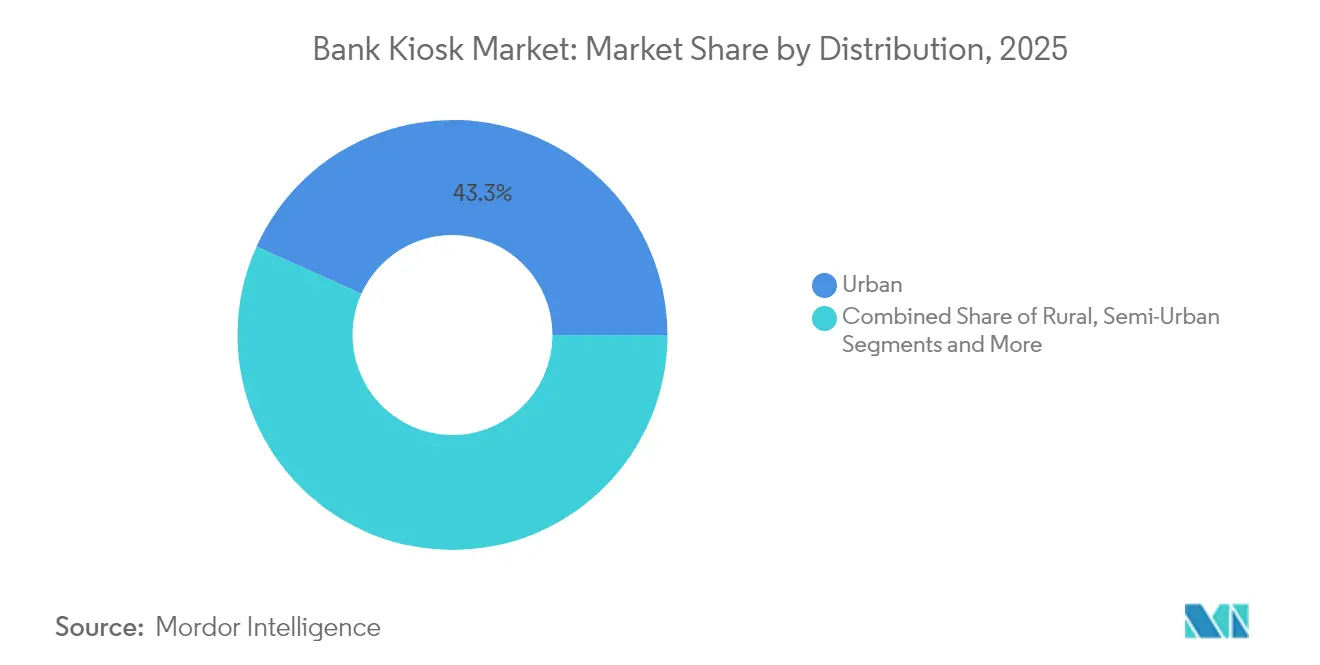
- By distribution, Urban locations held 43.25% of the bank kiosk market share in 2025; Rural deployments are expected to grow at 16.21% CAGR between 2026 and 2031.
- By location, Off-site installations captured 52.88% of the bank kiosk market size in 2025, whereas On-site units are advancing at a 16.02% CAGR through 2031.
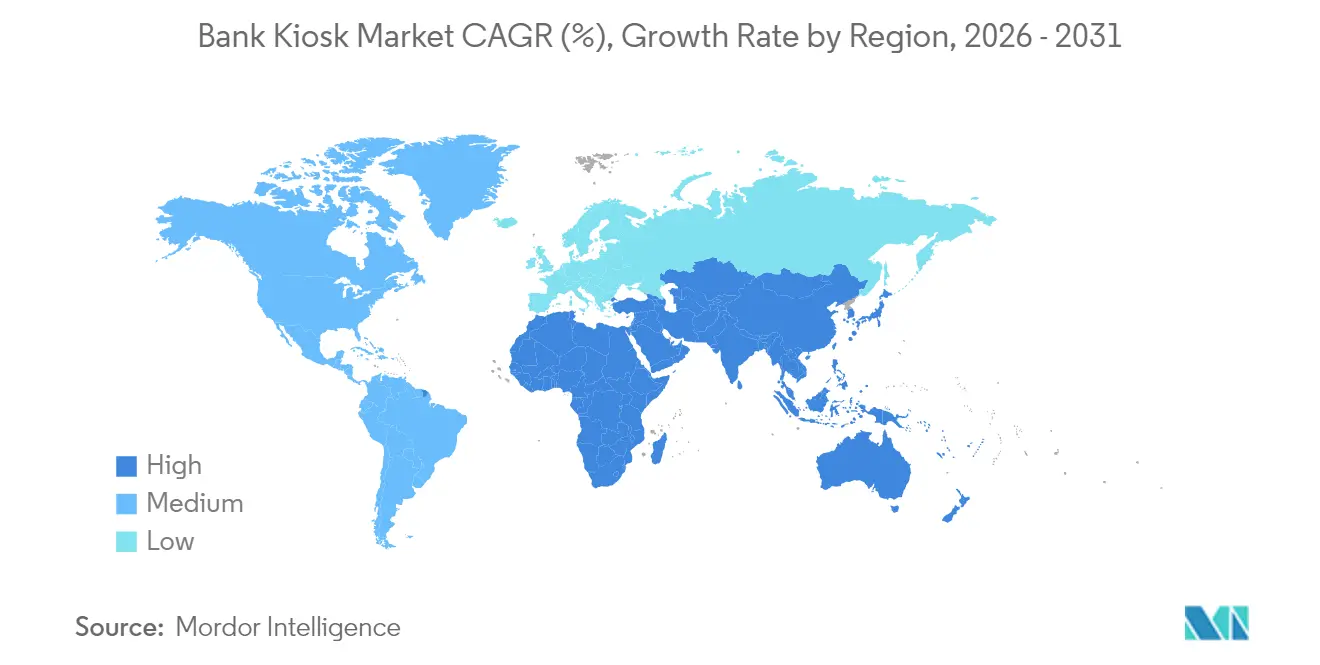
- North America commanded 27.95% of global revenue in 2025; Asia-Pacific is the fastest-growing region with a 16.52% CAGR through 2031.
Note: Market size and forecast figures in this report are generated using Mordor Intelligence’s proprietary estimation framework, updated with the latest available data and insights as of 2026.
Market Trends and Insights
Drivers Impact Analysis of Bank Kiosk Market*
| Driver | (~) % Impact on CAGR Forecast | Geographic Relevance | Impact Timeline |
|---|---|---|---|
| Rising demand for self-service multi-function kiosks | +4.2% | Global, with highest adoption in North America and Europe | Medium term (2-4 years) |
| Cost reduction and branch optimisation | +3.8% | Global, particularly acute in mature markets with high labor costs | Short term (≤ 2 years) |
| Enhanced customer experience / shorter queues | +2.9% | Urban centers globally, particularly in Asia-Pacific | Medium term (2-4 years) |
| AI-enabled predictive maintenance cuts downtime | +1.7% | North America, Europe, developed Asia markets | Medium term (2-4 years) |
| Financial-inclusion mandates in emerging markets | +2.1% | Asia-Pacific, Africa, parts of Latin America | Long term (≥ 4 years) |
| Branch-as-a-Service kiosks for fintech tie-ups | +1.5% | North America, Europe, urban Asia-Pacific | Long term (≥ 4 years) |
| Source: Mordor Intelligence | |||
Rising Demand for Self-Service Multi-Function Kiosks
Banks continue to replace legacy ATMs with multi-function units able to complete 90% of branch transactions, including cash recycling, account opening, and loan origination. Customer preference has shifted markedly, with 75% rating interactive-teller experiences higher than traditional counter service. Transaction abandonment has fallen by 40% as intuitive interfaces streamline workflows. The driver resonates most in metro areas where digital expectations are highest and branch footprints are shrinking. Cost efficiencies further amplify adoption, cementing the role of multi-function kiosks as core infrastructure in the bank kiosk market.
Cost Reduction and Branch Optimisation
Personal Teller Machines cost 20–30% less than legacy ATMs yet handle nearly all teller operations, enabling annual savings of USD 70,000–100,000 per unit. Institutions implementing hub-and-spoke networks with kiosk-only satellites have lowered network operating costs by up to 25%. Staff redeployment toward advisory roles improves cross-sell rates and revenue per employee. Mature markets with elevated labor expenses see the strongest ROI, reinforcing kiosk investment across the bank kiosk market.
Enhanced Customer Experience and Shorter Queues
Average transaction times have fallen 40–60%, shrinking lines and boosting satisfaction. Remote video tellers now deliver perceived service quality on par with in-branch staff for 69% of users. Extended kiosk operating hours, often 12–24 hours daily, benefit small businesses that bank outside normal windows. Queue-management integrations let customers pre-book slots via mobile, while personalization engines leverage data to present tailored menus, cementing loyalty and driving repeat use in the bank kiosk market.
AI-Enabled Predictive Maintenance Cuts Downtime
Machine-learning algorithms monitoring more than 200 performance parameters now predict failures before they occur, cutting critical downtime by up to 35%. Remote resolution addresses 45% of incidents without site visits, slashing mean-time-to-repair from days to hours. Given that each hour offline equates to USD 250–400 in lost value, uptime gains materially strengthen the business case for scaling kiosk fleets, especially at off-site venues where access is harder.
Restraints Impact Analysis of Bank Kiosk Market*
| Restraint | (~) % Impact on CAGR Forecast | Geographic Relevance | Impact Timeline |
|---|---|---|---|
| High upfront installation and maintenance costs | -2.3% | Global, particularly impactful in emerging markets | Short term (≤ 2 years) |
| Mobile banking cannibalisation of foot-traffic | -1.9% | Urban centers globally, particularly in markets with high smartphone penetration | Medium term (2-4 years) |
| Regulatory scrutiny of biometric data at kiosks | -1.2% | Europe (GDPR), California (CCPA), emerging global regulations | Medium term (2-4 years) |
| Escalating cyber-attack surface and reputational risk | -1.4% | Global, with heightened impact in markets with stringent data protection laws | Long term (≥ 4 years) |
| Source: Mordor Intelligence | |||
High Upfront Installation and Maintenance Costs
Fully featured Interactive Teller Machines cost USD 60,000–80,000 per unit, with site preparation adding another USD 10,000–15,000. Annual maintenance and licensing consume 20–25% of hardware value, stretching ROI horizons to 24–36 months. Smaller banks and institutions in emerging markets face budget hurdles, though hardware-as-a-service financing is gaining traction, converting capital expenditure into opex and potentially unlocking latent demand in the bank kiosk market.
Mobile Banking Cannibalisation of Foot-Traffic
Smartphone transactions are rising 28% annually, diverting basic tasks like balance inquiries away from physical channels. Each 10% mobile-use uptick correlates with a 3–5% decline in kiosk volumes, pressuring utilization rates among younger, high-value demographics. Vendors are countering by enabling complex workflows—document scanning, high-value cash, and biometric ID—that remain challenging on small screens, while pre-staged mobile transactions finalized at kiosks aim to blend both touchpoints.
*Our forecasts treat driver/restraint impacts as directional, not additive. The impact forecasts reflect baseline growth, mix effects, and variable interactions.
Bank Kiosk Market Segment Analysis
By Type:
Multi-Function Dominance with Video Teller MomentumMulti-Function units captured 59.35% of bank kiosk market share in 2025 by consolidating cash handling, check imaging, card issuance, and document workflows. Transaction costs average USD 0.70 versus USD 4.50 for counter service, allowing urban branches to trim operating expenses by up to 40%. In the bank kiosk market size context, these systems anchor most transformation projects, enabling smaller footprints and higher throughput. The segment’s growth is reinforced by modular designs that accommodate biometric modules, digital-receipt printers, and AI-driven personalization, future-proofing investments for banks wary of obsolescence.
Virtual/Video Teller Machines, projected to post a 19.47% CAGR, fuse automation with human expertise through centralized call centers. Banks report that 81% of customers deem remote tellers as knowledgeable as in-person staff, widening acceptance in both complex and advisory transactions. Workforce pooling improves staffing flexibility, and extended hours differentiate service in competitive urban corridors. Single-Function kiosks persist in niche use cases but their relevance is shrinking as integrated solutions dominate the bank kiosk market.



By Offering:
Hardware Foundations with Services UpswingHardware retained 50.76% of 2025 revenue, underpinning the bank kiosk market with touch displays, cash recyclers, encrypted PIN pads, and multi-modal biometric sensors. Manufacturers emphasize energy efficiency—new lines consume 40% less power—and modularity that extends asset lives beyond seven years. Mandatory security updates, including TR-31 key block mandates effective 2025, are triggering refresh cycles and supporting near-term hardware demand across the bank kiosk market.
Services, advancing at an 17.84% CAGR, reflect the operational complexity of multi-vendor estates. Predictive maintenance contracts guaranteeing 98%+ uptime command premiums of 15-20% over break-fix models. Managed-service agreements cover software patching, cash logistics, and fraud monitoring, shifting risk from banks to vendors and creating sticky, recurring revenue streams. Concurrently, API-first software platforms enable agile deployment of new features, expanding addressable value within the bank kiosk market.
By Distribution:
Urban Stronghold and Rural AccelerationUrban deployments held 43.25% of 2025 revenue, reflecting dense transaction volumes and digital-first customer expectations. City branches are shrinking their floor space by up to 30% while embedding kiosks as the primary transaction channel, elevating advisory engagement ratios. High deployment density yields scale benefits in cash handling and service logistics, reinforcing ROI in metropolitan areas of the bank kiosk market.
Rural installations, growing 16.21% annually, leverage kiosk economics to bridge service gaps where full-service branches are non-viable. Programs such as India’s Digital India and NABARD support subsidies for micro-ATM and kiosk rollouts. Ruggedized hardware and offline transaction queuing address connectivity challenges, expanding financial access. Semi-urban zones sit between these extremes, balancing volume and cost, while metropolitan transport hubs integrate kiosks with ticketing and municipal services, broadening use cases inside the bank kiosk market.
By Location:
Off-Site Reach Versus On-Site ReinventionOff-site kiosks led with 52.88% of 2025 revenue, enabling banks to seed touchpoints in retail stores, airports, and campuses with 1,500–2,000 monthly transactions per unit. Break-even periods as short as 18 months underscore compelling economics. Physical security innovations such as IoT alarms, reinforced vaults, and AI-based anomaly detection are pivotal in sustaining trust at unmanned sites and underpin the off-site component of the bank kiosk market size.
On-site units, expanding at 16.02% CAGR, underpin branch reconfiguration from cashier counters to advisory lounges. When 70–80% of routine transactions migrate to self-service, teller headcount falls 30–40% and customer-relationship time rises. Integrated scheduling tools let users switch seamlessly from self-service to banker consultation, tightening retention. Open-plan kiosk designs replace enclosed booths, aligning with branch aesthetics that favor transparency and collaboration across the evolving bank kiosk market.
Geography Analysis
North America Bank Kiosk Market
North America retained a 27.95% revenue share in 2025, propelled by FDIC guidance that Interactive Teller Machines are not domestic branches, cutting compliance hurdles. United States banks account for two-thirds of regional deployments, leveraging kiosks to consolidate footprints while sustaining coverage in suburban and rural zones. Canadian institutions lead in video teller adoption, with 35–40% of complex tasks now completed remotely, highlighting a mature service blend inside the bank kiosk market.
APAC Bank Kiosk Market
Asia-Pacific is forecast to post a 16.52% CAGR through 2031, spearheaded by large-scale national inclusion campaigns. China commands roughly 40% of regional volume, embedding advanced biometrics and AI-driven analytics into next-gen units to serve vast urban populations. India relies on kiosks to extend formal banking into underbanked villages, underpinning explosive unit growth that reshapes the global bank kiosk market trajectory. Japan and South Korea innovate through integrations with investment, crypto, and transport ecosystems, broadening functional scope.
EMEA Bank Kiosk Market
Europe exhibits divergent patterns: Western states optimize existing branch networks while Eastern markets expand first-generation coverage. Germany and the United Kingdom report that 50–60% of day-to-day transactions have moved to kiosks, freeing staff for higher-value roles. GDPR compliance fuels investment in privacy safeguards such as proximity sensors and privacy filters. The Middle East aligns kiosk rollouts with smart-city programs, while selected African nations experiment with hybrid models that blend mobile pre-staging with kiosk completion, enlarging inclusion within the bank kiosk market.

Regulatory Landscape
Regulation affecting bank kiosks increasingly centers on data protection, cash security, and licensing rules for kiosks enabling digital asset or cash-to-digital services. In the United States, North Carolina's Virtual Currency Kiosk Consumer Protection Act (SL 2026-45) formalizes operator licensing and fraud controls, with comparable 2026 actions in Virginia, Kansas, and Wyoming that reference licensing and fraud-prevention tooling such as blockchain analytics. California's Department of Financial Protection and Innovation ties kiosk-related digital asset activity to the California Digital Financial Assets Law, with a licensing deadline of July 1, 2026 for covered business activity.
In Asia, compliance anchors include national standards and central-bank directions that shape hardware, software, and onboarding workflows. China issued GA/T 1003-2024, effective October 1, 2024, setting baseline technical and security requirements for self-service deployments. In India, the Reserve Bank of India's Master Directions for digital banking channels are effective January 1, 2026, reinforcing governance and controlled third-party security for kiosk onboarding and transactions.
Value Chain Analysis
The value chain spans component suppliers (touch displays, cash recyclers, encrypted PIN pads, cameras/biometric modules, printers, and vaulting), OEMs and integrators that assemble and certify platforms, and software providers delivering orchestration, security, remote monitoring, and video teller enablement. Banks and credit unions act as primary buyers, while deployment and operations rely on site owners for off-site placements (retail, airports, campuses) plus field-service organizations for installation, break-fix, cash logistics coordination, and compliance reporting.
A key evolution is the shift from equipment procurement to bundled software and managed services, evidenced by Renasant Bank extending NCR Atleos Activate Enterprise across its network in February 2025. Diebold Nixdorf's Branch Automation Solutions portfolio announced in August 2025 further aligns hardware and software to simplify multi-vendor estates and support faster feature rollouts across distributed kiosk fleets.
Competitive Landscape
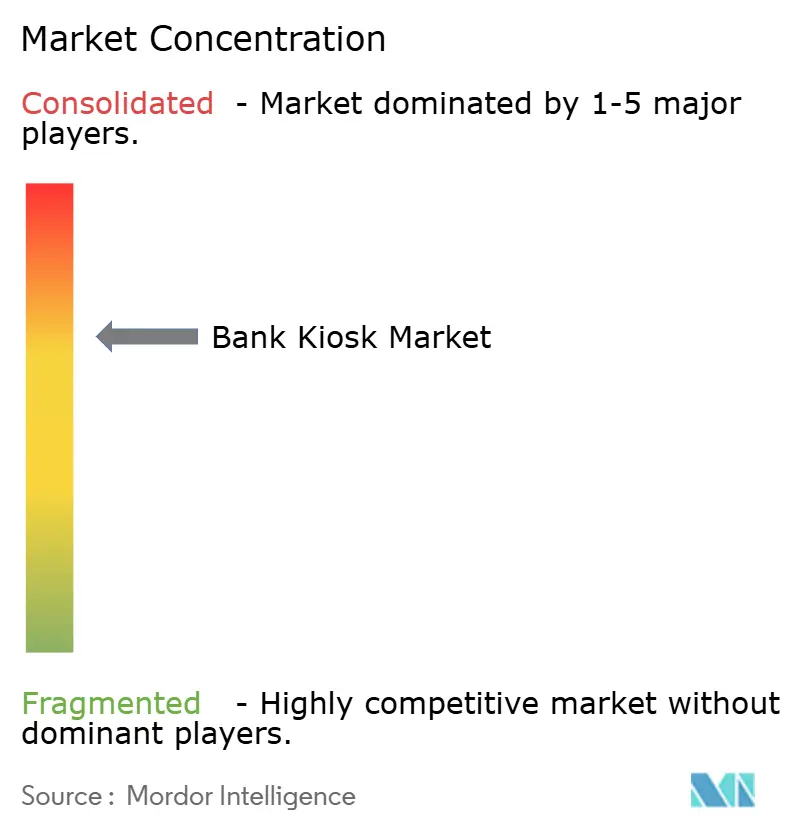
The bank kiosk market features moderate concentration; the top five suppliers capture roughly 65% of global revenue. NCR, Diebold Nixdorf, and Nautilus Hyosung maintain scale advantages yet increasingly monetise through cloud software, analytics, and managed services as hardware margins compress. Diebold Nixdorf’s DN Vynamic suite exemplifies this pivot, enabling integrated orchestration of transactions, security, and customer journeys while delivering durable annuity streams.
Regional specialists including GRG Banking in China and OKI Electric in Japan harness local regulatory knowledge to tailor feature sets such as multi-language interfaces and government-ID verification. Partnerships between hardware vendors and fintech firms are proliferating, fusing open-API platforms with niche capabilities in blockchain, small-business services, and data analytics. Disruptors focused on cloud-agnostic software challenge vertically integrated incumbents by lowering switching friction for banks, an emerging competitive battleground inside the bank kiosk market.
Artificial intelligence is now the primary differentiator. Vendors compete on predictive maintenance accuracy, fraud detection algorithms, and real-time personalization engines. Sustainability is an additional vector, with newest models cutting power draw by up to 40% and supporting recycled-material casings. As managed-service penetration deepens, the basis of rivalry shifts from unit shipments to lifetime value, reinforcing ecosystem lock-in and redefining competitive strategy across the bank kiosk market.
Bank Kiosk Industry Leaders
NCR Corporation
Diebold Inc
Glory Limited
Nautilus Hyosung Corporation
Korala Associates Ltd (KAL ATM Software)
- *Disclaimer: Major Players sorted in no particular order
Bank Kiosk Market Companies Covered in this Report
- NCR Corporation
- Diebold Nixdorf AG
- Nautilus Hyosung Corporation
- Glory Ltd
- GRG Banking Equipment Co. Ltd
- KIOSK Information Systems
- Olea Kiosks Inc.
- RedyRef Interactive Kiosks
- Phoenix Kiosks
- Advantech Co. Ltd
- Embross Group
- Auriga S.p.A.
- Korala Associates Ltd (KAL ATM Software)
- Hitachi-Omron Terminal Solutions Corp.
- OKI Electric Industry Co. Ltd
- Fujitsu Ltd
- Cisco Systems Inc.
- Shenzhen Yihong Computer Co. Ltd
- Glory Global Solutions (UK) Ltd

Market Opportunities and Future Outlook
A major whitespace sits in extending bank-grade self-service beyond branches into retail and community locations, using off-site kiosks as omnichannel endpoints that support cash services plus identity verification, document capture, and assisted onboarding. This opportunity is reinforced by visible market activity among kiosk-network operators targeting expansion capital and new geographies, including PointsKash filing a USD 30 million stock and convertible debt offering in December 2025 and January 2026 to fund deployment of more than 1,500 multi-financial services kiosks. As banks seek lower-cost service points, these retail-adjacent footprints create a pathway for partnerships that combine bank compliance and products with third-party site access and operations.
Another opportunity lies in software-led differentiation and compliance-driven capability upgrades, particularly where regulation mandates stronger fraud controls, customer disclosures, and governance for kiosk-enabled transactions. The tightening patchwork of 2026 U.S. state requirements for virtual currency kiosk operators (including North Carolina SL 2026-45 and comparable actions in Virginia, Kansas, and Wyoming that reference licensing and fraud-prevention tooling) increases demand for standardized compliance workflows, remote monitoring, and auditable controls across distributed fleets. In emerging markets, financial inclusion programs and fintech-led kiosk networks provide additional deployment lanes, exemplified by KaliSpot raising USD 4 million in April 2026 to expand its 1Net smart financial kiosk network and enter additional West and Central African markets (Cote d'Ivoire, Gabon, and Guinea).
Recent Industry Developments in Bank Kiosk Market
- March 2026: JN Bank expanded self-service banking across Jamaica using Diebold Nixdorf DN Series 200V cash recyclers, with implementation supported by partner MC Systems. The rollout shows continued demand for cash recycling and branch automation platforms in regional markets.
- February 2026: The Brink's Company announced a definitive agreement to acquire NCR Atleos in a cash-and-stock transaction. The move expands Brink's service footprint into bank self-service networks and scales managed services across terminals.
- May 2025: NCR Atleos launched its next-generation SelfServ 80 Series with enhanced cash recycling and integrated interactive teller functionality. The platform strengthens vendor differentiation as banks refresh fleets to consolidate teller tasks into multi-function self-service endpoints.


Bank Kiosk Market Report Scope and Research Methodology
Market Definition and Coverage
For this report, the bank kiosk market is defined as revenue generated from self-service and assisted-service kiosks deployed by banks and credit unions to handle customer transactions and service requests at branches, off-site points, and small-format outlets.
Scope exclusions: We exclude non-bank retail kiosks and we also exclude broader branch and core banking software licenses that are not physically resident in the kiosk.
Segments Covered in This Report
- By Type
- Single-Function Kiosk
- Multi-Function Kiosk
- Virtual / Video Teller Machine
- By Offering
- Hardware
- Software
- Services
- By Distribution
- Rural
- Semi-Urban
- Urban
- Metropolitan
- By Location
- On-site
- Off-site
- By Geography
- North America
- United States
- Canada
- Mexico
- Europe
- Germany
- United Kingdom
- France
- Italy
- Spain
- Rest of Europe
- Asia-Pacific
- China
- India
- Japan
- South Korea
- Australia and New Zealand
- Rest of Asia-Pacific
- South America
- Brazil
- Argentina
- Rest of South America
- Middle East and Africa
- Middle East
- Saudi Arabia
- United Arab Emirates
- Turkey
- Rest of Middle East
- Africa
- South Africa
- Nigeria
- Rest of Africa
- Middle East
- North America
Data Sources, Market Sizing, and Validation
Desk Research
Desk work starts with mapping where kiosks get deployed and what triggers replacement or new installs across regions, because those patterns shape the demand pool. We use public sources such as central bank and banking supervisor publications, national statistics offices, World Bank financial access indicators, and ITU connectivity series to understand branch density, cash usage trends, and digital readiness.
We also review listed-company filings, annual reports, investor decks, and press releases to capture product mix, order commentary, and service revenue hints tied to self-service banking equipment. When needed, paid subscriptions for company financials and intelligence, patent databases, and a news and financials platform are used to cross-check timelines for product launches, channel moves, and M and A activity that can shift share. The desk sources described above are illustrative and not exhaustive, and additional public materials were also used for data collection, validation, and research clarification.
Primary Interviews and Surveys
Primary work is used to confirm what is counted as a bank kiosk in real projects, and to pressure-test pricing and service attachment assumptions that vary by region and bank size. We speak with bank operations and channel leaders, branch transformation teams, integrators, and service partners, then we circle back on conflicting inputs before locking the ranges for volumes and average selling prices. For a global market, coverage is balanced across APAC, EMEA, and the Americas so regional deployment styles (on-site versus off-site, and assisted versus self-service) are reflected consistently.
Distribution of primary research fieldwork respondents
| Company type | Respondent position | Region |
|---|---|---|
| Top tier: 34% | CXOs: 14% | APAC: 48% |
| Mid tier: 44% | Functional/Unit leaders: 33% | EMEA: 31% |
| Smaller Players: 22% | Managers: 53% | Americas: 21% |
Market-Sizing & Forecasting
Sizing is built using a top-down approach where branch and service-point footprints, transaction migration trends, and self-service penetration rates are translated into an addressable install base, which is then converted into annual demand through replacement cycles and new deployments. To keep it practical, the model is anchored on a small set of inputs that can be validated, such as kiosk installed base growth, average unit prices by kiosk class (self-service versus assisted or video), service and maintenance attachment rates, and typical refresh periods tied to hardware lifecycles.
Once the totals are formed, we corroborate them with selective bottom-up approximations using sampled supplier revenues, channel checks with integrators, and a volume times ASP sanity check for a few large countries. The totals are then adjusted if the checks do not reconcile. For areas where public signals are weak, ranges are set using primary feedback on procurement patterns and how banks bundle hardware, embedded software, and field service contracts.
Forecasting uses scenario analysis supported by short input series, where we vary kiosk penetration, branch rationalization pace, and unit-price erosion. We then select the most likely path based on what experts expect in budgets and rollout plans. The final forecast stays traceable to these drivers, so changes in access points, adoption of assisted-service formats, or service attachment can be re-run quickly and consistently.
Data Validation & Update Cycle
Validation is done by comparing model outputs against independent signals, such as branch footprint changes, public capex commentary from banks, and supplier shipment and service-revenue direction. Any unusual jumps in a country curve are reviewed, and the assumptions are re-checked with an extra round of calls when the variance looks structural rather than timing related.
Before sign-off, the workbook goes through step-by-step peer review so the math, currency conversions, and year mapping stay consistent across regions. Reports are refreshed annually, and interim updates are triggered when a major regulatory shift, large deployment program, or a sharp change in banking access points materially changes the demand picture. Right before delivery, a fresh pass is done so clients receive the latest updated view.
Mordor Intelligence's Bank Kiosk Market Sizing Compared With Other Published Estimates
Published values for bank kiosks can differ because the counted items are not always the same, and pricing and service revenue treatment varies from one model to another. Timing also matters since some sources anchor to an earlier base year, while others quote a current year that already reflects step-ups in deployment activity.
The gaps usually come down to what gets bundled into the kiosk revenue line, how off-site deployments are treated, and whether the forecast assumes conservative or aggressive kiosk penetration across branches and micro-branches. Currency conversion timing and refresh cadence can also shift the number in regions where installs and replacement cycles change quickly.
Benchmark comparison
| Source | Market Size | Gaps in Research Methodology |
|---|---|---|
| Mordor Intelligence | USD 24.56 B (2026) | |
| Global Consultancy A | USD 21.98 B (2025) | This estimate is anchored to an earlier year and is often published with a broader application bucket that can include ATMs and adjacent self-service endpoints, which shifts totals when replacement cycles are applied differently. |
| Industry Platform B | USD 22.48 B (2025) | This view may expand end-user coverage beyond regulated banking in some cuts and can apply a different split between hardware, software, and services, which moves revenue between years when service attachment is assumed upfront. |
The table shows that 2025-anchored figures sit below the 2026 current-year value, and in Mordor Intelligence's model the market counts kiosk hardware, embedded software, and recurring field services, while excluding non-bank retail kiosks and non-resident core banking software licenses. With the scope kept consistent and the drivers tied to install base, refresh cycles, and service attachment, the output stays transparent and repeatable when inputs are updated.


Key Questions Answered in the Report
What is the current size of the bank kiosk market?
The bank kiosk market stands at USD 24.56 billion in 2026 and is projected to reach USD 50.54 billion by 2031.
Which segment holds the largest share of the bank kiosk market?
Multi-Function Kiosks lead with 59.35% revenue share in 2025 due to their ability to handle most teller transactions and lower operating costs.
Why are services growing faster than hardware in the bank kiosk market?
Banks increasingly outsource maintenance, software updates, and predictive analytics, driving an 17.84% CAGR for services as they focus on core activities.
Which region is expected to grow fastest through 2031?
Asia-Pacific is forecast to expand at a 16.52% CAGR, propelled by financial inclusion programs and rapid urbanization, especially in China and India.
How do predictive-maintenance features improve kiosk economics?
AI-driven monitoring cuts critical downtime by up to 35% and resolves 45% of issues remotely, protecting transaction revenue and customer satisfaction.
What is the main challenge restraining wider adoption in emerging markets?
High upfront installation costs—USD 60,000–80,000 per unit plus site preparation—stretch ROI periods, though hardware-as-a-service models are easing the burden.
Page last updated on:


 Your data is secure and never sold or shared.


