
Market Overview
| Study Period | 2020 - 2031 |
|---|---|
| Forecast Data Period | 2026 - 2031 |
| Base Year Market Size (2025) | USD 262.41 Billion |
| Market Size (2026) | USD 286.79 Billion |
| Market Size (2031) | USD 423.84 Billion |
| Growth Rate (2026 - 2031) | 8.13 % |
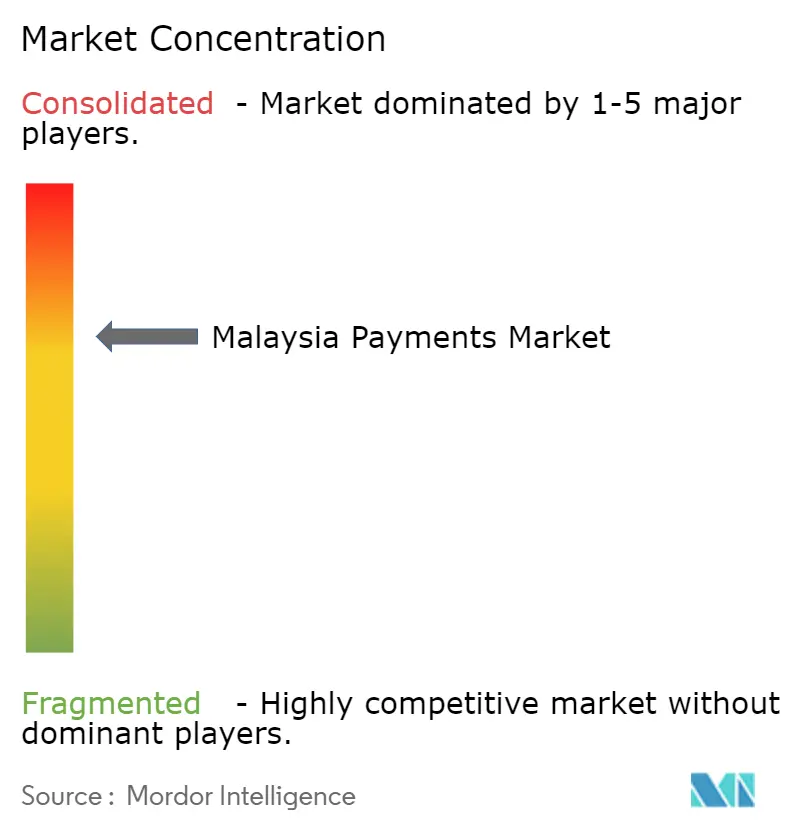
| Market Concentration | Medium |
Major Players *Disclaimer: Major Players sorted in no particular order Image © Mordor Intelligence. Reuse requires attribution under CC BY 4.0. | |
Malaysia Payments Market Analysis by Mordor Intelligence
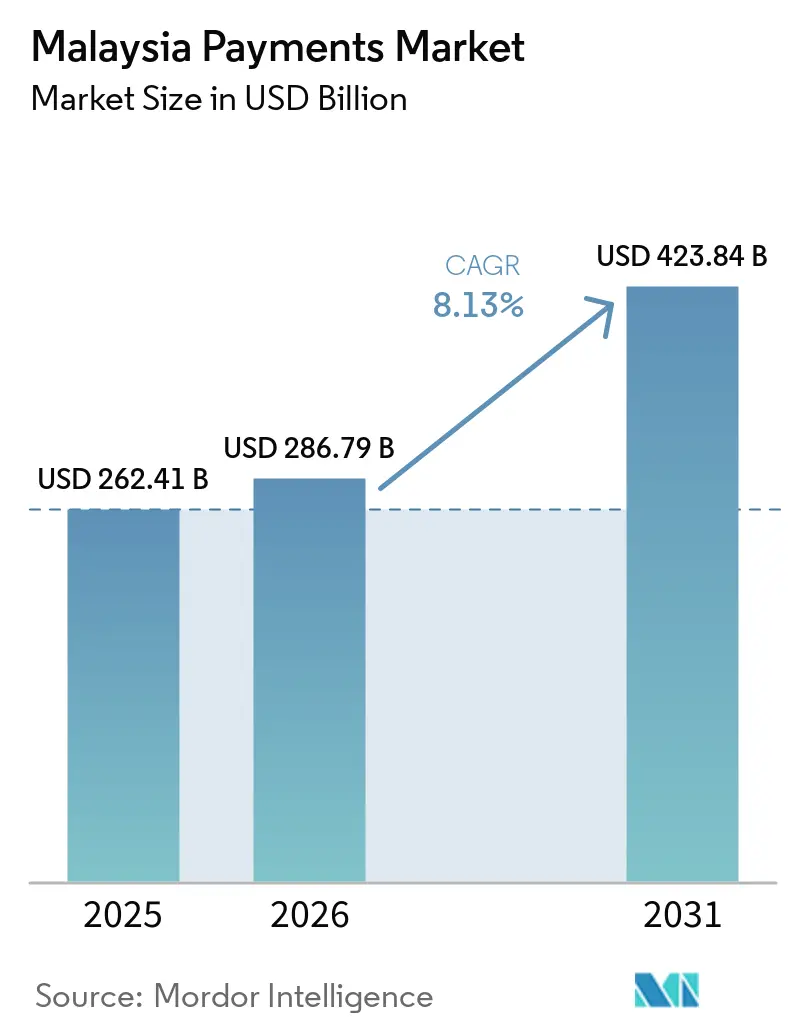
The Malaysia payments market size is projected to be USD 262.41 billion in 2025, USD 286.79 billion in 2026, and reach USD 423.84 billion by 2031, growing at a CAGR of 8.13% from 2026 to 2031. Debit and credit cards still anchor physical retail, yet transaction value is tilting toward interoperable QR codes that compress interchange fees and toward real-time rails that promise instant settlement. The central bank’s DuitNow infrastructure has already connected millions of merchants, while ASEAN cross-border agreements let travelers scan a single code across Malaysia, Singapore, and Thailand. Islamic digital wallets, gig-economy payout demands, and government e-invoice rules are deepening wallet penetration, while persistent fraud and rural connectivity gaps temper the pace of adoption. Competitive pressure is migrating from fee-based card issuers to data-rich platform ecosystems that monetize payments through lending, insurance, and loyalty rather than pure interchange.
Key Report Takeaways
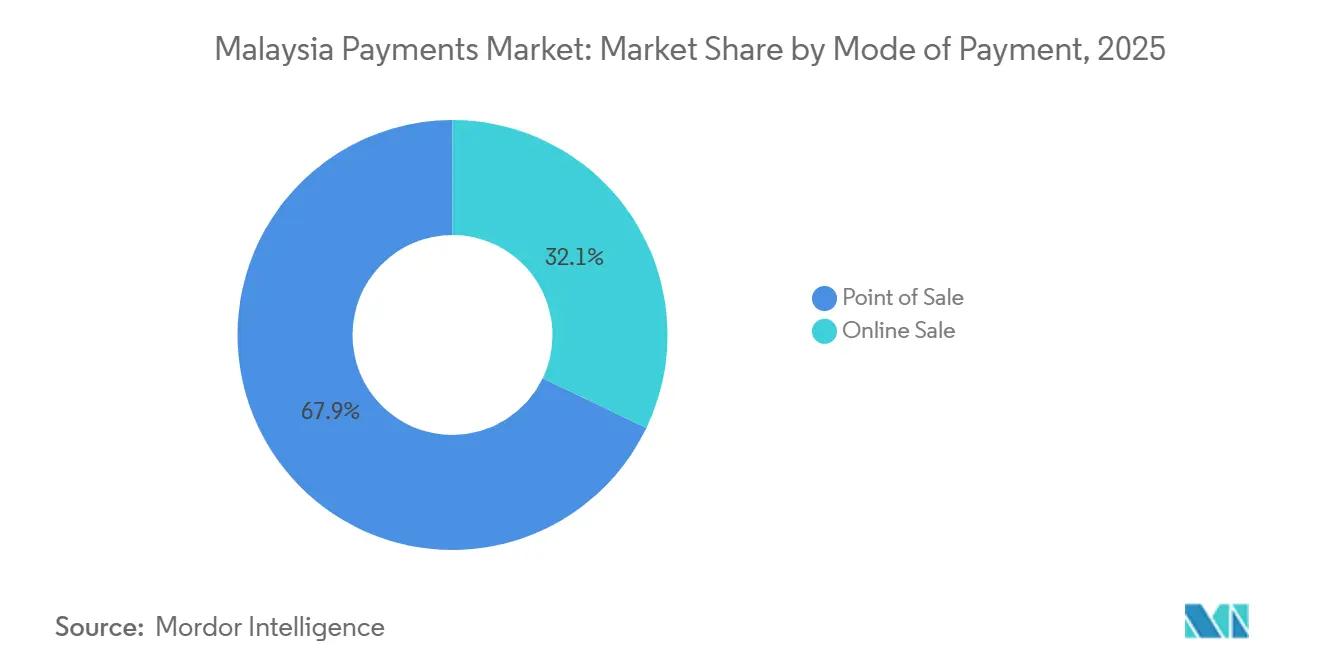
- By mode of payment, Point of Sale channels led with 67.89% of transaction value in 2025, while Online Sale channels are forecast to grow at a 10.13% CAGR to 2031.
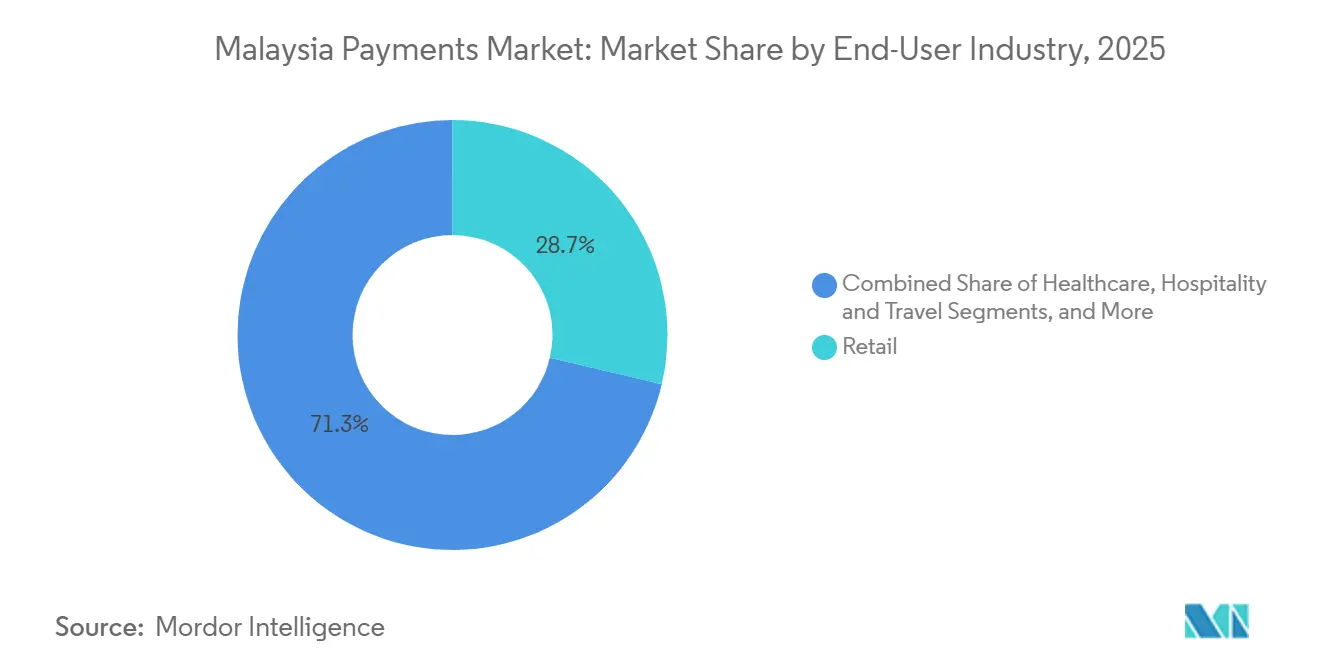
- By end-user industry, retail captured 28.67% of value in 2025, whereas hospitality and travel are advancing at an 11.24% CAGR through 2031.
Note: Market size and forecast figures in this report are generated using Mordor Intelligence’s proprietary estimation framework, updated with the latest available data and insights as of 2026.
Market Trends and Insights
Drivers Impact Analysis of Malaysia Payments Market*
| Driver | (~) % Impact on CAGR Forecast | Geographic Relevance | Impact Timeline |
|---|---|---|---|
| Rapid E-Commerce Expansion and Mobile-Shopping Adoption | +1.8% | National, concentrated in Klang Valley, Penang, Johor Bahru | Medium term (2-4 years) |
| Government Push for Interoperable QR (DuitNow) and Contactless Cards | +1.5% | National, mandated by Bank Negara Malaysia | Short term (≤ 2 years) |
| Contactless Card Penetration and NFC Terminal Rollout | +1.2% | Kuala Lumpur, George Town, Johor Bahru | Short term (≤ 2 years) |
| Rise of Islamic Fintech and Sharia-Compliant Payment Propositions | +0.9% | States with higher Islamic banking penetration | Long term (≥ 4 years) |
| ASEAN Cross-Border E-Wallet Interoperability Initiatives | +0.7% | Malaysia-Singapore and Malaysia-Thailand corridors | Medium term (2-4 years) |
| Instant Payouts for Gig-Economy via Real-Time Rails | +0.6% | Klang Valley, Penang, Johor Bahru | Short term (≤ 2 years) |
| Source: Mordor Intelligence | |||
Rapid E-Commerce Expansion and Mobile-Shopping Adoption
Smartphone penetration exceeded 90% in 2025, and super-apps such as Shopee and Lazada integrated one-tap wallet checkouts that bypass card-network fees.[1] Mobile-first buyers transact 40% more often than desktop users, improving merchant customer-acquisition economics. Touch 'n Go’s link-up with Grab’s ride-hailing and food-delivery services embeds payments inside daily routines, heightening platform stickiness. The phased e-invoice mandate pushes businesses to digitize invoices, indirectly nudging suppliers and buyers into online settlements.[2] Cash-on-delivery is shrinking as prepaid digital wallets gain dispute-resolution credibility. If rural broadband roll-out under the Jendela plan slips behind schedule, the usage gap between urban and outstation shoppers could widen.
Government Push for Interoperable QR (DuitNow) and Contactless Cards
Bank Negara Malaysia requires all payment terminals to migrate to PIN authentication by June 2026, closing loopholes that enabled signature-based fraud.[3] DuitNow QR unifies previously siloed wallet codes and has enrolled 2.6 million merchants, with volumes jumping 47% year-on-year in 2025. The George Town Accord among ASEAN central banks guarantees reciprocal QR acceptance, so Malaysian tourists buy meals in Bangkok with Touch 'n Go while avoiding foreign-exchange spreads. Tourism rebound, already at 85% of 2019 levels by mid-2025, accelerates QR adoption among hospitality merchants. Visa and Mastercard see card-present revenue erosion because flat-fee QR rails undercut percentage-based interchange models.
Contactless Card Penetration and NFC Terminal Rollout
Maybank and CIMB distributed 8 million contactless cards by end-2025, shrinking average supermarket checkout time from 45 seconds to 12 seconds. Touch 'n Go retrofit 6 million vehicles with RFID tags that double as wallet identifiers for tolls and parking.[4] NFC readers now dominate Malaysia’s main transit and retail nodes, lowering the psychological barrier to mobile-tap payments. Samsung and Huawei preload wallets on devices sold through the country’s top telcos and achieve a 30% activation rate by mid-2025. A looming challenge is terminal-subsidy withdrawal once card-network interchange pools compress.
Rise of Islamic Fintech and Sharia-Compliant Payment Propositions
Islamic banking assets hit RM 1.2 trillion (USD 267.0 billion) in 2025, amounting to 39.5% of national banking Bank Islam Malaysia’s wallet automatically diverts zakat contributions, satisfying observant users’ faith obligations. Maybank Islamic structures buy-now-pay-later plans as murabaha contracts, side-stepping interest and gaining traction among 12 million MAE users. The Securities Commission approved Sharia-compliant crowdfunding portals that clear payments only through Islamic wallets. Foreign workers remit RM 30 billion (USD 6.7 billion) annually, and pilots such as Wahed’s gold-backed stablecoins promise faster, halal-compliant cross-border transfers.
Restraints Impact Analysis of Malaysia Payments Market*
| Restraint | (~) % Impact on CAGR Forecast | Geographic Relevance | Impact Timeline |
|---|---|---|---|
| Persistent Cash Preference Among SMEs and Rural Consumers | -0.8% | Rural Sabah, Sarawak, Interior Pahang, Kelantan | Long term (≥ 4 years) |
| Rising Fraud and Cybersecurity Concerns Lowering Trust | -0.6% | National, higher incidence in urban areas | Short term (≤ 2 years) |
| Fragmented Acquiring Market Keeps MDR High for Micro-Merchants | -0.4% | National, micro-enterprises | Medium term (2-4 years) |
| E-KYC Hurdles for Migrant and Foreign Workers | -0.3% | Klang Valley, Penang, Johor | Medium term (2-4 years) |
| Source: Mordor Intelligence | |||
Persistent Cash Preference Among SMEs and Rural Consumers
Seventy percent of SMEs still prefer cash, citing tax-audit fears and liquidity needs. Sabah and Sarawak’s intermittent internet and aging demographics reinforce this behavior. The 2024 eBelia youth subsidy drove short-term wallet activation but post-incentive usage cratered, proving that handouts without merchant ubiquity lack staying power. QR pilots in wet markets faltered because 24-hour settlement cycles undermine vendors’ working capital. Until real-time payouts reach tier-three towns, cash maintains speed and trust advantages.
Rising Fraud and Cybersecurity Concerns Lowering Trust
Consumers lost MAR 1.51 billion (USD 335.0 million) to 51,020 scams in 2024, a 218% jump year-on-year. The National Scam Response Centre froze MAR 200 million (USD 44.4 million) of suspicious funds in six months, yet 42% of surveyed users said they dialed back wallet usage after hearing of fraud. Mandatory cooling-off periods and step-up biometrics mitigate risk but add friction. Gig-economy riders on shared smartphones experience rising credential theft, prompting Grab to deploy behavioral analytics at additional cost. Without continued investment in AI-driven detection, a trust spiral could undermine digital adoption.
*Our forecasts treat driver/restraint impacts as directional, not additive. The impact forecasts reflect baseline growth, mix effects, and variable interactions.
Malaysia Payments Market Segment Analysis
By Mode of Payment:
Online Channels Capture Checkout Velocity as QR Codes Commoditize Point-of-SalePoint of Sale methods accounted for 67.89% of value in 2025, supported by entrenched card habits in supermarkets, fuel pumps, and restaurants. Within this group debit cards remain dominant among salaried workers, while credit cards capture big-ticket discretionary spending through reward programs and flexible installment plans. Bank financing blends Islamic murabaha structures with conventional installment offers, appealing to consumers furnishing homes or buying electronics. Prepaid cards are losing utility to reloadable wallets that facilitate contactless transit and instant peer transfers. Digital wallets are the star turn, their growth amplified by DuitNow QR’s fee waivers that attract micro-merchants.
Online Sale channels, though smaller, are scaling at a 10.13% CAGR to 2031 as mobile-optimized checkouts eliminate form-fill friction. Cards still mediate roughly 60% of e-commerce value, yet their share is bleeding to wallets embedded inside Shopee and Lazada that avoid card-network tolls. Bank financing online supports zero-interest installment plans for mid-range smartphones and white goods, with Islamic variants expanding appeal. Prepaid cards see limited rotation because refund handling is clunky. Digital wallets dominate low-value, high-frequency orders such as food delivery, with Touch 'n Go boasting 82.41% of user penetration and Boost at 66.68%. Buy-now-pay-later products like BigPay Later funnel users who want budgeting discipline and interest-free spreading of payments.
By End-User Industry:
Hospitality Outpaces Retail as Contactless Becomes Table StakesRetail captured 28.67% of transaction value in 2025, driven by supermarkets and convenience chains that now favor self-checkout kiosks and QR acceptance. Entertainment and digital content follows, as recurring billing for streaming and gaming locks users into monthly debits that reduce churn. Healthcare digitization remains piecemeal; the newly launched iPayment portal standardizes government-hospital charges but private clinics lag behind.
Hospitality and travel is the fastest-growing vertical, rising at an 11.24% CAGR toward 2031 thanks to recovering inbound tourism and widespread adoption of contactless check-ins and mobile room keys. Airlines embed wallet payments for baggage and seat upgrades, shaving cash handling at counters. Government and utilities migrate tax, water, and vehicle-license fees to the MyGovernment portal, yet older citizens and rural users still queue at brick-and-mortar offices. Miscellaneous categories, including education fees and charitable giving, test automated monthly debits, but consumer-protection rules on auto-renewals are still evolving.

Geography Analysis
Urban Malaysia drives digital adoption. The Klang Valley alone contributes roughly 45% of national transaction value as dense merchant networks, high smartphone penetration, and multinational payrolls reinforce cashless behavior. Penang and Johor Bahru together add another 20%, buoyed by cross-border QR spending with Singapore and Thailand. The ASEAN Payment Connectivity initiative, which cleared 12.9 million QR transactions in H1 2025, is most active in these border corridors.
Rural Sabah and Sarawak cover 60% of land mass yet generate barely 15% of payments value. Only 70% of populated areas enjoy reliable 4G, and bank branches are sparse. Broadband under the Jendela program promises 100 Mbps to 9 million premises, but mountainous interior districts remain unprofitable for fiber roll-out. Wet-market digitization pilots stumbled because settlement delays erode vendors’ liquidity. Until wallets work offline and offer same-day settlement, cash will keep its velocity and privacy appeal.
The East Coast states form a mixed picture. Urban centers such as Kuantan mirror Penang’s payment patterns, while rural hinterlands emulate Sabah’s cash preference. Youth-oriented eBelia subsidies posted 75% redemption in Kuala Lumpur but only 50% in Kelantan, signaling that merchant acceptance, not consumer willingness, is the bottleneck. Islamic wallet features, including zakat auto-deduct and halal merchant flags, resonate in these states. Migrant workers in Klang Valley factories and Penang tech parks remain an untapped segment because strict e-KYC rules bar onboarding without local IDs. Regulatory elasticity here could unlock a 5-7% boost in volume.
Regulatory Landscape
Malaysia payments operate under Bank Negara Malaysia (BNM) oversight, with core legal foundations including the Payment Systems Act 2003 and the Financial Services Act 2013 shaping licensing, conduct, and systemic-risk controls for payment systems and e-money. A near-term compliance milestone is BNM's requirement for payment terminals to migrate to PIN authentication by June 2026, tightening authentication controls for card-present transactions alongside wider fraud-mitigation measures.
Interoperability and digitalization mandates are tightening across retail payments and commerce workflows. On 30 June 2026, BNM issued the Interoperable Fund Transfer Framework (IFTF), superseding the 2019 Interoperable Credit Transfer Framework and requiring banks and e-money issuers to phase out proprietary QR code scheme networks by 30 June 2028, reinforcing shared rails such as DuitNow. In parallel, the Inland Revenue Board of Malaysia (IRBM) updated its e-Invoice Specific Guidelines (Version 4.8) on 7 July 2026 under the Income Tax Act 1967, adding compliance pressure on merchants and platforms that must align payment reconciliation to e-invoicing requirements while e-commerce legislation review efforts continue under the Ministry of Domestic Trade and Cost of Living (KPDN).
Value Chain Analysis
The value chain begins with consumers and businesses using cards, digital wallets, bank transfers, and QR at point of sale and online checkouts. Issuing banks and e-money issuers provide accounts and wallets, while acquiring banks, payment gateways, and merchant acquirers enable acceptance for retailers, marketplaces, travel, and services. Device OEMs and telcos support access through NFC and mobile wallets, and fraud, identity (e-KYC), and risk vendors sit across onboarding and transaction monitoring.
National shared infrastructure is anchored by Payments Network Malaysia (PayNet), owned by BNM and 11 domestic financial institutions, and operates rails such as DuitNow and other interbank payment services that standardize connectivity across participants. Clearing and settlement through shared rails and schemes convert authorization into final funds movement, and interoperability and compliance now influence how value is created and captured. Malaysia recorded 18.4 billion e-payment transactions in 2025 (538 e-payments per capita), indicating scale for processors, acquirers, and fraud controls as volumes expand. BNM's IFTF (30 June 2026) adds an ecosystem deadline to retire proprietary QR networks by 30 June 2028, which pushes wallets, banks, and acquirers toward common QR acceptance and reduces fragmentation at the merchant layer. Downstream monetization is also shifting toward credit and installment features, with the Consumer Credit Act 2025 (gazetted 31 December 2025, in force 1 March 2026) bringing BNPL under the Consumer Credit Oversight Board (CCOB) and increasing governance demands for lenders, platforms, and payment firms that embed financing into checkout.
Competitive Landscape
The Malaysia payments market exhibits moderate concentration, with no single player exceeding 20% value share, but leadership hinges on ecosystem breadth rather than pure payments functionality. Touch 'n Go wields a multimodal moat across highways, parking, and mass transit that delivers 15 million active users and granular mobility data. Maybank’s MAE leverages 2,400 physical branches and corporate payroll ties to cross-sell wealth and insurance products, monetizing insights harvested from 12 million wallet users. Visa, Mastercard, and UnionPay defend relevance through co-branded cards and loyalty, yet flat-fee QR rails dilute their interchange margin.
White-space opportunities persist. Roughly 2.4 million foreign workers remain outside mainstream wallets because document checks fail. BigPay courts them with low-cost remittance corridors that undercut Western Union fees. Razer Merchant Services, by integrating Alipay+ across 60,000 terminals, aims squarely at rebounding Chinese tourist spend. Embedded-finance challengers such as Shopee and Lazada are pursuing digital bank licenses to lock users into a unified commerce-lending-payment loop. Technology sophistication is varied: tier-one players deploy AI-driven fraud detection, yet smaller gateways cling to rule-based filters that frustrate merchants through false positives.
Regulation influences trajectories. Bank Negara Malaysia’s five digital bank licensees, including Sea Group and Grab, must meet capital and consumer-protection thresholds that could temper disruptive pace. Mandatory PIN authentication from June 2026 will squeeze acquirers that postpone EMV upgrades. As card-present volume shifts to QR, fee pools thin and acquirers scramble for ancillary revenue such as data analytics and lending.
Malaysia Payments Industry Leaders
-
Ipay88 (m) Sdn Bhd
-
United overseas bank (Malaysia) Bhd
-
Malayan Banking Berhad (Maybank)
-
CIMB Group Holdings Berhad
-
PayPal Holdings, Inc.
- *Disclaimer: Major Players sorted in no particular order
Malaysia Payments Market Companies Covered in this Report
- Malayan Banking Berhad (Maybank)
- CIMB Group Holdings Berhad
- Touch 'n Go Digital Sdn Bhd
- PayPal Holdings, Inc.
- Visa Inc.
- Mastercard Incorporated
- UnionPay International Co., Ltd.
- Payments Network Malaysia Sdn Bhd (PayNet)
- iPay88 (M) Sdn Bhd
- Boost Holdings Sdn Bhd
- Razer Merchant Services Sdn Bhd
- Huawei Technologies Co., Ltd. (Huawei Pay)
- Samsung Electronics Co., Ltd. (Samsung Pay)
- Stripe, Inc.
- BigPay Later Sdn Bhd
- Pine Labs Private Ltd. (FavePay)
- Ant Group Co., Ltd. (Alipay)
- United Overseas Bank (Malaysia) Bhd
- Bank Islam Malaysia Berhad
Market Opportunities and Future Outlook
The most immediate whitespace is tied to mandated interoperability and merchant consolidation around shared rails. BNM's Interoperable Fund Transfer Framework (30 June 2026) requires proprietary QR networks to be phased out by 30 June 2028, which increases demand for DuitNow QR-ready acquiring, gateway upgrades, and merchant migration services across micro-merchants and fragmented acquirers. Scale and acceptance expansion also support platform economics: DuitNow QR reached three billion transactions in 2025, and national touchpoints exceeded three million, strengthening the case for PSPs to bundle payments with loyalty, working-capital tools, and reconciliation for SMEs.
Cross-border QR connectivity and compliance digitization create additional monetization layers beyond domestic acceptance. PayNet and NPCI International signed an agreement in February 2026 to enable cross-border QR payments between Malaysia and India using DuitNow QR and UPI, adding a new corridor for tourism and trade-linked spending that benefits acquirers and wallets positioned for inbound and outbound flows. Budget 2026 allocates RM 12.9 billion for digital-related initiatives and supports the continued e-invoicing rollout toward full adoption by 2026, which drives demand for payment-to-invoice matching, automated receivables, and compliant reporting within merchant platforms. Longer-horizon product opportunities are also forming around regulated data-sharing and new payment forms, as BNM advances an Open Finance framework (phased implementation starting in 2027) and continues experimentation through its Digital Asset Innovation Hub initiatives, pushing PSPs to build consented-data capabilities and tokenization-ready acceptance stacks.
Recent Industry Developments in Malaysia Payments Market
- July 2026: RHB Bank integrated with PayNet to expand its QR payment ecosystem, enabling merchants to accept QR payments from participating regional banking apps and e-wallets, including networks across China and ASEAN corridors. The integration expands Malaysia's inbound and cross-border QR acceptance at the merchant layer and increases competitive pressure on acquirers that are slower to support multi-origin QR flows.
- June 2026: TNG Digital launched ASB Financing in collaboration with CIMB Islamic Bank, positioning it as the platform's first Islamic financing product within the Touch 'n Go eWallet experience. Embedding Sharia-aligned financing into a high-usage wallet adds non-interchange revenue opportunities and raises the bar for rivals that compete primarily on payment fees and QR acceptance.
- April 2026: IDEMIA Secure Transactions partnered with PayNet to support the expansion of digital payments, including tokenization of MyDebit cards for mobile payments across 11 banks. Tokenization improves security and enables broader mobile-card usage, supporting contactless growth while reducing fraud exposure as more transactions shift to digital channels.
Malaysia Payments Market Report Scope and Research Methodology
Market Definition and Coverage
For this study, the market covers the value of payments completed in Malaysia across in-store and online channels, counted across major instruments such as cards, bank-based methods, prepaid, and digital wallets. The focus stays on transaction value linked to purchases and bill payments.
Scope exclusions: We exclude pure cash payments and non-payment financial activities such as lending balances, deposit balances, and investment flows.
Segments Covered in This Report
- By Mode of Payment
- Point of Sale
- Card Payments
- Debit Cards
- Credit Cards
- Bank Financing Prepaid Cards
- Digital Wallets (includes Mobile Wallet)
- Other Point of Sale
- Card Payments
- Online Sale
- Card Payments
- Debit Cards
- Credit Cards
- Bank Financing Prepaid Cards
- Digital Wallets
- Other Online Sales (includes Cash on Delivery, Bank Transfer, and Buy Now Pay Later)
- Card Payments
- Point of Sale
- By End-User Industry
- Retail
- Entertainment and Digital Content
- Healthcare
- Hospitality and Travel
- Government and Utilities
- Other End-User Industries
Data Sources, Market Sizing, and Validation
Desk Research
Desk work started with public payment system indicators that explain how much value is moving, and through which rails, across Malaysia. We relied on sources such as Bank Negara Malaysia payment statistics, national payments and QR interoperability updates, and open releases from government digital economy programs. These were paired with country macro series (GDP, consumption, inflation, FX) from sources such as the World Bank and IMF to keep the trend lines realistic.
To shape channel and merchant coverage, we reviewed association and scheme level publications that discuss cards, e-money, and acceptance expansion, along with public company filings and investor decks from relevant financial and platform businesses operating locally. Where needed, we also used a paid subscription for company financials and for news and filings tracking, so assumptions on growth steps and inflection points could be time-stamped. The desk sources listed are illustrative and not exhaustive, and other public documents were also used to collect data, validate assumptions, and resolve definition gaps.
Primary Interviews and Surveys
Primary inputs came from structured interviews and surveys with payment value chain participants, including issuers, acquirers, payment facilitators, merchants, and ecosystem advisors. We used these discussions to confirm what gets counted as a payment in practice, sanity-check channel mix shifts (POS versus online), and align adoption timing for QR and wallet usage across retail and services.
Distribution of primary research fieldwork respondents
| Company type | Respondent position |
|---|---|
| Top tier: 25% | CXOs: 13% |
| Mid tier: 57% | Functional/Unit leaders: 36% |
| Smaller Players: 18% | Managers: 51% |
Market-Sizing & Forecasting
Sizing was built using a top-down and bottom-up approach, where national payment and transaction value signals were used to reconstruct the total pool and then allocated into POS and online flows by instrument. The top-down layer leaned on published payment statistics, consumer spending direction, and merchant acceptance expansion, which are then reconciled to channel shifts observed in Malaysia.
To keep totals grounded, we corroborated outcomes with selective bottom-up approximations such as sampled merchant category splits, indicative instrument shares, and checks on average ticket movement by channel. Key inputs included growth in e-commerce value, wallet and QR acceptance expansion (including DuitNow-linked usage signals), card spending momentum, FX movement for USD conversion consistency, and inflation-linked ticket changes for everyday categories. Forecasting was run using scenario analysis supported by trend smoothing, with scenario weights adjusted based on what interviewees expect for wallet substitution rates, online share growth, and policy or infrastructure timelines. When any input series was incomplete, gaps were handled using conservative interpolation and then re-checked against independent direction indicators before finalizing.
Data Validation & Update Cycle
Validation was done in layers so one source could not overly steer the outcome. We checked internal consistency across instruments and channels, compared implied growth to macro consumption patterns for Malaysia, and reviewed outliers where the model produced sharp share swings without a matching market explanation.
Before sign-off, the build goes through analyst review steps that include variance checks versus earlier editions and a second pass on FX and base-year definitions. If a material variance is triggered by a new regulation, a major network or wallet change, or a visible shift in published payment statistics, respondents are re-contacted to confirm whether the change is structural. Reports refresh annually, and a final pre-delivery review is completed so clients receive the latest updated view.
Mordor Intelligence's Malaysia Payments Market Size Compared Against Other Published Estimates
Published market values for Malaysia payments can look far apart because sources do not always count the same payment rails, and they often mix up total payments with only one instrument type. Differences also come from how USD conversion is handled across years, and whether online bank transfers and QR flows are treated as part of the same market.
The main gap comes from scope, where Mordor Intelligence counts Malaysia payments across POS and online modes, including cards, bank financing and transfer-based methods, prepaid, and digital wallets, instead of limiting the total to card spending only. Some figures are also reported as a single-year projection without reconciling end-user coverage (for example, retail versus utilities and government services), which can skew totals depending on what is left out.
Benchmark comparison
| Source | Market Size | Gaps in Research Methodology |
|---|---|---|
| Mordor Intelligence | USD 262.41 B (2025) | |
| Trade Journal A | USD 84.90 B (2024) | This figure is focused on card payments value, so it excludes non-card rails such as digital wallets funded through transfers, account-to-account methods, and other online payment modes. |
| Trade Journal B | USD 50.50 B (2024) | This estimate is limited to credit and charge card spending, which leaves out debit cards and most digital and bank-based payment methods that contribute to the wider payments total. |
The spread is mainly explained by whether the measurement is for all payment instruments and channels, or only a slice of cards. By tying the model to clear payment modes, end-user coverage, and consistent USD conversion timing, we keep the total traceable to inputs that can be checked and repeated over time.
Key Questions Answered in the Report
How large is the Malaysia payments market in 2031?
The Malaysia payments market size is projected to be USD 262.41 billion in 2025, USD 286.79 billion in 2026, and reach USD 423.84 billion by 2031, growing at a CAGR of 8.13% from 2026 to 2031.
Which payment mode is growing fastest online?
Digital wallets embedded in super-apps are expanding online transaction value at a 10.13% CAGR, displacing cards for low-value, high-frequency purchases.
Which industry segment shows the strongest growth?
Hospitality and travel is advancing at an 11.24% CAGR as hotels and airlines adopt contactless and in-app payment flows.
How is fraud affecting user trust?
Financial scams cost consumers USD 335 million in 2025, prompting stricter authentication rules and influencing 42% of surveyed users to reduce wallet usage.
What role does Islamic fintech play?
Sharia-compliant wallets offer zakat automation and riba-free installment plans, capturing a share of the RM 1.2 trillion Islamic banking pool and attracting faith-driven consumers.