
Market Overview
| Study Period | 2020 - 2031 |
|---|---|
| Market Size (2026) | USD 20.5 Billion |
| Market Size (2031) | USD 24.98 Billion |
| Growth Rate (2026 - 2031) | 4.04 % |
| Fastest Growing Market | Asia Pacific |
| Largest Market | Asia Pacific |
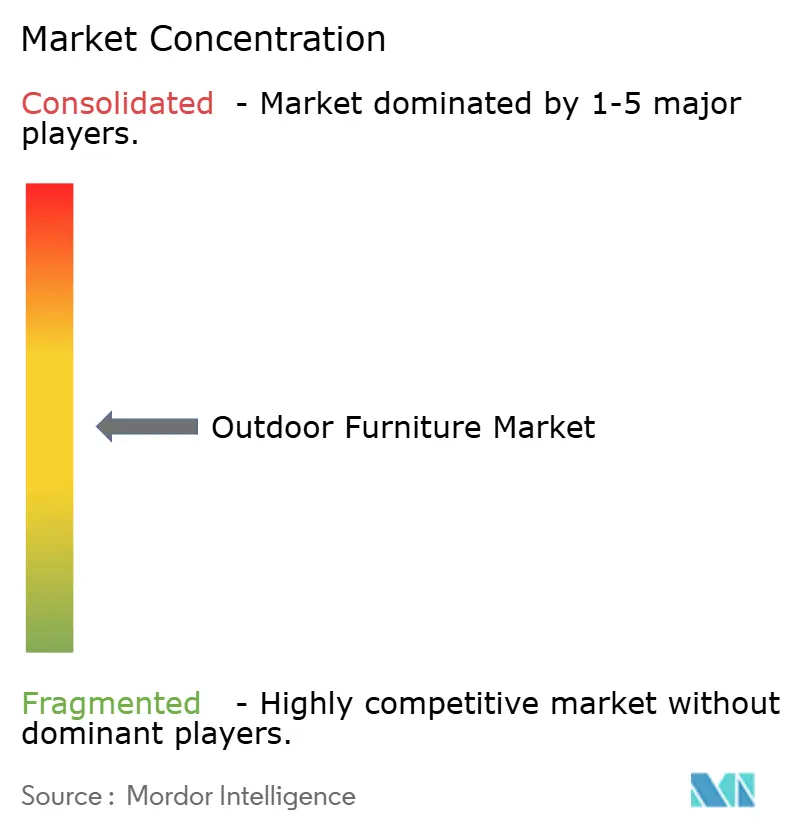
| Market Concentration | Medium |
Major Players *Disclaimer: Major Players sorted in no particular order Image © Mordor Intelligence. Reuse requires attribution under CC BY 4.0. | |
Outdoor Furniture Market Analysis by Mordor Intelligence
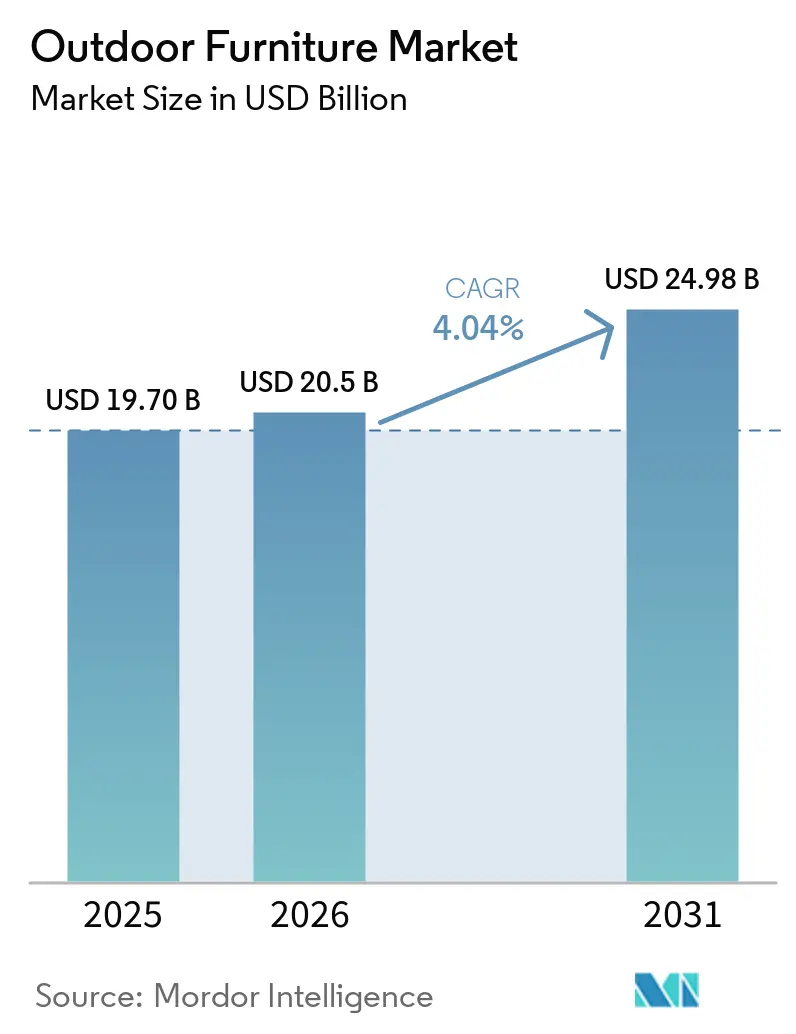
The outdoor furniture market size was valued at USD 19.70 billion in 2025 and estimated to grow from USD 20.5 billion in 2026 to reach USD 24.98 billion by 2031, at a CAGR of 4.04% during the forecast period (2026-2031). Despite volatile raw-material costs and seasonal demand swings, the sector is set to maintain steady growth as manufacturers pivot to eco-friendly materials, modular designs, and omnichannel distribution. Strong investment in resort construction, rooftop amenities, and outdoor-living renovations keeps commercial demand high while the residential segment accelerates on the back of work-from-home lifestyle shifts. Premium collections outpace the overall market as buyers weigh total cost of ownership and curb-appeal value more heavily than the upfront price. Material innovation, especially recycled composites and hybrid designs, remains a crucial differentiator, while smart features such as built-in charging ports help brands stand out in a crowded field.
Key Report Takeaways
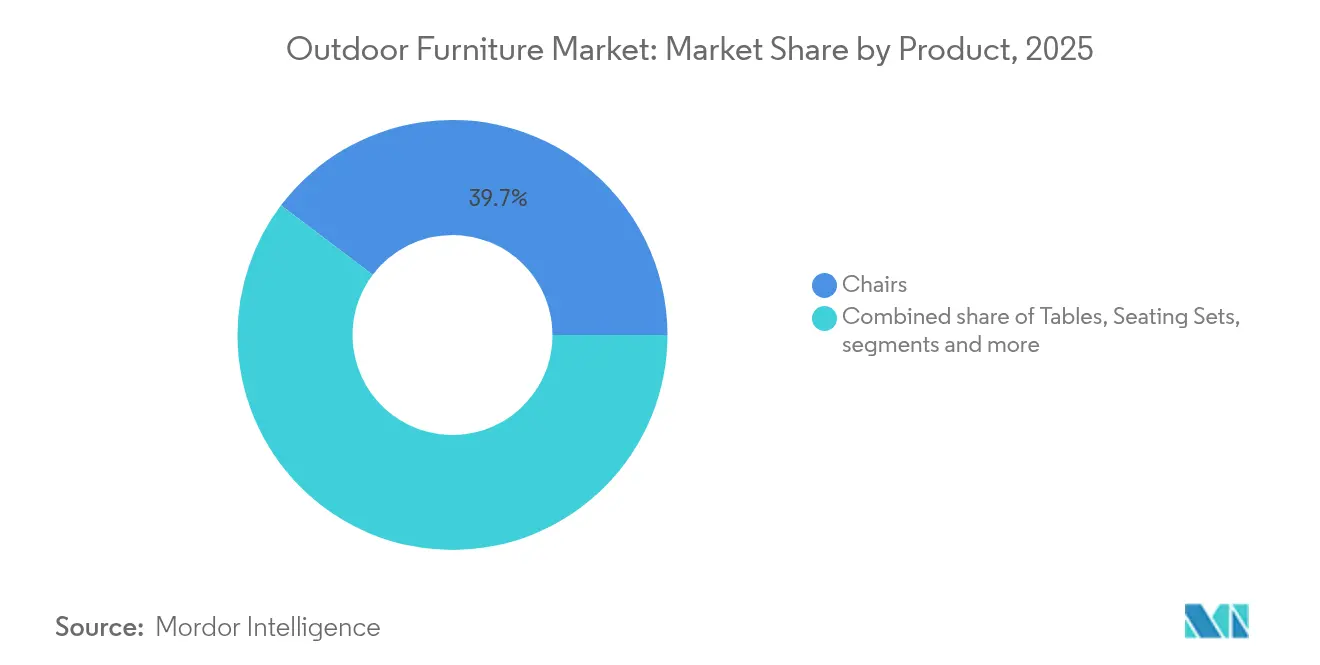
- By product, chairs led with 39.70% outdoor furniture market share in 2025, while loungers and daybeds are projected to grow at a 5.68% CAGR through 2031.
- By end user, the commercial segment captured 59.20% of the outdoor furniture market in 2025; the residential segment is forecast to expand at a 5.19% CAGR to 2031.
- By material, wood held 39.60% outdoor furniture market share in 2025; plastics and polymers are advancing at a 5.0% CAGR.
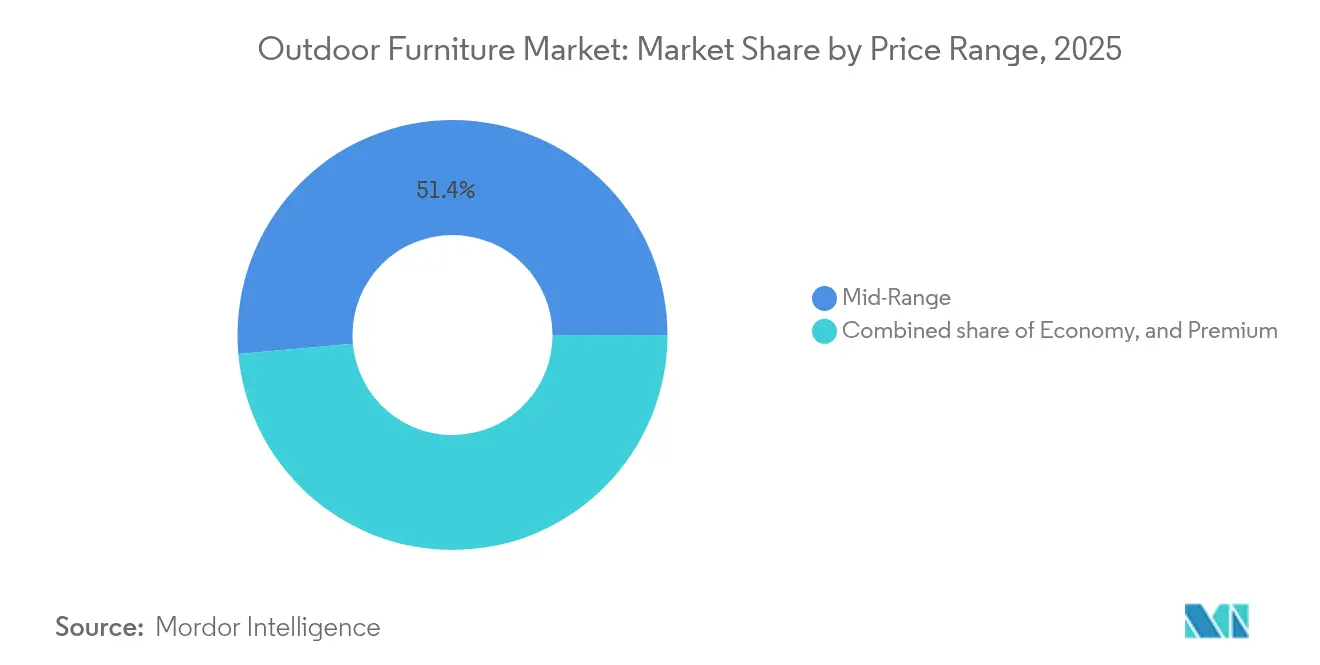
- By price range, the mid-range tier accounted for 51.40% of the outdoor furniture market in 2025; the premium tier is set to rise at a 5.88% CAGR.
- By distribution channel, the B2B/contractor route represented 58.60% of the outdoor furniture market in 2025; the online channel within B2C/retail is advancing at a 6.86% CAGR.
- By geography, Asia-Pacific commanded 45.70% outdoor furniture market share in 2025 and is pacing a 6.27% CAGR to 2031.
Note: Market size and forecast figures in this report are generated using Mordor Intelligence’s proprietary estimation framework, updated with the latest available data and insights as of 2026.
Market Trends and Insights
Drivers Impact Analysis of Outdoor Furniture Market*
| Driver | (~) % Impact on CAGR Forecast | Geographic Relevance | Impact Timeline |
|---|---|---|---|
| Resort and boutique-hotel construction raising demand for premium poolside sets | +1.2% | North America, Europe, Asia-Pacific | Medium term (2-4 years) |
| Outdoor-living room renovation trend among millennials and Gen-X homeowners | +0.9% | Global, led by North America and Europe | Long term (≥ 4 years) |
| Direct-to-consumer e-commerce platforms are easing bulk purchases | +0.7% | Global | Short term (≤ 2 years) |
| Urban rooftop and co-working terrace projects adopting modular sets | +0.5% | Asia-Pacific, Europe, North America | Medium term (2-4 years) |
| Environmental regulations and green procurement | +0.3% | Europe, North America, and Asia-Pacific | Long term (≥ 4 years) |
| Source: Mordor Intelligence | |||
Surging Resort and Boutique-Hotel Construction Boosting Premium Poolside Furniture Demand
Developers in 2025 allocated Furniture, Fixtures, and Equipment (FF&E) budgets to outdoor zones, turning pool decks and beach clubs into headline amenities that drive guest bookings and social-media exposure. Marriott’s network expansion to 8,800 properties across 139 countries and its 2025 leisure-travel revenue surge testify to the scale of future demand.[1]Marriott Investor Relations, “Annual Report 2024,” Marriott International, marriott.gcs-web.com Properties increasingly specify modular seating that can be reconfigured for events, pushing suppliers to design re-stackable frames and quick-swap cushions. Contract buyers also demand performance fabrics that resist sunscreen stains, salt spray, and UV fading across multiyear duty cycles. As hospitality pipelines diversify into glamping, bungalow, and wellness-retreat formats, product lines that blend resort durability with boutique aesthetics enjoy an enlarged addressable market.
Outdoor-Living Room Renovation Trend among Millennials and Gen-X Homeowners
Homeowners now treat patios, balconies, and yards as true extensions of the floor plan, with deep-seating sectionals, plush daybeds, and coordinated décor mirroring indoor comfort. Millennials already account for a rising share of category spending and frequently dedicate up to one-quarter of home-improvement budgets to open-air spaces. Manufacturers respond with mix-and-match modules that let buyers add pieces over successive seasons, mitigating budget constraints while driving brand loyalty. Built-in USB ports, solar-powered lighting, and weather-responsive textiles boost functional value and create cross-sell opportunities for smart-home suppliers. Architectural Digest reports that 82% of U.S. homeowners became more inclined to upgrade outdoor areas post-pandemic, a signal that the behavior has structural rather than temporary roots.
Direct-to-Consumer E-commerce Platforms Lowering Barriers for Bulk Outdoor Furniture Purchases Globally
Specialized DTC platforms give retailers, developers, and residential buyers instant visibility into pricing tiers and lead times once available only through offline dealer networks. Augmented-reality tools improve conversion by letting users visualize true-to-scale items in situ, while back-end integrations provide real-time inventory updates. Fermob’s B2B portal, which now contributes one-quarter of turnover, illustrates the efficiency benefits of a digital-first model. Manufacturers are leveraging these channels to trial limited-edition collections, gather usage analytics, and run just-in-time production cycles that cut stock obsolescence.
Environmental Regulations and Green Procurement
Europe leads with strict limits on chemical preservatives and deforestation, forcing global suppliers to verify the chain of custody and adopt water-based finishes. Public-sector tenders and corporate sustainability pledges now require environmental product declarations or comparable proofs of recycled content. Companies such as Kedel have commercialized 100% recycled plastic benches that outperform timber in marine and park settings while ticking ESG boxes for institutional buyers. As compliance costs rise, vertically integrated firms with traceable material flows gain margin resilience and regulatory headroom.
Restraints Impact Analysis of Outdoor Furniture Market*
| Restraint | (~) % Impact on CAGR Forecast | Geographic Relevance | Impact Timeline |
|---|---|---|---|
| Volatile raw-material prices are squeezing manufacturer margins | -0.8% | Global, high in Asia-Pacific | Medium term (2-4 years) |
| Seasonality and weather variability raise inventory risk | -0.6% | North America, Europe | Short term (≤ 2 years) |
| Stringent anti-deforestation and chemical-preservative rules limiting wood supply | -0.4% | Europe, North America, and the Global impact | Long term (≥ 4 years) |
| Source: Mordor Intelligence | |||
Volatile Raw-Material Prices Pressuring Manufacturer Margins
Aluminum, teak, and petroleum-based inputs have swung sharply since 2024, leaving mid-market producers vulnerable. Material efficiency in wood processing can range from 70–85%; any spike in timber prices flows straight to cost of goods sold and erodes profitability. Larger groups combat volatility through multi-source contracts and scrap-recycling programs, yet smaller firms must either hedge, absorb the hit, or pass costs to distributors. Capital-intensive vertical-integration moves promise future savings but worsen near-term cash-flow strain.
Seasonality and Weather Variability Increasing Inventory Risk for Retailers
Erratic spring or autumn onset distorts sell-through timelines, resulting in premature markdowns and costly overstocks. Because outdoor sets occupy significant floor and warehouse space, missed sales windows can impair a retailer’s entire year. Merchants now experiment with seasonless assortments and drop-ship partnerships that shift stock risk back onto factories equipped for flexible manufacturing.
*Our forecasts treat driver/restraint impacts as directional, not additive. The impact forecasts reflect baseline growth, mix effects, and variable interactions.
Outdoor Furniture Market Segment Analysis
By Product:
Loungers Lead Relaxation RevolutionLoungers and daybeds are the fastest-growing category, advancing at a 5.68% CAGR as buyers invest in premium relaxation pieces suitable for pool decks and shaded reading nooks. The chairs segment, while mature, retained 39.70% of 2025 revenue and continues to anchor bundled patio sets in both hospitality and residential channels. Advancements in quick-dry foams, UV-stable dyes, and ergonomic forms elevate perceived value and extend upgrade cycles. Integrated side tables, shade articulations, and electronic charging modules further differentiate high-end loungers amid rising competition.
Manufacturers target multifunctional formats that adapt from sun-bathing to social-gathering layouts, an approach favored in urban settings where balconies double as dining and lounging zones. The outdoor furniture market size for loungers is expected to outstrip overall growth as wellness-focused consumers allocate discretionary income toward yoga daybeds and zero-gravity recliners. Meanwhile, dining tables and benches gain traction in commercial patios where year-round outdoor service extends guest capacity. Designers cite texture layering—rope, woven accents, and teak inserts—as a key tactic to lift aesthetic appeal without hiking frame weight.



By Material:
Sustainability Drives InnovationWood preserved its 39.60% share in 2025 on the strength of teak’s weather resistance and warm appeal, yet supply constraints and price sensitivity push experimentation with eucalyptus, bamboo, and thermally modified pine. Rattan furniture is also gaining attention for its lightweight construction, natural appearance, and suitability for outdoor settings. Plastics and polymers hold the highest growth runway at 5.0% CAGR as suppliers commercialize recycled composites such as ScanCom’s DuraPlast, which meets circular-economy goals while outperforming virgin HDPE under UV exposure. Hybrid builds combine aluminum skeletons with synthetic-rope or TechTeak slats, creating lighter yet robust profiles that speed container loading and reduce freight emissions.
Commercial buyers increasingly request environmental declarations alongside warranty documents, embedding sustainability into the procurement scorecard. The outdoor furniture market size for recycled plastic collections is set to climb steadily, supported by park agencies and hospitality chains seeking maintenance-free solutions. Metal frames remain the mainstay in high-traffic venues where resistance to impact and vandalism supersedes weight considerations. Powder-coat advancements and marine-grade stainless steel bolsters corrosion defenses in coastal installations.
By End User:
Commercial Dominance PersistsCommercial projects captured 59.20% of 2025 revenue, underpinned by hotel, resort, restaurant, and corporate campus spending. Hospitality designers specify furniture that marries luxury aesthetics with contract durability, including concealed fasteners and replaceable upholstery panels for cost-efficient refurbishment. Restaurants have converted sidewalks, rooftops, and car parks into semi-permanent al-fresco zones, keeping demand elevated even in cooler climates through the addition of heaters and windbreaks.
The residential segment is posting a 5.19% CAGR as homeowners continue pandemic-era investments in outdoor sanctuaries configured for remote work, family gatherings, and wellness activities. The outdoor furniture market size for premium residential sets is forecast to rise faster than mid-market offers, reflecting homeowners’ willingness to pay more for weather-proof fabrics and extended warranties. Commercial aesthetics increasingly influence residential tastes, while homeowners’ desire for commercial-grade robustness encourages crossover designs with thicker wall sections and contract-grade fabrics.
By Price Range:
Premium Segment AcceleratesMid-range collections held 51.40% of revenue in 2025, but premium lines are tracking a 5.88% CAGR on the back of affluent consumer demand for bespoke finishes, muted jewel tones, and artisan craftsmanship. Buyers justify the uplift through lower lifetime maintenance and stronger resale value if properties change hands. Premium producers now offer bundle design consultation, 3D space planning, and white-glove delivery, making service a key value driver alongside product.
Economy tiers still serve first-time buyers and price-sensitive rental markets, yet rising awareness of durability gaps constrains their share gains. Manufacturers leverage feature migration, such as quick-dry foam and Sunbrella-level fabrics, to refresh mid-range lines and defend volume. The outdoor furniture industry uses premium innovation as a halo effect that elevates perceived quality across an entire brand portfolio in both residential and commercial eyes.
By Distribution Channel:
B2B Efficiency Drives GrowthThe B2B pathway concentrates 58.60% of sales due to developers and hospitality groups sourcing in bulk to lock consistent aesthetics across multi-site portfolios. Dedicated sales teams, project-management software, and just-in-sequence shipping schedules create stickiness with these clients. Contract furniture makers integrate BIM libraries and configurable SKUs to streamline specifications with architects and procurement teams.
Within the retail/B2C segment, which represents 41% of global revenue, online channels show the fastest expansion, registering a 6.86% CAGR forecast for 2026-2031. Growth is propelled by sharper 3-D visualization tools, broader SKU depth, and frictionless checkout options that make high-ticket outdoor items easier to buy sight-unseen. Retailers and home centers retain relevance in residential starter sets by offering immediate pickup and adjacent categories such as grills and décor. However, DTC platforms now bridge showroom inspiration and online convenience, providing AR visualization, chat-based design advice, and no-interest financing. The outdoor furniture market sees rising hybrid models: brands operate flagship experiences for tactile engagement, then route transactions to web portals that carry the full catalog, reducing inventory overhead.
Geography Analysis
APAC Outdoor Furniture Market
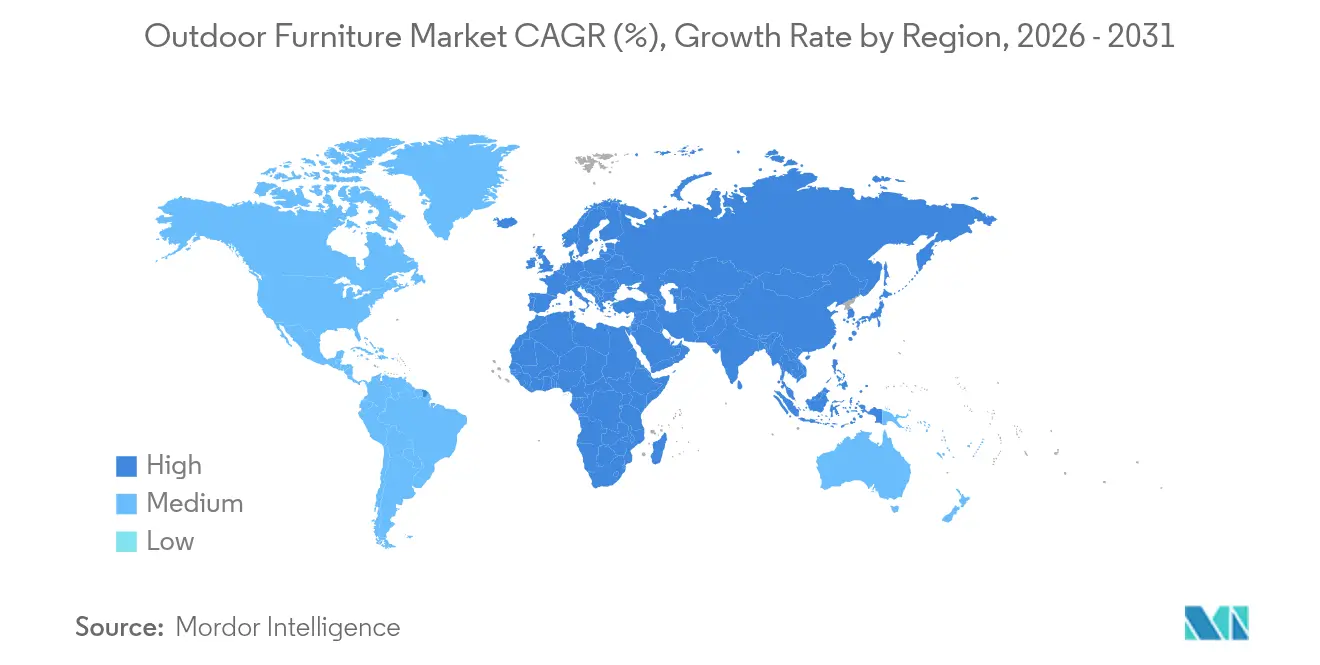
Asia-Pacific leads with a 45.70% share and should maintain a 6.27% CAGR to 2031 as rising urban middle-class households adopt Western-style outdoor-living concepts. China dominates production and internal demand, while India’s fast-growing residential construction and hotel pipelines underpin long-run volume gains. Japan and South Korea focus on compact, modular lines that suit high-density living, whereas Australia spends heavily on all-season alfresco culture. Singapore and Malaysia benefit from tourism and luxury condos that demand high-end communal decks furnished with contract-grade sets.
North America Outdoor Furniture Market
North America ranks second in revenue. The United States remains the bellwether; its deep-seated patio culture drives replacement cycles every four to six years. Covered porches and three-season rooms mitigate strict winter off-season periods, smoothing sales curves. Canada mirrors the U.S. in design tastes but emphasizes harsher climate resistance. Mexican demand rises as resort development and a growing middle class converge. Reshoring is also gaining traction as U.S. case-goods manufacturers convert tariff headwinds into competitive advantage by relocating portions of production to domestic facilities. These moves shorten lead times, buffer supply-chain shocks, and let brands highlight “Made in USA” provenance in premium positioning. This intensifies competition for skilled labor and raises interest in automation technologies to offset higher labor cost.
Europe Outdoor Furniture Market
Europe exhibits sophisticated taste and strict sustainability. Germany spearheads eco-compliance, forcing suppliers to refine coatings and secure FSC timber certificates. France and Italy leverage heritage manufacturing and design cachet in the premium tier, while the Nordics favor weather-adaptive textiles that cope with short summers and long winters. Mediterranean nations sustain a robust café culture that privileges dining sets, umbrellas, and stackable seating. Eastern Europe expands its manufacturing footprint, luring OEM contracts and accelerating domestic availability of mid-range collections.

Regulatory Landscape
Outdoor furniture safety and compliance requirements are tightening across major consuming regions, which raises the bar for testing, labeling, and traceability for both brick-and-mortar and online sellers. In Europe, the General Product Safety Regulation, Regulation (EU) 2023/988 (GPSR), has been fully applicable since December 2024. It broadens obligations for manufacturers and marketplaces to ensure non-food consumer products meet updated safety expectations, strengthening post-market surveillance and documentation for outdoor furniture sold across channels.
Product performance and mechanical safety benchmarks are also being refreshed. In May 2026, CEN released EN 581-2:2026 (seating) and EN 581-3:2026 (tables) to update mechanical safety requirements for camping, domestic, and contract outdoor furniture in the EU. In the United States, trade policy continues to influence sourcing decisions. The USTR maintained Section 301 tariff actions as an active enforcement area, with a July 2026 public-comment deadline tied to the ongoing process, keeping import-cost volatility in focus for furniture retailers and brands managing China-linked supply chains.
Value Chain Analysis
The outdoor furniture value chain starts with inputs such as aluminum extrusions, steel, FSC-certified hardwoods (notably teak alternatives and veneers), plastics and polymers (including recycled resins), foams, performance textiles, and coatings or finishes. Manufacturing includes frame fabrication (welding, casting, and powder coating), weaving and sling or textile assembly, wood processing, cushion sewing, and final assembly and packaging. Production remains concentrated in Asia, with dense clusters in China (notably Zhejiang and Guangdong) supporting vertical integration across aluminum and PE rattan-related components. At the same time, sustainability-linked constraints, including limited availability of certified wood and longer lead times for water-based PU coatings, are increasingly shaping procurement and planning.
Downstream, products move through B2B project channels (hotels, resorts, restaurants, real estate, and public-sector tenders) and B2C retail and online channels, supported by regional warehouses, last-mile delivery, and installation and after-sales services such as replacement slings, cushions, and refurbishment. Lead times have become a competitive lever, with reported median order-to-delivery cycles extending to 16.3 weeks by early 2026 as factories retool for lower-VOC finishing and compliance processes. Some brands also diversify frames and subassemblies toward nearer-shore locations such as Turkey and Mexico to reduce logistics exposure and tariff risk. Modular design and vendor-managed inventory partnerships are being used to limit SKU complexity, manage seasonal peaks, and improve fill rates for both contract projects and e-commerce-driven replenishment.
Competitive Landscape
The outdoor furniture market hosts global manufacturers, regional specialists, and agile DTC entrants, creating a moderately concentrated competitive landscape. Leading groups leverage vertical integration—from sawmill to upholstery—and multi-brand portfolios that cover economy through luxury. Mid-tier brands often pursue niche differentiation in materials, such as HDPE lumber or artisan wicker, to avoid direct price wars.
Lean manufacturing fused with sustainability yields measurable performance gains.[3]Marek Wieruszewski et al., “Economic Efficiency of Pine Wood Processing in Furniture Production,” Forests Journal, doi.org Leaders also deploy digital twins to simulate weather exposure and structural loads, shortening design-to-launch cycles. Polywood remains a benchmark for recycled-plastic lumber adoption, locking in hospitality contracts where maintenance-free durability offsets higher acquisition costs.
Strategic moves center on capacity expansion, material innovation, and omnichannel integration. Marriott-aligned suppliers invest in regional warehouses to fulfill rollouts across multiple hotel flags. Competitive tension is elevated by lifestyle retailers and grill makers broadening into furniture bundles, diluting traditional segmentation lines, and intensifying the race for consumer attention.
Outdoor Furniture Industry Leaders
IKEA
Ashley Furniture Industries Inc.
Brown Jordan Inc.
Agio International Company Ltd.
Keter Group
- *Disclaimer: Major Players sorted in no particular order
Outdoor Furniture Market Companies Covered in this Report
- IKEA
- Ashley Furniture Industries Inc.
- Brown Jordan Inc.
- Agio International Company Ltd.
- Century Furniture LLC
- Keter Group
- Lloyd Flanders Industries
- Homecrest Outdoor Living LLC
- POLYWOOD LLC
- Treasure Garden Inc.
- Dedon GmbH
- Kettal Group
- TUUCI LLC
- Fermob SA
- Gloster Furniture GmbH
- Roda Srl
- Royal Botania NV
- ScanCom International A/S
- B&B Italia (Outdoor Collection)
- RH (Restoration Hardware)
- La-Z-Boy Outdoor (Sunset West)

Market Opportunities and Future Outlook
Sustainability-driven materials and compliance-ready product documentation create space for suppliers that can provide verified recycled content, chain-of-custody wood sourcing, and clear safety files for both B2B tenders and online retail. The December 2024 applicability of the EU GPSR, along with the May 2026 updates to EN 581-2 and EN 581-3, increases the importance of test-backed designs and traceability across seating and tables. This, in turn, supports demand for standardized, contract-grade SKUs that can be specified repeatedly across multi-site hospitality and public-space projects.
Manufacturing innovation is also opening opportunities for faster iteration, more localized production, and made-to-order customization, particularly for premium and project-led demand where lead time and finish control matter. In May 2026, Haddy opened a 3,000-square-metre AI-controlled robotic micro-factory in St Petersburg, Florida, for large-format 3D printing, with a stated capacity of 300,000 furniture parts annually, illustrating an on-demand production pathway closer to end markets. Materials R&D is expanding the design palette for weather-exposed seating as well. In January 2026, Fraunhofer WKI highlighted completion of the LinumTube cooperation project (July 2024 to August 2025), using multi-layer flax fiber fabric covers and a steel substructure with zero-waste weaving approaches, which supports development of alternative, lower-impact seating constructions for outdoor-living and contract use.
Recent Industry Developments in Outdoor Furniture Market
- May 2026: Haddy opened a 3,000-square-metre AI-controlled robotic micro-factory in St Petersburg, Florida, for large-format 3D printing with a capacity of 300,000 furniture parts annually. The new facility supports on-demand production close to key markets and strengthens resilience in supply chains for outdoor furniture components.
- April 2026: IKEA launched the SOLUPPGANG outdoor collection globally, focusing on portable, affordable items such as foldable furniture and enamelled steel tableware for casual outdoor use. The rollout broadens entry- and mid-tier assortment breadth in core retail channels and heightens price-competitive pressure in mass-market outdoor categories.
- July 2025: Ashley Furniture Industries debuted its Outdoor by Ashley collection and opened a 9,000-square-foot showroom at Casual Market Atlanta in AmericasMart Building 1. The extended physical footprint strengthens B2B engagement with retailers and designers, supporting faster line merchandising ahead of peak seasonal demand.


Outdoor Furniture Market Report Scope and Research Methodology
Market Definition and Coverage
This market covers movable furniture designed for outdoor use, for both residential and commercial settings, and it is tracked in value terms using selling prices at the manufacturer level.
Scope exclusions: built-in outdoor fixtures and site-built structures are not included. Adjacent outdoor living items, such as grills and patio heaters, are also excluded from the count.
Segments Covered in This Report
- By Product
- Chairs
- Tables
- Seating Sets
- Loungers and Daybeds
- Dining Sets
- Other Products
- By Material
- Wood
- Metal
- Plastic & Polymer
- Other Materials
- By End User
- Residential
- Commercial
- By Price Range
- Economy
- Mid-Range
- Premium
- By Distribution Channel
- Retail/B2C Channels
- Home Centers
- Specialty Stores
- Online
- Other Distribution Channels
- B2B Channel/Contractors
- Retail/B2C Channels
- By Geography
- North America
- Canada
- United States
- Mexico
- South America
- Brazil
- Peru
- Chile
- Argentina
- Rest of South America
- Europe
- United Kingdom
- Germany
- France
- Spain
- Italy
- BENELUX (Belgium, Netherlands, and Luxembourg)
- NORDICS (Denmark, Finland, Iceland, Norway, and Sweden)
- Rest of Europe
- Asia-Pacific
- India
- China
- Japan
- Australia
- South Korea
- South East Asia (Singapore, Malaysia, Thailand, Indonesia, Vietnam, and Philippines)
- Rest of Asia-Pacific
- Middle East And Africa
- United Arab of Emirates
- Saudi Arabia
- South Africa
- Nigeria
- Rest of Middle East And Africa
- North America
Data Sources, Market Sizing, and Validation
Desk Research
Desk work starts by mapping the outdoor seating, dining, and lounging demand pool and the corresponding supply chain, then aligning that to consistent value definitions across geographies. Public sources used include UN Comtrade trade statistics, World Bank macro indicators, national statistics offices for housing starts and consumer spending, and customs or tariff schedules that help separate furniture categories used outdoors.
To keep assumptions realistic, we also reviewed company annual reports and investor presentations, along with trade association pages and business press that cover furniture consumption and channel shifts. For additional triangulation, we referenced paid subscriptions for company financials and intelligence, and we used a shipment-level import and export database to cross-check trade flows and price bands. This list is not exhaustive, and additional sources were used for data collection, validation, and clarification throughout the work.
Primary Interviews and Surveys
Primary inputs were used to validate items that secondary sources typically do not isolate well, for example, outdoor versus indoor allocation in mixed furniture lines, typical price movements by material, and the split between residential upgrades and hospitality demand. We spoke with manufacturers, distributors, retailers, and large buyers across APAC, EMEA, and the Americas to check and adjust assumptions on volumes, channel mix, and margins.
Distribution of primary research fieldwork respondents
| Company type | Respondent position | Region |
|---|---|---|
| Top tier: 26% | CXOs: 13% | APAC: 45% |
| Mid tier: 59% | Functional/Unit leaders: 43% | EMEA: 33% |
| Smaller Players: 15% | Managers: 44% | Americas: 22% |
Market-Sizing & Forecasting
Sizing begins with a top-down build, where furniture demand is reconstructed using housing activity, consumer spending on furnishings, and trade and production signals that help isolate outdoor-suitable categories. After the total is formed, we run selective bottom-up approximations, such as sampled brand and channel price points multiplied by estimated unit movement in key countries, and then complete supplier and distributor sense checks.
Key inputs used in the model include housing completions and remodeling activity, hospitality capacity additions, outdoor living adoption in urban households, material mix shifts (wood, metal, plastic, and composites), and average selling price movement by product type and channel. Where bottom-up data is thin, we use proxy indicators such as import penetration and retail category growth rates, then normalize the results to avoid double counting across channels.
For forecasting, scenario analysis is used first and then anchored to a multivariate regression that links demand to macro variables such as real disposable income, housing turnover, and travel and lodging activity. Assumptions are refined based on expert feedback, with particular focus on price realization, seasonality, and how quickly online channels are changing the mix.
Data Validation & Update Cycle
Outputs are validated through multiple checks, comparing model totals against independent signals such as trade balances, pricing ranges from channel checks, and visible capacity and expansion announcements. If a country or region shows an unusual jump, we trace it back to the exact input series and review it again, and we trigger follow-up outreach when the variance cannot be explained with the available evidence.
Before sign-off, a second analyst reviews the logic, units, and currency conversions, and a final pass is completed close to delivery so the latest material events are reflected. The report is refreshed annually, and interim adjustments are made when major shifts occur in raw material pricing, trade flows, or demand conditions.
Mordor Intelligence's Global Outdoor Furniture Market Estimate Compared With Other Published Estimates
Published market values for outdoor furniture can differ widely because the counted product set, the pricing point applied in the value chain, and the timing of currency conversion are not always aligned. Differences also show up when one publisher uses manufacturer shipment logic and another uses retail sales value plus broader outdoor living add-ons.
Some estimates expand scope to include outdoor grills, patio heating, and other adjacent outdoor living products, which can lift the total. In Mordor Intelligence, only movable outdoor furniture is counted and it is kept at manufacturer-level pricing, then cross-checked with trade flows and housing and hospitality demand signals to reduce overstatement risk.
Benchmark comparison
| Source | Market Size | Gaps in Research Methodology |
|---|---|---|
| Mordor Intelligence | USD 20.5 B (2026) | |
| Industry Publisher A | USD 22.69 B (2024) | Uses a different base year and may mix revenue definitions across regions, and the scope description does not clearly separate outdoor furniture from nearby outdoor living categories or explain the price point used. |
| Industry Publisher B | USD 26.76 B (2030) | Provides a longer-horizon projection and uses a revenue forecast frame that can embed more aggressive adoption assumptions, and it does not clearly state exclusions like grills or heaters that can inflate the reported total. |
Overall, the spread is mainly explained by scope expansion into adjacent outdoor living items and by whether values are captured at retail or at manufacturer prices. By keeping the inputs tied to observable demand drivers and applying repeatable checks on prices and trade, the final number is easier to reconcile across regions and years.


Key Questions Answered in the Report
What is the size of the outdoor furniture market in 2026?
The outdoor furniture market stands at USD 20.5 billion in 2026 and is projected to hit USD 24.98 billion by 2031 at a 4.04% CAGR.
Which region holds the largest share of the outdoor furniture market?
Asia-Pacific leads with 45.70% market share in 2025 and is pacing the highest regional CAGR at 6.27% through 2031.
Which outdoor furniture product category is growing fastest?
Loungers and daybeds are the quickest-expanding segments with a 5.68% CAGR forecast for 2031.
What material type is gaining momentum in the outdoor furniture market?
Plastics and polymer composites are advancing at a 5.0% CAGR as recycled and weather-resistant formulations gain favor.
Which distribution channel generates the most outdoor furniture sales?
The B2B or contractor channel accounts for 58.60% of global revenue due to bulk hospitality and real-estate orders.
Page last updated on:




