
Market Overview
| Study Period | 2020 - 2031 |
|---|---|
| Forecast Data Period | 2026 - 2031 |
| Base Year Market Size (2025) | USD 125.81 Billion |
| Market Size (2026) | USD 130.57 Billion |
| Market Size (2031) | USD 157.20 Billion |
| Growth Rate (2026 - 2031) | 3.78 % |
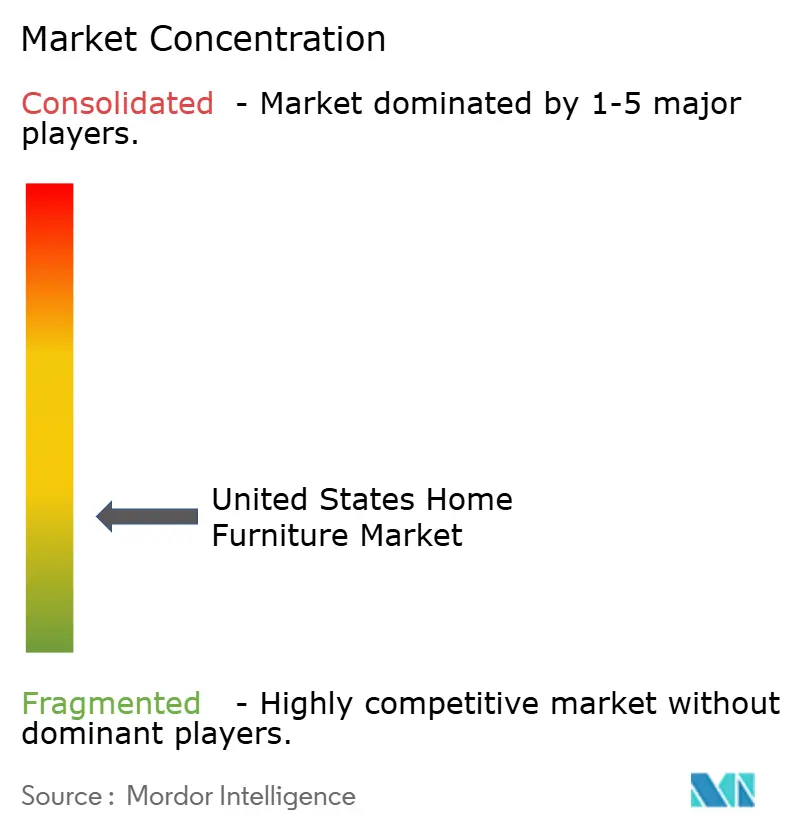
| Market Concentration | Low |
Major Players *Disclaimer: Major Players sorted in no particular order Image © Mordor Intelligence. Reuse requires attribution under CC BY 4.0. | |
United States Home Furniture Market Analysis by Mordor Intelligence
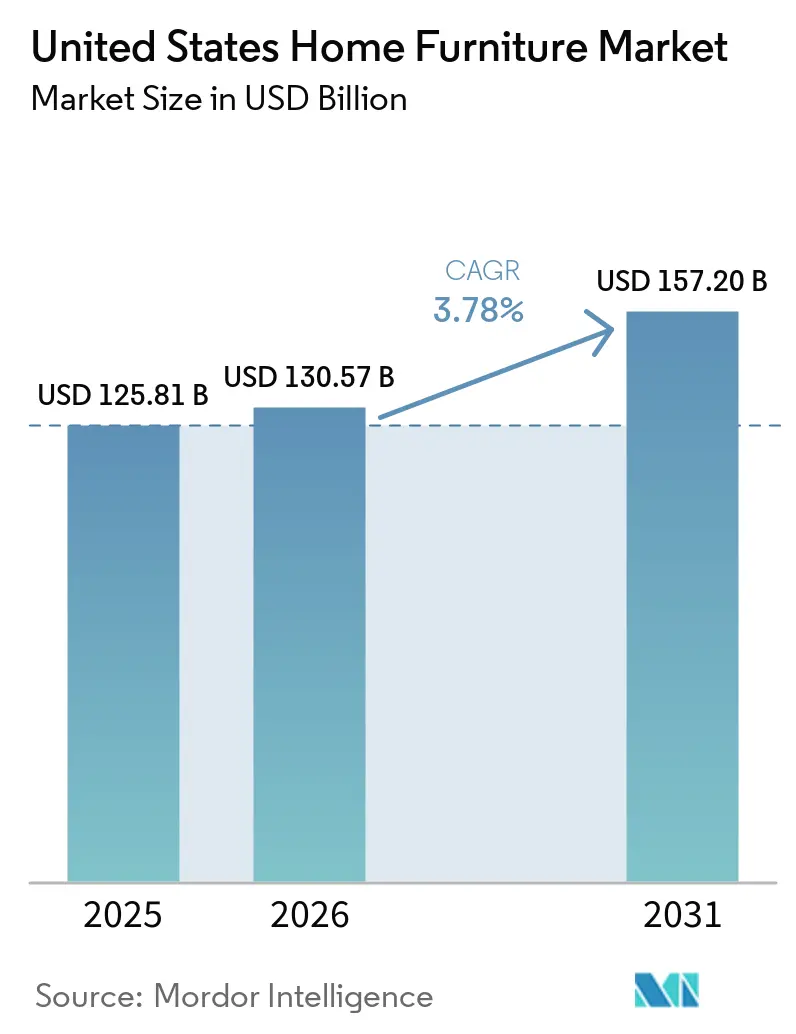
The US home furniture market size was valued at USD 125.81 billion in 2025 and estimated to grow from USD 130.57 billion in 2026 to reach USD 157.2 billion by 2031, at a CAGR of 3.78% during the forecast period (2026-2031). Growth rests on immigration-driven household formation, a remodeling boom, and rising demand for multi-functional furnishings that fit compact urban layouts. Housing turnover remains muted because mortgage rates stay elevated, encouraging owners to remodel and replace furniture instead of relocating. The US home furniture market benefits from sustained federal and state sustainability incentives that favor certified wooden products. Import competition and freight volatility continue to challenge margins even as supply-chain automation lowers production cost for leading manufacturers.
Key Report Takeaways
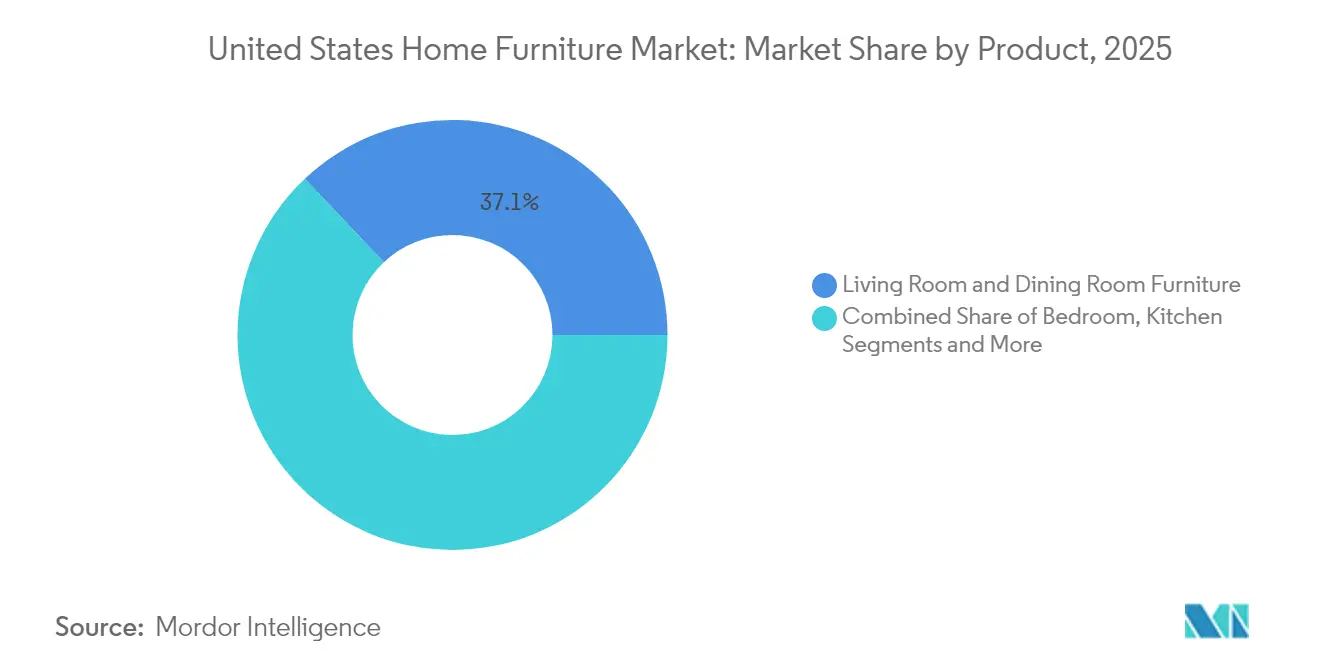
- By product category, Living Room and Dining Room Furniture led with a 37.05% share of the US home furniture market in 2025; Bedroom Furniture is projected to expand at a 4.11% CAGR through 2031.
- By material, Wood captured 62.10% of the US home furniture market size in 2025, while the Plastic & Polymer segment is set to grow at a 4.6% CAGR to 2031.
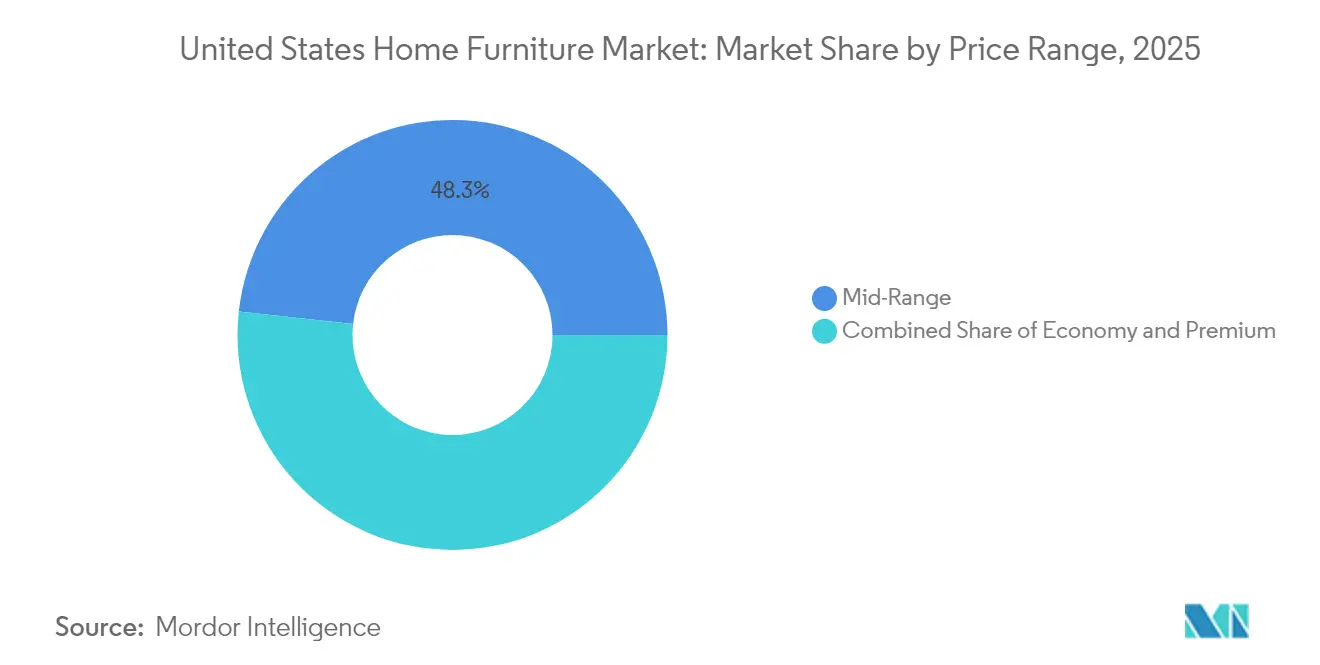
- By price range, Mid-Range offerings held 48.25% of the US home furniture market share in 2025; Premium products are forecast to post a 4.96% CAGR to 2031.
- By distribution channel, Specialty Stores accounted for 74.85% revenue share in 2025; Online retail is advancing at a 6.4% CAGR through 2031.
- By geography, the West commanded 27.05% of regional sales in 2025, while the Southwest is on track for a 5.18% CAGR to 2031.
Note: Market size and forecast figures in this report are generated using Mordor Intelligence’s proprietary estimation framework, updated with the latest available data and insights as of 2026.
Market Trends and Insights
Drivers Impact Analysis of United States Home Furniture Market*
| Driver | (~) % Impact on CAGR Forecast | Geographic Relevance | Impact Timeline |
|---|---|---|---|
| Improved Condo Affordability Spurs Demand for Modular, Multi-Functional Furniture | +0.8% | West Coast metros, Northeast urban cores | Medium term (2-4 years) |
| Rising Home-Renovation Spending | +1.2% | National, with concentration in high-income metros | Short term (≤ 2 years) |
| Rapid Growth of D2C Online Furniture Start-Ups with Free-Return Logistics | +0.6% | National, urban-centric adoption | Medium term (2-4 years) |
| Immigration-Led Household Formation Increasing First-Time Furniture Purchases | +0.9% | Gateway cities, Sunbelt expansion markets | Long term (≥ 4 years) |
| Federal/Provincial Sustainability Rebates Accelerating Uptake of Eco-Certified Wooden Products | +0.4% | California, Northeast states with green incentives | Long term (≥ 4 years) |
| AI-powered AR/VR visualization tools boosting conversion | +0.3% | Tech-forward metros, younger demographic clusters | Medium term (2-4 years) |
| Source: Mordor Intelligence | |||
Improved Condo Affordability Spurs Demand for Modular, Multi-Functional Furniture
Condominium price corrections in several coastal markets enable first-time buyers to enter homeownership sooner. These smaller units require versatile furniture, and buyers spend 23% more on space-saving products than single-family counterparts[1]. Millennials favor sectional sofas that separate into configurable pieces, fueling sectional demand across living-room lines. Manufacturers now bundle storage ottomans and convertible tables that shift from work to dining use within minutes. The US home furniture market gains incremental revenue as condo buyers furnish entire units in compressed purchasing windows.
Rising Home-Renovation Spending
Americans spent USD 603 billion on remodeling in 2024, and outlays are slated to reach USD 509 billion in 2025 despite tighter credit. Kitchen projects averaging USD 35,000 and bathroom remodels near USD 17,000 lead to coordinated furniture upgrades that complement new finishes. Elevated mortgage rates lock many owners into existing homes, multiplying renovation cycles across longer ownership periods. Baby Boomers account for the majority of projects and prioritize age-friendly furniture designs. Premium cabinets and dining pieces that match renovated interiors raise average selling prices in the US home furniture market.
Rapid Growth of D2C Online Furniture Start-Ups with Free-Return Logistics
Online furniture sales reached 29% of all home-improvement spend in 2024 as D2C brands removed risk through free returns and AR visualization tools. Eighty percent of shoppers say confidence rises when they can preview scale and color in augmented reality experiences. Subscription and rental models gain urban traction, offering flexibility for transient renters while generating recurring revenue for brands. Data-driven inventory planning shortens delivery times and minimizes stock-outs. The US home furniture market thus shifts toward omnichannel ecosystems that merge digital engagement with physical servicing.
Immigration-Led Household Formation Increasing First-Time Purchases
Net international migration added 6 million residents between 2021 and 2024, and recent arrivals show a 30% household-formation rate. More than 1 million new households will fully furnish homes over the next five years, favoring entry-level sets initially and premium upgrades later. Sunbelt metros capture much of this demand thanks to employment growth and affordable housing. Cultural preferences for large dining sets and multi-generational layouts expand category breadth. The US home furniture market thereby secures a durable volume pipeline independent of domestic birth trends.
Restraints Impact Analysis of United States Home Furniture Market*
| Restraint | (~) % Impact on CAGR Forecast | Geographic Relevance | Impact Timeline |
|---|---|---|---|
| Interest-Rate-Driven Housing-Market Slowdown Dampening Big-Ticket Furniture Sales | -1.1% | National, acute in high-cost coastal markets | Short term (≤ 2 years) |
| Persistent Freight & Port Delays Lengthening Delivery Lead-Times | -0.7% | Import-dependent regions, West Coast ports | Medium term (2-4 years) |
| US Import Price Competition Under USMCA Squeezing Domestic Margins | -0.6% | Manufacturing-heavy regions, North Carolina, Southeast | Long term (≥ 4 years) |
| Rising import penetration despite Section 301 tariffs | -0.8% | National, concentrated in wood furniture segments | Medium term (2-4 years) |
| Source: Mordor Intelligence | |||
Interest-Rate-Driven Housing-Market Slowdown Dampening Big-Ticket Sales
Existing-home transactions are projected to decline by 4.3% year-on-year in early 2025, reducing furniture purchases typically associated with home moves. Mortgage rates exceeding 6% are expected to deter budget-conscious buyers, impacting demand for complete bedroom and dining sets. Consumer confidence has reached decade lows, prompting households to delay discretionary upgrades. While retailers offer promotional financing to mitigate high prices, tighter credit standards have lowered acceptance rates. The US home furniture market faces a mixed scenario, with renovation-driven orders partially offsetting the decline in transaction-related demand.
Persistent Freight & Port Delays Lengthening Delivery Lead Times
Container rates fell from 2021 peaks yet remain double pre-pandemic norms, and port congestion keeps delivery windows at 12–16 weeks for many import-heavy categories[2]. Customers faced with prolonged waits pivot toward alternatives, in stock alternatives or delaying purchases, eroding conversion rates. Retailers invest in higher inventory buffers, increasing working-capital needs and warehousing costs. Domestic manufacturers scramble to source components locally or nearshore to Mexico in search of reliability. The US home furniture market shoulders incremental logistics expense that squeezes margins unless they pass through to price.
*Our forecasts treat driver/restraint impacts as directional, not additive. The impact forecasts reflect baseline growth, mix effects, and variable interactions.
United States Home Furniture Market Segment Analysis
By Product:
Versatile Living-Space Lines Anchor SalesLiving Room and Dining Room Furniture accounted for 37.05% of the US home furniture market share in 2025, underscoring the central role of communal spaces. Open-concept designs encourage coordinated sectional seating, media consoles, and dining sets that deliver visual continuity across connected zones. Manufacturers integrate stain-resistant fabrics and modular footprints to meet lifestyle demands for flexibility and easy maintenance. Bedroom Furniture posts the fastest growth at a 4.11% CAGR as consumers upgrade mattresses, nightstands, and wardrobes that now double as remote-work backdrops. Sleep-wellness awareness fuels premium mattress pairs bundled with adjustable bases and tech-enabled headboards.
Living-room dominance persists because streaming entertainment keeps households at home more often, driving replacement cycles for sofas and recliners subjected to daily use. Dining categories regain momentum after pandemic disruptions as consumers resume in-home gatherings. Bedroom spending benefits from bundled financing that allows shoppers to complete suites rather than purchase piecemeal. Emerging niches such as convertible vanity-desk hybrids tap the work-from-home trend without sacrificing floor space. Across categories, the US home furniture market favors designs that pivot smoothly between leisure, dining, and professional needs.

By Material:
Wood Retains Prestige Amid Polymer AdvancesWood secured 62.10% of 2025 revenue thanks to tactile warmth, renewable sourcing, and favorable carbon narratives verified under FSC protocols. Solid-oak dining tables and walnut bedroom frames anchor premium lines aimed at buyers seeking heirloom durability. Plastic & Polymer pieces are growing at a 4.6% CAGR as recycled composites and bio-based resins shed historical stigma around perceived flimsiness. Injection molding now produces sleek silhouettes impossible with traditional joinery, opening mid-century design reinterpretations at accessible prices. Metal lines hold steady by capitalizing on loft aesthetics and outdoor durability.
Supply-chain shocks spur interest in domestic hardwoods, reducing dependency on volatile Asian plywood flows. Consumer education campaigns by the Sustainable Furnishings Council elevate awareness of low-VOC finishes and formaldehyde limits. Polymer innovators tout closed-loop recyclability, aligning with rising Gen Z eco-values. Hybrid constructions mix wood veneers with polymer cores, cutting cost without undermining surface authenticity. Material choices hence diversify while wood continues anchoring brand narratives around craftsmanship within the US home furniture market size.
By Price Range:
Premiumization Gains MomentumMid-Range collections captured 48.25% of sales in 2025, balancing value engineering and tasteful design for mainstream households. Inflation fatigue nudges discerning shoppers toward Premium tiers that promise longevity, and this segment is advancing at a 4.96% CAGR through 2031. Brands justify higher tags by offering customizable finishes, integrated charging ports, and lifetime hardware warranties. Economy lines lose share to private-label imports that compress margins for traditional discount chains. Deferred-interest promotions help bridge affordability gaps, keeping volume flowing across brackets.
Resale platforms spotlight higher residual values on premium goods, reinforcing buy-once thinking among eco-minded consumers and supporting demand in the second hand furniture market. D2C labels leverage online configuration tools to deliver bespoke options at lower mark-ups than boutique showrooms. Warranty length emerges as a decisive factor, with ten-year coverage now common in premium mattresses and sofas. Regional wealth hubs along the coasts post outsized premium penetration, while value-oriented heartland markets lean mid-range. The US home furniture market size is thus segments along income lines, yet trends toward quality investment over frequent replacement.
By Distribution Channel:
Omnichannel Takes Center StageSpecialty Stores retained 74.85% revenue share in 2025 by combining tactile displays with design consultations that remain persuasive for big-ticket decisions. Many now integrate endless-aisle kiosks and virtual-reality planners to merge digital breadth with physical validation. Online channels, however, are racing ahead at a 6.4% CAGR as improved last-mile networks enable scheduled, room-of-choice delivery on bulky items. Home centers and warehouse clubs capture impulse buys on accent pieces yet struggle to match the visualization experiences offered by online leaders. Hybrid journeys dominate, with 45% of shoppers researching online before buying in-store.
Mobile checkout must be frictionless because a majority of Wayfair orders originate on phones; retailers, therefore, invest in faster page loads and one-tap payment integrations. Live-chat design advice and AI-driven recommendation engines lift online attachment rates. Showrooms deploy QR codes that transfer cart contents to customer phones for later completion, unifying channels. Inventory visibility across networked stores enables same-day pickup, satisfying immediacy expectations. The US home furniture market rewards retailers that present consistent pricing, availability, and service regardless of entry point.
Geography Analysis
The West claimed 27.05% of US home furniture market size in 2025, buoyed by California’s high incomes and stringent sustainability codes that spur demand for certified wood collections. Tech-centric wealth centers such as San Francisco and Seattle adopt AR-enabled shopping faster than other regions, setting digital benchmarks that ripple nationwide. Proximity to Pacific ports eases import flows, yet recent congestion motivates investment in Southern California distribution hubs that shorten final-mile distance. Open-plan urban condos drive strong sales of modular living-room systems designed for flexibility within compact footprints. West-coast style leadership often cascades to interior states within two product cycles, reinforcing the region’s trend-setting role.
The Southwest registers the fastest CAGR at 5.18% through 2031 as migrants and corporate relocations fuel continuous household formation. Texas metros like Dallas and Austin post double-digit population gains that translate directly into furniture demand across mid-range and premium brackets. Year-round mild weather expands outdoor-living categories, boosting demand for weather-resistant seating and dining sets. Hispanic cultural influences favor large family-gathering furniture, enlarging dining room order sizes. Business-friendly tax regimes attract manufacturers seeking central U.S. distribution nodes, further anchoring furniture supply chains within the region.
The Northeast, Southeast, and Midwest exhibit varied dynamics shaped by demographic shifts, manufacturing heritage, and climate. The Northeast maintains premium segment strength despite slower population growth because renovation frequency remains high in aging housing stock. The Southeast leverages logistical advantages and an existing upholstery cluster in North Carolina, supporting faster restock cycles for national chains. The Midwest grapples with out-migration yet retains strong specialty-store networks in Chicago and Minneapolis that serve regional customers seeking quality craftsmanship. These regions keep the US home furniture market diversified and resilient against localized shocks.
Value Chain Analysis
The US home furniture value chain begins with raw-material and component sourcing, including hardwood, engineered wood panels, foam, textiles, hardware, and finishes, which then feed into domestic manufacturing and imported finished goods. Domestic producers and assemblers supplement inputs with overseas components, while trade bodies such as the American Home Furnishings Alliance (AHFA), Association of Woodworking and Furnishings Suppliers (AWFS), and International Wood Products Association (IWPA) connect suppliers, manufacturers, and policy priorities across the ecosystem. Labor and capacity constraints in upstream inputs have become more visible, including closures among US textile mills during 2024-2025, which tightened upholstery and fabric availability for some categories.
Midstream operations include casegoods and upholstery plants, importers of finished furniture, and distributors that manage consolidation, packaging, and quality control before retail fulfillment. Specialty furniture stores remain a dominant downstream outlet in 2025, and online players continue to expand with dependence on parcel, LTL, and specialized furniture carriers for bulky delivery and returns. Logistics remains a key friction point, with port congestion and freight volatility extending lead times for import-heavy categories. Late-2024 port disruption planning pushed importers to build inventory buffers and reroute volumes to alternative gateways, shifting congestion onto domestic rail and warehousing networks. Retailers and manufacturers have responded by rationalizing assortments toward higher-velocity SKUs, holding more safety stock for best-sellers, and increasing nearshore sourcing where feasible to stabilize service levels and reduce working-capital swings tied to uncertain transit times.
Competitive Landscape
Three sizable deals have redefined scale economics: HNI’s USD 2.2 billion Steelcase purchase, Tempur Sealy’s USD 5 billion Mattress Firm takeover, and IKEA’s USD 2.2 billion omnichannel expansion program. Consolidators aim to secure procurement leverage, unified logistics, and cross-category assortment breadth. Ashley Furniture has invested USD 2 billion since 2017 on U.S. automation, deploying nearly 500 robots that raise throughput and mitigate labor shortages[4]. Despite scale moves, only 3% of brands offer native AR, leaving differentiation headroom for digital pioneers. Direct-to-consumer entrants exploit social-media reach and customizable product flows to chip away at legacy store loyalty.
Import price pressure endures as Chinese producers circumvent tariffs by shifting final assembly to Vietnam and Indonesia. Domestic firms counter with rapid-ship programs promising delivery in under two weeks, enabled by strategically located inventory pools. Sustainability credentials become must-have bid qualifiers in hospitality and government tenders, prompting widespread adoption of BIFMA LEVEL and GREENGUARD certifications. Subscription furniture start-ups remain niche yet spark interest among younger renters who value flexibility over ownership, prompting incumbents to pilot leasing models. Competitive intensity therefore spans cost, speed, sustainability, and experience, with few players excelling in all four.
Niche specialists carve defensible ground through localized craftsmanship, reclaimed-wood narratives, or heritage upholstery techniques. At the same time, artificial-intelligence tools for demand forecasting and hyper-personalized marketing gain traction among midsize chains aiming to close the data gap with e-commerce giants. IKEA’s new Plan & Order points illustrate how physical footprints can shrink while design services expand, lowering fixed costs per sale. Wayfair’s labeling program, “Wayfair Verified,” signals a push toward consistent quality metrics that could raise consumer expectations across the board. Overall, the US home furniture market rewards agile firms that scale sustainably and digitize customer interactions without abandoning tactile brand attributes.
United States Home Furniture Industry Leaders
-
Ikea
-
Williams-Sonoma, Inc.
-
Wayfair Inc.
-
Ashley Furniture Industries
-
La-Z-Boy Inc.
- *Disclaimer: Major Players sorted in no particular order
United States Home Furniture Market Companies Covered in this Report
- Ashley Furniture Industries
- Inter IKEA Holding B.V.
- Williams-Sonoma Inc. (Pottery Barn, West Elm)
- Wayfair Inc.
- La-Z-Boy Inc.
- American Signature Inc. (Value City)
- RH (Restoration Hardware)
- Ethan Allen Interiors
- Bassett Furniture Industries
- Flexsteel Industries
- Haverty Furniture Companies
- Hooker Furnishings Corp.
- Sauder Woodworking Co.
- American Woodmark Corp.
- Sleep Number Corp.
- Tempur Sealy International
- Casper Sleep Inc.
- Rooms To Go Inc.
- Crate & Barrel Holdings
- Amazon.com Inc. (Furniture category)
- Walmart Inc.
- Overstock.com Inc.
Market Opportunities and Future Outlook
Customization and fast-ship capability stand out as growth levers across modular and upholstery-heavy categories as consumers look for configurable footprints, durable performance fabrics, and coordinated looks tied to remodeling projects. The investment signals seen in 2025-2026 point to a renewed focus on domestic capacity and quicker replenishment, including Peachtree Works initiating domestic manufacturing in Candor, North Carolina in December 2025 using about 400,000 square feet to support the Braxton Culler and Classic Home brands, and multiple 2026 projects expanding production capability in North Carolina. In March 2026, Universal Furniture opened a 200,000-square-foot upholstery plant in Burke County with advanced CNC routers and automated cutting, while Davis Furniture expanded its High Point campus through a 124,000-square-foot building purchase and a groundbreaking for additional advanced manufacturing and showroom space.
Opportunities also sit where technology-enabled selling intersects with returns control as online furniture penetration rises and shoppers seek confidence before checkout. Retailers that deploy AR room visualization, stronger product data, and AI-supported discovery can reduce return friction and lift add-on attachment (delivery, protection plans, coordinating pieces) across omnichannel journeys, while continuing to use specialty-store strengths in consultation and tactile validation. On the supply side, brands with wood-heavy lines that pair sustainability claims with verifiable sourcing can better match demand for low-VOC finishes and align with procurement requirements. Freight uncertainty and tariff-driven cost swings further increase the payoff from vertical integration, localized manufacturing footprints, and regionally positioned inventory pools that support two-week or faster delivery programs without overexposing operations to longer import lead times.
Recent Industry Developments in United States Home Furniture Market
- March 2026: Universal Furniture opened a 200,000-square-foot upholstery facility in Burke County, North Carolina, replacing a smaller Conover site and adding CNC and automated cutting capability. The expansion strengthens domestic lead-time control for upholstery-driven assortments and supports faster replenishment for retailers prioritizing quick-ship programs.
- August 2025: HNI Corporation agreed to acquire Steelcase for about USD 2.2 billion, creating a larger combined platform across furniture categories with added scale in procurement and distribution. The transaction underscores ongoing consolidation that can reshape bargaining leverage with suppliers and channel partners.
- October 2024: Flexsteel shifted import volumes from East Coast gateways to West Coast ports ahead of anticipated labor-related port disruptions. The rerouting highlighted how logistics planning and inventory buffering can materially alter delivery reliability and working-capital needs for import-reliant furniture lines.
United States Home Furniture Market Report Scope and Research Methodology
Market Definition and Coverage
This market covers the value of home furniture sold in the United States for residential use, across common rooms in a home, and across offline and online buying routes. We treat the market as the sales value generated from furniture products purchased for home settings.
Scope exclusions: We exclude non-furniture home goods such as major appliances, home electronics, and most home decor accessories that are not typically classified as furniture.
Segments Covered in This Report
- By Product
- Living Room and Dining Room Furniture
- Bedroom Furniture
- Kitchen Furniture
- Home Office Furniture
- Bathroom Furniture
- Outdoor Furniture
- Other Furniture
- By Material
- Wood
- Metal
- Plastic & Polymer
- Others
- By Price Range
- Economy
- Mid-Range
- Premium
- By Distribution Channel
- Home Centers
- Specialty Furniture Stores (including exclusive brand outlets)
- Online
- Other Distribution Channels (includes hypermarkets, supermarkets, teleshopping, warehouse clubs, departmental stores, etc.)
- By Geography
- Northeast
- Southeast
- Midwest
- Southwest
- West
Data Sources, Market Sizing, and Validation
Desk Research
Desk research was used to build the initial demand and supply picture for US home furniture, before any numbers were modeled. We leaned on public datasets such as US Census Bureau retail and manufacturing statistics, BEA personal consumption expenditure series, BLS inflation data to normalize pricing, and USITC trade data for furniture imports and exports.
Alongside these, we reviewed company filings and investor presentations to understand mix and revenue context, and we also used association websites and reputed press for trend validation, including shifts in e-commerce share and housing-linked demand changes. Where needed, paid subscriptions supporting company financials and intelligence, patent databases, and shipment-level import and export views were used to sanity check product scope and timing. These examples are illustrative, and many other sources were also consulted for collection, validation, and clarification.
Primary Interviews and Surveys
Primary work focused on speaking with manufacturers, brand owners, distributors, and large retailers, then validating demand drivers with channel-side and category specialists. We also checked viewpoints across major US demand pockets and supply linkages, because pricing, inventory cycles, and import exposure can vary by region and by furniture type.
The respondent input helped clarify where channel mix shifts in the US market tend to show up first, for example when e-commerce share rises, and which furniture sub-categories are consistently treated as furniture versus adjacent home goods by different industry players.
Distribution of primary research fieldwork respondents
| Company type | Respondent position |
|---|---|
| Top tier: 31% | CXOs: 13% |
| Mid tier: 54% | Functional/Unit leaders: 31% |
| Smaller Players: 15% | Managers: 56% |
Market-Sizing & Forecasting
Our sizing starts with a top-down build where US consumer spending signals, retail and manufacturing indicators, and trade flows are used to reconstruct the addressable home-furniture pool in value terms, then adjusted for category relevance. To keep the total grounded, results are corroborated with selective bottom-up approximations such as sampled average selling price ranges multiplied by unit proxies, supplier and channel roll ups for a few major categories, and distributor checks where gaps exist.
Inputs that mattered in the model included housing starts and existing home sales as a direction check for move-in and replacement cycles, furniture and home-furnishings price inflation as a control on value growth, import share trends that influence availability and pricing, e-commerce penetration shifts that affect channel mix, and promotional intensity patterns that can compress realized ASPs. Where a bottom-up cross-check could not cover smaller categories cleanly, we used conservative share assumptions that were later stress-tested during calls with category and channel experts.
For forecasting, scenario analysis was used with a base case anchored to consensus interview expectations on demand normalization, price movement, and channel inventory behavior, then the scenarios were blended back into a single forecast path. When inputs moved in conflicting directions, we revisited the assumptions and rechecked the data series timing before finalizing the outputs.
Data Validation & Update Cycle
Validation is done through stepwise triangulation, where the modeled totals are compared against independent signals like consumer spending series, retail category performance, and trade value movements. If variances fall outside expected ranges, the drivers are traced back to either pricing, channel mix, or scope alignment, and then the assumptions are adjusted and rechecked.
Before sign-off, the work goes through multi-step analyst reviews that look for breaks in trend, unusual inflation effects, and any year-to-year jumps that are not supported by external indicators. Reports are refreshed annually, and interim updates are triggered when material events occur, such as sharp tariff changes, major demand shocks tied to housing, or sustained changes in import costs. Right before delivery, we do a final pass to ensure the newest public releases are reflected in the model.
Mordor Intelligence's US Home Furniture Market Size Versus Other Published Estimates
Published market values for US home furniture can differ a lot, even when they measure the same headline category. Most of the spread comes from what each publisher includes in scope, how they treat price and inflation, and whether the numbers reflect consumer spending or industry sales.
The biggest gap usually comes from adjacent product coverage and value basis, where Mordor Intelligence counts home furniture sales value but does not fold in broader consumer spend buckets like furnishings and floor coverings, which can lift totals when they are bundled into one line item.
Benchmark comparison
| Source | Market Size | Gaps in Research Methodology |
|---|---|---|
| Mordor Intelligence | USD 125.81 B (2025) | |
| Industry Data Platform A | USD 257.23 B (2025) | Uses a consumer-spending construct that includes furniture, furnishings, and floor coverings, which expands the basket beyond furniture-only sales and can mix in non-furniture categories. |
| Regional Consultancy B | USD 91.10 B (2024) | Uses a narrower household furniture framing with different category boundaries and a different base year, and it may treat channels and end-user splits in a way that excludes parts of the broader home-furniture retail market. |
The comparison shows that the same label can hide different baskets and different value bases. By keeping the scope tied to furniture products for home use, and by checking price movement and demand signals year by year, the estimate stays traceable to clear inputs and repeatable steps.
Key Questions Answered in the Report
What is the projected value of the US home furniture market in 2031?
The sector is expected to reach USD 157.2 billion by 2031, reflecting a 3.78% CAGR over the forecast period.
What is the market size of the US home furniture market in 2026?
The market is estimated at USD 130.57 billion in 2026.
Which product category currently leads sales?
Living Room and Dining Room Furniture holds the top spot with 37.05% revenue share in 2025.
Which region is growing the fastest?
The Southwest is set to post a 5.18% CAGR through 2031 thanks to strong migration and household formation.
How quickly are online channels expanding?
Online furniture sales are advancing at a 6.4% CAGR, the highest among distribution channels.
What material dominates manufacturing?
Wood remains the leading material, accounting for 62.10% of 2025 sales because of consumer preference for natural aesthetics and certified sourcing.