
Market Overview
| Study Period | 2020 - 2031 |
|---|---|
| Forecast Data Period | 2026 - 2031 |
| Base Year Market Size (2025) | USD 0.89 Trillion |
| Market Size (2026) | USD 0.95 Trillion |
| Market Size (2031) | USD 1.35 Trillion |
| Growth Rate (2026 - 2031) | 7.14 % |
| Market Concentration | High |
Major Players *Disclaimer: Major Players sorted in no particular order Image © Mordor Intelligence. Reuse requires attribution under CC BY 4.0. | |
China ICT Market Analysis by Mordor Intelligence
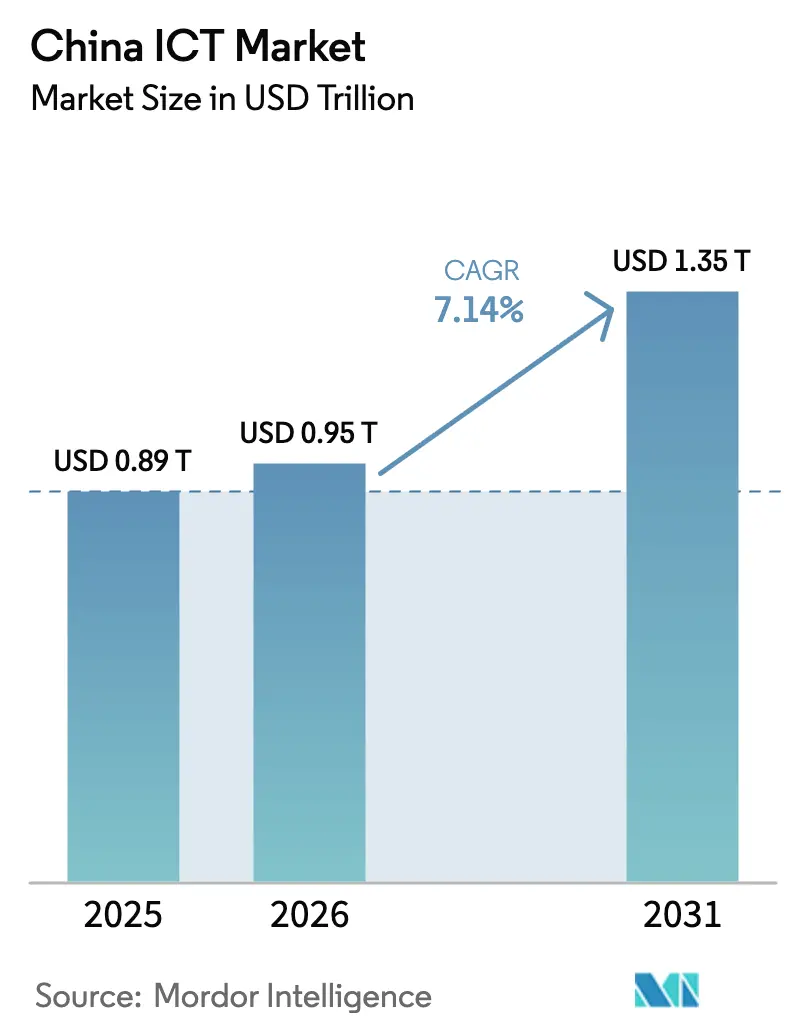
The China ICT Market size is expected to grow from USD 0.89 trillion in 2025 to USD 0.95 trillion in 2026 and is forecast to reach USD 1.35 trillion by 2031 at 7.14% CAGR over 2026-2031. Hardware infrastructure continues to underpin spending, yet software and platform services record the quickest gains as enterprises shift toward cloud-native operating models. Government programs under the “Digital China” banner align fiscal incentives, data-center construction, and preferential procurement to accelerate domestic technology uptake. Persistent US export controls amplify import substitution, deepening the local component ecosystem and reinforcing long-term resilience. The China ICT market also benefits from surging 5G adoption, which raises demand for edge processing and IoT solutions, while artificial intelligence integration increases per-user value across retail, manufacturing, and public services.
Key Report Takeaways
- By type, hardware led with 42.65% revenue share of the China ICT market in 2025, whereas software is projected to advance at a 10.09% CAGR through 2031.
- By enterprise size, large enterprises captured 63.55% of China's ICT market share in 2025; small and medium enterprises are expanding at a 10.32% CAGR to 2031.
- By industry vertical, manufacturing controlled 26.85% of the China ICT market size in 2025, while retail and e-commerce are poised for 11.02% CAGR growth to 2031.
- By technology domain, cloud computing accounted for 30.35% of China's ICT market size in 2025; artificial intelligence shows the fastest trajectory at a 11.74% CAGR through 2031.
Note: Market size and forecast figures in this report are generated using Mordor Intelligence’s proprietary estimation framework, updated with the latest available data and insights as of 2026.
China ICT Market Trends and Insights
Drivers Impact Analysis*
| Driver | (~) % Impact on CAGR Forecast | Geographic Relevance | Impact Timeline |
|---|---|---|---|
| Rising internet and 5G penetration | +1.5% | National, early gains in East and South | Medium term (2-4 years) |
| Government “Digital China” and 14th Five-Year ICT plan | +1.2% | National, tier-1 cities | Long term (≥4 years) |
| Accelerated enterprise cloud migration | +0.8% | East and South China | Short term (≤2 years) |
| AI-driven productivity gains | +1.1% | East China, spill-over to Central | Medium term (2-4 years) |
| “Xinjiang” localization push | +0.9% | National, strongest in manufacturing | Long term (≥4 years) |
| Carbon-informatization mandates | +0.7% | National, led by East and South China | Long term (≥4 years) |
| Source: Mordor Intelligence | |||
Rising Internet and 5G Penetration
Nationwide 5G rollout exceeded 101.4 million subscribers in 2024, lifting mobile internet usage to 78.6%. [1]National Bureau of Statistics of China, “Statistical Communiqué of the People’s Republic of China on the 2024 National Economic and Social Development,” stats.gov.cn Industrial parks adopt private 5G networks to enable real-time quality control and autonomous guided vehicles. Each additional base station multiplies data traffic, increasing the addressable workload for edge servers and IoT gateways. Pricing models evolve from bandwidth metering toward outcome-based arrangements that link service fees to measured productivity uplifts. The China ICT market, therefore, captures both subscription revenues and high-margin integration services as enterprises redesign processes around low-latency connectivity.
Government “Digital China” and 14th Five-Year ICT Plan
Central planning sets explicit digital-economy targets, including a 45% GDP contribution by 2030. [2]Fujian Provincial Government, “Outline of the 14th Five-Year Plan (2021-2025) for National Economic and Social Development and Vision 2035,” fujian.gov.cn Unified technical standards lower integration costs for smart-city, telemedicine, and e-government platforms. Provincial grants funnel workloads westward under the “Eastern Data, Western Computing” program, cutting energy expenses and balancing regional capacity. Mandatory preference for local suppliers expands market access for domestic chip, server, and middleware vendors. The China ICT market thus gains both volume and value as policy support creates predictable demand cycles.
Accelerated Enterprise Cloud Migration
State-owned and private enterprises shift capital budgets toward operating-expense-based cloud subscriptions to conserve cash and boost agility. Hybrid deployments combine domestic clouds for regulated data with global providers for overseas operations, complicating integration and raising demand for professional services. Large retailers demonstrate AI-assisted supply-chain systems that cut fulfillment costs and improve delivery predictability. Small firms gain access to the same toolsets without building on-premises stacks, narrowing the technology gap with market leaders. Cloud-native development frameworks shorten product cycles, cementing the platform model as the de facto innovation backbone of the Chinese ICT market.
AI-Driven Productivity Gains Across Sectors
AI training capacity expanded to 23,000 PetaFLOPS with SenseTime’s SenseNova 5.5 platform release in 2025. Manufacturers report downtime reductions of up to 30% after deploying predictive-maintenance algorithms, while banks improve fraud detection accuracy with real-time models. Healthcare pilots use AI imaging to triage cases, lowering specialist workloads. The growing availability of domain-specific datasets lifts model quality, driving faster ROI and encouraging repeat investment. As AI workloads often run on domestic clouds, each new application anchors clients deeper into incumbent ecosystems, enlarging the China ICT market service revenue pool.
Restraints Impact Analysis*
| Restraint | (~) % Impact on CAGR Forecast | Geographic Relevance | Impact Timeline |
|---|---|---|---|
| Legacy IT complexity in state-owned enterprises | -0.6% | National, industrial regions | Medium term (2-4 years) |
| Escalating cybersecurity / data-sovereignty risk | -0.4% | National, heightened in border provinces | Short term (≤2 years) |
| US export controls on advanced semiconductors | -0.8% | National, severe in coastal tech hubs | Long term (≥4 years) |
| Fragmented provincial procurement processes | -0.3% | Central and West China | Medium term (2-4 years) |
| Source: Mordor Intelligence | |||
Legacy IT Complexity in State-Owned Enterprises
Many state actors still depend on proprietary mainframe environments installed over decades. Integrating cloud applications with these systems requires middleware and custom connectors that increase project timelines and costs. Procurement frameworks emphasize vendor track record, restricting market entry for emerging software firms. Workforce retraining adds an organizational challenge because digital workflows often conflict with established operating procedures. This inertia slows the overall pace at which the Chinese ICT market can penetrate heavy-industry value chains.
Escalating Cybersecurity and Data-Sovereignty Risk
The Cybersecurity Law and Personal Information Protection Law mandate domestic storage of sensitive datasets, forcing multinationals to duplicate infrastructure. Financial institutions must segment networks to comply with regulator audits, fragmenting architectures and raising the total cost of ownership. Threat actors increasingly target industrial control systems, prompting double-digit budget reallocation toward detection and response tools. Approved security vendors are limited, creating lock-in and supply concentration. As compliance burdens grow, discretionary funds for innovation shrink, tempering some potential expansion of the China ICT market.
*Our forecasts treat driver/restraint impacts as directional, not additive. The impact forecasts reflect baseline growth, mix effects, and variable interactions.
Segment Analysis
By Type: Hardware Foundation Enables Software Innovation
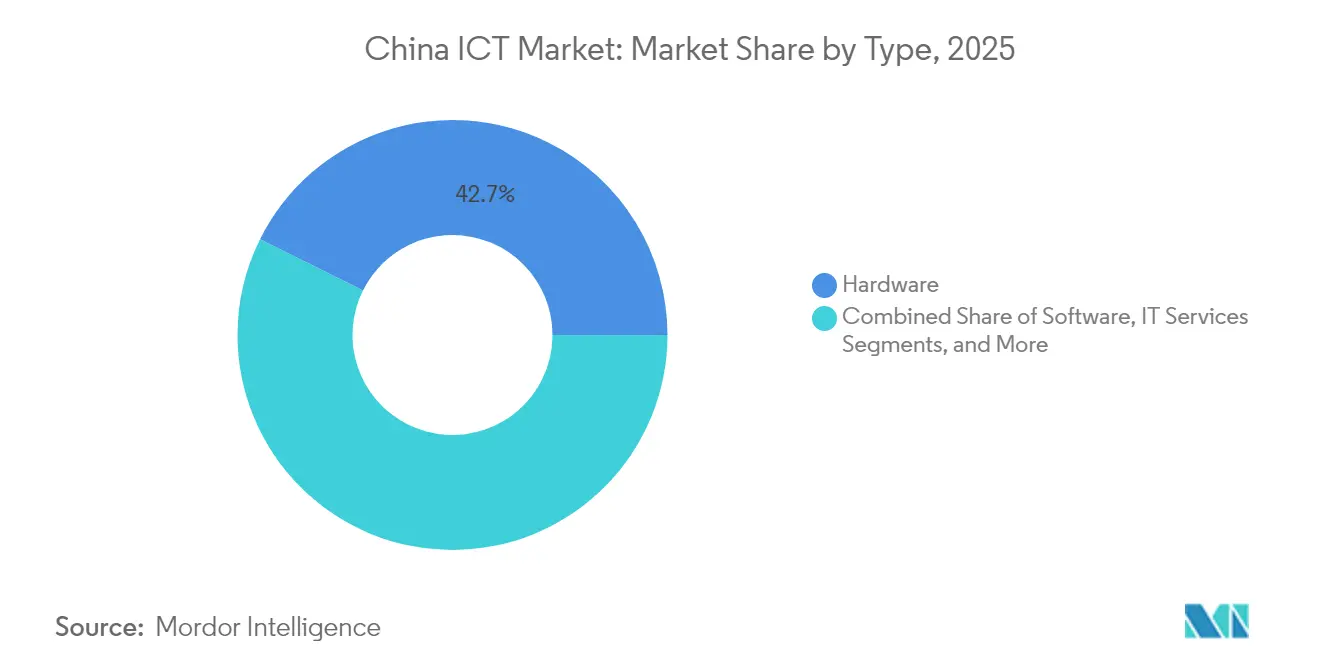
The hardware segment accounted for 42.65% of China's ICT market revenue in 2025. Investments in 5G base stations, high-density servers, and edge gateways form the indispensable substrate for nationwide digitalization. Procurement linked to smart-city, transportation, and manufacturing projects guarantees a steady equipment refresh cycle. Datacenter operators prioritize domestic chips and switch gear to mitigate export risk, anchoring value locally.
Software, though smaller today, is forecast to post a 10.09% CAGR, making it the fastest-growing component of the China ICT market. Platform-as-a-Service offerings accelerate code deployment, while low-code tools let non-technical staff prototype customer-facing applications. System-infrastructure software rides the cloud wave as enterprises modernize legacy workloads. The convergence of hardware and software yields integrated stacks, allowing vendors such as Huawei to monetize silicon, operating systems, and cloud services in a single contract.



By Enterprise Size: SME Digitalization Drives Growth
Large organizations retained 63.55% of the China ICT market share in 2025 due to sizable ERP, SCM, and CRM deployments that require bespoke integration. Their digital-transformation roadmaps span core production, finance, and distribution functions, locking in high consulting demand. Procurement cycles are lengthy yet produce multi-year recurring revenue streams once relationships mature.
SMEs log the fastest expansion at 10.32% CAGR, adding fresh addressable volume to the China ICT market size. Fiscal incentives, including tax rebates on qualifying software purchases, lower adoption barriers. Subscription-based cloud suites grant access to AI analytics, cybersecurity, and e-commerce modules without up-front hardware spend. Peer-to-peer knowledge sharing boosts confidence, and local service partners offer affordable customization. As SME digital intensity rises, overall productivity gains per USD invested often exceed those of larger rivals, reinforcing the structural importance of this customer layer.
By Industry Vertical: Manufacturing Leads Digital Transformation
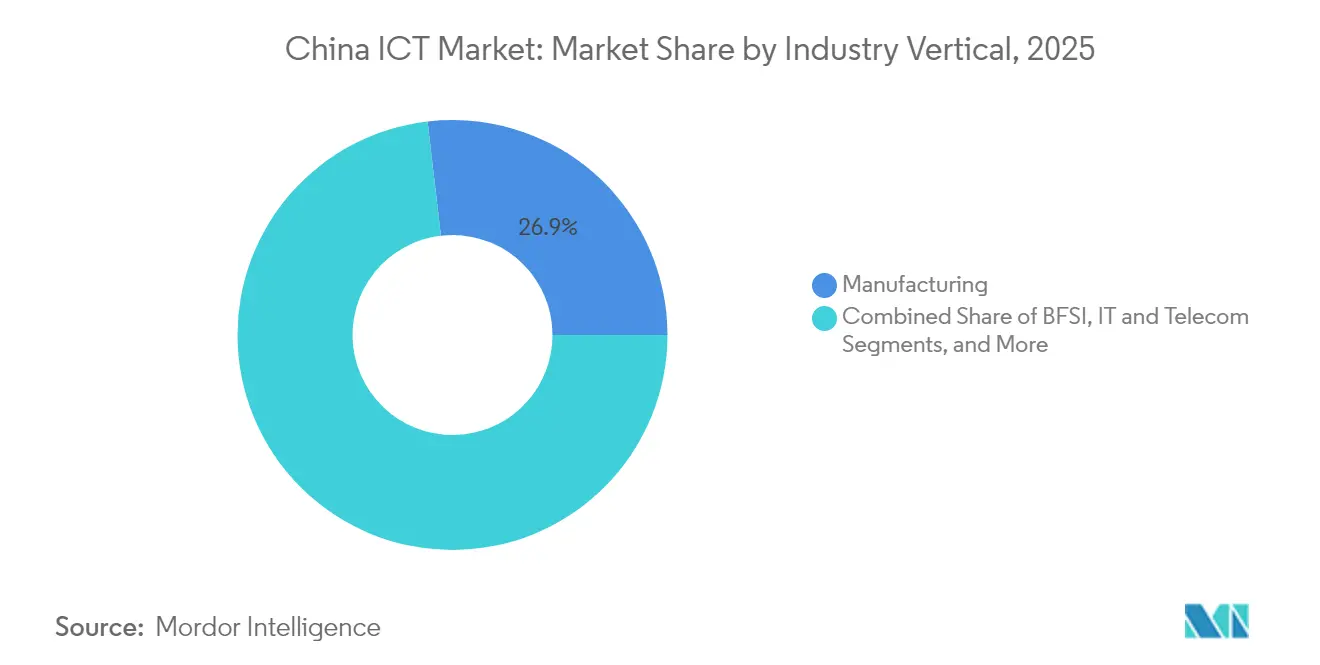
Manufacturing generated 26.85% of China's ICT market revenue in 2025, reflecting government backing for smart-factory rollouts under “Made in China 2025.” IoT sensors supply granular data on machine health, enabling predictive repairs that cut downtime and scrap. Additive manufacturing and machine-vision tools increase product complexity while preserving unit economics.
Retail and e-commerce register an 11.02% CAGR to 2031, the fastest among tracked verticals. Livestreaming commerce platforms combine AI-driven personalization with real-time payment settlement to heighten consumer engagement. Logistics firms deploy route-optimization algorithms that shave delivery times, strengthening omnichannel propositions. BFSI, health, and public services also deepen digitization to meet compliance and citizen-service targets, collectively broadening the China ICT market footprint.
By Technology Domain: AI Transforms Cloud Computing
Cloud computing maintained 30.35% of the China ICT market size in 2025 as the central orchestration layer for enterprise workloads. Providers differentiate by bundling databases, middleware, and AI frameworks to drive higher average revenue per user. Interoperability standards mature, easing migration between clouds and minimizing lock-in concerns.
Artificial intelligence is projected to grow at a 11.74% CAGR to 2031, gaining from expanding data availability and improved neural-network efficiencies. Pre-trained large language models enable natural-language interfaces for internal applications, trimming employee training requirements. Edge AI supports computer-vision tasks in inspection lines and autonomous vehicles. Together, AI and cloud offerings create flywheel effects: each new AI service lifts utilization of base compute, enlarging the total China ICT market.
Geography Analysis
East China commands the largest slice of the Chinese ICT market because Shanghai, Hangzhou, and Nanjing host dense clusters of software firms, data centers, and venture funding. Regional governments commit capital to 5G macro-cell expansion and AI research institutes, stimulating corporate demand for managed infrastructure. Superior logistics links let manufacturers execute just-in-time strategies, further driving system integration spend.
South China benefits from adjacency to Hong Kong and global trade lanes. Shenzhen’s smart-city blueprint pilots sensor-rich traffic systems, digital citizen IDs, and green-energy microgrids that require real-time analytics. Semiconductor design houses in Guangdong draw on cross-border talent, reinforcing the local innovation pipeline. The combination of hardware engineering and fintech experimentation elevates the region’s share of the Chinese ICT market.
Central and Western provinces capture increasing workloads as “Eastern Data, Western Computing” incentives steer hyperscale data centers toward lower-cost inland sites. Cooler climates reduce cooling expenses, and renewable-energy availability aligns with carbon-reduction mandates. Improved rail and fiber corridors lower latency to coastal consumers, permitting national-scale services to run from interior locations. These shifts spread the China ICT market’s economic impact while narrowing historical development gaps.
Regulatory Landscape
China’s ICT regulation is shaped by overlapping data, cybersecurity, and telecom market-order regimes, with the Cyberspace Administration of China (CAC) leading internet governance and the Ministry of Industry and Information Technology (MIIT) overseeing industrial policy, telecom licensing, and standards. In this context, requirements under the Cybersecurity Law and the Personal Information Protection Law continue to drive data localization, security assessment, and compliance-led architecture choices for cloud, platforms, and enterprise IT deployments.
Rulemaking and standardization activity accelerated in 2026. On May 29, 2026, the CAC issued the Regulations on the Management of Internet Information Content Multi-Channel Distribution Services, which took effect September 1, 2026. On July 3, 2026, the CAC released a draft of the Measures for the Administration of Internet Information Services for public consultation, focusing on digital platforms and generative AI-related services. On the technical side, MIIT approved 453 industry standards on March 11, 2026, including YD/T 7048-2026 (telecom network cloud-native technology, released June 1, 2026) and YD/T 6786-2026 (industrial internet 5G access, released April 15, 2026), which raise baseline requirements for carrier networks and enterprise connectivity stacks.
Value Chain Analysis
China’s ICT value chain spans upstream semiconductors and components, midstream ICT equipment and platform build-out, and downstream delivery through operators, cloud providers, integrators, and industry-specific solution partners. Upstream localization continues to reshape sourcing for advanced compute and networking, while midstream players bundle servers, storage, and cloud software into integrated stacks sold into state-owned enterprises, manufacturing groups, and internet platforms.
In domestic compute, the ecosystem includes foundry and packaging capacity, alongside local AI chip design and deployment. SMIC continues production of 7nm-class chips using multi-patterning DUV techniques, while Hua Hong Group is preparing 7nm production at its Shanghai facility, supported by Huawei-backed equipment supplier SiCarrier. On the design and consumption side, Alibaba T-Head, Cambricon, and Baidu (Kunlunxin) are among the notable domestic AI chip designers. Large-scale deployment into cloud clusters strengthens feedback loops between hyperscalers, silicon teams, and systems vendors, reinforced by national funding instruments such as Big Fund III that support semiconductor localization across the supply chain.
Competitive Landscape
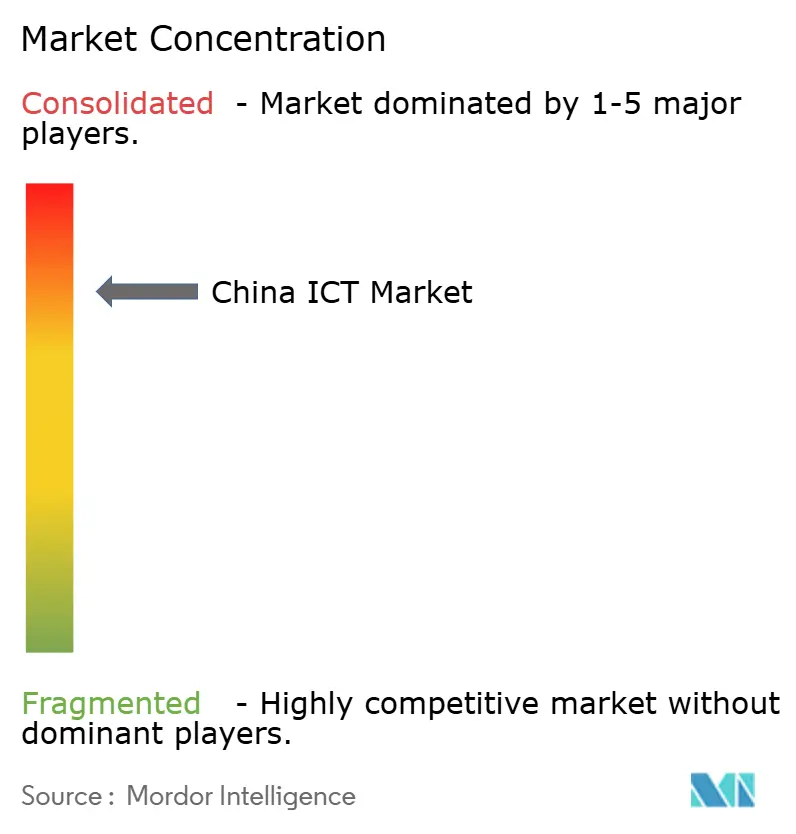
The vendor field shows medium concentration. Three local hyperscalers—Alibaba Cloud, Tencent Cloud, and Huawei Cloud—command the bulk of infrastructure services revenue, each scaling user communities through bundled AI, payments, and messaging extensions. Cybersecurity, enterprise software, and edge hardware markets remain fragmented, with scores of specialist firms targeting regulatory niches or vertical workflows.
Domestic firms accelerate proprietary chip design to sidestep export controls. Huawei’s system-on-chip roadmap illustrates vertical integration that shields supply continuity and differentiates performance for telecom and cloud workloads. [4]UC Institute on Global Conflict and Cooperation, “Huawei is Quietly Dominating China’s Semiconductor Supply Chain,” ucigcc.org Platform strategy dominates: ecosystem lock-in via developer toolkits and marketplace incentives discourages multicloud substitution. Proprietary APIs embed services deep in customer operations, raising switching costs and inflating customer lifetime value.
International intellectual-property licensors such as InterDigital adapt by signing portfolio deals that bundle 5G, video, and Wi-Fi patents, monetizing standards compliance without competing on end-user services. Foreign hyperscalers serve joint-venture customers but face data-localization barriers, cementing domestic providers’ dominance. Overall, the China ICT market balances scale benefits with innovation churn, giving agile newcomers room while rewarding incumbents that refresh technology stacks rapidly.
China ICT Industry Leaders
Alibaba Group Holding Ltd.
Huawei Technologies Co Ltd.
Tencent Holdings Ltd.
China Mobile Communications Group Co. Ltd.
Lenovo Group Ltd.
- *Disclaimer: Major Players sorted in no particular order

Market Opportunities and Future Outlook
Policy-backed self-reliance and compliance-driven architecture are creating near-term whitespace for domestic hardware-software stacks and for services that simplify regulated deployments across cloud, AI, and security. CAC’s 2026 rule activity for internet information services and content distribution, including the May 29, 2026 regulations effective September 1, 2026 and the July 3, 2026 draft measures, increases the demand for governance tooling, content and platform compliance workflows, and secure-by-design cloud configurations that enterprises and public-sector users can productize.
Compute localization is also opening opportunities for domestic AI infrastructure and optimization services across data centers and edge environments. China’s stated push for safe and reliable bedrock AI technologies by 2027, together with 2026-2030 priorities for semiconductor self-reliance, supports demand for domestically designed accelerators and server platforms. Hyperscaler deployment is providing traction for local silicon, including Alibaba T-Head’s Zhenwu 810E and M890 chips used in Alibaba Cloud clusters for large-scale training, expanding the addressable market for model training platforms, inference acceleration, and systems integration around domestic chips across regulated and performance-sensitive workloads.
Recent Industry Developments
- June 2026: Huawei and China Mobile Hubei validated an AI Inference Acceleration Solution at MWC Shanghai 2026, featuring OceanStor A800 storage and Ascend A3 SuperPoD. The integration supports domestic AI compute stack progress for carrier-grade workloads and strengthens the Huawei Kunpeng Ascend ecosystem in core telco and data center markets.
- June 2026: China Telecom awarded a 1.7 billion USD high performance server contract for 40,000 units, with over 70 percent of value tied to the Huawei Kunpeng ecosystem. The scale of enterprise and server procurement reinforces the Kunpeng Huawei dominated infrastructure supply chain and ecosystem fusion in core telecom deployments.
- June 2026: MiIT granted approvals to 166 foreign invested enterprises to operate value added telecom services in pilot zones including internet data centers and information services. The regulatory expansion of foreign invested telecom services increases competition and supports digital infra growth in pilot zones, broadening foreign participation in domestic ICT services.


Research Methodology Framework and Report Scope
Market Definition and Coverage
For this methodology, the China ICT market covers spending in China on information and communication technologies, including core hardware, software, and IT and telecom related services that enable connectivity, computing, and digital operations across end users.
Scope exclusions: This sizing excludes consumer electronics not used for ICT delivery and pure content, media, and entertainment revenues that do not represent ICT product or service spend.
Segmentation Overview
- By Type
- Hardware
- Computing Devices
- Network Equipment
- Datacentre Infrastructure
- Software
- System Infrastructure
- Enterprise Applications
- IT Services
- Consulting and Integration
- Managed Services
- Telecommunication Services
- Mobile Services
- Fixed-Line and Broadband
- Hardware
- By Enterprise Size
- Small and Medium Enterprises (SMEs)
- Large Enterprises
- By Industry Vertical
- BFSI
- IT and Telecom
- Government and Public
- Retail and E-commerce
- Manufacturing
- Energy and Utilities
- Healthcare
- Education
- Transportation and Logistics
- Other Industry Verticals
- By Technology Domain
- Cloud Computing
- Artificial Intelligence
- Cybersecurity
- Digital Services (SaaS, PaaS)
- Edge Computing
- Internet of Things
- Blockchain
- By Region
- East China
- South China
- North and Northeast China
- Central China
- West and North-west China
Data Sources, Market Sizing, and Validation
Desk Research
Desk research was used to anchor the model to publicly visible demand and supply signals inside China, and to keep the time series consistent across the study period. We relied on official telecom and internet industry statistics (for example, Ministry of Industry and Information Technology statistical bulletins), national macro series and sector breakdowns (for example, National Bureau of Statistics releases), and connectivity adoption indicators (for example, CNNIC internet development reports).
To refine the ICT spending pool, we also reviewed supporting materials such as listed company annual reports, investor presentations, and reputable press coverage of cloud, data center buildout, and 5G rollout milestones. In a few cases, paid subscriptions for company financials and intelligence and a patent database were used to cross-check revenue exposure and product activity, mainly to validate assumptions rather than to build the total. The desk sources mentioned here are illustrative only, and many other public documents and databases were also used for data collection, validation, and clarification.
Primary Interviews and Surveys
Primary work focused on validating how ICT budgets are being set and where the fastest shifts in mix are occurring, especially between hardware-led infrastructure and faster growing software and platform services. We spoke with stakeholders across telecom and IT service delivery, enterprise IT buyers, and channel and system integration roles, and then we revisited uncertain inputs until the model outputs matched what practitioners described for major provinces and city clusters.
Distribution of primary research fieldwork respondents
| Company type | Respondent position |
|---|---|
| Top tier: 33% | CXOs: 18% |
| Mid tier: 49% | Functional/Unit leaders: 36% |
| Smaller Players: 18% | Managers: 46% |
Market-Sizing & Forecasting
Sizing was built using a top-down approach where official telecom service revenue, internet and related services revenue, and enterprise digitalization investment signals were used to reconstruct the addressable ICT spend for China, followed by careful adjustments to avoid double counting across overlapping categories. To keep the output practical, we then corroborated totals with selective bottom-up checks, such as sampling typical contract values for enterprise IT services, using channel feedback on shipment momentum for core infrastructure, and applying indicative ASP x volume logic where product units were reasonably observable.
Key inputs used in the model included telecom business revenue trends, 5G user growth and traffic indicators, cloud and data center buildout signals, enterprise software adoption pace, and the direction of domestic substitution in key technology stacks. For forecasting, scenario analysis was used so that growth paths could reflect different speeds of enterprise budget recovery, infrastructure rollout pacing, and policy-driven digitization programs. Those scenarios were filtered through consensus ranges shared by interviewed experts. Where product or service splits were not directly observable, gaps were handled by using proxy ratios from public series and then stress-testing them against interview feedback until the totals stayed internally consistent.
Data Validation & Update Cycle
Outputs were validated through multiple checks, including comparing implied per user and per enterprise spend against observable sector signals, and reviewing any year over year jumps that did not align with policy timing or rollout milestones. We also ran variance checks between independent inputs, and if the spread crossed a comfort band, assumptions were revisited and selected respondents were re-contacted to confirm what changed.
Before sign-off, the model and write-up go through stepwise analyst reviews so that arithmetic, scope boundaries, and unit conversions are consistent. Reports are refreshed annually, and interim updates are made when material events occur that can move ICT investment patterns. Right before delivery, a final update pass is completed so clients receive the latest view that can be traced back to the same repeatable inputs.
Mordor Intelligence's China Ict Market Estimate Compared With Other Published Estimates
Published China ICT market numbers often vary because the underlying spend pool is not defined the same way across sources, and because different models handle overlaps between telecom services, IT services, and adjacent digital services differently. Differences in currency timing, base year selection, and whether values are reported as a strict current spend view or a forward leaning scenario also add to the spread.
Telecom business revenue series, 5G adoption indicators, and internet and related services revenue are the evidence checks that keep Mordor Intelligence's estimate tied to a measurable China demand pool, rather than a broader digital economy total. Gaps also show up when some estimates fold in wider consumer device value or digital content revenues, or when software and platform growth is projected using aggressive ASP uplift without validating enterprise budget constraints and procurement cycles.
Benchmark comparison
| Source | Market Size | Gaps in Research Methodology |
|---|---|---|
| Mordor Intelligence | USD 0.89 T (2025) | |
| Industry Association A | USD 0.80 T (2025) | Uses a narrower accounting view that emphasizes telecom and certain IT service revenues, and it tends to exclude parts of enterprise software and platform spending that sit outside the association reporting perimeter. |
| Trade Journal B | USD 1.05 T (2025) | Applies a wider definition that can blend ICT with adjacent digital services, and it commonly assumes faster price and mix uplift for software and cloud related items without the same level of buyer-side budget validation. |
Taken together, the table shows that most variation comes from boundary setting and from how mix and pricing are carried forward into the current year. By tying the total to observable revenue and adoption signals, and then pressure-testing overlaps through interviews, the final number stays balanced and easier to reproduce with clear steps.


Key Questions Answered in the Report
What is the value of China’s ICT market today and in 2031?
The market is valued at USD 0.95 trillion in 2026 and is forecast to reach USD 1.35 trillion by 2031, growing at a 7.14% CAGR.
Which component of spending is expanding the fastest?
Software is the quickest-growing segment with a 10.09% CAGR through 2031, reflecting a shift toward platform services and recurring revenue models.
How do government policies shape industry growth?
“Digital China” programs and the 14th Five-Year ICT Plan direct investment, set procurement preferences for domestic suppliers, and target a 45% digital-economy share of GDP by 2030, creating predictable demand cycles.
Why is artificial intelligence so important to Chinese enterprises?
AI workloads improve productivity—manufacturers report up to 30% fewer equipment outages—while SenseTime’s SenseNova 5.5 brings 23,000 PetaFLOPS of compute to market, enabling rapid deployment without building in-house models.
Which region contributes the largest share of ICT spending?
East China leads due to dense clusters of technology firms and datacenters in Shanghai, Hangzhou, and Nanjing, supported by strong logistics and policy incentives.
What restraints could slow market expansion?
Legacy IT systems in state-owned enterprises, tighter data-sovereignty rules, and ongoing US export controls on advanced chips each subtract from potential growth by adding complexity, cost, or supply risk.
Page last updated on:


 Your data is secure and never sold or shared.


