
Singapore Telecom MNO Market Analysis by Mordor Intelligence
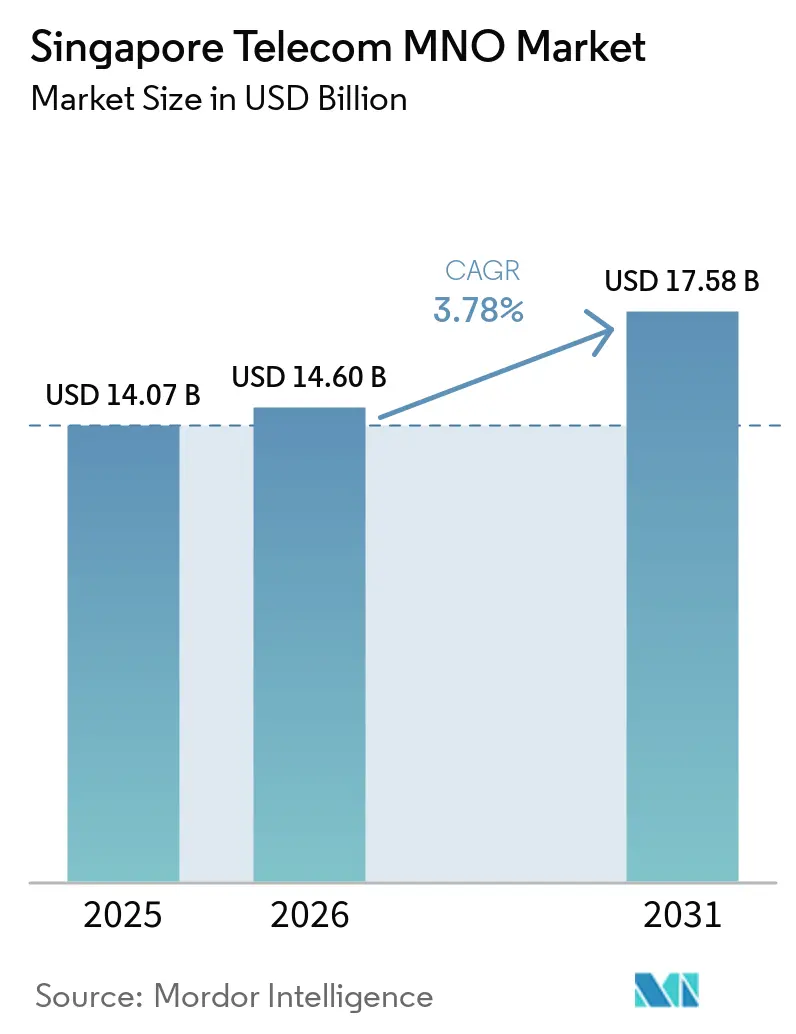
The Singapore telecom MNO market size was valued at USD 14.6 billion in 2026 and estimated to grow from USD 15.15 billion in 2027 to reach USD 17.92 billion by 2032, at a CAGR of 3.41% during the forecast period (2027-2032).
Singapore’s installed fiber and standalone 5G networks create room for higher-value offers built around secure institutional workflows and industrial IoT applications. Heavier mobile use broadens service requirements, while price competition and legacy-service erosion limit how much of this activity becomes additional earnings. Operators can respond with enterprise network services, fixed-mobile household bundles and device-protection benefits on mobile plans that give customers reasons to choose them. Growth depends on whether paid tiers and bundles earn enough to outpace the slower-growing voice and pay-TV lines.
Key Report Takeaways
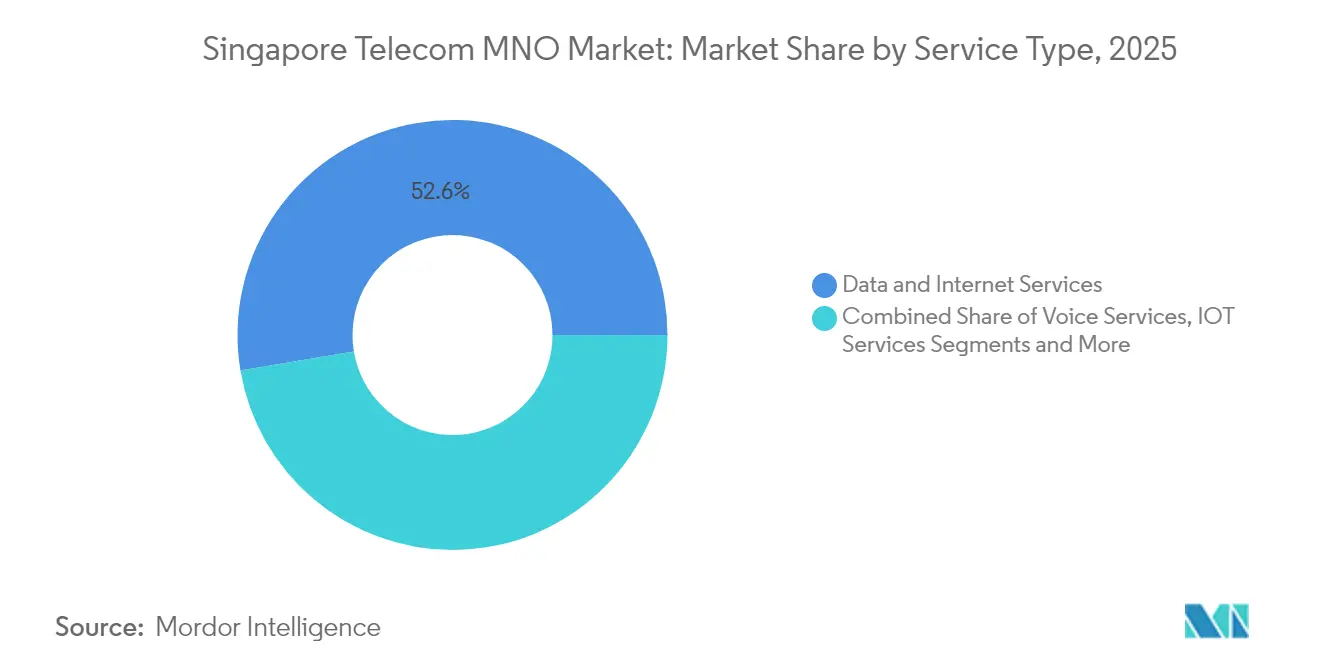
- By service type, data and internet services held a 52.71% share of the Singapore telecom MNO market size in 2026, while the IoT and M2M services segment is projected to grow fastest at a 3.62% CAGR during 2027-2032.
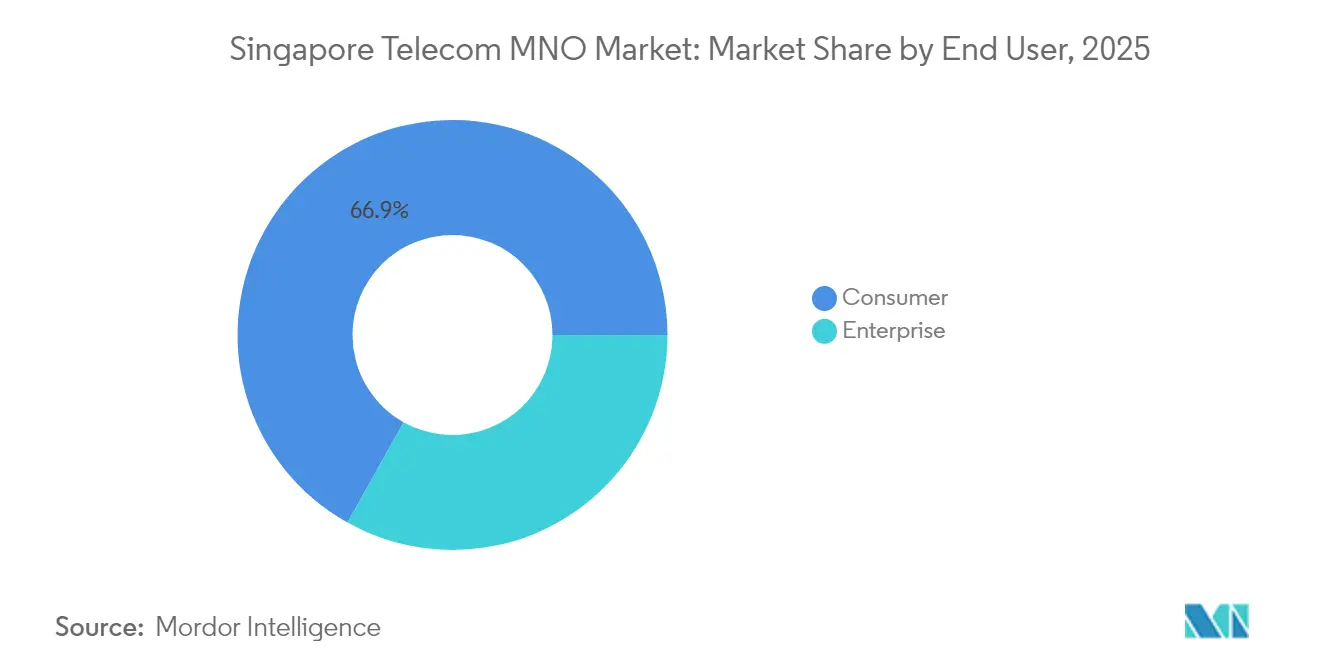
- Across end users, the consumer segment represented a 66.76% Singapore telecom MNO market share in 2026, and enterprises are forecast to grow fastest at a 3.8% CAGR during 2027-2032.
Note: Market numbers in this report are based on Mordor Intelligence's proprietary estimation framework, which combines nine months of actuals with Q4 projections for base year 2026.
Market Trends and Insights
Drivers Impact Analysis of Singapore Telecom MNO Market*
| Driver | (~) % Impact on CAGR Forecast | Geographic Relevance | Impact Timeline |
|---|---|---|---|
| Nationwide Stand-alone 5G coverage unlocks premium consumer and enterprise use-cases | +1.6% | Nationwide | Medium term (2-4 years) |
| Intensifying digital-first public-sector initiatives driving secure high-capacity connectivity demand | +1% | Nationwide | Medium term (2-4 years) |
| Nationwide fiber-to-the-home (FTTH) coverage enabling gigabit-class bundled offers | +1.2% | Nationwide | Short term (≤ 2 years) |
| Surging mobile data consumption per-capita supports ARPU uplift | +0.9% | Nationwide | Short term (≤ 2 years) |
| Maritime And port private-network pilots catalyze Industrial 5G adoption (UNDER-RADAR) | +0.4% | Major fairways, anchorages, terminals and boarding grounds | Medium term (2-4 years) |
| 5G network-slicing -priority lanes- for gamers And fintech users creates new B2C monetization (UNDER-RADAR) | +0.3% | Nationwide | Short term (≤ 2 years) |
| Source: Mordor Intelligence | |||
Nationwide Stand-alone 5G coverage unlocks premium consumer and enterprise use-cases
Enterprise 5G demand can develop around devices that do not require the full capabilities of a standard 5G deployment. On May 29, 2025, M1 announced the commercial launch of enterprise 5G RedCap services, describing it as Southeast Asia’s first publicly known enterprise RedCap-services launch.[1] M1 identified industrial IoT devices and low-power wearables as use cases and cited reduced costs, longer battery life and lower latency. By 2025, Singtel had introduced network slicing for enterprise customers and consumers after launching its nationwide 5G standalone network in 2022. These capabilities create a route to design enterprise offers around the requirements of different connected devices. For an enterprise buyer, RedCap offers a device tier that can bring industrial IoT devices and wearables into the network sale alongside more demanding applications.
Intensifying digital-first public-sector initiatives driving secure high-capacity connectivity demand
Secure access for public officers makes public-sector connectivity an opportunity built around how government work is delivered. In its July 2025 update, GovTech described development of software-defined wide-area and Zero Trust government networks. Supporting flexible, secure working across government workflows creates a use for connections designed around both capacity and access requirements. An operator pursuing this opportunity can frame its offer around the government network's service needs, with performance commitments defined for the institutional customer. GovTech’s focus on software-defined wide-area and Zero Trust architectures makes fit with those network designs a stronger basis for an operator’s proposal than mobile line counts.
Nationwide fiber-to-the-home (FTTH) coverage enabling gigabit-class bundled offers
Nationwide fiber reach makes retail service integration a more important growth lever than extending the basic network footprint. NetLink NBN Trust maintained 100% island-wide fiber coverage during FY2026, the year ended March 31, 2026. NetLink operates the passive fiber infrastructure, separating underlying access availability from the household service package that a retailer assembles. For mobile operators, a fixed-mobile bundle can combine household connectivity needs through a broader retail relationship within that established footprint. Retailers can seek more revenue per household by combining fixed and mobile subscriptions, so customer take-up matters more than the availability of passive fiber.
Surging mobile data consumption per-capita supports ARPU uplift
More data use per connected customer strengthens the commercial case for matching mobile service tiers to the intensity of use. Singtel reported monthly data usage of 20 GB among its Singapore postpaid smartphone customers, excluding wholesale, in the quarter ended June 30, 2026, up 19.2% year over year.[2] In May 2025, Singtel described making 5G+ Priority available to paying customers, particularly top-end Priority Plus customers. For heavier users, priority performance can provide a reason to choose a higher-value subscription when designing an offer around their service needs. A shift toward those paid performance tiers would raise revenue per line through the subscription mix.
Restraints Impact Analysis of Singapore Telecom MNO Market*
| Restraint | (~) % Impact on CAGR Forecast | Geographic Relevance | Impact Timeline |
|---|---|---|---|
| Hyper-competition from MVNOs And fourth MNO (Simba) keeps consumer price elasticity high | -0.8% | Nationwide | Short term (≤ 2 years) |
| OTT substitution erodes legacy voice/SMS and Pay-TV revenues | -0.5% | Nationwide | Medium term (2-4 years) |
| High spectrum-renewal And energy costs compress EBITDA margins | -0.4% | Nationwide | Long term (≥ 4 years) |
| Limited domestic market size caps scale economics for heavy-capex 5G standalone (UNDER-RADAR) | -0.3% | Nationwide | Long term (≥ 4 years) |
| Source: Mordor Intelligence | |||
Hyper-competition from MVNOs And fourth MNO (Simba) keeps consumer price elasticity high
Price competition reaches operator economics through both the revenue earned per customer and the resulting mobile service revenue. In the quarter ended June 30, 2026, Singtel Singapore’s operating revenue fell 3.1% year over year amid intense price competition. Mobile service revenue, net of bill rebates and prepaid sales discounts and including international calls and broadband bundles, fell 4.0% on lower ARPU. Monthly ARPU fell 4.7% year over year on an average-subscriber basis that included international telephone-call revenue and excluded wholesale customers. Falling ARPU leaves Singtel with less revenue per line to cover network costs, so subscriber additions alone offer weaker protection for mobile service earnings.
OTT substitution erodes legacy voice/SMS and Pay-TV revenues
Legacy services can weaken the economics of a converged telecom portfolio even when an operator has several distinct customer propositions. Singtel TV revenue in Singapore fell 8.3% year over year in the quarter ended June 30, 2026. Singtel’s Singapore fixed-voice revenue fell 5.8% year over year in the same quarter. The two declines expose a portfolio problem, since weakness spans both communications and entertainment services within the same operator. Any growth in newer service lines must first replace the losses in Singtel TV and fixed voice before it can lift total revenue.
*Our forecasts treat driver/restraint impacts as directional, not additive. The impact forecasts reflect baseline growth, mix effects, and variable interactions.
Singapore Telecom MNO Market Segment Analysis
By Overall Telecom Revenue and ARPU:
Service Breadth Shapes Account ValueFor Singapore's MNOs, a consumer subscription, an industrial device and a corporate connectivity account offer different ways to earn revenue. Adding IoT connections can increase billable endpoints without increasing revenue per consumer subscription, so a single average need not reflect service expansion. An enterprise account can also combine device connectivity with a wider network-service commitment, making the return on the whole relationship relevant alongside revenue per connection. Industrial connectivity is commercially useful when it adds earnings from the customer's operating equipment, even if the operator's consumer ARPU does not move.
Household bundling presents a different measurement problem for Singapore's mobile operators than enterprise-device expansion. A fixed-mobile account can contain several mobile lines and one home broadband service, making revenue per household different from revenue per mobile subscriber. Increasing the household's service commitment can improve account revenue even if a discounted additional line lowers a mobile-only average. The household offer should therefore be assessed on the combined contribution of its mobile and broadband services, since rejecting an additional line solely for reducing mobile ARPU could also forgo earnings from the broader bundle.
By Service Type:
Data Scale and Connected Devices Support Distinct Revenue RolesData and internet services accounted for a 52.71% share of the Singapore telecom MNO market size in 2026. Singapore’s monthly-average mobile data usage reached 103 petabytes in Q4 2025. That recurring service volume gives operators a substantial operating requirement to serve, connecting this largest segment’s commercial position to the delivery of usable data capacity. Carrying this traffic creates a capacity obligation, while the revenue opportunity depends on selling service allowances and performance that users value enough to pay for.
IoT and M2M services are forecast to be the fastest-growing segment, with a 3.62% CAGR during 2027-2032. In FY2025, Singtel Singapore reported growth in IoT connectivity, ICT and broadband service revenues that partially offset a broader operating-revenue decline. The combination matters because lower handset sales and legacy carriage revenues were reducing Singtel Singapore’s existing revenue base. IoT’s commercial contribution therefore depends on how much replacement service revenue it adds alongside ICT and broadband as the operator’s mix changes.

By End-user:
Consumer Scale and Enterprise Account Value Shape GrowthThe consumer segment represented a 66.76% Singapore telecom MNO market share in 2026. StarHub reported 2.22 million consumer-segment mobile subscribers in Q2 2026, compared with 2.14 million in Q2 2025. The measure combines postpaid and prepaid subscribers. That base illustrates why serving the largest segment requires a proposition that works across both ways of paying for mobile service. StarHub’s mixed base leaves room to seek additional revenue through both new lines and higher service commitments within existing prepaid and postpaid relationships.
Enterprises are forecast to be the fastest-growing segment, with a 3.8% CAGR during 2027-2032. In FY2026, ended March 31, 2026, Singtel Singapore’s enterprise business accounted for more than 50% of its revenue, despite structural price competition in the consumer market. That company-level mix gives enterprise service development substantial strategic weight, since changes in a large business segment can materially influence the operator’s overall revenue profile. Enterprise sales can influence Singtel’s overall performance without requiring a recovery in consumer pricing.
Geography Analysis
Jurong Innovation District gives enterprise connectivity a production role, where factory data can become part of the service proposition. JTC says 5G networking throughout the district enables IoT, digital twins, analytics, AI and machine learning for next-generation manufacturing. A May 2025 National University of Singapore study described Hyundai Motor Group Innovation Center Singapore using a private 5G network with Singtel for real-time factory data, digital twins and EV quality control. For the manufacturing user, that application makes continuity of factory data a concrete service requirement, because digital twins and quality control depend on those flows.
Tuas connects the telecom opportunity to the scale of an expanding port operation, giving suppliers a defined enterprise setting for their service proposals. PSA Singapore expanded Tuas Port to 12 operational berths in 2025. For a connectivity provider, this larger operating footprint offers a concrete basis for discussing the reach and service responsibilities of a port-focused enterprise offer with its buyer. Each added berth potentially enlarges the area a port connectivity proposal must address, tying service scope to PSA’s physical expansion rather than to population growth.
Changi Airport recorded 69.98 million passenger movements in 2025. Changi Airport Group was among Singtel Singapore’s partners for advanced 5G and AI development and deployment identified in its FY2026 report. On January 20, 2026, the airport deployed 2 driverless tractors to transfer baggage between Terminals 1 and 4 because T4’s baggage system was unconnected to the other 3 terminals’ systems. In May 2025, Singtel said its 5G network was powering Changi Airport Group. The 5G relationship and the FY2026 partnership give Singtel an airport-operator counterpart for enterprise service development.
Regulatory Framework and Outlook
Within the selected jurisdiction of Singapore, the comparison separates national operating rules from building-access requirements under the Code of Practice for Info-communication Facilities in Buildings (COPIF) 2018. The assessment takes the perspective of an operator providing licensed mobile services. Under the Telecommunications Act 1999, the Infocomm Media Development Authority (IMDA) may grant licenses unconditionally or with specified conditions. The Telecom and Media Competition Code also imposes binding obligations on telecommunications licensees and regulated persons according to its applicability rules.
Regulatory Table of Singapore Telecom MNO Market
| Decision factor | Singapore operating framework | Singapore building-access framework |
|---|---|---|
| Primary authority | Infocomm Media Development Authority (IMDA) | IMDA |
| Key instruments or direction | Telecommunications Act 1999; Telecom and Media Competition Code | COPIF 2018; March 2026 design-stage coordination proposal |
| Commercial effect | Written interconnection agreements go to IMDA; non-dominant agreements take effect on submission; dominant-party agreements require approval before taking effect | Building owners provide mobile installation space at qualifying developments |
| Current policy attractiveness | Medium | High |
| Future direction of policy attractiveness | No change | No change |
| Source: Mordor Intelligence | ||
Conditional licensing and interconnection oversight support Medium attractiveness for operating rules, balancing a defined route to participation with compliance obligations. Building access rates High because COPIF 2018 requires mobile installation space at residential developments with at least 80 units and non-residential developments with mobile coverage areas above 2,000 square meters. In March 2026, IMDA proposed design-stage coordination between building owners and MNOs, identifying potential reductions in costly retrofits and faster coverage enhancements. Together, the operating rules and the limited scope of the proposed design process support continuity in operators’ main entry and deployment obligations.
Value Chain Stages
The value chain compares infrastructure provision, network operation and enterprise managed services to show where suppliers earn and how delivery responsibilities develop. NetLink NBN Trust owns and operates a passive fiber network and provides open, non-discriminatory wholesale access to it. M1 (Keppel) supplies mobile, fixed-line and fiber communications to consumer and corporate customers in Singapore. In FY2026, NetLink completed central-office enhancements in anticipation of increased customer infrastructure deployment to support growth in 10 Gbps connections.
Value Chain Analysis Table of Singapore Telecom MNO Market
| Primary activity | Key participants | Value capture | Bottleneck | Resilience response |
|---|---|---|---|---|
| Passive network and wholesale access provision | Infrastructure operators such as NetLink NBN Trust | Network access and connection service charges | Central-office readiness for operator infrastructure upgrades | Enhance central offices ahead of anticipated customer deployments |
| Mobile and fixed network operation | Network operators such as M1 (Keppel) | Connectivity service charges | Coordinating mobile and fixed service requirements | Plan capacity and support for each access type |
| Enterprise integration and managed operation | Managed infrastructure providers such as M1 (Keppel) | Service and support contract fees | Keeping distributed systems observable and recoverable | Combine monitoring, maintenance and recovery support |
| Source: Mordor Intelligence | ||||
In FY2026, services under NetLink’s regulated asset-base framework contributed approximately 84% of the trust’s revenue. M1’s managed IT infrastructure services include hardware maintenance, backup and replication, and network and systems monitoring. An ongoing support contract can add supplier earnings alongside access while extending responsibility into the customer’s operating environment. NetLink’s regulated-service revenue anchors its infrastructure business, whereas managed-service income depends on the scope of maintenance and monitoring a provider contracts to deliver.
Competitive Landscape
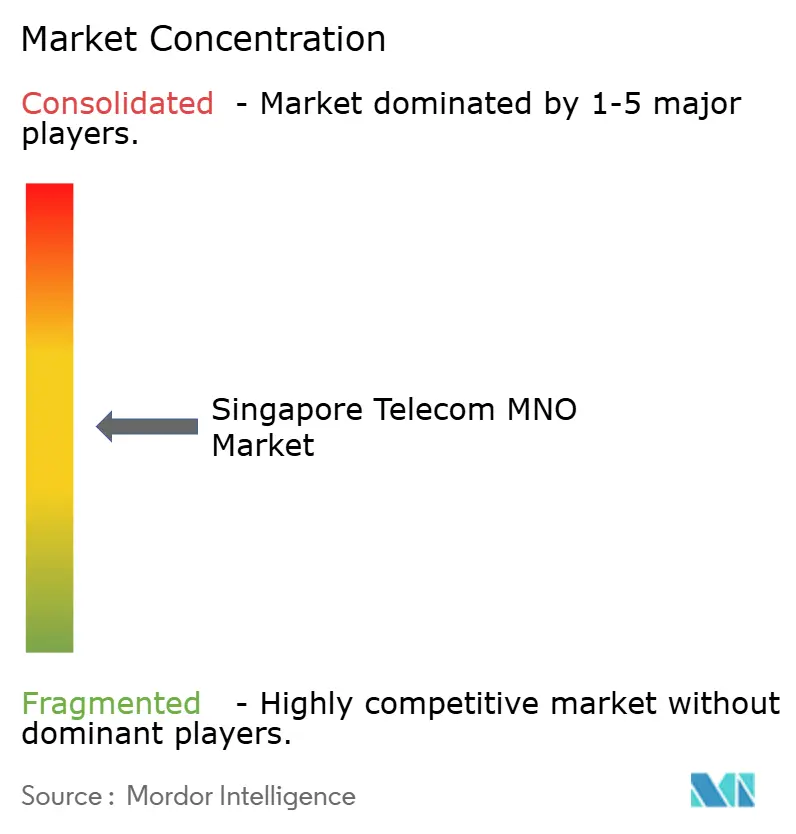
Competition has a concentrated network-operator core, with additional retail-brand competition supported by hosted mobile services. Simba Telecom, Tuas Limited’s Singapore mobile operator, increased active mobile services from 1.25 million at FY2025-end to 1.46 million as of July 31, 2026. M1 (Keppel) operates a mobile network, MyRepublic supplies branded mobile services, and Singtel operates consumer mobile services. Simba and M1 operate mobile networks, while MyRepublic uses StarHub as its network host, separating network operation from the retail brand. Simba’s growing active-service base makes competition within the network-owning core commercially significant alongside rivalry from hosted retail brands.
M1 added FoneCare+ Pro repair and replacement coverage to its Bespoke Flexi 800GB, 1TB and 10TB plans at no additional monthly charge on June 11, 2026. It described the plans as the first in Singapore to include that coverage. Singtel Singapore upgraded over 1.5 million customers to consumer 5G+ capabilities by March 2026 through Priority and Enhanced plans launched in May 2025. M1 packages protection against handset repair costs, while Singtel’s offer differentiates the connection itself through enhanced network capabilities.
On October 8, 2026, StarHub announced it would acquire MyRepublic’s Singapore mobile business, subject to applicable conditions precedent.[3] MyRepublic Mobile customers were already being progressively migrated to StarHub’s network at the announcement. Keppel’s proposed sale of M1 Telco to Simba was terminated on May 22, 2026, after regulatory approvals were not obtained by the May 21 extended long-stop date. That proposed sale excluded M1’s Technology Solutions & Services business and other carved-out assets. M1 therefore stays under Keppel, while StarHub, which described itself in August 2026 as Singapore’s clear number 2 mobile operator by revenue market share, seeks to consolidate MyRepublic’s mobile business and hosted 4G customer base.
Singapore Telecom MNO Industry Leaders
-
Simba Telecom
-
M1 (Keppel)
-
MyRepublic
-
Singtel
- *Disclaimer: Major Players sorted in no particular order
Singapore Telecom MNO Market Companies Covered in this Report
- Singtel
- M1 (Keppel)
- Simba Telecom
- MyRepublic
Key Opportunities for Market Participants
The opportunities compare direct government mobile supply, monitoring-network connectivity and a wholesale role within maintenance-led delivery. GovTech’s August 2026 integrated mobile-services tender was pending award after bids closed on September 14, 2026. Its listed service period was November 1, 2026, through October 31, 2029. In October 2026, the National Environment Agency (NEA) invited bids for one mandatory lot combining comprehensive maintenance of the seismic systems RSITES and CSAMP with network connectivity for RSITES, with bids due November 5, 2026.
Market Opportunities Table of Singapore Telecom MNO Market
| Opportunity | Why now | Buyer / lead segment | Recommended play | Main barrier | Likely beneficiaries |
|---|---|---|---|---|---|
| Integrated government mobile-service delivery | GovTech procurement pending award for a 2026-2029 service term | GovTech / government mobile services | Prepare delivery against the published service period | Closed bid window restricts new direct entry | Enterprise mobile providers such as M1 (Keppel) and Singtel |
| RSITES connectivity packaged with maintenance | October 2026 procurement combines connectivity and maintenance | NEA / monitoring-system operations | Pair network service with the required maintenance capability | Specialist maintenance scope extends beyond connectivity | M1 (Keppel), Singtel and maintenance-led service teams |
| Component connectivity for maintenance-led integrators | The combined lot creates a component-supply opening | Technical maintenance providers assembling integrated offers | Supply connectivity within a complete maintenance proposal | Responsibility for failures across service interfaces | Enterprise connectivity providers such as M1 (Keppel) and Singtel |
| Source: Mordor Intelligence | |||||
The central opening is to attach connectivity to a defined institutional operating requirement, giving operators a route to value beyond an individual mobile line. For the NEA procurement, the network contribution must fit the maintenance scope of the mandatory lot. Choosing between leading the complete service proposition and supplying its connectivity component is therefore consequential, because each route assigns a different level of delivery responsibility.
Recent Industry Developments in Singapore Telecom MNO Market
- Oct 2026: StarHub announced it would acquire MyRepublic’s mobile business in Singapore, subject to applicable conditions precedent.
- Jun 2026: M1 added FoneCare+ Pro repair and replacement coverage to its Bespoke Flexi 800GB, 1TB and 10TB plans at no additional monthly charge.
- May 2026: Keppel’s proposed sale of M1 Telco to Simba Telecom was terminated on May 22 after the relevant regulatory approvals were not obtained by the May 21 extended long-stop date.
Singapore Telecom MNO Market Report Scope and Research Methodology
Market Definition and Coverage
Singapore telecom MNO market measures annual revenue from telecommunications and operator-provided digital and pay-TV services sold in Singapore. It covers services billed to consumers, enterprises, and other service providers, with value measured as annual service revenue.
Scope exclusions: Device sales, standalone telecom hardware sales, pure media content revenues, and telecom service demand outside Singapore are excluded.
Segments Covered in This Report
- By Overall Telecom Revenue and ARPU
- By Service Type
- Voice Services
- Data and Internet Services
- Messaging Services
- IoT and M2M Services
- OTT and PayTV Services
- Other Services (VAS, Roaming & International Services, Enterprise And Wholesale Services, etc.)
- By End-user
- Enterprises
- Consumer
Data Sources, Market Sizing, and Validation
Desk Research
The analysis uses official Singapore statistics and operator disclosures, such as Infocomm Media Development Authority (IMDA) telecom statistics for subscriptions and usage, the IMDA Telecom and Media Competition Code for sector obligations, and Singtel annual reports for service and customer trends. Public market context from the Singapore telecom outlook published by Industry Outlook Publisher B supports review of service revenue, 5G adoption and legacy-service trends, while IMDA's statistical series provide independent checks on mobile, fixed-line and broadband activity.
Company filings, investor materials and reputable Singapore business press help distinguish service revenue from broader company revenue and clarify material changes in network, customer and service conditions. These examples are not exhaustive, and further sources inform collection, validation and clarification.
Primary Interviews and Surveys
Structured interviews and surveys would include Singapore mobile operator commercial and finance leaders, service and network unit leaders, and managers responsible for consumer, enterprise, wholesale and digital services. Respondents would check the interpretation of secondary evidence, explain differences in reported service categories and identify gaps in the revenue bridge, with unresolved items compared against operator disclosures, regulator statistics and other independent indicators.
Distribution of primary research fieldwork respondents
| Company type | Respondent position | Region |
|---|---|---|
| Top tier: 35% | CXOs: 20% | |
| Mid tier: 45% | Functional/Unit leaders: 35% | |
| Smaller Players: 20% | Managers: 45% |
Market-Sizing & Forecasting
The model estimates Singapore service revenue top down by reconciling operator-reported service totals with regulator indicators and then checks selected components through supplier revenue roll-ups and service-level comparisons. Key indicators include mobile and fixed subscriptions, data use per connection, average revenue per user, enterprise and wholesale service revenue, and the contribution of data, voice, messaging, IoT, pay-TV and other billed services. These indicators help separate customer and usage growth from pricing and service mix, while segment shares are built from reported service composition and checked against the resulting revenue pool. Historical revenue and connection series support a multivariate regression for the main forecast, with scenario analysis used for 5G monetization, consumer price pressure and enterprise service uptake. Analysts compare variable-level forecasts with informed Singapore market respondents and investigate differences before accepting an input. When a service category is not separately reported, analysts use the closest disclosed category, reconcile it to total operator service revenue, and document the allocation basis. Selective supplier or channel checks serve as checks rather than as a full bottom-up estimate.
Data Validation & Update Cycle
Analysts triangulate operator revenue disclosures, regulator subscription and usage series, market publications and primary evidence, then check that service components reconcile to the Singapore total and that independent signals move plausibly together. They investigate outliers, boundary changes and material variance from prior periods through a multi-step review by the analyst and reviewer, and re-contact respondents when an explanation remains unclear or a new development changes an input. The model is refreshed annually, revisited between cycles after material regulatory, network or market events, and given a fresh source and calculation review before delivery.
Mordor Intelligence's Singapore Telecom Market Size Compared Against Other Published Estimates
Published estimates can differ in the transactions and products they count and the inputs used to model demand. Singapore telecom MNO market measures annual revenue from telecommunications and operator-provided digital and pay-TV services sold in Singapore.
Key Gap Drivers include the study's defined coverage and market-specific modeling choices. Key indicators include mobile and fixed subscriptions, data use per connection, average revenue per user, enterprise and wholesale service revenue, and the contribution of data, voice, messaging, IoT, pay-TV and other billed services.
Benchmark comparison
| Source | Market Size | Gaps in Research Methodology |
|---|---|---|
| Mordor Intelligence | USD 15.15 B (2027) | |
| Market Research Firm A | USD 3 B (2025) | At its 2025 base, this estimate is 80.2% below this report's 2027 value of USD 15.15 B, 2 years later. The published total excludes media content and non-connectivity ICT revenue, narrowing its stated telecom-services perimeter. |
| Industry Outlook Publisher B | USD 2.9 B (2024) | At its 2024 base, this estimate is 80.9% below this report's 2027 value of USD 15.15 B, 3 years later. Its estimate is for an earlier measurement year, and its published outlook rises through 2030. |
Mordor Intelligence's analysts triangulate operator revenue disclosures, regulator subscription and usage series, market publications and primary evidence, then check that service components reconcile to the Singapore total and that independent signals move plausibly together.
Key Questions Answered in the Report
What is the Singapore telecom MNO market size and growth outlook?
It is estimated at USD 15.15 billion in 2027 and forecast to reach USD 17.92 billion by 2032, at a 3.41% CAGR during 2027-2032.
What supports demand for mobile-network services in Singapore?
Standalone 5G capabilities, fiber reach and heavier mobile use support service development. Singtel reported 20 GB of monthly data usage among Singapore postpaid smartphone customers in the quarter ended June 30, 2026, excluding wholesale.
Which service type holds the largest share of telecom MNO revenue?
Data and internet services led with 52.71% of the market in 2026.
Which companies compete in Singapore’s mobile sector?
Major participants include Simba Telecom, M1 (Keppel), MyRepublic and Singtel. StarHub announced it would acquire MyRepublic’s Singapore mobile business on October 8, 2026, subject to conditions precedent.
What is the main challenge for mobile operators’ revenue growth?
Singtel Singapore’s monthly ARPU, based on average subscribers and including international calls but excluding wholesale, fell 4.7% year over year in the quarter ended June 30, 2026. This illustrates pricing pressure on returns from each line.
How do industrial and transport locations shape enterprise telecom demand in Singapore?
Manufacturing applications in Jurong Innovation District, 12 operational Tuas Port berths in 2025 and Changi Airport Group’s 5G and AI partnership in Singtel’s FY2026 report give enterprise sales distinct industrial and transport settings.