Chemicals & Materials
2nd JuneUnlocking Supplier Partnerships in the Africa Lubricants Market
5 Min Read
The Scratch Resistant Glass Report is Segmented by Product Type (Sapphire Glass and Chemically Strengthened Glass), Application (Smartphones and Tablets, Automotive, Electronics, and Other Applications (Industrial and Defense Displays, Etc. )), and Geography (Asia-Pacific, North America, Europe, South America, and Middle East and Africa). The Market Forecasts are Provided in Terms of Value (USD).
Market Overview
| Study Period | 2020 - 2031 |
|---|---|
| Market Size (2026) | USD 4.19 Billion |
| Market Size (2031) | USD 6.03 Billion |
| Growth Rate (2026 - 2031) | 7.55 % CAGR |
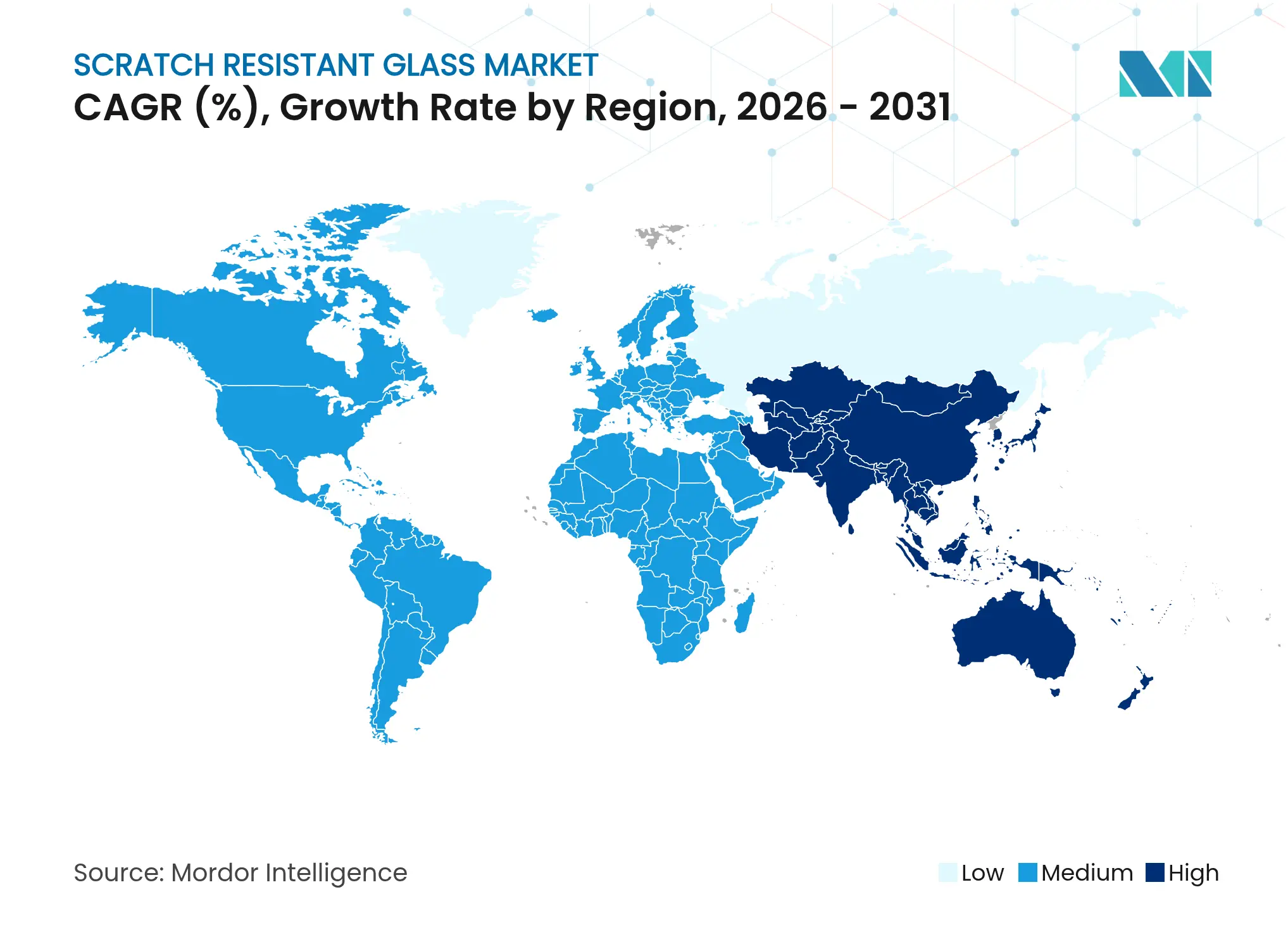
| Fastest Growing Market | Asia Pacific |
| Largest Market | Asia Pacific |
| Market Concentration | Medium |
Major Players *Disclaimer: Major Players sorted in no particular order. Image © Mordor Intelligence. Reuse requires attribution under CC BY 4.0. |
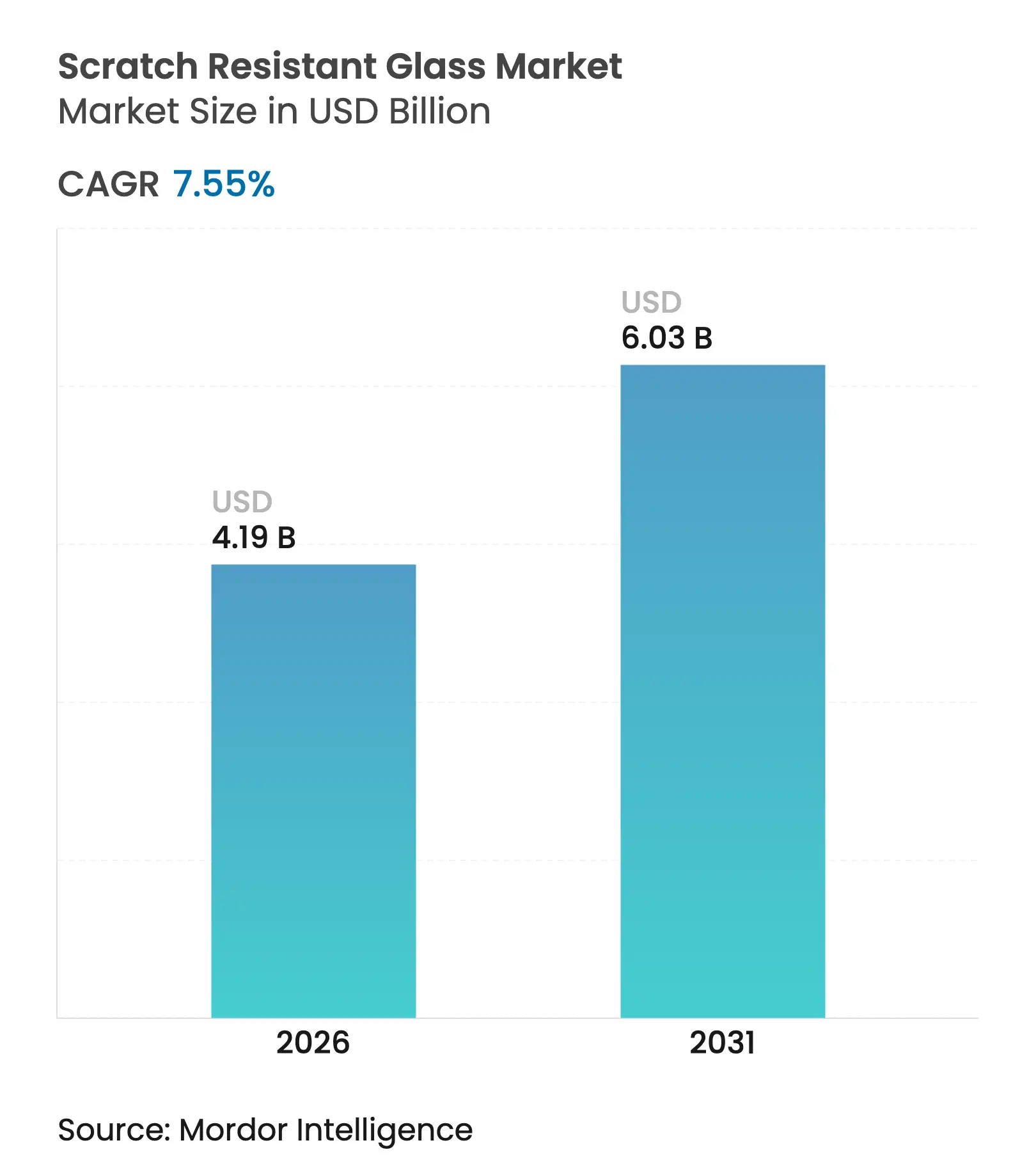

The Scratch Resistant Glass market is expected to grow from USD 3.9 billion in 2025 to USD 4.19 billion in 2026 and is forecast to reach USD 6.03 billion by 2031 at 7.55% CAGR over 2026-2031. Robust demand for durable display surfaces in smartphones, tablets, electric vehicles, and wearable medical devices anchors this outlook. Chemically strengthened glass maintains cost leadership, while sapphire glass captures the fastest growth as premium brands push hardness limits. Expansion of large in-vehicle displays in electric cars, the rising popularity of foldable Organic Light Emitting Diode (OLED) handsets, and an aging installed base of premium devices together broaden adoption across end-markets. Manufacturers are accelerating capacity additions in Asia-Pacific, investing in ion-exchange, surface-treatment, and recycling technologies to improve throughput, lower defect rates, and reduce energy use. Competition centers on technology rather than price, with incumbents strengthening intellectual-property portfolios, deepening vertical integration, and targeting next-generation niches such as augmented-reality optics and automotive cockpit glass.
Key Report Takeaways
Drivers Impact Analysis
| Driver | (~) % Impact on CAGR Forecast | Geographic Relevance | Impact Timeline | |||
|---|---|---|---|---|---|---|
Rising Smartphone and Tablet Shipments in Emerging Economies Rising Smartphone and Tablet Shipments in Emerging Economies | +2.1% | APAC core, spill-over to MEA | Medium term (2-4 years) |
(~) % Impact on CAGR Forecast
:
+2.1%
|
Geographic Relevance
:
APAC core, spill-over to MEA
|
Impact Timeline
:
Medium term (2-4 years)
|
Surge in In-Vehicle Display Area in Electric Vehicles (EVs) and Connected Cars Surge in In-Vehicle Display Area in Electric Vehicles (EVs) and Connected Cars | +1.8% | Global, early gains in China, Europe, North America | Long term (≥ 4 years) | |||
Strong Replacement Cycle for Premium Consumer Electronics Strong Replacement Cycle for Premium Consumer Electronics | +1.5% | North America & EU, expanding to APAC | Short term (≤ 2 years) | |||
Demand for Ultra-thin Flexible Glass for Foldable Organic Light Emitting Diode (OLEDs) Demand for Ultra-thin Flexible Glass for Foldable Organic Light Emitting Diode (OLEDs) | +1.2% | Global, led by South Korea, China | Medium term (2-4 years) | |||
Integration Into Wearable Medical/Health Devices Integration Into Wearable Medical/Health Devices | +0.9% | North America & EU, expanding globally | Long term (≥ 4 years) | |||
| Source: Mordor Intelligence | ||||||
Rising Smartphone and Tablet Shipments in Emerging Economies
Accelerating handset adoption in Asia-Pacific increases baseline demand for scratch-proof cover glass, especially among first-time users who prioritize durability at mid-range price points. Regional e-commerce is projected to reach 6.1% of global Gross Domestic Product (GDP) by 2025, amplifying mobile-centric lifestyles that intensify device usage and raise the risk of surface damage. In response, Corning launched Gorilla Glass 7i for entry-level smartphones, touting double the scratch resistance of standard lithium aluminosilicate glass [1]Corning Incorporated, “Gorilla Glass 7i Technical Brief,” corning.com. This tiered portfolio allows handset Original Equipment Manufacturers (OEMs) to match durability to bill-of-materials budgets without compromising user experience. Continuous urbanization and rising disposable incomes in India, Indonesia, and the Philippines sustain double-digit shipment growth that feeds directly into the scratch resistant glass market.
Surge in In-Vehicle Display Area in Electric Vehicles and Connected Cars
Electric-vehicle cabin designs replace analog buttons with panoramic touchscreens and heads-up displays, driving a step-change in automotive glass surface area. Integrated driver-assistance sensors embedded behind windshields demand pristine optical clarity; even minor scratches can deflect lidar or camera signals. Corning’s ion-exchange-based ultra-thin bendable glass enables curved dashboards that save space, reduce bezel width, and improve occupant ergonomics. The Chinese electric vehicle (EV) segment leads early adoption, followed by European premium brands whose cockpit digitalization roadmaps specify scratch-proof optics to meet Euro New Car Assessment Program (NCAP) safety targets. Widespread uptake supports long-run demand visibility for the scratch resistant glass market.
Strong Replacement Cycle for Premium Consumer Electronics
Premium device owners upgrade frequently to access the latest processors, camera arrays, and durable enclosures. Samsung’s Galaxy S25 Ultra, featuring Corning Gorilla Armor 2, resists drops from 2.2 m on concrete and delivers four-fold higher scratch resistance than prior models. Superior drop and abrasion metrics justify higher prices and shorten ownership cycles, creating recurring revenue streams for glass suppliers. Corning has already delivered glass to over 8 Billion devices worldwide, signaling a mature but still expanding installed base primed for refresh.
Demand for Ultra-thin Flexible Glass for Foldable OLEDs
Foldable smartphones and tablets require bend radii below 1 mm yet must repel keys, coins, and particulate scratches in pocket or purse. Variable-thickness glass with reinforced surface compression meets both flexibility and hardness criteria. Corning vertically integrated the melt-to-finish supply chain to control thickness uniformity, a critical parameter for hinge durability. As foldable form factors migrate to laptops and tablets, the scratch resistant glass market gains a high-value niche that offers premium margins.
Restraints Impact Analysis
| Restraint | (~) % Impact on CAGR Forecast | Geographic Relevance | Impact Timeline | |||
|---|---|---|---|---|---|---|
High Manufacturing and Capital Costs High Manufacturing and Capital Costs | -1.4% | Global, affecting emerging-market penetration | Short term (≤ 2 years) |
(~) % Impact on CAGR Forecast
:
-1.4%
|
Geographic Relevance
:
Global, affecting emerging-market penetration
|
Impact Timeline
:
Short term (≤ 2 years)
|
Optical Distortion in Thick Sapphire Substrates Optical Distortion in Thick Sapphire Substrates | -0.8% | Global, impacting premium applications | Medium term (2-4 years) | |||
Cost-competitive Polymer Hard-coatings Cost-competitive Polymer Hard-coatings | -1.1% | Global, stronger in price-sensitive segments | Long term (≥ 4 years) | |||
| Source: Mordor Intelligence | ||||||
High Manufacturing and Capital Costs
Manufacturing scratch-resistant glass requires substantial capital investments in specialized equipment and precision-controlled environments, creating barriers to entry and limiting production scalability across global markets. Ion-exchange furnaces, clean-room polishing lines, and plasma deposition chambers require multimillion-dollar investments that deter new entrants. A one-minute power loss during annealing can destroy six months of output, costing EUR 200,000 (USD 216,440) daily, prompting Saint-Gobain to partner with Schneider Electric on software-defined automation to mitigate downtime [2]Compagnie de Saint-Gobain, “2024 Annual Results,” saint-gobain.com. Capital intensity accelerates consolidation, favoring incumbents with large-scale plants and robust balance sheets.
Optical Distortion in Thick Sapphire Substrates
Sapphire glass manufacturing faces inherent challenges with optical distortion in thicker substrates, limiting its application scope despite superior hardness properties compared to chemically strengthened alternatives. Research into grinding parameters reveals that wheel speed significantly impacts surface roughness and subsurface crack damage depth, with optimal conditions requiring precise control to achieve acceptable optical quality. The subsurface damage depth in sapphire crystals directly correlates with optical performance, creating trade-offs between thickness, durability, and visual clarity that constrain design flexibility. Until manufacturers perfect process windows, sapphire will remain confined to camera lenses, watch covers, and select flagship handsets, limiting upside for the scratch resistant glass market.
By Product Type: Cost Leadership versus Premium Differentiation
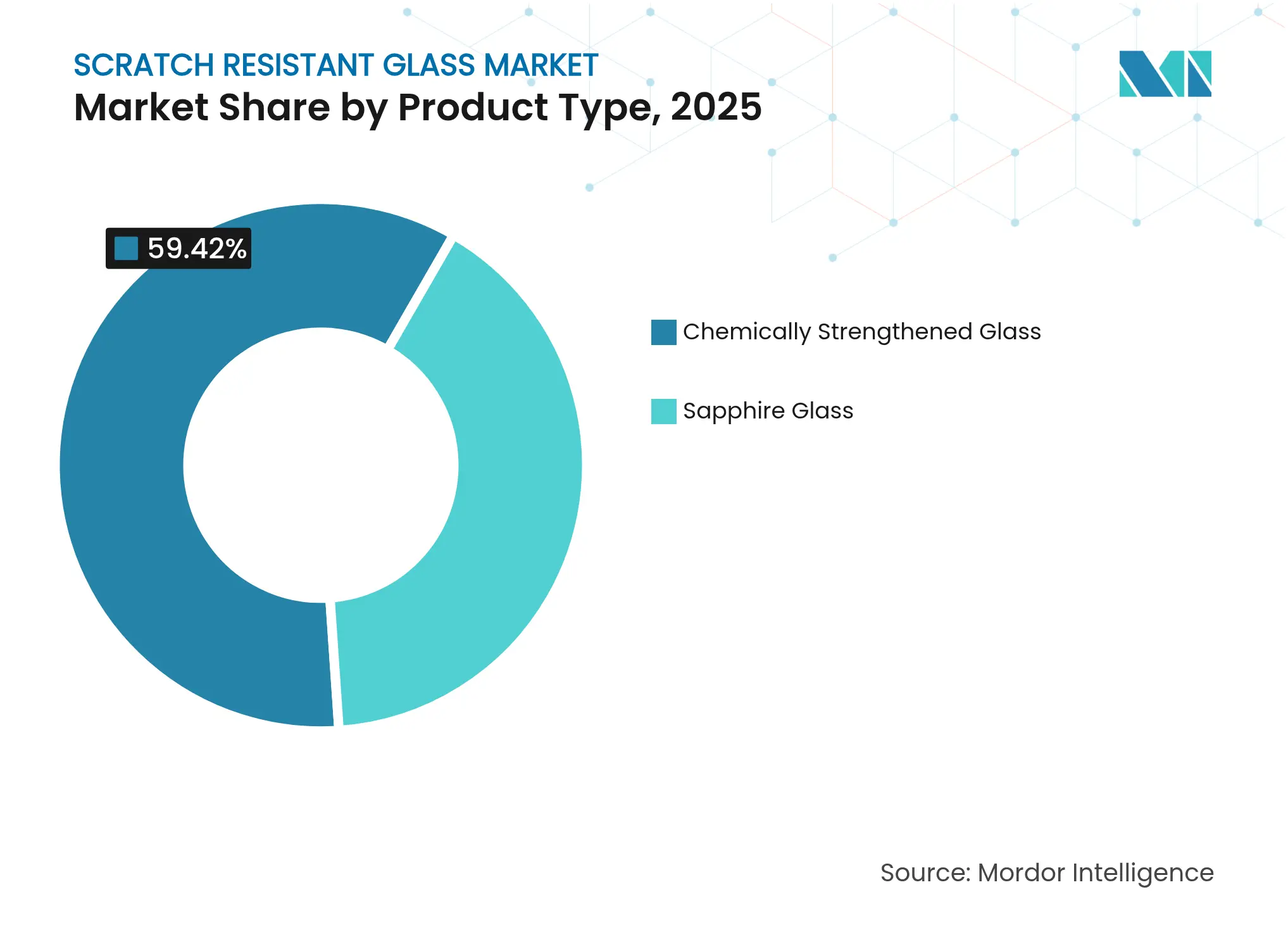
Chemically strengthened glass controlled a 59.42% share of the Scratch Resistant Glass market in 2025, benefiting from mature production lines, high yields, and compatibility with mainstream handset assembly. SCHOTT’s Xensation series blends lithium-aluminosilicate with borosilicate chemistries to increase surface compression, delivering better drop protection without incurring sapphire-level costs. AGC Inc. supplements ion-exchange with electron-cyclotron-resonance ion implantation; nitrogen atoms densify the silica network, raising hardness while enabling subtle anti-reflective gradients. These iterative improvements protect the segment’s incumbency in high-volume applications where bill-of-materials discipline is strict.
Sapphire glass remains the fastest-growing product type in the market, advancing at an 8.42% CAGR through 2031. Premium smartphone makers deploy sapphire camera-lens covers and watch bezels to market durability as a brand ethos. Process refinements, such as smaller boule diameters that shorten crystal-growth cycles, gradually chip away at cost disadvantages. Yet grinding and polishing challenges continue to limit pane sizes, keeping the segment’s share moderate within the overall scratch resistant glass market size. Suppliers therefore position sapphire as a halo material, commanding margins that subsidize research and development (R&D) while protecting broader product families.
Note: Segment shares of all individual segments available upon report purchase
By Application: Cockpit Digitalization Redraws Demand Charts
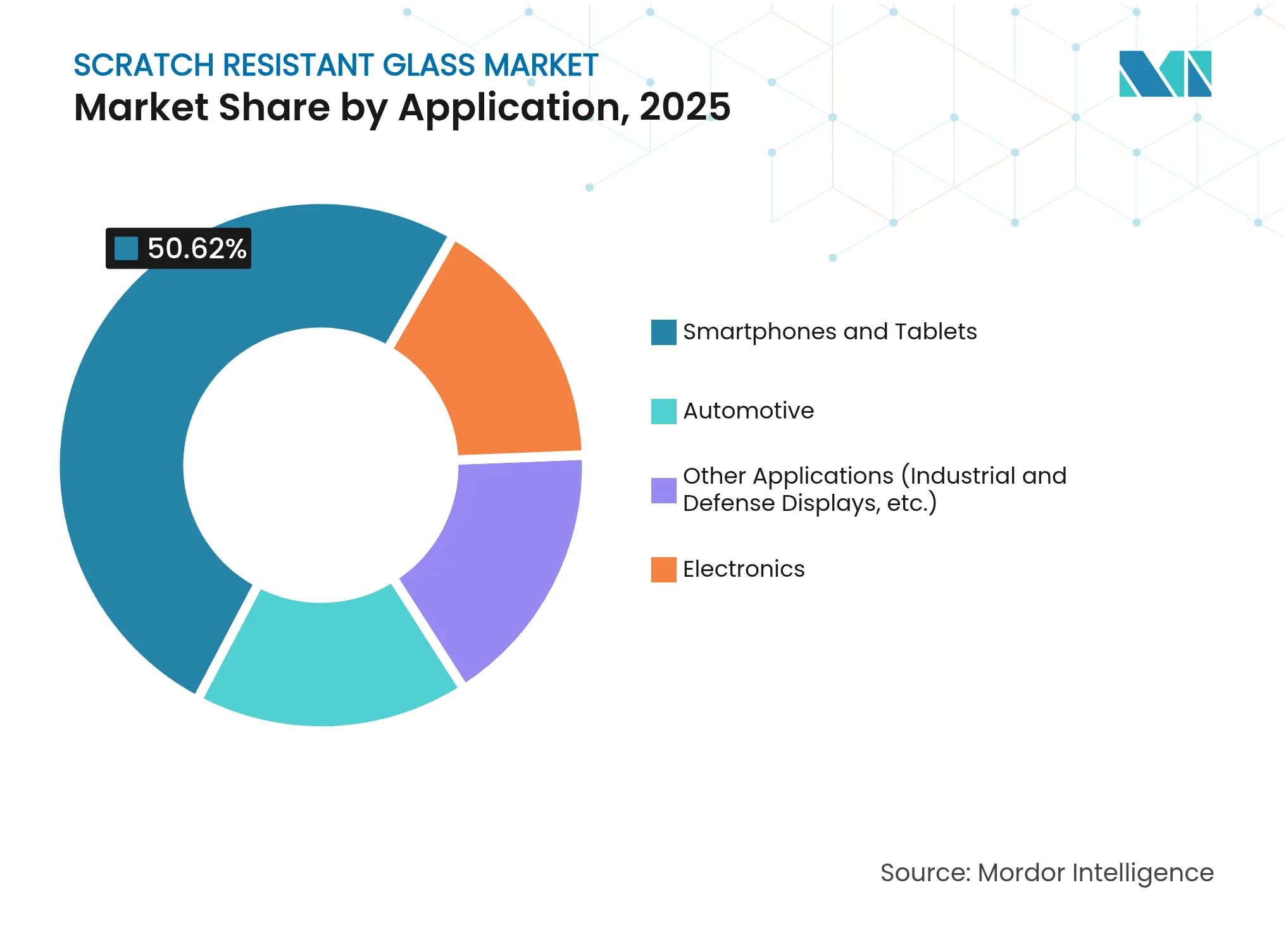
Smartphones and tablets held 50.62% of Scratch Resistant Glass market size in 2025, but shipment growth is plateauing in developed economies where penetration tops 90%. Value now migrates to differentiated sub-segments like foldables and gaming phones that demand specialized glass stacks. Automotive displays represent the fastest-growing application at 8.31% CAGR, propelled by the shift from mechanical knobs to multi-panel touch interfaces. Regulatory mandates for driver-assistance systems place optical quality and scratch resilience at the center of safety compliance, nudging automakers toward premium glass.
Wearables, Augmented Reality/Mixed Reality (AR/MR) goggles, and industrial-control screens create supplemental niches. AGC Inc.’s M100/200 glass substrate secured Consumer Electronics Show (CES) 2025 awards for augmented-reality optics, showcasing sub-2 nm roughness essential for waveguide clarity. These specialized fields reward suppliers capable of tight thickness tolerances and near-zero birefringence. Although volumes lag handset levels, premium pricing lifts revenue contribution, broadening the Scratch Resistant Glass market beyond its consumer-electronics origins.
Note: Segment shares of all individual segments available upon report purchase
Asia-Pacific owns 43.58% of Scratch Resistant Glass market share as of 2025 and is projected to grow at 8.2% CAGR to 2031. Domestic smartphone champions in China, South Korea, and India integrate Corning Incorporated, AGC Inc., or SCHOTT AG glass across mid-range and flagship tiers, ensuring embedded demand visibility. India’s Production-Linked Incentive scheme draws USD 1.003 Billion of cover-glass finishing investment from Corning and Optiemus, adding 840 jobs and deepening regional supply chains. Mainland China leverages existing display fabs and booming electric vehicle (EV) output to localize glass procurement, while Japanese and South Korean firms anchor upstream innovation in ultra-thin and flexible variants.
North America remains a technology powerhouse. Corning’s USD 315 Million expansion in New York increases capacity for high-purity fused silica used in semiconductor packaging glass, aligning with the CHIPS Act’s USD 32 Million grant support. The well-established premium handset base prioritizes replacement driven by feature adoption rather than first-time ownership, keeping average selling prices high and sustaining strong glass content per device.
Europe advances sustainability leadership. Saint-Gobain recorded EUR 47.9 Billion sales in 2024 while certifying nearly 90% of its product range under Cradle-to-Cradle standards. AGC Inc. Interpane deploys photovoltaic roofs at glass plants in Germany and Austria, trimming Carbon Dioxide (CO2) emissions and stabilizing energy costs. Automotive electrification stimulates demand for scratch-proof windshield overlays that host augmented-reality driver-assistance displays. Strict waste directives push recycling rates, spurring research into closed-loop cullet processing that maintains optical-grade purity.
South America and the Middle East & Africa contribute smaller but rising volumes. Smartphone penetration in Brazil, Nigeria, and Saudi Arabia still trails global averages, offering runway for first-time adoption. Regional assembly hubs import glass from Asia-Pacific until domestic capacity scales. Lower discretionary income heightens price sensitivity, favoring chemically strengthened glass over sapphire. Long-term infrastructure projects in Gulf states incorporate durable touch panels in mass-transit kiosks and smart-city furniture, adding incremental outlets for the Scratch Resistant Glass market.
Market Concentration
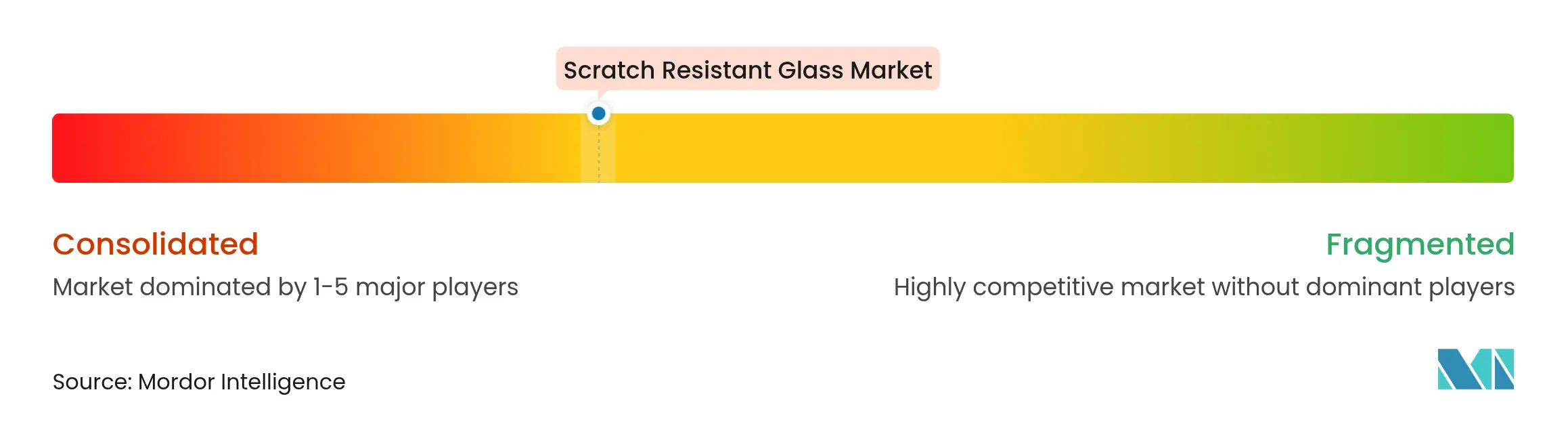
The Scratch Resistant Glass market is moderately consolidated with the presence of major players, including Corning Incorporated, AGC Inc., SCHOTT AG, Guardian Glass LLC, and Nippon Electric Glass Co., Ltd. Corning’s Gorilla Glass franchise spans seven generations, with Gorilla Armor 2 launching in January 2025 and delivering quadruple scratch resistance versus competing silicate compositions. The company leverages six global melt plants and proprietary fusion-draw lines to maintain scale economies. AGC Inc. differentiates through ion-implantation hardening and anti-reflective gradients, securing design wins in augmented-reality headsets and electric vehicle (EV) dashboards. Emerging challengers explore nanostructured surfaces that mimic moth-eye textures to boost scratch resistance without increasing thickness.

*Disclaimer: Major Players sorted in no particular order
1. Introduction
2. Research Methodology
3. Executive Summary
4. Market Landscape
5. Market Size and Growth Forecasts (Value)
6. Competitive Landscape
7. Market Opportunities and Future Outlook
The Scratch Resistant Glass market report include:
Unlocking Supplier Partnerships in the Africa Lubricants Market
5 Min Read
Strategic Expansion of Floor Coatings in the MEIA Region
4 Min Read
US Market Entry for Taiwanese Machine Tool Manufacturers
5 Min Read
When decisions matter, industry leaders turn to our analysts. Let’s talk.


