
Laminated Glass Market Size and Share
Market Overview
| Study Period | 2021 - 2031 |
|---|---|
| Market Size (2026) | USD 21.78 Billion |
| Market Size (2031) | USD 27.68 Billion |
| Growth Rate (2026 - 2031) | 4.91 % |
| Fastest Growing Market | Asia Pacific |
| Largest Market | Asia Pacific |
| Market Concentration | Medium |
Major Players *Disclaimer: Major Players sorted in no particular order Image © Mordor Intelligence. Reuse requires attribution under CC BY 4.0. | |
Laminated Glass Market Analysis by Mordor Intelligence
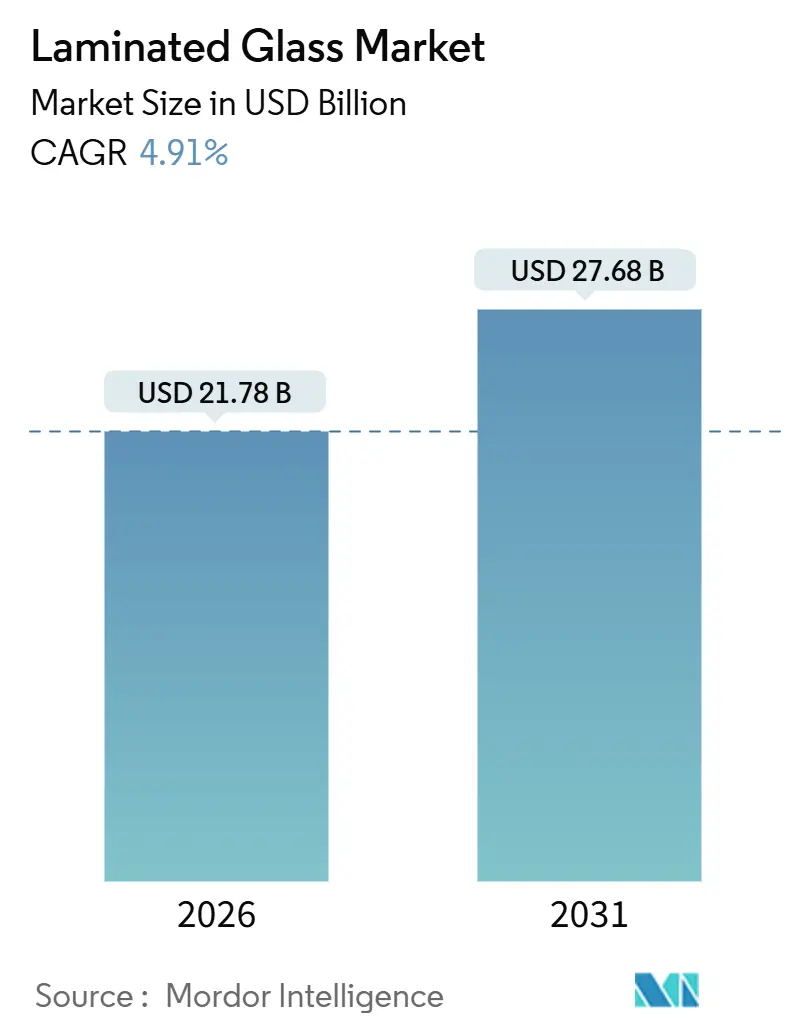
The Laminated Glass Market size is estimated at USD 21.78 billion in 2026, and is expected to reach USD 27.68 billion by 2031, at a CAGR of 4.91% during the forecast period (2026-2031). Strict safety rules, low-energy construction codes, and the rise of electric vehicles are boosting demand for interlayer-bonded glass in buildings, cars, and photovoltaic façades. Polyvinyl butyral (PVB) kept a 53.13% revenue lead in 2025, yet ionoplast grades are growing faster as cyclone-prone regions mandate hurricane-grade curtain walls. Solar and building-integrated PV (BIPV) panels now outpace traditional uses as China’s zero-energy codes take force. Competitive focus is shifting to high-margin interlayers, with top float-glass groups using vertical integration to shield margins while niche ionoplast firms carve out coastal and defense jobs.
Key Report Takeaways
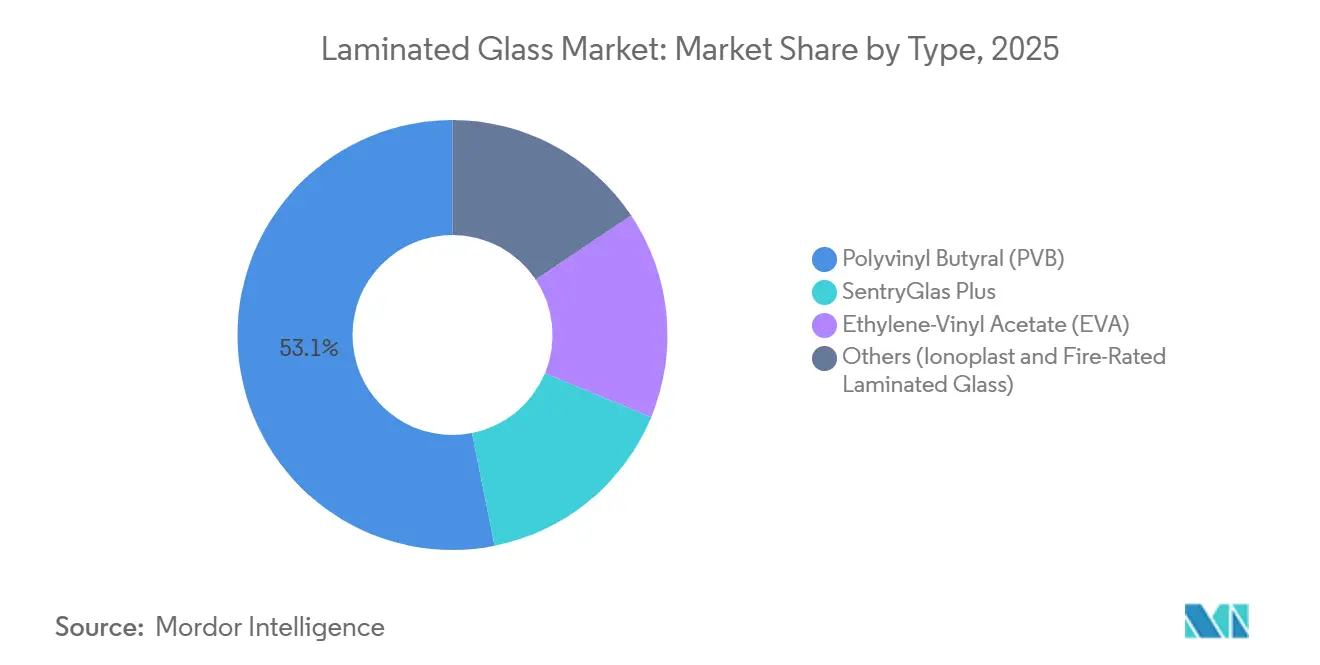
- By type, Polyvinyl Butyral retained 53.13% of the laminated glass market share in 2025, yet SentryGlas Plus is forecast to grow fastest at 5.92% CAGR to 2031.
- By application, architectural interiors led with 43.13% revenue share in 2025; solar/BIPV modules are projected to expand at an 8.18% CAGR through 2031.
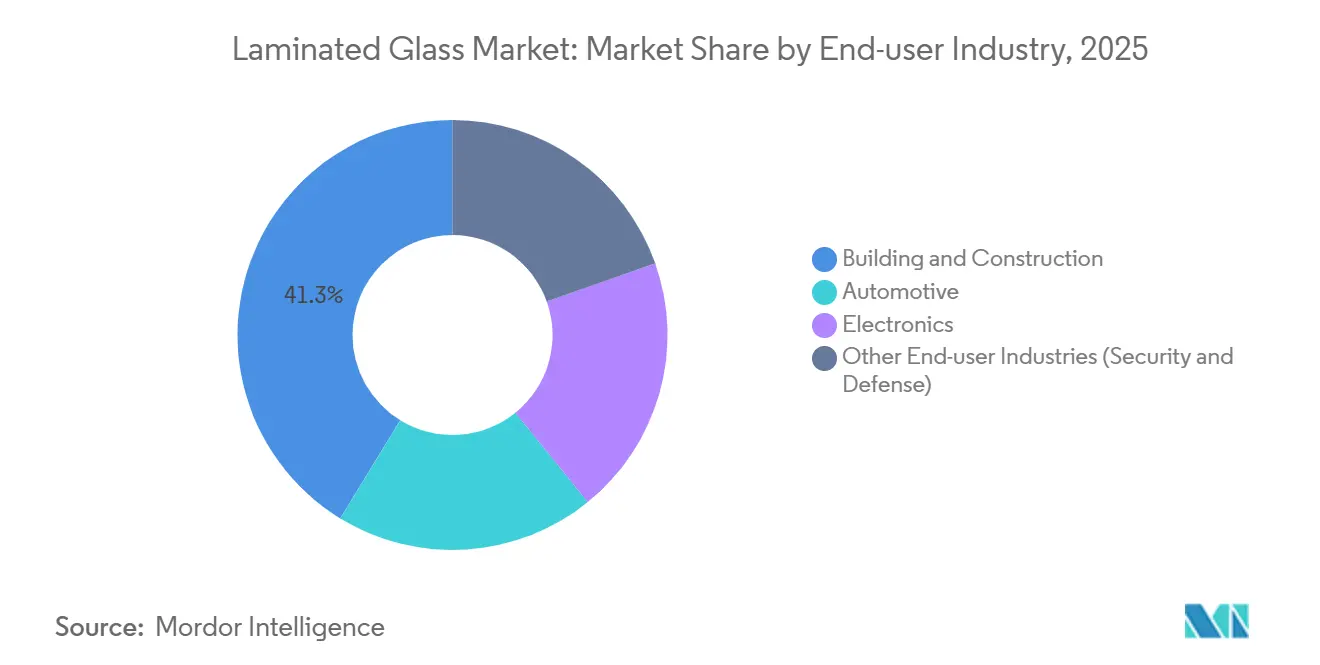
- By end-user industry, building and construction held 41.26% of the laminated glass market size in 2025, while automotive is on track for a 6.72% CAGR between 2026-2031.
- By region, Asia Pacific dominated with 48.25% of sales in 2025 and is advancing at a 6.03% CAGR to 2031.
Note: Market size and forecast figures in this report are generated using Mordor Intelligence’s proprietary estimation framework, updated with the latest available data and insights as of January 2026.
Global Laminated Glass Market Trends and Insights
Drivers Impact Analysis*
| Driver | (~) % Impact on CAGR Forecast | Geographic Relevance | Impact Timeline |
|---|---|---|---|
| Urban skyscraper boom in Asia Pacific demanding hurricane-grade façades | +1.2% | APAC core (China, India, Southeast Asia), spill-over to Middle East | Medium term (2-4 years) |
| Mandated HUD-ready laminated windshields in premium EVs | +0.9% | Global, with early gains in North America, Europe, China | Short term (≤ 2 years) |
| EU-27 compulsory safety-glazing in public infrastructure | +0.7% | Europe (Germany, France, Italy, Spain, Nordic countries) | Long term (≥ 4 years) |
| BIPV mandates in China's "Zero-Energy Building" codes | +1.1% | China national, provincial pilots in Jiangsu, Guangdong, Zhejiang | Medium term (2-4 years) |
| Rapid growth of ultra-quiet high-rise housing (acoustic laminates) | +0.6% | Global urban centers, concentrated in APAC and Middle East | Medium term (2-4 years) |
| Source: Mordor Intelligence | |||
Urban Skyscraper Boom in Asia-Pacific Demanding Hurricane-Grade Façades
Cyclone-exposed coastal cities from Shenzhen to Manila now specify impact-resistant laminates in towers above 50 m to cut glass fallout risks. Ionoplast interlayers supply five-fold tear strength versus standard PVB, which lets designers trim pane thickness and reduce façade dead load by up to 15%. India’s 2024 building code revision extended similar rules to buildings taller than 15 stories along its eastern and western coastlines, adding more than 40,000 new residential units yearly[1]Bureau of Indian Standards, “National Building Code 2024,” bis.gov.in. Dubai mirrored the shift in its 2025 Fire and Life Safety Code that obliges laminated balustrades for balconies in sand-storm zones. Thailand and Vietnam still lack local ionoplast extrusion, driving 10-12 week import lead times that inflate costs by 20–30%. As a result, regional capacity additions from Kuraray and AGC remain likely through 2028.
Mandated HUD-Ready Laminated Windshields in Premium EVs
Head-up-display (HUD) functions in luxury electric cars need wedge-shaped interlayers with refractive tolerances tighter than 0.0005 to avoid double images. Eastman combined acoustic damping and optical precision in its 0.76 mm Saflex DG film, commercialized in 2024[2]Eastman Chemical Company, “Saflex Acoustic DG Product Sheet,” eastman.com. EU rule ECE R43 amendment 05, effective 2025, obliges laminated windshields in all passenger vehicles, abolishing the toughened-glass option in low-cost models. General Motors adopted HUD-compatible glass across its Ultium EV range during 2025, shaving warranty claims on stress cracks by about 30%. Tier-2 fabricators without precision calendaring now face steep capital hurdles, consolidating supply around AGC, NSG Pilkington, and Fuyao.
EU-27 Compulsory Safety Glazing in Public Infrastructure
Eurocode 10 updates mandate laminated or wired glass in atriums, stairwells, and overhead glazing to curb injury from spontaneous breakage. Fire-rated products must meet EN 13501-2 EI 60 at a minimum, yet certification takes 18–24 months due to full-scale furnace tests. Saint-Gobain and Schott invested over EUR 25 million apiece in in-house labs, letting them cycle products faster and dominate tenders. The UK’s 2024 Building Safety Act extended similar rules to residential towers taller than 18 m, lifting demand by over 1 million m² annually. Higher interlayer costs, however, mean budget projects often delay upgrades until subsidies improve.
BIPV Mandates in China’s Zero-Energy Codes
China’s 2024 amendment to GB/T 51350 requires new public buildings in Tier-1 cities to self-generate 20% of annual electricity by 2027. Laminated glass with EVA encapsulants protects crystalline cells while meeting national safety glazing norms. Jiangsu launched 30% BIPV subsidies in 2025, triggering 15 GW of façade-mounted capacity additions. CSG Holding and Xinyi Glass responded by adding EVA lines that cut module costs by 25% versus imports. UV-induced EVA aging above 85°C remains a hurdle, pushing developers to shaded orientations or pricier ionomer films.
Restraints Impact Analysis*
| Restraint | (~) % Impact on CAGR Forecast | Geographic Relevance | Impact Timeline |
|---|---|---|---|
| Volatile soda-ash and PVB feedstock prices | -0.8% | Global, acute in Asia Pacific and Europe | Short term (≤ 2 years) |
| Lengthy European Union fire-rated certification cycles | -0.5% | Europe, indirect impact on global product roadmaps | Long term (≥ 4 years) |
| End-of-life laminated glass recycling bottlenecks | -0.3% | Europe and North America (regulatory pressure), limited Asia Pacific impact | Medium term (2-4 years) |
| Source: Mordor Intelligence | |||
Volatile Soda-Ash and PVB Feedstock Prices
Spot soda-ash jumped from USD 220/t in late 2024 to USD 260/t in early 2025 after environmental shutdowns idled 1.5 million t of Chinese capacity. PVB resin cost followed suit when butyraldehyde feedstock climbed 12% year on year, forcing Kuraray and Eastman to raise list prices by up to 10% in January 2025. Laminators on fixed building contracts see 200-bp margin hits during the pass-through lag. Currency shifts add pain; a weaker rupee and baht increased imported PVB bills 5% in 2025 for Indian and Thai processors.
Lengthy European Union Fire-Rated Certification Cycles
EN 1363-1 furnace tests take 90-120 minutes per pane and cost EUR 15,000-20,000, creating 14-month queues at labs running near full capacity. Each new interlayer or thickness calls for fresh trials, so smaller entrants cannot fund multi-SKU pipelines. Saint-Gobain, Schott, and AGC hold in-house furnaces, cementing a 70% share of certified EI-90 capacity in 2025. Proposed CPR reforms might cut duplication after 2028, yet timing remains uncertain.
*Our forecasts treat driver/restraint impacts as directional, not additive. The impact forecasts reflect baseline growth, mix effects, and variable interactions.
Segment Analysis
By Type: Ionoplast Gains as Coastal Codes Tighten
Polyvinyl butyral maintained 53.13% of 2025 revenue, anchoring the laminated glass market thanks to entrenched use in cars and office partitions. SentryGlas Plus, however, is forecast to post a 5.92% CAGR and seize share as coastal regions impose hurricane standards. The laminated glass market size for ionoplast could top USD 5 billion by 2031 if current code trajectories hold. Ionoplast’s 30 MPa tear strength lets façades slim down while meeting impact tests, saving up to 15% structural steel. Pricing premia of 12-15% narrowed in 2025 as new extrusion lines in Guangdong and Dubai improved supply.
Adoption spreads fastest in Southeast Asia and the Gulf, where cyclone and sandstorm loads converge. Developers also favor ionoplast for blast resistance that satisfies insurer guidelines for assets within 500 m of shorelines. Fire-rated gels stay niche, constrained to European public infrastructure, while EVA owns BIPV modules by lowering lamination temperature to protect cells. Other interlayers, such as TPU and polycarbonate, address sunroofs, while security glazing will stay specialized through 2031.



By Application: Solar Modules Outpace Traditional Segments
Architectural interiors commanded 43.13% of 2025 revenue as frameless glass and tempered glass grew in offices and hotels, but solar and BIPV modules are projected to rise at an 8.18% CAGR. The laminated glass market size tied to BIPV may approach USD 7 billion by 2031, buoyed by China’s 20-25% on-site energy targets. Visible-light transmission losses from embedded cells dropped to 30-32% in 2025, easing aesthetic objections in retail façades.
International WELL rules cap sound levels, so acoustic partitions retain a strong base in offices. Automotive windshields account for nearly 30% of volume and are climbing as HUD becomes standard on premium EVs, adding USD 10 per pane. Exterior curtain walls hold 18-20% share but migrate toward high-spec ionoplast to satisfy cyclone maps in India and Florida. Security glazing sits below 5% yet commands margins triple those of commodity interiors, helping offset rising energy costs at integrated plants.
By End-User Industry: Automotive Electrification Accelerates Glass Demand
Building and construction led with 41.26% of 2025 demand, yet the automotive sector is the growth engine with a 6.72% CAGR to 2031. Panoramic EV roofs now exceed 1.5 m² and must be laminated to meet rollover rules, driving square-meter uptake. Mercedes EQS and BMW iX models added more than 12 kg of laminated glass per vehicle in 2025.
Electronics makers use laminates in foldable phones to fight crease propagation, but they hold just a 6-8% share. Defense, marine, and aerospace markets remain sub-5% due to weight needs that favor polycarbonate. Overall, the laminated glass market will rely on construction and automotive for roughly 75% of revenue by 2030, concentrating power with Tier-1 suppliers that can serve both channels.
Geography Analysis
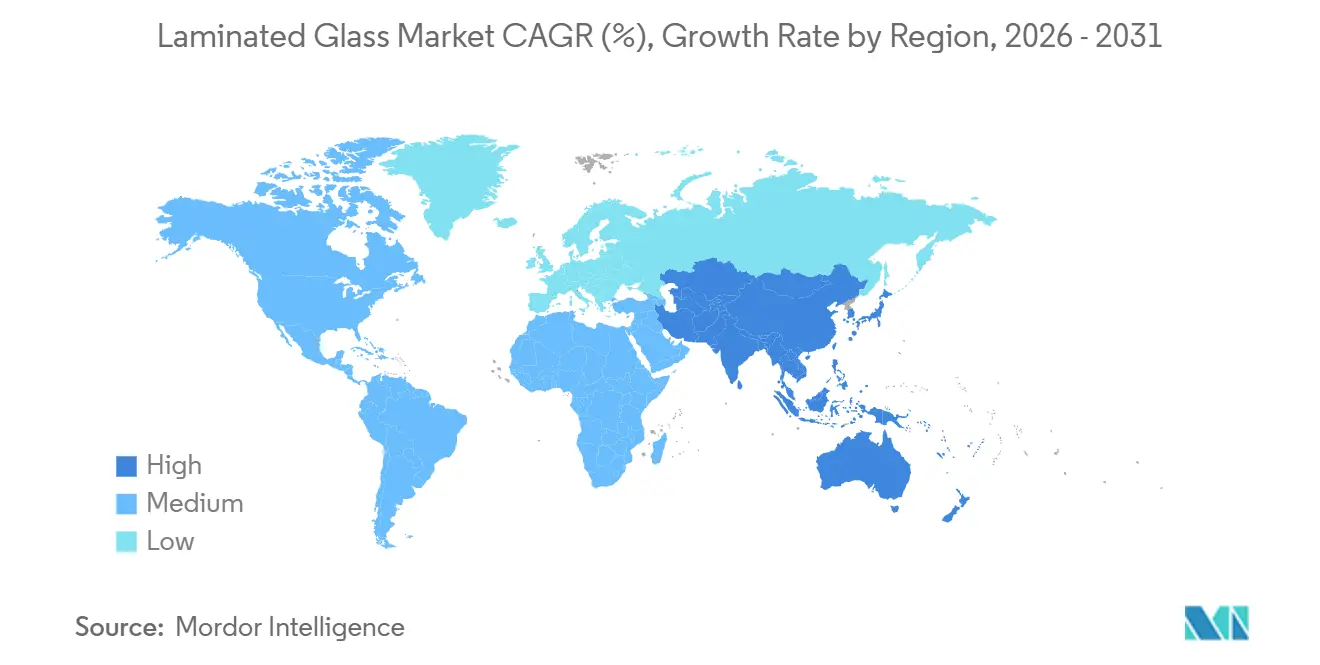
Asia Pacific held 48.25% of 2025 revenue and is growing at a 6.03% CAGR, making it the clear volume and growth leader in the laminated glass market. China consumed about 440 million m² in 2025, helped by Jiangsu and Guangdong subsidies that cover 30% of BIPV capital costs. India’s USD 1.4 trillion infrastructure plan adds 25 million m² of curtain walls per year, yet local laminating capacity lags demand by 20%.
In North America, FMVSS 205 already requires laminated windshields, but HUD adoption lifts PVB unit value by USD 8-12. Canada’s 2025 code now calls for overhead safety glass in public spaces, adding close to 1 million m² of annual need. Mexico’s Vitro and Guardian plants ship 20 million windshields yearly to US assembly lines, anchoring regional exports.
In Europe, Eurocode 10 drove 2 million m² extra demand for public-building atriums, yet long certification waits restrain smaller suppliers. Nordic nations top per-capita consumption due to triple-glazed units with laminated outer panes that fight ice shedding. South America and the Middle East share the remaining 9%, with Saudi megaprojects specifying ionoplast façades able to withstand 100 km/h sand storms.

Value Chain Analysis
The laminated glass value chain begins with upstream inputs such as silica sand and soda ash for float glass, and interlayer chemistries including PVB, EVA, and ionoplast, alongside energy-intensive furnace operations. Float glass production is capital intensive, and converters then cut and finish the substrate, prepare edgework and washing steps, lay up the interlayer, and bond the panes through autoclave processing (or newer autoclave-free routes). The downstream phase adds coatings and quality inspection to meet the safety and optical tolerances demanded by architectural facades and automotive HUD applications.
Downstream, distribution and fabrication flow to construction glaziers and facade contractors, automotive OEMs and Tier suppliers, and solar/BIPV module makers. Handling constraints for jumbo, heavy glass lites shape logistics and inventory practices. Bottlenecks highlighted for the current cycle include feedstock volatility (soda ash and PVB) and trade friction, including 2025 US tariff measures on imported laminated glass and interlayers that drove regional sourcing changes, alternative supplier qualification, and revised inventory strategies. Traceability and tighter QA are also becoming more prominent for safety-critical applications, including Kuraray implementing batch traceability across its Trosifol and SentryGlas brands in September 2025.
Competitive Landscape
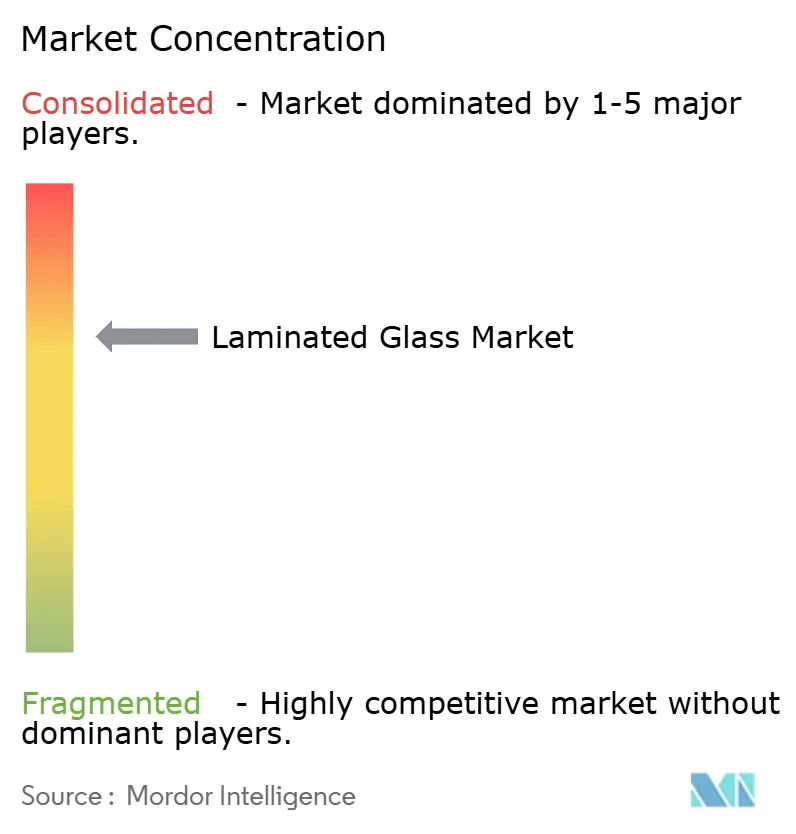
The Laminated Glass market is moderately consolidated. Integrated producers save up to USD 12 per m² by melting float glass and calendaring PVB in-house, a gap that protects margins when a soda-ash spike occurs. Technology leadership centers on HUD-ready wedge interlayers that need ±0.02 mm thickness precision. Only AGC, Kuraray, and Eastman run such lines at scale. Fuyao opened a USD 250 million plant in Ohio during 2025 to supply Detroit EV platforms, trimming logistics costs by USD 15 per windshield versus Asian imports.
Laminated Glass Industry Leaders
Saint-Gobain
AGC Inc.
Guardian Industries
Nippon Sheet Glass Co., Ltd
Xinyi Glass Holdings Limited
- *Disclaimer: Major Players sorted in no particular order

Market Opportunities and Future Outlook
Near-term opportunities are tied to regionalization and to higher-value laminated configurations that combine safety, energy performance, and lower embodied-carbon credentials. Capacity and capability investments across flat and coated glass are creating more supply options for laminators and facade systems: in 2026, Sisecam completed major flat and coated glass investments, including a 432,000 tonnes per year greenfield facility in Tarsus, Türkiye, plus new coated glass lines in Italy and Bulgaria. India is also building upstream resilience, with Asahi India Glass announcing a INR 2,700 crore float glass plant investment in July 2026 to support automotive supply chains. In North America, Stewart Glass announced in May 2026 a second line at its Logan, Ohio solar glass facility, targeting an increase in daily capacity to 250 tons by June 2027 as the report focus shifts toward solar/BIPV laminates.
Product-level white space shows up most clearly in low-carbon and lightweight laminated solutions that allow projects to meet tightening building decarbonization requirements without compromising safety performance. Manufacturers are pairing low-carbon glass substrates with recycled-content interlayers, including Eastman branded low-carbon PVB offerings that glass producers are incorporating into laminated product ranges. Research into validated lightweight and thin laminated glass solutions, such as ThinLam involving Folienwerk Wolfen, SCHOTT, and BAUKO, is also expanding design options that reduce weight while meeting EN356 and EN12600, supporting use cases in complex facades, retrofit projects, and applications where dead load and handling constraints influence costs.
Recent Industry Developments
- July 2026: AGC Glass Europe launched the Low-Carbon Stratobel laminated glass range, pairing low-carbon float glass with Eastman Saflex LiteCarbon Clear PVB interlayers. It targets embodied-carbon reduction requirements in facade specifications and differentiates laminated products beyond commodity safety glazing.
- October 2025: Khalifa Economic Zones Abu Dhabi disclosed that China Southern Glass (CSG) plans to establish its first overseas intelligent manufacturing facility in the United Arab Emirates. The project is designed for over 5 million square meters per year of coated, laminated, and insulating glass, supporting high-spec architectural glazing and shortening lead times for Gulf construction programs.
- March 2025: AGC Glass Europe introduced Stratobel Mirox, a laminated mirror designed for interior applications. The product combines mirror aesthetics with laminated safety performance, expanding laminated glass uptake in interior fit-outs where safety glazing requirements and premium finishing are specified.


Research Methodology Framework and Report Scope
Market Definition and Coverage
This market covers the value of newly manufactured laminated glass. Laminated glass is produced by bonding two or more glass layers with a polymer interlayer, then sold into end uses where safety, security, and noise reduction are specified.
Scope exclusions: Excludes tempered-only and annealed-only glass sold without an interlayer, as well as aftermarket safety films and repair or replacement services.
Segmentation Overview
- By Type
- Polyvinyl Butyral (PVB)
- SentryGlas Plus
- Ethylene-Vinyl Acetate (EVA)
- Others (Ionoplast, Fire-Rated Laminated Glass)
- By Application
- Architectural Exteriors (Curtain Walls and Facades)
- Architectural Interiors (Partitions and Balustrades)
- Automotive Windshields
- Automotive Sunroofs and Body Glazing
- Solar / BIPV Modules
- Electronics and Smart Devices
- Security and Defense Glazing
- By End-user Industry
- Building and Construction
- Automotive
- Electronics
- Other End-user Industries (Security and Defense)
- By Geography
- Asia-Pacific
- China
- India
- Japan
- South Korea
- Thailand
- Malaysia
- Indonesia
- Vietnam
- Rest of Asia-Pacific
- North America
- United States
- Canada
- Mexico
- Europe
- Germany
- United Kingdom
- France
- Italy
- Spain
- Turkey
- Russia
- Nordic Countries
- Rest of Europe
- South America
- Brazil
- Argentina
- Colombia
- Rest of South America
- Middle-East and Africa
- Saudi Arabia
- United Arab Emirates
- Qatar
- South Africa
- Nigeria
- Egypt
- Rest of Middle-East and Africa
- Asia-Pacific
Data Sources, Market Sizing, and Validation
Desk Research
Desk work starts by aligning a simple fact base on construction and vehicle demand where laminated glass is typically specified. We referenced public sources such as USGS minerals and materials statistics, UN Comtrade trade codes for glass products, International Energy Agency building-related indicators, World Bank macro series, and building code and safety standard bodies where glazing requirements are published.
To convert demand signals into a usable market model, we also reviewed company annual reports, investor presentations, and press releases for capacity expansions, product mix commentary, and regional revenue color. When gaps appeared around interlayer trends and specialty uses, we cross-checked patent databases and an import-export shipment-level database for directional validation. These sources are illustrative only, and we relied on many other public references to collect, validate, and clarify individual data points.
Primary Interviews and Surveys
Primary work focuses on how laminated glass is actually ordered and priced across construction, automotive glazing, and safety applications, and how that pattern shifts by region and specification. We spoke with a mix of manufacturers, interlayer suppliers, processors, distributors, fabricators, and large buyers to confirm adoption rates, typical thickness builds, and pricing movement, then checked the same assumptions across APAC, EMEA, and the Americas.
Distribution of primary research fieldwork respondents
| Company type | Respondent position | Region |
|---|---|---|
| Top tier: 32% | CXOs: 14% | APAC: 40% |
| Mid tier: 47% | Functional/Unit leaders: 29% | EMEA: 33% |
| Smaller Players: 21% | Managers: 57% | Americas: 27% |
Market-Sizing & Forecasting
Sizing is built using a top-down approach where construction activity and vehicle production signals are translated into a laminated-glass demand pool, then valued using region-appropriate price bands. The key inputs we leaned on include building starts and renovation activity, vehicle output and windshield fitment rates, safety and hurricane code adoption, the mix shift between PVB and EVA interlayers, and the share of higher value uses such as acoustics or security glazing.
Before finalizing totals, we corroborated them with selective bottom-up approximations, including sampled processor throughput, channel checks on typical order sizes, and price per square meter checks by thickness and performance class. Where direct visibility was limited, for example in specialty security projects, we used conservative penetration ranges from interviews and normalized them against trade flows and capacity announcements.
For forecasting, scenario analysis is used so macro drivers and sector cycles can be reflected without overfitting. Growth paths are adjusted using expert expectations for construction recovery timing, auto glazing mix changes such as more laminated sidelites in some models, and the pace of code-driven upgrades.
Data Validation & Update Cycle
Validation is done through repeated cross-checks so the final number is not dependent on a single data series. We compare outputs against independent signals such as regional glass trade movements, announced capacity additions, and construction spending direction, then recheck any large year-over-year jumps before sign-off.
A multi-step review is followed where assumptions, pricing, and conversion factors are checked by another analyst, then reconciled with interview feedback that is most relevant to the year being sized. Reports are refreshed annually, and interim updates are triggered when major events occur, such as a sharp energy cost change impacting glass pricing or a meaningful code update affecting laminated adoption. Before delivery, we complete a fresh pass so clients receive the most current view.
Mordor Intelligence's Laminated Glass Market Size Compared Against Other Published Estimates
It is normal to see different laminated glass market numbers across publishers because they do not always count the same products, end uses, and pricing points in the value chain. Differences also come from the base year picked, the currency conversion timing, and whether the forecast assumes a steady or fast shift toward higher specification glazing.
Aftermarket safety films sit outside Mordor Intelligence's scope, and that single exclusion can move totals when other estimates blend factory-built laminated glass with retrofit layers and replacement activity. The spread is also influenced by whether solar and BIPV laminated glass is treated as a core demand bucket, and how interlayer mix is translated into pricing as thicker or acoustic builds gain share.
Benchmark comparison
| Source | Market Size | Gaps in Research Methodology |
|---|---|---|
| Mordor Intelligence | USD 21.78 B (2026) | |
| Industry Publisher A | USD 21.93 B (2024) | Uses a 2024 base year and does not clearly separate retrofit films and service-led replacement activity from first-sale laminated glass value, which can compress or inflate comparisons depending on local repair intensity. |
| Industry Publisher B | USD 25.09 B (2024) | A broader end-use lens is indicated and the value build appears to lean on higher average pricing across applications, which can lift the total if premium acoustic and security specifications are applied too widely. |
Taken together, the table shows that scope edges and pricing logic typically explain more of the gap than simple math errors. By keeping inclusions tied to factory-manufactured laminated glass and checking adoption and pricing with real buyer and supplier inputs, the final number stays traceable to clear demand drivers and repeatable steps.


Key Questions Answered in the Report
What is the current value of the laminated glass market?
The laminated glass market size reached USD 21.78 billion in 2026 and is forecast to climb to USD 27.68 billion by 2031.
Which interlayer type is growing fastest?
SentryGlas Plus interlayers post the quickest rise with a 5.92% CAGR through 2031, driven by hurricane-grade and blast-resistant façade codes.
Why are solar and BIPV panels important for laminated glass demand?
China’s zero-energy mandates and provincial subsidies push builders toward façade-integrated PV, lifting solar and BIPV laminates at an 8.18% CAGR.
How will electric vehicles influence laminated-glass volumes?
Premium EV models need HUD-ready windshields and large panoramic roofs, fueling a 6.72% CAGR for automotive glazing through 2031.
Which region leads growth in laminated glass consumption?
Asia Pacific both leads in share at 48.25% and shows the fastest growth at a 6.03% CAGR thanks to construction booms and BIPV rules.
Page last updated on:


 Your data is secure and never sold or shared.


