
Impact Resistant Glass Market Size and Share
Market Overview
| Study Period | 2020 - 2031 |
|---|---|
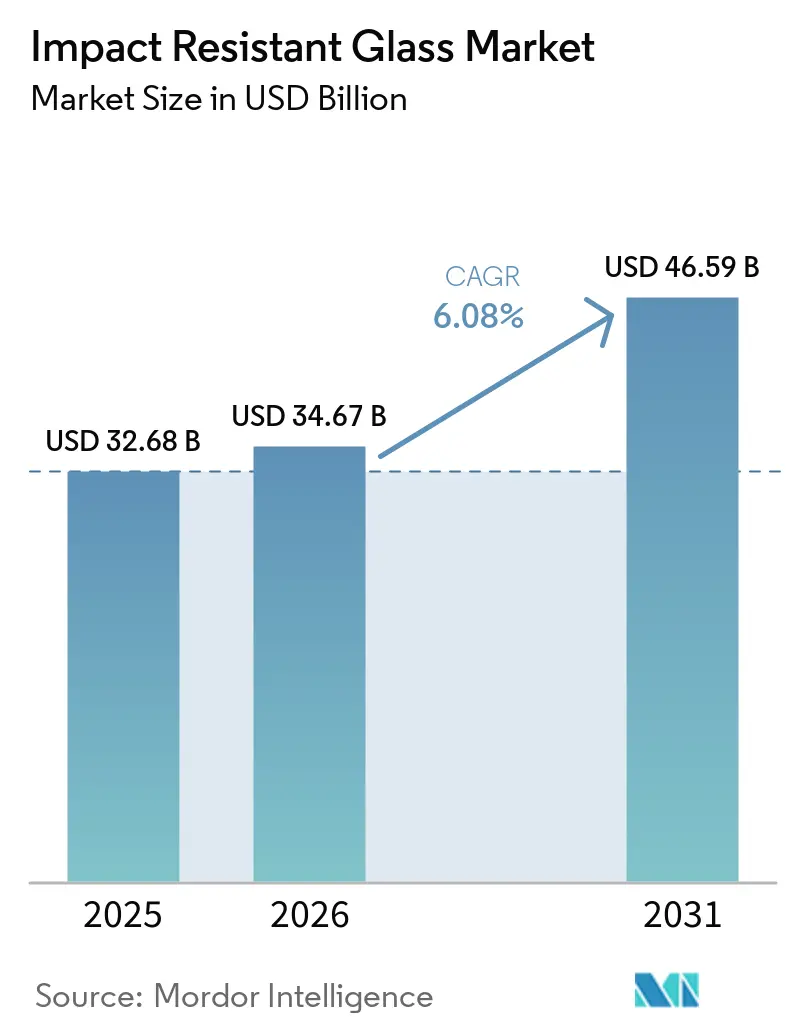
| Market Size (2026) | USD 34.67 Billion |
| Market Size (2031) | USD 46.59 Billion |
| Growth Rate (2026 - 2031) | 6.08 % |
| Fastest Growing Market | Asia Pacific |
| Largest Market | Asia Pacific |
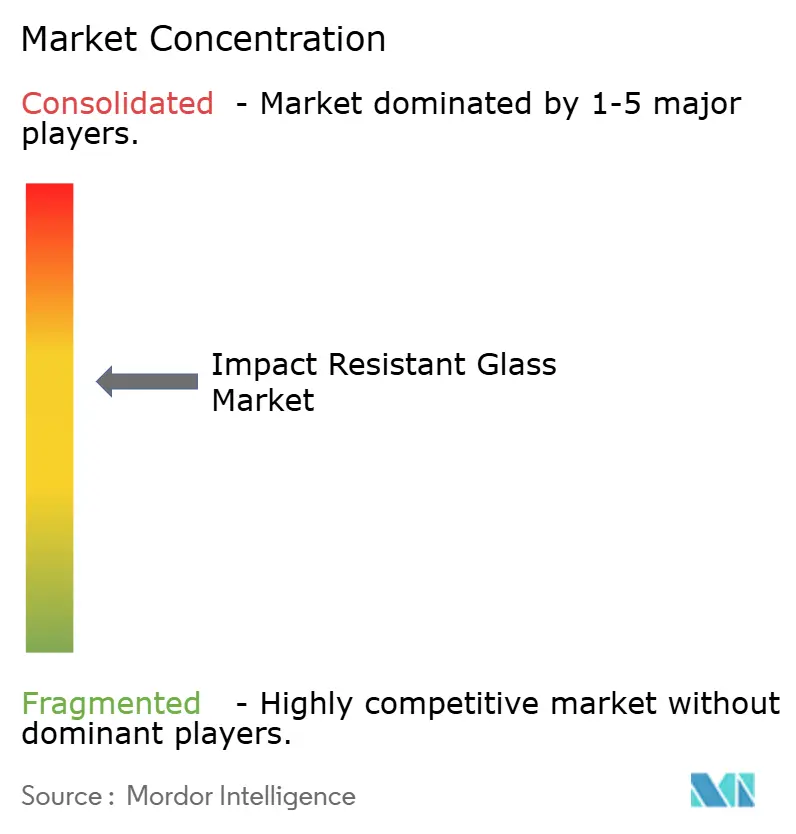
| Market Concentration | Medium |
Major Players *Disclaimer: Major Players sorted in no particular order Image © Mordor Intelligence. Reuse requires attribution under CC BY 4.0. | |
Impact Resistant Glass Market Analysis by Mordor Intelligence
The impact resistant glass market size was valued at USD 32.68 billion in 2025 and estimated to grow from USD 34.67 billion in 2026 to reach USD 46.59 billion by 2031, at a CAGR of 6.08% during the forecast period (2026-2031). Rising storm intensity, tighter glazing mandates in construction and automotive, and escalating insurance incentives keep demand buoyant even where capital costs remain high. Asia-Pacific leads in volume thanks to large-scale building programs, whereas North America delivers premium-priced growth as Florida, Texas, and Louisiana broaden wind-borne debris zones. The laminated segment stays dominant because of fragment retention benefits, yet cost-optimized tempering lines are gaining momentum. Automotive OEMs install lighter, sensor-compatible glass to meet electric vehicle efficiency goals, while governments invest in blast-resistant infrastructure that pushes the technology frontier. Overall, manufacturers with deep R&D pipelines and multiple furnace upgrades capture share as smaller fabricators struggle with energy price swings and higher working-capital needs.
Key Report Takeaways
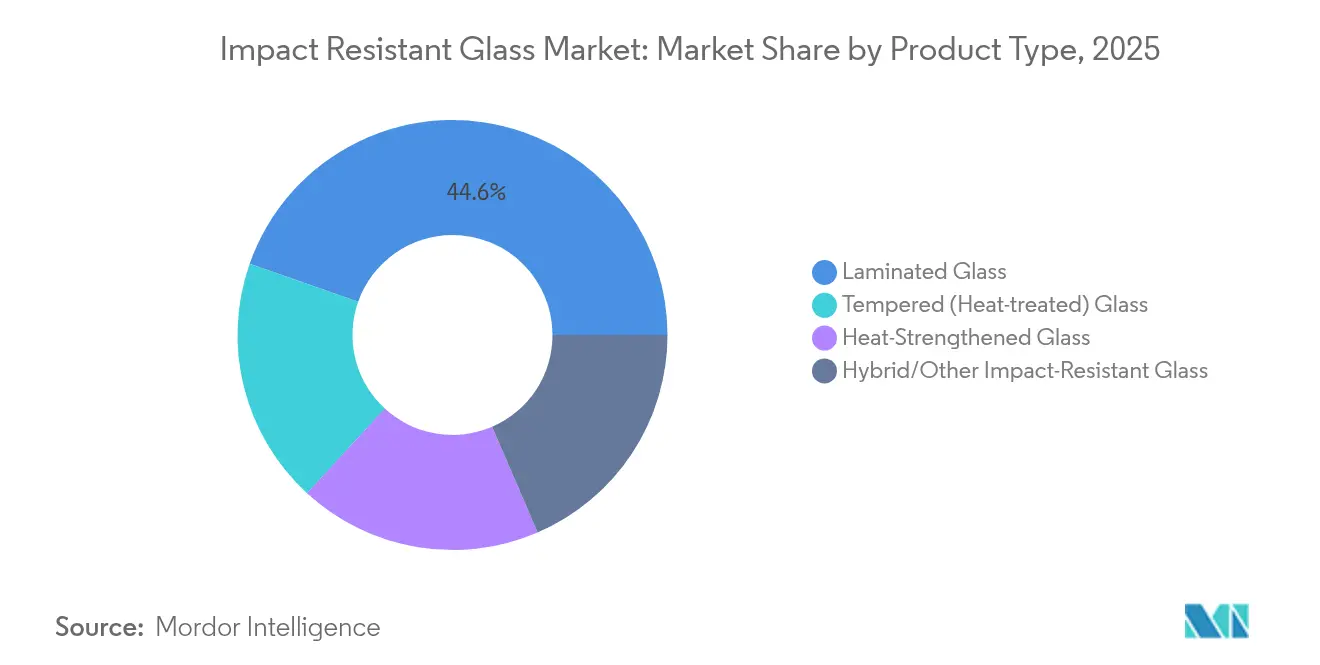
- By product type, laminated glass held 44.62% of the impact resistant glass market share in 2025, while tempered glass is projected to expand at a 7.39% CAGR through 2031.
- By interlayer, polyvinyl butyral captured 48.63% revenue share in 2025; ionoplast interlayers post the fastest growth at 7.46% CAGR to 2031.
- By application, facades, curtain walls, and windows accounted for 40.74% of the impact resistant glass market size in 2025, while windscreens and side-lites are projected to advance at a 6.58% CAGR through 2031.
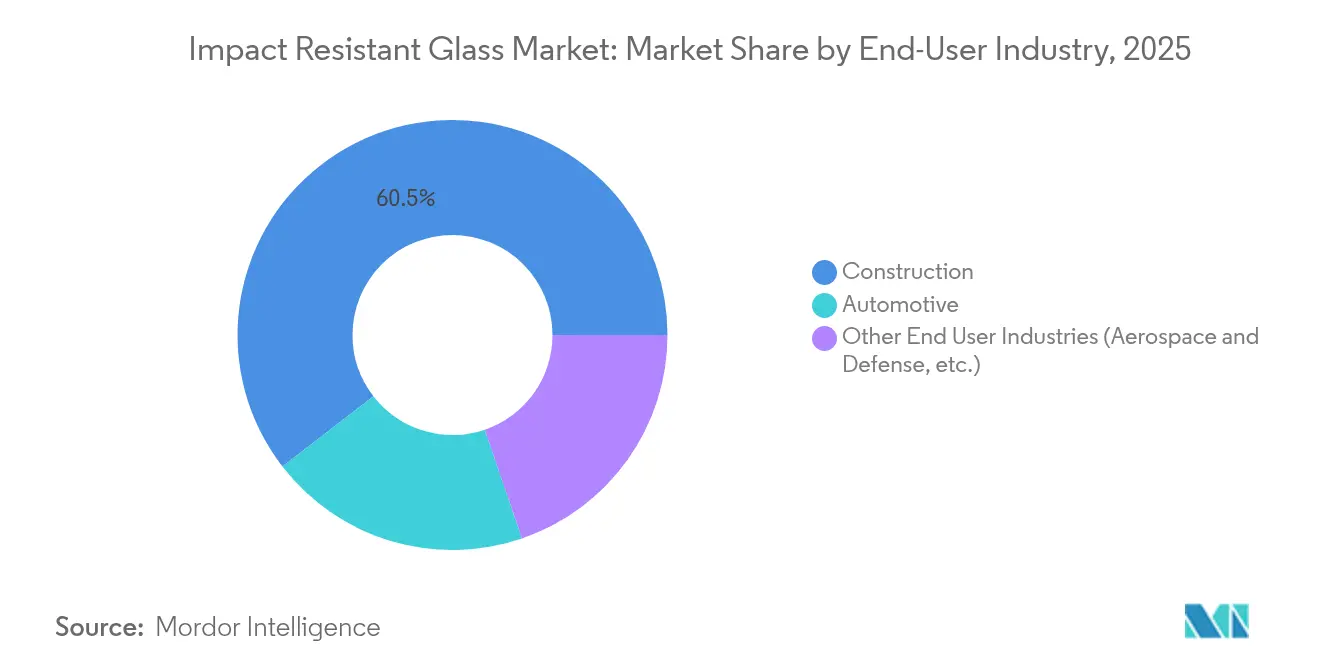
- By end-user industry, construction accounted for 60.47% of the impact resistant glass market size in 2025, whereas automotive rises the quickest at 7.18% CAGR through 2031.
- By geography, Asia-Pacific led with 39.88% revenue share in 2025; the region advances at 7.62% CAGR to 2031.
Note: Market size and forecast figures in this report are generated using Mordor Intelligence’s proprietary estimation framework, updated with the latest available data and insights as of 2026.
Market Trends and Insights
Drivers Impact Analysis of Impact Resistant Glass Market*
| Driver | (~) % Impact on CAGR Forecast | Geographic Relevance | Impact Timeline |
|---|---|---|---|
| Growing adoption in hurricane-prone construction | +1.8% | North America Gulf Coast, Caribbean, Southeast Asia | Medium term (2-4 years) |
| Stricter automotive glazing safety regulations | +1.5% | Global, with early implementation in EU, North America | Short term (≤ 2 years) |
| Infrastructure security investments | +1.2% | Global, concentrated in developed markets | Long term (≥ 4 years) |
| Climate-resilience retrofitting of legacy buildings | +1.0% | North America, Europe, developed Asia-Pacific | Medium term (2-4 years) |
| Insurance premium incentives for impact-rated facades | +0.9% | Hurricane-prone regions, primarily North America | Short term (≤ 2 years) |
| Source: Mordor Intelligence | |||
Growing Adoption in Hurricane-Prone Construction
Wider wind-borne debris zones under the 2023 Florida Building Code compel developers to specify glazing able to withstand 120 mph wind impacts[1]. Louisiana and Texas mirror these updates, so demand extends beyond traditional High Velocity Hurricane Zones. Claim data after Hurricane Ian showed 75% fewer payouts for properties using compliant windows. Builders see a dual return: reduced damage plus up to 55% insurer discounts that offset incremental capex. As a result, the impact resistant glass market gains constant specification in new coastal multifamily projects and public schools. Suppliers scale laminated lines in Georgia and Texas to curb freight costs and guarantee just-in-time deliveries to storm-season job sites.
Stricter Automotive Glazing Safety Regulations
Federal Motor Vehicle Safety Standard 205 now requires higher impact thresholds that accommodate cameras and lidar units embedded in windshields[2]. Corning’s Fusion5 laminate meets these tests while cutting weight by 12% to support electric vehicle range targets. Europe aligns through ECE R43 updates, and OEM platforms launching in 2026 already lock in laminated side-lites. Therefore, the impact resistant glass market benefits from synchronized global rollouts that shorten payback on new autoclave investments. Tier-one glass producers are negotiating multiyear contracts with EV startups that favor thin ionoplast layers for optics and stiffness.
Infrastructure Security Investments
Revised U.S. Department of Defense criteria specify glazing that withstands explosive shock without catastrophic failure. University of Missouri researchers achieved the same fragment retention at half the thickness, easing curtain-wall weight constraints. Government courthouses, data centers, and airports adopt these solutions, elevating the average selling price per square foot. The impact resistant glass market thus captures orders that were once niche defense projects but are now mainstream in urban redevelopment. Manufacturers integrate automated blast-test rigs to validate large panels quickly and secure federal procurement approvals.
Climate-Resilience Retrofitting of Legacy Buildings
INOVUES retrofit modules convert two-pane units to triple-pane impact glass, cutting heat loss by 50% while dampening street noise. Utility incentives in Massachusetts shorten paybacks below five years, stimulating retrofit pipelines in Boston and Cambridge. Project Drawdown calculates 8.82 gigatons of potential CO₂ abatement from widespread high-performance glass retrofits by 2050. Real-estate funds now bundle glazing upgrades with roof insulation and HVAC swaps to achieve green-bond certification, making impact glass a keystone of energy-plus renovations. For the impact resistant glass market, legacy façades present a recurring revenue pool distinct from volatile new-build cycles.
Restraints Impact Analysis of Impact Resistant Glass Market*
| Restraint | (~) % Impact on CAGR Forecast | Geographic Relevance | Impact Timeline |
|---|---|---|---|
| High production & capital costs | -1.4% | Global, particularly affecting emerging markets | Medium term (2-4 years) |
| Raw-material & energy price volatility | -1.1% | Global, higher impact in energy-intensive regions | Short term (≤ 2 years) |
| Laminate recycling & landfill restrictions | -0.8% | Europe, North America, developed Asia-Pacific | Long term (≥ 4 years) |
| Source: Mordor Intelligence | |||
High Production & Capital Costs
Furnace upgrades for laminated or tempered lines cost 30-40% more than basic float glass setups, limiting entry by small fabricators. The U.S. Energy Information Administration reports that glass plants consume 73% natural gas and 24% electricity, exposing them to dual fuel price curves[3]. Producer Price Index data show a 4.5% climb in 2024 that contractors resist passing to owners, squeezing margins. Consequently, only multiregional firms such as AGC can justify back-to-back capital projects that exceed USD 300 million per site. Therefore, the impact resistant glass market risks capacity pinch points whenever a large furnace goes offline for a rebuild.
Raw-Material & Energy Price Volatility
Polyvinyl butyral prices move with petrochemicals, and ionoplast sheets command a premium that challenges budget projects. Natural gas spot spikes raise melt costs because glass baths run at 1,500 °C without interruption. The U.S. Commerce Department launched antidumping cases on Chinese and Malaysian float, adding tariff risk to supply planning. Faced with uncertainty, converters carry extra interlayer inventory that ties up cash. These factors curtail aggressive pricing strategies and moderate expansion in the impact resistant glass market during commodity up-cycles.
*Our forecasts treat driver/restraint impacts as directional, not additive. The impact forecasts reflect baseline growth, mix effects, and variable interactions.
Impact Resistant Glass Market Segment Analysis
By Product Type:
Laminated Glass Leads Despite Tempered AccelerationLaminated glass retained 44.62% of 2025 revenue and anchors the impact resistant glass market thanks to polyvinyl butyral layers that keep shards intact after impact. Builders in coastal zones and automakers selecting windshield substrates rely on this characteristic to satisfy code and safety audits. Tempered glass picks up speed at a 7.39% CAGR to 2031 because new roller quench designs improve flatness and cut energy usage. Production innovations let fabricators supply large panels at lower unit cost, encouraging architects to specify tempered walls in mid-rise offices. Heat-strengthened glass serves a narrow gap between annealed and fully tempered, favored for oversized lites that face thermal stress. AGC’s Temperlite platform delivers five-fold shock resistance while maintaining automotive-grade optics. Specialty hybrid panes that embed fiber composites enter blast and military facilities, but today they still form a small slice of the impact resistant glass industry.
Second-generation laminated formats integrate ionoplast layers that stiffen assemblies enough to trim thickness. This redesign lowers façade weight and decreases aluminum mullion size. The shift yields measurable savings in curtain-wall framing and installation labor, lifting laminated economics even when interlayer price premiums persist. Thus, while tempered volumes may rise faster, laminated revenue remains robust and underpins much of the impact resistant glass market size through 2031.

By Interlayer:
PVB Dominance Challenged by Ionoplast InnovationPolyvinyl butyral commanded 48.63% of the 2025 demand. Its track record with autoclave cycles and recyclability keeps it the go-to interlayer for windshields and residential doors. Eastman’s recent Saflex LiteCarbon Clear variant reduces embodied carbon and targets LEED credits for commercial towers. Ionoplast formulations, however, should climb 7.46% CAGR as their high shear modulus enables thinner glass stacks and lighter vehicle glazing. OEMs select ionoplast where optical devices need precise alignment. EVA interlayers gain share in photovoltaic glass and smart façades that carry wiring because EVA bonds handle higher localized temperatures. Academic tests confirm EVA stiffness comparable with PVB, hinting at wider adoption once supply scales. TPU and multilayer laminates occupy premium blast-rated niches where specification value dwarfs material cost, further diversifying the impact resistant glass market.
Developers in Europe explore biopolymers to comply with circular-economy directives that restrict landfill disposal of PVB scrap. Recycling pilots grind used interlayers into feedstock for flooring and sealants, potentially easing disposal bottlenecks that weigh on glass plant EHS budgets. Until commercial volumes emerge, PVB remains dominant, but ionoplast marketing underscores its transparency retention at elevated UV loads, a factor resonating in tropical installations.
By Application:
Facades Lead While Windscreens AccelerateFacades, Curtain walls, and windows comprised 40.74% of the 2025 use. Urban architects specify floor-to-ceiling glass to maximize daylight and align with wellness-focused design standards, a direction that keeps the impact resistant glass market embedded in every major mixed-use project pipeline. Renovation also matters; landlords retrofit older façades to secure green loans and lower operational carbon. Vehicle windshields and side-lites form the quickest-growing slot at 6.58% CAGR. Updated FMVSS 205 tests and head-up display integration drive laminated uptake, lifting average glass area per car. Electric SUVs amplify this curve since demand for panoramic roofs and acoustic glass increases cabin comfort without sacrificing safety. Structural glazing and scratch resistant glass floors stay niche, yet they showcase the ultimate strength and stiffness attainable with advanced interlayers, promoting long-term perception of glass as both a structural and protective element.
By End-User Industry:
Construction Strength Meets Automotive MomentumConstruction produced 60.47% of global revenue in 2025, driven by hurricane-code requirements across Florida, Texas, and the Caribbean. High-rise developers embrace continuous glazing to stand out in competitive skylines, feeding steady volume into the impact resistant glass market. Insurer discounts as high as 55% tilt life-cycle economics toward laminated façades, reinforcing adoption. Automotive, while smaller, is the fastest mover at 7.18% CAGR through 2031. Fuyao Glass backs this outlook with USD 5.8 billion of new furnaces mainly serving electric vehicles that demand lighter panes for range. Thin ionoplast windshields and laminated side windows reduce cabin noise, enhance camera clarity, and meet emerging pedestrian impact criteria. Aero-defense orders encompass ballistic cabins and pilot canopies, where budgets justify exotic multilayer stacks that command margins far above mainstream projects.
Public-sector retrofit programs in the United States and Europe also elevate construction demand because city councils tie permitting to storm-hardening and energy-saving outcomes. This trend offsets softness in discretionary homeowner spending whenever interest rates climb, helping stabilize the impact resistant glass market.
Geography Analysis
APAC Impact Resistant Glass Market
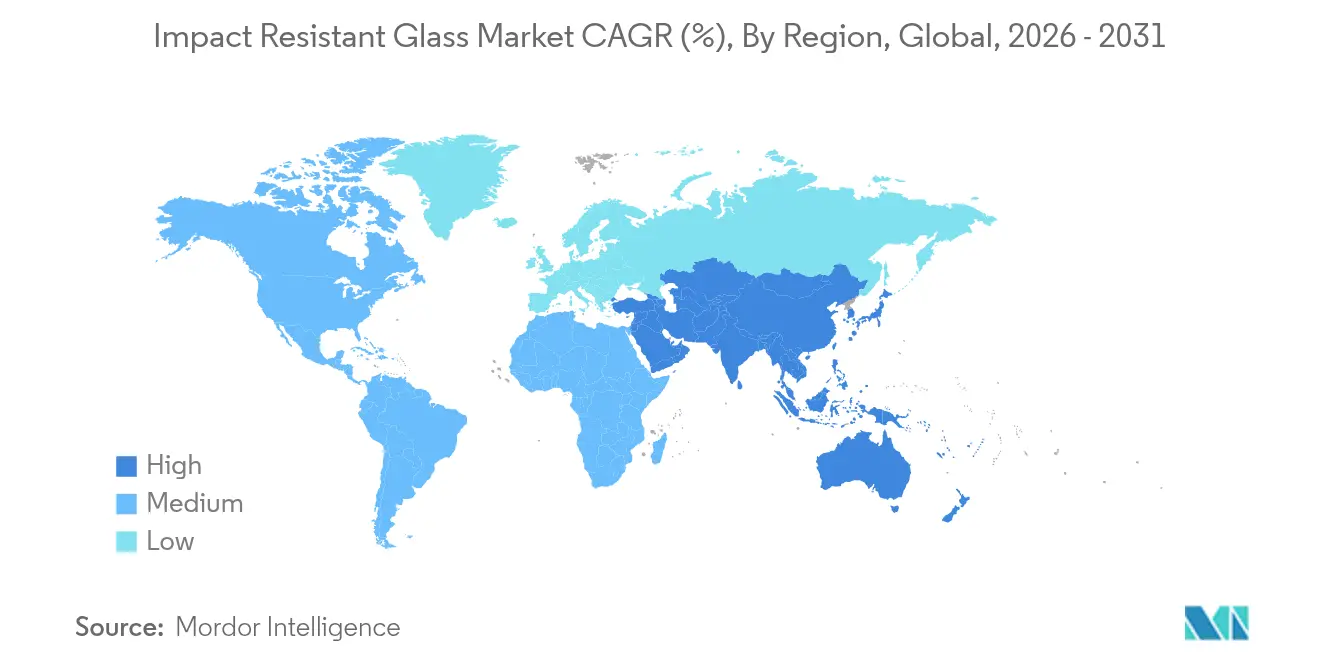
Asia-Pacific contributed 39.88% of 2025 value and should post 7.62% CAGR. Chinese infrastructure programs, including expansive high-speed rail stations, embed large laminated skylights that feed continuous furnace workloads. India’s smart-city push and commercial tower boom extend volume, while storm-preparedness guidelines in Philippines and Vietnam lift specification of impact panes in schools and hospitals. Fuyao’s multi-site expansion worth USD 9.1 billion increases float capacity plus downstream laminating, ensuring regional freight optimization and rapid supply for automotive export platforms. Hence suppliers there shape pricing norms that spill into global tenders and influence the trajectory of the impact resistant glass market.
North America Impact Resistant Glass Market
North America ranks second in size. Florida’s broader wind-borne debris rules apply to counties once considered low-risk, strengthening pipeline visibility. Insurance rebates magnify the financial incentive for both new builds and retrofits. Domestic float supply remains tight; the Federal Register notes antidumping probes into Asian imports, suggesting possible cost pass-throughs that defend local pricing power. Automakers in Michigan and Tennessee retool windshield lines to laminated formats that integrate ADAS sensors, reinforcing demand beyond coastal construction. Combined, these forces lock in stable growth even as energy bills fluctuate.
Europe Impact Resistant Glass Market
Europe advances as a sustainability leader. Saint-Gobain’s hybrid electric furnace in France cuts CO₂ by 75%, and the output qualifies for low-carbon building certifications. EU renovation wave programs free funds for façade upgrades, channeling more laminated panels into aging housing stock. Germany and Austria support renewable energy integration, so EVA-laminated photovoltaic glazing finds early adopters. Simultaneously, blast-resistant glass specifications for embassies and rail stations gain traction amid evolving security assessments. Supply chains benefit from strong recycling mandates that pressure producers to innovate end-of-life PVB solutions, influencing product design choices across the impact resistant glass market.
Regulatory Landscape
Impact resistant glass demand is shaped by safety-glazing and impact-test requirements that vary by region, and are often incorporated into building codes. In the United States, compliance for architectural glazing in hazardous locations is commonly demonstrated through CPSC 16 CFR Part 1201 or ANSI Z97.1, as referenced by the International Building Code (IBC). ASTM updates are also tightening the technical baseline used by manufacturers for qualification and in-plant control, including ASTM F3007-24 (October 2024) for ball drop impact testing of laminated flat glass and ASTM F3006-25 (May 2025) for ball drop impact resistance specifications for laminated architectural glazing.
Regulatory and standards refresh cycles in Asia and international bodies are adding new compliance checkpoints for exporters and multi-regional suppliers. China issued GB/T 15763.2-2025 for tempered safety glazing materials (replacing the 2005 version, with an implementation timeline indicated for August 1, 2026), which increases the importance of country-specific certification planning for tempered products. At the international level, ISO published ISO 19916-4:2026 in May 2026, extending standardized pendulum impact testing and safety classification into vacuum insulating glass (VIG), which raises testing and documentation needs when impact resistance is combined with high thermal performance.
Value Chain Analysis
The value chain starts with upstream minerals and additives for float glass (silica sand, soda ash, lime, dolomite) and recycled cullet, then moves to energy-intensive melting and forming on float lines. Converters create impact-resistant formats through heat treatment (tempering or heat strengthening) and lamination, where interlayer supply (PVB, ionoplast/ionomer, EVA, and other polymers) becomes a key differentiator for post-breakage integrity, thickness reduction, and optical or sensor compatibility. Processing steps such as autoclave lamination, edge finishing, and inspection are tightly linked to the impact-test and marking requirements included in region-specific safety glazing standards.
Downstream, distribution and installation economics tend to favor localized float and fabrication footprints. Large-format architectural lites are costly to ship and more damage-prone, which pushes producers toward regional hubs and just-in-time supply for construction and automotive plants. Compliance and specification flow through architects, façade engineers, and OEM glazing teams, with standards and design guidance shaping product selection, including CEN/TS 19100-4:2024 in Europe (published May 2024) for glass selection tied to human injury risk. Procurement is also increasingly influenced by environmental documentation, with EPD disclosures used in commercial projects to compare embodied-carbon profiles across float, coated, and laminated product offerings.
Competitive Landscape
The impact resistant glass market shows moderate consolidation. AGC, Saint-Gobain, and Fuyao command manufacturing footprints across at least three continents, enabling multi-regional sourcing deals with global contractors. Corning differentiates through proprietary fusion processes that yield ultra-thin, high-clarity laminates. Eastman strengthens interlayer value with lower-carbon PVB lines that align with embodied emissions targets.
Joint R&D ventures expand digital modeling that predicts breakage modes in mixed-temperature laminates, reducing testing cycles. Recycling alliances such as AGC’s tie-up with ROSI target closed-loop solar and architectural glass cullet use, meeting EU circular mandates. Medium-sized regional players focus on tempering upgrades and local code expertise to serve contractors seeking just-in-time supply. Yet high furnace capital keeps overall entry barriers prominent, so the impact resistant glass market remains shaped by a handful of R&D-rich operators rather than fragmented artisans.
Impact Resistant Glass Industry Leaders
-
Saint-Gobain
-
AGC Inc.
-
Nippon Sheet Glass Co., Ltd
-
Vitro Architectural Glass
-
Guardian Industries Holdings
- *Disclaimer: Major Players sorted in no particular order
Impact Resistant Glass Market Companies Covered in this Report
- AGC Inc.
- CGS Holding
- Eastman Chemical Company
- Fuyao Glass Industry Group
- Guardian Industries Holdings
- MITER Brands
- Nippon Sheet Glass Co., Ltd
- Saint-Gobain
- Schott AG
- Şişecam
- Trulite
- Vitro Architectural Glass
- Xinyi Glass Holdings Limited.
Market Opportunities and Future Outlook
A key whitespace area is harmonized compliance packaging for global projects that must meet multiple safety-glazing regimes (for example, ANSI Z97.1 in the United States, CAN/CGSB-12.1 in Canada, and country-specific building code references). In 2026, standards activity created a clear trigger for suppliers and test labs to refresh qualification and labeling workflows: Canada released CAN/CGSB-12.1-2026 (March 2026) and ANSI released an updated ANSI Z97.1-2026 (July 2026) that expands scope elements such as vacuum insulating glazing (VIG) and consolidates certain weathering references. These updates create room for manufacturers that can shorten recertification cycles and provide code-ready documentation bundles for façade contractors and national retailers.
Supply-chain localization and lower-carbon product platforms are translating into concrete investment and product differentiation tracks in impact-resistant glazing. In July 2026, Asahi India Glass (AIS) commissioned an automotive float glass plant in Rajasthan and outlined a broader investment push to localize supply for Indias automotive sector, supporting shorter lead times for laminated windscreens and side-lites as vehicle glazing content rises. In parallel, low-embodied-carbon float and circular cullet initiatives (including recycled feedstocks) are becoming more visible in buyer specifications for commercial buildings, creating a pathway for impact-rated laminated systems that pair post-breakage safety with documented carbon reductions.
Recent Industry Developments in Impact Resistant Glass Market
- July 2026: Asahi India Glass (AIS) commissioned an automotive float glass plant in Rajasthan and outlined a broader investment program to localize Indias automotive glass supply chain. The added float capacity supports downstream lamination needs for windscreens and side-lites, reducing dependence on imports and improving lead times for OEM programs. The move also strengthens local sourcing options for impact-performing glazing used in vehicles with higher glass area and tighter optical requirements.
- April 2026: NSG Group launched Pilkington Mirai One, an architectural float glass positioned with over 35% lower embodied carbon than standard float glass. By expanding lower-carbon substrate availability, the launch supports impact-resistant laminated assemblies used in facade and window specifications that increasingly request environmental documentation alongside safety performance. It also broadens the material base for converters seeking to pair impact ratings with green-building procurement criteria.
- October 2024: ASTM International released ASTM F3007-24, a ball drop impact resistance test method for laminated architectural flat glass. The updated test method reinforces factory quality control and helps manufacturers align production checks with the impact performance demanded in safety-glazing specifications. It also influences how fabricators document conformance for projects where ball-drop testing is used as a screening or qualification tool for laminated products.
Impact Resistant Glass Market Report Scope and Research Methodology
Market Definition and Coverage
For this study, the market covers revenue generated from impact resistant glass that is engineered to stay largely intact after a strong strike, which helps protect people and property in buildings and vehicles.
Scope exclusions: It does not include standalone plastic glazing sheets such as monolithic polycarbonate or acrylic that are not combined with glass.
Segments Covered in This Report
- By Product Type
- Laminated Glass
- Tempered (Heat-treated) Glass
- Heat-Strengthened Glass
- Hybrid/Other Impact Resistant Glass
- By Interlayer
- Polyvinyl Butyral (PVB)
- Ionoplast Polymer
- Ethylene-Vinyl Acetate (EVA)
- Other Interlayers (Thermoplastic Polyurethane (TPU), etc.)
- By Application
- Facades, Curtain Walls & Windows
- Structural Glazing & Floors
- Windscreens & Side-lites
- Security & Blast-Resistant Installations
- By End-User Industry
- Construction
- Automotive
- Other End User Industries (Aerospace and Defense, etc.)
- By Geography
- Asia-Pacific
- China
- India
- Japan
- South Korea
- Rest of Asia-Pacific
- North America
- United States
- Canada
- Mexico
- Europe
- Germany
- United Kingdom
- France
- Italy
- Rest of Europe
- South America
- Brazil
- Argentina
- Rest of South America
- Middle East and Africa
- Saudi Arabia
- South Africa
- Rest of Middle East and Africa
- Asia-Pacific
Data Sources, Market Sizing, and Validation
Desk Research
Desk work was used to set the measurable demand pool and to anchor the model with public, repeatable inputs. We relied on sources such as building permit and construction output statistics from national agencies, energy and building safety code updates from public authorities, and trade data that signals glass and interlayer material flows.
To connect demand drivers to dollars, we reviewed broader references including company filings, investor presentations, association websites, and respected press coverage on hurricanes, storm seasons, and resilience retrofit programs. Where helpful, we also used paid subscriptions for company financials and intelligence, patent databases, and an import and export shipment-level database to sanity-check supply availability and pricing movements. These examples are not exhaustive, and we reviewed other public sources for data collection, validation, and clarification.
Primary Interviews and Surveys
Primary conversations were used to confirm what is actually sold as impact resistant glass, how glazing specifications change by end use, and how pricing behaves for laminated builds and interlayer choices. We spoke with a balanced mix of manufacturers, fabricators, distributors, and application-side stakeholders, so assumptions from desk research could be corrected and then triangulated across regions.
Distribution of primary research fieldwork respondents
| Company type | Respondent position | Region |
|---|---|---|
| Top tier: 31% | CXOs: 18% | APAC: 44% |
| Mid tier: 49% | Functional/Unit leaders: 31% | EMEA: 36% |
| Smaller Players: 20% | Managers: 51% | Americas: 20% |
Market-Sizing & Forecasting
Sizing starts from a top-down build where construction and vehicle production indicators are translated into a realistic glazing demand pool, then adjusted using adoption rates for impact-rated specifications in high risk zones. Once that demand pool is clear, we apply average selling price ranges that reflect laminated configurations, thickness and performance rating expectations, and the mix of new build versus replacement.
To keep totals grounded, we run selective bottom-up checks, such as sampled project-level glass area to value conversions, distributor channel checks, and supplier-side capacity and utilization signals where they can be observed. Variables that typically matter in this market include hurricane and storm exposure maps that shape code enforcement, the share of buildings using laminated safety glass, replacement cycle timing after extreme weather events, interlayer mix shifts (PVB, EVA, ionoplast), and regional construction spending trends.
For forecasting, scenario analysis is used so the model can separate a base case from more aggressive retrofit waves after major storms, and this is supported by expert views on how quickly codes and insurance requirements are tightening. Where public data cannot fully quantify a variable, we use clearly stated assumption bands, which are later narrowed through interview feedback and cross checks against observed price and volume signals.
Data Validation & Update Cycle
Validation happens in steps, since no single data point fully explains this market. We compare outputs against independent signals such as construction activity, announced capacity additions, and import and export movements, and then investigate any variance that looks too large to be explained by price or mix.
Before sign-off, the model goes through peer review where assumptions are traced back to sources and interview notes, and any outliers trigger re-contact with respondents for clarification. Reports are refreshed annually, and interim updates are made when material events occur, such as code changes, major storm impacts, or sharp raw material price movements. Right before delivery, we complete a fresh pass so clients receive an updated view rather than an older snapshot.
Mordor Intelligence's Impact Resistant Glass Market Size Compared With Other Published Estimates
Published market sizes for impact resistant glass can look different even when the topic sounds the same, because teams make different choices on what to include, which year they anchor on, and how they handle pricing and mix changes. Differences also come from how tightly the scope is tied to real demand signals from construction and vehicles, rather than only using high level growth assumptions.
The main gap comes from whether non-glass plastic glazing is counted alongside laminated and treated glass, and Mordor Intelligence keeps the value tied to glass-based impact solutions, excluding monolithic polycarbonate and acrylic sheets, which can inflate totals in broader definitions. Another driver is the base year and price progression logic, since some estimates start from a different anchor year and may apply a faster retrofit ramp or a higher blended ASP without checking it against project specifications and regional code enforcement timing.
Benchmark comparison
| Source | Market Size | Gaps in Research Methodology |
|---|---|---|
| Mordor Intelligence | USD 34.67 B (2026) | |
| Global Consultancy A | USD 32.11 B (2025) | Anchors the series one year earlier and may apply a higher growth ramp for 2026 onward, which can shift totals when retrofit timing and code-led adoption are not rebuilt from local demand indicators. |
| Industry Publisher B | USD 31.78 B (2025) | Uses a different base year and forecast window and may blend end-user scope and pricing assumptions differently, especially around interlayer mix and project specification levels across regions. |
Seen together, the spread is mostly explained by scope choices and the year used to anchor pricing and adoption, rather than any single demand driver. By keeping the model traceable to construction and vehicle demand pools, plus practical checks on ASP and interlayer mix shifts, the final number stays easier to reproduce and explain during planning.
Key Questions Answered in the Report
What is the current Impact Resistant Glass Market size?
The market is valued at USD 34.67 billion in 2026 and is projected to reach USD 46.59 billion by 2031, reflecting a 6.08% CAGR.
Which segment leads by product type?
Laminated glass commands the largest share at 44.62% because its interlayer keeps shards intact, satisfying stringent safety and hurricane-code requirements.
Which is the fastest growing region in the Impact Resistant Glass Market?
Asia-Pacific led with 39.88% of 2025 revenue and is forecast to grow at 7.62% CAGR, driven by China’s infrastructure programs and India’s expanding construction pipeline.
Why is the automotive sector the fastest-growing end-user industry?
Updated FMVSS 205 regulations, electric-vehicle lightweighting targets, and the need to integrate cameras and sensors in windshields push automotive glazing demand to a 7.18% CAGR through 2031.