
Gooseberry Market Size and Share
Gooseberry Market Analysis by Mordor Intelligence
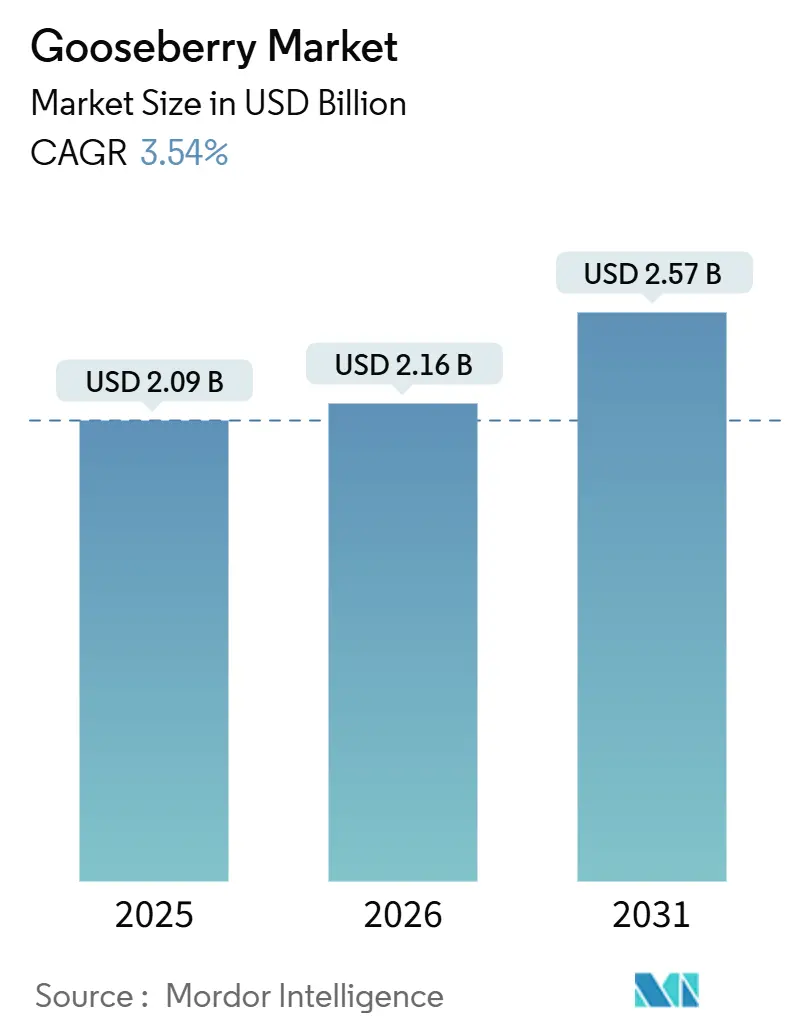
The gooseberry market size is projected to be USD 2.09 billion in 2025, USD 2.16 billion in 2026, and will reach USD 2.57 billion by 2031, reflecting a 3.54% CAGR. Steady topline growth reflects a realignment in the value chain, shifting fruit from niche fresh produce sections to higher-margin nutraceutical and cosmetic formulations. Pharmaceutical formulators and cosmetic ingredient buyers now compete directly with food processors, accelerating investments in freeze-drying, solvent extraction, and blockchain traceability. India anchors supply through contract-farming clusters, while Colombia scales certified organic plantations. E-commerce ingredient portals shorten discovery cycles, and mechanical harvesting pilots signal the next efficiency leap. Climate volatility remains the principal supply risk, but premium buyers have shown willingness to absorb higher costs in exchange for traceable material and strict residue compliance[1]Source: Food Safety and Standards Authority of India, “Revised Pesticide Residue Limits,” fssai.gov.in.
Key Report Takeaways
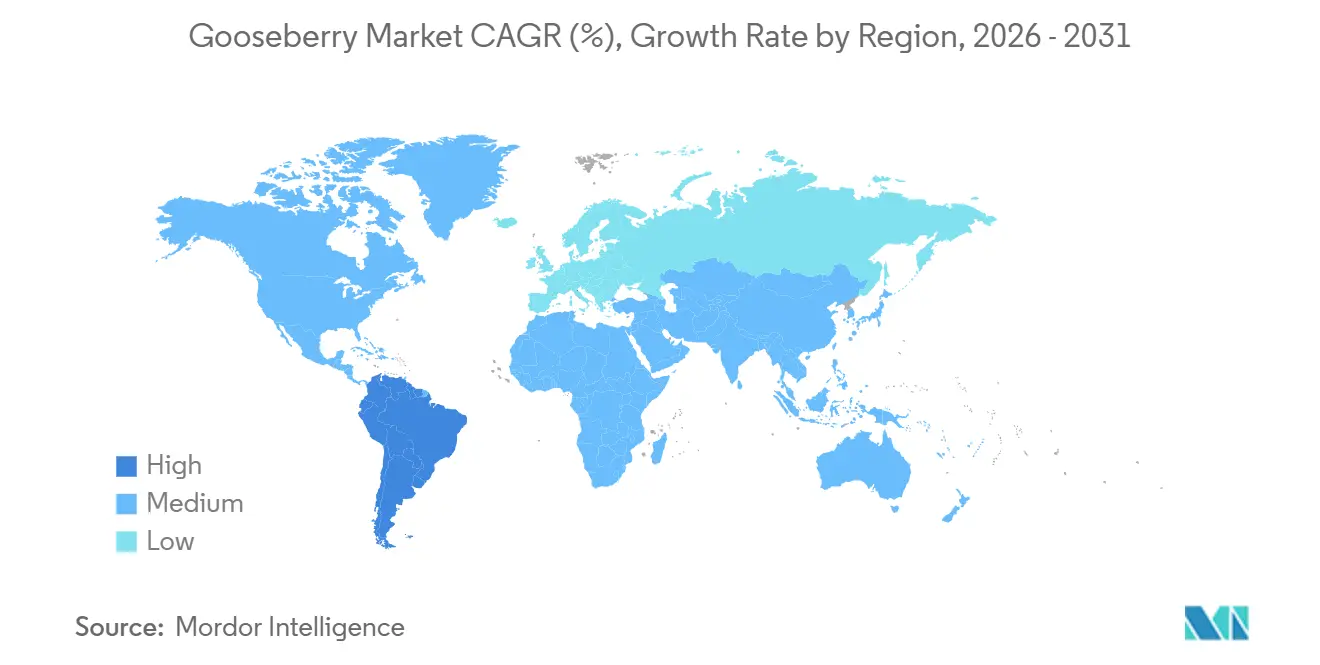
- By geography, Asia-Pacific held 48.2% gooseberry market share in 2025, while South America records the fastest 4.1% CAGR through 2031.
Note: Market size and forecast figures in this report are generated using Mordor Intelligence’s proprietary estimation framework, updated with the latest available data and insights as of January 2026.
Global Gooseberry Market Trends and Insights
Drivers Impact Analysis
| Driver | (~) % Impact on CAGR Forecast | Geographic Relevance | Impact Timeline |
|---|---|---|---|
| Surge in ayurvedic and nutraceutical demand | +0.9% | Asia-Pacific core, spillover to North America and Europe | Medium term (2-4 years) |
| Cosmetic-grade natural vitamin-C sourcing boom | +0.7% | Global, with concentration in Europe and North America | Medium term (2-4 years) |
| Government export incentives for horticulture | +0.5% | Asia-Pacific (India), South America (Colombia, Brazil), Middle East (Turkey) | Short term (≤ 2 years) |
| Contract farming clusters scaling output | +0.6% | Asia-Pacific (India), South America (Colombia) | Long term (≥ 4 years) |
| E-commerce B2B ingredient marketplaces | +0.4% | Global, with early adoption in North America and Europe | Short term (≤ 2 years) |
| Mechanical harvesting and optical grading | +0.3% | Europe (Spain, Germany), Middle East (Turkey), early pilots in Asia-Pacific | Long term (≥ 4 years) |
| Source: Mordor Intelligence | |||
Surge in Ayurvedic and Nutraceutical Demand
Gooseberry has transitioned from a traditional remedy to a prominent supplement in global nutraceutical markets. Major brands now require extracts with specific tannin content, driving investments in advanced drying and extraction technologies. Regulatory requirements in key export markets mandate stringent identity testing and batch-level traceability, prompting smaller exporters to consolidate or adopt blockchain-based documentation systems[2]Source: Press Information Bureau, “India Ayurvedic Product Exports Reach USD 724 Million,” pib.gov.in. Buyers in the nutraceutical segment are generally less price-sensitive than those in fresh fruit markets, providing growers with financial stability during years of lower harvests. In some regions, cereal acreage is being converted into gooseberry orchards, supported by guaranteed minimum prices for processed amla powder. This shift is transforming agricultural landscapes and reinforcing gooseberries' role in health-oriented product portfolios.
Cosmetic-Grade Natural Vitamin-C Sourcing Boom
The clean-beauty movement is encouraging cosmetic companies in Europe and North America to replace synthetic vitamin C with natural botanical sources. Gooseberry has emerged as a preferred option due to its high ascorbic acid content and superior oxidative stability compared to other fruits. Leading cosmetic brands have increased their reliance on botanical vitamin C, with gooseberry becoming one of their top inputs by volume. Strict residue and microbial standards, along with adherence to international cosmetic regulations, favor plantations with certifications such as organic and GLOBALG.A.P. (Global Good Agricultural Practice). Premium processors in regions like South Asia and South America are securing higher prices for certified gooseberry materials. This trend is establishing gooseberry as a key ingredient in the natural skincare and cosmetics industry.
Government Export Incentives for Horticulture
Governments in various countries are actively promoting gooseberry exports through subsidies and incentive programs. In India, initiatives have been launched to assist exporters in obtaining certifications and upgrading cold-chain infrastructure[3]Source: Agricultural and Processed Food Products Export Development Authority, “Market Access Initiative Guidelines 2025,” apeda.gov.in. In South America, cooperatives have received funding for irrigation systems and pack-house equipment to meet international standards. Turkey has introduced export rebates for fresh and processed gooseberry products targeting European and Gulf markets. These measures reduce financial barriers for mid-tier processors and enhance compliance with pesticide and food safety regulations. Collectively, these incentives are improving competitiveness and expanding the global market presence of gooseberry products.
Contract Farming Clusters Scaling Output
Contract farming models are increasingly being implemented to expand gooseberry production and reduce risks for growers. Large buyers provide seedlings, training, and guaranteed offtake agreements, encouraging farmers to adopt orchard cultivation. In India, major companies have contracted thousands of hectares, staggering harvests across regions to ensure continuous utilization of processing facilities. In Colombia, cooperatives have entered multi-year agreements with smallholders, offering price premiums in exchange for sustainability certifications. These arrangements reduce supply fragmentation and align production with buyer requirements. Consequently, contract farming clusters are emerging as a reliable mechanism for consistent output and quality assurance in the gooseberry market.
Restraints Impact Analysis
| Restraint | (~) % Impact on CAGR Forecast | Geographic Relevance | Impact Timeline |
|---|---|---|---|
| High production and processing cost | -0.6% | Global, acute in Asia-Pacific and South America | Medium term (2-4 years) |
| Seasonal production constraints | -0.4% | Global, most severe in Asia-Pacific and Europe | Short term (≤ 2 years) |
| High post-harvest perishability | -0.5% | Asia-Pacific, South America, Africa | Medium term (2-4 years) |
| Climate-induced fruit drop volatility | -0.3% | Asia-Pacific (India), South America (Colombia), Europe (Spain) | Long term (≥ 4 years) |
| Source: Mordor Intelligence | |||
High Production and Processing Cost
Gooseberry cultivation and processing face significant cost challenges, limiting competitiveness against synthetic alternatives. Labor constitutes a substantial portion of orchard expenses, while energy-intensive freeze-drying further pressures margins. Rising industrial power rates have increased processing costs, reducing profitability for many operators. Additionally, cold-chain logistics add to distribution expenses, making gooseberry products more costly compared to synthetic inputs. These challenges are particularly pronounced in price-sensitive categories where affordability is a priority. Without efficiency improvements or premium positioning, producers may struggle to remain competitive in broader markets.
Seasonal Production Constraints
Gooseberry production is highly seasonal, with harvests concentrated in short regional windows. While different countries produce at varying times of the year, overall availability is limited to a few months. Buyers often need to finance long-term inventory to ensure year-round supply, which increases the risk of stockouts and higher costs. During shortages, some brands switch to synthetic vitamin C to maintain product continuity. Although controlled atmosphere storage can slightly extend shelf life, it adds costs and does not fully preserve nutrient levels. Seasonal production constraints remain a structural challenge, requiring careful planning and diversification to stabilize supply chains.
Geography Analysis
The Asia-Pacific holds the largest share, 48.2% in the gooseberry market in 2025, driven by extensive cultivation in India, China, and Southeast Asia. In India, northern and central states are key contributors, with orchards increasingly replacing traditional cereal crops. Regulatory harmonization has enhanced export opportunities, particularly to European markets, spurring investments in processing facilities and cold-chain infrastructure. In China, provinces are reallocating vegetable acreage to gooseberry orchards to meet growing demand for nutraceutical and cosmetic applications. Indonesia, on the other hand, focuses on supplying local fresh-fruit markets, with gooseberries primarily consumed domestically rather than exported. The region benefits from robust agricultural capacity, supportive government initiatives, and increasing consumer awareness, solidifying Asia Pacific's position as the global leader in gooseberry production and trade.
South America is the fastest-growing region in the gooseberry market, with a 4.1% CAGR through 2031, led by Colombia and Brazil. Colombia’s high-altitude regions produce gooseberries with high vitamin C content, which fetch premium prices in international markets. A significant share of production is exported, either fresh or processed, with quick-freezing technologies preserving nutritional value and extending shelf life. In Brazil, southern and southeastern states are expanding cultivation to meet rising domestic demand for functional foods and cosmetic ingredients. The region also benefits from counter-seasonal production, enabling fresh shipments to Europe and North America during their off-season. This seasonal advantage strengthens South America’s position as a reliable supplier, while investments in cooperatives and processing facilities enhance competitiveness and support long-term market growth.
North America and Europe remain net importers of gooseberries, with demand concentrated in supplements, functional beverages, artisanal foods, and cosmetics. Regulatory challenges, such as novel-food authorizations, slow mainstream adoption, but niche markets continue to grow steadily. In the Middle East and Africa, production is smaller but expanding, with Turkey promoting acreage growth through export incentives. Pilot projects in Kenya and trials in South Africa focus on supplying domestic fresh markets, reflecting the early stages of development. Despite these constraints, the regions are gradually building production capacity, supported by consumer interest in natural vitamin C sources and functional nutrition. Collectively, these markets contribute incremental growth, complementing Asia Pacific's dominance and South America's rapid expansion in the global gooseberry industry.
Competitive Landscape
Gooseberry production is primarily driven by numerous smallholders cultivating small plots, typically ranging from half a hectare to two hectares. These growers often face challenges in scaling their production individually, which has led to the establishment of cooperatives. By pooling resources and capital, cooperatives can invest in shared infrastructure and secure long-term supply agreements with international buyers. This collective approach enables smallholders to access premium markets that require certifications and consistent quality standards. Additionally, cooperatives help stabilize incomes, mitigate risks associated with fragmented production, and ensure growers remain competitive in a market increasingly influenced by advanced processing requirements.
Processing stakeholders include vertically integrated firms and specialized technology providers that are transforming the value chain. Companies are investing in captive freeze-drying facilities, organic certification programs, and blockchain traceability systems to differentiate their products and comply with global standards. Advanced technologies, such as optical grading and near-infrared nutrient assessment, are becoming critical tools, enabling real-time quality control and nutrient profiling. These innovations create barriers to entry, favoring processors with the financial capacity to adopt such technologies, while smaller operators often depend on partnerships or licensing agreements. Technology providers play a key role in enhancing industry standards and improving efficiency across the processing segment.
Regulatory bodies and emerging market stakeholders have a significant impact on the gooseberry industry. Compliance with botanical guidance, cosmetic regulations, and import tolerances requires processors to maintain in-house laboratories and implement robust testing protocols. This regulatory environment benefits established firms but also presents opportunities in regions with underdeveloped infrastructure. For instance, Africa and Southeast Asia offer potential for investment in processing facilities and cold-chain systems. Local governments and development agencies are increasingly supporting these initiatives, aiming to build capacity and integrate smallholders into global supply chains. Stakeholders in these regions represent a key area for future industry expansion.
Recent Industry Developments
- January 2026: Odisha exported 1,050 metric tons of Indian jujube and gooseberries to Dubai, marking a milestone in expanding international market access for Indian growers. The export was supported by the Department of Agriculture and Farmers' Empowerment, Government of Odisha. The shipment underscores rising demand for gooseberries in Middle Eastern markets and highlights export potential beyond domestic consumption.
- November 2025: Patanjali has initiated dedicated amla seed research facilities, marking a significant step in advancing natural wellness innovation. The program focuses on improving varietal performance, supporting higher yields and greater resilience, and further reinforcing India’s leadership position in the gooseberry market.
- October 2024: Keva Flavours highlighted natural taste innovations at FI India 2024, showcasing its brand‑new gooseberry extracts designed to enhance nutraceutical and functional food applications. These innovations support product diversification in supplements and beverages, strengthening opportunities within the growing gooseberry market.
Global Gooseberry Market Report Scope
A gooseberry is a small fruit that has a sour taste and is covered with tiny hairs. Black Velvet, Captivator, and Hinnonmaki Red are some of the hybrids of gooseberries that are commercially grown. The Gooseberry Market Report is Segmented by Geography (North America, South America, Asia-Pacific, Europe, and More). The Report Includes Production Analysis (Volume), Consumption Analysis (Value and Volume), Import Analysis (Value and Volume), Export Analysis (Value and Volume), Wholesale Price Trend Analysis, List of Key Players, Regulatory Framework, Logistics and Infrastructure, and Seasonality Analysis. The Market Forecasts are Provided in Terms of Value (USD) and Volume (Metric Tons).
| North America | United States | Production Analysis (Area Harvested, Yield, and Production Volume) |
| Consumption Analysis (Consumption Value and Volume) | ||
| Import Market Analysis (Import Value, Volume, and Key Supplying Markets) | ||
| Export Market Analysis (Export Value, Volume, and Key Destination Markets) | ||
| Wholesale Price Trend Analysis and Forecast | ||
| Regulatory Framework | ||
| List of Key Players | ||
| Logistics and Infrastructure | ||
| Seasonality Analysis | ||
| Canada | Production Analysis (Area Harvested, Yield, and Production Volume) | |
| Consumption Analysis (Consumption Value and Volume) | ||
| Import Market Analysis (Import Value, Volume, and Key Supplying Markets) | ||
| Export Market Analysis (Export Value, Volume, and Key Destination Markets) | ||
| Wholesale Price Trend Analysis and Forecast | ||
| Regulatory Framework | ||
| List of Key Players | ||
| Logistics and Infrastructure | ||
| Seasonality Analysis | ||
| Europe | Germany | Production Analysis (Area Harvested, Yield, and Production Volume) |
| Consumption Analysis (Consumption Value and Volume) | ||
| Import Market Analysis (Import Value, Volume, and Key Supplying Markets) | ||
| Export Market Analysis (Export Value, Volume, and Key Destination Markets) | ||
| Wholesale Price Trend Analysis and Forecast | ||
| Regulatory Framework | ||
| List of Key Players | ||
| Logistics and Infrastructure | ||
| Seasonality Analysis | ||
| Spain | Production Analysis (Area Harvested, Yield, and Production Volume) | |
| Consumption Analysis (Consumption Value and Volume) | ||
| Import Market Analysis (Import Value, Volume, and Key Supplying Markets) | ||
| Export Market Analysis (Export Value, Volume, and Key Destination Markets) | ||
| Wholesale Price Trend Analysis and Forecast | ||
| Regulatory Framework | ||
| List of Key Players | ||
| Logistics and Infrastructure | ||
| Seasonality Analysis | ||
| United Kingdom | Production Analysis (Area Harvested, Yield, and Production Volume) | |
| Consumption Analysis (Consumption Value and Volume) | ||
| Import Market Analysis (Import Value, Volume, and Key Supplying Markets) | ||
| Export Market Analysis (Export Value, Volume, and Key Destination Markets) | ||
| Wholesale Price Trend Analysis and Forecast | ||
| Regulatory Framework | ||
| List of Key Players | ||
| Logistics and Infrastructure | ||
| Seasonality Analysis | ||
| Asia-Pacific | China | Production Analysis (Area Harvested, Yield, and Production Volume) |
| Consumption Analysis (Consumption Value and Volume) | ||
| Import Market Analysis (Import Value, Volume, and Key Supplying Markets) | ||
| Export Market Analysis (Export Value, Volume, and Key Destination Markets) | ||
| Wholesale Price Trend Analysis and Forecast | ||
| Regulatory Framework | ||
| List of Key Players | ||
| Logistics and Infrastructure | ||
| Seasonality Analysis | ||
| India | Production Analysis (Area Harvested, Yield, and Production Volume) | |
| Consumption Analysis (Consumption Value and Volume) | ||
| Import Market Analysis (Import Value, Volume, and Key Supplying Markets) | ||
| Export Market Analysis (Export Value, Volume, and Key Destination Markets) | ||
| Wholesale Price Trend Analysis and Forecast | ||
| Regulatory Framework | ||
| List of Key Players | ||
| Logistics and Infrastructure | ||
| Seasonality Analysis | ||
| Indonesia | Production Analysis (Area Harvested, Yield, and Production Volume) | |
| Consumption Analysis (Consumption Value and Volume) | ||
| Import Market Analysis (Import Value, Volume, and Key Supplying Markets) | ||
| Export Market Analysis (Export Value, Volume, and Key Destination Markets) | ||
| Wholesale Price Trend Analysis and Forecast | ||
| Regulatory Framework | ||
| List of Key Players | ||
| Logistics and Infrastructure | ||
| Seasonality Analysis | ||
| South America | Brazil | Production Analysis (Area Harvested, Yield, and Production Volume) |
| Consumption Analysis (Consumption Value and Volume) | ||
| Import Market Analysis (Import Value, Volume, and Key Supplying Markets) | ||
| Export Market Analysis (Export Value, Volume, and Key Destination Markets) | ||
| Wholesale Price Trend Analysis and Forecast | ||
| Regulatory Framework | ||
| List of Key Players | ||
| Logistics and Infrastructure | ||
| Seasonality Analysis | ||
| Colombia | Production Analysis (Area Harvested, Yield, and Production Volume) | |
| Consumption Analysis (Consumption Value and Volume) | ||
| Import Market Analysis (Import Value, Volume, and Key Supplying Markets) | ||
| Export Market Analysis (Export Value, Volume, and Key Destination Markets) | ||
| Wholesale Price Trend Analysis and Forecast | ||
| Regulatory Framework | ||
| List of Key Players | ||
| Logistics and Infrastructure | ||
| Seasonality Analysis | ||
| Middle East | Turkey | Production Analysis (Area Harvested, Yield, and Production Volume) |
| Consumption Analysis (Consumption Value and Volume) | ||
| Import Market Analysis (Import Value, Volume, and Key Supplying Markets) | ||
| Export Market Analysis (Export Value, Volume, and Key Destination Markets) | ||
| Wholesale Price Trend Analysis and Forecast | ||
| Regulatory Framework | ||
| List of Key Players | ||
| Logistics and Infrastructure | ||
| Seasonality Analysis | ||
| Africa | Kenya | Production Analysis (Area Harvested, Yield, and Production Volume) |
| Consumption Analysis (Consumption Value and Volume) | ||
| Import Market Analysis (Import Value, Volume, and Key Supplying Markets) | ||
| Export Market Analysis (Export Value, Volume, and Key Destination Markets) | ||
| Wholesale Price Trend Analysis and Forecast | ||
| Regulatory Framework | ||
| List of Key Players | ||
| Logistics and Infrastructure | ||
| Seasonality Analysis | ||
| South Africa | Production Analysis (Area Harvested, Yield, and Production Volume) | |
| Consumption Analysis (Consumption Value and Volume) | ||
| Import Market Analysis (Import Value, Volume, and Key Supplying Markets) | ||
| Export Market Analysis (Export Value, Volume, and Key Destination Markets) | ||
| Wholesale Price Trend Analysis and Forecast | ||
| Regulatory Framework | ||
| List of Key Players | ||
| Logistics and Infrastructure | ||
| Seasonality Analysis | ||
| By Geography | North America | United States | Production Analysis (Area Harvested, Yield, and Production Volume) |
| Consumption Analysis (Consumption Value and Volume) | |||
| Import Market Analysis (Import Value, Volume, and Key Supplying Markets) | |||
| Export Market Analysis (Export Value, Volume, and Key Destination Markets) | |||
| Wholesale Price Trend Analysis and Forecast | |||
| Regulatory Framework | |||
| List of Key Players | |||
| Logistics and Infrastructure | |||
| Seasonality Analysis | |||
| Canada | Production Analysis (Area Harvested, Yield, and Production Volume) | ||
| Consumption Analysis (Consumption Value and Volume) | |||
| Import Market Analysis (Import Value, Volume, and Key Supplying Markets) | |||
| Export Market Analysis (Export Value, Volume, and Key Destination Markets) | |||
| Wholesale Price Trend Analysis and Forecast | |||
| Regulatory Framework | |||
| List of Key Players | |||
| Logistics and Infrastructure | |||
| Seasonality Analysis | |||
| Europe | Germany | Production Analysis (Area Harvested, Yield, and Production Volume) | |
| Consumption Analysis (Consumption Value and Volume) | |||
| Import Market Analysis (Import Value, Volume, and Key Supplying Markets) | |||
| Export Market Analysis (Export Value, Volume, and Key Destination Markets) | |||
| Wholesale Price Trend Analysis and Forecast | |||
| Regulatory Framework | |||
| List of Key Players | |||
| Logistics and Infrastructure | |||
| Seasonality Analysis | |||
| Spain | Production Analysis (Area Harvested, Yield, and Production Volume) | ||
| Consumption Analysis (Consumption Value and Volume) | |||
| Import Market Analysis (Import Value, Volume, and Key Supplying Markets) | |||
| Export Market Analysis (Export Value, Volume, and Key Destination Markets) | |||
| Wholesale Price Trend Analysis and Forecast | |||
| Regulatory Framework | |||
| List of Key Players | |||
| Logistics and Infrastructure | |||
| Seasonality Analysis | |||
| United Kingdom | Production Analysis (Area Harvested, Yield, and Production Volume) | ||
| Consumption Analysis (Consumption Value and Volume) | |||
| Import Market Analysis (Import Value, Volume, and Key Supplying Markets) | |||
| Export Market Analysis (Export Value, Volume, and Key Destination Markets) | |||
| Wholesale Price Trend Analysis and Forecast | |||
| Regulatory Framework | |||
| List of Key Players | |||
| Logistics and Infrastructure | |||
| Seasonality Analysis | |||
| Asia-Pacific | China | Production Analysis (Area Harvested, Yield, and Production Volume) | |
| Consumption Analysis (Consumption Value and Volume) | |||
| Import Market Analysis (Import Value, Volume, and Key Supplying Markets) | |||
| Export Market Analysis (Export Value, Volume, and Key Destination Markets) | |||
| Wholesale Price Trend Analysis and Forecast | |||
| Regulatory Framework | |||
| List of Key Players | |||
| Logistics and Infrastructure | |||
| Seasonality Analysis | |||
| India | Production Analysis (Area Harvested, Yield, and Production Volume) | ||
| Consumption Analysis (Consumption Value and Volume) | |||
| Import Market Analysis (Import Value, Volume, and Key Supplying Markets) | |||
| Export Market Analysis (Export Value, Volume, and Key Destination Markets) | |||
| Wholesale Price Trend Analysis and Forecast | |||
| Regulatory Framework | |||
| List of Key Players | |||
| Logistics and Infrastructure | |||
| Seasonality Analysis | |||
| Indonesia | Production Analysis (Area Harvested, Yield, and Production Volume) | ||
| Consumption Analysis (Consumption Value and Volume) | |||
| Import Market Analysis (Import Value, Volume, and Key Supplying Markets) | |||
| Export Market Analysis (Export Value, Volume, and Key Destination Markets) | |||
| Wholesale Price Trend Analysis and Forecast | |||
| Regulatory Framework | |||
| List of Key Players | |||
| Logistics and Infrastructure | |||
| Seasonality Analysis | |||
| South America | Brazil | Production Analysis (Area Harvested, Yield, and Production Volume) | |
| Consumption Analysis (Consumption Value and Volume) | |||
| Import Market Analysis (Import Value, Volume, and Key Supplying Markets) | |||
| Export Market Analysis (Export Value, Volume, and Key Destination Markets) | |||
| Wholesale Price Trend Analysis and Forecast | |||
| Regulatory Framework | |||
| List of Key Players | |||
| Logistics and Infrastructure | |||
| Seasonality Analysis | |||
| Colombia | Production Analysis (Area Harvested, Yield, and Production Volume) | ||
| Consumption Analysis (Consumption Value and Volume) | |||
| Import Market Analysis (Import Value, Volume, and Key Supplying Markets) | |||
| Export Market Analysis (Export Value, Volume, and Key Destination Markets) | |||
| Wholesale Price Trend Analysis and Forecast | |||
| Regulatory Framework | |||
| List of Key Players | |||
| Logistics and Infrastructure | |||
| Seasonality Analysis | |||
| Middle East | Turkey | Production Analysis (Area Harvested, Yield, and Production Volume) | |
| Consumption Analysis (Consumption Value and Volume) | |||
| Import Market Analysis (Import Value, Volume, and Key Supplying Markets) | |||
| Export Market Analysis (Export Value, Volume, and Key Destination Markets) | |||
| Wholesale Price Trend Analysis and Forecast | |||
| Regulatory Framework | |||
| List of Key Players | |||
| Logistics and Infrastructure | |||
| Seasonality Analysis | |||
| Africa | Kenya | Production Analysis (Area Harvested, Yield, and Production Volume) | |
| Consumption Analysis (Consumption Value and Volume) | |||
| Import Market Analysis (Import Value, Volume, and Key Supplying Markets) | |||
| Export Market Analysis (Export Value, Volume, and Key Destination Markets) | |||
| Wholesale Price Trend Analysis and Forecast | |||
| Regulatory Framework | |||
| List of Key Players | |||
| Logistics and Infrastructure | |||
| Seasonality Analysis | |||
| South Africa | Production Analysis (Area Harvested, Yield, and Production Volume) | ||
| Consumption Analysis (Consumption Value and Volume) | |||
| Import Market Analysis (Import Value, Volume, and Key Supplying Markets) | |||
| Export Market Analysis (Export Value, Volume, and Key Destination Markets) | |||
| Wholesale Price Trend Analysis and Forecast | |||
| Regulatory Framework | |||
| List of Key Players | |||
| Logistics and Infrastructure | |||
| Seasonality Analysis | |||
Key Questions Answered in the Report
How large is the global gooseberry market projected to be by 2031?
The gooseberry market size is projected to reach USD 2.57 billion by 2031, advancing at a CAGR of 3.54% between 2026 and 2031.
Which region holds the largest gooseberry market share?
Asia Pacific leads the market, accounting for 48.2%, supported by extensive cultivation in India and expanding orchard acreage in China.
Which region is growing fastest in the gooseberry market?
South America records the fastest growth, advancing at a 4.1% CAGR through 2031, driven by Colombia’s organic plantations and Brazil’s functional food demand.
What technology trends are reshaping gooseberry processing?
Freeze-drying, solvent extraction, blockchain traceability, and optical nutrient grading are transforming efficiency and quality assurance, while mechanical harvesting pilots address labor shortages.

