
Fresh Berries Market Size and Share
Fresh Berries Market Analysis by Mordor Intelligence
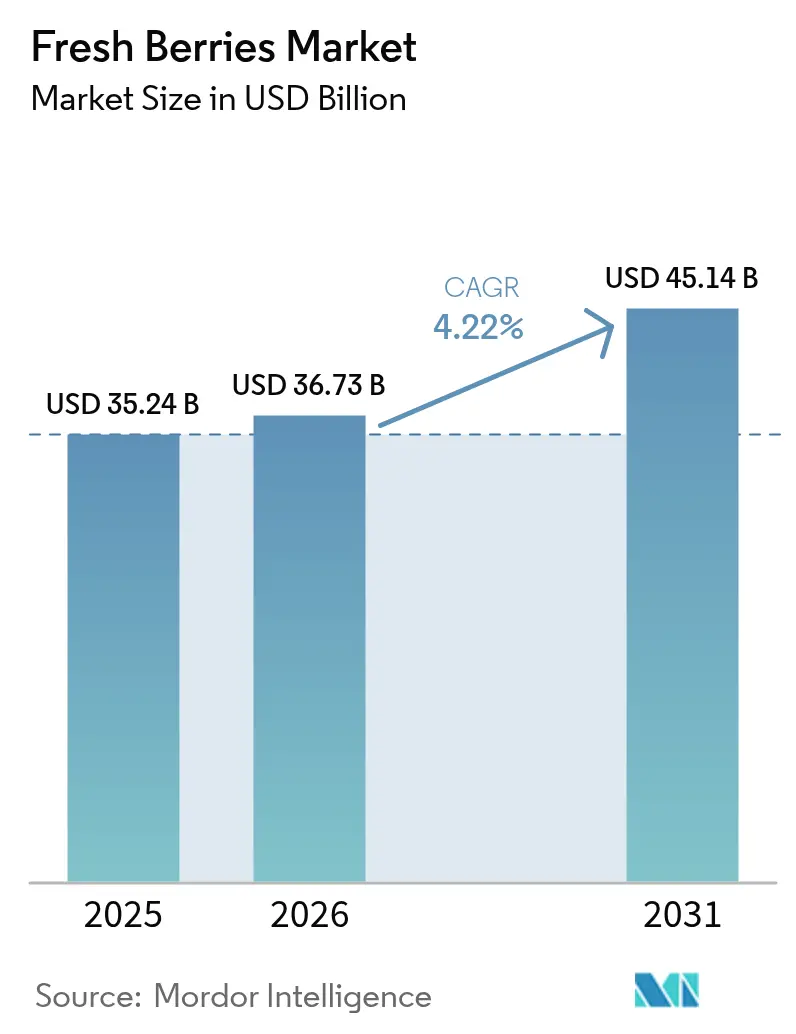
fresh berries market size in 2026 is estimated at USD 36.73 billion, growing from 2025 value of USD 35.24 billion with 2031 projections showing USD 45.14 billion, growing at 4.22% CAGR over 2026-2031. Steady gains arise from health-driven diets, rapid Adoption of protected cultivation systems, and wider global supply chains that guarantee year-round availability of premium fruit.[1]Source: U.S. Department of Agriculture, “U.S. Cranberries on the Up,” fas.usda.gov Growth is strengthened by berries overtaking all other organic fresh produce categories in U.S. retail, generating significant revenue in 2023. Technology-enabled yield gains, notably from proprietary cultivars, cut production risk while enhancing flavor consistency, and e-commerce adoption broadens consumer reach. Competitive dynamics reveal a dual structure in which grower cooperatives dominate individual berry types while capital-rich marketers expand through acquisitions and automation. Climate change remains a wildcard, but investment in protected tunnels, substrate systems, and shelf-life extension technology substantially offsets weather-driven volatility.
Key Report Takeaways
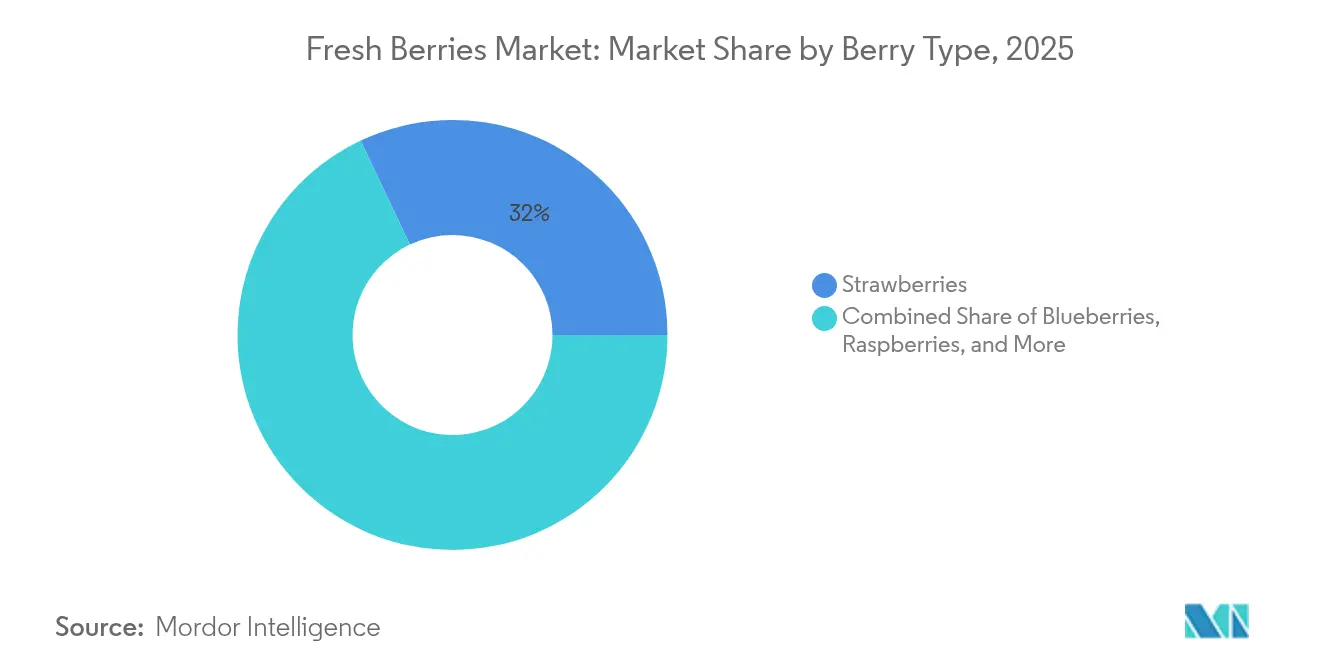
- By berry type, strawberries led with 32.02% of the fresh berries market share in 2025, and blueberries recorded the highest projected CAGR at 6.92% through 2031.
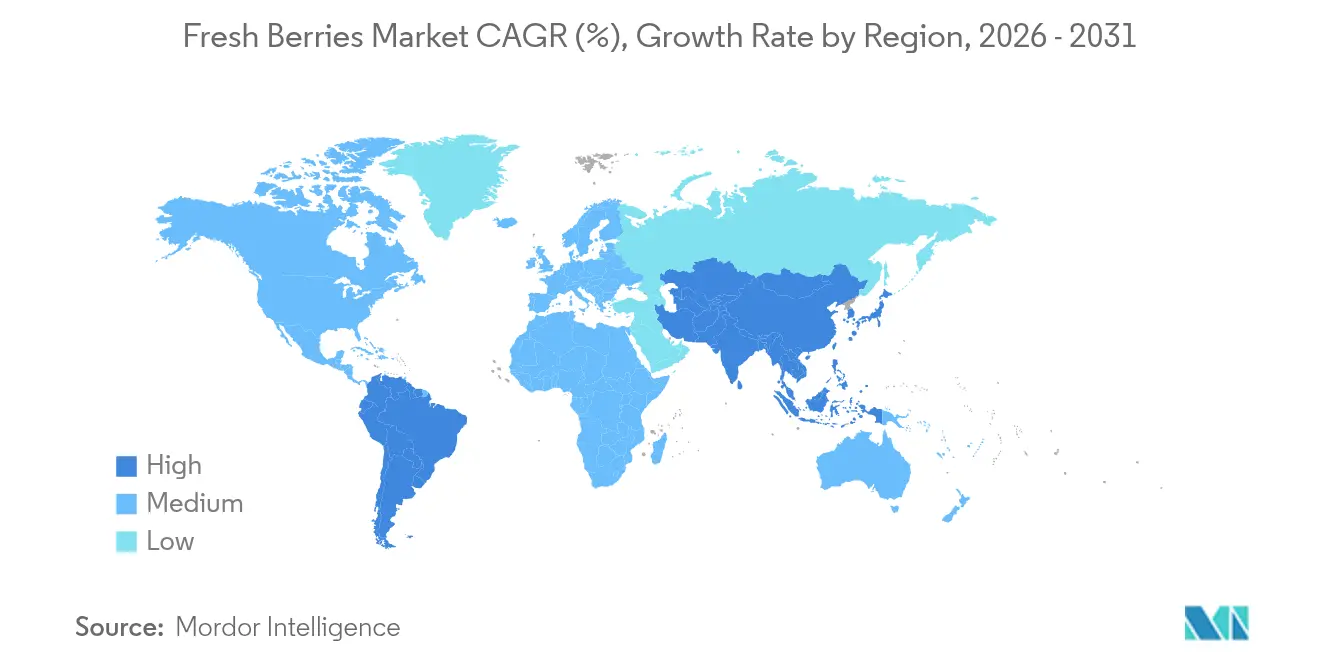
- By geography, North America held 31.12% of the fresh berries market size in 2025, and Asia-Pacific is forecast to expand at a 5.47% CAGR between 2026 and 2031.
Note: Market size and forecast figures in this report are generated using Mordor Intelligence’s proprietary estimation framework, updated with the latest available data and insights as of 2026.
Global Fresh Berries Market Trends and Insights
Drivers Impact Analysis*
| Driver | (~) % Impact on CAGR Forecast | Geographic Relevance | Impact Timeline |
|---|---|---|---|
| Health-centric diets fueling berry intake | +1.2% | North America and Europe | Medium term (2-4 years) |
| Demand from functional food and beverage launches | +0.8% | Global urban centers | Medium term (2-4 years) |
| Adoption of protected cultivation and high-density tunnels | +0.7% | Europe, North America, Asia-Pacific | Long term (≥ 4 years) |
| Yield gains via proprietary cultivars and genetics | +0.6% | Global | Long term (≥ 4 years) |
| Advanced cold-chain logistics and modified-atmosphere packaging | +0.5% | Global, strongest in North America and Europe, expanding to Asia-Pacific | Medium term (2-4 years) |
| Premium pricing and margins for organic certification | +0.4% | North America, Europe, affluent Asia-Pacific | Short term (≤ 2 years) |
| Source: Mordor Intelligence | |||
Health-centric diets fueling berry intake
Rising consumer focus on nutrient-dense foods positions berries as a cornerstone of preventive nutrition. Blueberries deliver the highest antioxidant density among common fruits, with anthocyanins linked to improved glycemic control and cardiovascular health. Millennials and Generation Z demonstrate the strongest preference, 33% of U.S. shoppers aged 18-29 purchase only organic strawberries, underscoring willingness to pay for perceived health benefits. Household penetration trails other fruit, so upside remains significant even in mature regions. Product developers respond by incorporating concentrates and powders into functional beverages, breakfast bars, and yogurts, expanding routes to market. The net result is a broad, price-resilient demand base that shields the fresh berries market from macroeconomic slowdowns.
Demand from functional food and beverage launches
Food and beverage manufacturers accelerate new concepts leveraging berries’ natural color and polyphenol content for specific health claims. High-pressure processing and gentle dehydration maintain bioactivity, allowing clean-label positioning without synthetic additives. Food manufacturers increasingly incorporate berries into products targeting metabolic health, with dried cranberries and berry-infused functional beverages capturing premium price points. The regulatory environment supports this trend, as berries generally receive favorable treatment under health claim regulations. The convergence of clean-label trends with functional nutrition creates sustained demand from food and beverage manufacturers.
Yield gains via proprietary cultivars and genetics
Breeding pipelines emphasize flavor, shelf life, and disease resistance without genetic modification. Driscoll’s patents multiple proprietary varieties, shielding margins, and curbing direct price competition. California Berry Cultivars introduced two new strawberries in 2025 that raise grower returns through higher sugar levels and firmer texture. Artificial intelligence accelerates selection cycles. USDA scientists deploy deep-learning tools to develop heat-resistant cranberry lines, cutting breeding timelines by 40%. Proprietary genetics thus serve as both a supply-chain stabilizer and brand-building asset in the fresh berries market.
Advanced cold-chain logistics and modified-atmosphere packaging
Investment in automated refrigerated warehouses, high-capacity tunnel freezers, and last-mile refrigerated vans reduces spoilage and widens export windows for fresh berries. Modified-atmosphere packaging (MAP) films extend shelf life by lowering oxygen and elevating carbon dioxide levels, slowing respiration and mold growth. In pilot programs, MAP punnets kept strawberries market-ready for 14 days versus 7 days in standard clamshells, enabling ocean freight substitution for air cargo and cutting logistics costs by 30%. North American operators added 300 million cubic feet of temperature-controlled storage space in 2024 alone, while European retailers moved to fully MAP-sealed berry packs across private-label lines.
Restraints Impact Analysis*
| Restraint | (~) % Impact on CAGR Forecast | Geographic Relevance | Impact Timeline |
|---|---|---|---|
| Volatile farm labor availability and rising wages | −1.1% | North America and Europe | Short term (≤ 2 years) |
| Climate-driven yield variability and extreme weather | −0.9% | Global | Medium term (2-4 years) |
| Inadequate cold chain in emerging consumer markets | −0.6% | Asia-Pacific, Africa, South America | Medium term (2-4 years) |
| Stricter phytosanitary and maximum-residue regulations | −0.4% | Global trade corridors | Long term (≥ 4 years) |
| Source: Mordor Intelligence | |||
Volatile farm labor availability and rising wages
The H-2A Temporary Agricultural Workers program certified 400,000 positions in fiscal 2024, yet average Adverse Effect Wage Rates climbed to USD 17.55 and surpassed USD 19 in high-cost states. Specialty crop operations now commit up to 40% of total expenses to labor, pressuring margins. Robots like Harvest CROO replace 25 pickers per machine, but capital outlays remain prohibitive for small farms. Labor uncertainty, therefore, tempers near-term expansion plans for the fresh berries market.
Stricter phytosanitary and maximum-residue regulations
The European Union caps thiacloprid residues at 0.01 mg/kg effective May 2025 and discontinues dimethomorph approval, forcing immediate practice changes. Australia classifies ready-to-eat berries as “risk food” from mid-2025, demanding Hazard Analysis and Critical Control Point (HACCP) certification for importers.[2]Source: Department of Agriculture, Fisheries and Forestry. "Berries that are ready-to-eat - DAFF," agriculture.gov.au Compliance costs disproportionally burden smaller exporters, potentially fast-tracking consolidation across the fresh berries market.
*Our forecasts treat driver/restraint impacts as directional, not additive. The impact forecasts reflect baseline growth, mix effects, and variable interactions.
Segment Analysis
By Berry Type: Blueberries Drive Premium Growth
Strawberries captured 32.02% of the fresh berries market share in 2025, underpinned by stable global demand and year-round tunnel production. Blueberries exhibit a 6.92% CAGR, the highest within the fresh berries market size, as rising disposable incomes support premium fruit purchases across China, Peru, and emerging Asian economies. Proprietary genetics spur yield and flavor advances; 70% of Mexico’s blueberry acreage now features patented cultivars, securing price resilience. Raspberries and blackberries grow at moderate rates and benefit from robotics that lower labor intensity. Cranberries maintain volume stability through cooperative marketing.
Protected substrate cultivation lifts strawberry yields significantly, enabling growers to satisfy retail contracts consistently. Parallel gains occur in high-density blueberry orchards using evergreen pruning practices and precision fertigation. As functional food brands scale, demand for berry powders strengthens the “others” category (mulberries, gooseberries), though supply remains concentrated in small geographies. Innovation, therefore, progressively segments the fresh berries market by flavor profile, nutritional density, and proprietary branding.



Geography Analysis
North America holds the dominant position with a 31.12% market share in 2025, driven by sophisticated infrastructure, established distribution networks, and premium organic positioning that enables higher margins despite increasing production costs. The United States leads global cranberry production with approximately two-thirds of world output, generating USD 343 million in exports during 2023, while Canada serves as both a major producer and key import destination for counter-seasonal supplies. Mexico emerges as a critical supply source, with berry exports projected to reach 752,000 metric tons in 2025, representing continued growth in blackberries, raspberries, and strawberries despite blueberry production facing competitive pressure from Peru.
Asia-Pacific represents the fastest-growing region with a 5.47% CAGR from 2026-2031, led by China's transformation into the world's largest blueberry producer with 77,000 hectares under cultivation, yielding 520,000 metric tons annually. China's Yunnan Province alone contributes 30% of national output, generating over CNY 3 billion (USD 413 million) in revenue while creating employment for over 100,000 people. Driscoll’s acquisition of Costa Group expands high-tech greenhouse acreage in Australia and China, improving year-round output. Yet inadequate last-mile refrigeration in India and Southeast Asia constrains wider market penetration.
Europe shows steady gains, but climate extremes undermine traditional open-field production. Two-fifths of U.K. berry growers risk insolvency by 2026 due to rising costs and retailer price pressure. EU mandates on pesticide reduction elevate compliance expenses yet encourage transition to protected culture and biocontrols. South America remains export-oriented, with Peru doubling blueberry shipments over five years. Government incentives spur cold-chain hubs at Atlantic ports, linking to North America and Europe. The Middle East and Africa contribute small volumes, but import demand accelerates, especially for premium blueberries, as modern retail expands in the Gulf Cooperation Council region.

Regulatory Landscape
Fresh berries trade and production are governed by a mix of food-safety rules, plant health measures, and tariff actions that affect market access and compliance costs. In the United States, FDA requirements under 21 CFR Part 112 (Produce Safety Rule) apply to berry growing, harvesting, packing, and holding. The agency also published a commodity-specific prevention strategy for hepatitis A and norovirus risks in fresh and frozen berries, which tightens expectations around hygiene, water, and handling controls for a high-risk commodity.
On cross-border movement, phytosanitary frameworks continue to evolve. The International Plant Protection Convention (IPPC) updated its International Standards for Phytosanitary Measures (ISPM) list in April 2026 (including ISPM 48 on field inspection), and national regulators maintained import-health pathways such as New Zealand MPI consultations on fresh blueberry import requirements. Trade-policy volatility also remains a factor for berries moving into the United States after a February 2026 U.S. Supreme Court ruling constrained IEEPA-based tariff use, prompting a shift in tariff authority discussions. In Europe, the United Kingdoms 2025 Official Controls (Plant Health) and Phytosanitary Conditions amendments updated quarantine pest listings, and the UK Government flagged additional detail on the developing UK-EU SPS approach for release in summer 2026.
Value Chain Analysis
The fresh berries value chain runs from breeding and plant material (proprietary genetics, nurseries) through farm production (open field and protected tunnels/substrate systems), harvesting (labor-intensive and increasingly assisted by mechanization), and post-harvest handling (pre-cooling, grading, clamshell/punnet packing and modified-atmosphere formats) into refrigerated transport, importers/marketers, and retail and foodservice channels. Genetics and variety licensing are an increasingly strategic upstream lever, with breeding pipelines focusing on flavor, shelf life, and resilience. Industry reporting in 2026 highlighted new strawberry and raspberry genetic deployments and pre-commercial trials that shape future supply profiles and branded programs.
Downstream, cold chain execution and commercialization power sit with vertically integrated platforms and large marketers that coordinate multi-origin supply, packaging specifications, and retailer service levels, while cooperatives remain important in certain berry categories. Companies such as Hortifrut and AgroBerries illustrate integrated models that link controlled genetics, diversified growing regions, and international distribution to support 365-day programs. The chain is exposed to weather and cost shocks at origin, as seen in the 2025-2026 campaign where Moroccan soft fruit exports declined 5% amid flooding and labor constraints. Competitive pressure from rising Chinese blueberry volumes also altered pricing and trade flows. Retailer procurement practices influence grower viability in high-cost regions, as multi-year supply agreements and tighter specifications shift value toward suppliers that can deliver consistent volume and higher compliance.
Market Opportunities and Future Outlook
Opportunities are forming around digitalization, shelf-life extension, and multi-origin production models that reduce waste and improve transaction reliability for a highly perishable category. In June 2026, Nuvagra launched Berry Marketplace as a B2B platform spanning Europe and Latin America to create verifiable digital trade flows and reduce reliance on informal cross-border deal-making. The development points to whitespace for standardized, auditable commerce tools that connect growers, exporters, and buyers. Field decision-support improvements are also gaining traction, with Driscoll expanding AI-driven tools, including pest identification, predictive yield modeling, and BerryGPT-style guidance, to translate historical and sensor data into farm-level actions that can improve harvest timing and packout quality.
Post-harvest and logistics innovation offers another value-capture pathway because berries are highly sensitive to temperature and atmosphere control. In May 2026, TransFRESH Corporation acquired Hazel Technologies to integrate modified-atmosphere and freshness solutions (including membrane technology) into pallet-level operations, reinforcing how packaging and controlled environments enable longer shipping windows and lower shrink. At the production and sourcing level, emerging origins and protected systems are widening supply options. Mexico is scaling output through investments in improved varieties and pot-substrate cultivation to target premium seasonal windows, while China is increasing export activity supported by transport corridors such as the China-Laos railway. These shifts create actionable whitespace for brands and retailers to secure year-round programs via diversified origin portfolios, while also raising the bar on compliance, traceability, and cold-chain performance as more volume moves through global channels.
Recent Industry Developments
- July 2026: SanLucar acquired a controlling stake in U.S.-based Twin River Berries. The transaction strengthened SanLucar's control over North American sourcing and complemented its broader 52-week premium fruit supply strategy into Asia and other markets. Greater integration can tighten program reliability for key buyers while increasing competitive pressure on independent marketers.
- June 2026: Elite Agro Holding inaugurated a 200-hectare blueberry and raspberry farm in Kenitra, Morocco, backed by a reported USD 136 million investment. The project expanded Moroccos modern berry capacity and reinforced the region's role in supplying export programs into Europe. Large-scale development at origin also increased demand for skilled agronomy, labor solutions, and cold-chain throughput.
- January 2024: India reduced import tariffs on fresh blueberries from 30% to 10% under a trade arrangement with the United States. The cut improved price competitiveness for imported blueberries and expanded access for U.S. exporters into a large, growing consumer market. Lower tariff friction supports broader retailer assortments and can accelerate investment in import handling and cold storage.


Research Methodology Framework and Report Scope
Market Definition and Coverage
For this study, the fresh berries market covers the value of berries sold for fresh consumption, from farm gate through wholesale and retail, across key producing and consuming countries.
Scope exclusions: We exclude processed berries and berry ingredients sold as frozen, dried, pureed, juiced, canned, or used mainly as industrial inputs.
Segmentation Overview
-
By Berry Type
- Strawberries
- Blueberries
- Raspberries
- Blackberries
- Cranberries
- Others (Mulberries, Gooseberries, etc.)
-
By Geography (Production Analysis (Volume), Consumption Analysis (Volume and Value), Import Analysis (Volume and Value), Export Analysis (Volume and Value), and Price Trend Analysis)
-
North America
- United States
- Canada
-
Europe
- Germany
- United Kingdom
- France
- Spain
- Netherlands
- Poland
- Russia
-
Asia-Pacific
- China
- Japan
- India
- Australia
-
South America
- Brazil
- Argentina
-
Middle East
- Turkey
- Saudi Arabia
-
Africa
- South Africa
- Egypt
-
North America
Data Sources, Market Sizing, and Validation
Desk Research
Desk work starts by mapping the fresh berries supply chain and checking what is reported consistently across countries. We referenced public sources such as FAOSTAT, UN Comtrade, USDA and other national agriculture statistics, Eurostat, and customs and port authority releases to understand production, trade flow direction, and seasonal availability.
Pricing and consumption signals were then validated using a mix of retailer price trackers, wholesale market bulletins, and government inflation and food price series, along with company annual reports, investor presentations, and reputable press. Where needed, we also used paid subscriptions for company financials and news intelligence, import and export shipment-level details, and patent databases to confirm technology and packaging shifts. These sources are illustrative, and many other public and paid references were also used for collection, cross-checking, and clarification.
Primary Interviews and Surveys
Primary work was used to pressure-test the desk assumptions that most affect value, especially price realization and channel mix for fresh berries. We spoke with growers, packers, importers and exporters, distributors, and retail and foodservice buyers across the main producing and consuming regions, and then reconciled differences in views before finalizing the model.
Distribution of primary research fieldwork respondents
| Company type | Respondent position | Region |
|---|---|---|
| Top tier: 31% | CXOs: 13% | APAC: 45% |
| Mid tier: 53% | Functional/Unit leaders: 34% | EMEA: 35% |
| Smaller Players: 16% | Managers: 53% | Americas: 20% |
Market-Sizing & Forecasting
The model is built using a top-down approach where production and trade data are reconstructed into apparent consumption by region, and then translated into value using observed price bands across seasons and channels. To keep the totals realistic, we also ran selective bottom-up checks using sampled shipment volumes, pack formats, and typical price realization by berry type, followed by distributor and retailer channel checks.
Key inputs used in the sizing include berry production volumes (metric tons), import and export volumes and values, seasonal price movements, yield and acreage trends, and the mix shift toward protected cultivation that affects supply stability. We also track household fresh fruit spend direction and the share of berries within fresh fruit shelves in key markets to avoid overstating demand.
Forecasts are produced using scenario analysis supported by short variable-level projections from expert feedback, such as expected acreage additions, normal weather ranges, freight and cold chain constraints, and likely price progression by pack mix. Where country-level data is incomplete, gaps are handled by using peer-market ratios and trade mirror statistics, which are then re-checked with interview insights before being accepted.
Data Validation & Update Cycle
Outputs are validated by triangulating the value model against independent signals such as volume growth, price direction, and reported trade balances, which helps catch cases where a single input would distort the total. Outliers are reviewed country by country, and assumptions are revisited when the implied per-capita consumption or price level moves outside a reasonable range.
Before sign-off, the work goes through multi-step analyst review, and re-contacts are triggered when primary feedback conflicts with desk indicators or when large variances show up across adjacent markets. The report is refreshed annually, and interim updates are made when material events occur, such as major crop shocks, trade rule changes, or sustained price swings. Right before delivery, a final pass is completed so the latest public releases and expert checks are reflected in the numbers.
Mordor Intelligence's Fresh Berries Market Size Measured Against Other Published Estimates
It is common to see different market sizes for fresh berries because groups define the product boundary and pricing point in different ways. The spread usually comes from what is counted as fresh versus processed, the year used for pricing, and whether trade and re-exports are treated carefully.
By tracking trade-adjusted apparent consumption and refreshing price assumptions by season and pack mix, Mordor Intelligence keeps the fresh berries value tied to fresh-only demand signals and avoids double counting between producing and importing countries.
Benchmark comparison
| Source | Market Size | Gaps in Research Methodology |
|---|---|---|
| Mordor Intelligence | USD 36.73 B (2026) | |
| Industry Publisher A | USD 25.80 B (2024) | Uses an earlier base year and a broad revenue lens that can understate the current market after recent price inflation, and it may not fully normalize re-exports in trade-heavy hubs. |
| Industry Publisher B | USD 25.72 B (2024) | Centers the estimate on a 2024 base and may apply blended pricing across channels, which can compress value where premium retail pack formats and higher off-season prices are meaningful. |
The comparison shows that year selection and how trade and pricing are handled can shift the total by a wide margin. When the scope stays fresh-only and the value is rebuilt from production, net trade, and realistic price bands, the result becomes easier to explain and repeat across regions.


Key Questions Answered in the Report
How large is the fresh berries market in 2026?
The fresh berries market size stands at USD 36.73 billion in 2026 and is projected to reach USD 45.14 billion by 2031.
Which geography leads fresh berry sales?
North America holds 31.12% of the fresh berries market share, supported by advanced cold storage and established retail channels.
What is the fastest-growing berry segment?
Blueberries are forecast to post a 6.92% CAGR between 2026 and 2031 due to rising health awareness and wider protected-culture acreage.
How will labor shortages affect growers?
Rising wages and limited visa labor push growers toward robotic harvesters, raising capital needs but lowering long-term labor exposure.
Page last updated on:


 Your data is secure and never sold or shared.


