
Wi-fi 7 Market Size and Share
Market Overview
| Study Period | 2020 - 2031 |
|---|---|
| Market Size (2026) | USD 8.63 Billion |
| Market Size (2031) | USD 35.66 Billion |
| Growth Rate (2026 - 2031) | 32.80 % |
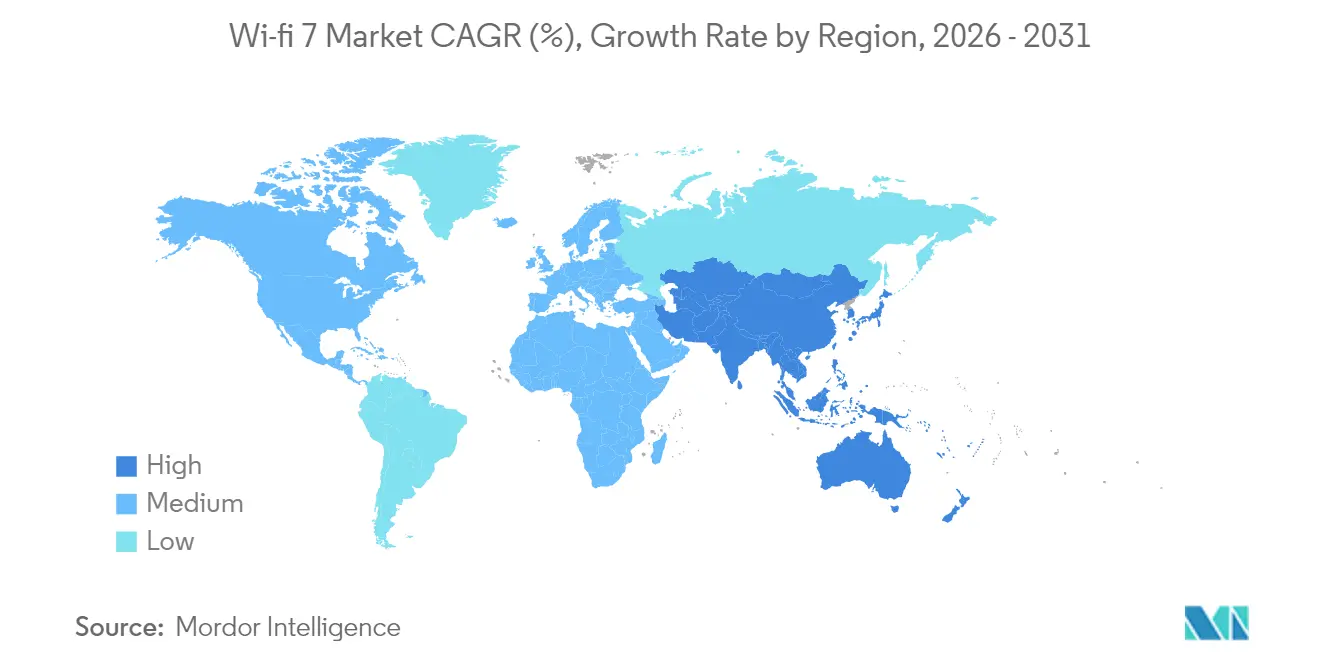
| Fastest Growing Market | Asia Pacific |
| Largest Market | North America |
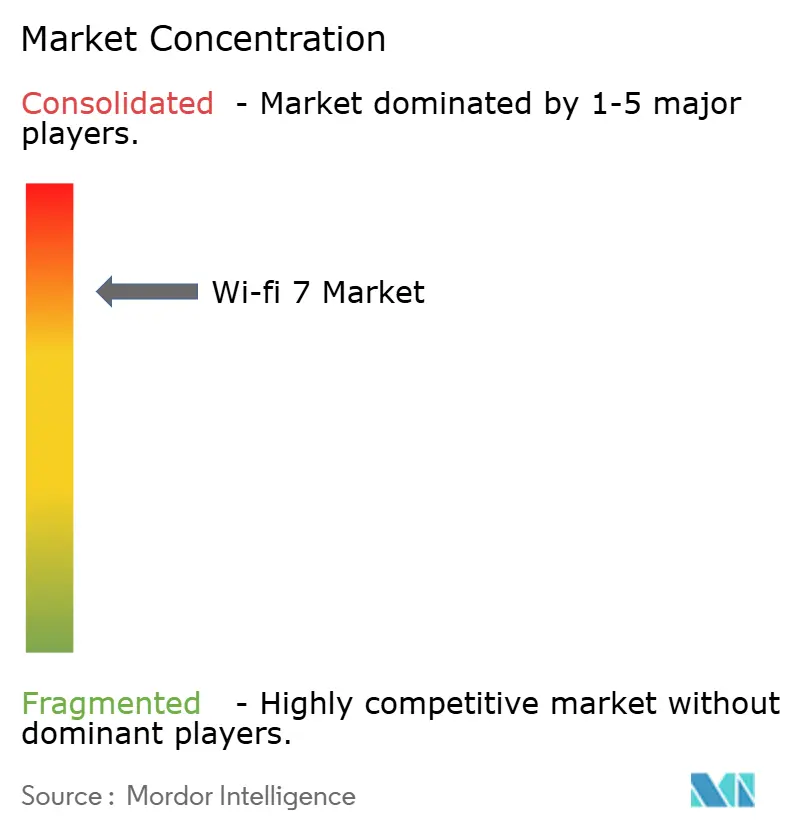
| Market Concentration | High |
Major Players *Disclaimer: Major Players sorted in no particular order Image © Mordor Intelligence. Reuse requires attribution under CC BY 4.0. | |
Wi-fi 7 Market Analysis by Mordor Intelligence
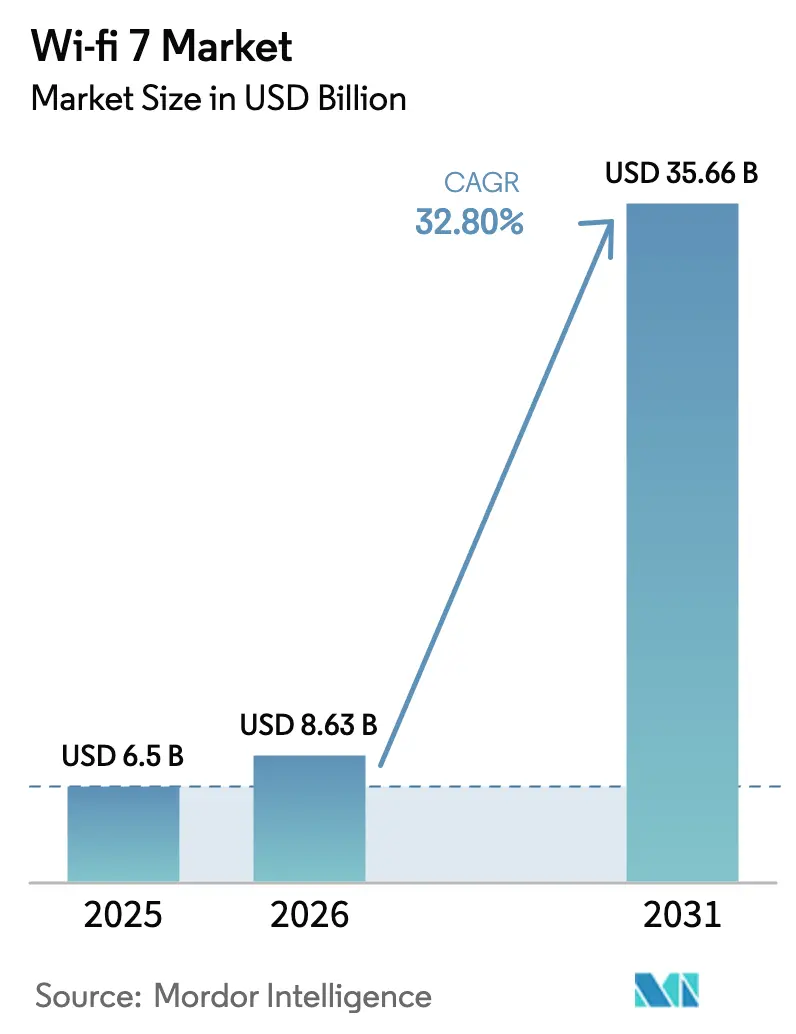
The Wi-Fi 7 market size was valued at USD 6.5 billion in 2025 and estimated to grow from USD 8.63 billion in 2026 to reach USD 35.66 billion by 2031, at a CAGR of 32.8% during the forecast period (2026-2031). The acceleration mirrors surging enterprise digital-transformation budgets, consumer demand for multi-gigabit connectivity, and the domino effect of 6 GHz spectrum allocations in multiple economies.[1]Wi-Fi Alliance, “Wi-Fi 7 Momentum Builds With Certification Launch,” wifi.org Chipset and gateway vendors shipped 233 million Wi-Fi 7 devices during 2024, demonstrating that mainstream adoption has already begun. The proliferation of AI-centric devices that need sustained throughput above 5 Gbps, China’s fiber-to-the-room roll-outs that shorten gateway refresh cycles to 18 months, and in-vehicle zonal architectures integrating 802.11be all reinforce the growth trajectory. Services tied to managed connectivity are scaling fastest as tier-1 ISPs monetize fiber backbones, while hardware still commands the bulk of spending thanks to access-point and gateway overhauls.
Key Report Takeaways
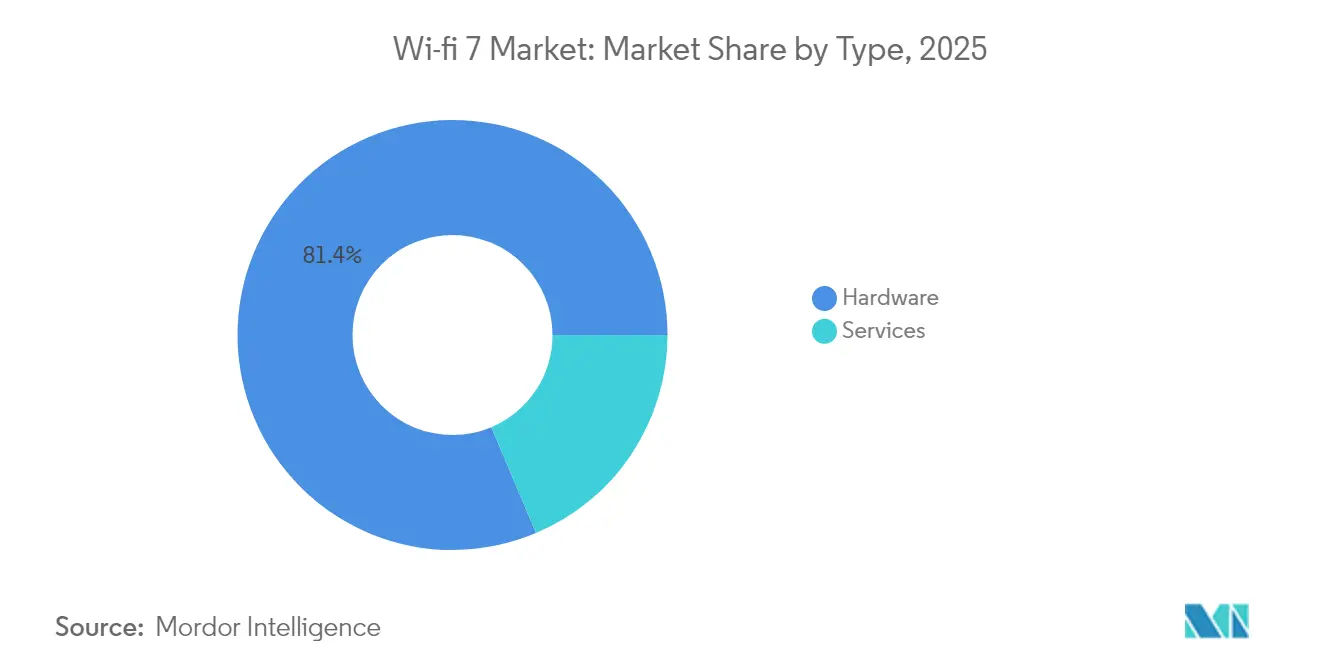
- By type, hardware held 81.35% Wi-Fi 7 market share in 2025; services are expected to expand at a 40.2% CAGR through 2031.
- By application, indoor deployments led with 66.20% revenue share in 2025 in the Wi-fi 7 market; outdoor projects are projected to grow at a 39.4% CAGR to 2031.
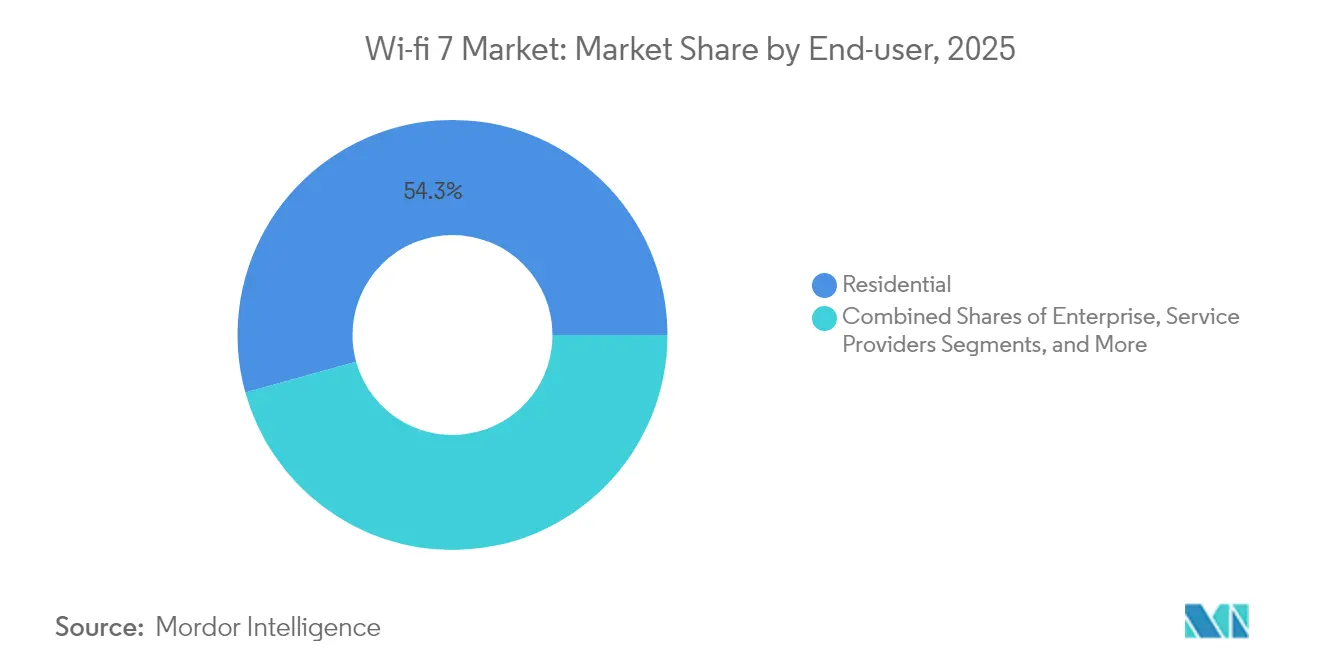
- By end user, residential accounted for 54.30% of the Wi-Fi 7 market size in 2025; industrial and manufacturing use cases are advancing at a 41.6% CAGR to 2031.
- By frequency-band configuration, dual-band captured 79.10% share of the Wi-Fi 7 market size in 2025, whereas tri-band systems are forecast to rise at a 45.5% CAGR through 2031.
- By geography, Asia-Pacific led with 40.60% revenue share in 2025 in Wi-Fi 7 market; theAsia-Pacific is the fastest-growing region with a 34.7% CAGR through 2031
Note: Market size and forecast figures in this report are generated using Mordor Intelligence’s proprietary estimation framework, updated with the latest available data and insights as of 2026.
Market Trends and Insights
Drivers Impact Analysis of Wi-fi 7 Market*
| Driver | (~) % Impact on CAGR Forecast | Geographic Relevance | Impact Timeline |
|---|---|---|---|
| Tri-band CPE bundling by Tier-1 ISPs accelerates household upgrade cycles | + 8.5% | Global, with early gains in North America and Europe | Short term (≤ 2 years) |
| Wi-Fi Alliance "Wi-Fi CERTIFIED 7" labeling reduces enterprise-grade interoperability risk | + 6.2% | Global | Medium term (2-4 years) |
| 6 GHz spectrum release mandates in EU and Brazil open 1.2 GHz of new air-waves | + 7.8% | Europe, Latin America, spill-over to APAC | Medium term (2-4 years) |
| OEM race to ship AI-PCs and XR headsets that exceed 5 Gbps throughput ceiling | + 9.1% | Global, concentrated in North America and APAC | Long term (≥ 4 years) |
| Fiber-to-the-room (FTTR) roll-outs in China driving gateway refresh every below 18 months | + 5.4% | China, with expansion to broader APAC region | Short term (≤ 2 years) |
| Automotive zonal-architecture adoption of 802.11be for in-cabin streaming | + 3.2% | Global, led by premium automotive markets | Long term (≥ 4 years) |
| Source: Mordor Intelligence | |||
Tri-band CPE Bundling by Tier-1 ISPs Accelerates Household Upgrade Cycles
Tri-band CPE bundling by tier-1 ISPs accelerates household upgrade cycles. Service providers such as Charter Communications began shipping Advanced Wi-Fi 7 routers in late 2024, bypassing the usual four-year consumer replacement cadence and ensuring that expensive fiber lines deliver full in-home speeds. Lumen Technologies followed with an internally designed Wi-Fi 7 gateway, proving how operator subsidies can erase upfront hardware costs for subscribers. The strategy locks customers into premium broadband tiers, widens average revenue per user, and seeds millions of tri-band endpoints that lift the entire Wi-Fi 7 market.
Wi-Fi Alliance “Wi-Fi CERTIFIED 7” Labeling Lowers Enterprise Interoperability Risk
Wi-Fi Alliance “Wi-Fi CERTIFIED 7” labeling reduces enterprise interoperability risk. The January 2024 certification launch ended buyer hesitation by validating 320 MHz channels, Multi-Link Operation, and 4K QAM features in a vendor-neutral process. Cisco’s intelligent access points released in December 2024 are built around the program, adding AI-driven self-configuration that slashes deployment times.[2]Cisco Systems, “Cisco Catalyst Wi-Fi 7 Access Points Data Sheet,” cisco.com Large organizations now treat Wi-Fi 7 gear as standards-compliant, enabling multi-site purchases that were on hold for ratification.
6 GHz Spectrum Release Mandates In The EU and Brazil Open 1.2 GHz of New Airwaves
6 GHz spectrum release mandates in the EU and Brazil open 1.2 GHz of new airwaves. Brussels harmonized the 5,945–6,425 MHz band for unlicensed use, effectively tripling the spectrum available versus legacy 2.4 GHz and 5 GHz allocations. Brazil mirrored the decision, allowing equipment makers to build global SKUs, while Ofcom’s draft UK rules prioritize unlicensed indoor Wi-Fi, further lowering certification hurdles. Together, these moves make 320 MHz channels commercially viable and sustain the Wi-Fi 7 market momentum.
OEMs Race to Ship AI-PCs and XR Headsets That Exceed 5 GBPS Throughput
OEMs race to ship AI-PCs and XR headsets that exceed the 5 Gbps throughput ceiling. Qualcomm’s FastConnect 7900 integrates AI optimization to keep latency below 2 ms during multi-link operation, a must for cloud-assisted XR workloads.[3]Qualcomm, “FastConnect 7900 Fact Sheet,” qualcomm.com Apple’s in-house Wi-Fi 7 silicon for iPhone 17 underlines how crucial radio performance is for on-device AI and immersive apps. As vendors link premium user experience to multi-gigabit wireless, design wins for Wi-Fi 7 chipsets spike across handsets, laptops, and wearables, expanding the addressable Wi-Fi 7 market.
Restraints Impact Analysis of Wi-fi 7 Market*
| Restraint | (~) % Impact on CAGR Forecast | Geographic Relevance | Impact Timeline |
|---|---|---|---|
| High incremental BoM cost vs. Wi-Fi 6E in entry-level smartphones | - 4.3% | Global, particularly APAC manufacturing hubs | Short term (≤ 2 years) |
| AFC‐related certification delay for outdoor APs in US and EMEA | - 3.7% | North America and Europe | Medium term (2-4 years) |
| Power-consumption penalty (above 30%) in battery-constrained IoT sensors | - 2.8% | Global, concentrated in Industrial IoT deployments | Long term (≥ 4 years) |
| Channel-occupancy compliance risk in unlicensed 6 GHz in India and Russia | - 1.9% | India, Russia, and similar regulatory environments | Medium term (2-4 years) |
| Source: Mordor Intelligence | |||
High Incremental BoM Versus Wi-Fi 6E in Entry-Level Smartphones
High incremental BoM cost versus Wi-Fi 6E in entry-level smartphones. Support for 320 MHz channels and 4,096-QAM requires advanced RF front-end designs; vendors such as Qorvo supply multi-antenna modules that raise handset costs by 15-25%, which budget-phone makers cannot absorb.[4]Qorvo, “Tri-Band Wi-Fi 7 Front-End Module Portfolio,” qorvo.com The gap confines early Wi-Fi 7 adoption to flagship models until component prices fall, delaying volume scale in the mass market.
AFC-related Certification Delay for Outdoor APs in the US and EMEA
AFC-related certification delay for outdoor APs in the US and EMEA. Although the FCC approved standard-power operations in February 2024, real-time coordination with incumbent microwave users adds months of lab testing and system integration. Enterprises planning stadium or campus-wide coverage must wait for cleared automated-frequency-coordination databases, pushing revenue recognition for outdoor Wi-Fi 7 projects into future fiscal cycles.
*Our forecasts treat driver/restraint impacts as directional, not additive. The impact forecasts reflect baseline growth, mix effects, and variable interactions.
Wi-fi 7 Market Segment Analysis
By Type:
Hardware Dominance Drives Infrastructure RefreshThe hardware segment generated 81.35% of overall revenue in 2025, underscoring the capital intensity linked to new RF architectures that cannot be retrofitted. Access points, gateways, and chipsets account for the bulk of this spending, while software analytics and managed services sit on top of the installed base and are growing at a 40.2% CAGR. The Wi-Fi 7 market size for hardware is projected to stretch from USD 5.29 billion in 2025 to USD 29.02 billion in 2031, validating supplier focus on silicon, antennas, and front-end modules. Services still represent the fastest-climbing slice of the Wi-Fi 7 industry as ISPs bundle cloud portals, device-as-a-service plans, and automated optimization tools.
Access points remain the largest hardware sub-segment thanks to enterprise refresh cycles and high-density venues that demand tri-radio designs. Gateways follow closely, propelled by tri-band CPE subsidies. Chipsets set the pace for innovation: Broadcom’s BCM 6765 and MediaTek’s Filogic platforms exemplify purpose-built silicon tuned to specific deployment environments.



By Application:
Indoor Deployments Lead Market PenetrationIndoor use cases captured 66.20% of 2025 revenue as offices, universities, and high-rise apartments needed multi-gigabit coverage without recabling. This segment leads because Wi-Fi 7 features, such as Multi-Link Operation, excel at mitigating interference in dense device clusters. Outdoor applications, including stadiums, municipal Wi-Fi, and smart-city corridors, trail in absolute value but are forecast to grow at 39.4% CAGR through 2031.
Extreme Networks showcased Wi-Fi 7 tri-radio APs at the Zwarte Cross 2024 festival, delivering consistent bandwidth to tens of thousands of concurrent users. Such proof points validate outdoor performance, setting the stage for service-provider offload and city-wide backhaul upgrades. As regulatory AFC hurdles clear, outdoor roll-outs will underpin incremental revenue streams for the Wi-Fi 7 market.
By End User:
Residential Base Supports Enterprise InnovationResidential deployments held a 54.30% share of 2025 revenue, illustrating how ISP-bundled gateways create large installed bases quickly. Industrial and manufacturing plants, however, log the highest growth at 41.6% CAGR via wireless time-sensitive-networking that needs deterministic latency. Enterprises sit in the middle: their budgets fund advanced features first, which then trickle down to consumer hardware once cost curves improve.
Healthcare environments offer a specialized sub-segment where real-time telemetry and mixed-reality surgery training depend on consistent gigabit throughputs. These demanding scenarios highlight the upside for Wi-Fi 7 vendors that can optimize power efficiency while meeting regulatory compliance.
By Frequency Band Configuration:
Tri-Band Architecture Drives PerformanceDual-band gear still dominates shipments with 79.10% revenue share in 2025 because enterprises can layer Wi-Fi 7 efficiency gains onto existing 2.4 GHz and 5 GHz footprints without coordinating 6 GHz channels. Tri-band configurations, however, outpace all other categories at a 45.5% CAGR since they unlock 320 MHz channels to hit double-digit gigabit peaks. Intel notes that more than 1 200 device models already support Wi-Fi 7 across three bands, a number that doubled in under 12 months.
MaxLinear’s single-chip tri-band solution reaches 11.5 Gbps on the 6 GHz lane, demonstrating the head-room needed for AI edge workloads and immersive media. High-density enterprises and event venues increasingly specify tri-band designs in bid documents, a trend that will redistribute revenue toward higher-value SKUs within the overall Wi-Fi 7 market.
Geography Analysis
APAC Wi-fi 7 Market
Asia-Pacific commanded 40.60% of 2025 revenue as Chinese operators turned fiber-to-the-room into a de-facto baseline. China Telecom alone grew to 193 million broadband lines with 27.3% gigabit penetration, which forces a nation-wide gateway upgrade cadence far shorter than Western norms. Supply-chain proximity aids quick iterations, allowing vendors to push successive Wi-Fi 7 reference designs into contract manufacturers within months.
North America Wi-fi 7 Market
North America remains a premium early adopter region. The FCC’s approval of standard-power operation above 5,945 MHz unlocks outdoor deployments, even though the AFC database still imposes friction on. Service providers such as Charter and Lumen position tri-band gateways as a differentiator in crowded gigabit tiers. Enterprise refresh cycles pick up as Cisco, HPE Aruba, and CommScope ship certified gear.
Europe Wi-fi 7 Market
Europe approaches adoption through regulatory cohesion. The European Commission harmonized the lower 6 GHz band in 2024, allowing ISPs and enterprises to roll out 6 GHz channels across national borders without re-certification. Vodafone UK completed Wi-Fi 7 router testing in 2024, flagging a 2025 commercial debut.
MEA and South America Wi-fi 7 Market
The Middle East shows a signficjant growth through 2031. Governments bundle Wi-Fi 7 into smart-city tenders that feature AI video surveillance, connected transit, and immersive tourist experiences. A public demonstration in Dubai logged 3.7 Gbps downlink on pre-production equipment, underscoring favorable propagation in open urban layouts. South America benefits from Brazil’s proactive spectrum release, while African markets wait for regional regulators to echo ITU guidelines.

Regulatory Landscape
Wi-Fi 7 commercialization depends on both formal standardization and national 6 GHz unlicensed rules. IEEE published 802.11be-2024 on July 22, 2025, and the Wi-Fi Alliance runs the Wi-Fi CERTIFIED 7 program (launched January 2024), which reduces enterprise procurement risk for capabilities such as Multi-Link Operation and 320 MHz channels.
Spectrum access and power rules remain the key regulatory swing factor for 6 GHz Wi-Fi 7 performance, particularly outdoors. In the United States, the FCC expanded the operating model for the 6 GHz band through rules effective April 27, 2026, allowing unlicensed geofenced variable power (GVP) devices in parts of 6 GHz (U-NII-5 and U-NII-7), while automated-frequency-coordination (AFC) workflows still affect standard-power outdoor access point certification and rollouts. In Europe, the European Commission continues a hybrid 6 GHz approach, keeping the lower 6 GHz track for unlicensed use while deferring the upper band decision toward WRC-27. India is taking a similar stance, with TRAI recommending that upper 6 GHz auction decisions wait until after WRC-27.
Value Chain Analysis
The Wi-Fi 7 value chain begins with standards, certification, and silicon IP, then moves through RF front-end components, device OEM integration, and channel partners. IEEE 802.11 and the Wi-Fi Alliance shape interoperability and certification, while chipset supply remains concentrated among Broadcom, Qualcomm, MediaTek, and Intel, affecting reference designs, driver stacks, and time-to-market for routers, gateways, client devices, and enterprise access points.
Downstream, networking OEMs and system vendors turn chipset capabilities into deployable enterprise and service-provider platforms, combining tri-band radios with cloud orchestration and security. Vendors such as Cisco package Wi-Fi 7 access points with AI-assisted management, zero-trust controls, and campus networking integration, while deployments also rely on adjacent infrastructure such as WPA3 security and power delivery (for example, IEEE 802.3bt/UPOE-class PoE for higher-end access points). In residential CPE, distribution splits between retail and e-commerce, while enterprise, industrial, and smart-city deployments lean on value-added distributors, integrators, and managed service providers, where site surveys, RF design, and lifecycle management support service attach.
Competitive Landscape
The chipset layer is moderately concentrated. Broadcom, Qualcomm, MediaTek, and Intel together control a majority of design wins, leveraging decades of intellectual property, foundry contracts, and software stacks. Broadcom’s second-generation portfolio targets residential gateways and enterprise APs. Qualcomm integrates AI processing in FastConnect 7900, chasing mobile and XR form factors. MediaTek compresses bill-of-materials costs for mass-market Android devices, whereas Intel prioritizes PC and enterprise certifications. Apple’s internal silicon project for Wi-Fi 7 radios in iPhone 17 signals deeper vertical integration that could shift bargaining power away from merchant suppliers.
Equipment vendors differentiate on cloud orchestration, AI assurance, and vertical expertise. Cisco’s intelligent APs adjust channel plans autonomously and bundle zero-trust security. Extreme Networks positions tri-radio hardware at sports arenas, while Arista Networks extends deterministic scheduling into campus fabrics. Start-ups such as Synaptics target IoT nodes with purpose-built low-power Wi-Fi 7 chipsets.
Patent filings on Multi-Link Operation, target-wake-time algorithms, and spectral masks suggest sustained R&D races. Meta and Microsoft both lodged claims that adapt Wi-Fi 7 for AR/VR, hinting that horizontal players could cross over into silicon design, further intensifying rivalry. The Wi-Fi 7 market thus rewards ecosystem control as much as raw radio performance
Wi-fi 7 Industry Leaders
Intel Corporation
Broadcom Inc.
Cisco Systems Inc.
MediaTek Inc.
Qualcomm Technologies, Inc.
- *Disclaimer: Major Players sorted in no particular order
Wi-fi 7 Market Companies Covered in this Report
- Broadcom Inc.
- Qualcomm Technologies, Inc.
- Intel Corporation
- MediaTek Inc.
- Cisco Systems, Inc.
- TP-Link Technologies Co., Ltd.
- Huawei Technologies Co., Ltd.
- Netgear, Inc.
- Cambium Networks
- Synaptics
- CommScope
- AsusTek Computer Inc.
- Extreme Networks
- Sercomm Corporation

Market Opportunities and Future Outlook
Enterprise WLAN refresh is an immediate whitespace for Wi-Fi 7 vendors because purchase decisions increasingly align with measurable application needs rather than pre-ratification caution. IDC data indicates Wi-Fi 7 reached 44.5% of enterprise WLAN dependent access point revenues in 1Q26, up from 11.8% in 1Q25, supporting differentiated tri-radio access points, cloud-managed assurance, and multi-site standardization tied to Wi-Fi CERTIFIED 7 interoperability.
Outdoor and campus-scale opportunities depend on how 6 GHz operating frameworks and coordination mechanisms mature. The FCCs April 2026 effective rules for geofenced variable power devices in 6 GHz add an additional operating mode that vendors can productize for higher-performance unlicensed deployments, while AFC-related processes continue to constrain standard-power outdoor timelines in parts of North America and EMEA. Beyond venues and municipalities, Wi-Fi 7 also creates upgrade pathways in latency-sensitive settings such as AR/VR training and industrial connectivity, where Multi-Link Operation and wider channel widths support simultaneous link usage and congestion avoidance. In residential broadband, tier-1 ISP bundling of tri-band CPE shortens replacement cycles and expands the installed base for managed Wi-Fi services.
Recent Industry Developments in Wi-fi 7 Market
- July 2026: SoftAtHome deployed prpl-based Wi-Fi 7 repeater software commercially for Orange in France and Poland, with three additional European markets expected. The rollout expands adoption of the prpl ecosystem and supports more software-defined Wi-Fi 7 deployments.
- July 2026: eero launched eero 7 and eero Pro 7 Wi-Fi 7 routers, available for purchase via Amazon.com. The release supports consumer Wi-Fi 7 adoption through a major retail channel.
- July 2026: ADI announced the Araknis Networks 830 Wi-Fi 7 Indoor Access Point, available globally. The new indoor AP expands the enterprise-focused Wi-Fi 7 portfolio and distribution.


Wi-fi 7 Market Report Scope and Research Methodology
Market Definition and Coverage
For this report, the Wi-Fi 7 market is measured as revenue generated from Wi-Fi 7 (802.11be) hardware and related services used for indoor and outdoor wireless connectivity across end users, tracked at global level in USD.
Scope exclusions: legacy Wi-Fi standards, wired LAN equipment, and cellular-only connectivity spending are not counted unless they are bundled as part of a Wi-Fi 7 specific offering.
Segments Covered in This Report
- By Type
- Hardware
- Access Points
- Gateways
- Routers and Extenders
- Chipsets / Modules
- Services
- Hardware
- By Application
- Indoor
- Outdoor
- By End User
- Residential
- Enterprise
- Industrial and Manufacturing
- Service Providers / Smart-City
- By Frequency Band Configuration
- Dual-band (2.4/5 GHz)
- Tri-band (2.4/5/6 GHz)
- By Geography
- North America
- South America
- Europe
- Asia-Pacific
- Middle East and Africa
Data Sources, Market Sizing, and Validation
Desk Research
Desk research was used to set the groundwork for the model, mainly around technology readiness, spectrum availability, and adoption timing. We reviewed public documents from bodies and sources such as the IEEE 802.11 working group, Wi-Fi Alliance publications, FCC and other national spectrum regulators, and ITU materials to understand the regulatory changes that enable 6 GHz use and the certification pathways for devices.
To translate those signals into a market model, we also used financial disclosures and product commentary from company filings and investor presentations, along with reputable press and association websites that track enterprise WLAN refresh cycles and consumer networking demand. In a few places, paid subscriptions were used for company financials and intelligence, news and financials, and patent database checks, so that product launch claims and chipset roadmap timing could be cross-verified. These sources are illustrative, and many other references were used for data collection, validation, and research clarification.
Primary Interviews and Surveys
Primary work focused on validating what is actually shipping and being deployed, since early-cycle Wi-Fi standards can look bigger on paper than in procurement reality. We spoke with a mix of component ecosystem participants, device and equipment stakeholders, channel partners, and enterprise and service provider buyer-side roles across major regions, and then used their inputs to confirm the adoption pace, pricing movement, and timing of refresh cycles.
Distribution of primary research fieldwork respondents
| Company type | Respondent position | Region |
|---|---|---|
| Top tier: 29% | CXOs: 16% | APAC: 39% |
| Mid tier: 49% | Functional/Unit leaders: 35% | EMEA: 35% |
| Smaller Players: 22% | Managers: 49% | Americas: 26% |
Market-Sizing & Forecasting
Sizing starts with a top-down build where the addressable demand pool is reconstructed using Wi-Fi standard transition timing, 6 GHz regulatory enablement, and the practical replacement cycle for access points, gateways, and client devices. After the initial total is built, we check it with selective bottom-up approximations, including sampled shipment run-rates in key device categories and a price times volume logic for representative Wi-Fi 7 units. This helps adjust totals when one input looks overstated.
Key inputs used in the model include the rollout status of 6 GHz across countries, the share shift from Wi-Fi 6 and 6E to Wi-Fi 7 in new equipment, average selling price steps between generations, enterprise WLAN refresh timing for indoor networks, and the mix movement between dual-band and tri-band configurations. Where direct volume visibility is limited, we handle gaps by using proxy indicators such as certified product momentum, channel availability signals, and buyer-reported attach rates, and then stress-test the assumptions during follow-up calls.
Forecasting uses scenario analysis, since adoption can swing based on certification timing, spectrum constraints, and pricing normalization. For each scenario, variables are stepped forward using expert consensus from interviews, followed by a final reconciliation so the trajectory remains consistent with realistic upgrade cadence and spending capacity across regions and end users.
Data Validation & Update Cycle
Outputs are validated through triangulation across independent indicators, and the biggest variances are reviewed before sign-off. We run anomaly checks at country and end-user level so sudden jumps are challenged with a clear reason, and if the story cannot be supported, assumptions are revisited and corrected.
A multi-step review is followed, where another analyst rechecks the math, units, and conversion timing before the narrative and numbers are finalized. The report is refreshed annually, and interim updates are triggered when there is a material event like a major regulatory change, certification milestone, or a demand shock. Before delivery, an analyst performs a fresh pass so clients receive the latest updated view.
Mordor Intelligence's Wi Fi 7 Market Size Compared With Other Published Estimates
Published Wi-Fi 7 market numbers do not always line up, mainly because the market is still early and different studies anchor their totals to different evidence. Some builds start from long-range forecasts and broad device inclusion, while others lean more on near-term shipment reality and the timing of 6 GHz readiness by geography.
Shipment momentum and certification signals are the main checks used here, and those are then tied back to what is actually being deployed in indoor and outdoor networks and what is being paid for in hardware and services, which keeps Mordor Intelligence's 2026 estimate aligned to a defined adoption window rather than a broader future-looking device universe.
Benchmark comparison
| Source | Market Size | Gaps in Research Methodology |
|---|---|---|
| Mordor Intelligence | USD 8.63 B (2026) | |
| Industry Research Release A | USD 1.30 B (2024) | Uses an earlier base year and tends to capture only the initial commercialization phase, so later-cycle enterprise refresh and service spend are not yet reflected in the base value. |
| Industry Research Release B | USD 1.80 B (2024) | Anchors the model to a 2024 starting point and may apply aggressive early adoption and pricing curves, which can understate the step-up that occurs when 6 GHz coverage and enterprise rollouts broaden. |
The spread is mostly explained by year selection and how quickly adoption is assumed to move from early devices into large-scale network upgrades. With clear scope rules and repeated checks against adoption signals, the estimate stays traceable to practical deployment timing and repeatable pricing and mix assumptions.


Key Questions Answered in the Report
What is the projected value of the Wi-Fi 7 market by 2031?
The Wi-Fi 7 market is expected to reach USD 35.66 billion by 2031 on a 32.8% CAGR trajectory.
Which region leads current Wi-Fi 7 spending?
Asia-Pacific leads with 40.60% revenue share thanks to large-scale fiber-to-the-room gateway upgrades in China.
Why are ISPs bundling tri-band Wi-Fi 7 routers?
Bundling guarantees subscribers experience multi-gigabit speeds across the home, supporting higher-priced broadband tiers while seeding the equipment base for the Wi-Fi 7 market.
What hampers roll-out of outdoor Wi-Fi 7 access points?
Automated-frequency-coordination approval processes in the 6 GHz band add months to certification, delaying deployments in stadiums and smart cities.
How fast are industrial and manufacturing Wi-Fi 7 deployments growing?
Industrial and manufacturing applications are forecast to expand at a 41.6% CAGR between 2026 and 2031, driven by wireless time-sensitive-networking requirements.
Which configuration is growing faster, dual-band or tri-band?
Tri-band Wi-Fi 7 equipment is advancing at a 45.5% CAGR because only three-band radios unlock 320 MHz channels and peak throughput above 10 Gbps.
Page last updated on:


 Your data is secure and never sold or shared.


